

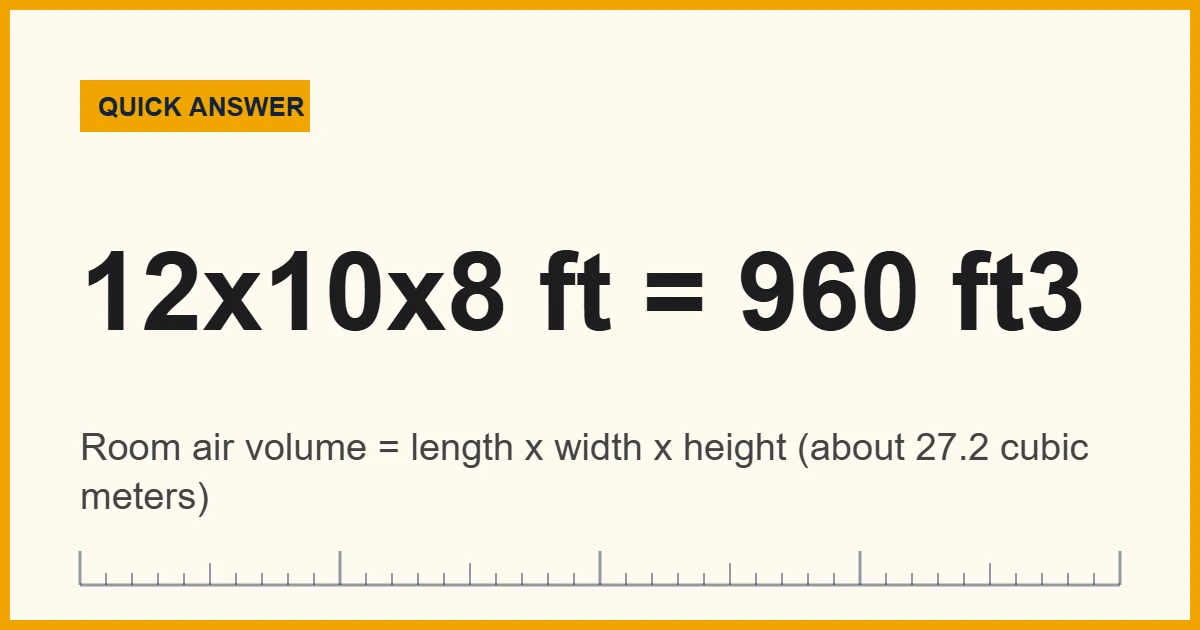
To find the volume of air in a room, multiply length x width x height. For example, a 12 x 10 ft room with an 8 ft ceiling holds 960 cubic feet, or about 27.2 cubic meters. For air in a bottle or your lungs, trap it under water and read how much water it pushes out.
Air is invisible, so people often assume it cannot be measured. In fact, it takes up space just like water does, and you can measure that space in two very different situations. First, there is the air that fills a room, which matters for heaters, air purifiers, dehumidifiers and fresh-air ventilation. Second, there is the air inside a container, such as a bottle, a balloon or your own lungs, which is a classic science-class experiment.
However, the method is different for each case. A room has walls you can measure, so the volume of air is simple geometry. A balloon or a breath has no fixed shape, however, so you measure it by displacement instead. In this case, the trapped air pushes water out of a container, and the water you can see tells you how much air you cannot see.
In short: measure a room with a tape and multiply, and measure a gas sample by catching it under water. After that, if you want to know how fast air moves through a room, you need airflow (cubic feet per minute), which is a separate number from volume.
For ventilation, the US Centers for Disease Control and Prevention (CDC) uses the same room-volume math. Its ventilation guidance suggests aiming for 5 or more air changes per hour of clean air, and it calculates air changes from airflow divided by room volume.
Convert a Volume of Air Between Liters, Gallons and Milliliters
Use this converter for containers, bottles and breath samples. Then enter the amount you measured and pick the unit. For rooms, remember that 1 cubic foot is about 28.32 liters and 1 cubic meter is exactly 1,000 liters, so convert your room result to liters first.
Recommended Tools for Measuring Air Volume
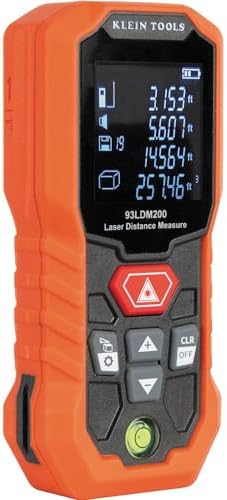
A laser distance measurer makes room measurements quick and accurate, especially for tall ceilings that a tape cannot reach easily. Meanwhile, a set of glass graduated cylinders lets you read displaced water to the nearest milliliter. Finally, a vane anemometer with a CFM mode helps when you need airflow at a vent rather than a static volume. In addition, the picks below come from established brands, based on manufacturer specs and buyer reports.



As an Amazon Associate, Measuring Expert earns from qualifying purchases.
Key Takeaways
- Room air volume = length x width x height, all in the same unit.
- Also, one cubic foot equals about 28.32 liters or 7.48 US gallons.
- One cubic meter equals 1,000 liters, or about 35.31 cubic feet.
- Air changes per hour (ACH) = CFM x 60 / room volume in cubic feet.
- Meanwhile, water displacement measures air in a bottle, balloon or breath.
- Volume (cubic feet) and airflow (cubic feet per minute) are different numbers.
- Temperature and pressure change a gas volume, so note both for lab work.
How to Find the Volume of Air in a Room
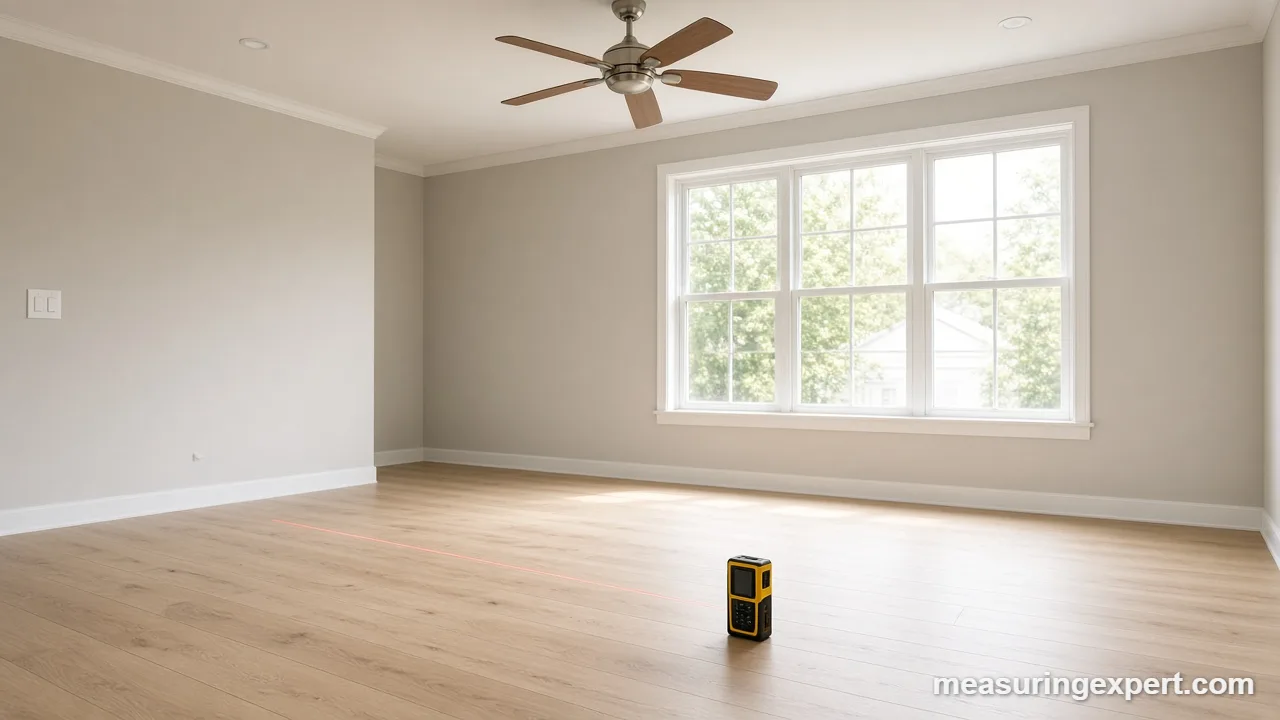
A rectangular room is a box, so its volume is the floor area times the ceiling height. First, measure the length and width along the floor, wall to wall. Next, measure the height from floor to ceiling. Finally, keep every number in the same unit and multiply.
Volume = length x width x height
For example, a bedroom that is 12 ft long, 10 ft wide and 8 ft high holds 12 x 10 x 8 = 960 cubic feet of air. In metric terms, that is about 27.18 cubic meters, or roughly 27,180 liters. Similarly, a 4 m x 3 m room with a 2.5 m ceiling holds exactly 30 cubic meters, which is about 1,059 cubic feet. If you need a refresher on box and cylinder formulas, see our guide on how to calculate cubic volume.
| Room (L x W x H) | Cubic feet | Cubic meters | Liters |
|---|---|---|---|
| 10 x 10 x 8 ft | 800 | 22.65 | 22,653 |
| 12 x 10 x 8 ft | 960 | 27.18 | 27,184 |
| 15 x 12 x 9 ft | 1,620 | 45.87 | 45,873 |
| 20 x 15 x 8 ft | 2,400 | 67.96 | 67,960 |
| 30 x 40 x 7 ft (basement) | 8,400 | 237.86 | 237,862 |
| 4 x 3 x 2.5 m | 1,059 | 30.00 | 30,000 |
Odd shapes, however, take one more step. For example, split an L-shaped room into two rectangles, find each volume, and add them. For a sloped or vaulted ceiling, use the average height: add the lowest and highest heights and divide by 2. As a result, you get a close estimate without complicated geometry.
Volume of Air and Air Changes per Hour
Once you know the room volume, you can work out how often a fan, purifier or HVAC system replaces that air. In other words, this figure is air changes per hour, or ACH. Because airflow is usually rated in cubic feet per minute (CFM), the formula multiplies by 60 to get an hourly figure.
ACH = CFM x 60 / room volume (cubic feet)
So a purifier that delivers 300 CFM of clean air in the 960 cubic foot bedroom gives 300 x 60 / 960 = 18.75 air changes per hour. To flip the question around, the CDC target of 5 ACH in that room needs 960 x 5 / 60 = 80 CFM. For the 8,400 cubic foot basement, by contrast, the same target needs 700 CFM.
| Room volume | CFM for 3 ACH | CFM for 5 ACH | CFM for 8 ACH |
|---|---|---|---|
| 800 cu ft | 40 | 67 | 107 |
| 960 cu ft | 48 | 80 | 128 |
| 1,620 cu ft | 81 | 135 | 216 |
| 2,400 cu ft | 120 | 200 | 320 |
| 8,400 cu ft | 420 | 700 | 1,120 |
Measuring the Volume of Air in a Container
Similarly, a container with a regular shape works like a small room. For instance, a box-shaped tank is length x width x height, and a cylinder is pi x radius squared x height. Most bottles have curved shoulders and thick bases, though, so geometry gives a poor answer.
Instead, fill the empty container with water, then pour that water into a measuring cup or graduated cylinder. As a result, the water volume equals the air volume the container held. In other words, a 2 L soda bottle holds about 2 liters of air when “empty”, which is 0.53 US gallons or about 67.6 US fluid ounces.
To capture a gas sample, on the other hand, use the reverse trick. First, fill a container with water, turn it upside down in a tub of water, and feed the gas in through a tube. Next, bubbles rise and push water out. Finally, mark the new water level, then measure how much water it takes to refill to that mark. Our article on measuring the volume of a gas covers this method in a lab setting.
How to Measure Lung Volume of Air With a Bottle
This classic demo shows how much air you breathe out in one long exhale. You need a large plastic bottle (a 5 L water bottle works well), a tub or sink, a flexible tube, a measuring jug and a marker.
- Mark the bottle. Pour in water 250 mL at a time and draw a line at each level, so the bottle becomes a measuring scale.
- Fill it completely. Top the bottle up with water and cap it or cover the opening with your hand.
- Turn it upside down in the tub. Hold the opening under the water surface before you uncap it, so no air sneaks in.
- Insert the tube. Slide one end into the bottle neck and keep the other end out of the water.
- Breathe out once. Take a deep breath, then exhale steadily through the tube until you cannot push out any more.
- Read the air level. At this point, the line where water now sits shows the volume of air you exhaled.
- Repeat and average. Afterward, do three tries with rest in between and record the average result.
What should you expect? A normal quiet breath, the tidal volume, is about 500 mL for an average adult male and about 400 mL for a female, according to a StatPearls review on NCBI. By contrast, a full exhale after a deep breath moves several liters. Total lung capacity in healthy adults averages about 6 liters, but you can never empty your lungs completely, so the bottle always reads less than that.
Balloon and Syringe Methods for a Small Volume of Air
A round balloon gives a quick estimate. Measure its circumference with a soft tape, divide by pi to get the diameter, and then halve it for the radius. After that, use the sphere formula V = 4/3 x pi x radius cubed. For example, a balloon 30 cm across holds about 14.1 liters, while one 12 inches across holds about 905 cubic inches, or 14.8 liters.
Real balloons are rarely perfect spheres, however, so treat this as an estimate. For a better reading, push the balloon fully under water in a full container and catch the overflow. Then the overflow equals the balloon’s volume, including the thin rubber skin.
For tiny amounts, a syringe is the simplest tool. Pull the plunger back and read the scale: a 60 mL syringe holds up to 60 mL of air. Therefore it is handy for checking small containers or demonstrating that air compresses when you block the tip and push.
Air Flow vs Volume: Two Different Measurements
Put simply, volume is how much space the air fills. Airflow, on the other hand, is how much air moves past a point each minute. For example, a room has a volume, while a fan, duct or vent has an airflow. Consequently, mixing them up leads to badly sized equipment.
| Quantity | What it describes | Common units | How you measure it |
|---|---|---|---|
| Air volume | Space the air occupies | cu ft, m3, L, gal | Tape or laser measure; water displacement |
| Airflow | Air moving per unit of time | CFM, m3/h, L/s | Anemometer x duct area; flow hood |
| Air changes per hour | How often the room air is replaced | ACH | Airflow x 60 / volume |
For conversions, 1 CFM equals about 1.699 cubic meters per hour, or 0.472 liters per second. An anemometer measures air speed, so you multiply that speed by the vent or duct area to get airflow. For example, air moving at 400 feet per minute through a 0.5 square foot opening gives 200 CFM.
Why Temperature and Pressure Change the Volume of Air
A room keeps the same volume whatever the weather, because the walls do not move. A trapped gas sample behaves differently, though. For instance, warm it and it expands; squeeze it and it shrinks. At constant pressure, warming air from 20 C (68 F) to 30 C (86 F) increases its volume by about 3.4 percent.
Likewise, higher pressure packs the same air into less space. That relationship is Boyle’s law, and our guide to the pressure of a gas explains how pressure, volume and temperature fit together. So for school or lab work, note the room temperature and, if you can, the air pressure next to every result.
In addition, air has weight. At about 20 C and sea-level pressure, a cubic meter of air weighs roughly 1.2 kg. As a result, the 960 cubic foot bedroom holds around 33 kg, or about 72 pounds, of air.
Do and Don’t When Measuring Air Volume
Do
- Keep every dimension in the same unit before multiplying.
- Use the average height for sloped ceilings.
- Read water levels at eye level, at the bottom of the curve.
- Also note temperature for any gas sample.
- Repeat container and lung tests three times.
Don’t
- Mix inches and feet in one calculation.
- Confuse CFM ratings with room volume in cubic feet.
- Trust balloon geometry for precise work.
- Share tubes or mouthpieces in the breath demo.
- Subtract furniture unless you need real precision.
Honest Limits
To begin with, room math gives the volume of the empty space, not the exact air content. Of course, furniture, cabinets and people take up some space, but usually only a few percent of a living room, so most guides ignore them. Meanwhile, real rooms are rarely perfect boxes, and a quarter-inch error on each side changes the result slightly.
Displacement is more precise; however, it has limits too. Water vapor from your breath, water clinging to the bottle and air dissolving into water all shift the reading a little. Also, the bottle demo measures what you can breathe out, not your full lung capacity. In short, treat home results as good estimates rather than lab-grade data.
When to Call a Professional
Above all, call an HVAC contractor when you size a furnace, air conditioner or whole-house ventilation system. That is because they use a load calculation that includes insulation, windows and climate, not just room volume. Similarly, an industrial hygienist or test-and-balance technician can measure real airflow in offices, labs and clinics with calibrated flow hoods.
Frequently Asked Questions
How do you calculate the volume of air in a room?
Multiply length x width x height in the same unit. A 12 x 10 ft room with an 8 ft ceiling holds 960 cubic feet, or about 27.18 cubic meters.
How many liters of air are in a cubic foot?
One cubic foot holds about 28.32 liters, which is also about 7.48 US gallons.
How do you measure the volume of air in a bottle?
Fill the bottle with water and pour the water into a measuring cup. The water volume equals the air volume the empty bottle held.
What is air changes per hour?
It is how many times the full room volume is replaced in an hour. Calculate it as CFM x 60 divided by room volume in cubic feet.
How much CFM do I need for 5 air changes per hour?
Multiply room volume in cubic feet by 5 and divide by 60. A 960 cubic foot room needs 80 CFM; an 8,400 cubic foot basement needs 700 CFM.
What is the volume of air in human lungs?
Total lung capacity averages about 6 liters in healthy adults. A normal quiet breath moves about 400 to 500 mL.
Is airflow the same as the volume of air?
No. Volume is the space air fills, in cubic feet or liters. Airflow is the volume moving per minute or hour, such as CFM or cubic meters per hour.
Does temperature change the volume of air?
Yes, for a gas that can expand. At constant pressure, warming air from 20 C to 30 C increases its volume by about 3.4 percent. A room’s volume stays the same.
How much does the volume of air in a room weigh?
A cubic meter of air weighs about 1.2 kg near sea level. So a 960 cubic foot bedroom holds roughly 33 kg, or about 72 pounds, of air.
Can I measure air volume with a balloon?
Yes, as an estimate. Measure the circumference, find the radius, and use V = 4/3 x pi x radius cubed. Sinking the balloon in water gives a more accurate result.
Bottom Line on the Volume of Air
For a room, the volume of air is length x width x height, and that single number lets you size purifiers, fans and ventilation through air changes per hour. For a bottle, a balloon or a breath, water displacement shows you the invisible air as a visible amount of water.
In practice, keep the units consistent, separate volume from airflow, and note temperature for gas samples. Then use the converter above to switch between liters, gallons and milliliters whenever you need to.
1 thought on “How to Measure the Volume of Air: Rooms, Containers and Lungs”