

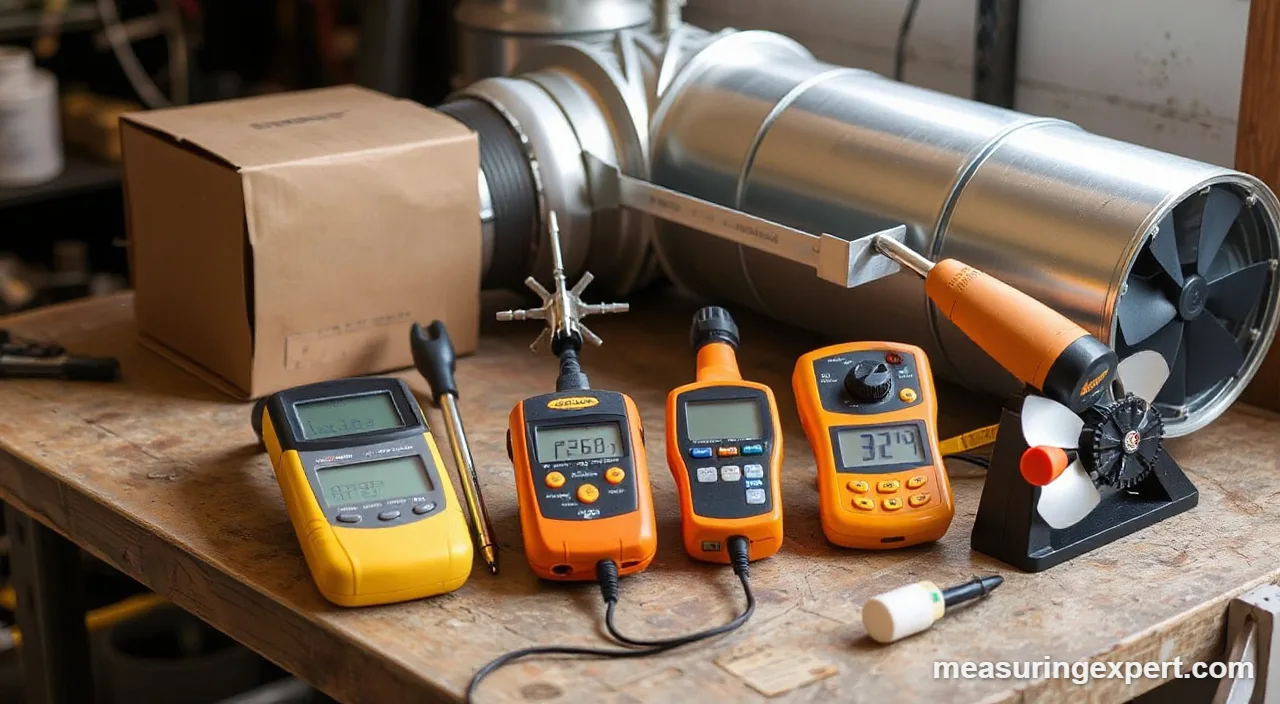
The best handheld anemometer for most HVAC jobs is the Testo 405i Smart Probe, because its hot-wire sensor reads air speed from 0 to 30 m/s and the phone app works out CFM. What decides the choice is the job: duct airflow needs a probe, while outdoor wind needs a rugged fan meter.
In short: pick the Testo 405i for ducts, the Testo 417 for grilles, and the Kestrel 5500FW for outdoor wind.
As an Amazon Associate, Measuring Expert earns from qualifying purchases. Our picks are based on research, specifications and owner feedback, not paid placement.
Best Overall

Best Budget

Best Rugged Wind Meter

Quick Answer: The Best Handheld Anemometer for Each Job
- Best overall: Testo 405i Smart Probe, a Bluetooth hot-wire probe.
- Best for grilles: Testo 417 with a 100 mm vane.
- Best for duct traverses: Fieldpiece STA2 with a 38 in ruled probe.
- Best datalogger: Extech AN340, which logs 12,000 readings.
- Best telescopic vane: UEi DAFM4 on a 39 in probe.
- Best budget: BTMETER BT-100 for simple wind checks.
- Best rugged wind meter: Kestrel 5500FW, sealed to IP67.
On This Page
- Comparison Table
- The 7 Best Handheld Anemometers, Reviewed
- How We Chose
- Vane, Hot-Wire or Cup
- HVAC and CFM
- Shooting, Drones and Sailing
- Wind Speed Units
- Wind Speed Converter
- How to Measure Duct Airflow
- Care and Calibration
- Honest Limits
- FAQ
- Bottom Line
Best Handheld Anemometer Comparison Table
| # | Product | Best For | Standout Feature | Link |
|---|---|---|---|---|
| 1 | Testo 405i Smart Probe | HVAC checks with a phone as the display | Bluetooth hot-wire probe, 0 to 30 m/s | View |
| 2 | Testo 417 Vane Anemometer | Grille and diffuser airflow checks | 100 mm vane with funnel option | View |
| 3 | Fieldpiece STA2 | In-duct CFM work | 38 in telescoping probe with ruling | View |
| 4 | Extech AN340 | Airflow plus humidity logging | Logs 12,000 readings | View |
| 5 | UEi DAFM4 | Duct work with humidity readings | 39 in telescopic vane probe | View |
| 6 | BTMETER BT-100 | Occasional wind checks | Eight-blade fan with five speed units | View |
| 7 | Kestrel 5500FW Fire Weather Meter Pro | Shooting, sailing and field work | IP67, floats, logs 10,000 data sets | View |
The 7 Best Handheld Anemometers, Reviewed
In short, each pick below lists only specs that a maker page confirms. Prices change often, so check the current price on Amazon.
Best Overall
1. Testo 405i Smart Probe (Hot-Wire)
Best for: technicians and homeowners who want a slim hot-wire probe that reads on a phone.
The 405i is a slim probe, not a full meter. First, it sends readings by Bluetooth to the free testo Smart app, so your phone becomes the display. Testo also lists a hot-wire sensor for air velocity and a separate NTC sensor for temperature.
This design suits small supply registers and tight duct holes, so it travels easily. In addition, a telescopic shaft extends to about 400 mm (15.7 in). Next, the app calculates volume flow from the duct dimensions you enter, and it supports timed and multipoint traverses. As a result, you can log a full duct check without a separate meter.
- Velocity range: 0 to 30 m/s (0 to 5906 fpm)
- Velocity accuracy: +/-(0.3 m/s + 5% of reading) from 2 to 15 m/s
- Temperature: -20 to 60 C, +/-0.5 C
- Bluetooth 4.2 or later; iOS 13 or newer, Android 8 or newer
- Power: 3 AAA batteries, about 15 hours
Pros
- Hot-wire sensor reads low air speeds well, so it suits registers
- Phone app calculates CFM and exports reports
- Telescopic shaft reaches into ducts, so no extra pole is needed
Cons
- Needs a smartphone to read values
- Battery life is shorter than the vane probe, however
- Testo gives no accuracy figure for 15 to 30 m/s
Skip it if: you want a standalone meter with its own screen, since this probe reads only on a phone.
Best for Supply Grilles
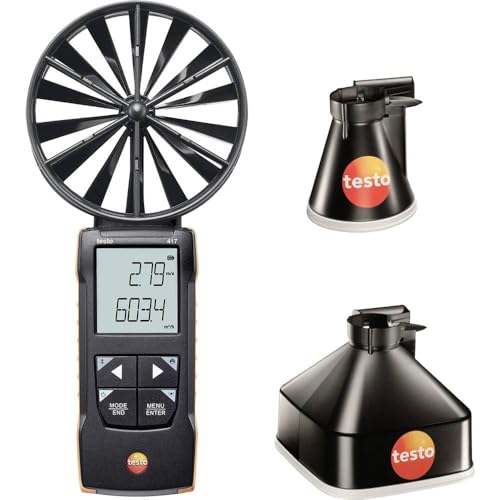
2. Testo 417 Vane Anemometer Kit
Best for: HVAC technicians who measure airflow at diffusers and grilles.
First, the Testo 417 has a large 100 mm (4 in) vane on a handheld body. As a result, it averages airflow over more area, which helps at grilles where air is uneven. However, the base unit has no funnels. Instead, Testo sells kits with two measuring funnels, and one kit adds a flow straightener.
For example, with the funnel set, Testo lists a volume-flow range of 0 to 259 CFM (0 to 440 m3/h). Meanwhile, the unit calculates timed and point averages on board. It also connects to the testo Smart app for graphs and documentation. Therefore, check the listing to see which kit you are buying.
- Velocity range: 0.3 to 20 m/s (59 to 3937 fpm)
- Velocity accuracy: +/-(0.1 m/s + 1.5% of reading)
- Resolution: 0.01 m/s
- Vane diameter: 100 mm (4 in)
- Power: 3 AA batteries, included
Pros
- Large vane gives a stable average
- Tight stated accuracy
- Funnel kits suit supply grilles
Cons
- Bulkier than a probe
- Funnels may not be included in the base unit
Skip it if: you only need duct traverses, because a hot-wire probe fits small holes better.
Best for Duct Traverses
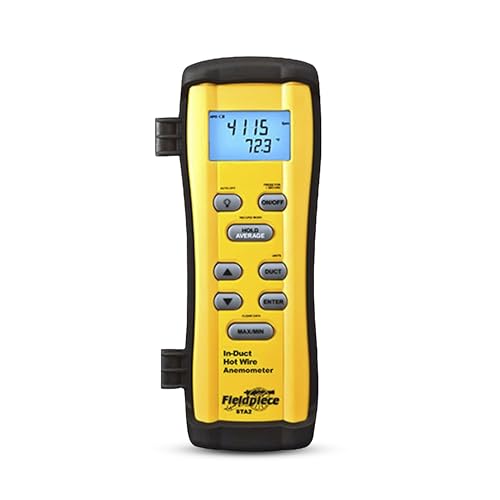
3. Fieldpiece STA2 Hot-Wire Anemometer
Best for: HVAC pros who run duct traverses and want depth marks on the probe.
The STA2 is built for ducts. First, its 38 in (96 cm) telescoping probe carries laser-etched ruling, so you can place the sensor at set depths across a duct. In addition, a stabilizing cone and a magnetic hanger help with hands-free readings.
Next, Fieldpiece lists a micro-glass bead thermistor for air speed and a separate thermistor for temperature. Also, the meter calculates CFM from air speed and the free area you enter. Moreover, it offers time and test-point averaging, which reduces the effect of turbulence. For details, read the Fieldpiece STA2 page.
- Velocity range: 40 to 3960 fpm (0.20 to 20.00 m/s)
- Velocity accuracy: +/-(5% + 1 digit) of reading
- Resolution: 1 fpm (0.01 m/s)
- Temperature: -4 to 140 F, +/-1.0 F from 32 to 113 F
- Power: one 9V battery, about 20 to 35 hours
Pros
- Telescoping probe with depth marks, so traverses are repeatable
- CFM calculation and averaging built in
- Magnetic hanger frees both hands
Cons
- Accuracy is looser than the Testo 417, because of its 5% rating
- No Bluetooth or app
Skip it if: you measure mostly at grilles, because a vane meter is easier there.
Best Datalogger
4. Extech AN340 Anemometer and Psychrometer

Best for: energy auditors who need airflow, humidity and dew point in one logger.
First, the AN340 pairs an external mini vane probe with a psychrometer. As a result, it reports air velocity, airflow, relative humidity, temperature, wet bulb and dew point. Also, Extech states it can store up to 12,000 readings, and it ships with Windows software and a USB cable.
Meanwhile, air velocity runs from 0.5 to 20 m/s with a basic accuracy of +/-3%. In addition, airflow reads up to 99,999 CFM or CMM. However, Extech did not list a velocity resolution on the page we checked.
- Velocity range: 0.5 to 20 m/s (100 to 3940 ft/min), +/-3%
- Humidity: 0.1 to 99.9% RH, +/-3%
- Temperature: -20 to 60 C, +/-0.6 C
- Datalogging: up to 12,000 readings
- Power: 6 AAA batteries
Pros
- Logs data and exports to a PC, so reports are easy
- Humidity, wet bulb and dew point included
- Two-year warranty from Extech
Cons
- Needs six AAA batteries
- Vane probe is separate from the main body, so it is less compact
Skip it if: you only need a pocket wind speed reading, because this meter is larger.
Best Telescopic Vane
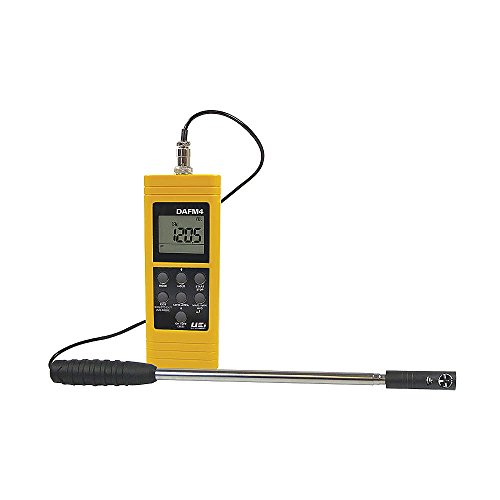
5. UEi DAFM4 In-Duct Vane Anemometer
Best for: technicians who prefer a vane probe on a long, scale-marked pole.
First, the DAFM4 is a mini vane meter on a 39 in (99 cm) telescopic probe. Because the 0.7 in (18 mm) vane is small, it fits small duct holes. The probe also carries temperature and humidity sensors, so the meter can derive wet bulb and dew point.
Next, UEi lists air velocity from 99 to 3937 ft/min and an accuracy of +/-(3% of reading + 39 ft/min). Therefore low readings carry a larger relative error than the percentage suggests. However, the spec sheet shows two different metric ranges, so rely on the ft/min range.
- Velocity range: 99 to 3937 ft/min
- Velocity accuracy: +/-(3% + 39 ft/min)
- Humidity: 0.1 to 99.9% RH, +/-3% at 25 C and 10 to 90% RH
- CFM display: 0 to 99,999
- Power: one 9V battery
Pros
- Long probe with scale marks
- Min/max, hold and averaging, so readings are steady
- Humidity and wet bulb included
Cons
- Metric range is unclear on the spec sheet, so use the ft/min range
- Low-end error is large
Skip it if: you need a low-speed hot-wire reading below about 100 ft/min.
Best Budget
6. BTMETER BT-100 Digital Anemometer
Best for: hobbyists who want a simple wind speed meter for drones, sailing or the garden.
The BT-100 is a basic handheld with a small eight-blade fan, so it is easy to use. First, its listing shows a range of 0.3 to 30 m/s with 0.1 m/s resolution. Also, it reads in m/s, km/h, ft/min, knots and mph, and it shows wind chill below freezing.
It also records maximum, minimum and average speed, and it has a 1/4 in tripod socket. However, specs vary between sellers. One listing gives +/-2% accuracy, while others state it differently. As a result, treat it as a general-purpose meter, not a calibrated reference.
- Wind range: 0.3 to 30 m/s (0.67 to 67 mph)
- Resolution: 0.1 m/s
- Units: m/s, km/h, ft/min, knots, mph
- MAX, MIN and AVG modes with backlit LCD
- Power: 2 AAA batteries
Pros
- Simple, handheld and light
- Five speed units
- Tripod socket for steady readings, so you can leave it in place
Cons
- Accuracy figure differs by seller
- No data logging
Skip it if: you need a traceable calibration or CFM readings.
Best Rugged Wind Meter
7. Kestrel 5500FW Fire Weather Meter Pro
Best for: shooters, sailors and field crews who need a rugged wind meter with extra weather data.
Kestrel is a well-known maker of pocket wind meters. First, the 5500FW measures wind speed, temperature, humidity and pressure. It also calculates wind chill, dew point, heat stress index and fire weather values such as probability of ignition.
Next, Kestrel lists wind speed from 0.6 to 40 m/s with an accuracy of the larger of 3% of reading, the least significant digit or 20 ft/min. Moreover, the meter is sealed to IP67, floats and is drop-tested to MIL-STD-810G. In addition, the LiNK model sends data to a phone over Bluetooth, and a vane mount turns it into a small weather station.
- Wind speed: 0.6 to 40.0 m/s, 0.1 m/s resolution
- Accuracy: larger of 3% of reading, last digit or 20 ft/min
- IP67, floats, MIL-STD-810G drop test
- Stores over 10,000 time-stamped data sets
- Power: one AA lithium battery
Pros
- Rugged and waterproof, so it survives field use
- Logs data and pairs with an app
- Adds temperature, humidity and pressure
Cons
- More features than a simple wind meter
- Fire weather features add little for non-field users, however
Skip it if: you only need a simple wind speed number, because a basic meter does that for less.
How We Chose the Best Handheld Anemometers
We did not field test these meters. Instead, we compared manufacturer specification pages, product listings and published manuals. Therefore our picks are research-based, and we state only specs that a maker page confirms. Where sellers disagree, we say so.
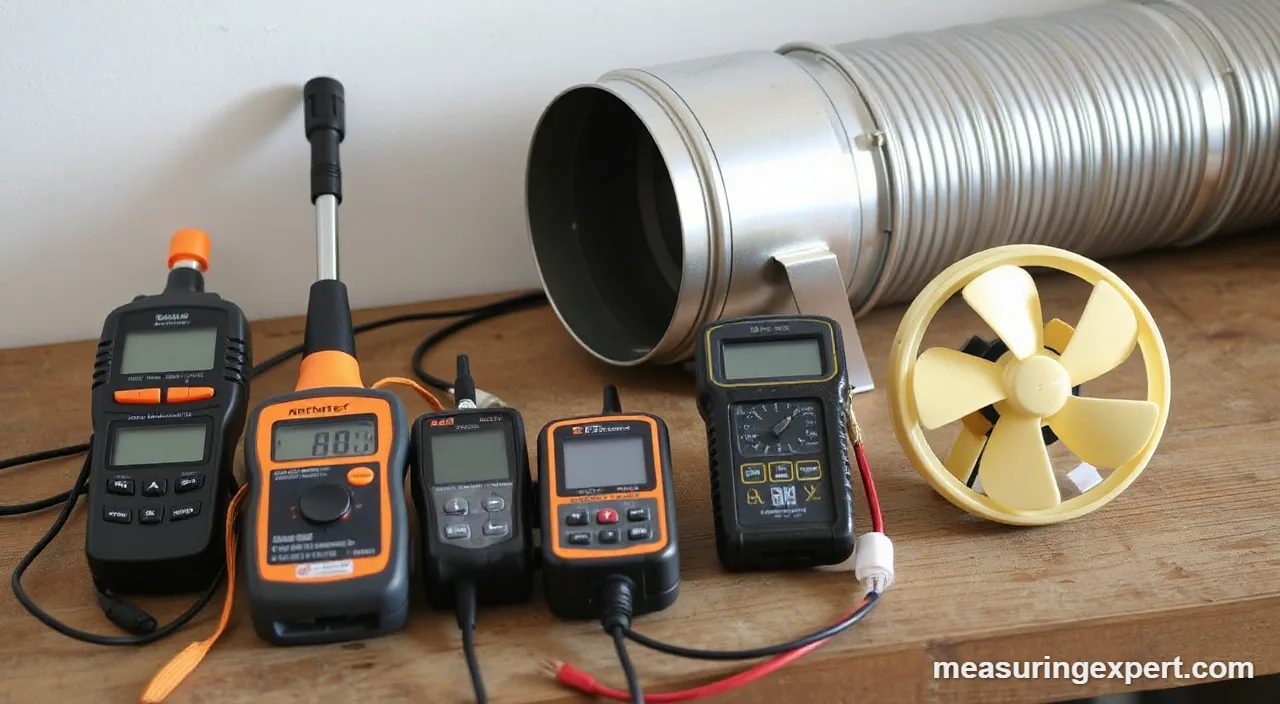
These criteria decided the ranking:
- Sensor type: hot-wire probes suit low airflow, while vane meters suit grilles, and fan or cup meters suit open air.
- Range and accuracy: the stated range must cover your jobs, and accuracy figures must be published.
- Units: also, a good meter shows m/s, km/h, mph, knots or ft/min, and CFM for duct work.
- Averaging: readings in moving air swing, so averaging and max-gust functions matter.
- Build: first, a rugged case helps outdoors, while a long probe helps in ducts.
- Brand mix: finally, no more than two picks per brand.
For background, we also used the National Weather Service Beaufort scale and the maker spec pages linked above. As a result, every spec in this guide comes from a page we opened.
Vane, Hot-Wire or Cup: Choosing the Best Handheld Anemometer Type
The sensor type decides what a meter does well. Next, here is how the main types compare.
| Type | How it senses | Best use | Trade-off |
|---|---|---|---|
| Vane (propeller) | Air spins a small impeller | Grilles, diffusers, open ducts | Needs enough airflow to spin; sensitive to angle |
| Hot-wire | Airflow cools a heated element | Ducts and low air speeds | Fragile element; contamination can shift readings |
| Cup | Wind spins small cups from any direction | Outdoor wind and fixed stations | Less common in handheld HVAC tools |
For HVAC work, a hot-wire or telescopic vane probe is usually the best handheld anemometer type, because it fits a duct hole. For outdoor wind, however, a rugged fan meter is the better choice. Our guide on how to use an anemometer to measure wind speed also covers the basics of each type.
Best Handheld Anemometer Use for HVAC and CFM
First, airflow in cubic feet per minute (CFM) equals air speed in feet per minute times the duct area in square feet. For example, a 10 in by 6 in duct has an area of 0.417 ft2. Then, if the average air speed is 600 ft/min, the flow is 250 CFM.
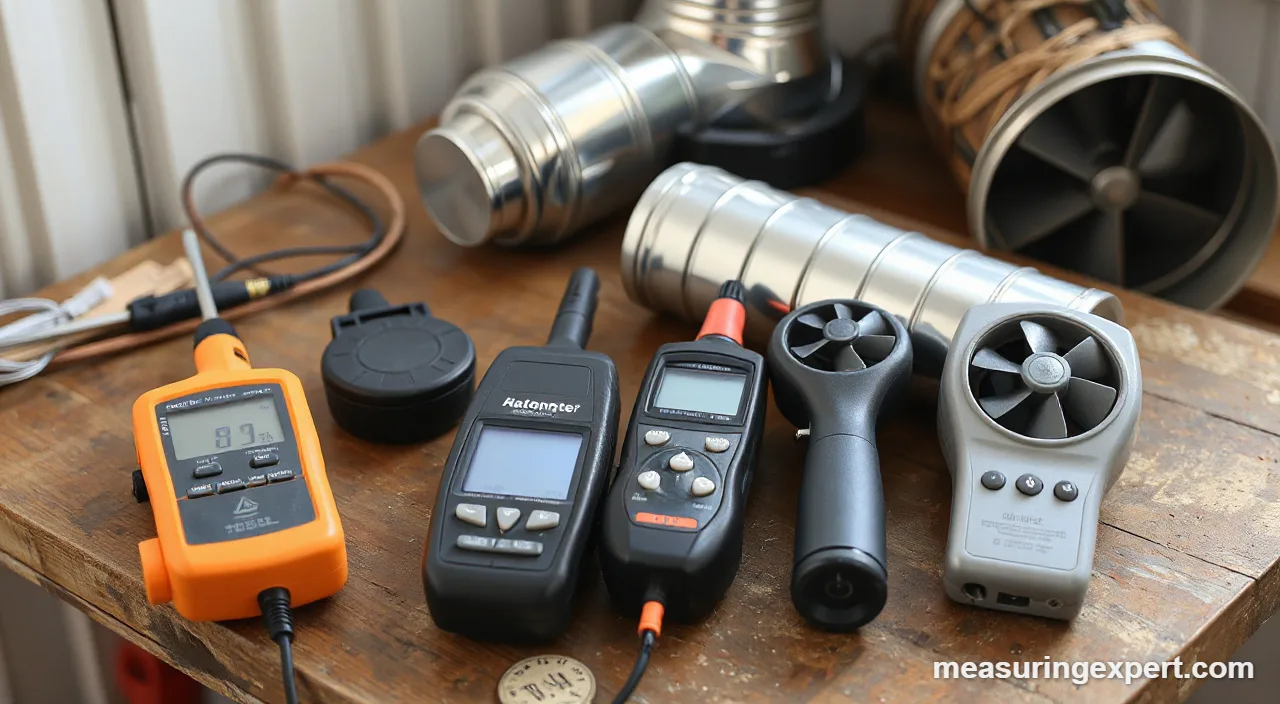
Air does not move evenly across a duct, so one reading is not enough. Instead, take several readings across the cross-section and average them. Testo and Fieldpiece both build timed or point averaging into their meters for this reason. In addition, our explainer on measuring the volume of air shows more worked examples.
Using a Handheld Anemometer for Shooting, Drones and Sailing
Outdoors, the meter reads the wind at your position. For example, shooters use it to judge crosswind where they stand, while drone pilots use it to compare ground wind with their aircraft limits. Likewise, sailors use it to judge conditions on deck. In each case, hold the meter at arm’s length, face the wind and then wait a few seconds for the reading to settle.
- Shooting: wind pushes a bullet sideways, so shooters read crosswind speed. Also, a max or gust reading shows the spikes.
- Drones: wind usually rises with height, so ground readings understate the air at flight altitude. Therefore, check your drone manual for its wind limit.
- Sailing: a moving boat measures apparent wind, which mixes boat speed and true wind. Therefore knots are the usual unit.
First, the National Weather Service uses the Beaufort scale to describe wind. Meanwhile, here are its first eight forces.
| Force | Description | mph | Knots |
|---|---|---|---|
| 1 | Light air | 1-3 | 1-3 |
| 2 | Light breeze | 4-7 | 4-6 |
| 3 | Gentle breeze | 8-12 | 7-10 |
| 4 | Moderate breeze | 13-18 | 11-16 |
| 5 | Fresh breeze | 19-24 | 17-21 |
| 6 | Strong breeze | 25-31 | 22-27 |
| 7 | Near gale | 32-38 | 28-33 |
| 8 | Gale | 39-46 | 34-40 |
For reference, also see the National Weather Service Beaufort scale. If you want a fixed station instead, see our best weather station guide.
Wind Speed Units: m/s, mph, km/h and Knots
First, one meter per second equals 2.237 mph, 3.6 km/h, 1.944 knots and 3.281 ft/s. Also, a reading in ft/min is the HVAC standard, and 1 m/s equals 196.85 ft/min. Because meters differ in units, always check the unit shown before you log a number.
Wind Speed Converter
Use this converter to switch a reading from m/s into the unit your manual or chart uses, so you avoid mistakes.
How to Measure Duct Airflow with the Best Handheld Anemometer
This method works with any of the HVAC meters above. However, a meter with built-in averaging does the math for you.
- Measure the duct. First, measure the inside width and height of the duct in inches, then divide the product by 144 to get the area in square feet.
- Open a test hole. Next, drill a small hole in the duct or use a register, and keep the probe straight and clean.
- Point the probe. Then point the sensor into the airflow, at a right angle to the duct wall, and hold it still.
- Take several readings. After that, record the air speed at several points across the duct. Wait a few seconds at each point.
- Average the speeds. Next, add the readings and divide by the number of points to get the average air speed in ft/min.
- Multiply by the area. Finally, multiply the average speed by the area. For example, 600 ft/min across 0.417 ft2 gives 250 CFM.
Seal the test hole afterward with tape or a plug, because leaks change duct airflow. In addition, repeat the traverse if the first set of readings varies by a large amount.
Care and Calibration for the Best Handheld Anemometer
Keep sensors clean and dry, because dust and oil on a hot-wire element can shift its readings, so store probes in their case. Next, for a vane or fan, blow gently to check that it spins freely. Never use compressed air at high pressure, because it can bend or overspeed the vane. Because most makers say little about calibration intervals, ask the maker or a calibration lab if you need traceable results for compliance work.
Honest Limits of the Best Handheld Anemometer
First, a handheld meter reads one point at one moment. Wind and duct airflow both gust and swirl, so readings vary. Also, a vane tilted off the airflow direction reads low. Because most makers state accuracy only under lab conditions, field results are usually less precise than the spec sheet. Finally, a handheld meter is not a substitute for a certified airflow measurement when a code or contract demands one.
Best Handheld Anemometer FAQ
What is the best handheld anemometer for HVAC?
The Testo 405i Smart Probe is our pick for the best handheld anemometer for HVAC. First, it has a hot-wire sensor, reads 0 to 30 m/s and calculates CFM in the app. However, the Fieldpiece STA2 is a strong alternative if you want a standalone meter with a ruled probe.
What is the best handheld anemometer for wind speed outdoors?
The Kestrel 5500FW is a rugged choice for outdoor wind, because it is sealed to IP67, floats and measures wind up to 40 m/s. For occasional checks, however, the BTMETER BT-100 is a simpler option.
Is a vane or hot-wire the best handheld anemometer type?
First, a vane meter measures air speed by the spin of a small impeller. In contrast, a hot-wire meter measures how fast moving air cools a heated element. Hot-wire probes read low air speeds well, while vane meters average over a larger area.
How do I measure CFM with the best handheld anemometer?
First, measure the duct area in square feet, then take several air speed readings in ft/min across the duct. Then average them and multiply by the area. For example, 600 ft/min across 0.417 ft2 is 250 CFM.
Is the best handheld anemometer accurate?
It can be, within its stated range. For example, published accuracy ranges from about 1.5 to 5 percent of reading for the HVAC meters here. However, field conditions such as gusts, angle and turbulence add error.
Can the best handheld anemometer help with shooting?
Yes, because a rugged meter such as the Kestrel 5500FW reads wind at your position and shows gust and average speeds. However, remember that wind downrange can differ from the wind at your feet.
Can a handheld anemometer check drone wind limits?
Yes, because it can show ground wind speed, which helps you compare with your drone manual. Also, because wind often rises with height, treat the ground reading as a lower bound.
What units does the best handheld anemometer show?
Most show m/s, km/h, mph, knots and ft/min. In addition, HVAC meters add CFM or CMM. For example, the BTMETER BT-100 lists five speed units, while the Fieldpiece STA2 lists fpm, m/s, km/h and mph.
How do I convert m/s to mph and knots?
First, multiply m/s by 2.237 for mph and by 1.944 for knots. For example, 10 m/s is 22.4 mph and 19.4 knots. Otherwise, use the converter on this page for other values.
How often should I calibrate an anemometer?
Makers rarely state a fixed interval. Therefore, if you need traceable results, ask the maker or a calibration lab how often to calibrate, and check the vane or sensor for dirt and damage before each job.
Bottom Line: The Best Handheld Anemometer to Buy
Overall, if you work on ducts and want a flexible tool, the Testo 405i Smart Probe is the best handheld anemometer for most HVAC jobs. Also, choose the Testo 417 for grilles, the Fieldpiece STA2 for duct traverses, and the Kestrel 5500FW for outdoor wind. Finally, for a weather overview, see our best weather station guide.