

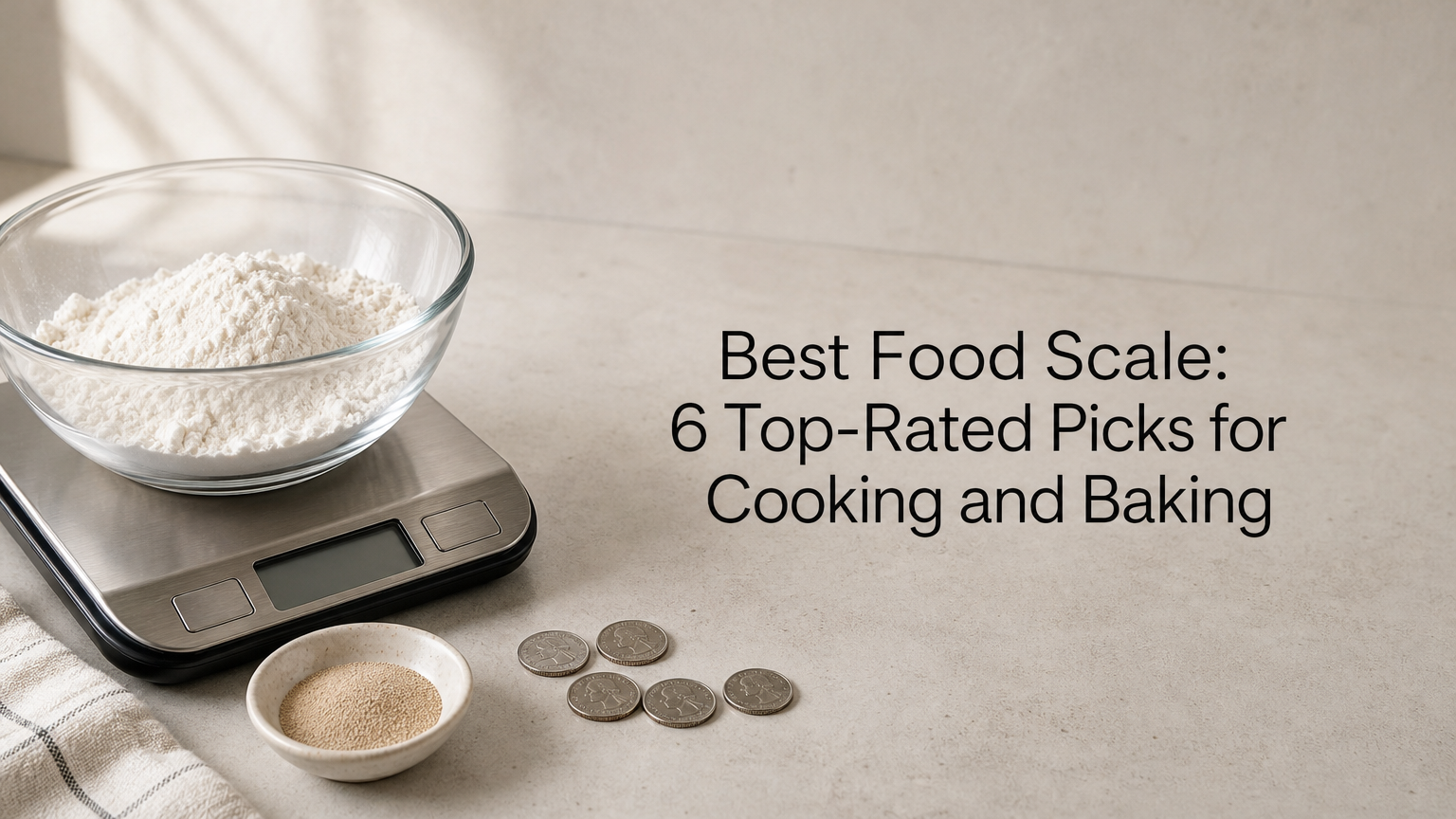
The best food scale for most kitchens is the Escali Primo. It reads in 1-gram steps, holds up to 11 pounds, costs about $25 to $30, and weighs correctly wherever you set the food on the platform. A good pick also settles fast, tares with one press, and does not shut off mid-recipe. If you weigh into wide bowls, the OXO Good Grips suits you better. If money is tight, the Amazon Basics works. Bakers who want baker’s percentages should look at the MyWeigh KD-8000, and anyone who needs tenths of a gram should look at the Fellow Tally.
Choosing is harder than it should be. Almost every digital scale claims to be accurate, the listings read alike, and a decimal display says little about real accuracy. The wrong scale costs you in flat loaves, miscounted portions, or a dead screen halfway through a recipe.
Measuring Expert focuses on measuring tools, so this guide ranks six scales on accuracy, speed, capacity, cleanup, and price. After the picks you’ll find a comparison table, a buying checklist, advice for weight loss tracking, and a five-minute test you can run on any scale you own.
1. Escali Primo Digital Food Scale
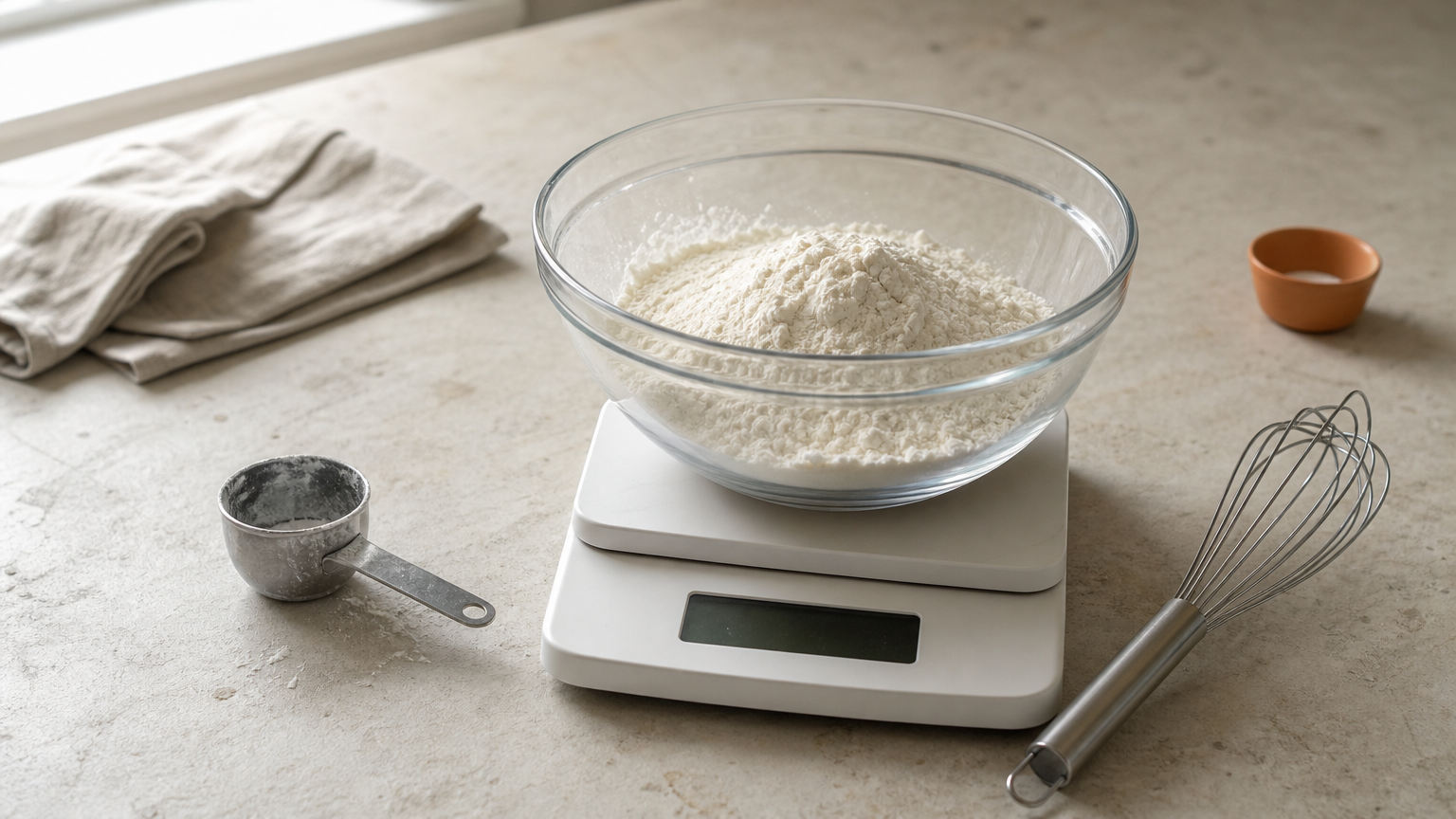
The Escali Primo is the best digital food scale for most people. It combines accuracy, a two-button design, and a low price, and it has topped long-running professional kitchen testing for years.
Specs and price
Here is what you get for roughly the price of a sandwich lunch.
- Capacity: 11 lb (about 5 kg)
- Increment: 1 gram
- Size: 8.5 x 6 x 1.5 inches
- Power: AA batteries, included
- Auto shut-off: 4 minutes 30 seconds
- Price: about $25 to $30, depending on the retailer
What works and what doesn’t
The weighing platform sits raised and offset from the base, so the display stays readable even under a large mixing bowl. The control panel is sealed, which means flour wipes off instead of settling into gaps, and four rubber feet keep the scale steady. It reads accurately whether the weight sits in the center or at an edge, and its 4.5-minute auto shut-off is longer than most competitors, so a pause to find the vanilla won’t reset your measurements.
The Escali Primo does the basics better than scales that cost twice as much.
The drawbacks are minor. It only measures in whole grams, the display has no backlight, and the buttons need a firm press because there is no touchscreen. None of that affects everyday cooking, but it rules the scale out for weighing coffee or spices to the tenth of a gram.
Who it suits
Choose the Escali if you want one reliable scale for bread, cookies, portioning burgers, and meal prep. It is also the safest first purchase if you’re unsure which features you’ll use.
Skip it if you brew pour-over coffee or measure tiny amounts of yeast and salt in small batches. Those jobs call for a 0.1-gram scale, like pick 5 below.
2. OXO Good Grips 11-Pound Food Scale
The OXO Good Grips is the best choice if you weigh into big bowls, because its display pulls out from the base and never hides under the bowl. It has been a long-time favorite of test kitchens and professional cooks.
Specs and price
OXO costs more than the Escali, and the premium goes to design rather than accuracy.
- Capacity: 11 lb
- Increment: 1 gram
- Platform: stainless steel, easy to wipe clean
- Display: pull-out, extends past the edge of a wide bowl
- Price: about $56 to $63, roughly double the Escali
What works and what doesn’t
The pull-out display is the reason to buy this scale. When you use a wide stand mixer bowl or a big dough tub, most scales force you to lean and peek around the rim. Here you slide the readout out, and you see every number clearly. The stainless-steel platform also resists staining and wipes clean, and the build feels like it will last for years of daily use.
You pay double for OXO’s display, not for better accuracy.
The price is the sticking point. Testers who liked the OXO still did not think it earned a place above the Escali, because the weighing performance is similar at half the cost. If you never struggle to see a display, the extra $30 buys you little.
Who it suits
Buy the OXO if you regularly weigh into oversized bowls, work in a kitchen where scale display visibility has annoyed you before, or want a scale you will use daily for a decade. Professional cooks like it for those reasons.
Skip it if your bowls are small to medium and your budget matters. The Escali gives you the same capacity and the same whole-gram readings for far less.
3. Amazon Basics Digital Kitchen Scale
The Amazon Basics scale is the best budget food scale. At about $11, it costs roughly half as much as the Escali and still delivers accurate readings in everyday use.
Specs and price
The numbers look a lot like the pricier picks, which is the point.
- Capacity: 11 lb
- Increment: 1 gram, with a 2-gram minimum weight
- Size: 8.3 x 7 x 1.3 inches
- Power: AAA batteries, included
- Auto shut-off: none listed
- Price: about $11
What works and what doesn’t
The layout copies the winners: two buttons, an elevated platform, and a 7-inch stainless-steel top that wipes down easily. In testing it responded almost as fast as the Escali and gave an accurate readout about 99% of the time. The rare errors showed up when someone kept adding weight or toggled units back and forth, and they were small. Clearing the platform, taring, and starting over fixed it.
For $11, a scale this accurate removes any excuse for measuring flour by the cup.
The corners it cut are visible. The buttons have no sealing, so crumbs and splashes can get into the gaps. The stainless platform smudges and scratches more easily than plastic. The scale also tends to overshoot a weight briefly before correcting itself, so wait a second before you stop pouring.
Who it suits
This is a good scale for a first-time buyer, a student kitchen, a gift, or a backup for a second kitchen. It is also a low-risk way to find out whether weighing ingredients suits you.
Skip it if you bake several times a week or need to weigh small amounts like 2 grams of yeast. The 2-gram minimum and the loose buttons will wear on you.
4. MyWeigh KD-8000 Digital Scale
The MyWeigh KD-8000 is the best food scale for serious bread bakers. It has a huge capacity, a backlit screen, and a baker’s percentage mode that other scales in this price class lack.
Specs and price
Prices differ by version, so check the current listing before you buy.
- Capacity: 8 kg (about 17.6 lb)
- Increment: 1 gram
- Platform: removable stainless-steel plate, 6.5 x 6.5 inches
- Power: 3 AA batteries, or a version with an AC adapter for continuous use
- Display: backlit LCD
- Extras: tare, adjustable auto-off, baker’s percentage mode
What works and what doesn’t
Bakers like the removable top plate, because dough and water wash off without soaking the electronics. The auto-off can be disabled, which matters when you’re mixing and need the scale on continuously. The baker’s percentage mode shows each ingredient as a share of the flour weight, so scaling a formula up or down takes one pass at the scale. One long-time user reports a decade of twice-daily use with only the button cover wearing off.
If you bake bread weekly, the MyWeigh’s features pay for themselves in saved math and cleanup.
It is also bulky. Some testers describe it as about the size of a small appliance, and that is overkill outside a professional bakery or a very active home bakery. The scale still only reads whole grams, so salt in small batches needs a separate 0.1-gram scale.
Who it suits
Pick the MyWeigh if you bake sourdough, divide dough into several pieces, or cook large batches that push past 11 pounds. It also suits anyone who wants to plug the scale in rather than replace batteries.
Skip it if cabinet space is tight or you only bake an occasional batch of cookies. The Escali covers that job for less money and in less space.
5. Fellow Tally Precision Scale
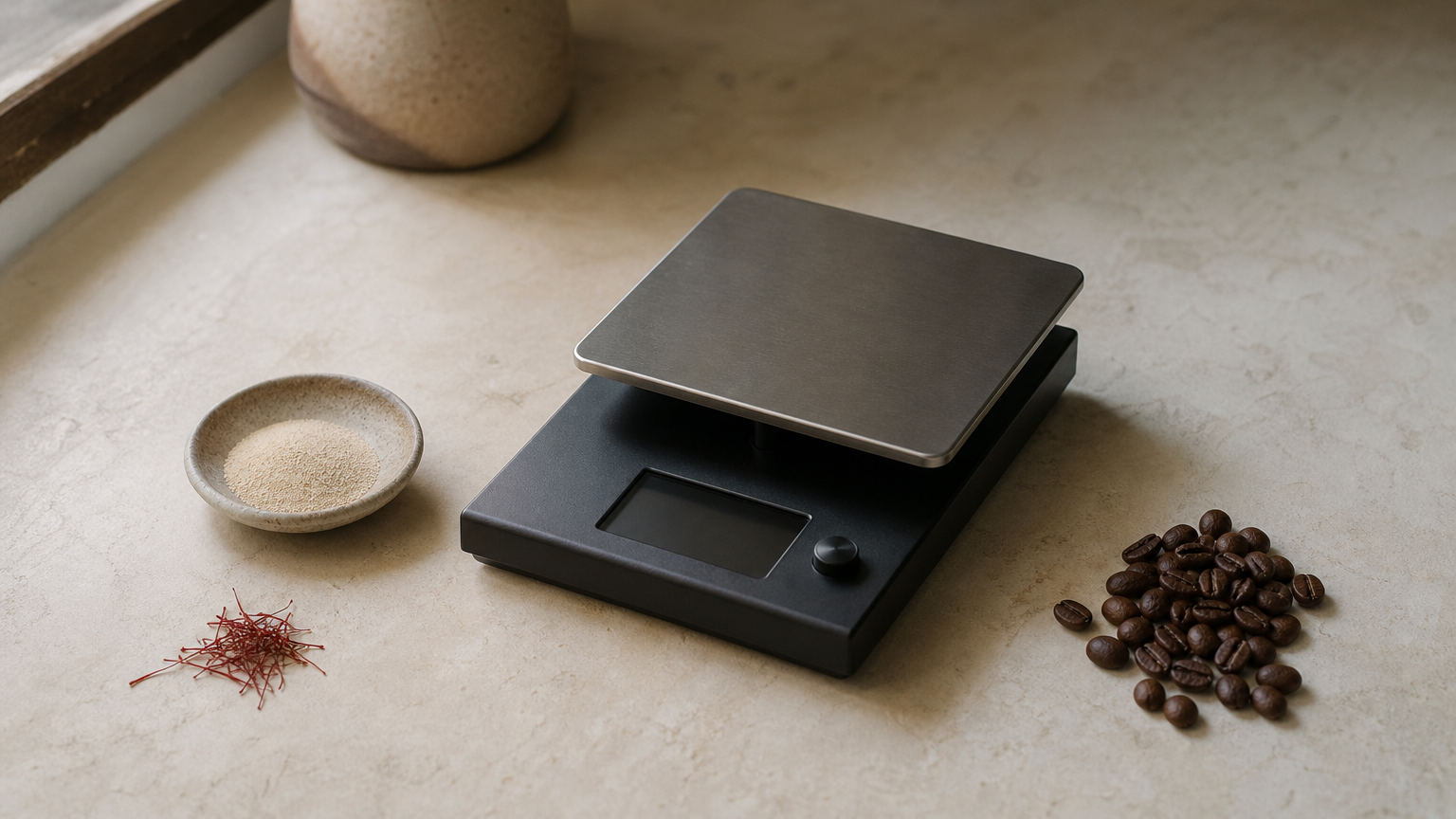
The Fellow Tally is the best pick if you need readings to the tenth of a gram. It is built as a coffee scale but handles most home baking too, at a premium price.
Specs and price
This is a specialist tool, so the specs differ from the others.
- Capacity: 5.5 lb
- Increment: 0.1 gram
- Platform: elevated, about 6 inches
- Display: OLED
- Units: grams, ounces, pounds, and milliliters (calibrated for water)
- Extras: built-in timer and brew-assist ratio guide
- Price: about $200
What works and what doesn’t
The 0.1-gram resolution lets you weigh a pinch of yeast, a gram of saffron, or 15 grams of coffee with confidence. The controls are tactile, the OLED display is easy to read, and the elevated platform holds a mixing bowl without hiding the numbers. The timer and ratio guide are a real convenience for pour-over, which is why coffee enthusiasts buy it.
You buy the Tally for the tenth of a gram, and it earns its price only if you’ll use it.
The cost is the obvious downside. At about $200 it is eight times the price of the Escali, so it is overkill for general cooking. The 5.5-pound capacity also falls short for big sourdough batches or holiday cookie dough, and the milliliter reading is only exact for water, so milk will read slightly off.
Who it suits
It suits people who weigh coffee, tea, spices, or leavening and also want one scale that can handle a normal baking day. If you would otherwise buy a coffee scale and a kitchen scale, this saves you from owning two.
Skip it if you only weigh flour, sugar, and portions. A decimal display does not make a scale more useful for tasks that never need it.
6. Escali Arti Glass Kitchen Scale
The Escali Arti is the best choice if you hate scales that shut off while you’re mid-recipe. A "hold" button keeps the reading on screen, and the glass top comes in several colors.
Specs and price
This is a step up from the Primo in features, not in accuracy.
- Controls: four buttons for on/off, unit change, tare, and hold
- Platform: glass top
- Hold feature: keeps the measurement on screen instead of shutting off automatically
- Colors: a wide range, so it is easy to match your kitchen
- Price: about $35, roughly $10 more than the Primo
What works and what doesn’t
Hold mode is useful in practice. If you weigh a batch, set it aside, and come back, the screen is still showing the number. The four-button panel is sleeker than the Primo’s, the build quality matches, and it comes from the same maker as the top pick. Testers called it a good scale overall.
The Arti is a very good scale, but the Primo does the same job for $10 less.
The case against it is value. Testers did not feel the added feature and upgraded design justified the extra $10. Some experienced bakers also avoid glass platforms, saying that dough and bowls feel awkward on glass and that glass is less forgiving of scratches than plastic or steel.
Who it suits
Buy the Arti if you want the hold feature, like the idea of a colored scale on the counter, or want the Escali’s reliability with a more polished look.
Skip it if you’d rather keep $10 or you mostly weigh dough and heavy bowls. The Primo’s plastic body is the more practical choice for messy baking.
Best food scales compared at a glance
The six scales split into three groups: everyday workhorses, specialists, and one design upgrade. The table puts the key differences side by side, and the list under it matches each scale to a job.
Side-by-side specs
Prices are ballpark figures that shift between retailers, so confirm the current price before you buy.
| Scale | Best for | Standout feature | Approx. price |
|---|---|---|---|
| Escali Primo | Most home cooks | Accurate, sealed controls, long auto-off | $25 to $30 |
| OXO Good Grips | Wide bowls | Pull-out display | $56 to $63 |
| Amazon Basics | Tight budgets | 11 lb capacity at the lowest price | About $11 |
| MyWeigh KD-8000 | Bread bakers | 8 kg capacity, baker’s percentages | Varies by version |
| Fellow Tally | Coffee and tiny amounts | 0.1 g increments, timer | About $200 |
| Escali Arti | Mid-recipe pauses | Hold button, colors | About $35 |
Which pick fits which job
Match the scale to the task you do most.
- Daily cooking and baking: Escali Primo
- Big mixing bowls: OXO Good Grips
- Cheapest accurate option: Amazon Basics
- Large sourdough batches: MyWeigh KD-8000
- Coffee, spices, and yeast: Fellow Tally
- Weighing and walking away: Escali Arti
How to choose a good food scale
A good food scale reads correctly anywhere on the platform, settles quickly, holds enough weight, stays on long enough, and wipes clean. Check those five things and you will avoid most bad buys, whatever the brand.
Accuracy versus resolution
Resolution is the smallest step on the display, and accuracy is how close the reading is to the truth. They are not the same. A scale that shows 0.1 g can still be off by more than that: one 0.1-gram scale is rated by its maker at plus or minus 0.7 g.
Here is why resolution matters for your recipe. Salt at 2% of 500 g of flour is 10 g. A scale that rounds to whole grams can be off by half a gram either way, or up to 5% of the salt, while a 0.1 g scale narrows that to about 0.5%. For flour, sugar, and portioning meat, 1 g is plenty. Buy 0.1 g only for tiny ingredients.
Capacity, display, and power
Eleven pounds, or about 5 kg, is more than enough for a home kitchen, and 1.65-pound pocket scales are too small for a bowl of flour. Remember the bowl counts against capacity, so leave headroom for a heavy mixing bowl.
Look at the display next. A raised platform or a pull-out screen keeps numbers visible. Then check how long the scale stays on. Whole-gram scales that shut off in a minute drive bakers mad, and 4.5 minutes is good. For power, AA batteries and plug-in models both work, but accuracy matters more than a rechargeable battery.
Build, size, and cleanup
Flour, oil, and dough get on everything, so a sealed control panel or removable plate saves you scrubbing. Plastic tops resist scratches better than steel or glass, and rubber feet keep the scale from sliding. Choose size honestly. A scale you won’t store in a cabinet is one you’ll stop using, so compact models win unless you need MyWeigh’s capacity.
Buy for accuracy across the whole platform first, then for display, then for features.
The best food scale for weight loss and portion tracking
The best food scale for weight loss is a plain whole-gram scale with a tare button and a long auto-off, such as the Escali Primo or the Amazon Basics. You don’t need an app-connected model to track portions well.
Why weighing beats measuring cups
Weighing is more consistent than scooping. A cup of peanut butter, rice, or oats varies with how you pack it, while 30 grams is always 30 grams. Whole-gram resolution holds a 30-gram portion to within about 3%, which is plenty for food tracking.
Match the state your nutrition data describes. Many labels and databases list raw or as-packaged weights, so weigh pasta, rice, and meat the same way your source does. If you want a calorie target or a diet plan, a doctor or dietitian can set it for you.
Features that matter for tracking
Tare is the key function. Put the plate on the scale, press tare, add the food, and then tare again before the next item, so you can build a meal on one plate. A long auto-off helps when you’re logging several ingredients, and a pause-friendly model like the Escali Arti helps when you’re also cooking.
Metric and ounce toggles matter too, because many databases list grams. All six picks switch units, so that part is easy.
Are smart scales worth it?
Usually not. App-connected nutrition scales sound convenient, but accuracy comes first. One popular smart nutrition scale was among the least accurate in testing: a 5-gram nickel read as low as 2 grams and as high as 6. Unless you need automatic logging, a basic scale and a tracking app you type into will serve you better.
For portion tracking, accuracy and a reliable tare beat Bluetooth every time.
How to test your food scale’s accuracy at home
You can check any scale in five minutes with coins and a bowl. Do it when you unbox a new scale and again if readings ever feel off.
A five-minute test
A US nickel weighs 5 grams, so five nickels make 25 grams. Use them like this:
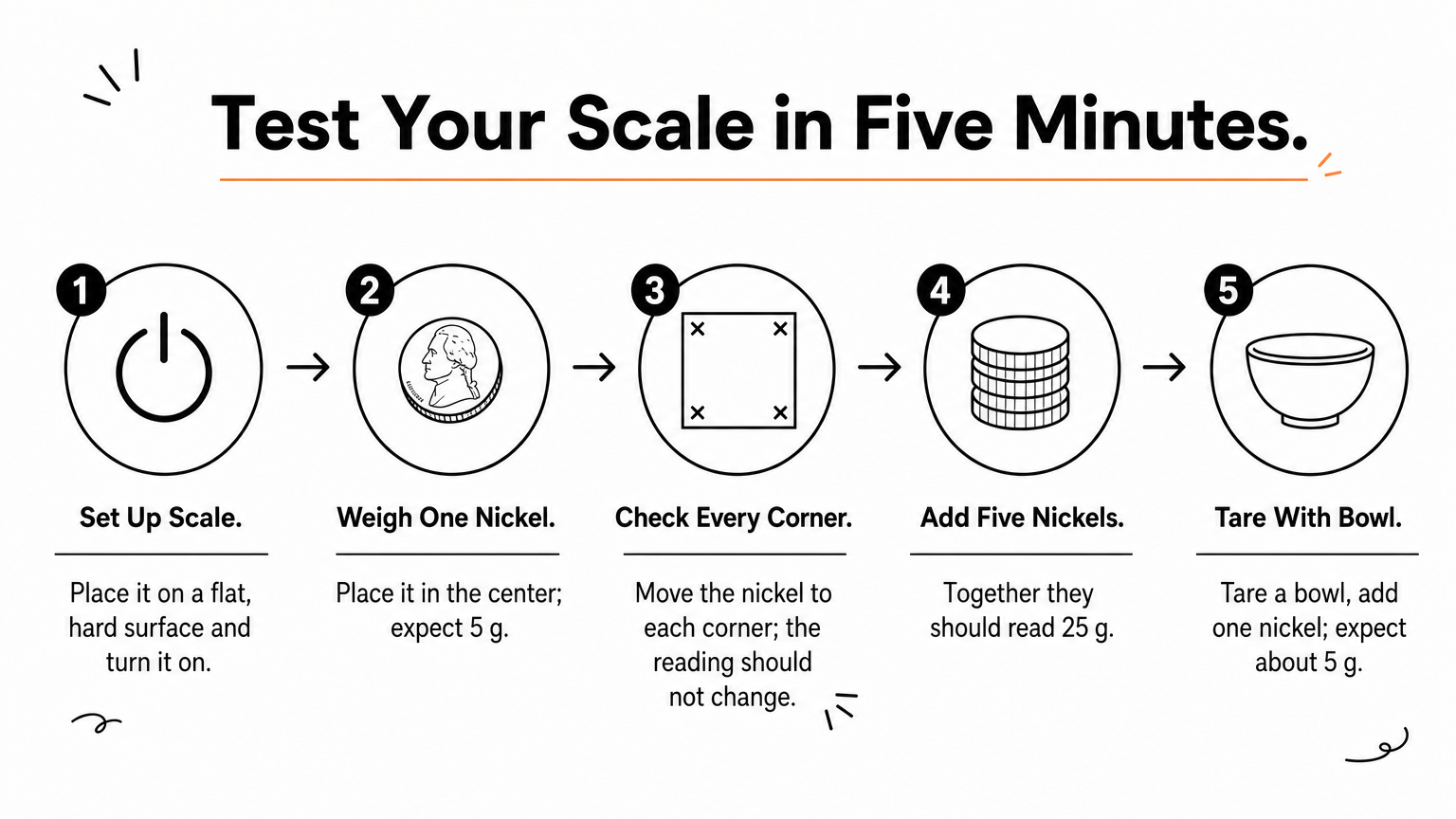
- Set the scale on a flat, hard surface and turn it on.
- Place one nickel in the center and note the reading. It should show 5 g, or 4 to 6 g on a scale with a 2-gram minimum.
- Move the nickel to each corner. The reading should not change.
- Add five nickels and check for 25 g.
- Put a mixing bowl on the scale, press tare, and add one nickel. A good scale still reads about 5 g.
That last step is the hardest and is where cheap scales fail. Bakers add salt and yeast on top of a loaded bowl, so small changes under weight matter.
When readings drift
Fresh batteries fix many problems, because weak ones cause erratic numbers. Make sure the scale sits level and nothing touches the platform edge. If a scale is still off by a gram or two after that, return it.
Most budget scales cannot be recalibrated. The MyWeigh KD-8000 can, using a 5 kg calibration weight, which helps if you move between very different altitudes.
Which food scale to buy
Start with the Escali Primo unless you have a specific reason not to. It is the best all-around food scale for cooking, baking, and portion tracking, and at about $25 to $30 it costs less than most recipes’ worth of wasted ingredients. Pick the OXO for wide bowls, the Amazon Basics for the lowest price, the MyWeigh for bread, and the Fellow Tally for tenths of a gram.
Whatever you buy, run the nickel test the day it arrives. For more guides to scales, measuring cups, timers, and conversions, browse Measuring Expert’s measuring tool guides and pick the next tool for your kitchen.