

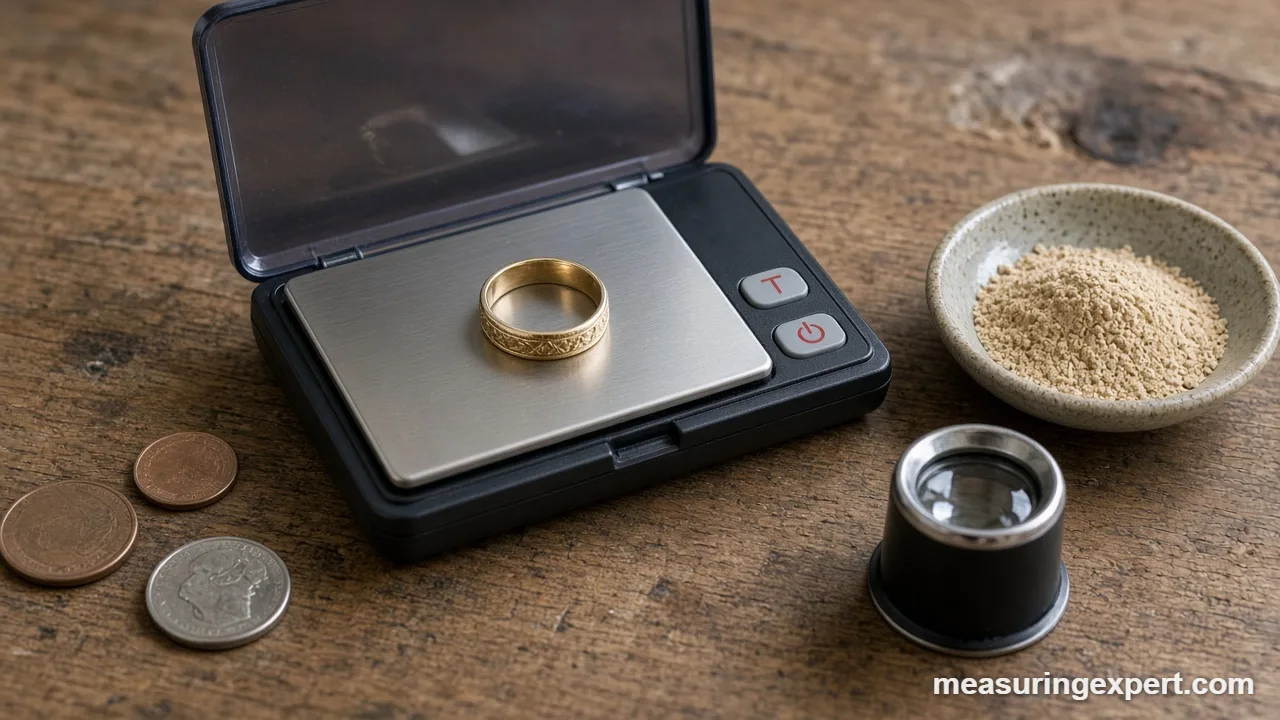
The best pocket scale for most people is the My Weigh Triton T3R, a rechargeable 500 g scale that reads to 0.01 g in six units. However, the right choice depends on what you weigh: jewelry and coins need 0.01 g, baking needs 0.1 g, and reloading needs a scale that reads in grains.
In short: get the Triton T3R as an all-rounder, the AWS-100 on a tight budget, and the Frankford Arsenal DS-750 for powder charges.
As an Amazon Associate, Measuring Expert earns from qualifying purchases. Our picks are based on research, specifications and owner feedback, not paid placement.
Best Overall

Best Budget

Best for Reloading

Quick Answer: Best Pocket Scale by Job
- All-rounder: My Weigh Triton T3R, 500 g x 0.01 g, rechargeable.
- Tight budget: AWS-100, 100 g x 0.01 g with carat mode.
- Reloading: Frankford Arsenal DS-750, 750 gr x 0.1 gr.
- Baking: My Weigh Triton T3-660 for yeast, salt and spices.
- Thinnest: Tanita 1479Z at just 10 mm thick.
- Bigger reloading loads: Frankford Arsenal Platinum Series, 1500 gr.
- Counting beads and parts: Jennings JSR-150.
On This Page
- Comparison table
- The 7 picks, reviewed
- How we chose
- Specs explained
- Which readability you need
- Unit converter
- How to weigh small items
- Calibration and care
- Honest limits
- FAQ
- Bottom line
Best Pocket Scale Comparison Table
First, match the readability to your job. Next, compare the standout feature, and jump to the full review.
| # | Product | Best For | Standout Feature | Amazon |
|---|---|---|---|---|
| 1 | My Weigh Triton T3R | Jewelry, coins and hobby weighing | 500 g at 0.01 g, rechargeable | View |
| 2 | AWS-100 | Small jewelry pieces and gemstone lots | 0.01 g with carat mode and a lid | View |
| 3 | Frankford Arsenal DS-750 | Spot-checking powder charges | Reads in grains; pan and weight included | View |
| 4 | My Weigh Triton T3-660 | Yeast, salt, spices and coffee | 660 g range, rubber-padded case | View |
| 5 | Tanita 1479Z | A shirt-pocket scale for quick checks | Only 10 mm thick, coin-cell power | View |
| 6 | Frankford Arsenal Platinum Series | Heavy bullets, brass sorting and bench use | 1500 gr range, 3-point calibration | View |
| 7 | Jennings JSR-150 | Beads, findings and small hardware | Pieces mode plus a spill catch | View |
The 7 Best Pocket Scale Picks, Reviewed
We start with the all-round 0.01 g picks, then move to reloading, baking, slim carry and counting. For travel-first models, see our best travel pocket scale guide instead.
Best Overall
1. My Weigh Triton T3R (500 g x 0.01 g)
Best for: Jewelers, coin collectors and hobbyists who want one pocket scale that covers both tiny and medium loads.
The Triton T3R is our pick as the best pocket scale for most people. Also, it weighs up to 500 g (17.6 oz) and reads in 0.01 g steps, so a single scale handles a 0.2 g earring back and a 400 g roll of coins. In addition, My Weigh lists 0.1 dwt and 0.01 ozt steps for gold and silver work.
Notably, the T3R is the rechargeable version of the Triton T3. My Weigh rates its lithium-ion battery at about 40 hours of continuous use, so you are not hunting for AAA cells. Also, the body has a rubber-padded outer case with shock-mounted internals, which helps it survive a drop. Finally, the tray is a roomy 3.15 x 2.4 in (80 x 60 mm). See the Triton T3R spec page for the full table.
- Capacity / readability: 500 g x 0.01 g (0.01 oz, 0.1 dwt, 0.01 ozt)
- Units: g, oz, dwt, ozt, gn, ct
- Tray: 3.15 x 2.4 in (80 x 60 mm)
- Size and weight: 5.6 x 3.2 x 0.95 in, 6 oz (170 g)
- Power: rechargeable Li-ion, rated about 40 hours; auto-off after 60 seconds
Pros
- Wide 500 g range at 0.01 g
- Rechargeable, so no spare cells
- Also a rubber-padded, shock-mounted body
Cons
- Thicker than ultra-slim models
- Calibration weight sold separately
- Auto-off at 60 seconds can feel short
Skip it if: You weigh gemstones or powders under 1 g, because a milligram scale reads ten times finer.
Best Budget
2. American Weigh Scales AWS-100 (100 g x 0.01 g)
Best for: First-time buyers who want 0.01 g readability for rings, chains, beads and loose stones at a low price.
Simply put, the AWS-100 is a simple, low-cost scale from American Weigh Scales. Specifically, it weighs up to 100 g (3.5 oz) in 0.01 g steps, and it switches between grams, ounces, carats and grains. So a jeweler can read a 1.25 ct stone or a 4.5 g ring without math.
Meanwhile, its platform is 2.5 x 3.0 in, which is generous for the size. Also, the backlit display changes color with each unit, which makes a wrong-unit mistake less likely. In addition, a hinged cover protects the pan in a drawer or bag. However, AWS calibrates it with a 100 g weight that is not in the box, so plan to buy one. Specs are on the AWS-100 product page.
- Capacity / readability: 100 g x 0.01 g
- Units: g, oz, ct, gn
- Platform: 2.5 x 3.0 in; overall 5 x 3 x 0.9 in
- Display: 0.5 x 1.2 in backlit LCD that changes color by unit
- Power: 2 x AAA (included); calibrates with a 100 g weight
Pros
- Low price for 0.01 g
- Carat and grain modes
- Also a color-coded display
Cons
- Only 100 g capacity
- No pennyweight or troy ounce mode
- Calibration weight not included
Skip it if: You weigh gold in pennyweights or troy ounces, because the Triton T3R shows both.
Best for Reloading
3. Frankford Arsenal DS-750 (750 gr x 0.1 gr)
Best for: Handloaders who want a small scale to spot-check powder charges and sort bullets at the range or bench.
To begin with, reloaders weigh powder in grains, and 1 grain is only 64.8 mg. For this reason, the DS-750 is built for that job. As a result, it reads up to 750 gr (about 48.6 g) in 0.1 gr steps, and it also shows grams, ounces and carats.
Moreover, Frankford Arsenal includes a powder pan, a calibration weight and a carry bag, and the scale has a built-in protective cover. Also, the blue backlit display is easy to read at the bench. However, any pocket scale used for loading should be checked with a known weight at the start of each session. Details are on the DS-750 product page.
- Capacity / readability: 750 gr (about 48.6 g) x 0.1 gr
- Units: grains, grams, ounces, carats
- Calibration weight included
- Includes powder pan and carry bag; built-in cover
- Display: blue backlit LCD
Pros
- Reads directly in grains
- Powder pan and weight in the box
- Also compact for a range bag
Cons
- 750 gr cap limits heavy bullets plus pan
- Needs a zero check every session
- No troy ounce or pennyweight
Skip it if: You weigh every charge for long-range loads, because a larger bench scale or balance is steadier.
Best for Baking
4. My Weigh Triton T3-660 (660 g x 0.1 g)
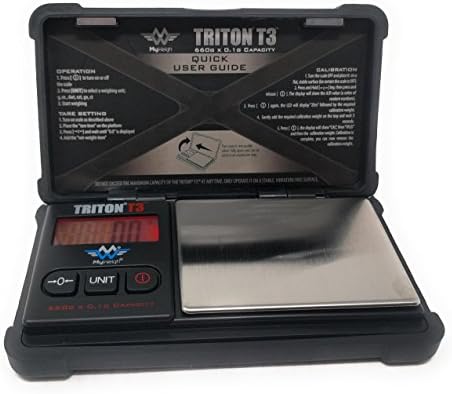
Best for: Bakers, coffee fans and home cooks who weigh yeast, salt, spices and small batches.
A kitchen scale that reads in 1 g steps cannot weigh a 2 g dose of yeast well. The Triton T3-660 reads to 0.1 g up to 660 g (23.3 oz), so it handles yeast, salt, baking soda, spice blends and coffee doses. Also, 660 g is enough for a small bowl or a sourdough levain.
Because it shares the T3 body, you get the same 3.15 x 2.4 in tray, red backlit display and rubber-padded, shock-mounted case. In addition, it runs on two AAA cells that come in the box. For more on small baking weights, see our guide on how to measure yeast.
- Capacity / readability: 660 g x 0.1 g (0.01 oz, 1 gn, 0.5 ct)
- Units: g, oz, dwt, ozt, gn, ct
- Tray: 3.15 x 2.4 in (80 x 60 mm)
- Size and weight: 5.6 x 3.2 x 0.95 in, 6 oz (170 g)
- Power: 2 x AAA (included); auto-off after 60 seconds
Pros
- 0.1 g steps for yeast and salt
- 660 g range covers a small bowl
- Also a rubber-padded case
Cons
- Not fine enough for gems or gold
- Bowl weight eats into the range
- Tray is small for big bowls
Skip it if: You mostly weigh full recipes, since a full-size kitchen scale handles big bowls better.
Slimmest Pick
5. Tanita 1479Z Mini Scale (200 g x 0.1 g)

Best for: Buyers who want the thinnest scale they can carry and only need 0.1 g steps.
To start, Tanita is a Japanese scale maker, and the 1479Z is one of its mini models. For example, it is only 10 mm (0.39 in) thick and runs on one CR2032 coin cell, so it slips into a shirt pocket or wallet. Also, capacity is 200 g (7.05 oz) in 0.1 g steps.
However, the unit list is short: grams, ounces, troy ounces and pennyweight. So it suits quick checks of letters, jewelry pieces or food portions more than lab-style work. Plus, a soft case comes in the box. Note that Tanita lists it as sold out on its 1479Z page at the time of writing, so check the Amazon card for stock.
- Capacity / readability: 200 g x 0.1 g (0.001 oz, 0.001 ozt, 0.1 dwt)
- Units: g, oz, ozt, dwt
- Thickness: 10 mm (0.39 in)
- Power: 1 x CR2032 (included); low-battery indicator
- Includes: soft case
Pros
- Thinnest scale on this list
- Coin cell fits anywhere
- Also a simple four-unit menu
Cons
- No grains or carats
- Only 0.1 g readability
- Stock can be limited
Skip it if: You need carats or grains, because the AWS-100 or Triton T3R cover them.
Best Larger Capacity
6. Frankford Arsenal Platinum Series Scale (1500 gr x 0.1 gr)

Best for: Reloaders who weigh heavy bullets or cases and want a portable scale that also runs on wall power.
By comparison, the Platinum Series scale doubles the DS-750 range. Therefore, it reads up to 1500 gr (about 97.2 g) in 0.1 gr steps, so heavy bullets, full cases and a pan of powder all fit. Also, it shows grains, grams, ounces and carats.
First, Frankford Arsenal includes two calibration weights for a three-point calibration, which checks the scale at more than one load. In addition, it runs on four AAA cells or a 110 V/220 V power supply, and it shuts off after 180 seconds. Finally, a sturdy case holds the scale, pan and weights together.
- Capacity / readability: 1500 gr (about 97.2 g) x 0.1 gr
- Units: grains, grams, ounces, carats
- Calibration: two weights, three-point calibration
- Power: 4 x AAA (included) or 110 V/220 V supply
- Auto shut-off after 180 seconds; protective cover and fitted case
Pros
- Twice the range of the DS-750
- Three-point calibration
- Also battery or wall power
Cons
- Bulkier than a true pocket scale
- No jewelry units beyond carats
- Still needs zero checks each session
Skip it if: You want something that fits in a pocket, because the DS-750 is smaller.
Best for Counting Parts
7. Jennings JScale JSR-150 (150 g x 0.1 g)

Best for: Crafters and hobbyists who count beads, findings, screws or other small parts by weight.
The JSR-150 from Jennings (JScale) is a 150 g (5.3 oz) scale that reads in 0.1 g steps. Above all, its standout feature is a pieces-counting mode: weigh a sample of, say, 20 beads, and the scale counts the rest for you.
In addition, the flip-down cover doubles as an expansion tray, and a raised catch keeps loose items from rolling off. Moreover, it switches between six units, including pennyweight and troy ounce. Also, the maker lists a wide working range of 50 to 104 F (10 to 40 C).
- Capacity / readability: 150 g x 0.1 g (0.5 ct, 0.1 dwt, 0.01 ozt)
- Units: g, oz, gn, ct, ozt, dwt; pieces counting
- Tray: 2.9 x 2.25 in (75 x 57 mm); flip-down cover
- Size: 4.9 x 3.25 x 0.9 in (125 x 82 x 23 mm)
- Power: 2 x AAA (included); auto-off after 2 minutes
Pros
- Counting mode for beads and parts
- Cover turns into a larger tray
- Also a spill catch for loose items
Cons
- Only 0.1 g readability
- 150 g cap is small
- Not suited to gems or gold
Skip it if: You need 0.01 g steps, because the AWS-100 or Triton T3R read ten times finer.
How We Chose the Best Pocket Scale Picks
To be clear, we did not test these scales by hand. Instead, our picks are research-based. First, we read maker spec pages for capacity, readability, units, calibration and power. Next, we weighed owner feedback on drift, battery life and build. Finally, we checked the unit math against the NIST page on SI units of mass.
We also kept to established scale brands and allowed no more than two models per brand. In addition, we covered distinct jobs: everyday 0.01 g use, jewelry and gems, reloading, baking, slim carry and counting parts. We left out the U.S. Solid 1 mg and GemOro models that already appear in our best digital scale guide, and the travel-first models in our travel pocket scale roundup.
Best Pocket Scale Specs Explained
Pocket scale listings use a short code such as “200 g x 0.01 g”. In other words, the first number is the capacity, and the second is the readability. However, those two numbers do not tell the whole story, so here is what each spec means in practice.
Readability is not accuracy
To clarify, readability (also called resolution or division) is the smallest step the display shows. Accuracy, on the other hand, is how close the reading is to the true mass. For example, a scale can show 0.01 g steps and still be off by 0.03 g if it is not calibrated. So treat the last digit as a hint until you check it with a known weight.
Capacity and the bottom of the range
In general, most pocket scales are least reliable near the bottom of their range. As a rule of thumb, aim for a reading of at least 20 to 50 divisions. That means about 0.2 g or more on a 0.01 g scale, and 2 g or more on a 0.1 g scale. Also, leave room for the tray or cup, because the tare weight counts toward capacity.
Units that matter for each job
- Grams (g): the base unit for food, supplements and crafts.
- Carats (ct): gemstones; 1 ct is exactly 0.2 g.
- Grains (gn or gr): powder and bullets; 1 gr is exactly 64.79891 mg.
- Pennyweight (dwt): gold trade; 1 dwt is 1.55517384 g.
- Troy ounce (ozt): precious metals; 1 ozt is 31.1034768 g, heavier than the 28.3495 g kitchen ounce.
Power, display and covers
Most scales here run on two AAA cells, while the Tanita uses one CR2032 coin cell. Also, a backlit display helps in dim rooms. Meanwhile, a flip cover protects the load cell in a bag, and on several models it doubles as a larger tray.
Which Best Pocket Scale Type Fits Your Job?
First of all, the biggest choice is readability. However, each step finer costs range, so pick the coarsest scale that still does the job.
| Readability | Typical range | Good for | Picks here |
|---|---|---|---|
| 0.1 g | 150 to 660 g | Yeast, salt, coffee, beads, letters | Triton T3-660, Tanita 1479Z, JSR-150 |
| 0.01 g | 100 to 500 g | Jewelry, coins, supplements, crafts | Triton T3R, AWS-100 |
| 0.1 gr (about 6.5 mg) | 750 to 1500 gr (about 48.6 to 97.2 g) | Powder charges, bullets, brass | Frankford Arsenal DS-750 and Platinum Series |
| 0.001 g (1 mg) | 20 to 50 g | Loose gemstones, tiny powders, cosmetic additives | See the 1 mg pick in our best digital scale guide |
Best Pocket Scale Unit Converter
As you can see, jewelers, reloaders and bakers each use different units. So use this mass converter to turn a reading into milligrams, grains, carats or ounces. The default is 1 g.
For example, a 0.1 gr step on a reloading scale equals about 6.5 mg. Similarly, a 0.01 g step is 0.05 ct. For more on very small units, see our explainer on what mcg means.
How to Use the Best Pocket Scale for Accurate Readings
In practice, good technique matters as much as the scale. So follow these steps each time you weigh something small.
- First, place the scale on a hard, level surface away from fans, vents and phones.
- Next, turn it on and wait about 30 seconds so the load cell settles.
- Check zero, then place a known calibration weight to confirm the reading.
- Then put your empty tray or paper on the pan and press tare.
- Add the item gently to the center of the pan, without touching the scale.
- Close the cover or draft shield if the scale has one, then wait for the stable reading.
- Finally, read the value, remove the item and confirm the display returns to zero.
Calibration and Care for a Pocket Scale
Inside, a pocket scale uses a small strain-gauge load cell, so its reading changes with temperature, shock and battery voltage. Therefore, check it often and calibrate when the check fails.
- Use the right weight: calibrate with the weight value the manual names, often the full capacity or a round value such as 100 g or 200 g.
- Handle weights with tweezers or gloves: skin oils add mass, and that matters at milligram level.
- Let it warm up: bring a cold scale to room temperature first; many makers list 50 to 86 F (10 to 30 C) as the best range.
- Replace weak batteries: low voltage can cause drift before the low-battery icon appears.
- Close the lid in transit: pressing on the pan can overload and damage the load cell.
Do
- Check zero and a known weight at the start of each session.
- Also, weigh in a cup or on paper, and tare it out.
- Keep loads well under the stated capacity.
Don’t
- Never press on the pan with a finger to test it.
- Avoid weighing next to a phone or under a ceiling fan.
- Do not use a pocket scale for trade or legal sales.
Honest Limits of Any Pocket Scale
Of course, pocket scales are handy, but they are not lab balances. For one thing, a readability of 0.01 g does not mean the scale is accurate to 0.01 g. Also, very light items, under about 20 divisions, often read high or low. In addition, these scales are not certified for trade, so a jeweler selling by weight in the US needs a scale approved under NIST Handbook 44 rules. Finally, a milligram scale is sensitive to breath, static and drafts, so it rewards patience more than speed.
Best Pocket Scale FAQ
What is the best pocket scale for jewelry?
For most jewelry work, a 0.01 g scale with carat, pennyweight and troy ounce modes is the best pocket scale. The My Weigh Triton T3R and the budget AWS-100 both fit. However, for loose gemstones under 1 ct, a milligram scale gives far more useful readings.
How accurate is a 0.01 g pocket scale?
In theory, a 0.01 g scale shows steps of 10 mg, but its true accuracy is often a few divisions, especially near the bottom of the range. So check it with a known weight and expect the best results above about 1 g.
What is the difference between readability and accuracy?
In short, readability is the smallest step the display shows. Accuracy is how close the reading is to the true mass. For example, a scale can read 0.01 g yet be off by 0.05 g if it is out of calibration.
Is the best pocket scale good enough for baking?
Yes, for small amounts. For example, a 0.1 g scale such as the Triton T3-660 weighs yeast, salt and spices well. However, a full-size kitchen scale is better for flour and large bowls.
How often should I calibrate a pocket scale?
First, check it with a known weight every session and calibrate whenever the check is off by more than one or two divisions. Also recalibrate after a drop, a battery change or a big temperature change.
What calibration weight do I need?
First, use the value your manual lists, which is often the full capacity or a round number like 100 g or 200 g. Also, a class F1 or M1 weight is plenty for a pocket scale.
Why does my pocket scale reading drift?
Most of the time, drift comes from drafts, a soft or tilted surface, temperature change, static or weak batteries. So let the scale warm up, use a hard level surface and close any draft shield.
Can a pocket scale weigh powder charges for reloading?
Yes, a scale that reads in 0.1 grain steps, such as the Frankford Arsenal DS-750, can check powder charges. Still, verify it with a check weight each session, because 0.1 gr is only about 6.5 mg.
How many grains are in a gram?
In fact, one gram equals about 15.432 grains, because one grain is exactly 64.79891 mg. So a 0.1 g step is about 1.5 grains.
Can I use a pocket scale for selling by weight?
Not in most cases. That is because pocket scales are not legal-for-trade devices, so anyone selling goods by weight in the US should use a scale approved for commercial use under state weights and measures rules.
Bottom Line: Which Best Pocket Scale to Buy
For most people, the My Weigh Triton T3R Rechargeable Pocket Scale (500 g x 0.01 g) is the best pocket scale. After all, it pairs a 500 g range with 0.01 g steps, six units and a rechargeable battery. However, choose the AWS-100 for a small budget, the DS-750 for powder charges, or the Triton T3-660 for baking.
2 thoughts on “Best Pocket Scale: 7 Picks for Jewelry, Coins, Reloading and Baking”