

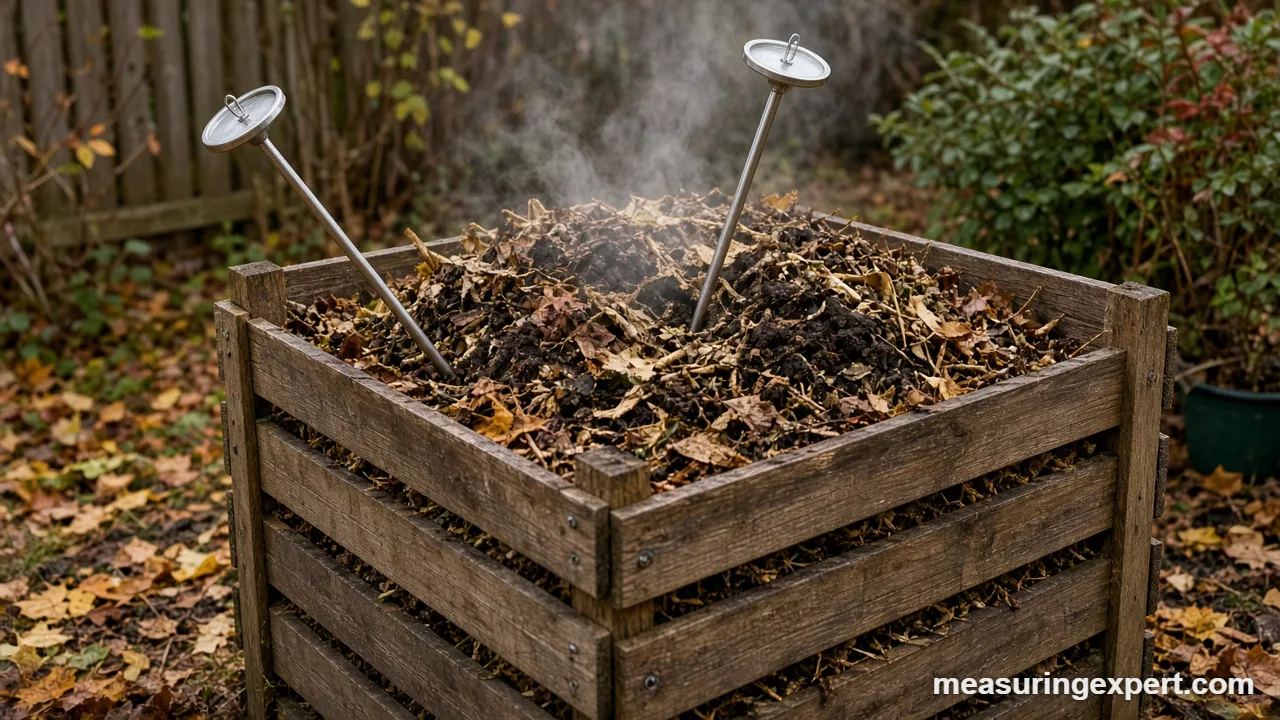
The best compost thermometer for most home piles is the REOTEMP 20 in Backyard model, because its stem reaches the center of a 3 ft pile and its sealed dial marks clear activity zones. Above all, match the stem length to your pile size, then choose a dial or digital readout.
In short: get the REOTEMP 20 in for a normal pile, the REOTEMP Backyard Pro 36 in for big heaps, and the Taylor if you want Fahrenheit and Celsius on one dial.
As an Amazon Associate, Measuring Expert earns from qualifying purchases. Our picks are based on research, specifications and owner feedback, not paid placement.
Best Overall
Best for Big Piles

Best F and C Dial
Quick Answer: Which Model Fits Your Pile?
- Overall: REOTEMP Backyard 20 in, with a sealed zoned dial and a thick 1/4 in stem.
- Big heaps: REOTEMP Backyard Pro 36 in, with a glass lens and a calibration screw.
- Both scales: Taylor with leaf guard, reading 20 to 180 F and 0 to 80 C.
- Plain backup dial: Greenco 20 in with Fahrenheit and Celsius.
- Grow-room shoppers: VIVOSUN 20 in with a 0 to 200 F range.
- Small bins: Wirezar 16 in, short enough for compact containers.
- Target zone: keep an active pile between about 104 and 149 F (40 to 65 C), and aim for 131 F (55 C) or more to kill pathogens.
On This Page
- Comparison table
- The picks, reviewed
- How we chose
- Compost temperature zones
- Stem length by pile size
- Dial vs digital
- F to C converter
- How to take a reading
- Specs that matter
- Calibration and care
- Honest limits
- FAQ
- Bottom line
Best Compost Thermometer Comparison Table
First, find the stem length that reaches the middle of your pile. Then compare the scale and the standout feature, and jump to the full review.
| # | Product | Best For | Standout Feature | Amazon |
|---|---|---|---|---|
| 1 | REOTEMP Backyard 20 in | Most home piles and bins | Sealed dial with three compost zones | View |
| 2 | REOTEMP Backyard Pro 36 in | Large piles, windrows and farm heaps | 36 in stem, glass lens, calibration screw | View |
| 3 | Taylor with Leaf Guard | Readers who want both F and C | Dual scale plus a silicone leaf guard | View |
| 4 | Greenco 20 in | A no-frills backup dial | Long stem with a dual-scale dial | View |
| 5 | VIVOSUN 20 in | Gardeners who already use VIVOSUN gear | 20 in probe, 0 to 200 F dial | View |
| 6 | Wirezar 16 in | Small bins and raised beds | Shorter 16 in stem for compact piles | View |
The 6 Best Compost Thermometer Picks, Reviewed
We list the picks from our top choice down. In addition, each review notes the stem length, the scale and who should skip it, so you can rule models out fast.
Best Overall
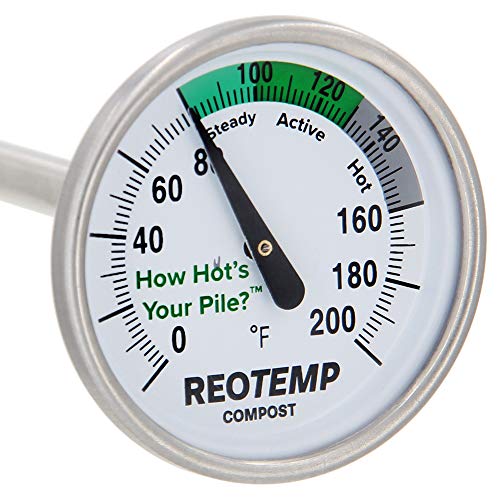
1. REOTEMP Backyard, 20 in Stem
Best for: Home composters with a standard pile or bin up to about 3 ft (0.9 m) across who want a sturdy, simple dial.
The REOTEMP Backyard model is our pick as the best compost thermometer for most people. Its 20 in (51 cm) stem reaches the middle of a typical 3 ft home pile, because the center of a 3 ft cube sits only 18 in (46 cm) from any face. In addition, the dial reads 0 to 200 F and marks three activity zones: Steady, Active and Hot. So a beginner can see at a glance whether the pile is working.
Also, REOTEMP has made thermometers since 1965, and this is its entry compost model. Moreover, the 1/4 in (6.4 mm) stem is thicker than many rivals, which helps it resist bending in a dense pile. Also, the dial is hermetically sealed, so it will not fog when you leave it in a steaming heap overnight. REOTEMP rates its analog compost dials at +/-1% of full scale, which works out to about +/-2 F (1.1 C) on a 200 F dial.
- Stem: 20 in long, 1/4 in (6.4 mm) diameter; a 16 in version also exists
- Range: 0 to 200 F (a 0 to 100 C version is sold separately)
- Dial: about 1.8 in, hermetically sealed, with Steady, Active and Hot zones
- Accuracy: +/-1% of full scale per REOTEMP (about +/-2 F)
- Warranty: 1-year limited; composting guide included
Pros
- Stem reaches the core of a 3 ft pile
- Sealed dial does not fog in steam
- Zones make readings easy to act on
Cons
- This listing is Fahrenheit only
- Small dial is harder to read from a distance
- No recalibration screw listed
Skip it if: Your pile is wider than about 4 ft (1.2 m), because the stem will stop short of the hot core. Pick the 36 in model below instead.
Best for Big Piles
2. REOTEMP Backyard Pro, 36 in Stem
Best for: Gardeners, market growers and community gardens that build piles 4 ft (1.2 m) or more across.
A big pile holds its heat deep inside, so a short probe reads the cooler outer shell. For that reason, the Backyard Pro uses a 36 in (91 cm) stem that reaches the core of a 5 to 6 ft wide heap. In addition, the stem is 5/16 in (7.9 mm) thick and all stainless steel, so it holds up when you push it through coarse material.
Moreover, the dial is larger: 2.5 in, hermetically sealed and covered by a glass lens that REOTEMP says will not yellow over time. Also, it has an adjustable calibration screw. As a result, you can check it in ice water and reset it to 32 F (0 C) if it drifts. Like the smaller model, it marks Steady, Active and Hot zones on the Fahrenheit dial.
- Stem: 36 in (also sold in 24 in), 5/16 in (7.9 mm) diameter, stainless steel
- Range: 0 to 200 F (a 0 to 100 C version is offered)
- Dial: 2.5 in, hermetically sealed, glass lens, three compost zones
- Calibration: adjustable screw on the dial
- Accuracy: +/-1% of full scale per REOTEMP; 1-year limited warranty
Pros
- Reaches the core of large heaps
- You can recalibrate it at home
- Bigger dial reads well from standing height
Cons
- Too long for small bins and tumblers
- Harder to push into dense material
- Costs more than 20 in models
Skip it if: You compost in a tumbler or a small bin, because a 36 in stem is awkward in a container under 3 ft wide.
Best F and C Dial
3. Taylor Dial with Leaf Guard
Best for: Home composters who think in Celsius, or who share a pile with people who do, and want a dial that shows both scales.
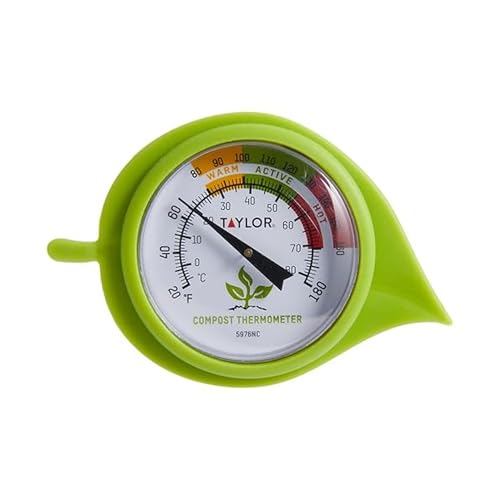
Taylor is one of the best-known US thermometer brands, and its compost model is a simple dial on a stainless steel probe. In addition, the dial shows both Fahrenheit and Celsius, from 20 to 180 F (0 to 80 C on the inner scale). So you can follow a guide written in either unit without converting.
Next, a silicone leaf guard sits under the dial. Taylor says it adds protection and a more secure grip when you push the probe in. Also, the dial labels warm, active and hot readings. However, the scale tops out at 180 F (82 C). That is still above the range where a healthy pile should sit, but it leaves little headroom if a heap overheats.
- Range: 20 to 180 F / 0 to 80 C, dual scale
- Probe: heavy-duty stainless steel; overall length about 20.7 in
- Guard: silicone leaf guard under the dial
- Dial labels: warm, active and hot
- Model: 5976NC (made in China)
Pros
- Both F and C on one dial
- Leaf guard protects the dial
- Also a familiar, widely sold brand
Cons
- Scale stops at 180 F
- Zone limits are not given in degrees
- No recalibration feature listed
Skip it if: You run a large, very hot pile, because the 180 F ceiling gives little warning above the hot zone.
Best Simple Dial
4. Greenco Dual-Scale Dial, 20 in

Best for: Gardeners who want a plain long-stem dial for compost and garden beds without zone graphics.
Greenco sells home and garden tools on Amazon, and this compost thermometer is a classic stainless dial on a 20 in stem, according to its listing. In addition, the dial shows Fahrenheit and Celsius, so it also works as a second thermometer to cross-check a zoned model.
However, the listing does not give an accuracy figure or a calibration feature. So treat it as a trend tool. For example, check that the pile rises after you turn it, rather than trusting a single reading to the degree.
- Stem: 20 in stainless steel (per listing)
- Scales: Fahrenheit and Celsius
- Display: analog bimetal dial, no battery
- Use: compost piles and garden soil
Pros
- Dual-scale dial
- Long stem for a standard pile
- No battery to replace
Cons
- No accuracy figure published
- No compost zones on the dial
- Brand support is limited
Skip it if: You want zone markings or a stated accuracy, because the REOTEMP Backyard gives you both.
Best for Growers
5. VIVOSUN Long-Probe Dial, 20 in

Best for: Indoor and outdoor growers who buy from VIVOSUN and want a matching long-probe compost dial.
VIVOSUN is a large grow-equipment brand that sells tents, lights and garden tools. In particular, its compost thermometer pairs a stainless dial with a 20 in probe and a 0 to 200 F range, per the listing. As a result, it covers the full span from a cold, idle heap to an overheating one.
In addition, the same tool works in raised beds and potting mixes, so it can double as a soil thermometer in spring. However, VIVOSUN does not publish an accuracy figure for it. So check it in ice water before you rely on it, as our care section explains.
- Probe: 20 in stainless steel (per listing)
- Range: 0 to 200 F
- Display: analog dial, no battery
- Use: compost, raised beds and soil
Pros
- Full 0 to 200 F range
- Long probe for standard piles
- Also handy as a soil thermometer
Cons
- No accuracy spec published
- Fahrenheit focus
- No zone graphics confirmed
Skip it if: You prefer a brand that publishes its accuracy, since REOTEMP does and VIVOSUN does not.
Best for Small Bins
6. Wirezar Short-Stem Dial, 16 in
Best for: Apartment and small-yard composters with a bin under about 2.5 ft (0.75 m) across.
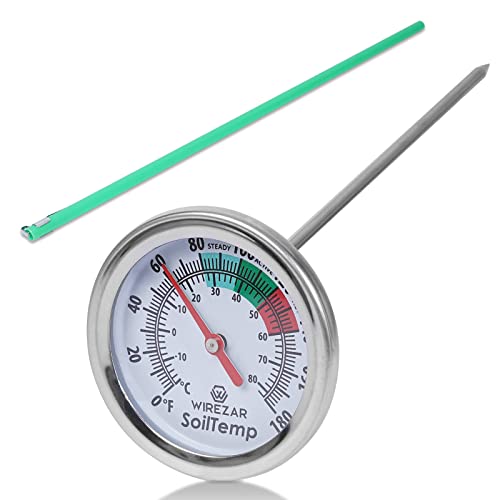
However, not every pile needs a long probe. In a small bin, a 16 in (41 cm) stem reaches the center while the dial stays close enough to read without bending down. So this Wirezar model suits plastic bins, worm-bin edges and raised beds, according to its listing.
Also, Wirezar is a smaller Amazon garden brand, and it lists the dial as waterproof with a stainless steel stem. However, it gives no accuracy figure. So use it to spot trends, such as a bin that never warms up, rather than to prove a pathogen-kill temperature.
- Stem: 16 in stainless steel (per listing)
- Display: analog dial listed as waterproof
- Use: compost bins, soil and raised beds
- Power: none needed
Pros
- Right length for small bins
- Easy to read up close
- No battery
Cons
- Too short for a full 3 ft pile
- No accuracy figure
- Lesser-known brand
Skip it if: Your pile is 3 ft or wider, because a 16 in stem stops short of its center.
How We Chose the Best Compost Thermometer
To be clear, we did not field-test these thermometers. Instead, our picks are research-based. First, we read the maker spec pages for stem length, stem diameter, dial size, range and stated accuracy. Next, we checked the temperature targets in university and federal compost guidance. Finally, we weighed long-term owner feedback on bent stems, fogged dials and drift.
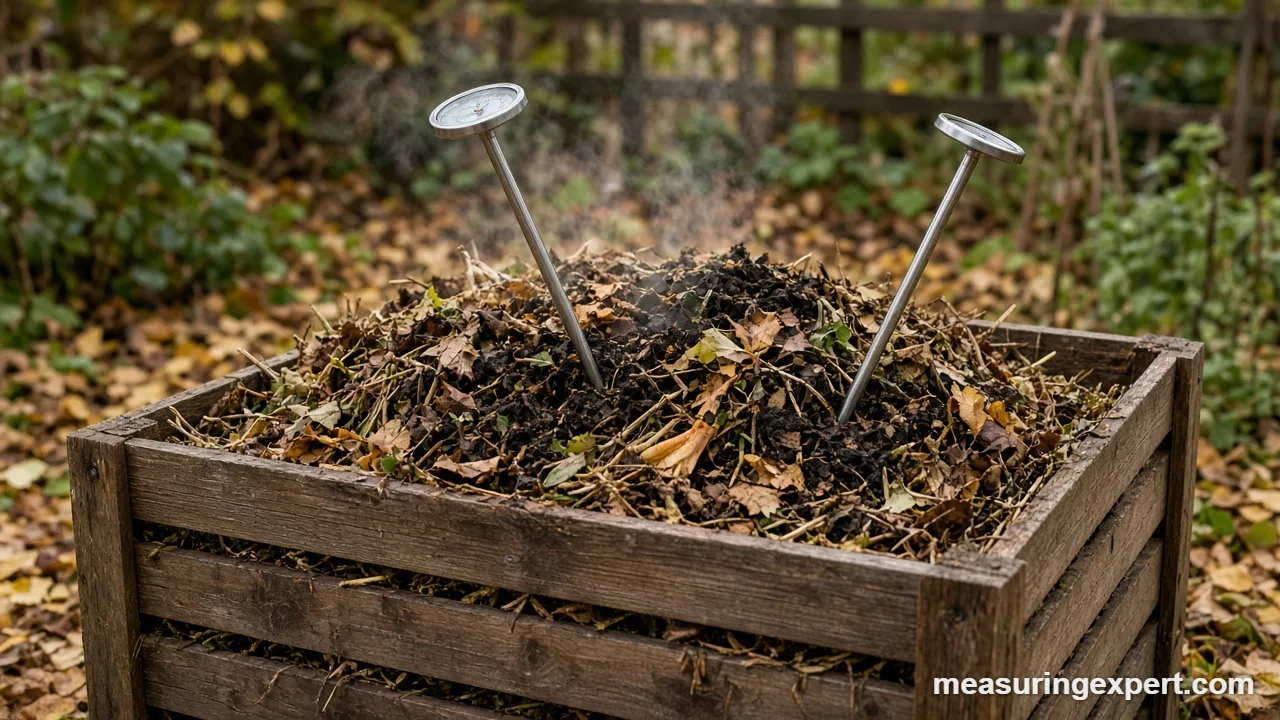
In practice, we ranked models on five points:
- Reach: a stem long enough to hit the center of the pile it is sold for.
- Readable zones: a range that covers about 0 to 200 F, ideally with marked compost zones.
- Published accuracy: brands that state a figure, such as REOTEMP’s +/-1% of full scale, ranked higher.
- Build: stainless stems, sealed dials and thicker stems that resist bending.
- Availability: we dropped models whose listings were unavailable when we checked, including several long-stem dials and digital probes.
Our main sources were the Cornell composting guide to compost physics, the federal EPA pathogen rules in 40 CFR Part 503, Appendix B, and the REOTEMP compost thermometer spec table.
Compost Temperature Zones the Best Compost Thermometer Should Show
Of course, a compost thermometer is only useful if you know what the numbers mean. Cornell’s composting program puts the fastest decomposition in the thermophilic stage, at about 40 to 60 C (104 to 140 F). It also notes that most microbes cannot survive above about 60 to 65 C (140 to 149 F), so managers try to keep piles below roughly 65 C (149 F).
Meanwhile, the EPA rule for composted biosolids sets 55 C (131 F) as the key pathogen line. In-vessel and static aerated piles must hold 55 C or more for three days. Windrows must hold it for 15 days or longer, with at least five turnings. However, those rules are written for sewage sludge facilities, not backyard bins. Still, they are the most cited benchmark for a “hot” compost.
| Reading | Celsius | What it means | What to do |
|---|---|---|---|
| Below about 90 F | Below 32 C | Slow or idle pile (rough guide) | Add greens, water or more material |
| 90 to 104 F | 32 to 40 C | Warming; mesophilic microbes at work | Wait and check again tomorrow |
| 104 to 140 F | 40 to 60 C | Thermophilic stage; fastest breakdown | Keep moisture even; leave it working |
| 131 F and up | 55 C and up | EPA pathogen-reduction line | Log days at or above this mark |
| Above about 149 F | Above 65 C | Too hot for most microbes | Turn the pile to release heat |
So a zoned dial saves you from memorizing this table. For example, REOTEMP’s Steady, Active and Hot bands give a quick read, while the degree scale still shows the exact number.
Stem Length: Sizing the Best Compost Thermometer to Your Pile
In general, the hottest part of a pile is its center. Therefore, the stem must reach about half the pile’s width, plus a little extra so the dial clears the surface. The table below uses simple geometry: the center of a cube sits half a side from each face.
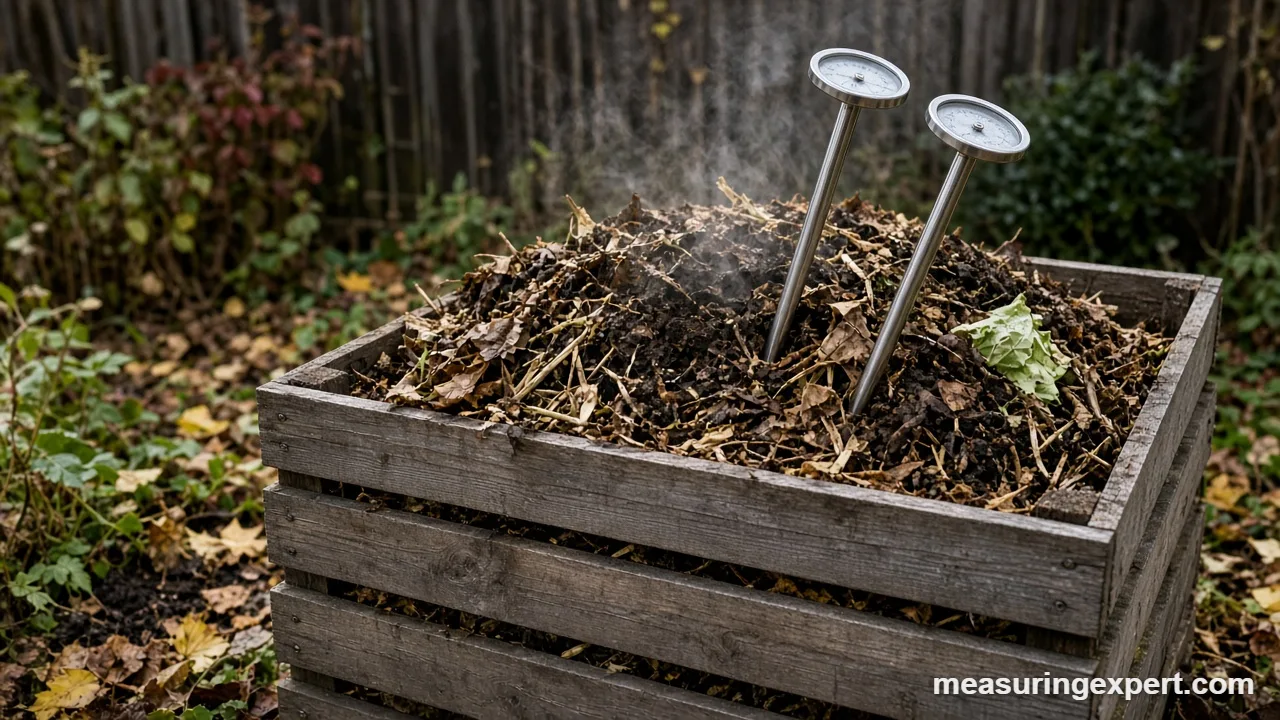
| Pile or bin width | Depth to center | Stem to buy |
|---|---|---|
| 2 ft (0.6 m) bin | 12 in (30 cm) | 16 in (41 cm) |
| 3 ft (0.9 m) pile | 18 in (46 cm) | 20 in (51 cm) |
| 4 ft (1.2 m) pile | 24 in (61 cm) | 24 to 36 in (61 to 91 cm) |
| 5 to 6 ft (1.5 to 1.8 m) heap | 30 to 36 in (76 to 91 cm) | 36 in (91 cm) |
| Wider windrows | Over 36 in | 48 in (122 cm) or longer |
However, longer is not always better. For example, a 36 in stem is hard to aim in a small bin, and it can poke through the far side. Also, thin stems bend more easily as they get longer. That is why REOTEMP moves from a 1/4 in stem on its 16 and 20 in models to a 5/16 in stem on its 24 and 36 in Backyard Pro.
Dial vs Digital: Picking the Best Compost Thermometer Type
Most compost thermometers use a bimetal dial. In fact, a coiled strip of two metals inside the stem twists as it warms and turns the needle. As a result, a dial needs no battery and can live in the pile for weeks. On the other hand, it responds slowly and you read it by eye.
A digital compost probe uses an electronic sensor instead. For example, REOTEMP’s heavy-duty digital model uses a 1,000 ohm Class A RTD and lists +/-0.95 F at 131 F (+/-0.53 C at 55 C), a 3-second refresh and an IP67 rating. That precision matters most when you must document a 131 F hold. However, digital models cost much more, and none we checked was available through our store feed when we updated this guide.
| Feature | Bimetal dial | Digital probe |
|---|---|---|
| Power | None | Battery |
| Typical stated accuracy | +/-1% of full scale (about +/-2 F on a 200 F dial) | About +/-1 F near 131 F on pro models |
| Response | Slow; wait for the needle to settle | Seconds |
| Reading | By eye, with zones | Exact number |
| Best for | Home piles and bins | Farms, schools and records |
Compost Temperature Converter (F to C)
Many compost guides use Celsius, while most US dials read Fahrenheit. So use this converter to translate any reading. It starts at 131 F, the EPA pathogen line.
In short, C = (F – 32) x 5/9, and F = C x 9/5 + 32. Note that a change in temperature converts without the 32. For instance, a 2 F dial error equals about 1.1 C.
How to Check Compost Temperature, Step by Step
- Check the zero: Stand the stem in a glass of crushed ice and water for a few minutes. It should read 32 F (0 C).
- Pick your spots: Plan to read the center of the pile and two spots halfway between the center and the edge.
- Insert the stem: Push it straight in by the stem or handle, never by the dial. In dense material, open a path with a metal rod first.
- Wait for the needle: Leave it until the reading stops moving, which can take a minute or more on a dial.
- Read at eye level: Look straight at the dial to avoid parallax, and note the zone and the number.
- Log the result: Write down the date, time, spot and reading in F or C.
- Act on it: Turn a pile that runs above about 149 F (65 C), and add greens or water to one that stays cool.
Next, repeat the check at the same time each day during the hot phase. A steady log shows the rise, the peak and the cool-down far better than any single reading.
Specs That Matter on the Best Compost Thermometer
- Range: 0 to 200 F (about -18 to 93 C) covers every real pile. A 180 F ceiling still works, yet it leaves less headroom.
- Accuracy: “+/-1% of full scale” means 1% of the whole dial span. So on a 0 to 200 F dial it is +/-2 F, and on a 0 to 100 C dial it is +/-1 C.
- Stem length and diameter: length sets reach, while diameter sets stiffness. A 5/16 in stem bends less than a 1/4 in stem of the same length.
- Dial size: a 2.5 in dial is far easier to read from standing height than a 1.8 in dial.
- Sealing and lens: a hermetically sealed dial resists fogging in steam, and a glass lens will not yellow in sun.
- Recalibration: an adjustment screw lets you correct drift after an ice-water check.
Calibration and Care for a Compost Thermometer
Generally, bimetal dials drift after knocks and seasons in the weather. Therefore, check yours in ice water at the start of each season. If the needle misses 32 F (0 C) and your model has a calibration screw, turn it until the needle sits on 32 F. If it has no screw, simply note the offset and add or subtract it from each reading.
However, avoid the boiling-water test. Water boils at 212 F (100 C) at sea level, which is above the top of most 200 F compost dials. As a result, the test can push the needle past its stop. In addition, wipe the stem clean after use, store it straight, and never use the dial as a hammer.
| Do | Don’t |
|---|---|
| Check the zero in ice water each season | Test a 200 F dial in boiling water |
| Push by the stem or a handle | Pound on the dial face |
| Read three spots, not one | Trust one reading near the edge |
| Store the stem straight | Use a bent stem as a pry bar |
Honest Limits of Any Compost Thermometer
First, a thermometer reads one spot at one time. So a cool reading may only mean you missed the hot core. Also, a dial left in full sun can warm above the pile’s true temperature, and a slow bimetal needle can lag a fast change.
Above all, temperature is only one sign of a healthy pile. Moisture and pH matter too, so a soil moisture sensor or a soil pH meter can explain why a pile stalls. Finally, if you also want a thermometer for the kitchen or the house, see our guide to general-purpose thermometers.
Best Compost Thermometer FAQ
What is the best compost thermometer for a home pile?
For most home piles, the REOTEMP 20 in Backyard model is the best compost thermometer. Its stem reaches the center of a 3 ft pile, its dial is sealed against fog, and it marks Steady, Active and Hot zones.
What temperature should compost reach?
An active pile should sit between about 104 and 140 F (40 to 60 C), the thermophilic range Cornell describes. To reduce pathogens, aim for 131 F (55 C) or more for several days, and keep it below about 149 F (65 C).
How long should a compost thermometer stem be?
In general, choose a stem that reaches about half the width of your pile. For example, a 20 in stem suits a 3 ft pile, while a 36 in stem suits a 5 to 6 ft heap. A 16 in stem fits a small bin.
Is a dial or digital compost thermometer better?
A dial is better for most home composters because it needs no battery and can stay in the pile. However, a digital probe reads faster and more precisely, so it suits farms, schools and anyone who must record a 131 F hold.
How accurate is a compost thermometer?
REOTEMP rates its analog compost dials at +/-1% of full scale, which is about +/-2 F on a 0 to 200 F dial. Many budget dials publish no figure, so check them in ice water first.
Can I leave a compost thermometer in the pile?
Yes, if the dial is sealed. REOTEMP says its hermetically sealed Backyard dial will not fog, so it can stay in the pile overnight. Still, move it now and then to read new spots.
How do I calibrate a compost thermometer?
First, stand the stem in crushed ice and water for a few minutes. Ideally, it should read 32 F (0 C). If it has a calibration screw, adjust it to 32 F; if not, note the offset and correct each reading.
Why is my compost not heating up?
A cool pile is often too small, too dry, or short on nitrogen-rich greens. So build it to about 3 ft across, add greens such as fresh grass or food scraps, and keep it as damp as a wrung-out sponge.
Can a compost thermometer measure soil temperature?
Yes. A compost thermometer reads garden soil too, which helps you time spring planting. However, the long stem is more than soil work needs, so push it in only a few inches.
Does the best compost thermometer need Celsius?
Not if you follow US guides, which mostly use Fahrenheit. However, a dual-scale dial like the Taylor helps if you read Celsius sources. Otherwise, the converter on this page translates any reading.
Bottom Line: The Best Compost Thermometer to Buy
For most gardeners, the REOTEMP 20 in Backyard Compost Thermometer is the best compost thermometer. After all, it reaches the core of a standard pile, shows clear zones, and REOTEMP publishes its accuracy. However, choose the REOTEMP Backyard Pro 36 in for big heaps, the Taylor for a dual-scale dial, or the Wirezar 16 in for a small bin.