


The best triple scale hydrometer for most brewers is the Brewing America Pro Series, a US-made glass hydrometer that reads 0.982 to 1.160 specific gravity, 0 to 35 Brix and 0 to 21% potential alcohol. However, the right pick depends on the scale range, glass or plastic, and whether you want a built-in thermometer.
In short: buy the Brewing America Pro Series for accuracy, the FastRack on a budget, and the Brewing America thermo-hydrometer if you read warm samples.
As an Amazon Associate, Measuring Expert earns from qualifying purchases. Our picks are based on research, specifications and owner feedback, not paid placement.
Best Overall
Best Budget
Best With Thermometer
Best Triple Scale Hydrometer Picks at a Glance
- Overall: Brewing America Pro Series, US-made glass, 0.982 to 1.160 SG.
- With a thermometer: Brewing America Thermo-Hydrometer with a correction scale.
- Budget: FastRack Triple-Scale, a cheap and simple glass stem.
- Hard to break: Craft A Brew in polycarbonate plastic.
- Starter kit: SOLIGT, which adds a glass test jar.
- Protected storage: Brewer’s Elite with a hard case.
- Spares: Chengu 3-pack; for casual wine, the Kosoeur.
On This Page
- Comparison table
- The 8 picks, reviewed
- How we chose
- The three scales explained
- Calibration temperature: 60 F vs 68 F
- Temperature correction table
- ABV from OG and FG
- Gravity to density converter
- How to take a reading
- Hydrometer, refractometer or thermometer
- Care and accuracy checks
- Do and don’t
- Honest limits
- FAQ
- Bottom line
Best Triple Scale Hydrometer Comparison
First, decide between glass and plastic. Next, check the standout feature, and then jump to the full review.
| # | Image | Product | Best For | Standout Feature | Amazon |
|---|---|---|---|---|---|
| 1 | 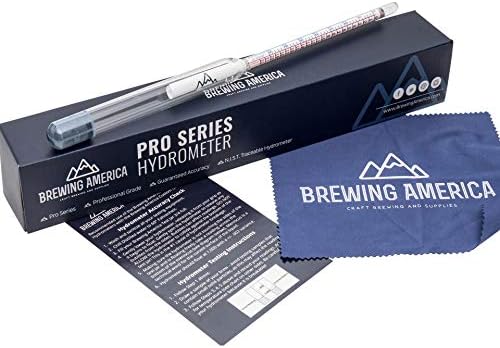 | Brewing America Pro Series | Most home brewers | US-made glass, 0.982-1.160 SG | View |
| 2 |  | Brewing America Thermo-Hydrometer | Correcting warm samples | Built-in thermometer and correction scale | View |
| 3 | 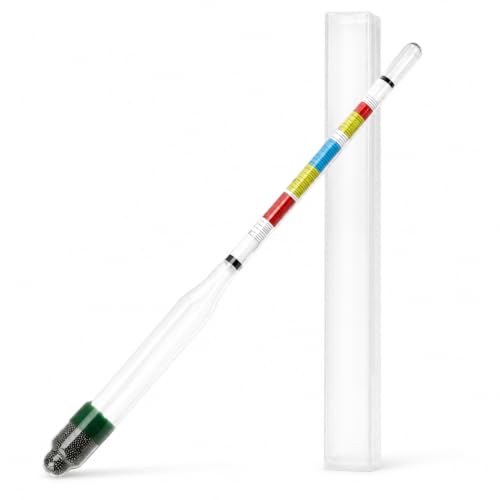 | FastRack Triple-Scale | A low-cost first hydrometer | Simple glass triple scale | View |
| 4 | 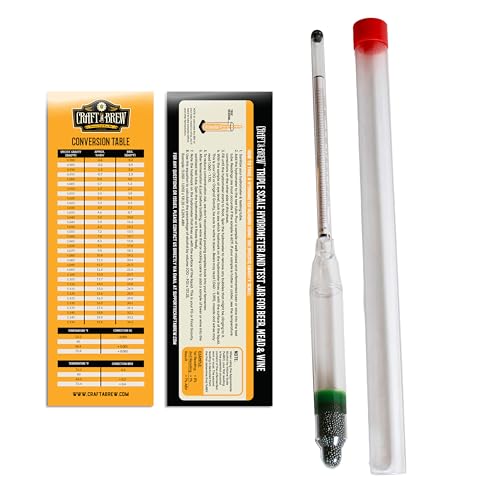 | Craft A Brew Polycarbonate | Clumsy hands and kids nearby | Polycarbonate body resists breakage | View |
| 5 |  | SOLIGT with Test Jar | Buying the hydrometer and jar together | Comes with a glass test jar | View |
| 6 |  | Brewer’s Elite Deluxe | Safe storage between batches | Hard case and cloth included | View |
| 7 |  | Kosoeur Triple Scale | Occasional wine and mead batches | Low-cost triple scale for wine | View |
| 8 |  | Chengu 3-Pack | Spares for several fermenters | Three hydrometers in one pack | View |
The 8 Best Triple Scale Hydrometer Picks, Reviewed
Overall, every pick here floats in your sample and reads three scales at once. We start with the most accurate glass models, then cover a plastic option, kits and spares.
Best Overall
1. Brewing America Pro Series Triple Scale Hydrometer
Best for: Beer, wine, cider and mead makers who want one well-made glass hydrometer that covers every stage of a batch.
Brewing America makes the Pro Series in the US, and its glass is hand blown. As a result, it is our pick as the best triple scale hydrometer for most people. The specific gravity scale runs from 0.982 to 1.160, so it reads a sweet mead must at the start and a bone-dry wine at the end. Also, the Brix/Balling scale covers 0 to 35, and potential alcohol covers 0 to 21%.
In addition, stainless steel balls sit in the bulb as ballast, and the maker says the glass has no lead or mercury. It ships in a hard plastic case with foam inserts and a microfiber cloth. However, the product page does not state the calibration temperature. So check the direction sheet before you apply a correction. See the Brewing America Pro Series page for the full listing.
- Specific gravity: 0.982 to 1.160
- Brix/Balling: 0 to 35; potential alcohol: 0 to 21%
- Build: hand-blown glass with stainless steel ballast
- Storage: hard case with foam inserts, plus a cloth
- Origin: made in the USA; sold as NIST traceable
Pros
- Wide SG range from must to dry wine
- Sturdy case for a fragile tool
- Also made in the USA
Cons
- No test jar in this listing
- Calibration temperature not on the product page
- Costs more than generic glass
Skip it if: You want a reading and a temperature in one glance, because the thermo-hydrometer below adds a thermometer.
Best With Thermometer
2. Brewing America Thermo-Hydrometer
Best for: Brewers who often read samples that are warmer or cooler than room temperature.
A thermo-hydrometer puts a small thermometer inside the stem. So you read the gravity and the sample temperature at the same moment, in the same jar. Brewing America also prints a temperature adjustment scale on the back of the thermometer. Then you add or subtract the shown amount and skip the chart.
Moreover, it comes with a two-page direction sheet and a conversion chart. Also, the maker lists it for beer, mead, wine, cider, sake and kombucha. However, it is the wrong tool for spirits. For example, distilled spirits need a proof and Tralle hydrometer instead, which the maker sells separately.
- Scales: triple scale (gravity, Brix, potential alcohol)
- Thermometer: built into the stem
- Correction: adjustment scale on the back of the thermometer
- Includes: box, microfiber cloth, direction sheet with chart
- For: beer, mead, wine, cider, sake, kombucha
Pros
- Gravity and temperature in one reading
- Correction scale saves math
- Also US-made glass
Cons
- Thermometer makes the stem busier to read
- Not for spirits or proofing
- More money than a plain hydrometer
Skip it if: You always cool samples to the calibration temperature first, since the plain Pro Series does the same job for less.
Best Budget
3. FastRack Triple-Scale Hydrometer
Best for: New brewers on a tight budget, and anyone who wants a cheap spare for the brew day box.
FastRack is a long-running homebrew supply brand, and this is its basic triple-scale hydrometer. It shows specific gravity, potential alcohol and Brix/Balling on one paper scale inside the glass stem. For most beer and wine batches, that is all you need.
However, the listing does not ship with a test jar, and it gives few published specs. So pair it with a narrow jar and check it in plain water before your first batch.
- Scales: specific gravity, potential alcohol, Brix/Balling
- Body: glass stem and bulb
- Use: beer, wine, mead, cider and kombucha
- Pair with: a narrow test jar (sold separately)
Pros
- Very low cost
- Easy to replace if it breaks
- Also the same three scales as pricier models
Cons
- Few published specs
- No case or jar
- Check zero in water before trusting it
Skip it if: You want published ranges and a protective case, because the Pro Series above includes both.
Most Durable
4. Craft A Brew Polycarbonate Hydrometer
Best for: Brewers who have broken a glass hydrometer before, or who brew in a busy kitchen.
Most hydrometers are thin glass, and they snap when they roll off a counter. By contrast, Craft A Brew uses polycarbonate plastic. As a result, a short drop is far less likely to end in broken glass and a lost reading.
Also, Craft A Brew lists clear ranges: specific gravity from 0.998 to 1.160, potential alcohol from 0 to 21%, and Brix from 0 to 35. One note, though: the SG scale stops at 0.998, so a very dry wine can sink below the bottom mark. See the Craft A Brew hydrometer page for details.
- Specific gravity: 0.998 to 1.160
- Potential alcohol: 0 to 21%
- Brix: 0 to 35 (sugar by weight)
- Body: polycarbonate plastic
Pros
- Survives drops that break glass
- Published scale ranges
- Also fine for beginners
Cons
- SG scale stops at 0.998
- Plastic can scratch with rough cleaning
- Not a lab-grade instrument
Skip it if: You make very dry wines or ciders that finish under 0.998, since the Brewing America scale reads lower.
Best Starter Kit
5. SOLIGT Hydrometer and Glass Test Jar
Best for: First-time wine, beer, mead and cider makers who do not own a test jar yet.
A hydrometer alone is half a tool, because you need a tall, narrow jar to float it in. The SOLIGT kit solves that by pairing a triple scale hydrometer with a glass test jar. So you can take your first reading the day the box arrives.
In addition, the kit covers the same three scales as the others: gravity, Brix and potential alcohol (ABV). However, glass jar plus glass hydrometer means two fragile parts. For that reason, set the jar on a flat towel, not on a hard counter edge.
- Includes: triple scale hydrometer and glass test jar
- Scales: gravity, Brix, potential alcohol
- Use: wine, beer, mead and cider
- Jar: glass, so it will not stain from red wine
Pros
- Jar included, so it is ready to use
- Glass jar cleans easily
- Also a good gift for a new brewer
Cons
- Two glass parts to protect
- Few published specs
- No storage case
Skip it if: You already own a test jar, because a single hydrometer costs less.
Best With Case
6. Brewer’s Elite Deluxe Hydrometer
Best for: Brewers who store gear in a crowded bin and want the hydrometer protected.
Brewer’s Elite sells its hydrometer as a deluxe set with a hard case and a microfiber cloth. The glass stem shows specific gravity from 0.990 to 1.160, potential alcohol from 0 to 20%, and Brix/Balling from 0 to 35. As a result, that covers normal beer, wine and mead batches.
However, the set does not include a test jar, so plan to buy one. In addition, owners note that the instructions are brief on ABV math, so use the formula in our ABV section below. Details are on the Brewer’s Elite product page.
- Specific gravity: 0.990 to 1.160
- Potential alcohol: 0 to 20%
- Brix/Balling: 0 to 35
- Body: all glass
- Includes: hard case and microfiber cloth
Pros
- Hard case protects the glass
- Published scale ranges
- Also a money-back guarantee from the maker
Cons
- No test jar
- Brief instructions
- Potential alcohol scale tops out at 20%
Skip it if: You need a test jar in the box, since the SOLIGT kit above includes one.
Best for Wine and Mead
7. Kosoeur Triple Scale Hydrometer
Best for: Casual wine and mead makers who check gravity a few times per batch.
Kosoeur markets this triple scale hydrometer to wine and mead makers. Like the others, it shows gravity, potential alcohol and Brix on one stem. For a fruit wine or a simple mead, those scales tell you when the must is ready and when fermentation has finished.
Still, the listing publishes few hard specs, so treat it as a value pick. First, check it in plain water at its calibration temperature. Then note any offset on a piece of tape on your jar.
- Scales: gravity, potential alcohol and Brix
- Use: wine, mead, beer and cider
- Pair with: a narrow test jar
Pros
- Low cost
- Same three scales as pricier models
- Also a handy backup
Cons
- Few published specs
- No case listed
- Less known brand
Skip it if: You want a maker that publishes full ranges, because Brewer’s Elite and Craft A Brew do.
Best Multipack
8. Chengu 3-Pack Triple Scale Hydrometer
Best for: Brewers who run several fermenters at once or who break glass now and then.
This Chengu pack gives you three triple scale hydrometers and a cleaning cloth. So you can leave one with each batch, or keep two as spares.
However, inexpensive multipacks can vary from one piece to the next. For that reason, float all three in plain water at the same temperature. Then keep the one that reads closest to 1.000 for final gravity, and use the others for rough checks.
- Includes: three hydrometers and a cleaning cloth
- Scales: gravity, potential alcohol and Brix
- Use: wine, beer, mead and cider
Pros
- Three tools for the price of one good one
- Spares for breakage
- Also good for classes
Cons
- Piece-to-piece variation is likely
- No case or jar
- Few published specs
Skip it if: You only run one batch at a time, because a single better hydrometer is the smarter buy.
How We Chose the Best Triple Scale Hydrometer
To be clear, we did not run lab tests. Instead, these are research-based picks. First, we listed triple scale hydrometers from established homebrew brands. Then we read each maker’s product page for scale ranges, materials and what comes in the box. Finally, we weighed owner feedback on breakage, readability and how close each one reads to 1.000 in plain water.

- Scale range: a specific gravity scale that reaches below 1.000 matters, because dry wine and cider finish there.
- Published specs: makers that list their ranges ranked higher than vague listings.
- Build: glass reads crisply, while plastic survives drops, so we included both.
- Extras: a test jar, case or thermometer adds real value for new brewers.
We also checked each listing against the US rules for alcohol gauging, which use 60 degrees F as the reference temperature for proof hydrometers (see 27 CFR Part 30, section 30.22).
The Three Scales on One Stem
A triple scale hydrometer is a weighted glass or plastic float. In other words, it sinks until it pushes aside its own weight in liquid. So a thick, sugary must holds it high, and a thin, dry wine lets it sink deeper. The paper inside the stem then turns that depth into three numbers.
| Scale | What it measures | Typical range | When you use it |
|---|---|---|---|
| Specific gravity (SG) | Density of the sample compared with water at the calibration temperature | 0.990 to 1.160 | Before and after fermentation; the main number for ABV |
| Brix / Balling | Grams of sugar per 100 g of solution (% by weight) | 0 to 35 | Grape juice and fruit must at the start |
| Potential alcohol (PA) | ABV you would get if all the sugar ferments | 0 to 20 or 21% | Planning the strength of a wine or mead |
For example, a grape must at 22 Brix has an SG near 1.092. Likewise, its potential alcohol scale would read about 12%. However, Brix only means “sugar” before fermentation starts. Once yeast makes alcohol, the Brix number stops tracking sugar, because alcohol is lighter than water. So after day one, rely on the SG scale.
Calibration Temperature: 60 F vs 68 F
In practice, every hydrometer is accurate at one temperature only. Most brewing hydrometers are calibrated at 60 degrees F (15.6 C). Others, often sold in metric markets, use 68 degrees F (20 C). Usually, the calibration temperature is printed on the paper scale or in the instructions.

Why does it matter? Liquids expand as they warm, so a warm sample is less dense. As a result, the hydrometer sinks lower and reads too low. For instance, pure water is about 0.99901 g/mL at 60 F but 0.99820 g/mL at 68 F (see our guide to the density of water). In fact, that gap alone is almost 0.001 SG. So a reading taken at the wrong temperature can shift your ABV math.
Temperature Correction Table
If you cannot cool the sample, add a correction. The values below come from the density of water at each temperature. Therefore, they are close for beer and wine, but not exact for very sweet musts. Also, they ignore the tiny expansion of the glass itself.
| Sample temp | 60 F hydrometer: add | 68 F hydrometer: add |
|---|---|---|
| 50 F (10 C) | -0.0007 | -0.0015 |
| 60 F (15.6 C) | 0.000 | -0.0008 |
| 68 F (20 C) | +0.0008 | 0.000 |
| 77 F (25 C) | +0.002 | +0.0012 |
| 80 F (26.7 C) | +0.0024 | +0.0016 |
| 90 F (32.2 C) | +0.004 | +0.0033 |
| 100 F (37.8 C) | +0.006 | +0.0052 |
For example, a wort that reads 1.048 at 77 F on a 60 F hydrometer is really about 1.050. To track sample temperature fast, a fermentation thermometer with a probe is the easiest add-on.
Working Out ABV From OG and FG
A hydrometer does not read alcohol directly in a fermented drink. Instead, you take two readings and do simple math. First, the original gravity (OG) is the reading before you add yeast. Next, the final gravity (FG) is the reading once fermentation has stopped. Then use the standard homebrew formula:
ABV (%) = (OG – FG) x 131.25
- Pale ale: OG 1.050, FG 1.010, so (0.040) x 131.25 = 5.25% ABV.
- Dry red wine: OG 1.090, FG 0.998, so (0.092) x 131.25 = about 12.1% ABV.
- Mead: OG 1.100, FG 1.000, so (0.100) x 131.25 = about 13.1% ABV.
Alternatively, read the potential alcohol scale at both points and subtract. For instance, 12.5% PA at the start minus 0.5% PA at the end gives about 12% ABV. Either way, both methods are estimates. Above about 8% ABV, the simple formula can read slightly low.
Convert a Gravity Reading to Density
Specific gravity is a ratio, so it has no units. However, density does. At 60 F, multiply SG by 0.99901 g/mL (the density of water) to get the sample’s density. Then use the converter for pounds per gallon or kilograms per cubic meter. It also helps with measuring brewing ingredients by weight.
How to Take a Reading With a Triple Scale Hydrometer
These steps work for any pick on this list. Above all, keep everything clean and sanitized, because the sample may go back into the batch.
- Sanitize the hydrometer, test jar and wine thief or baster.
- Draw enough sample to fill the jar about 1 inch (2.5 cm) from the top.
- Measure the sample temperature, and cool it toward the calibration temperature if needed.
- Lower the hydrometer slowly into the jar and give it a gentle spin to shed air bubbles.
- Wait until it stops bobbing and floats free of the jar walls.
- Read the scale at eye level at the flat surface of the liquid, not at the curved edge that climbs the stem.
- Apply any temperature correction, then write down the SG, the date and the temperature.
Hydrometer, Refractometer or Thermometer?
A hydrometer is the reference tool for gravity, but it needs a full jar of sample. By contrast, a refractometer needs only a few drops. However, a refractometer reads wrong once alcohol is present, unless you apply a correction formula. So many brewers use a refractometer on brew day and a hydrometer for final gravity. If you want a refractometer too, see our alcohol refractometer picks.
| Tool | Sample size | Best stage | Main limit |
|---|---|---|---|
| Triple scale hydrometer | About 100 to 250 mL | OG and FG | Needs temperature correction |
| Refractometer | 2 or 3 drops | OG and checks during the boil | Needs a formula after fermentation starts |
| Fermentation thermometer | None | The whole batch | Measures temperature, not sugar |
Care, Storage and Accuracy Checks
A hydrometer has no battery and no electronics. Still, it can drift if the paper scale slips inside the stem. So check it before each season.
- Water check: float it in distilled water at its calibration temperature. It should read 1.000.
- Record an offset: if it reads 1.002, subtract 0.002 from every reading, or replace it.
- Scale check: look for a scale that has shifted or come loose inside the glass.
- Cleaning: rinse in warm water right after use; avoid abrasive pads on plastic models.
- Storage: keep it in its case or tube, lying flat, away from the edge of a shelf.
Many listings say “NIST traceable.” That claim refers to the maker’s own calibration chain. In fact, NIST explains that it does not certify traceability claims made by other organizations (see NIST on metrological traceability). So a water check at home is still worth doing.
Habits That Keep Readings Honest
Do
- Spin the hydrometer to knock off bubbles.
- Read at eye level at the flat liquid line.
- Note the sample temperature every time.
- Take two FG readings a few days apart to confirm fermentation is done.
Don’t
- Drop it into the jar; lower it gently.
- Pour the sample back if it touched an unsanitized surface.
- Trust Brix after fermentation starts.
- Use a brewing hydrometer to proof spirits.
Honest Limits of the Best Triple Scale Hydrometer
Even the best triple scale hydrometer has limits. First, the scale on a budget model is often marked in steps of 0.002 SG, so you can only estimate between lines. Second, fruit pulp and CO2 bubbles hold it up and push readings high. Third, the ABV formula is an estimate, and added sugar or fruit late in fermentation breaks it.
In addition, a triple scale hydrometer is not a legal tool for labeling alcohol. Instead, commercial producers follow federal gauging rules and use certified instruments. Similarly, it cannot proof distilled spirits, because those need a proof and Tralle hydrometer.
Best Triple Scale Hydrometer FAQ
What is the best triple scale hydrometer for most home brewers?
For most people, the Brewing America Pro Series is the best triple scale hydrometer. It reads 0.982 to 1.160 SG, so it covers sweet musts and dry wines. Also, it is US-made glass and comes in a hard case.
Does the best triple scale hydrometer need a test jar?
Yes. Any hydrometer needs a tall, narrow jar to float in. The SOLIGT kit includes a glass jar, while most single hydrometers do not. So buy a jar that is a little taller than the hydrometer.
Which best triple scale hydrometer has a thermometer?
The Brewing America Thermo-Hydrometer has a thermometer built into the stem. It also prints a temperature adjustment scale on the back of the thermometer, so you can correct warm samples without a chart.
Can the best triple scale hydrometer measure spirits?
No. A brewing hydrometer is made for sugary liquids that sink it less. Distilled spirits are lighter than water, so you need a proof and Tralle hydrometer instead.
What temperature is a hydrometer calibrated at?
Most brewing hydrometers are calibrated at 60 F (15.6 C), and some use 68 F (20 C). Check the paper scale or the instructions. Then cool your sample to that temperature or apply a correction.
How accurate is a triple scale hydrometer?
A good one reads within about 0.001 to 0.002 SG when you read it at the right temperature. However, bubbles, pulp and a misread line can add more error than the tool itself.
How do I calculate ABV with a hydrometer?
Take the original gravity before fermentation and the final gravity after. Then multiply the difference by 131.25. For example, 1.050 minus 1.010 gives 0.040, and 0.040 x 131.25 is about 5.25% ABV.
Why does my hydrometer read below 1.000?
Alcohol is less dense than water. So a dry wine or cider with little sugar left can read 0.990 to 0.998. That is normal and means fermentation went far.
How do I check if my hydrometer is accurate?
Float it in distilled water at its calibration temperature. It should read 1.000. If it reads higher or lower, note the offset and apply it to every reading.
Should I use a hydrometer or a refractometer?
Use both if you can. A refractometer is quick for original gravity, while a hydrometer is more reliable for final gravity, because alcohol throws off a refractometer reading.
Bottom Line: Which Best Triple Scale Hydrometer to Buy
For most brewers, the Brewing America Pro Series Triple Scale Hydrometer is the best triple scale hydrometer. Its wide gravity range, US-made glass and protective case make it a tool you keep for years. However, pick the Brewing America thermo-hydrometer if you read warm samples, the FastRack on a tight budget, or the Craft A Brew if glass keeps breaking in your kitchen.
Black Friday is coming: shop the deals with Prime
2 thoughts on “8 Best Triple Scale Hydrometers (2026) for Beer, Wine and Mead”