

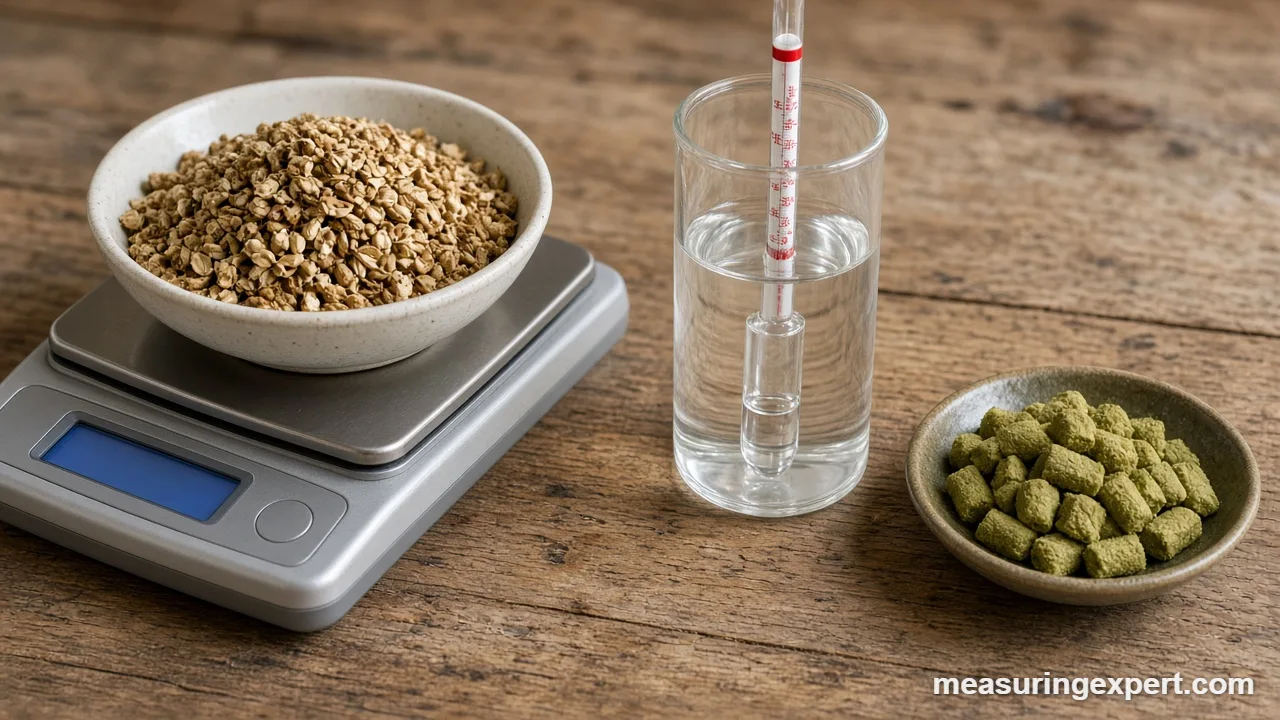
To measure brewing ingredients accurately, weigh grain, hops and sugar in grams on a digital scale, measure water in gallons or liters with marked containers, and check strength with a hydrometer. Weight beats volume because grain and hops vary in density. Convert recipe units first, then record every number.
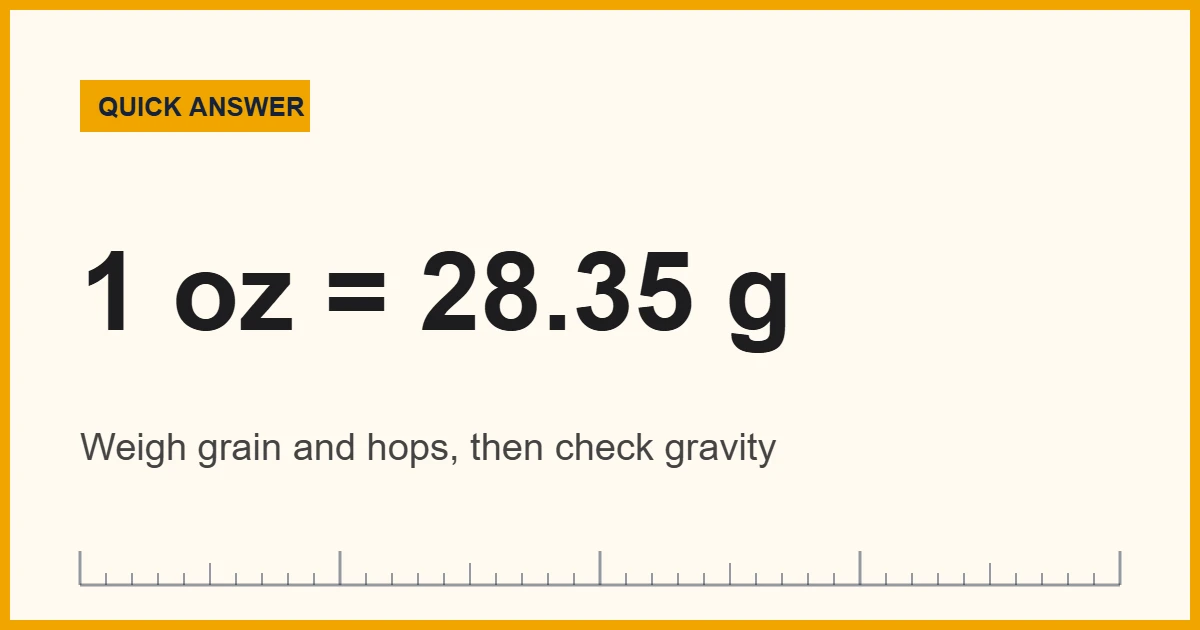
Convert Weights to Measure Brewing Ingredients
Beer recipes mix pounds, ounces and grams. Therefore, convert everything to one unit before you start. Type an amount below, pick its unit, and read the other units instantly.
Why Precision Matters When You Measure Brewing Ingredients
Beer is a short list of ingredients: malted grain, hops, water and yeast. Because the list is short, each amount has a large effect. For example, a few grams of hops change bitterness, while a few pounds of grain change the strength.
When you measure brewing ingredients the same way every batch, you can repeat a beer you liked. In addition, you can find the cause when a batch goes wrong. Otherwise, every difference is a guess.
In short, this guide covers the measuring side of brewing: scales, volumes, yeast math and gravity readings. It does not replace a tested recipe, and it does not cover sanitation or fermentation control in depth.
Recommended Tools to Measure Brewing Ingredients
A small kit covers nearly every measurement. First, you need a scale with a tare button for grain. Next, a second scale with 0.1 g steps suits small hop additions. Finally, a hydrometer and test jar let you read gravity before and after fermentation. Our guides to the best triple scale hydrometers and best fermentation thermometers go deeper on those two tools.


As an Amazon Associate, Measuring Expert earns from qualifying purchases.
Key Takeaways
- Weigh grain, hops and sugar; use marked containers for water.
- One US ounce is 28.35 g, and one US gallon is 3.785 L.
- Compare hops by weight times alpha acid percent, not by weight alone.
- Yeast pitch rate is about 1 million cells per mL per degree Plato for an ale.
- Read the hydrometer at the temperature printed on it.
- Write down every weight, volume and reading for each batch.
- Home brewing for personal use is limited by federal rules, plus state and local law.
How to Measure Brewing Ingredients Step by Step
First, use this routine on brew day. It works for extract and all-grain batches alike.
- Convert the recipe to grams and liters. Use the converter above so every number uses one system.
- Zero the scale with the empty container. Press tare so only the ingredient counts.
- Weigh grain in one pass. Add slowly as you near the target, then record the final number.
- Weigh each hop addition separately. Label the bags by boil time so nothing gets mixed up.
- Measure water in marked containers. Mark your kettle and fermenter at known volumes.
- Take a gravity reading before you pitch yeast. Cool the sample first, then read the hydrometer at eye level.
- Write everything in a brew log. Include weights, volumes, temperatures and readings.
Measure Brewing Ingredients: Grain and Malt
First, grain is the heaviest ingredient, so it sets the strength of the beer. Weigh it instead of scooping it, because grain varies in size and moisture. Likewise, crushed grain packs differently from whole grain, so a cup of each weighs a different amount.
For example, recipes often list grain in pounds. The table below converts common weights to grams and kilograms, using 1 lb = 453.59 g.
| Pounds | Grams | Kilograms |
|---|---|---|
| 6 lb | 2,722 g | 2.72 kg |
| 8 lb | 3,629 g | 3.63 kg |
| 10 lb | 4,536 g | 4.54 kg |
| 12 lb | 5,443 g | 5.44 kg |
Many kitchen scales top out around 11 pounds. If your grain bill is heavier, weigh it in two batches and add the totals. As a result, you stay inside the scale’s range and keep an accurate record.
Measure Brewing Ingredients: Hops
Hops are light, so small errors matter. A half ounce is only 14.17 g, and one ounce is 28.35 g. Consequently, a scale with 0.1 g steps helps with small additions, especially for late hops.
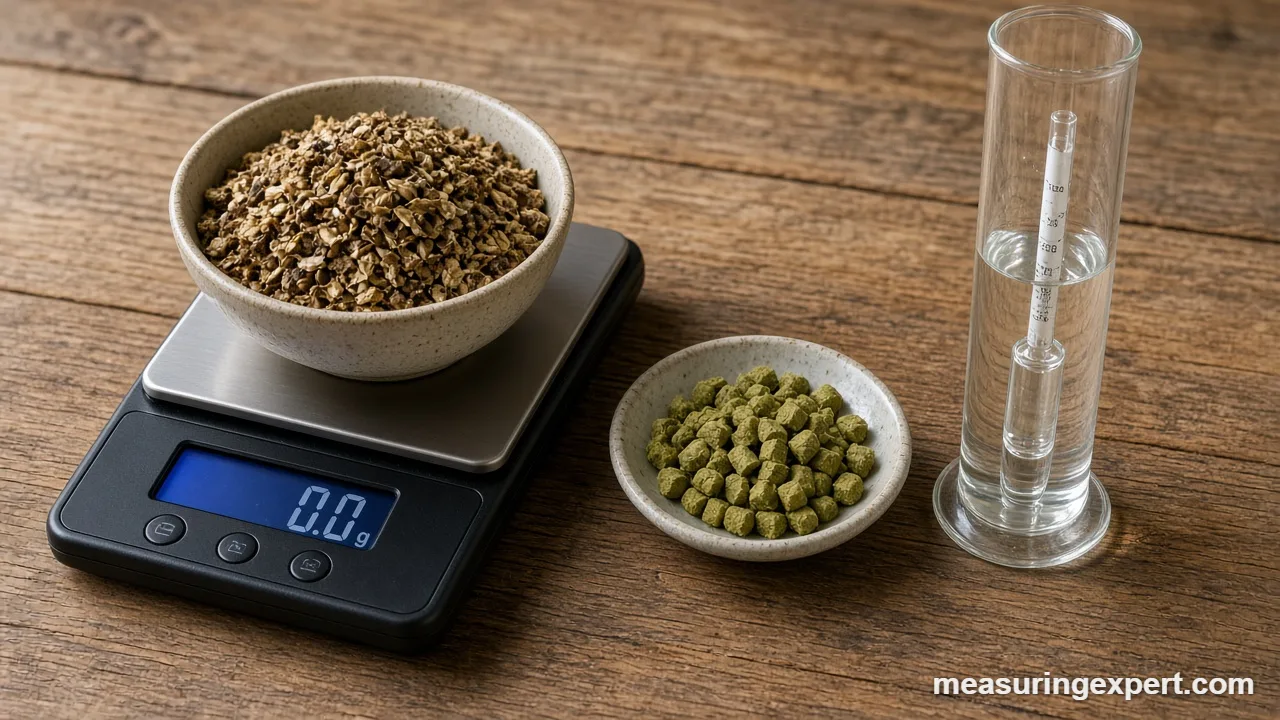
However, weight alone does not tell you how bitter a hop addition will be. In addition, every package lists an alpha acid percentage, and that number changes from crop to crop. One rough comparison is alpha acid units (AAU), which equal weight in ounces times the alpha acid percent. For example, 1 oz of 5% hops gives 5 AAU, and 0.5 oz of 10% hops also gives 5 AAU.
Brewing software gives a more complete bitterness estimate, because boil time and wort strength also matter. Even so, the AAU comparison helps you swap one hop for another at a glance. Pellets and whole leaf hops also fill a measure differently, so always weigh them.
Water: Gallons, Liters and Weight
Next, water is the largest ingredient by volume. A US gallon is exactly 3.785411784 L, so a 5-gallon batch is about 18.93 L. A gallon of water also weighs about 8.3 pounds, which helps if you weigh it instead of measuring volume.
Therefore, measure at two points. First, record the volume you start with. Then record the volume you collect after the boil, because boiling removes water and concentrates the wort. As a result, the gravity you read depends on both the grain weight and the final volume.
| US gallons | Liters |
|---|---|
| 1 gal | 3.79 L |
| 3 gal | 11.36 L |
| 5 gal | 18.93 L |
| 6.5 gal | 24.60 L |
For smaller liquid amounts, the guide to how much 30 mL is shows how milliliters, ounces and spoons relate.
Yeast Pitch Rate When You Measure Brewing Ingredients
However, yeast is measured in cells, not grams. The Homebrewers Association gives a standard rule: 1 million cells per milliliter of wort per degree Plato for an ale. For lagers, it advises multiplying that rate by 1.5 or 2.
Also, you can estimate degrees Plato from the gravity reading. Multiply the points above 1.000 by one quarter, so 1.048 is about 12 degrees Plato. A 5-gallon batch holds about 18,927 mL, so the math for a 12 degree Plato ale looks like this.
| Beer | Rate | Cells needed |
|---|---|---|
| Ale, 12 degrees Plato | 1 million per mL per degree | about 227 billion |
| Lager, 12 degrees Plato | 1.5 times the ale rate | about 341 billion |
| Lager, 12 degrees Plato | 2 times the ale rate | about 454 billion |
The same article also gives a package chart for liquid yeast. For 5 gallons up to 1.048 gravity, it lists one package with no starter. Stronger beers call for a starter, so read the label and the chart before you decide.
Gravity: Measure Strength With a Hydrometer
First, a hydrometer floats in your sample, and the reading at the liquid surface is the specific gravity. A reading of 1.050 means 50 gravity points. You take one reading before fermentation (original gravity) and one after (final gravity).
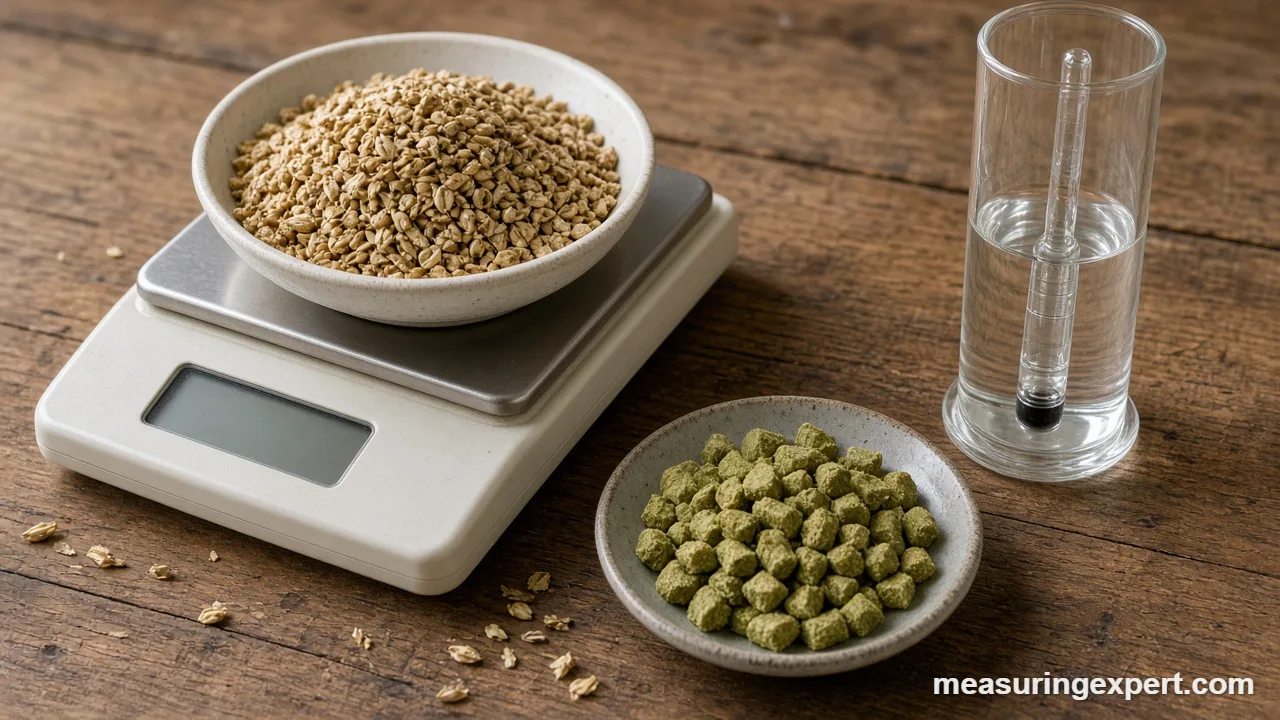
Next, a common rule of thumb for alcohol by volume is (original gravity minus final gravity) times 131.25. For example, 1.050 and 1.010 give 5.25 percent. Other formulas give slightly different results. Wikipedia’s article on gravity notes that the same example gives 5.31 percent with one simple formula and 5.23 percent with a more accurate method, so treat the figure as an estimate.
Temperature matters too. According to the same article, the current ASBC standard is 20 C, while some hydrometers are calibrated to 16 C (60 F). Check the temperature printed on your instrument, and cool the sample to match it before you read. Moreover, use the same hydrometer for the whole batch so the readings stay comparable.
Our ounce guide also helps if your recipe mixes weight ounces and fluid ounces.
Do and Don’t When You Measure Brewing Ingredients
Do
- Weigh grain, hops and sugar.
- Record each reading in a brew log.
- Check the alpha acid percent on the hop package.
- Cool samples before a hydrometer reading.
- Mark your kettle and fermenter volumes.
Don’t
- Scoop grain with a cup and trust the volume.
- Swap hops by weight alone.
- Read a hot sample straight from the kettle.
- Guess priming sugar amounts by the spoonful.
- Change two variables in one batch.
Honest Limits of Measuring Brewing Ingredients
Measuring controls what you add, but it does not control everything. Grain varies by crop, and hop alpha acid changes with age and storage. Furthermore, a hydrometer reads density, so dissolved sugar and other solids affect it. In short, consistent measuring narrows the variation but does not remove it.
Similarly, pitch-rate numbers are estimates. Yeast viability falls as it ages, and the cell counts on a package are targets, not guarantees. When a beer matters, brew from a tested recipe and compare your readings against its stated gravity.
Home Brewing Rules Before You Brew
First, US federal law allows adults to make beer at home for personal use. The Alcohol and Tobacco Tax and Trade Bureau (TTB) states in its beer FAQ that a household with one adult may make up to 100 gallons per calendar year, and a household with two or more adults may make up to 200 gallons. Adults may not sell the beer, and brewing must also comply with state and local law.
FAQs: How to Measure Brewing Ingredients
How do I measure brewing ingredients for beer?
Weigh grain, hops and sugar on a digital scale, measure water in marked containers, and read gravity with a hydrometer. Record every number in a brew log.
Is it better to weigh or measure by volume?
Weigh. Grain and hops differ in density, crush and moisture, so a cup of each can hold different amounts. Weight gives the same result each time.
How many grams are in an ounce of hops?
One US ounce is 28.35 g, so a half ounce is 14.17 g and two ounces is 56.70 g.
How many liters are in 5 gallons?
Five US gallons equal about 18.93 L, because one US gallon is 3.785 L.
What scale is best to measure brewing ingredients?
Use a kitchen scale with a tare button for grain, and a second scale that reads in 0.1 g steps for small hop additions. Check that it shows grams.
How do I compare hops with different alpha acids?
Multiply the weight in ounces by the alpha acid percent to get AAU. One ounce of 5 percent hops equals 0.5 ounce of 10 percent hops at 5 AAU.
How much yeast do I need to pitch?
The Homebrewers Association rule for an ale is 1 million cells per mL per degree Plato. A 5-gallon, 12 degree Plato ale needs about 227 billion cells.
What should my hydrometer read for beer?
It depends on the recipe. Use the original and final gravity listed in your recipe as a target, and compare your readings with them.
How do I measure the alcohol content of my homebrew?
Take original and final gravity readings, subtract, and multiply by 131.25 for a rough percent. For 1.050 and 1.010 that gives 5.25 percent.
How much beer can I make at home?
The TTB lists 100 gallons per calendar year for a one-adult household and 200 gallons for two or more adults. You may not sell it, and state law also applies.
Measure Brewing Ingredients: The Bottom Line
To sum up, weigh your grain, hops and sugar, mark your water volumes, and take gravity readings at the right temperature. When you measure brewing ingredients this way, each batch becomes easier to repeat and to fix.
Finally, keep a brew log and use the converter at the top of this page whenever a recipe mixes ounces, pounds and grams. Start with a tested recipe, change one thing at a time, and let the numbers tell you what to adjust.