

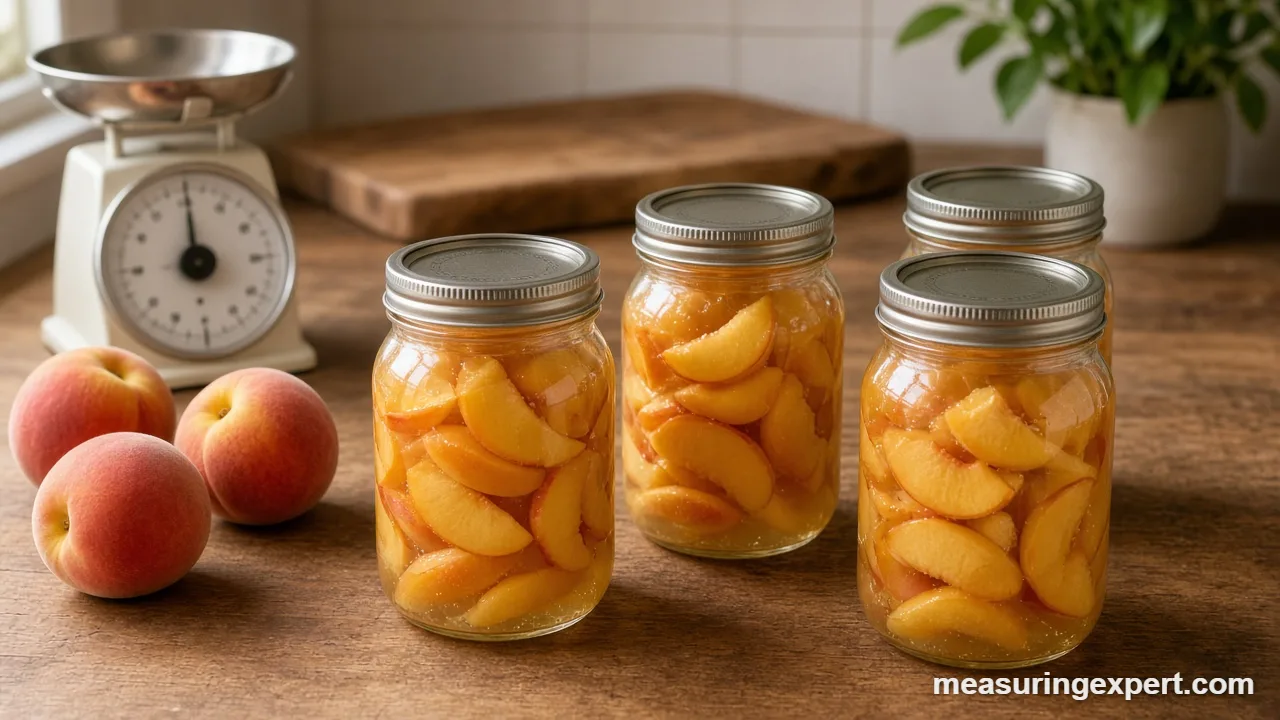
When canning fruits, measure three things: the fruit by weight, the syrup by cups, and the headspace by ruler. Plan on roughly 1 1/2 to 3 pounds of fruit per quart jar depending on the fruit, leave 1/2 inch of headspace, and make syrup from a tested table.
In fact, canning fruits looks forgiving, but the numbers still matter. For example, too little headspace leaves no room for the food to expand during processing. Raw-packed fruit, meanwhile, tends to float, and trapped air can discolor it in storage. In addition, a syrup that is much sweeter or thinner than the recipe changes both the taste and the look of the jar.
In short, this guide stays with fruit only. First, it shows how much fruit to buy per jar. Next, it covers syrup ratios, headspace, hot pack versus raw pack, and the small amounts of acid used for figs and for stopping browning. The numbers come from the New Mexico State University canning fruit guide (E-319) and from the National Center for Home Food Preservation (NCHFP) syrup page. For the basics that apply to every food, see our guide to measuring ingredients for canning.
- Headspace: 1/2 inch (about 13 mm) for most fruits in a boiling-water canner
- Fruit per quart jar: about 2 to 2 1/2 pounds for peaches, pears, plums and grapes
- Syrup: choose very light, light, medium, heavy or very heavy from the table below
- Figs: add 2 tablespoons bottled lemon juice per quart
- Anti-browning dip: 3 grams of ascorbic acid per gallon of cold water
Canning Fruits Weight Converter
Fruit is sold by the pound, while many recipes list kilograms or grams. Therefore, enter a weight below to switch between them. Also, the converter uses the exact definition of the pound.
How Much Fruit to Weigh for Canning Fruits
First, NMSU lists the pounds of fresh fruit needed for a full canner load: 9 pints or 7 quarts. Therefore, dividing each figure by the number of jars gives a planning number per jar. For example, 17 1/2 pounds of peaches across 7 quarts is 2.5 pounds per quart, which matches the NCHFP peach page.
| Fruit (as purchased) | 9-pint load | 7-quart load | About per pint | About per quart |
|---|---|---|---|---|
| Apples | 12 1/4 lb | 19 lb | 1.4 lb | 2.7 lb |
| Apricots | 10 lb | 16 lb | 1.1 lb | 2.3 lb |
| Berries | 8 lb | 12 lb | 0.9 lb | 1.7 lb |
| Cherries | 11 lb | 17 1/2 lb | 1.2 lb | 2.5 lb |
| Figs | 11 lb | 16 lb | 1.2 lb | 2.3 lb |
| Grapes | 9 lb | 14 lb | 1.0 lb | 2.0 lb |
| Nectarines | 11 lb | 17 1/2 lb | 1.2 lb | 2.5 lb |
| Peaches | 11 lb | 17 1/2 lb | 1.2 lb | 2.5 lb |
| Pears | 11 lb | 17 1/2 lb | 1.2 lb | 2.5 lb |
| Pineapple | 13 lb | 21 lb | 1.4 lb | 3.0 lb |
| Plums | 9 lb | 14 lb | 1.0 lb | 2.0 lb |
| Rhubarb | 7 lb | 10 1/2 lb | 0.8 lb | 1.5 lb |
The two right-hand columns are averages that we calculated, so treat them as a shopping guide. Buy a little extra because trimming, pits and skins vary. In addition, NCHFP says a 48-pound bushel of peaches yields 16 to 24 quarts, which averages about 2 1/2 pounds per quart. Next, to convert pounds to grams for a scale, multiply by 453.6. A quart of peaches at 2.5 pounds is therefore about 1,134 g of fresh fruit.
Recommended Tools for Canning Fruits
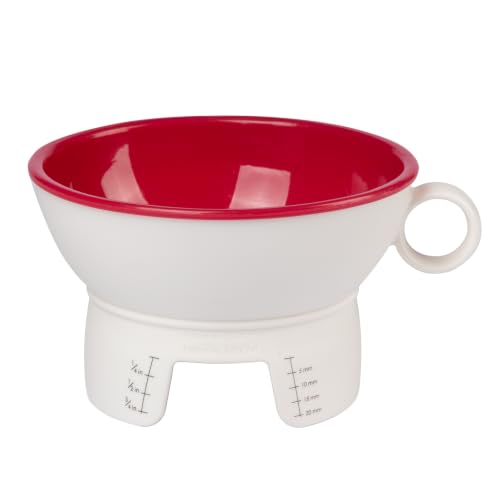
First, a scale handles the fruit and the sugar, while a liquid measuring cup handles the water and juice. A headspace tool then saves guessing at the top of the jar. Also, a wide funnel keeps syrup off the rim of the jar. For more on each type, see our guides to kitchen scales and food measuring cups.


As an Amazon Associate, Measuring Expert earns from qualifying purchases.
Key Takeaways
- First, weigh fruit before you start; a quart usually takes 2 to 2 1/2 pounds of most tree fruit.
- Next, leave 1/2 inch of headspace for most fruits, and 1/4 inch for fruit purees and grape juice.
- Then pick one syrup strength from the table and make only as much as the load needs.
- Also, honey or light corn syrup may replace up to half of the sugar.
- However, figs need lemon juice in every jar: 1 tablespoon per pint or 2 per quart.
- In short, hot pack is the preferred style for fruit in a boiling-water canner.
- Finally, processing time depends on the fruit, the jar size, the pack and your altitude.
Syrup Ratios for Canning Fruits
First, syrup is just sugar dissolved in water, and the strength is described by its approximate percent of sugar. Fortunately, NCHFP and NMSU publish the same table for a full canner load. To use it, first heat the water and sugar until the sugar dissolves and the syrup boils, then pour it over the fruit or use it to heat the fruit.
| Syrup | Approx. sugar | 9-pint load: sugar | 9-pint load: water | 7-quart load: sugar | 7-quart load: water |
|---|---|---|---|---|---|
| Very light | 10% | 3/4 cup (149 g) | 6 1/2 cups | 1 1/4 cups (248 g) | 10 1/2 cups |
| Light | 20% | 1 1/2 cups (297 g) | 5 3/4 cups | 2 1/4 cups (446 g) | 9 cups |
| Medium | 30% | 2 1/4 cups (446 g) | 5 1/4 cups | 3 3/4 cups (743 g) | 8 1/4 cups |
| Heavy | 40% | 3 1/4 cups (644 g) | 5 cups | 5 1/4 cups (1,040 g) | 7 3/4 cups |
| Very heavy | 50% | 4 1/4 cups (842 g) | 4 1/4 cups | 6 3/4 cups (1,337 g) | 6 1/2 cups |
The gram values are our conversion, using 198 g per cup of granulated sugar from the King Arthur Baking ingredient weight chart. In addition, weighing the sugar is more reliable than scooping it. Note also that NCHFP says the 9-pint amount is enough for a 4-quart load.
How Much Syrup Goes in Each Jar
However, how much syrup goes in each jar depends on the fruit. For example, NMSU lists 1/2 cup (about 118 mL) of syrup, juice or water per jar for raw-packed berries and for mixed fruit cocktail. Peaches and pears, on the other hand, are covered with hot liquid up to the headspace line. Therefore, measure the liquid for the first jar, then use that jar as your guide.
Honey, Corn Syrup and Plain Water
Also, mild honey or light corn syrup can replace up to half of the sugar, according to NCHFP. Fruit can also be canned in plain water, apple juice or white grape juice. Syrup helps fruit keep its flavor, color and shape, but it does not prevent spoilage, so a lighter syrup is a taste choice rather than a safety risk. However, sugar substitutes are different: NCHFP notes that granular Splenda does not preserve like sugar, so replace only part of the sugar and expect a different texture.
Headspace for Canning Fruits
First, headspace is the empty space between the food and the lid. In fact, NCHFP explains that the space is needed for the food to expand during processing and for a vacuum to form as the jar cools. In practice, for fruits processed in a boiling-water canner, the usual measurement is 1/2 inch, which is about 13 mm.
| Fruit product | Headspace | Metric |
|---|---|---|
| Most whole or sliced fruits (peaches, pears, apricots, cherries, berries) | 1/2 inch | about 13 mm |
| Fruit purees and grape juice | 1/4 inch | about 6 mm |
Next, measure from the rim of the jar down to the top of the fruit or liquid, not to the top of the threads. A headspace tool is handy because it has notches at the common depths. If you do not own one, a clean ruler works. After filling, wipe the rim, adjust the lid and process.
Hot Pack vs Raw Pack When Canning Fruits
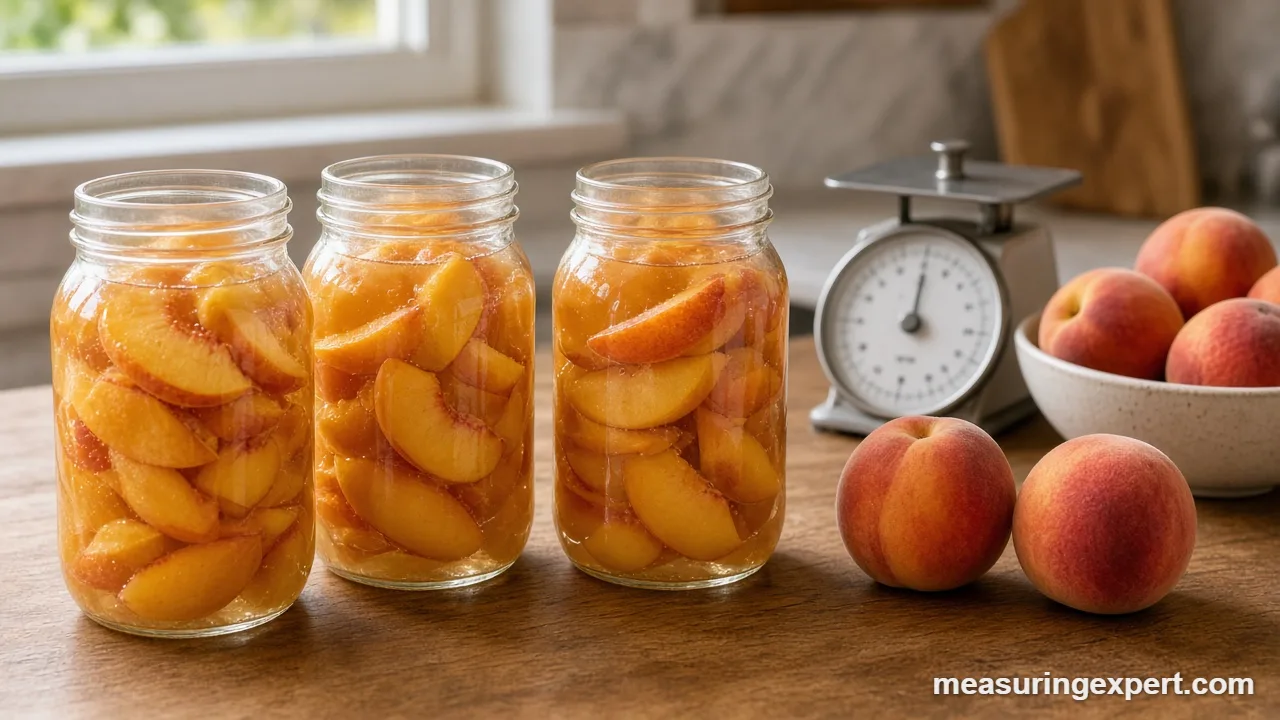
In short, with a raw pack, you fill jars with unheated fruit and add hot syrup. With a hot pack, on the other hand, you heat the fruit in the syrup first. In fact, NCHFP calls hot packing the preferred style for foods in a boiling-water canner. For one thing, it removes air from the fruit, shrinks it, and lets you fit more fruit into each jar. In addition, raw-packed fruit tends to float in the jar.
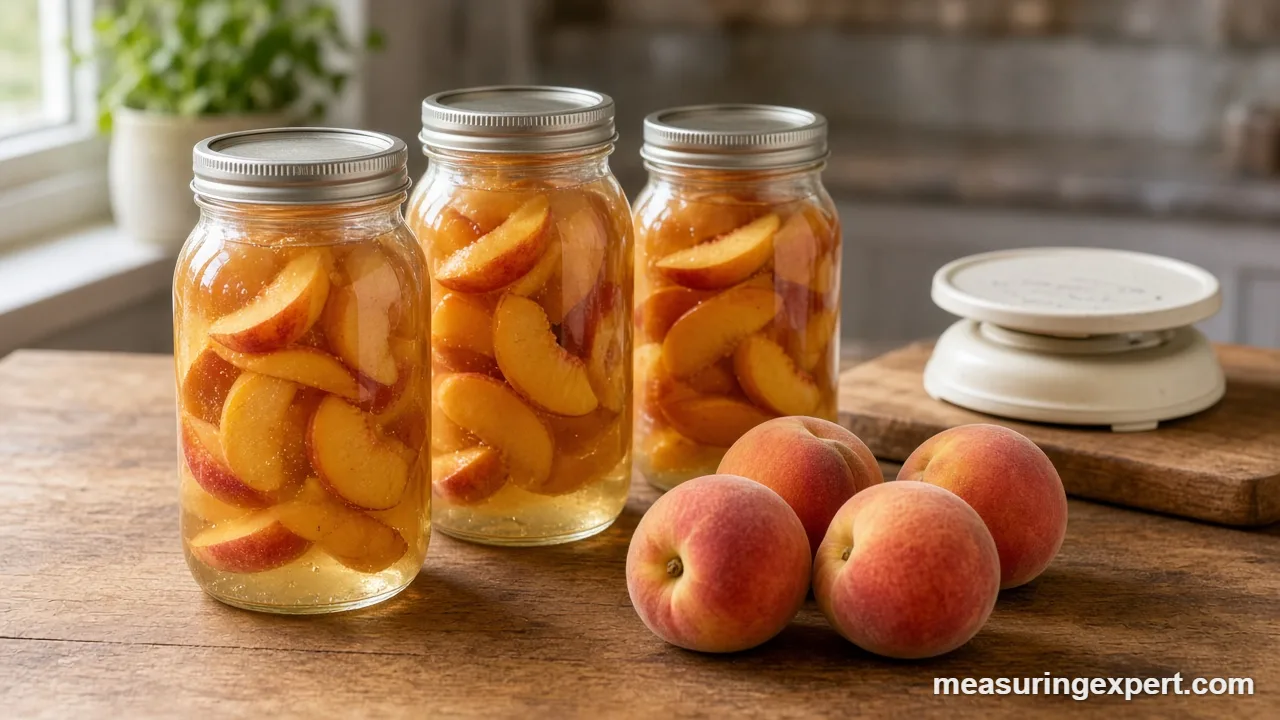
The choice also changes your clock. For example, NMSU gives raw-packed cherries 35 minutes for pints and 40 for quarts, compared with 20 and 25 minutes when hot packed. Meanwhile, for peaches, NCHFP warns that a raw pack makes poor-quality fruit, and it gives the same advice for pears.
| Peaches, boiling-water canner | 0-1,000 ft | 1,001-3,000 ft | 3,001-6,000 ft | Above 6,000 ft |
|---|---|---|---|---|
| Hot pack, pints | 20 min | 25 min | 30 min | 35 min |
| Hot pack, quarts | 25 min | 30 min | 35 min | 40 min |
| Raw pack, pints | 25 min | 30 min | 35 min | 40 min |
| Raw pack, quarts | 30 min | 35 min | 40 min | 45 min |
However, these times come from the NCHFP page for halved or sliced peaches and apply to that recipe only. Other fruits have their own times, so always use the recipe for the fruit in your jar. NCHFP also notes that this process is not for white-flesh peaches.
Acid and Anti-Browning Amounts for Canning Fruits
In practice, two small acid measurements come up when canning fruits. First, figs need lemon juice or citric acid. Second, light-colored fruit can get an anti-browning dip, which affects looks rather than safety.
| Use | Pint jar | Quart jar |
|---|---|---|
| Figs: bottled lemon juice | 1 tablespoon (about 15 mL) | 2 tablespoons (about 30 mL) |
| Figs: citric acid | 1/4 teaspoon | 1/2 teaspoon |
For the dip, NMSU suggests 3 grams of pure ascorbic acid per gallon (3.8 L) of cold water, which is 1 level teaspoon of the powder. A mix of 1 part lemon juice to 4 parts water also works, though ascorbic acid mixtures are more effective than citric acid ones. In addition, use the dip for apples, apricots, nectarines, peaches, white cherries and grapes. Then keep peeled fruit in it until you pack the jars.
How to Measure Ingredients for Canning Fruits Step by Step
- Choose a tested recipe. First, pick one for your exact fruit, pack style and jar size.
- Weigh the fruit. Next, use the weight table above, and buy a little extra for trimming.
- Weigh and mix the syrup. Then pick a strength from the table, weigh the sugar, and boil it with the measured water.
- Prepare the fruit. After that, peel and cut it, and hold light fruit in the ascorbic acid dip until you pack.
- Add acid where required. Also, put the lemon juice or citric acid in each jar before the fruit when your recipe calls for it.
- Pack and add liquid. Then fill the jar with fruit and hot liquid, leaving the headspace your recipe lists.
- Check, wipe and process. Finally, measure the headspace, wipe the rim, adjust the lid, and process for the time that fits your altitude.
Do and Don’t for Canning Fruits
Do
- First, weigh fruit and sugar on a scale.
- Next, measure headspace with a tool or ruler.
- Also, use bottled lemon juice for figs.
- Then hot pack fruit for a boiling-water canner.
- Finally, check your altitude before choosing a time.
Don’t
- Guess the headspace by eye, because small errors add up.
- Pack fruit so tightly that it crushes.
- Therefore, never use a time from a different fruit.
- Skip the acid that a recipe requires.
- Treat syrup strength as a safety setting.
Honest Limits of Canning Fruits by the Numbers
In short, weights per jar are averages, not promises. In fact, a bushel of peaches may yield 16 or 24 quarts, depending on size and trimming. For instance, fruit that is very ripe packs more tightly than firm fruit. As a result, you may finish a load with a spare jar or with a little fruit left over.
Also, the conversions on this page are rounded. For example, 1/2 inch is exactly 12.7 mm, and we show it as about 13 mm. Even so, a jar that is a few millimeters off the target is not what decides safety. Instead, the tested recipe, the clean rim, the correct processing time and a good seal matter far more.
Safety Notes for Canning Fruits
First, always process jars for the full time in your tested recipe, adjusted for altitude. For example, figs are one case where a tested recipe adds lemon juice or citric acid to every jar. Meanwhile, when you give jars as presents, see our guide to measuring food gift ingredients for labeling tips.
Frequently Asked Questions
How many pounds of fruit do I need per quart when canning fruits?
In short, most tree fruits need about 2 to 2 1/2 pounds per quart jar. For example, peaches, pears and nectarines average 2.5 pounds, plums and grapes about 2 pounds, and berries about 1.7 pounds.
How much headspace do I leave when canning fruits?
Leave 1/2 inch (about 13 mm) for most fruits in a boiling-water canner. However, fruit purees and grape juice use 1/4 inch.
What syrup should I use for canning fruits?
First, choose from very light, light, medium, heavy or very heavy. NCHFP lists very light, light or medium syrup for peaches and pears. You can also use water or juice.
How much sugar is in a light syrup for canning fruits?
In short, a light syrup is about 20 percent sugar. For example, for a 9-pint load, mix 1 1/2 cups of sugar with 5 3/4 cups of water.
Can I can fruit without sugar?
Yes. NCHFP says fruit can be canned in plain water or juice, because the heat of proper processing preserves the food. However, syrup mainly protects flavor, color and shape.
Can honey replace sugar when canning fruits?
Mild-flavored honey or light corn syrup can replace up to half of the sugar, but no more than that.
Why do figs need lemon juice?
The tested figs recipe calls for it, so add 1 tablespoon of bottled lemon juice per pint or 2 tablespoons per quart. Instead, citric acid works at 1/4 or 1/2 teaspoon.
How do I stop canned fruit from turning brown?
First, hold peeled fruit in a solution of 3 grams of ascorbic acid per gallon of cold water. Hot packing also helps keep fruit from floating and darkening.
Is hot pack or raw pack better for canning fruits?
Hot pack is preferred in a boiling-water canner. In addition, it removes air, shrinks the fruit, and gives better color and flavor after storage.
How many pints of fruit does a 9-pint load need?
In short, it depends on the fruit. Peaches, pears and nectarines need about 11 pounds for 9 pints, while berries need 8 pounds and pineapple 13 pounds.
Canning Fruits: The Bottom Line
To sum up, weigh the fruit, choose a syrup from the table, and leave 1/2 inch of headspace for most fruits. Add acid only where the recipe asks for it, and process for the time that matches the fruit, jar and altitude.
Finally, keep this page beside your tested recipe. The recipe tells you what to do, and the numbers here help you measure it accurately.
2 thoughts on “Canning Fruits: Measuring Syrup, Headspace and Fruit Weights”