

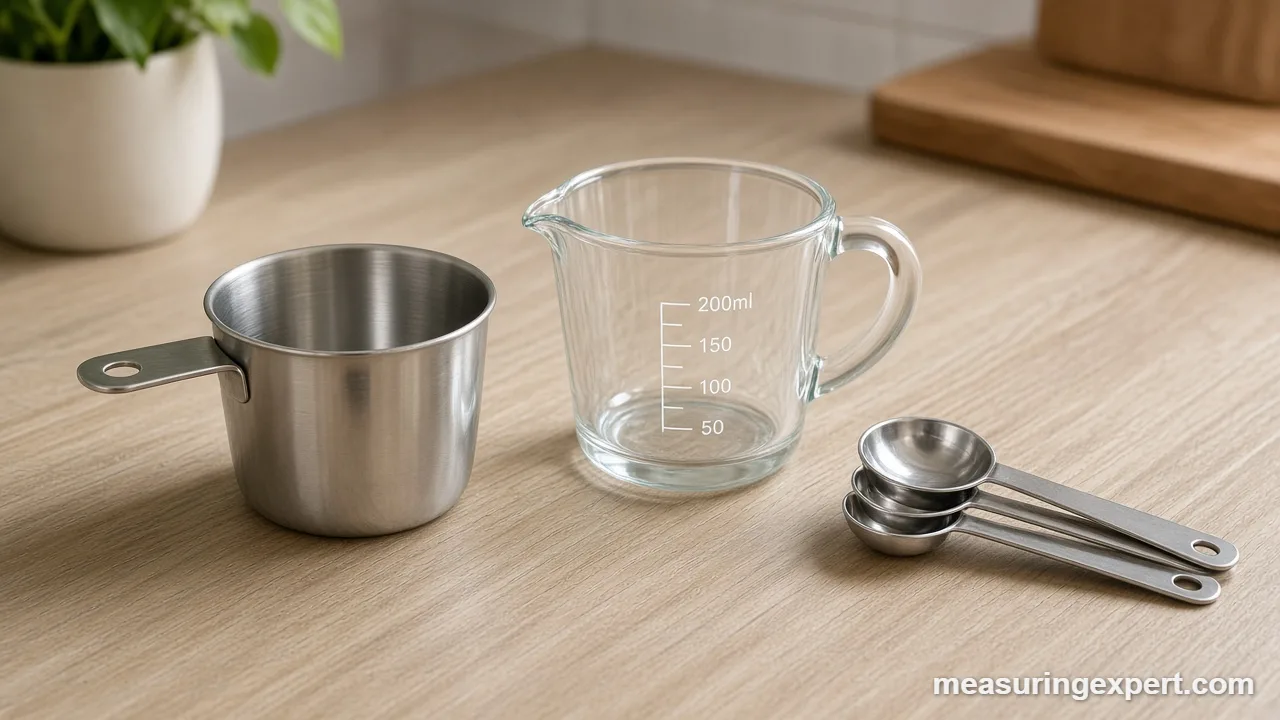
Japanese cooking measurements use a 200 mL cup, a 180 mL rice cup called a go, a 15 mL large spoon and a 5 mL small spoon. By comparison, a US cup is 236.588 mL, a US legal (nutrition label) cup is 240 mL, and a metric cup is 250 mL.
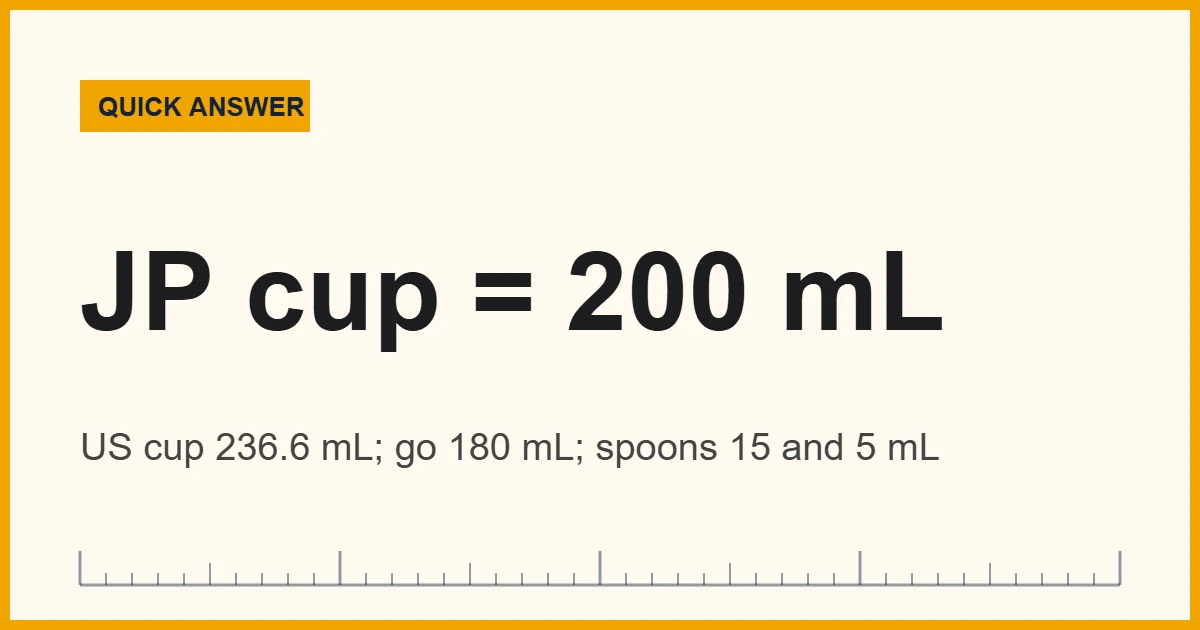
Convert Japanese Cooking Measurements to US and Metric Cups
First, enter an amount in milliliters, then read the same volume in milliliters, label cups, metric cups and spoons. Next, to convert a Japanese cup, multiply by 200 to get milliliters and enter that number in the milliliter box. However, the Japanese cup and the go are not built into this converter, so the chart below covers them.
First, a Japanese recipe and an American recipe can both say “1 cup” and mean different amounts. In fact, the Japanese cup holds 200 mL, which is about 15% less than a US cup. As a result, a cake, a soup or a pot of rice can turn out wetter or drier than the author intended.
The good news is that the gap is easy to fix once you know the numbers. For example, a Japanese soy sauce maker lists the standard sizes on its measuring spoon and cup guide: 15 mL for the large spoon, 5 mL for the small spoon, 200 mL for the cup and 180 mL for one go.
This page explains Japanese cooking measurements next to Western ones. In addition, it shows how to convert a recipe step by step, how to handle rice, and which mistakes cause the most trouble.
Japanese Cooking Measurements vs Western: Quick Chart
First, this chart lines up the cups and spoons you will meet in Japanese and Western recipes. The US values use the exact NIST definitions, while the Japanese values are the standard kitchen sizes.
| Measure | Milliliters | US cups | US fluid ounces |
|---|---|---|---|
| Japanese cup (kappu) | 200 mL | 0.85 cup | 6.76 fl oz |
| Japanese go (rice measure) | 180 mL | 0.76 cup | 6.09 fl oz |
| US customary cup | 236.588 mL | 1 cup | 8 fl oz |
| US legal (nutrition label) cup | 240 mL | 1.01 cups | 8.12 fl oz |
| Metric cup (Australia, New Zealand) | 250 mL | 1.06 cups | 8.45 fl oz |
| Japanese large spoon (osaji) | 15 mL | 0.063 cup | 0.51 fl oz |
| Japanese small spoon (kosaji) | 5 mL | 0.021 cup | 0.17 fl oz |
Overall, cup sizes are the big difference. In contrast, the 15 mL and 5 mL spoons, however, are nearly the same as a US tablespoon (14.787 mL) and teaspoon (4.929 mL). For a wider view of the metric system in the kitchen, see our guide to the metric system in cooking.
Recommended Tools for Japanese Cooking Measurements
Fortunately, you do not need a special set to follow Japanese recipes. Instead, look for tools marked in milliliters, because mL removes any doubt about which cup is meant. Also, a 180 mL rice cup is handy for rice, and a digital scale handles recipes written in grams.


As an Amazon Associate, Measuring Expert earns from qualifying purchases.
Key Takeaways
- First, the Japanese cup is 200 mL, while a US cup is 236.588 mL.
- Also, one go of rice is 180 mL, and the Hiroshima city guide lists it as about 150 g of rice.
- In addition, the large spoon is 15 mL and the small spoon is 5 mL, almost the same as US spoons.
- Meanwhile, a US legal cup is 240 mL and a metric cup is 250 mL, so “1 cup” depends on the country.
- Therefore, convert by milliliters, not by the word “cup”.
- Finally, weigh ingredients whenever the recipe gives grams.
Japanese Cooking Measurements: The 200 mL Cup
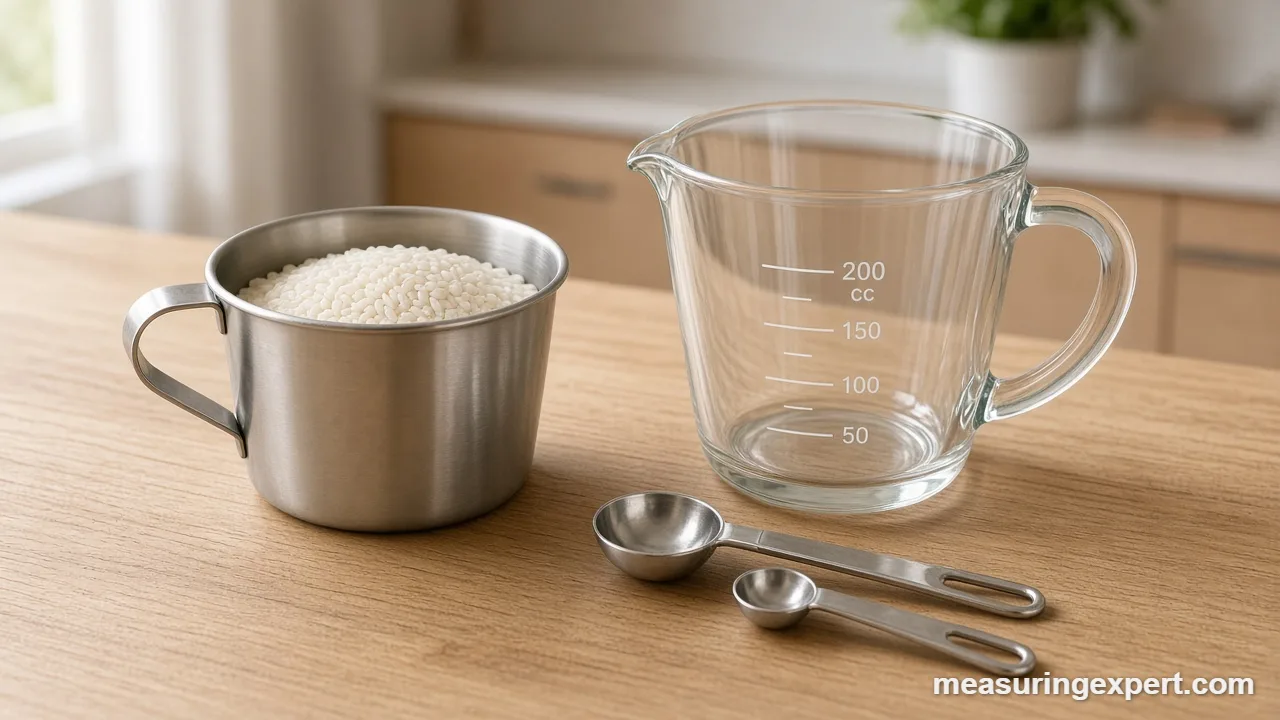
First, the standard Japanese measuring cup holds 200 mL. For example, a Hiroshima city cooking guide gives the same figure, noting that one cup equals 200 cc. Consequently, a US customary cup is about 18% larger, and a US legal cup is 20% larger.
| Japanese cups | Milliliters | US cups | Practical US measure |
|---|---|---|---|
| 1/2 cup | 100 mL | 0.42 cup | 6 tbsp + 2 tsp |
| 1 cup | 200 mL | 0.85 cup | 3/4 cup + 1 1/2 tbsp |
| 2 cups | 400 mL | 1.69 cups | 1 2/3 cups + 1 tsp |
| 3 cups | 600 mL | 2.54 cups | 2 1/2 cups + 2 tsp |
| 5 cups | 1,000 mL (1 L) | 4.23 cups | just under 4 1/4 cups |
To go the other way, simply divide US cups by 0.845. In other words, 1 US cup of 236.6 mL is 1.18 Japanese cups, or one Japanese cup plus about 2 1/2 tablespoons.
The Go: Japanese Rice Measure vs a Western Cup
Rice, meanwhile, has its own measure in Japan. In fact, one go is 180 mL, and a Japanese rice cooker usually comes with a cup of that size. In addition, the Hiroshima guide adds that one go of rice weighs 150 g.
Therefore, a rice cup is smaller than both the Japanese cup (200 mL) and the US cup (236.588 mL). As a result, one go is about 0.76 US cup. Also, ten go make one sho, which is about 1.8 L.
| Rice amount | Volume | Weight (Hiroshima guide) | US cups |
|---|---|---|---|
| 1 go | 180 mL | 150 g | 0.76 cup |
| 2 go | 360 mL | 300 g | 1.52 cups |
| 3 go | 540 mL | 450 g | 2.28 cups |
| 5 go | 900 mL | 750 g | 3.80 cups |
Large and Small Spoons: Japanese vs Western
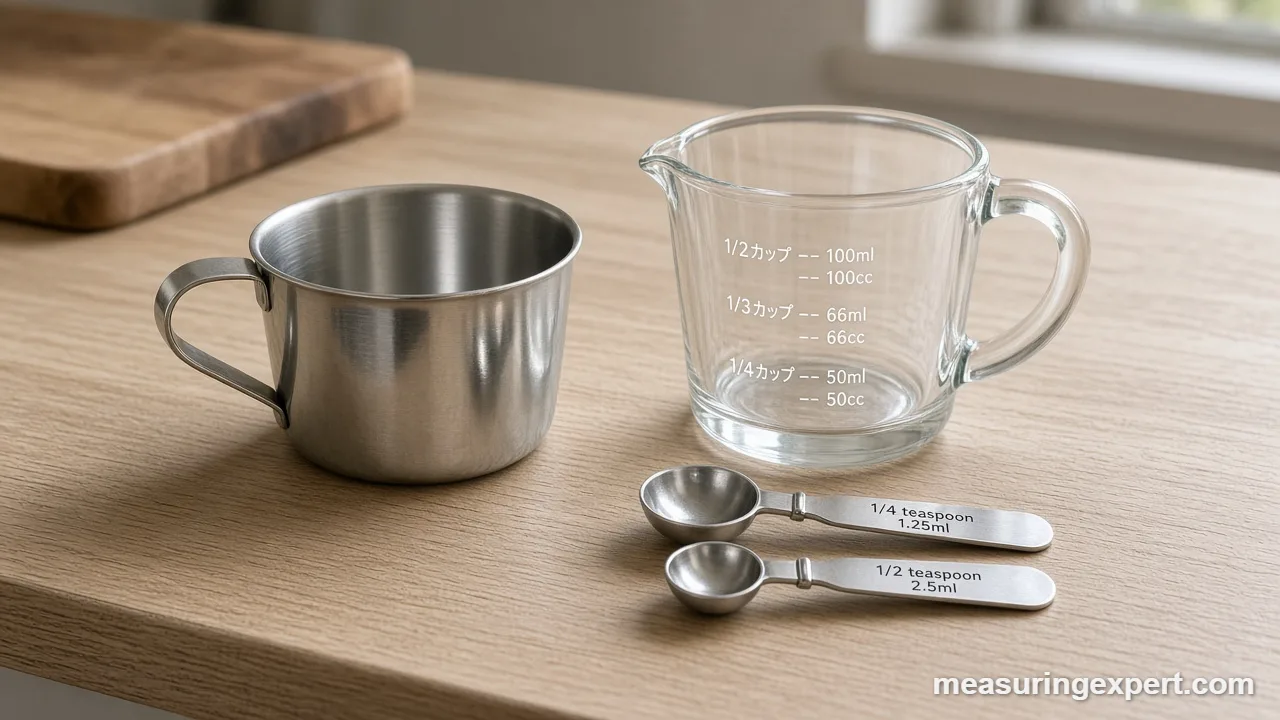
The spoons, in contrast, are almost identical. A Japanese large spoon is 15 mL and a small spoon is 5 mL, so they match the metric spoons used in many countries and the US nutrition label rule. The FDA household measure guidance sets 1 tablespoon at 15 mL, 1 teaspoon at 5 mL and 1 cup at 240 mL for labels.
| Spoon | Size | Difference from the Japanese spoon |
|---|---|---|
| Japanese large spoon | 15 mL | – |
| US tablespoon | 14.787 mL | about 1.4% smaller |
| Australian tablespoon | 20 mL | 33% larger |
| Japanese small spoon | 5 mL | – |
| US teaspoon | 4.929 mL | about 1.4% smaller |
Because the gap is only 1.4%, you can use US spoons for Japanese recipes without any conversion. Likewise, the Wikipedia article on measuring spoons lists the same 15 mL and 5 mL pair for Japan.
Spoon weights, however, depend on the ingredient. For example, the Hiroshima guide lists these level-spoon weights, in grams:
| Ingredient | Small spoon (5 mL) | Large spoon (15 mL) |
|---|---|---|
| Wheat flour | 3 g | 9 g |
| Sugar | 3 g | 9 g |
| Salt | 6 g | 18 g |
However, treat these as guide values. Also, salt varies by grain size, so a different salt can weigh less per spoon. Our guide to measuring with a cup also covers level and packed scoops.
How to Convert Japanese Cooking Measurements for a US Kitchen
- Find the unit. First, look for cup, go, large spoon or small spoon, because each has its own size.
- Write the milliliters. Next, use 200 mL for a cup, 180 mL for a go, 15 mL for a large spoon and 5 mL for a small spoon.
- Convert with the chart. Then divide milliliters by 236.588 to get US cups, or use the converter above.
- Keep the spoons as they are. Because the sizes match closely, a US tablespoon and teaspoon work for the 15 mL and 5 mL spoons.
- Weigh anything listed in grams. Also set the scale to grams and press tare before each ingredient.
- Convert the oven. Finally, change Celsius to Fahrenheit with the table below.
Oven Temperatures in Japanese Recipes
Recipes from outside the US usually give oven temperatures in Celsius. Therefore, Fahrenheit equals Celsius times 1.8 plus 32, so you can convert any value with that formula.
| Celsius | Fahrenheit |
|---|---|
| 160 C | 320 F |
| 180 C | 356 F |
| 200 C | 392 F |
| 220 C | 428 F |
Most US ovens accept steps of 5 or 25 degrees, so round 356 F to 350 F and 392 F to 400 F. Moreover, an oven thermometer shows whether your oven runs hot or cold.
Common Mistakes With Japanese Cooking Measurements
- Using a US cup for a Japanese cup. As a result, you add about 18% too much, so soups and batters turn out thin.
- Treating a go as a US cup. Therefore, you add about 31% too much rice, because 180 mL is smaller than the 236.588 mL US cup.
- Assuming a “cup” is always 240 mL. That value is for nutrition labels, so check the recipe’s country.
- Using the Australian tablespoon. Because it holds 20 mL, the dish ends up with too much salt or soy sauce.
- Mixing weight and volume. A cup is a volume, whereas an ounce on a scale is a weight.
Our guide to the best measuring cup substitute helps when you do not own the right cup, so keep it handy.
Do and Don’t for Japanese Cooking Measurements
Do
- Convert every cup to milliliters first.
- Also use a clear cup marked in mL.
- Next, level dry ingredients with a straight edge.
- Weigh rice and flour when grams are given.
- Finally, write your own conversions on the recipe.
Don’t
- Assume that a go equals a cup because both hold rice.
- Round 200 mL up to a full US cup because it seems close.
- Use a rice-cooker cup without first checking its size.
- Instead of checking, swap spoon sizes from other countries.
- Guess when the recipe lists milliliters, because exact numbers exist.
Honest Limits of These Numbers
Overall, these sizes are standard kitchen values, not guarantees for every tool. For example, measuring cups can differ slightly between brands, and a go cup can vary with the maker. Moreover, the traditional sho has a legal definition of about 1.8039 L, so a rounded 180 mL go is a kitchen simplification. In short, use the numbers to get close, then adjust by taste and texture.
When Accuracy Really Matters
For stews and stir-fries, a small error in the cup rarely matters. Rice, baking and sauces are different, however, because the liquid-to-solid ratio sets the result. In those cases, therefore, weigh the ingredients, or measure in milliliters with a marked cup.
Never use kitchen cups or spoons for liquid medicine. Instead, use the dosing device that comes with the medicine, and ask a pharmacist if you are unsure.
Frequently Asked Questions
Is a Japanese cup the same as an American cup?
No. A Japanese cup is 200 mL, while a US customary cup is 236.588 mL. In addition, a US legal cup for nutrition labels is 240 mL.
How many mL is a Japanese cup?
A Japanese cup is 200 mL. As a result, it equals about 0.85 US cup, or roughly 3/4 cup plus 1 1/2 tablespoons.
What are Japanese cooking measurements?
Japanese cooking measurements use a 200 mL cup, a 180 mL go for rice, a 15 mL large spoon and a 5 mL small spoon. In addition, many recipes list grams.
How many mL is 1 go of rice?
One go is 180 mL. Also, the Hiroshima city guide lists one go of rice as 150 g.
How many mL is a Japanese tablespoon?
The Japanese large spoon (osaji) is 15 mL. Because a US tablespoon is 14.787 mL, the two are nearly equal.
How many mL is a Japanese teaspoon?
The Japanese small spoon (kosaji) is 5 mL. Similarly, a US teaspoon is 4.929 mL.
Can I use US cups for Japanese cooking measurements?
Yes, but convert first. For example, multiply Japanese cups by 200 to get milliliters, then divide by 236.588 for US cups.
How do I convert 1 US cup to a Japanese cup?
Divide 236.588 mL by 200. Therefore, 1 US cup equals about 1.18 Japanese cups.
Is a metric cup the same as a Japanese cup?
No. A metric cup is 250 mL, so it is 25% larger than the 200 mL Japanese cup.
What is the main difference between Japanese and Western cooking measurements?
The main difference is cup size. For example, the Japanese cup is 200 mL, the go is 180 mL, and the spoons match the 15 mL and 5 mL metric spoons.
Japanese Cooking Measurements: The Bottom Line
To sum up, a Japanese cup is 200 mL, a go is 180 mL, and the spoons are 15 mL and 5 mL. Because a US cup is 236.588 mL, always convert by milliliters.
Finally, use the converter at the top of the page for any amount in milliliters, cups or spoons. Then keep a mL-marked cup in your kitchen so every recipe works the first time.