

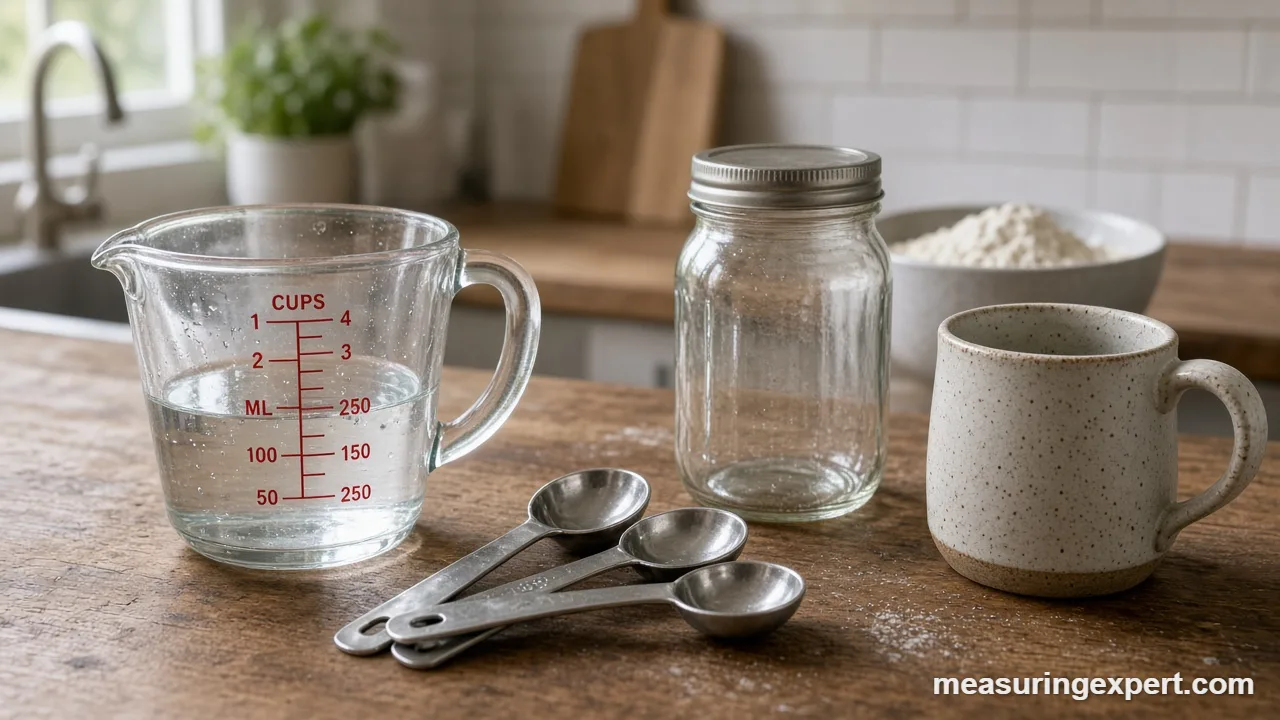
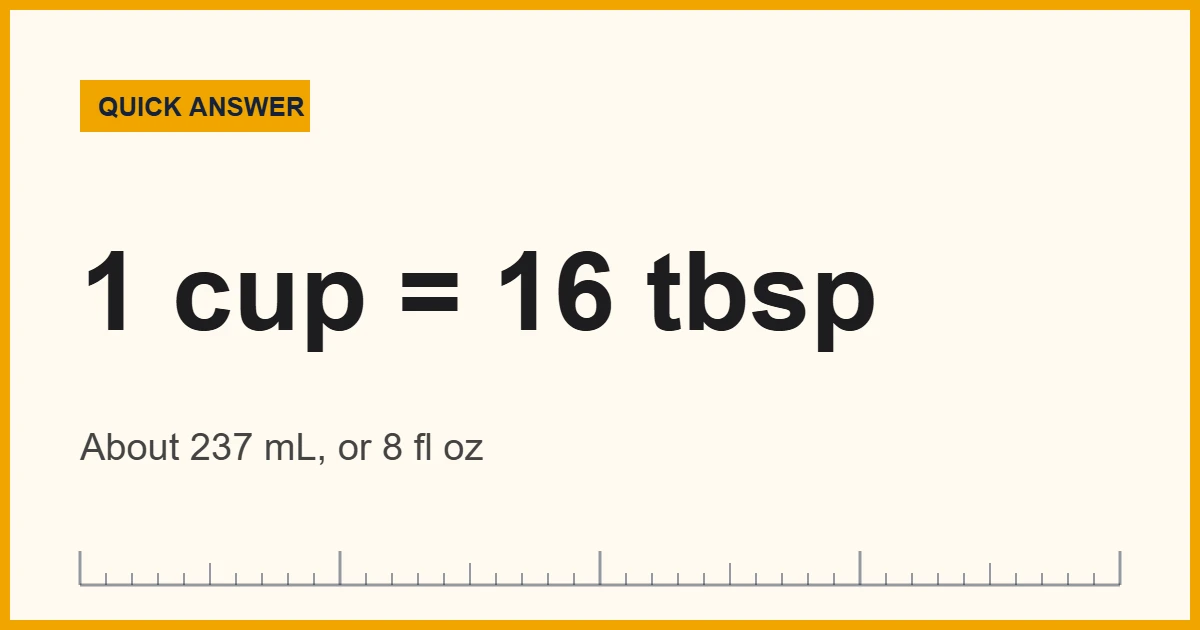
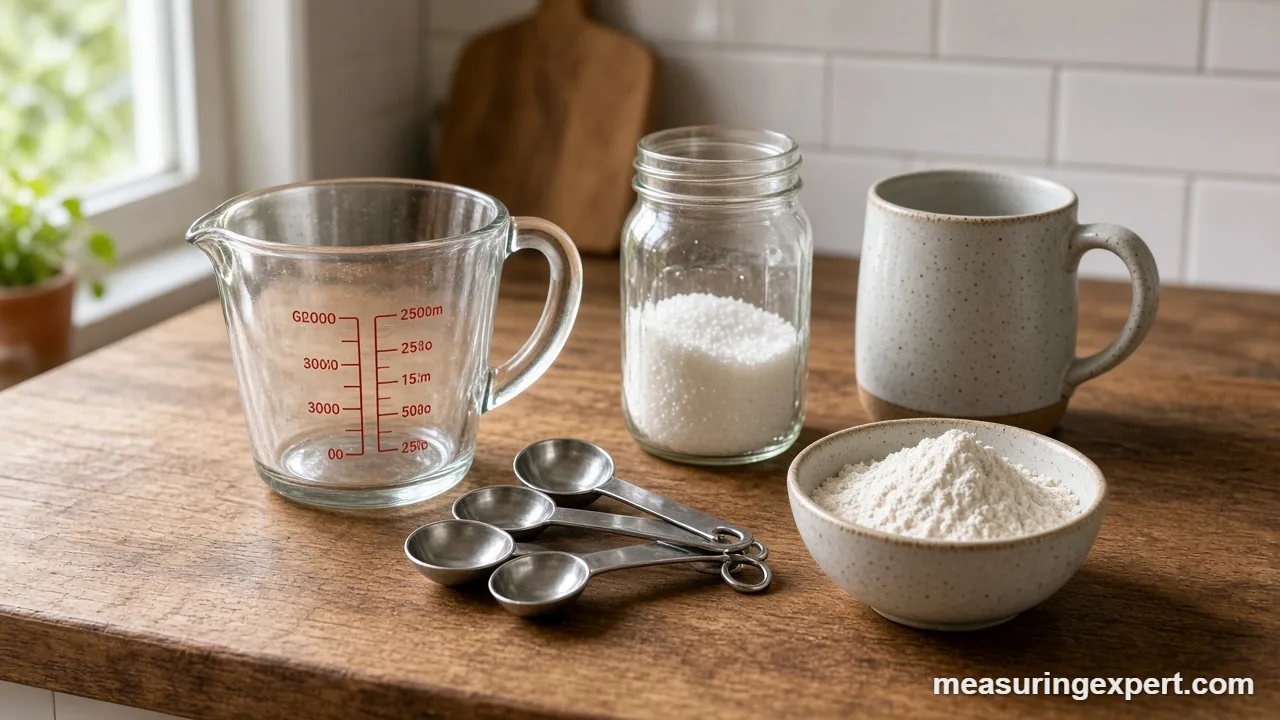
The most accurate measuring cup substitute is a kitchen scale, and the easiest is a tablespoon: 16 level US tablespoons make 1 cup (about 237 mL, or 240 mL on food labels). Without either, a glass or jar marked 8 fl oz holds about 1 cup.
Sooner or later, every cook hits this problem. For example, the recipe wants 1 cup of flour, and the measuring cups are in the dishwasher, lost, or still packed after a move. As a result, many people guess with a coffee mug. Unfortunately, mugs are one of the least reliable choices, because they range from about 8 to 16 fluid ounces.
The good news is that a cup is a fixed amount, so you can rebuild it from things you already own. For example, a spoon set, a marked jar or a digital scale can all stand in. In other words, a smart measuring cup substitute only needs one thing: a known size.
In short: use spoons or a scale first, use a marked container second, and use your hand or a mug only when the recipe is forgiving. Spoons work because 1 cup equals 16 tablespoons by definition. The US National Institute of Standards and Technology (NIST) lists 15 mL for a tablespoon and 240 mL for a cup in its metric kitchen equivalents, and notes that they are approximate values for home cooking.
Below, you will find a converter, a chart, and a table of household containers with their real sizes. After that, you will see how to calibrate any container with water, how to weigh ingredients instead, and where each method breaks down.
Measuring Cup Substitute Converter
First, enter the amount your recipe lists in cups. The converter then shows the same amount in tablespoons, teaspoons, milliliters and fluid ounces, so you can use whatever tool is in your drawer.
Measuring Cup Substitute Chart: Cups, Tablespoons and mL
So use this chart when you only have spoons or a marked container. The milliliter values use the exact US definitions and are rounded to two decimals.
| US cups | Tablespoons | Fluid ounces | Milliliters |
|---|---|---|---|
| 1/8 cup | 2 tbsp | 1 fl oz | 29.57 mL |
| 1/4 cup | 4 tbsp | 2 fl oz | 59.15 mL |
| 1/3 cup | 5 tbsp + 1 tsp | 2 2/3 fl oz | 78.86 mL |
| 1/2 cup | 8 tbsp | 4 fl oz | 118.29 mL |
| 2/3 cup | 10 tbsp + 2 tsp | 5 1/3 fl oz | 157.73 mL |
| 3/4 cup | 12 tbsp | 6 fl oz | 177.44 mL |
| 1 cup | 16 tbsp | 8 fl oz | 236.59 mL |
| 1 1/2 cups | 24 tbsp | 12 fl oz | 354.88 mL |
| 2 cups (1 pint) | 32 tbsp | 16 fl oz | 473.18 mL |
Nutrition labels round these values, so 1 cup becomes 240 mL and 1 tablespoon becomes 15 mL. For smaller amounts, see how much 30 mL is in spoons and ounces.
Recommended Tools for Measuring Without Guesswork
Substitutes are fine for one night, but a few inexpensive tools end the problem for good. First, a nested set of cups gives you the standard fractions. Next, a spoon set covers small amounts. Finally, a digital scale is the best backup of all, because it measures weight instead of volume. If you are choosing between sets, our guides to the best food measuring cups and the best baking scale compare more options.


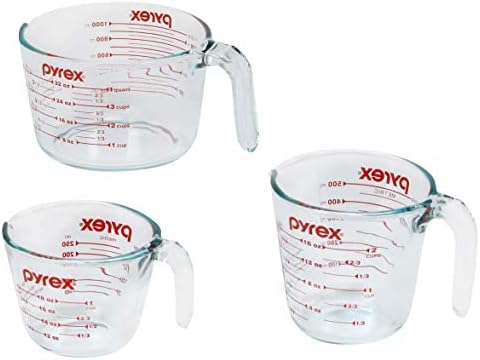
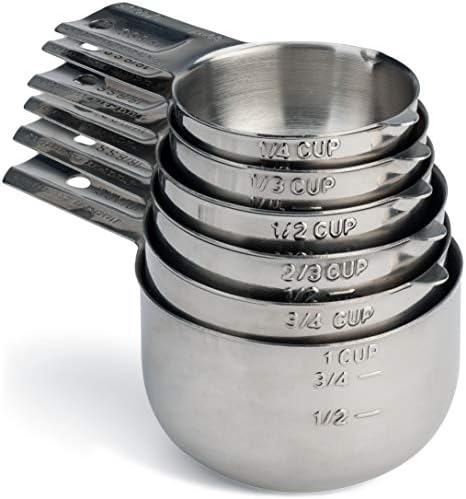

As an Amazon Associate, Measuring Expert earns from qualifying purchases.
Key Takeaways
- 1 US cup equals 16 tablespoons, 8 fluid ounces and about 236.6 mL.
- Spoons are the most reliable measuring cup substitute, because their size is fixed.
- A scale beats every volume method for flour, sugar and other dry goods.
- Mugs hold anywhere from 8 to 16 fluid ounces, so never trust one unchecked.
- Calibrate any container once with water, because 237 g of water is about 1 cup.
- Finally, level dry ingredients and read liquids at eye level.
Spoons as a Measuring Cup Substitute
First, measuring spoons are the simplest way to rebuild a cup. A US tablespoon holds about 14.79 mL, so 16 of them equal 1 cup. Likewise, 4 tablespoons make 1/4 cup, and 8 make 1/2 cup. Counting is slow for large amounts. However, it is very repeatable.
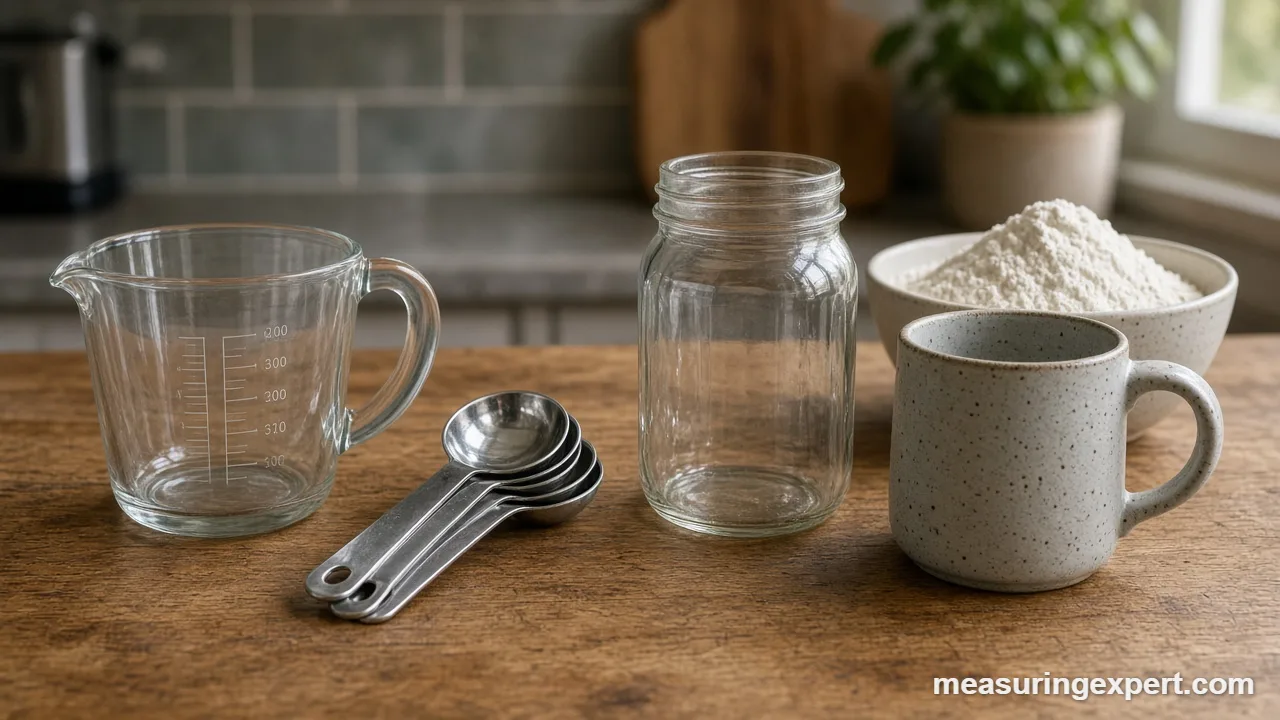
For example, drop a dry bean or coin into a small dish for every 4 tablespoons you add. That way, you never lose count halfway through a cup of flour. In addition, always use real measuring spoons. Cutlery spoons from a drawer vary widely, and they will skew the result.
Spoons also work well for liquids. However, hold the spoon over a separate bowl, because drips are easy to lose in a full-size recipe.
Mugs, Jars and Bowls as a Measuring Cup Substitute
In fact, many kitchens have a container that is close to a cup. The trouble is that “close” can mean 25 percent too much. For that reason, this table lists what common containers usually hold, so you can judge which ones are worth using.
| Container | Usual size | In cups | Verdict |
|---|---|---|---|
| Glass marked 8 fl oz | 8 fl oz | 1 cup at the mark | Good if the mark is clear |
| Coffee mug | 8 to 16 fl oz | 1 to 2 cups | Calibrate first |
| Half-pint (8 oz) canning jar | 8 fl oz labeled | 1 cup | Good, but check the fill line |
| Pint (16 oz) canning jar | 16 fl oz labeled | 2 cups | Good for 1 cup at the halfway mark |
| Small baby food jar | about 4 fl oz | about 1/2 cup | Read the label; sizes vary |
| Soup ladle | 2 to 8 fl oz | 1/4 to 1 cup | Often stamped with its size |
| Cereal bowl | varies widely | 1 1/2 to 3 cups | Too variable to use |
However, one label trap deserves a warning. A yogurt cup that says “6 oz” usually lists weight, not volume. As a result, it may not hold 3/4 cup. So always look for “fl oz” or “mL” on the container before you rely on it.
How to Calibrate Any Container With Water
Instead of guessing, test your favorite mug once and remember the answer. Water is the easiest reference, because 1 mL of water weighs about 1 g. Therefore, 1 cup of water weighs about 237 g.
- First, put the container on a kitchen scale and press the tare button so it reads zero.
- Next, pour in water until the scale shows 237 g (about 8.3 oz).
- Then mark the water line with a strip of tape or a dot of permanent marker on the outside.
- Finally, repeat for 1/2 cup (118 g) and 1/4 cup (59 g) if the container is wide enough.
Without a scale, you can use 16 level tablespoons of water instead. In either case, you now own a custom measuring cup for that exact recipe session.
Use a Kitchen Scale Instead of a Cup
In fact, many bakers prefer a scale to cups even when cups are available. As a result, a scale removes the biggest source of error, which is how tightly the ingredient is packed. King Arthur Baking recommends weighing ingredients with a digital scale, and its published chart lists the weights below.
| Ingredient (1 US cup) | Grams | Ounces |
|---|---|---|
| All-purpose flour | 120 g | 4 1/4 oz |
| Granulated sugar | 198 g | 7 oz |
| Brown sugar, packed | 213 g | 7 1/2 oz |
| Powdered sugar, unsifted | 113 g | 4 oz |
| Butter | 226 g | 8 oz |
| Milk | 227 g | 8 oz |
| Rolled oats (old-fashioned) | 89 g | 3 1/8 oz |
To use the scale, set your bowl on it, press tare, and add the ingredient until you reach the weight. Next, press tare again before adding the next ingredient. This way, you dirty only one bowl and skip every measuring tool. For the unit itself, see how much an ounce is.
Hand and Object Estimates
When nothing else is available, your hand and common objects give a rough guess. Therefore, these estimates suit soups, stews and salads. However, they are poor choices for baking, where small errors change the texture.
- Closed fist: roughly 1 cup, a common portion-size guide.
- Cupped palm: about 1/4 to 1/2 cup of a loose ingredient, depending on hand size.
- Thumb tip to first joint: about 1 tablespoon, give or take.
- Tennis ball: about 2/3 cup, since its volume is roughly 157 mL.
However, hand sizes differ a lot between people. Because of that, test your own fist once with a real cup, and note the result for next time.
How Big Is a Cup? US, Metric and UK Sizes
Also, part of the confusion is that “a cup” is not one size worldwide. If you follow a recipe from another country, the cup may differ from yours by 5 to 20 percent.
| Cup type | Size in mL | Where you see it |
|---|---|---|
| US customary cup | 236.59 mL | US recipes and measuring cups |
| US nutrition-label cup | 240 mL | Food labels |
| Metric cup | 250 mL | Australia, New Zealand, many UK and Canadian recipes |
| Old imperial cup (10 imperial fl oz) | 284.13 mL | Older British recipes |
In practice, the gap between 236.59 and 240 mL is small enough to ignore in most cooking. By contrast, the 250 mL metric cup is about 6 percent larger than a US cup, which can matter in baking.
How to Measure 1 Cup With a Measuring Cup Substitute
- Choose your tool. Pick a scale if you have one, then spoons, then a marked container.
- Check the recipe’s units. Confirm whether it uses US cups, metric cups or weights.
- Convert the amount. Use the converter above, for example 1 cup = 16 tablespoons or 237 mL.
- Fluff dry ingredients first. Stir flour or sugar in its bag so it is not compacted.
- Spoon and level. Fill the spoon or container lightly, then sweep the top flat with a knife.
- Read liquids at eye level. Set the container on a flat counter and look at the mark from the side.
- Write down what worked. Note the tool and count on the recipe card for next time.
Do and Don’t When Improvising
Do
- Use real measuring spoons for counted amounts.
- Calibrate a mug or jar once with water.
- Also level flour and sugar with a straight edge.
- Instead, weigh ingredients whenever a scale is available.
- Pick the same container for the whole recipe.
Don’t
- Trust a coffee mug unless you checked it first.
- Scoop flour straight from the bag, because it packs down.
- Mix cups from different countries in one recipe.
- Assume ounces on a package are fluid ounces.
- Use eating spoons for baking powder or soda.
Honest Limits of Every Substitute
Overall, no substitute is as consistent as a proper cup or scale. For one thing, container labels often show a nominal size, and the brim holds more than the line. Moreover, spoon counts add up small errors: a slightly heaped spoon repeated 16 times adds up to a noticeably larger cup, and it is easy to lose count.
Dry ingredients add another problem, because a cup of flour can weigh between about 120 and 150 g depending on how it was filled. In short, every volume method carries some uncertainty. For this reason, aim for steady technique over perfect numbers, and use a scale for anything delicate.
When Accuracy Really Matters
Soups and sauces, for instance, forgive a loose cup. In contrast, breads, cakes and cookies do not. Too much flour makes baked goods dry and dense, while too little makes them spread. Therefore, weigh flour and sugar for baking, and keep the improvised cup for forgiving dishes.
However, medicine is a separate case. Kitchen cups and spoons, after all, are not dosing tools. Always use the syringe or dosing cup supplied with the medicine, and ask a pharmacist if the dose is unclear.
Frequently Asked Questions
What can I use as a measuring cup substitute?
Use measuring spoons (16 tablespoons make 1 cup), a kitchen scale, or a container marked in fluid ounces or mL. A calibrated jar or glass also works.
How many tablespoons equal one cup?
There are 16 US tablespoons in 1 cup. That is also 48 teaspoons, 8 fluid ounces, or about 236.6 mL.
Is a coffee mug a good measuring cup substitute?
Not unchecked. Mugs hold from about 8 to 16 fluid ounces, so test yours with 237 g of water before you use it.
How can I measure 1 cup of flour without a measuring cup?
Weigh about 120 g of all-purpose flour on a scale. Without a scale, spoon the flour lightly into 16 level tablespoons and level each one.
What is equivalent to a measuring cup?
One US measuring cup equals 16 tablespoons, 8 fluid ounces, half a pint, or about 236.6 mL. Food labels round it to 240 mL.
What is an alternative measurement to cups?
Weight is the best alternative. Grams and ounces are more consistent than cups, which is why many baking recipes list both.
Which measuring cup substitute is best for baking?
A digital kitchen scale. It removes packing errors in flour and sugar, and it needs no cups at all.
Can I use my hand as a measuring cup substitute?
Only for rough cooking. A closed fist is roughly 1 cup, but hand sizes vary, so avoid this method for baking.
Does 1 cup of water weigh 237 grams?
Yes, closely. Water weighs about 1 g per mL, and a US cup is about 236.6 mL, so 1 cup is roughly 237 g.
Is a metric cup the same as a US cup?
No. A metric cup is 250 mL, while a US customary cup is about 236.6 mL. The difference is about 6 percent.
The Best Measuring Cup Substitute: Bottom Line
To sum up, a kitchen scale is the best measuring cup substitute, spoons come second, and a calibrated jar or glass comes third. Remember the key numbers: 1 cup equals 16 tablespoons, 8 fluid ounces and about 236.6 mL.
Finally, use the converter at the top of this page for any other amount. When you have a minute, a basic cup set and a scale will end the search for good, and your recipes will come out more consistently as a result.
1 thought on “What Is the Best Measuring Cup Substitute? Easy Tips”