


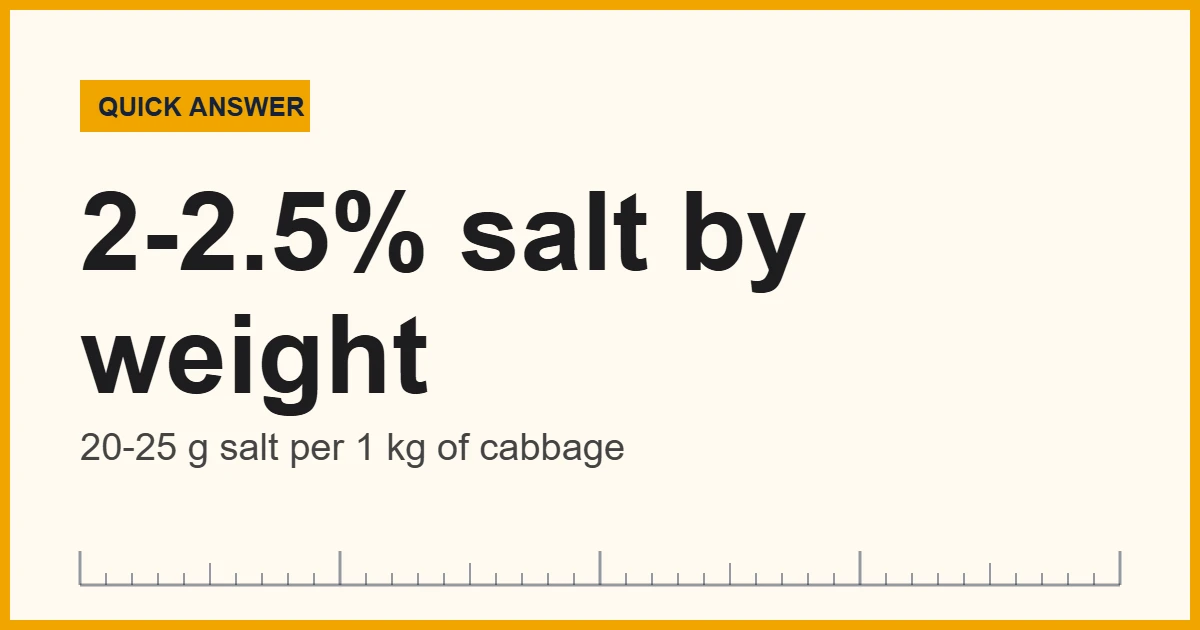
To measure ingredients for sauerkraut, weigh the shredded cabbage on a kitchen scale, then weigh the salt at about 2 to 2.5 percent of that weight. For example, 1 kg (2.2 lb) of cabbage takes 20 to 25 g of salt. In contrast, spoons and cups vary too much between salt types, so weight gives the most repeatable batch.
Convert Cabbage Weight Before You Measure Ingredients for Sauerkraut
Many recipes list cabbage in pounds, while salt guidance is easier to follow in grams. Therefore, enter the weight of your trimmed cabbage below and read it in kilograms, grams and ounces. Then use the salt table further down to find the right amount.
Sauerkraut has only two required ingredients, shredded cabbage and salt. However, the ratio between them decides whether the batch ferments safely, tastes balanced and stays crisp. As a result, learning to measure ingredients for sauerkraut well matters more than any fancy equipment.
The US National Center for Home Food Preservation (NCHFP) publishes a tested method, which you can read in its sauerkraut guide. It gives salt for each 5 pounds of cabbage rather than a vague “to taste”. This page explains how to turn that guidance into exact weights, so you can scale from a quart jar to a full crock.
Salt Needed When You Measure Ingredients for Sauerkraut
Most home fermenting recipes land between 2 and 2.5 percent salt by weight of vegetables. In addition, a University of California extension fact sheet says a salt solution of 1.7 percent or less is too low and that yeast thrives above 2.25 percent. Those figures describe the brine, not the cabbage, but they show why too little and too much salt both cause trouble. The grams below come from simple multiplication of the cabbage weight.
| Cabbage weight | Salt at 2% | Salt at 2.25% | Salt at 2.5% |
|---|---|---|---|
| 500 g (1.1 lb) | 10 g | 11.3 g | 12.5 g |
| 1 kg (2.2 lb) | 20 g | 22.5 g | 25 g |
| 2 kg (4.4 lb) | 40 g | 45 g | 50 g |
| 5 lb (2.27 kg) | 45.4 g | 51.0 g | 56.7 g |
| 10 lb (4.54 kg) | 90.7 g | 102.1 g | 113.4 g |
Pick one column and stay with it from batch to batch. Consequently, you can change the taste in small, deliberate steps instead of guessing. Our guide to measuring ingredients by weight explains the same habit for baking.
Recommended Tools to Measure Ingredients for Sauerkraut
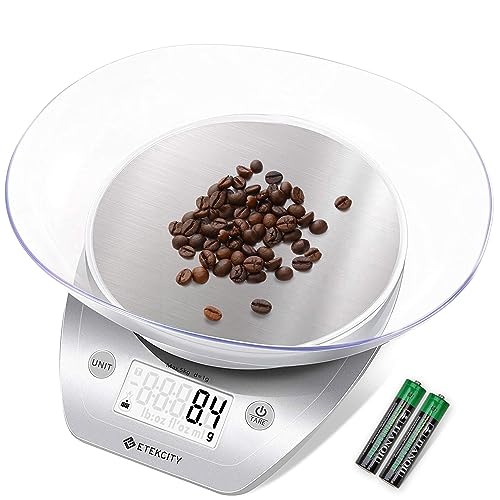
You need very little gear. First, a digital scale that reads in grams and has a tare button does most of the work. Next, a set of sturdy measuring spoons helps with caraway seeds and brine. Finally, a simple thermometer shows whether your kitchen sits in the 70 to 75 degree F range the NCHFP recommends.




As an Amazon Associate, Measuring Expert earns from qualifying purchases.
Key Takeaways
- Weigh the trimmed, shredded cabbage first, because every other amount depends on it.
- Use about 2 to 2.5 percent salt by weight, which is 20 to 25 g per kilogram of cabbage.
- Weigh the salt in grams, since a spoonful of fine salt holds more than a spoonful of coarse salt.
- The NCHFP method uses 3 tablespoons of canning salt for each 5 pounds of cabbage.
- Ferment at 70 to 75 degrees F for about 3 to 4 weeks.
- Keep the same ratio when you scale a batch up or down.
- Follow a tested recipe if you plan to can the finished kraut.
Weight vs Volume: Why a Scale Beats Cups and Spoons
A cup or spoon measures space, not amount. Shredded cabbage packs loosely or tightly depending on how fine you cut it and how hard you press, so a cup of it can differ by a wide margin. Salt behaves the same way. For example, coarse flaky salt takes up more room per gram than fine canning salt, so one tablespoon of each delivers different salt.
The NCHFP page shows how fast volume numbers drift. Its ingredient list calls for 3/4 cup of canning salt for 25 pounds of cabbage, yet its method says to add 3 tablespoons for each 5 pounds. Those are 12 tablespoons and 15 tablespoons for the same 25 pounds. Neither is wrong for its purpose, but the gap shows why weights are easier to repeat.
| Method | Strength | Weakness |
|---|---|---|
| Weighing in grams | Repeatable, scales to any batch size, ignores salt grain size | Needs a scale |
| Spoons and cups | No special gear, fine for small add-ins | Varies with salt type and packing |
| Following a tested volume recipe | Matches the lab-tested method exactly | Only works with the same salt and batch size |
If you only have spoons, use the salt type the recipe names. In that case, canning or pickling salt is the usual choice for kraut. For related conversions, see how much an ounce is in weight and in volume.
How to Measure Ingredients for Sauerkraut Step by Step
- Prepare the cabbage. Remove damaged outer leaves, quarter the head and cut out the core.
- Shred it. Slice the quarters into thin strips, because thinner strips release juice faster.
- Tare the bowl. Place your empty bowl on the scale and press the zero or tare button.
- Weigh the cabbage. Add the shreds and write down the weight in grams.
- Calculate the salt. Multiply the cabbage weight by 0.02 to 0.025. For 1,500 g, that gives 30 to 37.5 g.
- Weigh the salt. Tare a small dish, then add salt until the scale shows your target.
- Mix and massage. Work the salt into the cabbage with clean hands until juice pools at the bottom.
- Pack and cover. Press the cabbage down so the juice rises above it, then weigh it down.
The NCHFP advises working with about 5 pounds of cabbage at a time, so the salt spreads evenly. That tip also keeps the mixing bowl manageable. When you finish packing, write the cabbage weight, salt weight and start date on masking tape.
Add-Ins When You Measure Ingredients for Sauerkraut
Add-ins change the total weight of vegetables, and salt should follow that total. For instance, if you shred 1,000 g of cabbage and 100 g of carrot, base the salt on 1,100 g. At 2 percent, that is 22 g instead of 20 g.
Seeds and spices are different, because they add flavor but almost no weight. Measure caraway or juniper berries with a measuring spoon, and start with a small amount such as 1 teaspoon per 2 pounds. In addition, write the amount down so you can adjust it next time.
Brine for Topping Off the Jar
Sometimes the cabbage does not release enough juice to cover itself. In that case, the NCHFP suggests adding boiled and cooled brine made with 1 1/2 tablespoons of salt per quart of water. A quart is 946 mL, so you can also weigh that salt and water for a consistent solution.
Scale Up or Down: Measure Ingredients for Sauerkraut by Ratio
Because the recipe is a ratio, scaling is easy. Multiply the new cabbage weight by the same percentage, and you are done. As a result, a half-gallon jar and a 10 gallon crock follow the same rule.
| Batch | Cabbage | Salt at 2.25% |
|---|---|---|
| Quart jar | about 500 g (1.1 lb) | 11.3 g |
| Half-gallon jar | about 1 kg (2.2 lb) | 22.5 g |
| Small crock | 5 lb (2.27 kg) | 51.0 g |
| Large crock | 10 lb (4.54 kg) | 102.1 g |
Jar sizes in the table are rough guides, since packing density differs. Always weigh your own cabbage instead of trusting the jar label. For a similar approach to preserved foods, see our notes on canning measurements.
Common Mistakes When You Measure Ingredients for Sauerkraut
- Weighing before trimming. You end up with too much salt for the cabbage that is actually in the crock.
- Swapping salt types by the spoonful. A tablespoon of coarse salt is not a tablespoon of canning salt in grams.
- Forgetting to tare. The bowl weight then counts as cabbage.
- Skipping the vegetables in the total. Carrots and onions count toward the salt calculation.
- Using iodized or additive-heavy salt without checking. Many fermenters prefer pure salt, so read the label.
- Changing the ratio and the temperature together. Then you cannot tell which change caused the result.
Temperature and Time After You Measure
Good measuring only works if the jar sits at a steady temperature. The NCHFP says kraut at 70 to 75 degrees F (21 to 24 degrees C) is fully fermented in about 3 to 4 weeks. At 60 to 65 degrees F (16 to 18 degrees C), it takes about 5 to 6 weeks. Below 60 degrees F, the kraut may not ferment, and above 75 degrees F, it may become soft.
| Room temperature | Expected time |
|---|---|
| 70 to 75 degrees F (21 to 24 degrees C) | About 3 to 4 weeks |
| 60 to 65 degrees F (16 to 18 degrees C) | About 5 to 6 weeks |
| Below 60 degrees F (16 degrees C) | May not ferment |
| Above 75 degrees F (24 degrees C) | May turn soft |
A small room thermometer near the crock removes the guesswork. Meanwhile, check the kraut every few days and skim any scum, as the NCHFP recommends when you weigh it down with jars.
Do and Don’t When You Measure Sauerkraut Ingredients
Do
- Weigh the trimmed cabbage and every vegetable add-in.
- Weigh the salt in grams.
- Keep a note of each batch’s weights.
- Use the same salt type every time.
- Keep the jar in the recommended temperature range.
Don’t
- Guess the cabbage weight from the head size.
- Swap fine and coarse salt by the spoon.
- Cut the salt sharply to make a “low-sodium” kraut.
- Pour hot brine over raw cabbage.
- Round the scale reading up by a handful.
Honest Limits of These Numbers
The percentages on this page are common practice, not a laboratory guarantee for your kitchen. Cabbage varies in water content, so the same weight can release different amounts of juice. Likewise, kitchen scales have limits: a model reading to 1 g can be off by a gram or more on a 20 g salt dose. In short, treat the table as a reliable starting point and adjust to your taste within the range. Do not drop below the lower end, because fermentation safety depends on enough salt.
When to Follow a Tested Recipe
If you plan to can sauerkraut, follow a tested method exactly. The NCHFP lists boiling-water canner times of 10 minutes for pints and 15 minutes for quarts with a hot pack at 0 to 1,000 feet, and the times rise at higher elevations. Therefore, check the current NCHFP page for your altitude before you can anything. Kraut that stays in the refrigerator needs no processing.
Frequently Asked Questions
What is the best way to measure ingredients for sauerkraut?
Weigh the trimmed, shredded cabbage on a digital scale, then weigh salt at about 2 to 2.5 percent of that weight. Weights are more repeatable than cups or spoons.
How much salt do I need per pound of cabbage?
One pound is 453.6 g of cabbage. At 2 to 2.5 percent, that is about 9 to 11 g of salt. The NCHFP method uses 3 tablespoons per 5 pounds.
How much salt for 5 pounds of cabbage?
Five pounds is about 2,268 g. At 2 percent you need 45 g, and at 2.5 percent you need about 57 g. The NCHFP method uses 3 tablespoons of canning salt.
How much salt for 50 pounds of cabbage?
Fifty pounds is about 22.7 kg. At 2 to 2.5 percent, that is roughly 454 to 567 g of salt. Mix it in batches of about 5 pounds so it spreads evenly.
Can I measure ingredients for sauerkraut with cups instead of a scale?
Yes, but results vary. Cabbage packs differently each time, and salt types differ in density. If you use cups and spoons, follow a tested recipe with the same salt it names.
Do I weigh the cabbage before or after coring?
Weigh it after you trim, core and shred it. The core and outer leaves would otherwise inflate the weight and the salt amount.
Should carrots count toward the salt weight?
Yes. Add the weight of carrots and other vegetables to the cabbage weight, then calculate the salt from the total.
What happens if I use too little salt?
Too little salt can lead to soft kraut and a less favorable environment for fermentation. A University of California fact sheet calls a salt solution of 1.7 percent or less too low.
How long should homemade sauerkraut ferment?
At 70 to 75 degrees F it takes about 3 to 4 weeks, according to the NCHFP. At 60 to 65 degrees F it takes about 5 to 6 weeks.
Does the kind of salt matter for sauerkraut?
It matters for volume, not for weight. A gram of salt is a gram of salt, but a spoonful differs by grain size. Many fermenters choose canning or pickling salt without additives.
Measure Ingredients for Sauerkraut: The Bottom Line
To sum up, weigh the trimmed cabbage, multiply by 0.02 to 0.025, and weigh the salt in grams. Add the weight of any vegetables to the total, and keep the jar at 70 to 75 degrees F.
Finally, write down your numbers after each batch. Over time, those notes turn a good method into your own reliable recipe. The converter near the top of this page handles the pounds-to-grams step for you.