

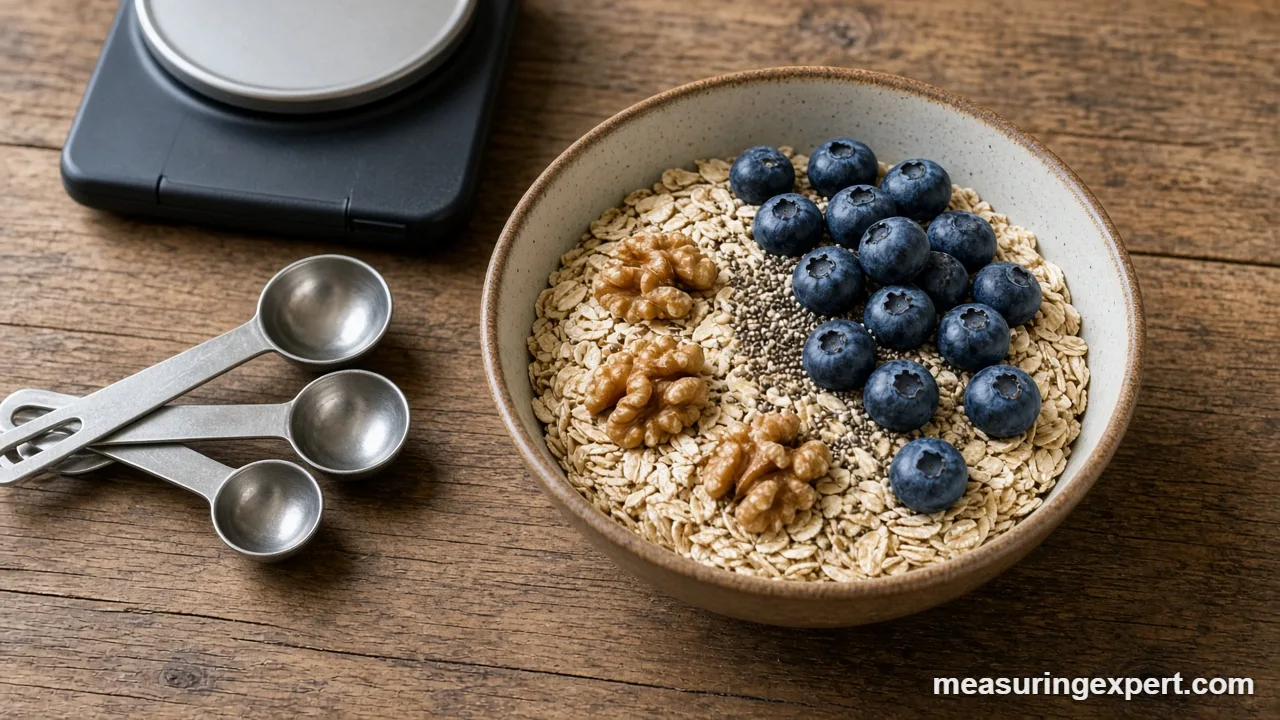
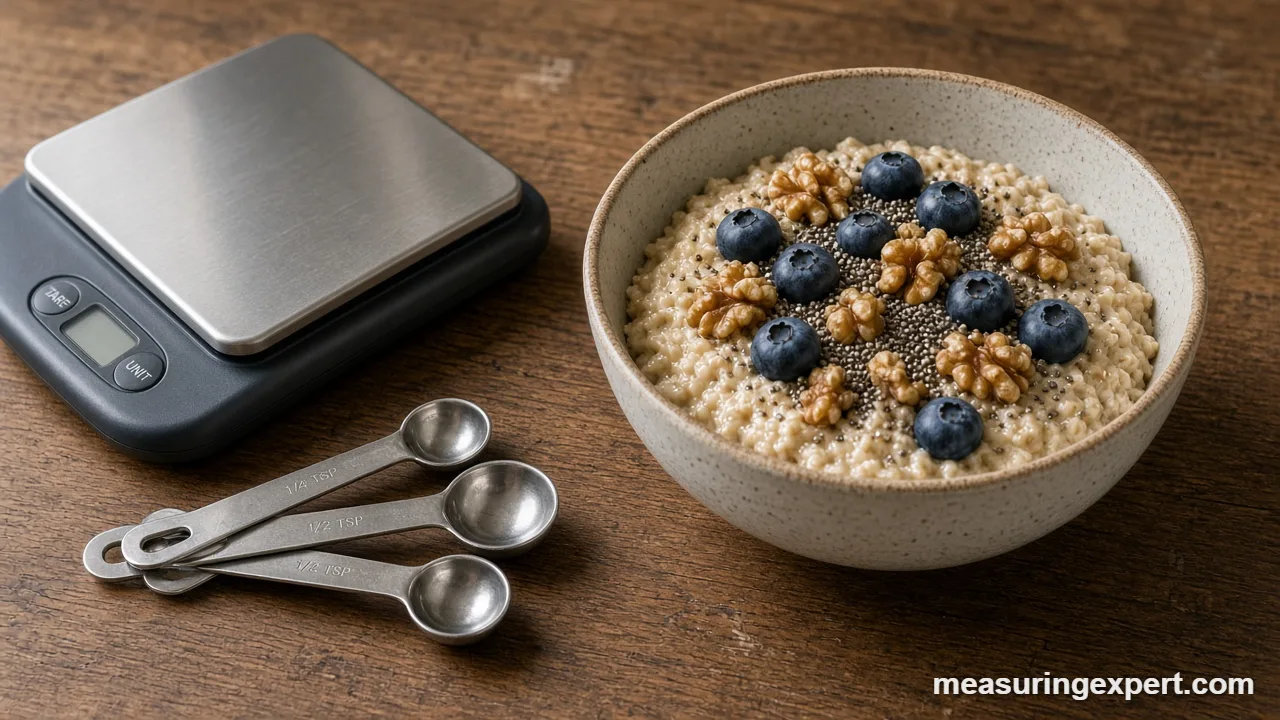
To get consistent brain-boosting recipes, weigh your ingredients in grams instead of scooping them. First, set a bowl on a digital scale, press tare, and add each item by weight. Then use level spoons for oils, seeds and spices, and read liquid cups at eye level. As a result, weighing keeps every portion the same.
Convert Grams to Ounces for Brain-Boosting Recipes
Recipes for smoothies, oat bowls and fish dishes often list grams, but many US scales and labels show ounces. First, enter a weight below to switch units. The converter uses the exact NIST definition, so 1 ounce is 28.3495 g.
“Brain-boosting” is a popular label for dishes built around berries, nuts, seeds, eggs, fish and olive oil. In addition, this page makes no health claims about any of them. Instead, it covers the part a kitchen scale can settle: how much of each ingredient actually goes into the bowl.
Measuring matters here because these recipes use small amounts of dense, high-fat or sticky foods. For example, a heaped spoon of chia or a loosely packed cup of walnuts can differ a lot from the next one. As a result, portions and macros drift from batch to batch unless you weigh.
Next, you will find gram weights for common ingredients, a worked bowl, a method for macros by weight, and tips for fish, oils and batch cooking. For a similar approach to blended drinks, see measuring ingredients for milkshakes.
Gram Weights for Common Brain-Boosting Recipes
These weights come from the King Arthur Baking ingredient weight chart. Also, the last column divides the chart value to get a tablespoon or single-item weight, rounded. Treat all values as typical, because brands, grind and moisture differ.
| Ingredient | Chart amount | Grams | About per tbsp or each |
|---|---|---|---|
| Rolled oats | 1 cup | 113 g (4 oz) | 7 g per tbsp |
| Walnuts, chopped | 1 cup | 113 g (4 oz) | 7 g per tbsp |
| Almonds, whole | 1 cup | 142 g (5 oz) | – |
| Blueberries, fresh or frozen | 1 cup | 140 to 170 g (5 to 6 oz) | – |
| Chia seeds | 1/4 cup | 37 g (1 1/3 oz) | 9 g per tbsp |
| Flax meal | 1/2 cup | 50 g (1 3/4 oz) | 6 g per tbsp |
| Olive oil | 1/4 cup | 50 g (1 3/4 oz) | 12.5 g per tbsp |
| Honey | 1 tbsp | 21 g (3/4 oz) | 21 g per tbsp |
| Almond butter | 1/4 cup | 68 g (2 1/3 oz) | 17 g per tbsp |
| Unsweetened cocoa | 1/2 cup | 42 g (1 1/2 oz) | 5 g per tbsp |
| Egg, large, out of the shell | 1 egg | 50 g (1 3/4 oz) | 50 g each |
Recommended Tools for Brain-Boosting Recipes
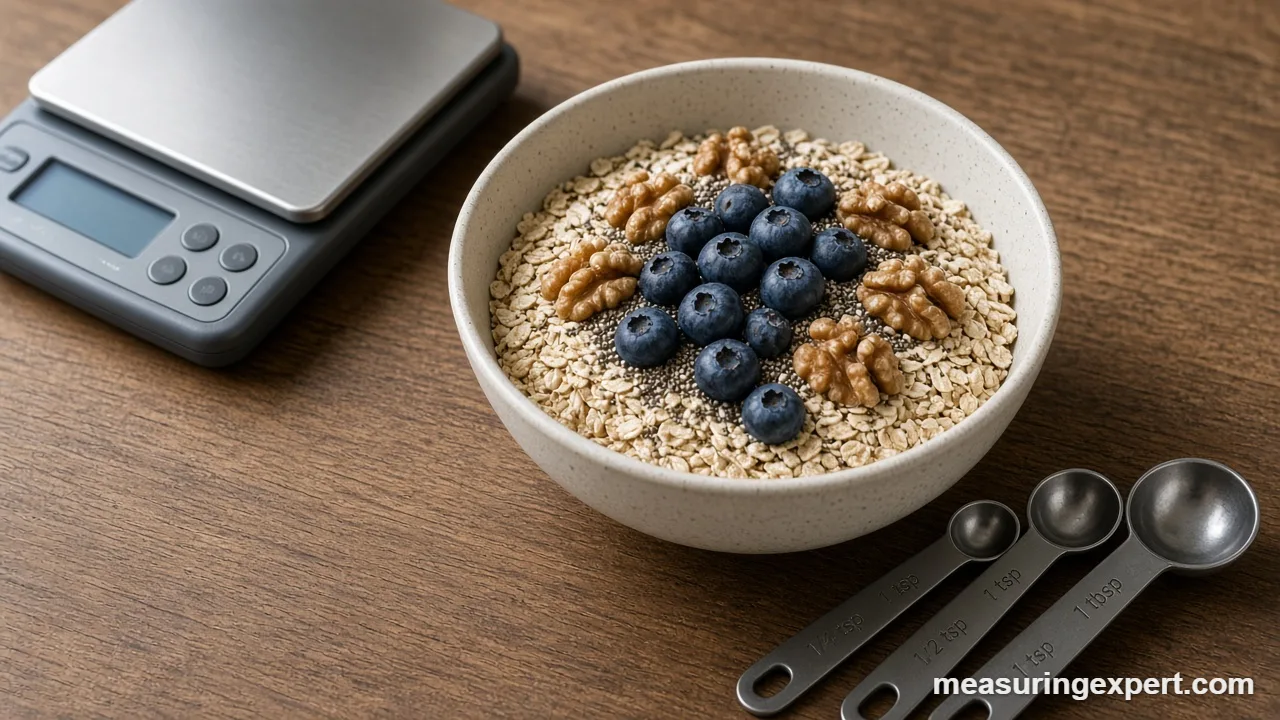
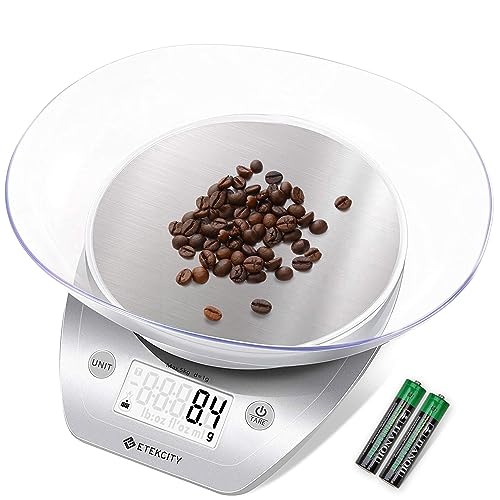
In short, a few basics cover almost every recipe. First, a digital scale with a tare button does most of the work. Next, a set of measuring spoons handles seeds, spices and oils. Finally, a clear liquid measuring cup helps with milk, broth and juice. Also, look for a scale with 1 g steps or finer and a platform wide enough for a mixing bowl.

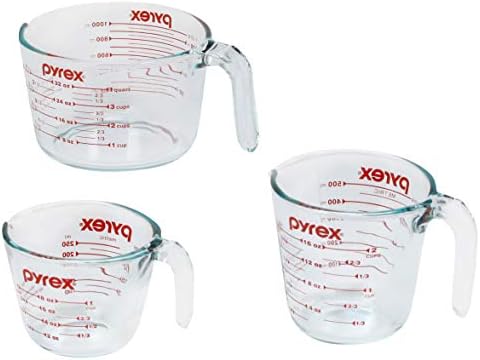


As an Amazon Associate, Measuring Expert earns from qualifying purchases.
Key Takeaways
- Weigh in grams, because a scale ignores packing and berry size.
- One large egg out of the shell is about 50 g.
- Chia is about 9 g per tablespoon and olive oil about 12.5 g.
- Press tare between ingredients to weigh everything in one bowl.
- Multiply a food’s per-100 g label values by your weight to get macros.
- Log raw and cooked foods against matching entries.
- This page covers measuring only and makes no health claims.
How to Weigh the Ingredients in Brain-Boosting Recipes
- Prepare the scale. First, put it on a flat counter and switch it to grams.
- Tare the bowl. Place the empty bowl on the platform and press tare so it reads 0.
- Weigh the biggest ingredient first. Then add it until the display matches the recipe.
- Tare and add the next one. Press tare after each addition so you read only the new weight.
- Use spoons for the tiny amounts. Next, level each spoon of seeds or spices with a straight edge.
- Read liquids at eye level. Also, set the cup on the counter and check the line at the bottom of the curve.
- Record the weights. Write the grams down so the next batch matches.
A Worked Example: One Breakfast Bowl by Weight
First, here is an illustrative bowl, not a recommendation. In short, the point is to show how weights add up and how tare keeps the math simple. Moreover, you can swap any ingredient and keep the same method.
| Ingredient | Weight for 1 bowl | Same amount in ounces |
|---|---|---|
| Rolled oats | 40 g | 1.41 oz |
| Blueberries | 75 g | 2.65 oz |
| Chopped walnuts | 15 g | 0.53 oz |
| Chia seeds (about 1 tbsp) | 9 g | 0.32 oz |
| Plain yogurt | 150 g | 5.29 oz |
| Total | 289 g | 10.19 oz |
For example, seventy-five grams of blueberries is roughly half a cup, based on the chart range. Similarly, fifteen grams of walnuts is about 2 tablespoons chopped, since the chart works out to about 7 g per tablespoon. In addition, the total tells you what the full bowl weighs on the plate.
Macros by Weight for Brain-Boosting Recipes
In short, tracking macros by weight is multiplication. For instance, many labels list nutrients per 100 g, which makes the math easy. The FDA explains that the nutrient amounts on a label apply to one serving, so a different amount means scaling the numbers up or down, as described on its Nutrition Facts label guide.
Next, here is an example with made-up values. A food lists 12 g protein, 6 g carbohydrate and 15 g fat per 100 g, and you weigh 35 g.
| Macro | Label per 100 g | Math for 35 g | Result |
|---|---|---|---|
| Protein | 12 g | 12 x 0.35 | 4.2 g |
| Carbohydrate | 6 g | 6 x 0.35 | 2.1 g |
| Fat | 15 g | 15 x 0.35 | 5.25 g |
First, divide your weight by 100 to get the multiplier, here 0.35. Then multiply each label value by it. Finally, add the results for every ingredient to get the recipe total, and divide by the number of portions.
However, when the label uses a serving size instead, divide your weight by the serving weight first. Also, our guide to measuring ingredients for keto shows that version step by step.
Eggs, Fish and Oil: Weighing the Tricky Ones
Eggs vary, so weigh them if a recipe depends on it. For instance, a large egg is about 50 g without its shell, which means 2 eggs are about 100 g. Next, whisk the eggs in a tared bowl and pour or spoon out the amount you need.
Fish and meat lose water as they cook, so cooked weight is lower than raw weight. Therefore, log a food in the same state as the entry you choose, and do not mix the two. In addition, weigh portions before cooking if you want to compare batches fairly.
In fact, oils are easiest in grams. For example, pour olive oil straight into a tared pan or bowl rather than using a spoon, which leaves a film behind. In other words, about 12.5 g equals one tablespoon, based on the chart. For salads, see how Mediterranean salad dressing is measured.
Scaling and Batch Cooking Brain-Boosting Recipes
Fortunately, weights make meal prep simple. Next, to make 4 bowls from the example above, multiply each weight by 4. As a result, that gives 160 g oats, 300 g blueberries, 60 g walnuts, 36 g chia and 600 g yogurt, for 1,156 g in total.
Then divide the finished mix by the number of portions. Alternatively, if you stir everything in one large container, tare the container, add the ingredients, and weigh out 289 g per bowl. As a result, every portion matches without counting scoops.
Do and Don’t for Brain-Boosting Recipes
Do
- Weigh nuts, seeds and oats in grams.
- Tare between every ingredient.
- Level spoons for chia, flax and spices.
- Match raw weights to raw entries.
- Write down your gram weights.
Don’t
- Pack nuts or berries into a cup.
- Use eating spoons as measuring spoons.
- Read liquids from above the line.
- Compare cooked and raw weights directly.
- Round gram values up out of habit.
Honest Limits of Measuring Ingredients
A scale gives an accurate weight, but it cannot tell you what a food contains. In addition, nutrition values come from labels or databases, and both are averages. Consequently, your computed macros are estimates.
However, chart weights are typical, not guaranteed. Similarly, berries, nuts and oats differ by brand and season. Cheap scales can also drift by a gram or two, so test yours with an item of known weight, such as a packaged block of butter.
When to Ask a Professional
Overall, this guide explains how to measure ingredients and portions. It also does not say what you should eat or what any food does for the body. Instead, questions about nutrition, memory, medicines or allergies belong with a doctor or registered dietitian.
Frequently Asked Questions
What is the best way to measure brain-boosting recipes?
First, weigh the ingredients in grams on a digital scale. Weights stay the same no matter how you pack or scoop, so portions match from batch to batch.
How many grams is a cup of rolled oats?
King Arthur Baking lists 1 cup of rolled oats at 113 g, or 4 oz. In other words, that is about 28 g per 1/4 cup.
How many grams is a cup of blueberries?
King Arthur Baking lists 1 cup of fresh or frozen blueberries at 140 to 170 g. In fact, the range reflects berry size and how they sit in the cup.
How many grams is a tablespoon of chia seeds?
About 9 g. King Arthur Baking lists 1/4 cup of chia at 37 g, and 37 divided by 4 is 9.25 g.
How much does one large egg weigh?
King Arthur Baking lists a large egg at 50 g, or 1 3/4 oz, without the shell.
Should I measure brain-boosting recipes by weight or by cups?
In short, weight is more consistent. However, cups are fine for rough cooking, but nuts, berries and seeds pack differently each time.
How do I calculate macros by weight?
First, divide your weighed grams by 100 if the label lists per 100 g. Then multiply each label value by that number, as in the worked table above.
Do I weigh fish raw or cooked?
Overall, either works if you stay consistent. Cooked fish weighs less because it loses water, so match your weight to a raw or cooked database entry.
How accurate does a kitchen scale need to be?
Overall, a scale with 1 g steps handles most recipes. Also, models with 0.1 g steps help with small amounts such as spices.
Do brain-boosting recipes on this page come with health claims?
No. Instead, this guide covers measuring and portions only. Therefore, ask your doctor or a registered dietitian about nutrition.
Brain-Boosting Recipes: The Bottom Line
To sum up, weigh your ingredients in grams, tare between additions, and keep spoons level for small amounts. In short, chart weights such as 113 g of oats per cup and 50 g per large egg make good checkpoints. Moreover, one multiplier scales a recipe or a whole week of meal prep.
Finally, remember that macros by weight are simple multiplication on top of careful measuring. Also, use the converter at the top whenever a recipe switches between grams and ounces.