

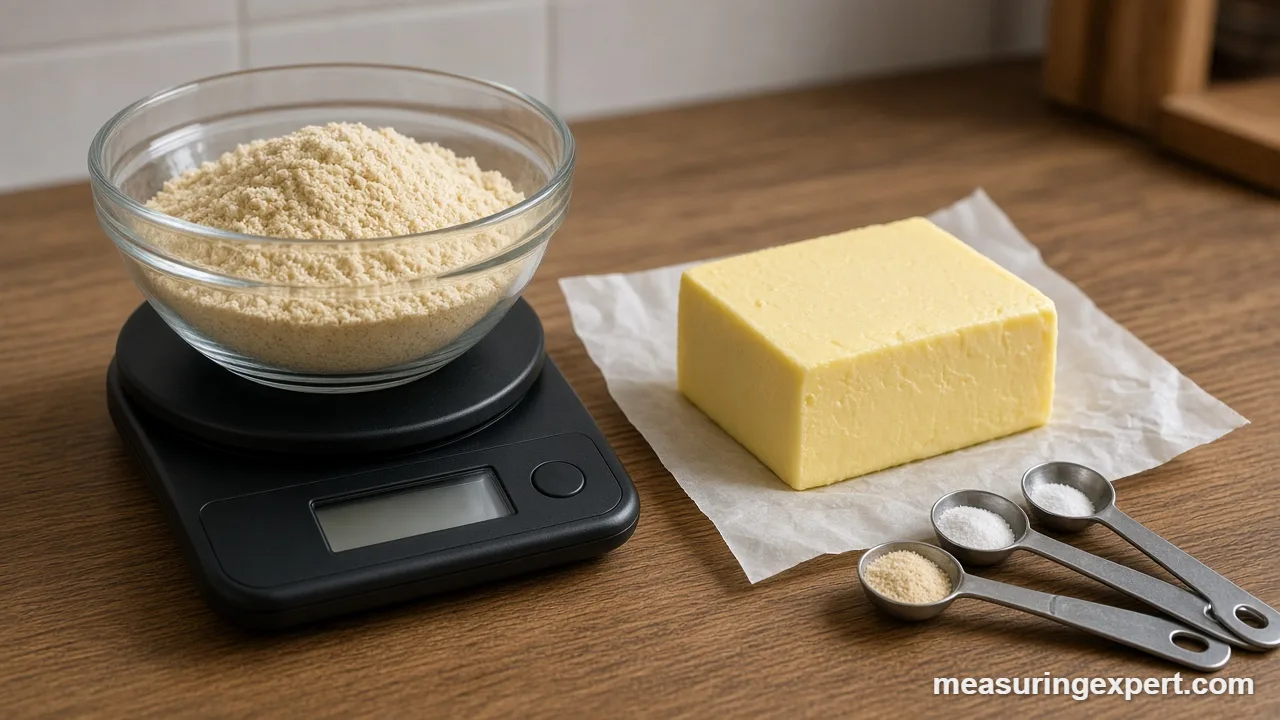
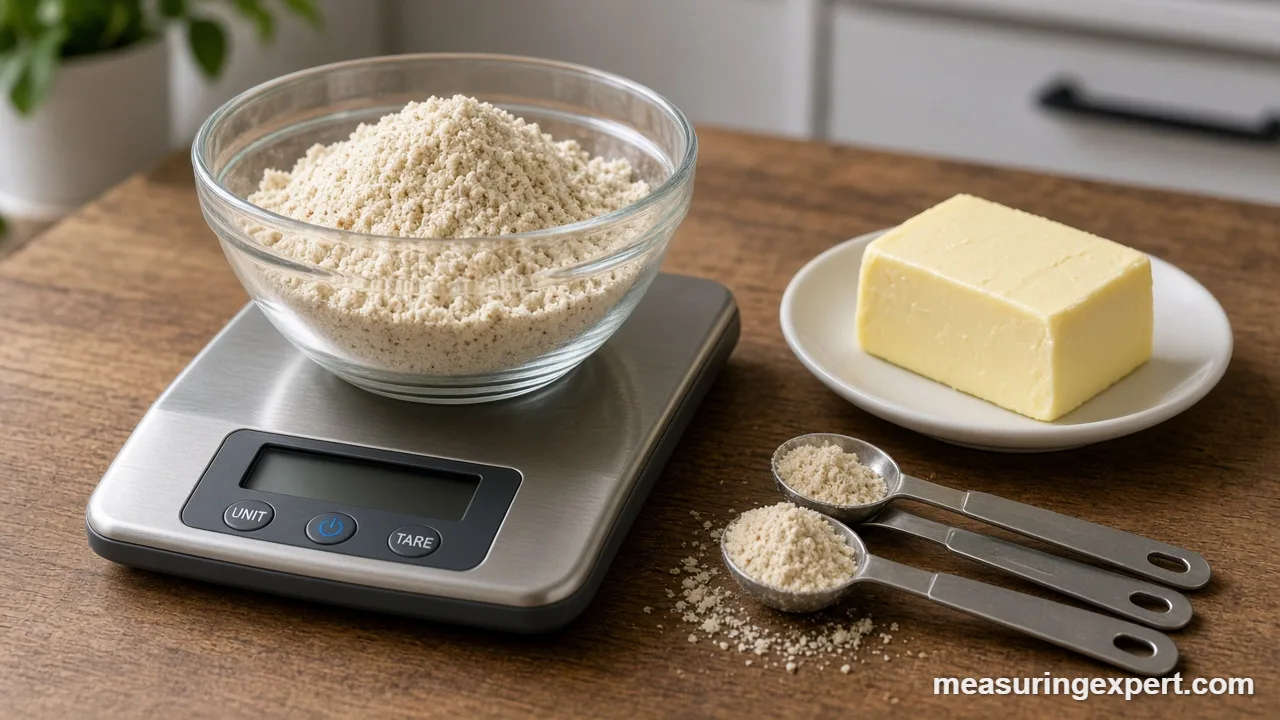
The best way to measure ingredients for keto recipes is by weight. Put a bowl on a digital scale, press tare, and add each ingredient in grams. Cups and spoons change with how you scoop and pack, whereas grams do not, so weighing keeps portions and macros by weight consistent.
Convert Grams and Ounces When You Measure Ingredients for Keto
Many keto recipes list grams, while US scales and labels often show ounces. Enter an amount below to switch between the two. The converter uses the exact NIST definitions, so 1 ounce is 28.3495 g and 1 pound is 453.59 g.
Keto-style cooking leans on nut flours, oils, cheese and cream. These ingredients are dense, and small errors in them add up fast. A heaped cup of almond flour, for example, can hold noticeably more than a lightly spooned one. As a result, two cooks can follow the same recipe and log different carbohydrate totals.
In short, weighing fixes most of that drift. This guide shows how to measure ingredients for keto recipes with a scale, which gram weights to expect for common ingredients, and how to scale a recipe. It also explains how to turn a label into macros by weight. Everything here is about measuring and portions, not about what you should eat.
For a second view on weighing, see how the same habit works in sourdough baking by weight.
Why Weight Beats Volume When You Measure Ingredients for Keto
A cup measures space, not mass. How much almond flour fits in that space depends on how finely it is ground, how settled it is, and how you fill the cup. Grams measure the amount of ingredient itself, so 96 g is 96 g however fluffy the bag feels.
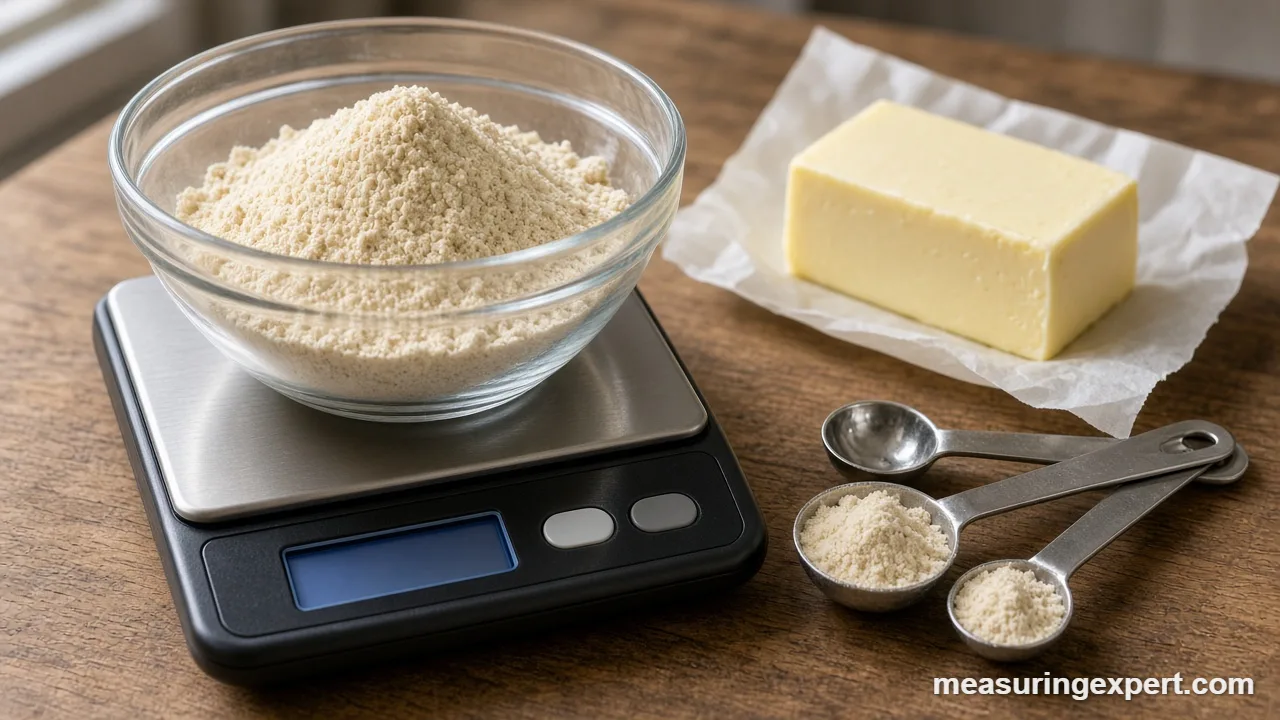
NIST notes that its kitchen equivalents are approximate and meant for home cooking. Its metric kitchen equivalencies page lists 1 cup as about 240 mL and 1 ounce as about 28 g. In other words, a cup is a convenient guide, whereas a scale gives the actual quantity.
The table below also shows why one cup is not one weight. Butter, cream and almond flour fill the same cup yet weigh very different amounts.
Grams per Cup and Tablespoon for Common Keto Ingredients
These weights come from the King Arthur Baking ingredient weight chart. The per-tablespoon column is simple division of the chart value, rounded. Treat every number as a typical value, because brands and packing differ.
| Ingredient | Chart amount | Grams | About per tbsp |
|---|---|---|---|
| Almond flour | 1 cup | 96 g (3 3/8 oz) | 6 g |
| Coconut flour | 1 cup | 128 g (4 1/2 oz) | 8 g |
| Flax meal | 1/2 cup | 50 g (1 3/4 oz) | 6 g |
| Unsweetened cocoa | 1/2 cup | 42 g (1 1/2 oz) | 5 g |
| Butter | 8 tbsp (1/2 cup) | 113 g (4 oz) | 14 g |
| Coconut oil | 1/2 cup | 113 g (4 oz) | 14 g |
| Heavy cream | 1 cup | 227 g (8 oz) | 14 g |
| Shredded cheese (cheddar, jack, mozzarella, Swiss) | 1 cup | 113 g (4 oz) | 7 g |
| Walnuts, chopped | 1 cup | 113 g (4 oz) | 7 g |
| Pecans, whole | 1 cup | 105 g (3 3/4 oz) | 7 g |
| Macadamia nuts, whole | 1 cup | 149 g (5 1/4 oz) | 9 g |
Recommended Tools to Measure Ingredients for Keto
In fact, you need very little gear. First, a digital scale with a tare button handles nearly everything. Next, a set of measuring spoons covers spices and small amounts. Look for a scale that reads in 1 g steps or finer, switches between grams and ounces, and has a platform big enough to hold a mixing bowl.


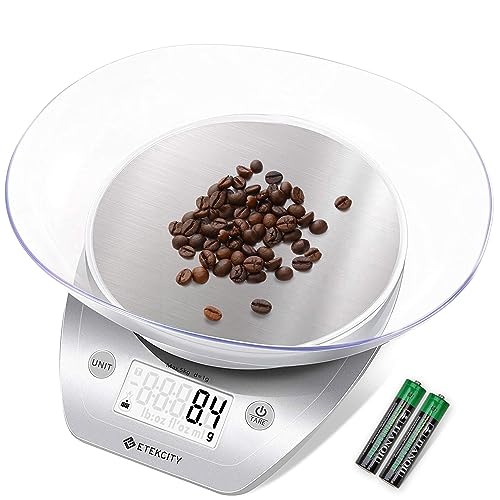


As an Amazon Associate, Measuring Expert earns from qualifying purchases.
Key Takeaways
- Weigh in grams, because grams do not change with packing.
- Almond flour is about 96 g per cup and coconut flour about 128 g.
- One tablespoon of butter weighs about 14 g.
- Tare the bowl before every new ingredient.
- Log each food in the state the database or label describes, raw or cooked.
- Scale every ingredient by the same factor when you resize a recipe.
- This page covers measuring only and does not give dietary advice.
How to Weigh Ingredients for a Keto Recipe, Step by Step
- Set up the scale. Place it on a flat, hard surface and switch it to grams.
- Add the bowl and tare. Put your empty bowl on the platform and press tare so the display reads 0.
- Weigh the first ingredient. Spoon it in until the display matches the recipe weight.
- Tare again. Press tare, then add the next ingredient into the same bowl.
- Repeat for each item. Work from the largest amount to the smallest, which keeps small amounts easy to control.
- Weigh liquids the same way. Oil and cream can go straight into the bowl in grams, which also saves a measuring cup.
- Write down the total. Note the final weights so you can repeat or scale the batch later.
Macros by Weight: Turning a Label Into Gram Math
Tracking macros by weight means multiplying a food’s weight by its per-gram values. Nutrition labels list a serving size in grams, plus grams of total carbohydrate, dietary fiber, protein and fat for that serving. Some keto trackers subtract fiber from total carbohydrate, so check which method your app uses.
For example, here is a worked example using made-up label numbers. A label lists 30 g per serving, with 6 g total carbohydrate and 3 g fiber. You weigh 90 g of the food for a recipe.
| Step | Math | Result |
|---|---|---|
| Servings in your portion | 90 g / 30 g | 3 servings |
| Total carbohydrate | 3 x 6 g | 18 g |
| Fiber | 3 x 3 g | 9 g |
| Total carbohydrate minus fiber | 18 g – 9 g | 9 g |
The same steps work for any food. First, find the serving weight on the label. Then divide your weighed amount by it, and multiply each macro by that number. Finally, add up every ingredient to get the recipe total, and divide by the number of portions you cut.
Two habits keep the math honest. Raw and cooked foods weigh differently because cooking drives off water, so log a food in the same state as the entry you choose. In addition, pick one data source for each ingredient and stick with it. For a deeper look at labels and carb counting with a scale, see measuring ingredients for diabetic recipes.
Small Amounts: Spoons Still Have a Job
Scales that read to 1 g struggle with a quarter teaspoon of salt or a pinch of sweetener. For those amounts, level measuring spoons are fine. One US teaspoon is about 4.93 mL and one tablespoon about 14.79 mL, while nutrition labels round them to 5 mL and 15 mL.
Also, level each spoon with a straight edge. Heaped spoons can hold twice as much as level ones, which matters for strong ingredients such as baking powder. A scale with 0.1 g steps is a worthwhile upgrade if you often weigh spices or concentrated sweeteners.
Do and Don’t When You Measure Ingredients for Keto
Do
- Weigh nut flours instead of scooping them.
- Press tare between ingredients.
- Check that the scale is set to grams.
- Use level spoons for tiny amounts.
- Record weights so you can repeat the recipe.
Don’t
- Pack almond or coconut flour into a cup.
- Swap coconut flour for almond flour cup for cup.
- Weigh on a soft or tilted surface.
- Mix up fluid ounces and weight ounces.
- Log cooked food against a raw entry.
Scaling a Keto Recipe Up or Down
Fortunately, weights make resizing simple. First, pick a factor, then multiply every ingredient by it. To make 1.5 times a recipe, a base of 96 g almond flour becomes 144 g, and 113 g of butter becomes 169.5 g, which rounds to 170 g.
To halve a recipe, divide by two: 227 g of cream becomes 113.5 g. Cups and spoons make this awkward, because half of 3 tablespoons is 1 1/2 tablespoons. As a result, grams just divide.
Keep the pan in mind, too. However, a larger batch usually needs a bigger pan and a different bake time, and a scale cannot answer that. Follow the recipe’s pan size and doneness cues instead of a timer alone. For more on scaling and labels, read our guide to measuring food gift ingredients.
Honest Limits of Weighing Ingredients
Overall, a scale is only as good as its calibration and its surface. Cheap scales can drift by a gram or two, and they read low when the battery fades. Test yours with an item of known weight, such as a new box of butter that states its net weight.
However, weights in charts are typical values. Products differ by brand, moisture and grind, so your almond flour might weigh slightly more or less per cup than the table shows. Similarly, nutrition labels round their numbers, so the macros you compute are close estimates rather than lab results.
When to Ask a Professional
This page explains how to measure ingredients for keto recipes. It does not tell you how much to eat. Questions about carbohydrate targets, medicines, allergies or health conditions belong with a doctor or registered dietitian.
Frequently Asked Questions
How do you measure ingredients for keto recipes without a scale?
Instead, use measuring cups and spoons, fill them gently, and level each with a straight edge. Do not pack nut flours. Results will vary more than with a scale, so weigh when you can.
Is it better to weigh or use cups to measure ingredients for keto?
Weighing is better because grams do not depend on packing. However, cups still work for rough cooking, such as a handful of cheese on top of a casserole.
How many grams is a cup of almond flour?
King Arthur Baking lists 1 cup of almond flour at 96 g, or 3 3/8 oz. That works out to about 6 g per tablespoon.
How many grams is a cup of coconut flour?
King Arthur Baking lists 1 cup of coconut flour at 128 g, or 4 1/2 oz. That is about 8 g per tablespoon.
How many grams is a tablespoon of butter?
About 14 g. King Arthur Baking lists 8 tablespoons of butter at 113 g, and 113 divided by 8 is about 14.1 g.
Should I weigh meat raw or cooked?
Either works if you stay consistent. Cooked meat weighs less because it loses water, so log it against a cooked entry, or log the raw weight against a raw entry.
How do I work out macros by weight from a label?
First, divide your weighed grams by the label’s serving weight. Then multiply each macro on the label by that number. The example table above shows each step.
Do I weigh oil and cream in grams or milliliters?
Grams are simpler, because you can pour straight into a tared bowl. Oil and cream differ in weight per milliliter, so converting by volume needs an ingredient-specific figure.
How accurate does a kitchen scale need to be?
A scale that reads in 1 g steps handles most recipes. Models with 0.1 g steps help with small amounts such as spices and concentrated sweeteners.
Does this guide set carb targets when I measure ingredients for keto?
No. It covers measuring only. Ask your doctor or a registered dietitian about personal targets.
Measure Ingredients for Keto: The Bottom Line
To sum up, weigh your ingredients in grams, tare between additions, and use level spoons for tiny amounts. Almond flour near 96 g per cup and butter near 14 g per tablespoon are handy checkpoints. Moreover, one factor scales the whole recipe.
Finally, remember that tracking macros by weight is just multiplication on top of good measurements. Use the converter at the top whenever a recipe switches between grams and ounces.