

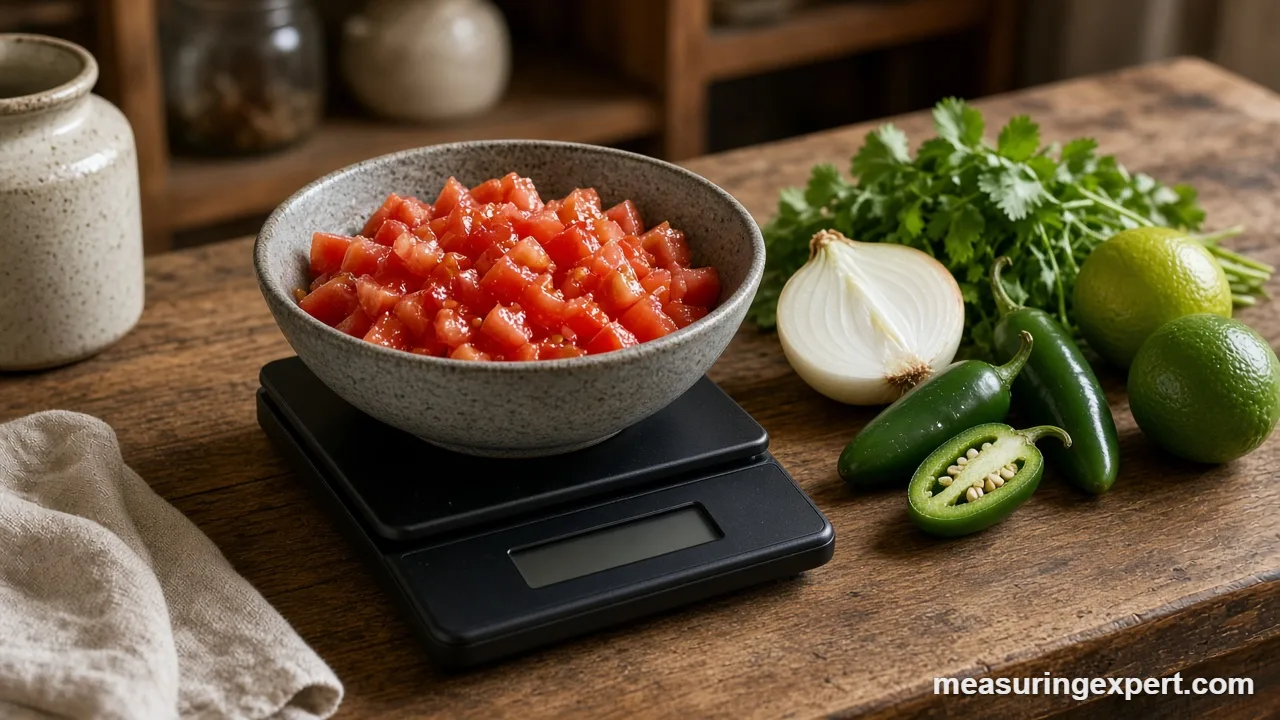
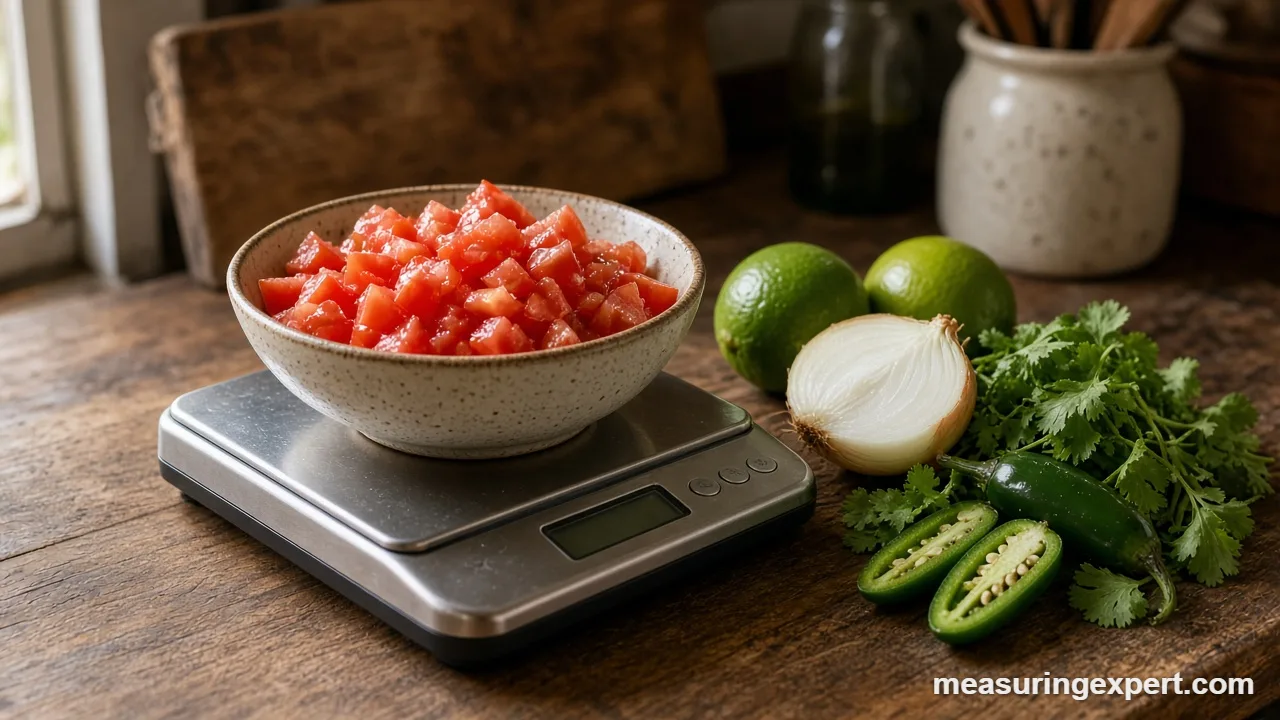
To measure ingredients for salsa, weigh the tomatoes, onions and chiles on a kitchen scale, and use spoons only for small amounts of salt and lime juice. A good starting point is 500 g of tomatoes with about 4 g of salt. Then taste, adjust, and write down the final weights.
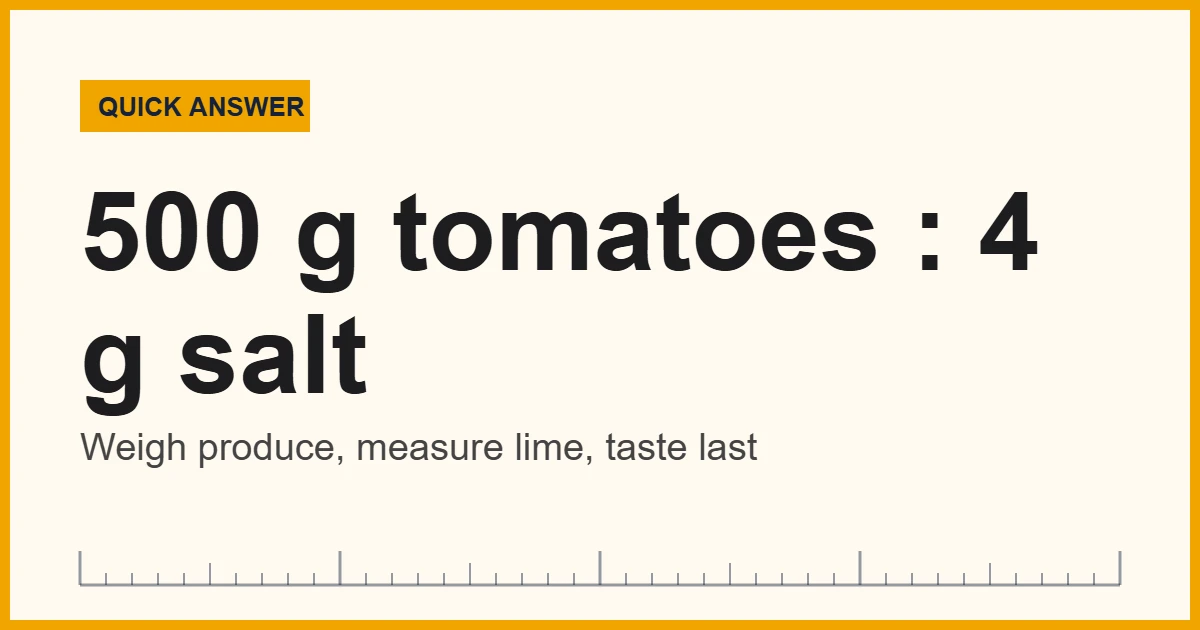
Convert Grams and Ounces to Measure Ingredients for Salsa
Enter the weight of your tomatoes, onions or chiles in grams. The converter then shows the same weight in ounces, pounds and kilograms, so a recipe from any country works with the scale you own.
Most salsa recipes online give amounts like “2 tomatoes” or “a handful of cilantro”. As a result, two cooks following the same recipe can end up with very different bowls. One tomato may weigh 100 g, and another may weigh 250 g. Meanwhile, a “handful” depends on the size of the hand.
Weight solves that problem. In fact, King Arthur Baking’s ingredient weight chart recommends a digital scale for the best results, because the same volume of an ingredient can weigh quite different amounts. The same logic applies to salsa, even though salsa is more forgiving than a cake.
This guide gives you a starting formula by weight, then explains where the real errors hide. First, you will see why salt is the biggest trap. After that, you will learn how to scale a batch and when a salsa recipe must never be changed at all.
A Starter Formula to Measure Ingredients for Salsa by Weight
The table below is a starting point for a fresh tomato salsa, not a rule. For example, a cook who likes more heat can raise the chile, while a cook who likes it mild can cut it in half. However, the weights give you a baseline, so every change becomes something you can write down and repeat.
| Ingredient | Weight or volume | Also equals |
|---|---|---|
| Ripe tomatoes, chopped | 500 g | 17.6 oz, about 1.1 lb |
| White onion, finely chopped | 80 g | 2.8 oz |
| Jalapeno, seeded and minced | 30 g | 1.1 oz |
| Cilantro leaves, chopped | 15 g | 0.5 oz |
| Fresh lime juice | 30 mL | 2 tbsp, 1 fl oz |
| Salt | 4 g | See the salt table below |
Together these add up to roughly 655 g, so the salt is about 0.6 percent of the batch. In addition, the lime juice makes up a little under 5 percent. Start there, taste, and then change one ingredient at a time.
Recommended Tools to Measure Ingredients for Salsa
You need very little equipment. First, a digital scale with a tare button handles the tomatoes, onions and chiles in one bowl. Next, a set of level measuring spoons covers salt and small amounts of spice. Finally, a clear measuring cup with a spout works for lime juice and other liquids.


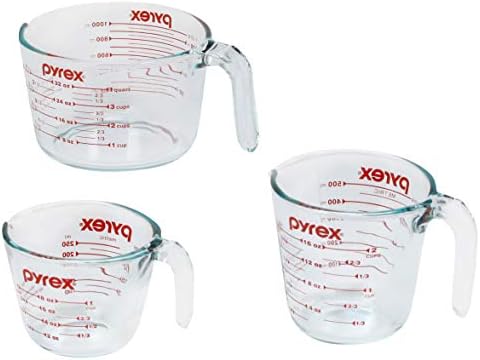


As an Amazon Associate, Measuring Expert earns from qualifying purchases.
Key Takeaways
- First, weigh tomatoes, onions and chiles instead of counting pieces.
- Also, the starter formula uses 500 g of tomatoes, 30 mL of lime juice and 4 g of salt.
- Salt is the biggest trap, because 1 tablespoon weighs 8 g, 16 g or 18 g depending on the type.
- In addition, scale every ingredient by the same factor when you make a bigger batch.
- Therefore, taste after each change and write the new weights down.
- Canned salsa is different: the tested proportions must never be changed.
Why It Matters When You Measure Ingredients for Salsa
Salsa has only a handful of ingredients, so each one shows. A little too much onion turns sharp. Too little lime leaves the bowl flat. Because there is no cooking step to blend the flavors, mistakes stay visible.
Fresh produce adds another problem. Tomatoes vary in water content, so a watery batch needs a different amount of salt than a dense one. Similarly, chiles differ from pepper to pepper, and most of the heat sits in the white ribs and seeds. For that reason, weights give you a fixed starting point, and your tongue does the final tuning.
Salt: The Biggest Source of Error
Salt causes more trouble than any other salsa ingredient. The reason is simple: salt crystals differ in size and shape, so the same spoon holds a different weight of each type. According to King Arthur Baking, 1 tablespoon of Diamond Crystal kosher salt weighs 8 g, Morton kosher salt weighs 16 g, and table salt weighs 18 g.
Dividing by three gives the teaspoon weights. As a result, the 4 g in the starter formula looks very different depending on the box in your cupboard.
| Salt type | Weight per tablespoon | Weight per teaspoon | Spoonfuls for 4 g |
|---|---|---|---|
| Diamond Crystal kosher | 8 g | 2.7 g | 1 1/2 tsp |
| Morton kosher | 16 g | 5.3 g | 3/4 tsp |
| Table salt | 18 g | 6.0 g | 2/3 tsp |
How to Measure Ingredients for Salsa Step by Step
- Put an empty bowl on the scale. Use a flat counter so the reading does not drift.
- Press tare. The display returns to zero, so only the food is counted.
- Weigh the chopped tomatoes first. Drain any pooled juice if the tomatoes are very ripe.
- Tare and add the onion. Stop at the target weight, because removing extra is messy.
- Tare and add the chile and cilantro. Add the chile in two halves, so you can taste in between.
- Measure the lime juice in a clear cup. Read the line at eye level.
- Add the salt last. Use the weight in grams if your scale reads to 1 g, or the spoon amount for your salt type.
- Taste and write down the final amounts. The next batch then starts from a number, not a memory.
Tomatoes, Onions and Chiles: Weight Beats Cups
Chopped vegetables pack differently depending on the knife cut. For example, a cup of finely minced onion holds more than a cup of rough chunks. Likewise, a cup of seeded tomato weighs less than a cup with the seeds and gel left in. Weighing removes both problems.
The usual conversion also helps when a recipe uses pounds. One pound is 453.59 g, so 500 g of tomatoes is about 1.1 lb. If your recipe lists pounds, use the converter near the top of this page. For a wider look at weights in cooking, see our cups to grams guide.
Chiles deserve a short note. Because the heat varies from one pepper to the next, add half of the chile, taste, and then add more. In short, weigh for repeatability and taste for heat.
Lime Juice and Other Acids
Lime juice is a liquid, so it is best measured by volume in a marked cup or a measuring spoon. The starter formula uses 30 mL, which is 2 tablespoons. If you need to convert a different amount, our guide on how to measure with a measuring cup explains liquid cups in detail.
Fresh limes vary in juice from one fruit to the next. Therefore, juice the limes into the cup first, then add the juice a spoonful at a time. Taste between additions, because it is easy to add acid and hard to remove it.
Canning Salsa: Do Not Change the Ratios
Everything above is for salsa you plan to eat fresh. Canned salsa follows different rules, because the acid level decides whether the jar is safe. The National Center for Home Food Preservation (NCHFP) publishes a tested recipe called Choice Salsa. It yields about 6 pint jars and uses 6 cups of chopped tomatoes, 9 cups of diced onions and peppers, 1 1/2 cups of commercially bottled lemon or lime juice, and 3 teaspoons of canning salt.
The acid is 1 1/2 cups for every 15 cups of vegetables, which is 10 percent by volume. NCHFP states that the proportions of tomatoes, vegetables and acid must not be altered, and that vinegar must not replace the lemon or lime juice. In addition, the listed processing time for pints at 0 to 1,000 feet of elevation is 15 minutes in a boiling water canner, with 1/2 inch of headspace.
Scaling a Salsa Recipe Up or Down
When you scale a fresh salsa, multiply every ingredient by the same factor. Otherwise the balance shifts. The table below doubles and quadruples the starter formula.
| Ingredient | 1x batch | 2x batch | 4x batch |
|---|---|---|---|
| Tomatoes | 500 g | 1,000 g | 2,000 g |
| White onion | 80 g | 160 g | 320 g |
| Jalapeno | 30 g | 60 g | 120 g |
| Cilantro | 15 g | 30 g | 60 g |
| Lime juice | 30 mL | 60 mL | 120 mL |
| Salt | 4 g | 8 g | 16 g |
For big batches, however, hold back a little of the salt and lime and add them in stages. Large amounts of tomato hide mistakes until the end. If you ever lose a measuring cup in the middle of a batch, these measuring cup substitutes can fill in.
Do and Don’t for Salsa Measuring
Do
- Weigh tomatoes, onions and chiles on a scale.
- Name the salt type next to the amount.
- Add heat and acid in small steps.
- Scale every ingredient by the same factor.
- Write down the final weights.
Don’t
- Count tomatoes or limes as if they were all one size.
- Swap table salt for kosher salt spoon for spoon.
- Use a dry cup for lime juice.
- Change a tested canning recipe.
- Pour in all the chile before tasting.
Honest Limits of Salsa Measurements
The starter formula is a baseline, not a standard. Tomatoes differ in water and sugar, onions differ in sharpness, and limes differ in acidity. As a result, two cooks using identical weights can still get slightly different salsas. In addition, a kitchen scale that reads to 1 g is accurate enough for the vegetables, but it is too coarse for small amounts of spices. For those, use level spoons. Finally, the weights from King Arthur Baking describe common products, and your brand of salt may differ a little.
Frequently Asked Questions
What is the best way to measure ingredients for salsa?
Weigh the tomatoes, onions and chiles on a digital scale, measure lime juice in a marked cup, and use level spoons for salt and spices.
How much salt goes in salsa?
The starter formula uses about 4 g of salt for 500 g of tomatoes. That is 1 1/2 teaspoons of Diamond Crystal kosher salt, 3/4 teaspoon of Morton kosher salt, or 2/3 teaspoon of table salt. Taste before adding more.
How many tomatoes do I need to measure ingredients for salsa for a party?
Plan on 500 g of chopped tomatoes per batch, which is about 1.1 lb. A 4x batch uses 2,000 g, or about 4.4 lb.
Should I measure ingredients for salsa before or after chopping?
Weigh after chopping and after removing seeds, because the starter formula lists chopped weights. If a recipe lists whole weights, say so on your recipe card.
How many limes make 30 mL of juice?
It depends on the fruit. Limes vary in size and juiciness, so juice one first, measure it, and add more fruit until you reach 30 mL, which is 2 tablespoons.
How do I double a salsa recipe?
Multiply every ingredient by two. Hold back a little salt and lime at first, then taste and add the rest.
Can I change the ratios in a canned salsa recipe?
No. The NCHFP states that the proportions of tomatoes, vegetables and acid must not be altered in its tested Choice Salsa recipe.
Can I use vinegar instead of lime juice when I can salsa?
No. The NCHFP says not to substitute vinegar for the commercially bottled lemon or lime juice in its tested recipe.
How many teaspoons of Morton kosher salt equal Diamond Crystal?
One teaspoon of Morton kosher salt weighs about 5.3 g, while Diamond Crystal weighs about 2.7 g. Therefore, you need about twice as many teaspoons of Diamond Crystal for the same saltiness.
What if I do not have a kitchen scale?
Use cups and spoons, but keep the pieces the same size and level every spoonful. Then taste often and write down what you used.
Measure Ingredients for Salsa: The Bottom Line
To sum up, weigh the vegetables, measure the lime in a marked cup, and treat salt as a weight, not a spoon count. The 500 g formula above gives you a baseline that you can scale and adjust.
Finally, remember the one exception. A canned salsa follows a tested recipe exactly, with no changes to the ratios. For fresh salsa, taste, adjust, and save your numbers. The converter at the top of this page handles the unit changes.