

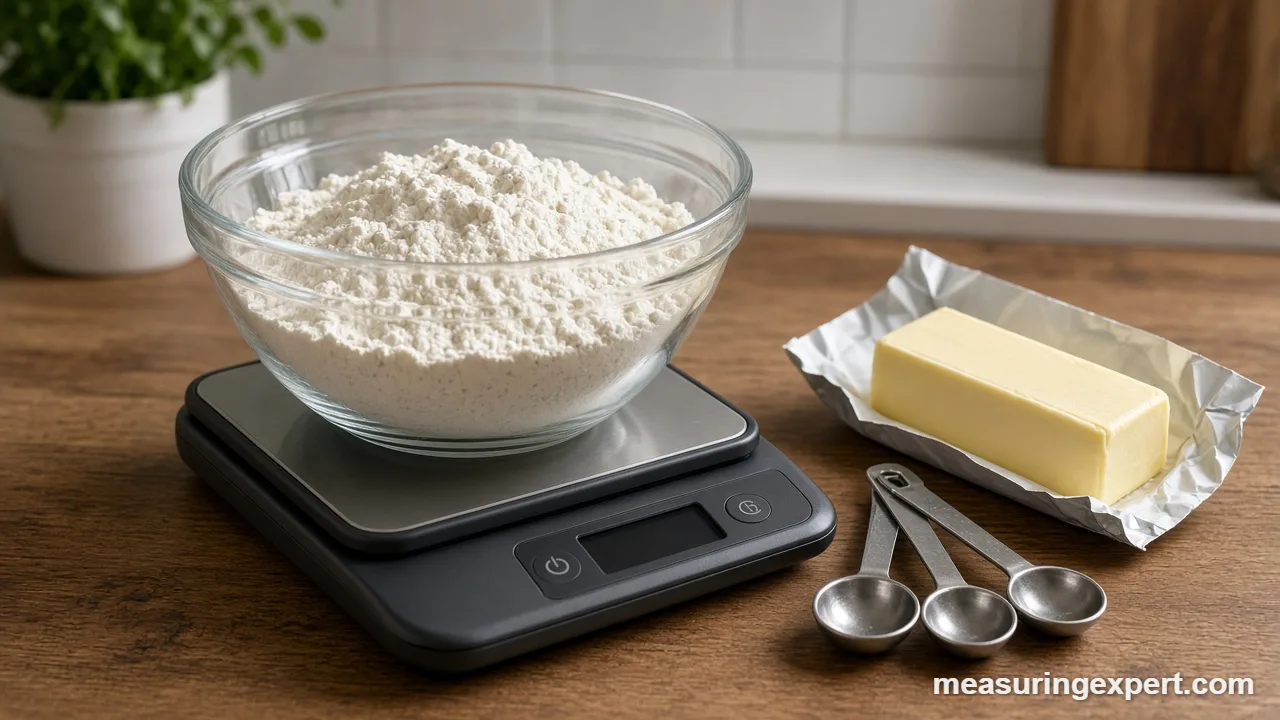
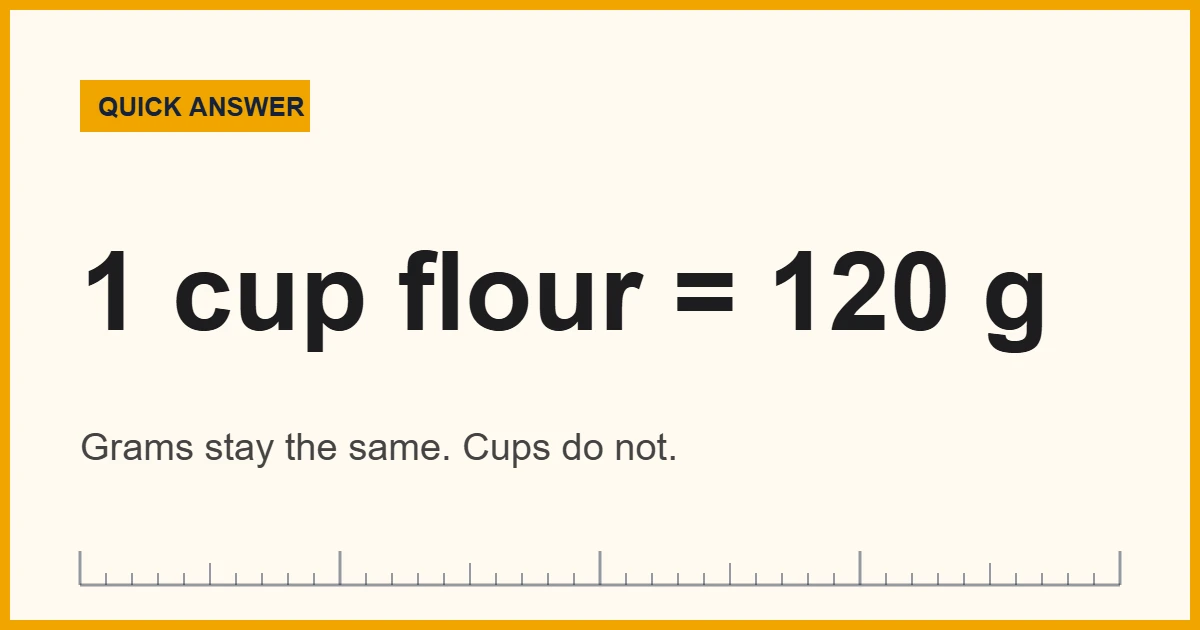
Measuring ingredients by weight means putting a bowl on a digital scale and adding grams instead of scooping cups. It matters because a cup of flour can hold very different amounts depending on how you fill it, while 120 grams is always 120 grams. As a result, your cakes, cookies and breads come out the same every time.
Convert Grams, Ounces and Pounds
Recipes mix grams, ounces and pounds, so a quick converter saves mistakes. Enter an amount, pick the unit you have, and the tool shows the other units using the exact NIST definitions.
Baking is chemistry in a mixing bowl. Flour, sugar, fat, eggs and leaveners have to stay in a fairly tight balance, or the texture shifts. Cups are a measure of space, not of matter. Therefore, the amount of flour in one “cup” depends on whether it was spooned, scooped, sifted or tapped down.
Measuring ingredients by weight removes that guesswork. For example, King Arthur Baking lists one cup of all-purpose flour as 120 grams (4 1/4 ounces) in its ingredient weight chart and recommends a digital scale for the best results. In addition, NIST notes that the metric system measures dry and fluid goods by volume units, so a gram-based recipe is a different, more direct approach than most US cup recipes (NIST kitchen equivalencies).
Below, you will find a weight chart for common baking ingredients, tools worth owning, a simple routine for using a scale, and a worked example of scaling a recipe. Finally, you will see where weighing helps less and where spoons are still fine.
Why Measuring Ingredients by Weight Works Better
A gram is a fixed amount of matter. A cup is a container, and what fits inside depends on the ingredient and on the person holding it. Because of that, two bakers can follow the same cup recipe and bake two different cakes.
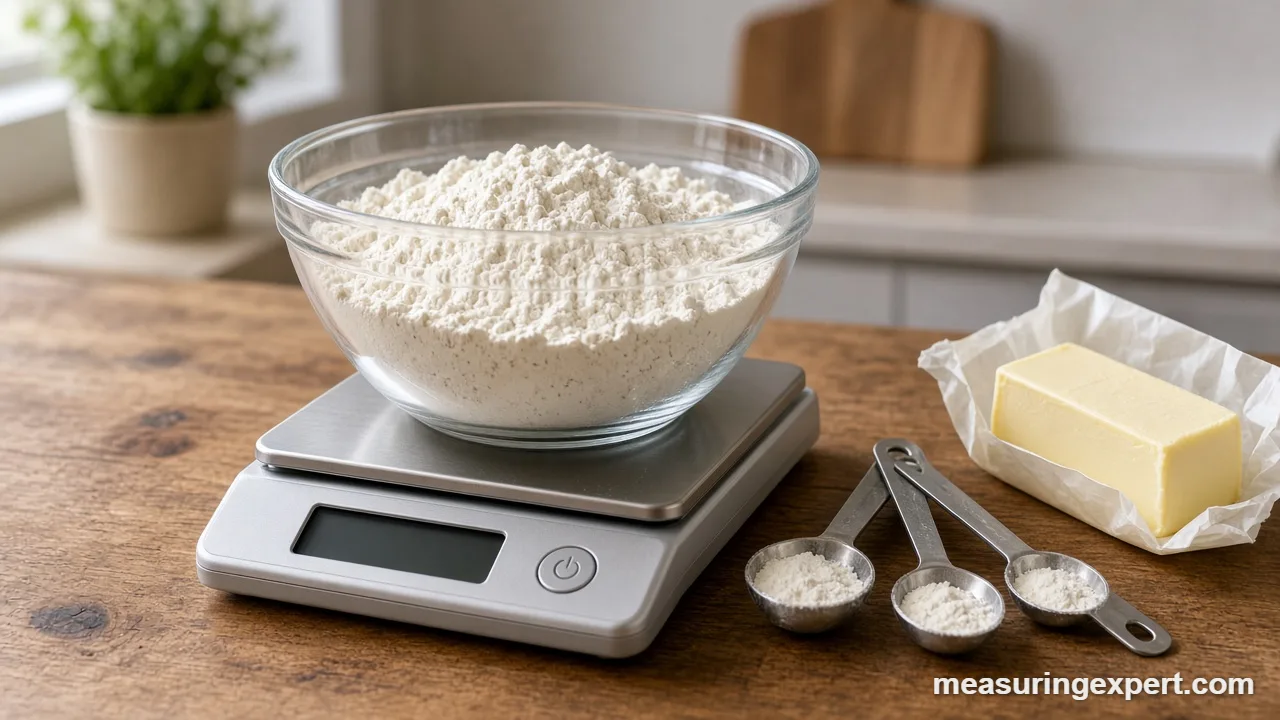
There are three practical gains from weighing. First, the result is repeatable: the same grams give the same batter on a Monday and on a Saturday. Second, it is faster, since you add each ingredient to one bowl and press the tare button between them. Third, it makes recipes easy to scale, because grams multiply cleanly where “3/4 cup plus 2 tablespoons” does not.
Professional bakeries rely on this approach for the same reasons. A recipe written in grams can be shared, doubled or cut in half, and it works the same in any kitchen. That is why many modern cookbooks now print gram weights next to the cup measures.
Ingredient Weight Chart for Measuring Ingredients by Weight
Use this chart to turn common cup measures into grams. The weights come from the King Arthur chart. In addition, the pound and ounce columns are rounded from the exact definitions of 28.35 g per ounce and 453.59 g per pound.
| Ingredient | Volume | Ounces | Grams |
|---|---|---|---|
| All-purpose flour | 1 cup | 4 1/4 | 120 |
| Granulated sugar | 1 cup | 7 | 198 |
| Brown sugar (packed) | 1 cup | 7 1/2 | 213 |
| Confectioners’ sugar (unsifted) | 1 cup | 4 | 113 |
| Butter | 1 cup (2 sticks) | 8 | 227 |
| Butter | 1/2 cup (1 stick, 8 tbsp) | 4 | 113 |
| Milk | 1 cup | 8 | 227 |
| Vegetable oil | 1 cup | 7 | 198 |
| Honey | 1 tablespoon | 3/4 | 21 |
Notice how different the cups are. Flour is light and airy, so a cup holds only 120 g. Granulated sugar is dense, so the same cup holds 198 g. Because of this, you cannot swap one for the other cup for cup and expect the same result.
For liquids, a rough rule helps. Water has a density close to 1 g per mL, so one US cup (236.6 mL) of water weighs about 237 g. However, milk, oil and honey differ, so use the chart values for those. For metric kitchen conversions, see how the metric system works in cooking.
Recommended Tools for Measuring Ingredients by Weight
A scale is the one tool you cannot replace with a spoon. First, look for a tare function so you can zero the bowl. Next, check that it reads in both grams and ounces. Also, a flat platform and a display you can read with a large bowl in place make daily use easier. Our roundup of food scales for cooking and baking goes deeper on features. Finally, keep a sturdy set of measuring spoons for small amounts.


As an Amazon Associate, Measuring Expert earns from qualifying purchases.
Key Takeaways
- Cups measure space. Grams measure matter, so grams are more repeatable.
- One cup of all-purpose flour is 120 g (4 1/4 oz) on the King Arthur chart.
- One cup of granulated sugar is 198 g, and one cup of butter is 227 g.
- A scale with a tare button lets you build a recipe in a single bowl.
- Scaling is easy in grams: multiply every weight by the same factor.
- Spoons are still fine for small amounts of salt, spices and extracts.
Weight vs Volume: Where Cups Go Wrong
Volume works well for water. It works less well for anything that packs, clumps or settles. Flour is the classic example: scoop straight from the bag and the cup compresses the flour, while spooning it lightly into the cup leaves air gaps.
| Method | What it measures | Main weakness |
|---|---|---|
| Measuring cup (dry) | Volume | Result changes with scooping, settling and packing |
| Liquid measuring cup | Volume | Reading error if you look from the wrong angle |
| Measuring spoons | Volume | Heaping versus level changes the amount |
| Digital scale | Weight (mass) | Needs a flat surface and a tare reset |
To see the effect, take a hypothetical example. If your scooped cup of flour weighs 140 g instead of the 120 g in the chart, you have added about 17% more flour than the recipe intended. That is enough to turn a soft cookie into a dry, cakey one. Of course, your own cup may differ, which is exactly the point: you cannot know without a scale.
Fluid ounces add another trap. A fluid ounce measures volume, while an ounce on a scale measures weight. For more on that difference, read how much an ounce really is.
How to Start Measuring Ingredients by Weight
- Set the scale on a flat surface. A wobbly counter or a towel under the scale throws off the reading.
- Switch to grams. Grams are finer than ounces, so they give more precise recipes.
- Place the empty bowl on the platform. Wait for the display to settle.
- Press tare. The display returns to zero, so only the ingredient is counted.
- Add the first ingredient slowly. Stop when the display matches the recipe weight.
- Tare again before the next ingredient. This lets you add everything to the same bowl.
- Weigh sticky ingredients straight into the bowl. Honey or syrup then needs no spoon and leaves nothing behind.
Scaling a Recipe When Measuring Ingredients by Weight
Scaling is where weighing pays off most. Suppose a base recipe uses 270 g of flour, 198 g of sugar and 227 g of butter. To make one and a half batches, multiply every weight by 1.5. Because all the ingredients share the same factor, the proportions stay intact.
| Ingredient | 1x batch | 1.5x batch | 2x batch |
|---|---|---|---|
| Flour | 270 g | 405 g | 540 g |
| Sugar | 198 g | 297 g | 396 g |
| Butter | 227 g | 341 g | 454 g |
Compare this with cups. One and a half batches would need 2 1/4 cups of flour, 1 1/2 cups of sugar and 1 1/2 cups of butter, and each cup carries its own error. As a result, small mistakes add up across the recipe. With grams, the errors stay small and do not multiply.
The reverse works too. If a recipe gives only cups, multiply by the chart weight. For instance, 4 1/6 cups of flour equals 500 g, since 500 divided by 120 is about 4.17.
Common Mistakes When Measuring Ingredients by Weight
- Forgetting to tare. The bowl is then counted as part of the flour.
- Mixing ounces and fluid ounces. Only the first one is a weight.
- Weighing on a soft surface. A towel or a tilted counter changes the reading.
- Using a scale near its limit. Check the maximum capacity and stay below it.
- Trusting an old battery. A weak battery can make readings drift, so replace it when the display dims.
- Weighing tiny amounts. Most home scales show whole grams, so a 2 g pinch of leavener is better measured with a spoon.
Do and Don’t for Weighing Ingredients
Do
- Use grams instead of ounces when you can.
- Tare the bowl before each ingredient.
- Write gram weights on recipes you repeat.
- Scale every ingredient by the same factor.
- Keep the scale dry and away from steam.
Don’t
- Swap a cup of one ingredient for a cup of another.
- Press on the platform while it reads.
- Convert grams to cups and back more than once.
- Use the scale above its maximum capacity.
- Assume chart weights match every brand.
Honest Limits of Weighing Ingredients
Weighing is better than scooping, but it is not perfect. For one thing, chart weights are averages. Flour varies slightly by brand and by humidity, so 120 g per cup is a typical figure, not a law. Moreover, a recipe written in cups was usually tested with cups, so converting it to grams carries over whatever the original author’s cup held. In short, a converted recipe is as good as the chart you used.
Scales also have limits. Cheap models may drift, and most home scales cannot read below 1 g. Therefore, weigh the large ingredients and keep spoons for small ones. If you want to check your scale, place a known weight on it, such as a sealed 1 lb package with a printed net weight, and see whether the display agrees.
When Spoons and Cups Are Still Fine
You do not need a scale for every task. Soups, stews and sauces forgive small differences, and so do most savory dishes. Similarly, a pinch of salt, a teaspoon of vanilla or a spoonful of spice is easier to measure with a spoon. If you want a refresher on spoon sizes, see how much 30 mL is in spoons and ounces.
Weigh instead when a recipe is sensitive: bread, cakes, cookies, pastry and anything built on ratios. In those recipes, flour, sugar and fat set the structure, so errors show up quickly.
Frequently Asked Questions
Why is measuring ingredients by weight more accurate than using cups?
A cup measures space, and the amount of flour or sugar that fits depends on how it is filled. A gram is a fixed amount of matter, so the same weight gives the same result every time.
How many grams are in a cup of all-purpose flour?
One cup of all-purpose flour is 120 g, or 4 1/4 ounces, according to the King Arthur ingredient weight chart.
How many grams are in a cup of sugar?
One cup of granulated sugar is 198 g, and one cup of packed brown sugar is 213 g, on the King Arthur chart.
How many grams are in a stick of butter?
One US stick of butter is 8 tablespoons, or 1/2 cup, which is 113 g or 4 ounces.
Do I need a scale for measuring ingredients by weight?
Yes. A digital kitchen scale with a tare button is the only tool that reads weight. Choose one that shows grams and ounces and that holds the weight of your largest bowl.
Is an ounce on a scale the same as a fluid ounce?
No. An ounce measures weight and is about 28.35 g. A fluid ounce measures volume and is about 29.57 mL. They are equal only for water-like liquids, and even then only roughly.
Should I use grams or ounces when measuring ingredients by weight?
Grams are better for baking. They are smaller units, so they let you set amounts more precisely than whole ounces.
What does the tare button do?
The tare button resets the display to zero with a container on the scale. As a result, the scale counts only what you add next.
Can I convert any cup recipe to grams?
Yes, if you know the weight of each ingredient per cup. Multiply the cups by the chart weight. The result is only as accurate as the chart and your original cup.
Does weighing help when scaling a recipe up or down?
Yes. In grams, you multiply every ingredient by the same factor. For example, a 1.5x batch of 270 g flour needs 405 g.
Measuring Ingredients by Weight: The Bottom Line
To sum up, a cup measures space, while a scale measures what you actually put in the bowl. Therefore, weighing gives you repeatable bakes, easy scaling and fewer dishes. The numbers to remember are 120 g of flour, 198 g of sugar and 227 g of butter per cup.
Finally, start with the recipes you bake most often. Weigh them once, write the grams down, and use the converter at the top of this page whenever a recipe lists ounces or pounds.
2 thoughts on “Measuring Ingredients by Weight: Why It Matters in Baking”