

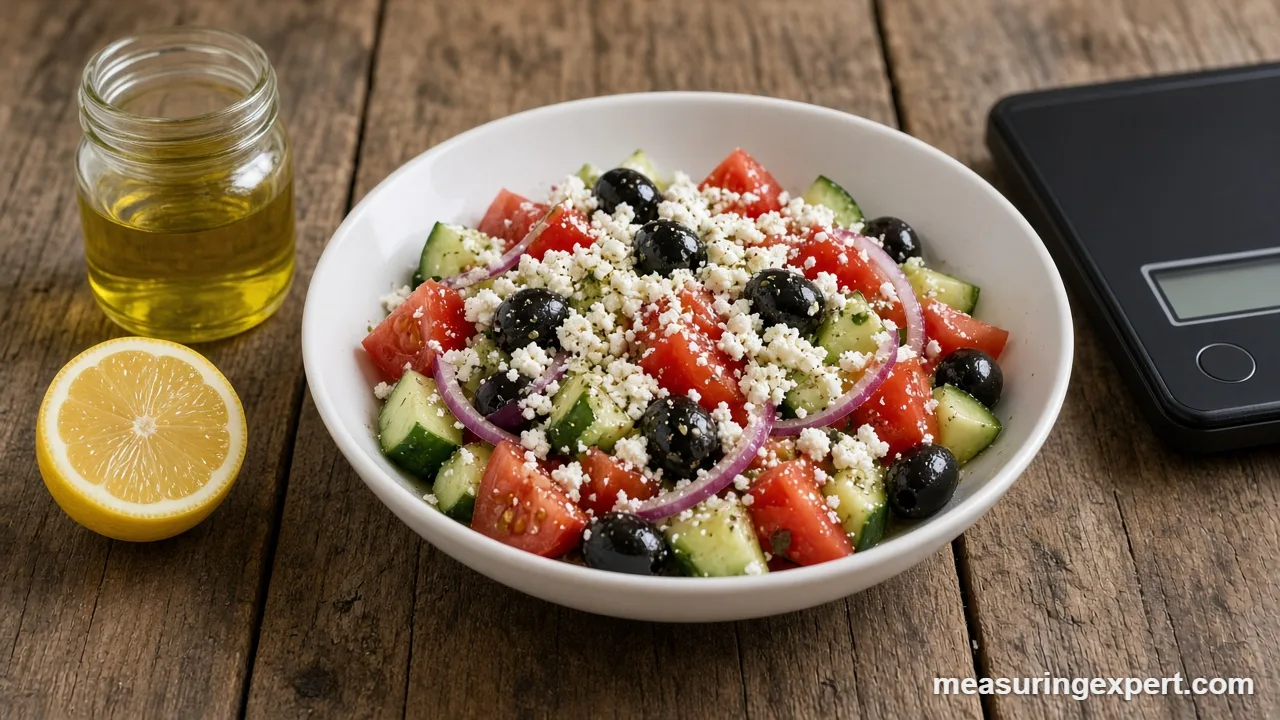
To measure Mediterranean salad ingredients well, weigh the dense items such as feta and olives on a scale, and use cups only for chopped vegetables. Then measure the dressing with level spoons. For example, a four-serving salad needs about 2 oz (57 g) of feta, 6 tbsp of olive oil and 2 tbsp of lemon juice.
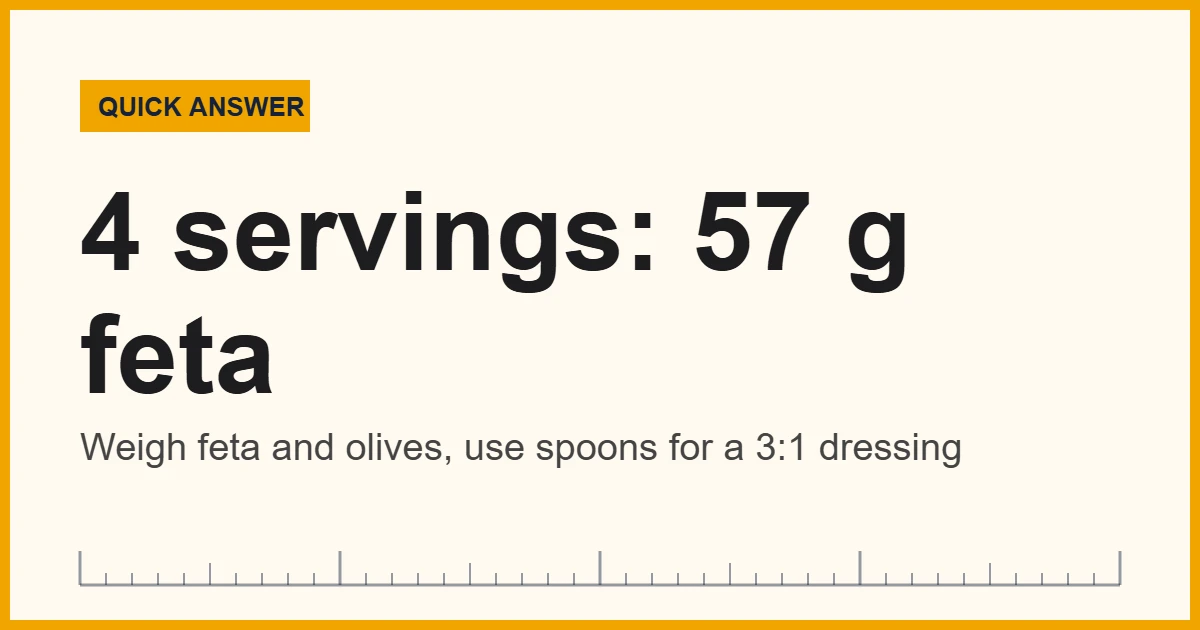
Measure Mediterranean Salad Ingredients Fast: Cups, Spoons and mL
Use the converter below when a recipe lists the dressing in one unit and your tools use another. For instance, you can turn 3/8 cup of olive oil into tablespoons or milliliters in one step. The tool applies the exact US definitions and also shows the metric spoon sizes.
Mediterranean salads look forgiving, and in many ways they are. However, they mix very different ingredients: watery cucumbers, salty feta, sharp onion and a lot of oil. As a result, a small mistake with one ingredient shows up quickly in the bowl. Too much feta makes the whole salad salty, while too little oil leaves it dry.
This guide explains how to measure Mediterranean salad ingredients by weight, by volume and by taste. First, you will see which tool suits each ingredient. Next, you will find starting amounts for four servings and a table for scaling them up or down. Finally, you will learn how to build a dressing that stays balanced at any size.
Weigh or Scoop? Tools for Each Mediterranean Salad Ingredient
A cup is a measure of space, so it can hold very different weights depending on how you chop and pack the food. However, weight does not change. In short, a scale is the better choice for dense, expensive or salty items, and a cup is fine for bulky, forgiving ones.
| Ingredient | Best tool | Reference amount |
|---|---|---|
| Crumbled feta | Scale | 1/2 cup = 57 g (2 oz) |
| Sliced olives | Scale or cup | 1 cup = 142 g (5 oz) |
| Olive oil | Spoons or scale | 1/4 cup = 50 g (1 3/4 oz) |
| Lemon juice | Spoons | 1 tbsp = 14 g (0.5 oz) |
| Leafy greens | Cup | 2 cups raw = 1 cup of vegetables (USDA) |
| Cucumber, tomato, onion | Cup, or scale for repeat batches | Depends on how small you cut them |
| Dried oregano | Level teaspoon | Small amounts, so use spoons |
The gram values for feta, olives, olive oil and lemon juice come from the King Arthur ingredient weight chart. The greens rule comes from USDA MyPlate. Brands and chop sizes vary, so treat every value as a close guide rather than an exact law.
Starting Amounts for a Four-Serving Greek-Style Salad
The amounts below suit a side-salad portion. Because tastes differ, think of them as a starting point. Also, for a main-course salad, plan on about one and a half times as much of each item.
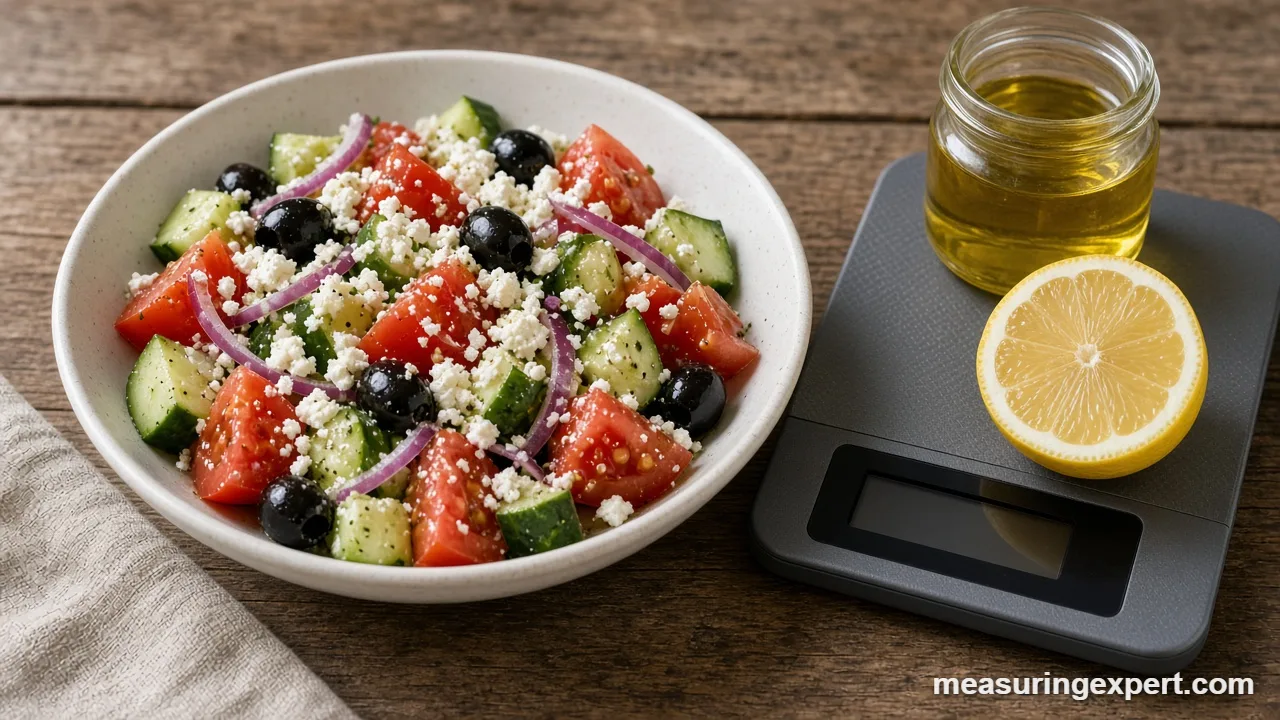
| Ingredient | Amount for 4 servings | Weight or metric |
|---|---|---|
| Cucumber, chopped | 2 cups | about 475 mL |
| Tomatoes, chopped | 2 cups | about 475 mL |
| Red onion, thinly sliced | 1/4 cup | about 60 mL |
| Sliced olives | 1/2 cup | about 71 g (2.5 oz) |
| Crumbled feta | 1/2 cup | about 57 g (2 oz) |
| Olive oil | 6 tbsp (3/8 cup) | about 89 mL |
| Lemon juice | 2 tbsp | about 30 mL |
| Dried oregano | 1 tsp | about 5 mL |
Also, the milliliter figures use the exact US cup of 236.59 mL, rounded to the nearest whole number. Labels and metric recipes round the same cup to 240 mL, which the FDA uses for nutrition labeling. For salad, however, the difference is too small to matter.
How to Scale Mediterranean Salad Ingredients for Two to Twelve Servings
Scaling is simple multiplication, but kitchen units make it awkward. For example, 1.5 times 3/8 cup is not a number anyone wants to measure. Therefore, convert the dressing to tablespoons first, then multiply.
| Ingredient | 2 servings | 4 servings | 8 servings | 12 servings |
|---|---|---|---|---|
| Cucumber | 1 cup | 2 cups | 4 cups | 6 cups |
| Tomatoes | 1 cup | 2 cups | 4 cups | 6 cups |
| Olives | 1/4 cup (36 g) | 1/2 cup (71 g) | 1 cup (142 g) | 1 1/2 cups (213 g) |
| Feta | 1/4 cup (28 g) | 1/2 cup (57 g) | 1 cup (114 g) | 1 1/2 cups (171 g) |
| Olive oil | 3 tbsp | 6 tbsp | 12 tbsp (3/4 cup) | 18 tbsp (1 cup + 2 tbsp) |
| Lemon juice | 1 tbsp | 2 tbsp | 4 tbsp (1/4 cup) | 6 tbsp (3/8 cup) |
| Dried oregano | 1/2 tsp | 1 tsp | 2 tsp | 3 tsp (1 tbsp) |
Meanwhile, salt and strong flavors deserve extra care in large batches. Add about two thirds of the planned amount, toss, taste and then decide. Our guide to measuring cup substitutes helps if you only own one size of cup.
Measure Mediterranean Salad Ingredients for the Dressing: The 3-to-1 Ratio
A classic vinaigrette uses three parts oil to one part acid, which is why the table above pairs 6 tbsp of olive oil with 2 tbsp of lemon juice. The ratio works with any spoon or cup, because it only compares two volumes. Likewise, you can swap in vinegar for the lemon juice and keep the same 3-to-1 split.
- Small batch: 3 tbsp oil plus 1 tbsp lemon juice for two servings.
- Standard batch: 6 tbsp oil plus 2 tbsp lemon juice for four servings.
- Large batch: 3/4 cup oil plus 1/4 cup lemon juice for eight servings.
Dressing amounts also depend on your taste. A common starting point is 1 to 2 tablespoons of dressing per serving, added a little at a time. Therefore, if the vegetables look glossy but not wet, you have probably added enough.
Salt: Spoons Are Not Equal
In fact, salt is the one dressing ingredient where spoon measures mislead. According to the King Arthur chart, 1 tablespoon of table salt weighs 18 g, while Diamond Crystal kosher salt weighs 8 g and Morton kosher salt 16 g. As a result, one teaspoon holds about 6 g, 2.7 g or 5.3 g depending on the brand. Feta and olives are already salty, so start with a pinch and taste.
How to Measure Mediterranean Salad Ingredients Step by Step
- Pick the number of servings. Choose a side-salad or main-course portion, then use the scaling table.
- Weigh the dense items first. Set the bowl on the scale, press tare, then add the feta and read the weight.
- Add the olives. Press tare again and weigh them in the same bowl.
- Cut and measure the vegetables. Chop to a similar size, then spoon them lightly into a dry measuring cup without pressing down.
- Whisk the dressing separately. Measure the oil and lemon juice with level spoons in a small bowl, then add the oregano.
- Dress in stages. Pour in half the dressing, toss, taste and add more only if needed.
- Write down what worked. Note the final weights, so the next batch is easy to repeat.
Common Mistakes When You Measure Mediterranean Salad Ingredients
In most cases, problems come from a handful of habits. First, people pack cucumbers and tomatoes into a cup, which squeezes out juice and changes the volume. Second, they measure feta in a loosely heaped cup, which can easily double the salt. Third, they pour the oil by eye, which makes the dressing too oily or too sharp.
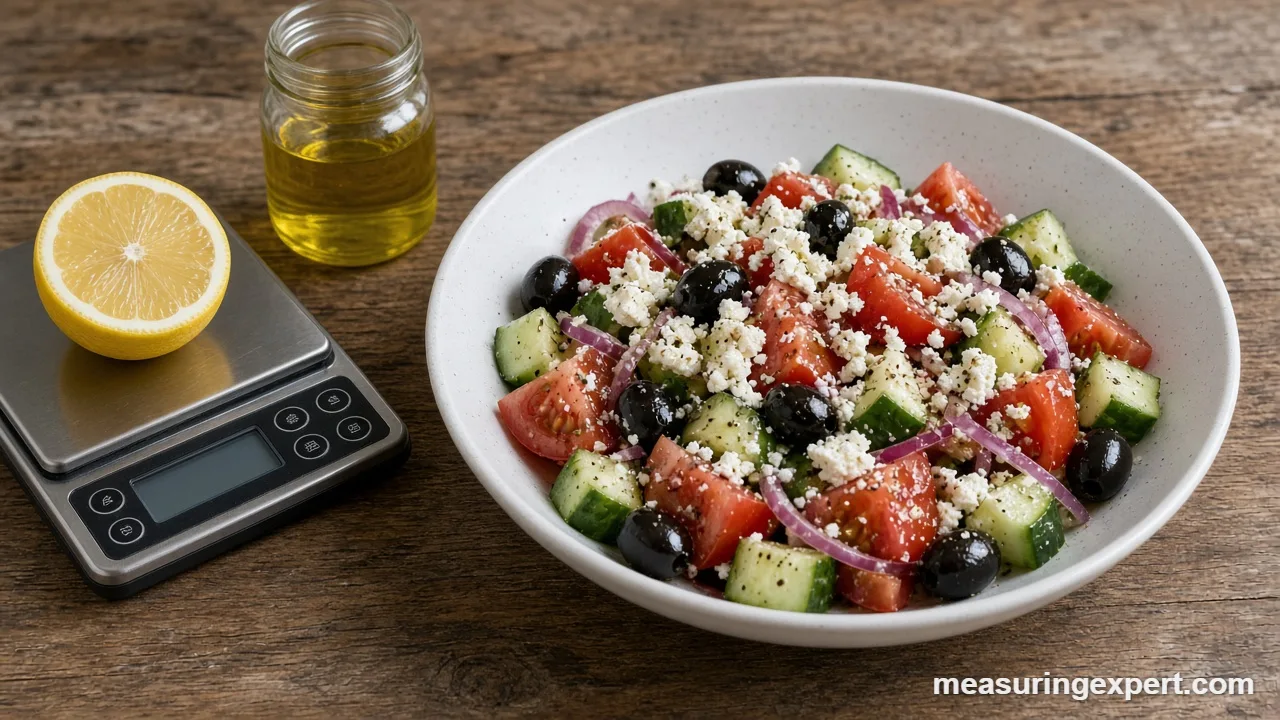
In addition, cut size matters more than most cooks expect. Small dice fits into a cup with fewer gaps than large wedges, so the same cup holds more weight. Therefore, if a recipe lists cups, cut the pieces to the size the recipe describes.
Recommended Tools to Measure Mediterranean Salad Ingredients
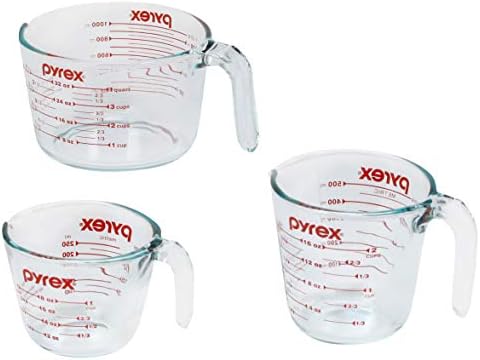
Fortunately, you do not need many tools. A digital scale with a tare button handles feta, olives and chickpeas. Next, a set of measuring spoons covers the dressing, and a glass liquid cup helps with larger oil or juice amounts. Also, look for markings that are engraved or molded, since printed lines wear off in the dishwasher.



As an Amazon Associate, Measuring Expert earns from qualifying purchases.
Key Takeaways
- Weigh feta and olives; scoop chopped vegetables and greens.
- Four side servings need about 57 g (2 oz) of feta and 71 g (2.5 oz) of olives.
- Mix dressing at 3 parts olive oil to 1 part lemon juice or vinegar.
- Two cups of raw leafy greens count as 1 cup of vegetables.
- One tablespoon of salt weighs 8 g to 18 g depending on the brand.
- Dress the salad just before serving and add the dressing in stages.
Do and Don’t for Mediterranean Salad Ingredients
Do
- Tare the bowl before adding each weighed item.
- Cut vegetables to a uniform size.
- Measure dressing with level spoons.
- Taste before adding more salt.
- Record your final amounts.
Don’t
- Pack tomatoes or cucumbers into the cup.
- Treat all salt as the same weight per spoon.
- Dress the salad long before serving.
- Pour oil straight from the bottle.
- Mix up fluid ounces and weight ounces.
The last point trips up many cooks. A fluid ounce measures volume, while an ounce on a scale measures weight, so they are not interchangeable. Our guides on how much an ounce is and how many cups are in 16 oz explain the difference. For small spoon amounts in metric, see how much 30 mL is.
Honest Limits of Salad Measurements
Overall, no chart can predict your exact bowl. Tomatoes vary in size and water content, olives come packed in different amounts of brine, and feta ranges from dry crumbles to creamy blocks. Moreover, the gram values quoted here come from one published chart, and other charts may differ by a few grams. In short, use the numbers to get close, then adjust by taste and texture. For a salad, that is usually enough.
When Precise Portions Matter
Cooking for a party is forgiving. However, some situations call for exact amounts. If you follow a meal plan for a medical condition, such as a sodium limit, weigh the feta and olives and read the nutrition label for the brand you use. In fact, brined foods differ a lot from one brand to the next.
Frequently Asked Questions
What is the best way to measure Mediterranean salad ingredients?
Weigh dense items such as feta and olives on a digital scale, measure chopped vegetables in a dry cup and use level spoons for oil, lemon juice and herbs.
How much feta do I need for a Mediterranean salad?
For four side servings, use about 1/2 cup of crumbled feta, which is roughly 57 g or 2 oz. Increase to about 3/4 cup for a main-course salad.
What is the dressing ratio for Mediterranean salad ingredients?
A common starting ratio is 3 parts olive oil to 1 part lemon juice or vinegar. For example, 6 tablespoons of oil goes with 2 tablespoons of lemon juice.
How many tablespoons of olive oil are in 1/4 cup?
There are 4 tablespoons in 1/4 cup. By weight, King Arthur lists 1/4 cup of olive oil at about 50 g.
How many cups of greens count as one cup of vegetables?
USDA MyPlate counts 2 cups of raw leafy greens as 1 cup of vegetables. One cup of raw greens therefore counts as half a cup.
Should I measure Mediterranean salad ingredients before or after chopping?
Measure after chopping when a recipe lists cups of chopped vegetables. If it lists weights, weigh the whole vegetable first and trim afterward.
How much does a tablespoon of lemon juice weigh?
King Arthur lists 1 tablespoon of lemon juice at 14 g, which is about 0.5 oz or 15 mL.
How do I scale Mediterranean salad ingredients for a crowd?
Multiply each amount by the number of servings divided by four, then convert the dressing to tablespoons first. Add salt in stages and taste before the final seasoning.
Why does my Mediterranean salad turn watery?
Salt draws juice out of cucumbers and tomatoes. Dress and salt the salad just before serving, and pat the chopped vegetables dry if they look wet.
Can I use a regular spoon instead of a measuring spoon?
For a rough dressing, a tableware spoon works, but sizes vary. A set of measuring spoons gives repeatable results, especially for salt.
Mediterranean Salad Ingredients: The Bottom Line
To sum up, weigh the feta and olives, scoop the chopped vegetables and keep the dressing at 3 parts oil to 1 part acid. Start with the four-serving table, scale it with the multipliers above and taste before the final toss.
Finally, write down the weights you like, so the next salad takes no guesswork. The converter at the top of the page handles any cup, tablespoon or milliliter amount in seconds.