

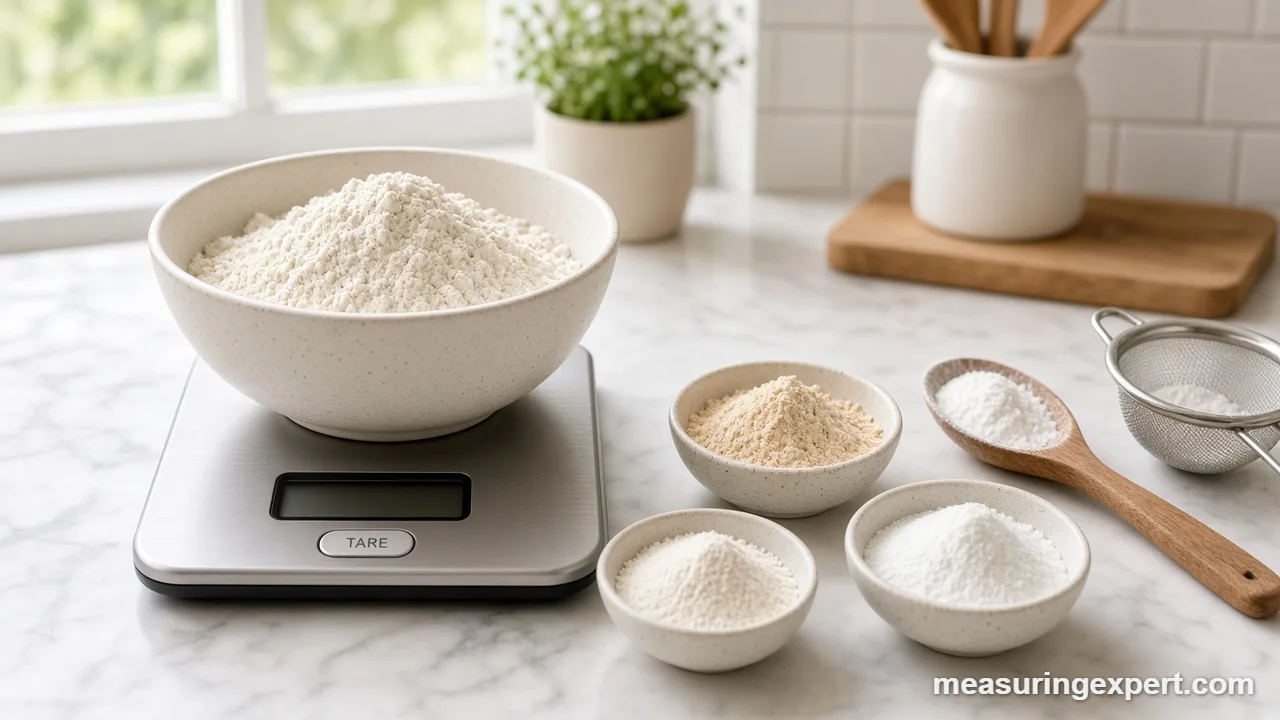
For accurate gluten free baking measurements, weigh your flours in grams instead of scooping cups. According to King Arthur Baking, one cup of gluten-free flour ranges from 85 g for chickpea flour to 156 g for its all-purpose blend. A scale removes that guesswork and makes every batch repeatable.
Gluten Free Baking Measurements Converter
Type a flour weight in grams to see it in ounces, pounds and kilograms. As a result, you can follow a recipe written in any unit with the scale you already own.
For example, a gluten-free cake can fail for a reason that has nothing to do with the recipe. The cup you scooped may simply have held 30 percent more flour than the cup the recipe writer used. Because gluten-free flours differ so much in density, volume is a poor guide.
The fix is to weigh. In fact, King Arthur Baking’s ingredient weight chart lists gram weights for dozens of gluten-free flours and starches, and it recommends a digital scale for best results. Therefore, this guide builds on that chart.
Below, you will find a cups-to-grams table, a worked example that converts a wheat recipe by weight, and a step-by-step weighing routine. In addition, the guide covers binders, liquids and cross-contact, which are the other places where small errors creep in.
Gluten Free Baking Measurements: Cups to Grams
The table uses the weights in King Arthur Baking’s chart. Moreover, ounce values are rounded to the nearest eighth, as the source lists them. Entries that name a King Arthur product describe that blend only, and other brands can differ.
| Flour or starch | Volume | Ounces | Grams |
|---|---|---|---|
| Gluten-free measure for measure flour | 1 cup | 4 1/4 oz | 120 g |
| Gluten-free all-purpose flour | 1 cup | 5 1/2 oz | 156 g |
| Gluten-free bread flour | 1 cup | 4 1/4 oz | 120 g |
| Brown rice flour | 1 cup | 4 1/2 oz | 128 g |
| White rice flour | 1 cup | 5 oz | 142 g |
| Sorghum flour | 1 cup | 4 7/8 oz | 138 g |
| Oat flour | 1 cup | 3 1/4 oz | 92 g |
| Almond flour | 1 cup | 3 3/8 oz | 96 g |
| Coconut flour | 1 cup | 4 1/2 oz | 128 g |
| Chickpea flour | 1 cup | 3 oz | 85 g |
| Tapioca starch or flour | 1 cup | 4 oz | 113 g |
| Potato starch | 1 cup | 5 3/8 oz | 152 g |
| Cornstarch | 1/4 cup | 1 oz | 28 g |
First, notice the spread. The lightest flour here is chickpea at 85 g per cup, and the heaviest is the all-purpose blend at 156 g. That is a difference of almost 1.8 times. For a wider look at baking weights, see our cups to grams guide for baking.
Why Cups Fail for Gluten Free Baking Measurements
In short, a cup measures space, while a scale measures mass. Fine starches pack tightly, but coarse or fluffy flours leave air gaps. As a result, the same cup holds a very different weight of each.
Scooping adds a second error. Dipping the cup into the bag compresses the flour, whereas spooning it in lightly does not. Even the same baker can end up with a different amount from one scoop to the next. By contrast, 120 g is always 120 g.
| Swap in a recipe | What happens by weight |
|---|---|
| 1 cup of gluten-free all-purpose flour in place of 1 cup of measure for measure flour | 156 g instead of 120 g, which is 30 percent more flour |
| 1 cup of almond flour in place of 1 cup of wheat flour | 96 g instead of 120 g, which is 20 percent less flour |
| 1 cup of oat flour in place of 1 cup of white rice flour | 92 g instead of 142 g, which is 35 percent less flour |
Recommended Tools for Gluten Free Baking Measurements
A few tools do most of the work. First, a digital scale with a tare button handles flours, starches and sugar in one bowl. Next, stainless steel dry cups and a leveling edge help when a recipe lists volumes only. Also, level measuring spoons cover small amounts, and a sifter breaks up lumps in fine starches.


As an Amazon Associate, Measuring Expert earns from qualifying purchases.
Key Takeaways
- First, one cup of gluten-free flour weighs between 85 g and 156 g in King Arthur’s chart.
- Also, swapping cups of one blend for another can change the flour by 30 percent.
- In addition, weigh the flour and keep the weight, not the cup count, when you convert a wheat recipe.
- Meanwhile, use level spoons for binders such as xanthan gum, and follow the recipe amount.
- Therefore, tare the bowl between ingredients and write the grams on the recipe card.
- Finally, wash tools well if anyone eating the bake has celiac disease.
Converting a Wheat Recipe to Gluten Free Baking Measurements
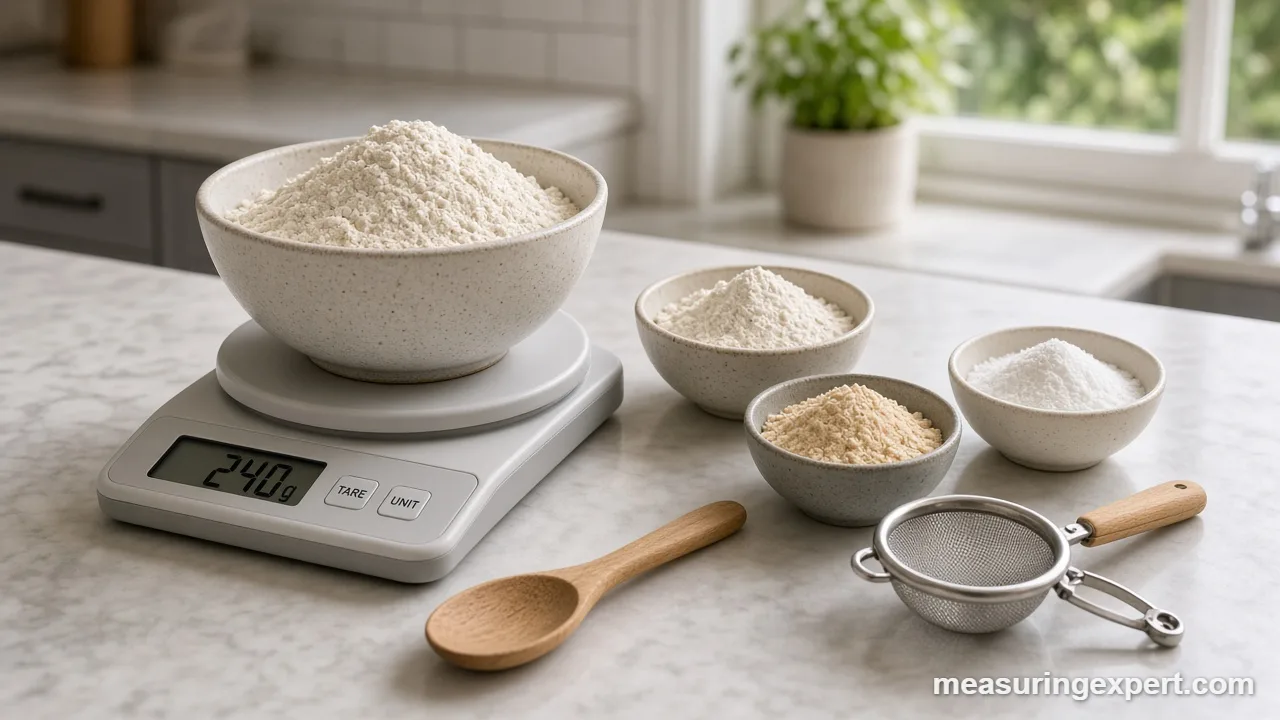
For example, suppose a recipe calls for 2 cups of all-purpose wheat flour. King Arthur lists a cup of its all-purpose flour at 120 g, so the recipe uses 240 g. To convert it, keep the weight at 240 g and choose a gluten-free blend. Then match the blend to the weight, not to the cups.
| Blend | Weight needed | Cups that weight equals |
|---|---|---|
| Gluten-free measure for measure flour (120 g per cup) | 240 g | 2 cups |
| Gluten-free all-purpose flour (156 g per cup) | 240 g | about 1 1/2 cups |
| Almond flour (96 g per cup) | 240 g | 2 1/2 cups |
If you measured two level cups of the 156 g blend instead, you would add 312 g, which is 72 g too much. That extra 30 percent explains many dry, crumbly results. However, a blend that is not made as a one-for-one swap may also need extra binder or liquid, so read the package directions. Our guide to how to measure baking ingredients explains the general method.
How to Weigh Gluten-Free Ingredients Step by Step
- Set the scale on a flat counter. A tilted surface makes the reading drift.
- Place the empty bowl on the scale. Wait until the number settles.
- Press tare. The display returns to zero, so only the flour counts.
- Whisk or stir the flour first. Starches settle and clump in the bag, so loosen them before weighing.
- Add flour until you reach the target grams. Spoon it in gradually, because scooping out extra is messy.
- Tare again and add the next dry ingredient. This keeps everything in one bowl.
- Measure the leavening and binder with level spoons. Small amounts are too light for most home scales.
- Write down the final grams. The next bake then starts from numbers instead of memory.
Binders, Leaveners and Other Small Amounts
Gluten gives wheat dough its stretch, so many gluten-free recipes add a binder such as xanthan gum or psyllium husk. These ingredients are used in small amounts, and a little too much can turn the crumb gummy. For that reason, use a level measuring spoon, sweep the top flat, and follow the amount in your recipe.
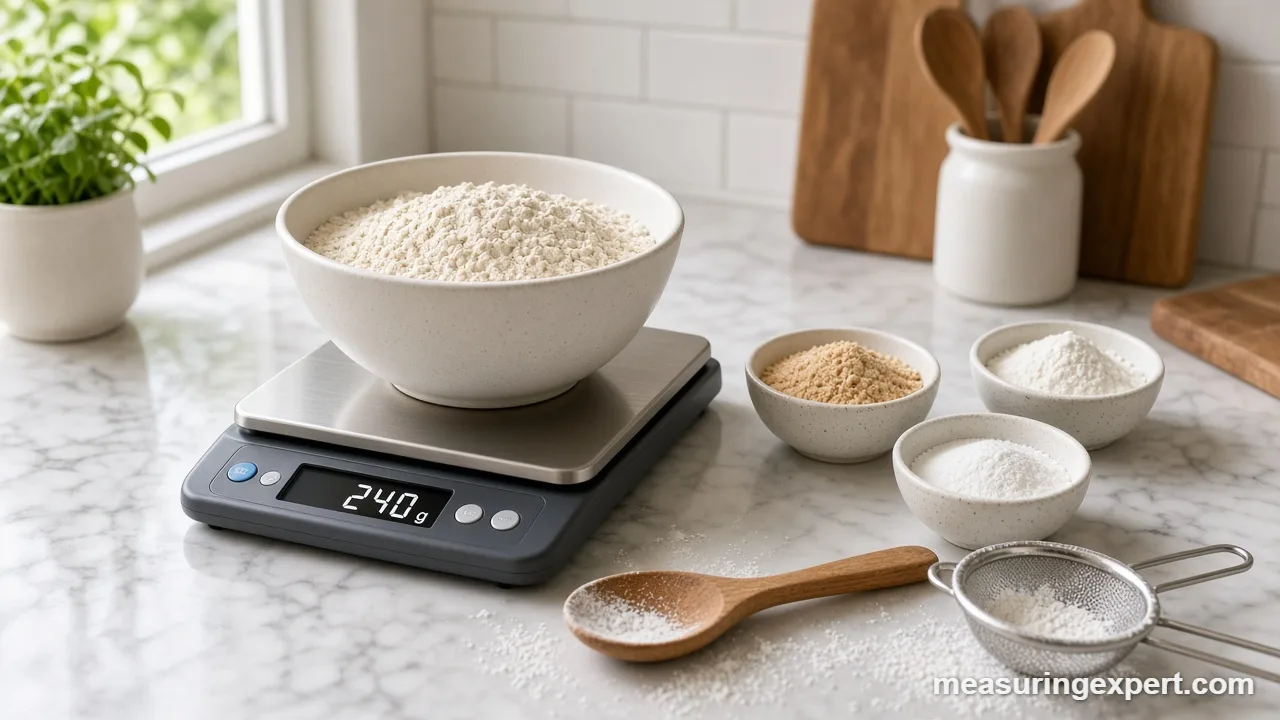
Many gluten-free blends already contain a binder. Therefore, check the package before you add more. Likewise, baking powder and baking soda should be level, never heaping, because the lift they give depends on exact amounts. If you need a refresher on spoon sizes, our guide on how to measure with a measuring cup covers the basics.
Liquids and Batter Thickness
Also, gluten-free batters often look thicker than wheat batters, and they can seem to change as they rest. In many recipes, the flour keeps absorbing liquid for a while after mixing. Consequently, a recipe may call for a rest period before baking, so follow it as written.
Measure liquids in a clear cup with a spout, set it on a flat counter, and read the line at eye level. Also, do not add extra liquid just because the batter looks stiff right after mixing. Instead, wait for the rest time, then judge the texture against the recipe description.
Labels and Cross-Contact
For people with celiac disease, measuring is not only about texture. The US Food and Drug Administration explains that a “gluten-free” label is voluntary and may be used only when a food meets its defined standard, as described on the FDA gluten-free labeling page. Even so, a label cannot protect a bake from a dirty scoop.
Likewise, clean cups, spoons and bowls matter, and so does a dedicated sifter if you also bake with wheat. For example, shared tools can carry wheat flour into a gluten-free batch. Because the safe level is a medical question, ask a doctor or dietitian about your own needs.
Common Gluten-Free Measuring Mistakes
- Swapping flours cup for cup. The weights differ, as the table above shows.
- Dipping the cup into the bag. This packs the flour and adds extra.
- Skipping the tare. The bowl’s weight then counts as flour.
- Adding extra binder to a blend that already has one. The crumb turns gummy.
- Adding liquid too early. The batter thickens as the flour absorbs water, so wait out the rest time.
Do and Don’t for Gluten-Free Baking
Do
- Weigh flours and starches in grams.
- Stir the flour before you weigh it.
- Use level spoons for binders and leaveners.
- Follow the recipe’s rest time.
- Clean tools well before each bake.
Don’t
- Swap one gluten-free flour for another by volume.
- Scoop straight from the bag with a cup.
- Add more binder without checking the blend.
- Trust a cup count over a weight.
- Guess at cross-contact risks.
Honest Limits of Gluten-Free Measurements
The weights in this guide come from one source and describe common products. Different brands mill their flours differently, so your bag may weigh a little more or less per cup. In addition, humidity changes how much water flour holds. As a result, treat the chart as a strong starting point, then adjust to your recipe. Finally, a kitchen scale that reads to 1 g is good for flour but too coarse for a pinch of xanthan gum, so use level spoons there.
Frequently Asked Questions
How do I get accurate gluten free baking measurements?
Weigh the flours and starches in grams on a digital scale with a tare button. Use level spoons for binders, leaveners and spices.
How much does a cup of gluten-free flour weigh?
It depends on the flour. In King Arthur’s chart, one cup ranges from 85 g for chickpea flour to 156 g for its gluten-free all-purpose flour.
Are gluten free baking measurements the same as regular flour?
No. A cup of King Arthur all-purpose flour is 120 g, but a cup of its gluten-free all-purpose flour is 156 g. Weigh instead of counting cups.
Can I swap gluten-free flours cup for cup?
Not safely. One cup of almond flour weighs 96 g, while one cup of potato starch weighs 152 g, and they absorb liquid differently as well.
How many grams of gluten-free flour equal 2 cups of wheat flour?
Two cups of King Arthur all-purpose flour weigh 240 g, so use 240 g of a one-for-one gluten-free blend.
Should I sift gluten-free flour before measuring?
Stirring or whisking is enough for weighing. Sifting helps break up lumps in fine starches, but it does not change the weight.
How much xanthan gum should I use?
Follow your recipe. The amount depends on the flour blend and the bake, and many blends already include a binder, so check the package first.
Why is my gluten-free bake dry or crumbly?
Too much flour is a common cause, because cups can hold far more than the recipe expects. Weigh the flour, and follow the recipe’s liquid and rest time.
Does a “gluten-free” label guarantee no cross-contact at home?
No. The label applies to the packaged food, while cross-contact can happen with your own tools. Clean cups, spoons and sifters well.
What size scale do I need for gluten free baking measurements?
A scale that reads to 1 g and holds at least a few pounds is enough for most home baking. A tare button is the most useful feature.
Gluten Free Baking Measurements: The Bottom Line
To sum up, gluten-free flours differ too much in density for cups to be reliable. Weigh them, keep the grams when you convert a wheat recipe, and use level spoons for the small stuff.
Finally, write the weights on your recipe card, and keep your tools clean if cross-contact matters. The converter at the top of this page handles the unit changes for you.