

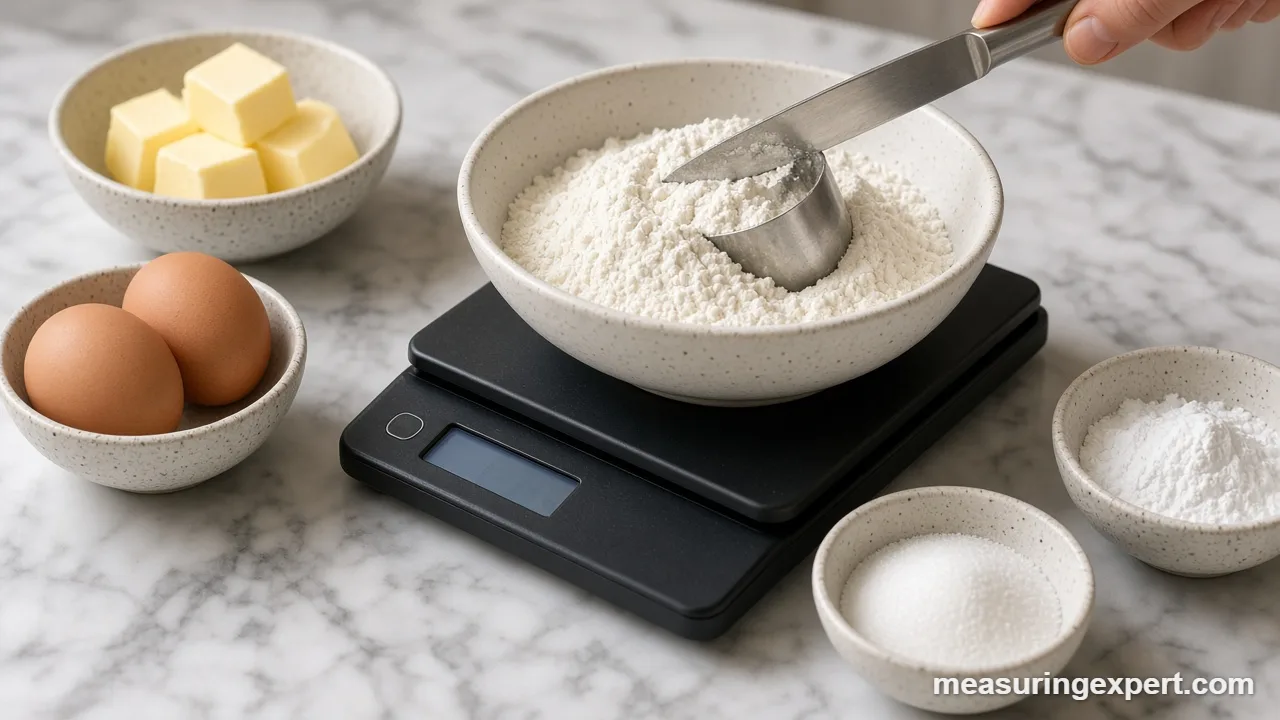
To measure baking ingredients accurately, weigh them on a digital scale in grams whenever you can. If you use cups, spoon flour into the cup and level it, pack brown sugar firmly, read liquids at eye level on a flat counter, and level every small spoonful with a straight edge.
Baking is chemistry you can eat. Flour builds structure, sugar tenderizes, leaveners make gas, and fat carries flavor. So when one of those amounts drifts, the whole recipe shifts with it. A cookie dough with too much flour bakes up dry and cakey, and a cake with too much baking soda tastes metallic.
The good news is that accuracy is mostly about habit, not talent. Once you know how to measure baking ingredients the right way, the same recipe turns out the same way every time. In addition, you can finally tell whether a failed bake came from the recipe or from your measuring.
In short: a scale is the most reliable tool, cups and spoons work well when you fill and level them correctly, and the method changes with the ingredient. Flour is spooned, brown sugar is packed, liquids are poured to the line, and sticky syrups are weighed or poured from a greased cup.
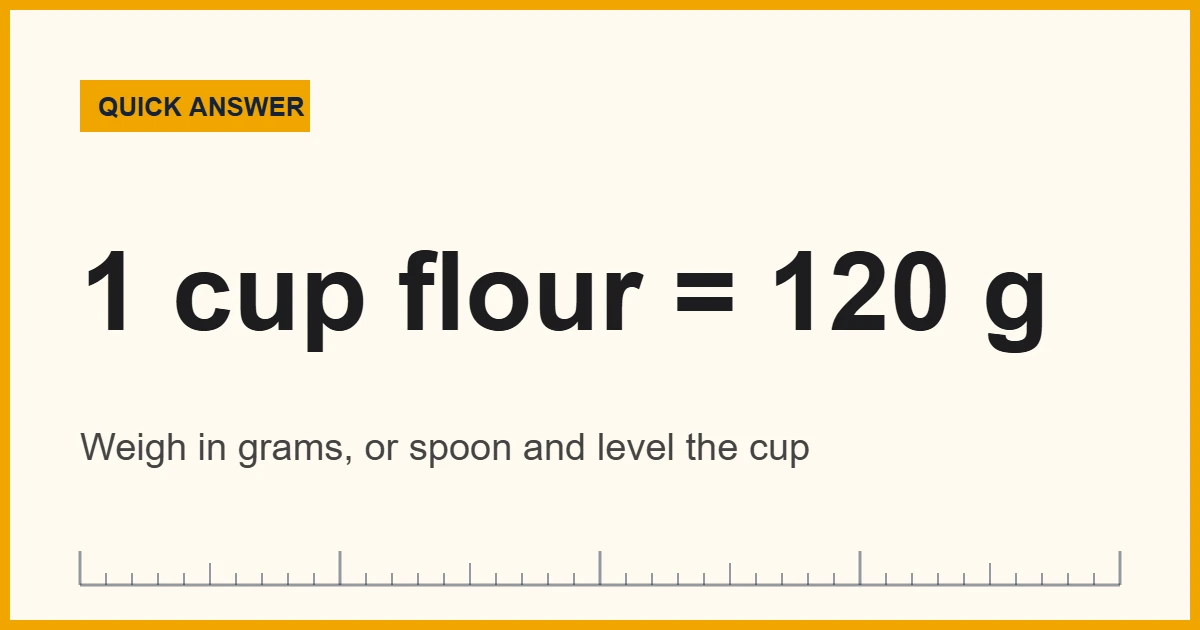
King Arthur Baking, whose test kitchen publishes one of the most widely used ingredient weight charts, recommends weighing ingredients with a digital scale for best results. Its chart lists 1 cup of all-purpose flour at 120 grams, and that figure is used throughout this guide.
Below, you will find a gram and ounce converter, a grams-per-cup chart, step-by-step methods for each ingredient type, and the mistakes that cause most baking failures.
Convert Grams and Ounces for Baking
Many recipes list grams while older family recipes use ounces, so type the amount from your recipe below. The converter then shows grams, ounces, pounds and kilograms using the exact definition of 1 ounce = 28.349523125 grams.
Recommended Tools to Measure Baking Ingredients
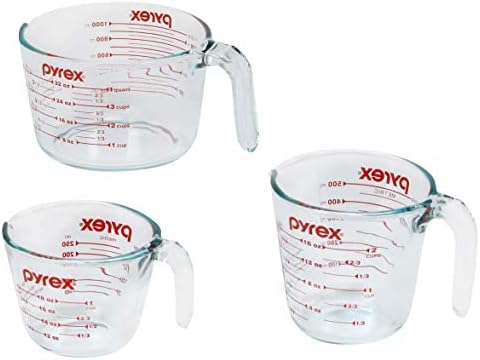
You do not need much gear. First, a digital scale with a tare button handles almost everything. Next, a set of dry measuring cups with a flat rim and a leveler covers recipes written in cups. Finally, a clear liquid measuring cup with a spout and a set of narrow measuring spoons take care of milk, oil and small amounts.




As an Amazon Associate, Measuring Expert earns from qualifying purchases.
- Weighing in grams is the most consistent way to measure.
- King Arthur lists 1 cup of all-purpose flour as 120 g (4 1/4 oz).
- Spoon flour into the cup and level it; never scoop straight from the bag.
- Pack brown sugar firmly: 1 packed cup is about 213 g.
- Read liquid cups at eye level on a flat counter.
- Press tare after adding each bowl or ingredient.
- Small amounts of leavener and salt matter most, so level every spoonful.
Weigh vs Scoop: The Best Way to Measure Baking Ingredients
A cup measures volume, which is the space an ingredient fills. A scale measures mass, which is how much ingredient is actually there. For liquids, the two track each other closely. For powders, however, they do not, because flour and cocoa can be fluffy or compacted. As a result, the same cup can hold quite different amounts depending on how you fill it.
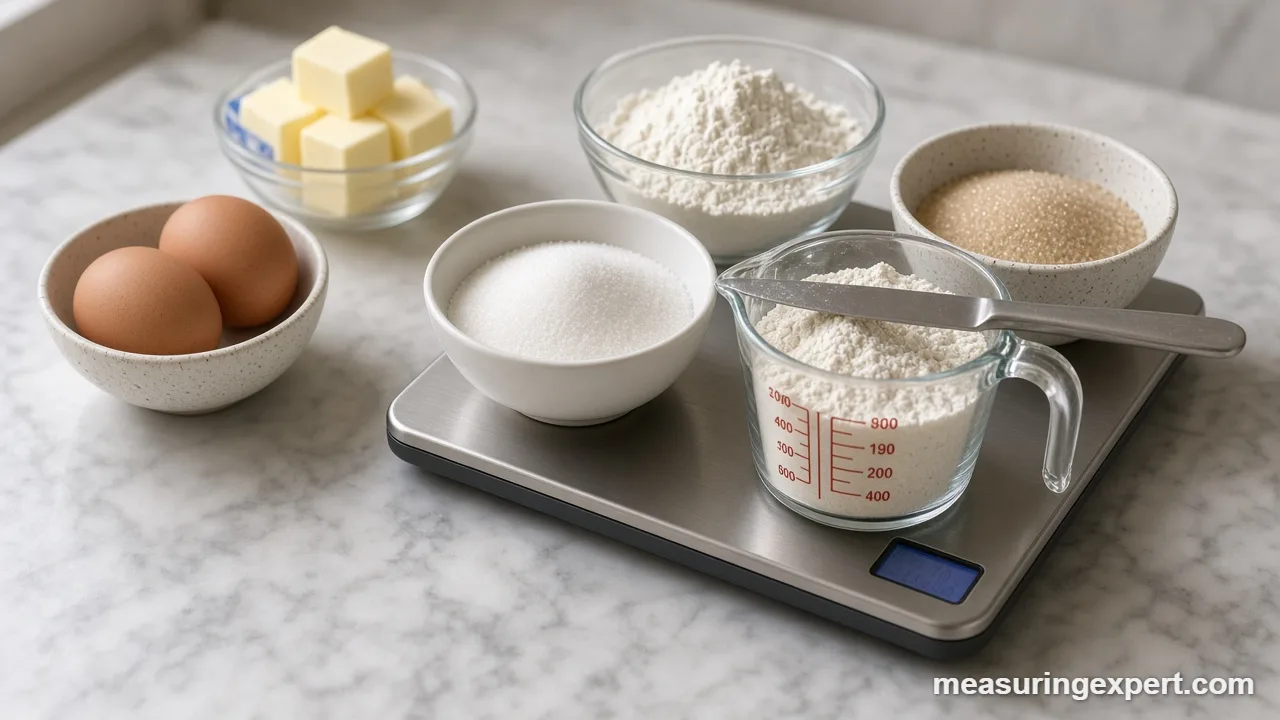
Weight, however, ignores all of that. For example, 120 grams of flour is 120 grams whether it was sifted, scooped or packed. That is why professional bakers write formulas in grams. For a deeper look at the two systems, see our guide to weight vs volume in cooking.
| Method | How consistent it is | Best for | Main weakness |
|---|---|---|---|
| Digital scale (grams) | Very consistent; limited mainly by the scale’s resolution | Flour, sugar, cocoa, nuts, chocolate, butter, bread dough | Needs a recipe that lists weights, or a reliable chart |
| Dry cups, spoon-and-level | Fairly consistent when done the same way each time | US recipes written in cups | Results depend on technique and how settled the flour is |
| Dry cups, scooped from the bag | Least consistent; packs extra flour into the cup | Nothing in baking | Often produces dry, dense results |
| Liquid measuring cup | Consistent for water-like liquids read at eye level | Milk, water, oil, cream | Viewing angle and sticky residue cause errors |
| Measuring spoons, leveled | Good for small volumes | Baking soda, baking powder, salt, spices, extracts | Heaped or rounded spoonfuls add a lot in percentage terms |
Grams Per Cup Chart for Common Baking Ingredients
These weights come from the King Arthur Baking ingredient weight chart. Each row keeps the volume King Arthur uses, so some lines are per tablespoon or half cup. The ounce values are King Arthur’s own rounded figures.
| Ingredient | Volume | Grams | Ounces |
|---|---|---|---|
| All-purpose flour | 1 cup | 120 g | 4 1/4 oz |
| Bread flour | 1 cup | 120 g | 4 1/4 oz |
| Granulated sugar | 1 cup | 198 g | 7 oz |
| Brown sugar (light or dark, packed) | 1 cup | 213 g | 7 1/2 oz |
| Confectioners’ sugar | 1 cup | 113 g | 4 oz |
| Butter | 8 tbsp (1/2 cup) | 113 g | 4 oz |
| Cocoa powder (unsweetened) | 1/2 cup | 42 g | 1 1/2 oz |
| Rolled oats | 1 cup | 113 g | 4 oz |
| Chocolate chips | 1 cup | 170 g | 6 oz |
| Chopped walnuts | 1 cup | 113 g | 4 oz |
| Milk or water | 1 cup | 227 g | 8 oz |
| Vegetable oil | 1 cup | 198 g | 7 oz |
| Honey | 1 tbsp | 21 g | 3/4 oz |
| Table salt | 1 tbsp | 18 g | 2/3 oz |
| Baking powder | 1 tsp | 4 g | 1/8 oz |
| Baking soda | 1/2 tsp | 3 g | 1/10 oz |
Keep in mind that other sources may list slightly different numbers, mainly because they fill the cup differently. Also, by definition a US cup is about 236.6 mL, so a cup of water weighs about 236 g; King Arthur rounds milk and water to 8 oz (227 g) for convenience. If a recipe was written with a specific chart, use that chart.
For volume conversions, the US National Institute of Standards and Technology (NIST) lists kitchen equivalents in its metric kitchen table, where 1 tablespoon rounds to 15 mL and 1 teaspoon to 5 mL.
How to Measure Baking Ingredients With a Kitchen Scale
Above all, using the tare button is the whole trick. It resets the display to zero, so you can add several ingredients to one bowl and read each one on its own.
- Set the scale on a flat, hard surface. A tilted or soft surface such as a towel can throw off the reading.
- Turn it on with nothing on the platform. Most scales zero themselves at startup.
- Choose grams. Grams give finer steps than ounces on most kitchen scales.
- Place your empty bowl on the scale and press tare. The display returns to 0 g.
- Add the first ingredient slowly. Pour or spoon it in until the display shows the target weight.
- Press tare again before the next ingredient. Then add it the same way, and repeat for each one.
- Remove spills before you reset. If you overshoot, spoon a little back out instead of starting over.
Spoon and Level: How to Measure Baking Ingredients Like Flour
First, flour settles in the bag. When you push a cup straight into it, you compress it and the cup ends up with far more flour than the recipe writer intended. Too much flour is the most common reason for dry cookies, tough muffins and dense cakes.
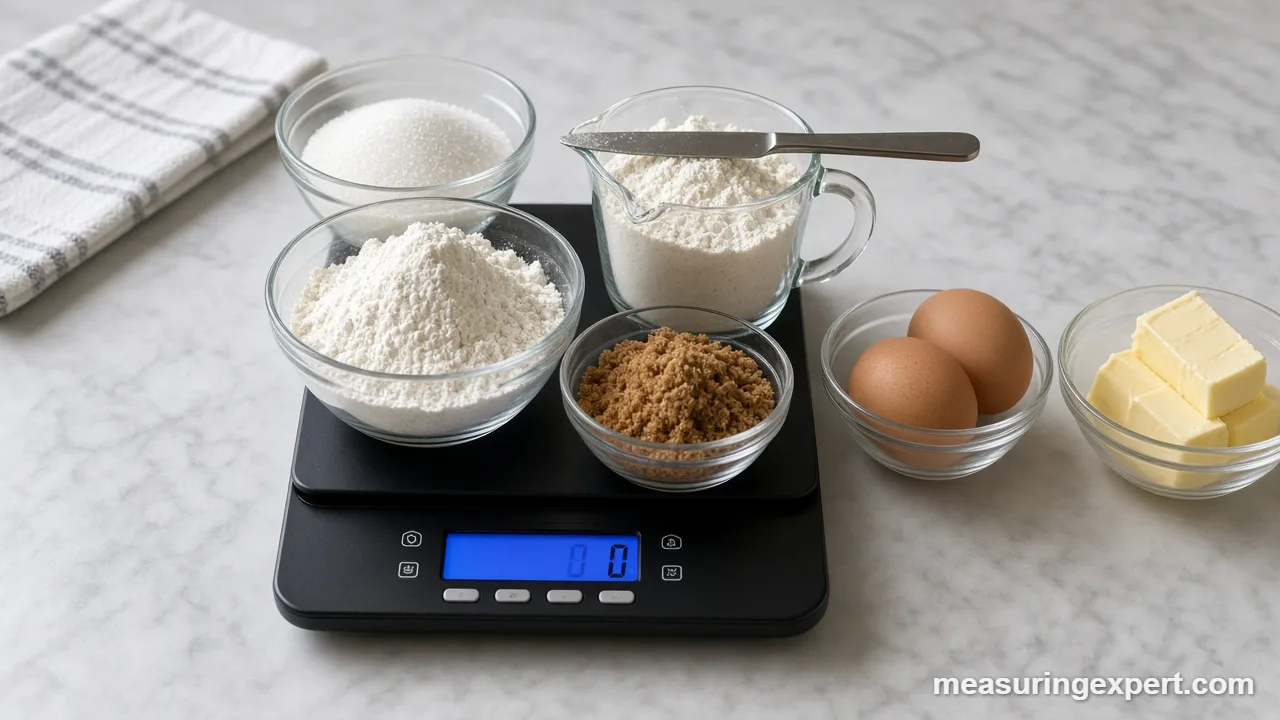
Instead, use the spoon-and-level method:
- Fluff the flour in its bag or canister with a spoon or whisk.
- Spoon it lightly into a dry measuring cup until it mounds over the rim.
- Avoid tapping or shaking the cup, because that packs the flour down.
- Sweep a straight edge, such as the back of a knife, across the rim.
The same approach works for cocoa powder, confectioners’ sugar, cornstarch and almond flour. On the other hand, granulated sugar barely compresses, so you can scoop it and level it. If a recipe says “1 cup sifted flour”, sift first and then measure. By contrast, “1 cup flour, sifted” means measure first and then sift.
Packed Brown Sugar and Other Exceptions
By contrast, brown sugar is the one dry ingredient you press down on purpose. Its molasses coating makes it moist and clumpy, so loose spoonfuls leave air pockets. Most US recipes therefore say “firmly packed”.
To pack it, press the sugar into a dry cup with the back of a spoon, add more, and press again until it is level with the rim. When you tip it out, it should hold the shape of the cup. According to King Arthur, 1 cup of packed brown sugar weighs about 213 g, compared with 198 g for granulated sugar. Our full guide on how to measure brown sugar covers hardened sugar and swaps between light and dark.
Butter is another special case. In the US, sticks are printed with tablespoon marks, so you can simply cut along the wrapper. Meanwhile, for shortening or soft butter in a cup, press it in firmly to remove air gaps and level the top.
How to Measure Baking Ingredients That Pour
Liquid measuring cups have a spout and the markings sit below the rim, so you can fill to the line without spilling. Dry cups, by comparison, are meant to be filled to the brim and leveled, which is hard to do with milk.
| Feature | Dry measuring cup | Liquid measuring cup |
|---|---|---|
| Shape | Flat rim, one size per cup | Spout, headroom above the top line |
| How you fill it | Overfill, then level | Pour to the marked line |
| Where you read it | At the rim | At eye level, bottom of the curve |
| Best for | Flour, sugar, oats, chips | Milk, water, oil, cream, juice |
For an accurate reading, set the cup on a flat counter and pour. Next, bend down until your eyes are level with the marking. Water-like liquids form a slight curve called the meniscus, so read the bottom of that curve. Looking down from above makes the level look higher than it is, and as a result you would underfill the cup.
Sticky liquids such as honey, molasses and corn syrup cling to the cup. So either lightly oil the cup first or, even better, set the mixing bowl on the scale and pour straight in. For example, King Arthur lists 1 tablespoon of honey at 21 g.
Measuring Small Amounts: Teaspoons, Pinches and Dashes
Small amounts, however, carry big effects. Baking soda, baking powder and salt are used by the teaspoon, so a rounded spoonful can add a large share on top of the intended amount. Because of that, always level these with a straight edge.
A US teaspoon is about 4.93 mL and a US tablespoon is about 14.79 mL, with 3 teaspoons in a tablespoon. Words such as “pinch” and “dash”, however, have no official definition. Some spoon sets label them, but the sizes vary by brand, so treat them as “a little” and taste where you can.
A standard kitchen scale usually reads in 1 g steps, which is too coarse for a 3 g half teaspoon of baking soda. If you want to weigh these, use a small pocket scale that reads to 0.1 g. Otherwise, a good set of narrow measuring spoons is the practical answer.
Do and Don’t When You Measure Baking Ingredients
Do
- Weigh flour and sugar when a recipe gives grams.
- Spoon flour into the cup and level it.
- Pack brown sugar until it holds its shape.
- Read liquids at eye level on a flat counter.
- Press tare between ingredients.
Don’t
- Scoop flour straight from the bag.
- Measure liquids in dry cups.
- Heap teaspoons of baking soda or salt.
- Read a liquid cup from above.
- Mix grams from one chart with cups from another.
Honest Limits of Kitchen Measuring
Of course, no method is perfect. To begin with, cup weights are averages, and flour can vary with humidity, brand and how long the bag has sat. Moreover, inexpensive measuring cups and spoons are not always exactly the size printed on them. Kitchen scales also have a tolerance, often a gram or two, which matters little for 500 g of flour but a lot for 2 g of yeast.
Even so, these small errors rarely ruin a bake on their own. Instead, failures usually come from large, repeated mistakes such as scooped flour or a tablespoon used in place of a teaspoon. In short, consistent technique matters more than perfect tools.
When Precision Matters Most
Some bakes forgive a loose hand, while others do not. Accuracy matters most in the following cases:
- Bread and enriched doughs. Hydration, the ratio of water to flour, controls how the dough handles and rises.
- Macarons, meringues and choux. These depend on tight ratios of sugar, egg and flour.
- Scaling a recipe up or down. Weights multiply cleanly, whereas cups and spoons create awkward fractions.
- Special diets. If you track sugar, sodium or carbohydrates for health reasons, a scale gives more reliable numbers than cups.
Frequently Asked Questions
What is the most accurate way to measure baking ingredients?
Weighing them on a digital scale in grams is the most accurate way. Weight does not change with how loosely or tightly an ingredient is packed, so the result is the same every time.
How many grams are in 1 cup of all-purpose flour?
King Arthur Baking lists 1 cup of all-purpose flour as 120 grams, or 4 1/4 ounces, when it is spooned into the cup and leveled.
Should I measure baking ingredients by weight or by cups?
Use weight when the recipe gives grams or ounces. If the recipe was written in cups, either method works as long as you spoon and level dry ingredients and read liquids at eye level.
How do I measure brown sugar?
Press it firmly into a dry measuring cup until it is level with the rim and holds its shape when turned out. One packed cup weighs about 213 grams.
Can I measure liquids in dry measuring cups?
You can, but it is less accurate because you have to fill to the brim without spilling. A liquid measuring cup with a spout read at eye level gives a better result.
What does the tare button do?
Tare resets the scale to zero with a bowl or ingredient already on it. That way the display shows only what you add next.
Why do my cookies come out dry and cakey?
The most common cause is too much flour, usually from scooping the cup straight into the bag. Spoon and level the flour, or weigh it at 120 grams per cup.
How do I measure baking ingredients without a scale?
Use dry cups for dry ingredients with the spoon-and-level method, pack brown sugar, use a liquid cup for liquids, and level every measuring spoon with a straight edge.
How much is a pinch of salt?
A pinch has no official size. It is simply a small amount held between your fingers, so taste and adjust where the recipe allows.
Do I need to sift flour before I measure baking ingredients?
Only if the recipe asks for it. “1 cup sifted flour” means sift first, then measure. “1 cup flour, sifted” means measure first, then sift.
Bottom Line
To sum up, the surest way to measure baking ingredients is to weigh them in grams on a digital scale, pressing tare between each one. When a recipe uses cups, spoon and level the flour, pack the brown sugar, read liquids at eye level, and level every small spoonful.
Finally, keep one reliable weight chart, such as King Arthur’s, and stick with it. Then use the converter above whenever a recipe switches between grams and ounces.
1 thought on “How to Measure Baking Ingredients Accurately (Weigh vs Scoop, With Grams Chart)”