

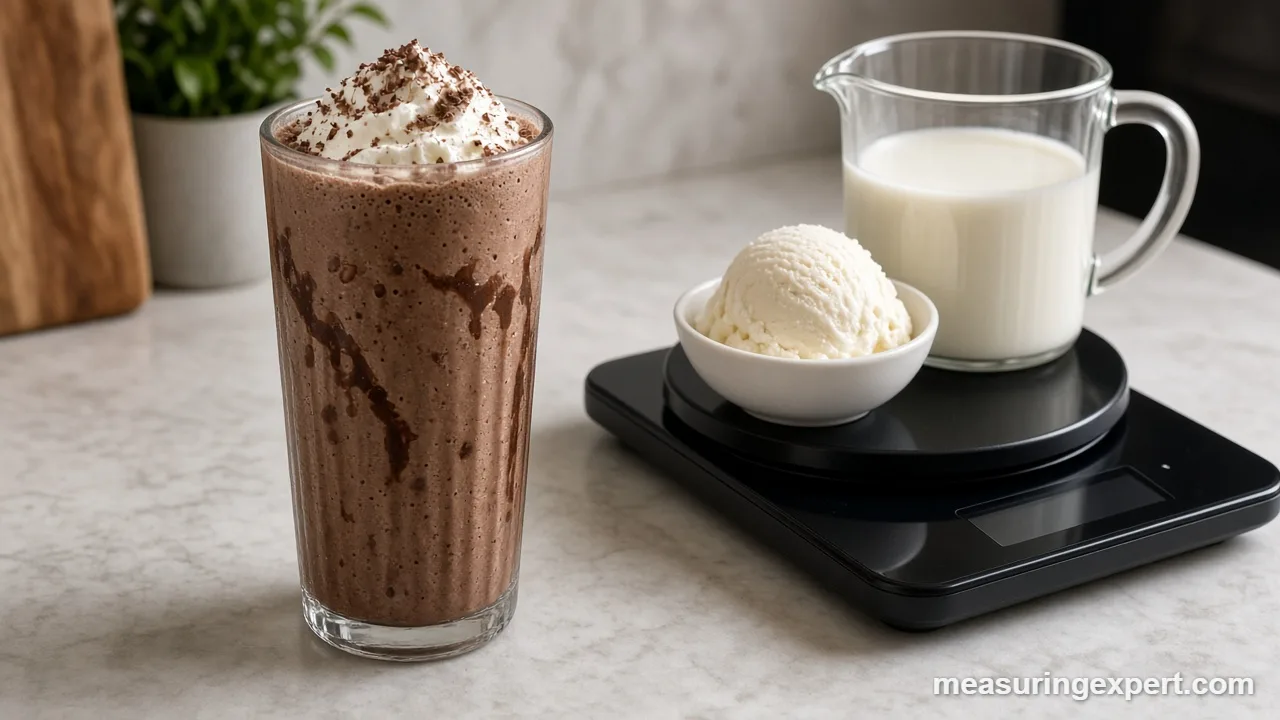
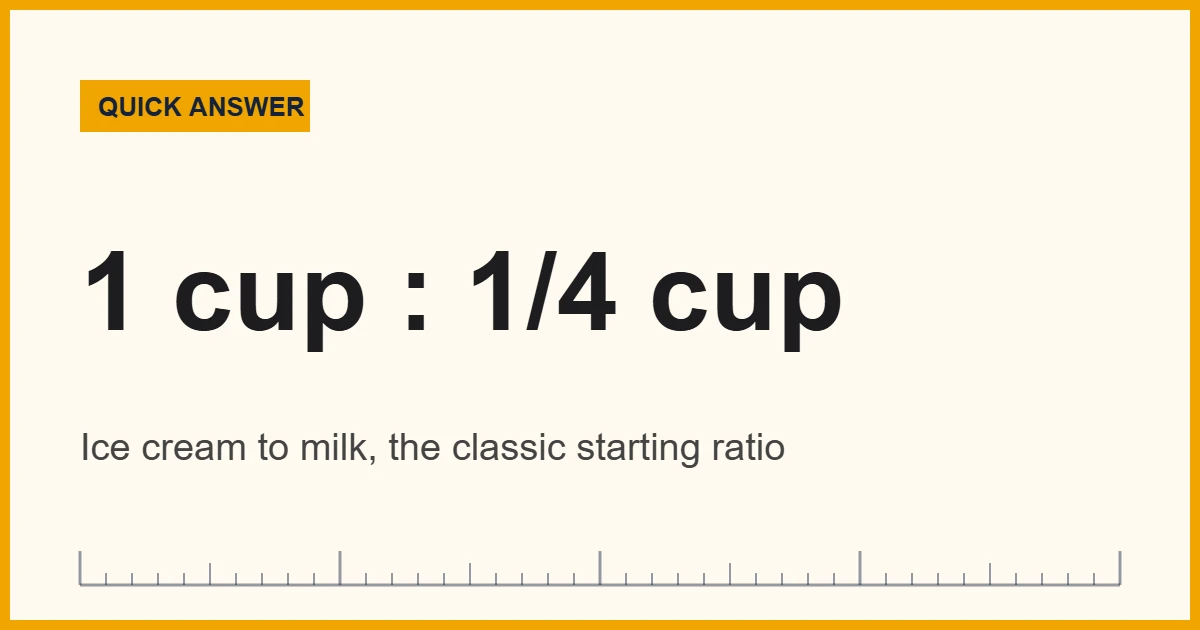
The best way to measure ingredients for milkshakes is to weigh them, or to follow one simple ratio: 1 cup of ice cream (237 mL) to 1/4 cup of milk (59 mL). Ice cream is full of air, so a scale beats a cup. For a thicker shake, use less milk. For a thinner one, add milk one tablespoon at a time.
A milkshake has only two main ingredients, yet small changes in each one swing the result a lot. For example, an extra splash of milk turns a thick, spoonable shake into a thin drink. Likewise, a loosely scooped cup of ice cream holds less than a packed one. As a result, two shakes made from the “same” recipe can taste and pour very differently.
Fortunately, you can fix that with a few fixed numbers. In this guide you will learn how to measure ingredients for milkshakes by volume and by weight, how to scale a batch from one glass to six, and how to adjust thickness by the spoonful. The numbers come from the Food Network’s basic milkshake method, the King Arthur ingredient weight chart, and US federal standards for ice cream.
First, you will see the core ratios. After that, you can use the converter, pick your tools, and work through the steps.
Milkshake Ratios: How Much Ice Cream and Milk?
The Food Network recommends starting with 1 cup of ice cream to 1/4 cup of milk, and that is the ratio used throughout this page. In other words, the milk is one quarter of the ice cream by volume. The table below shows what that looks like at three common thickness levels, per 1 cup (237 mL) of ice cream.
| Style | Milk per 1 cup ice cream | Milk in mL | Result |
|---|---|---|---|
| Extra thick | 2 tbsp | 30 mL | Eaten with a spoon |
| Classic | 4 tbsp (1/4 cup) | 59 mL | Thick, drinkable with a wide straw |
| Thin | 6 tbsp (3/8 cup) | 89 mL | Sips easily through a regular straw |
Treat these as starting points because ice cream brands differ in fat, sugar and air. As a result, you may need to nudge the milk up or down by a tablespoon. For a deeper look at tablespoon and cup conversions, see how much 30 mL is in spoons and ounces.
Converter to Measure Ingredients for Milkshakes
Type an amount in cups, and the converter shows the same quantity in tablespoons, fluid ounces and milliliters. It uses the exact US definitions, so you can switch between a US recipe and a metric one.
Recommended Tools for Measuring Milkshake Ingredients
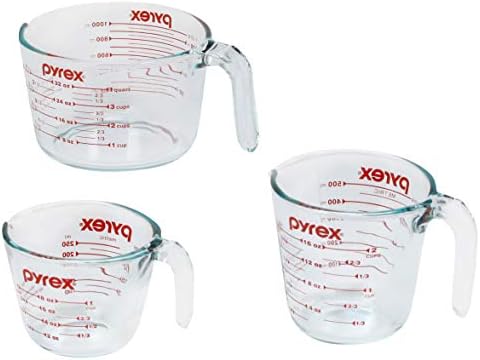
You need very little equipment. However, three items make the biggest difference. First, a digital scale with a tare button lets you weigh straight into the blender jar. Next, a clear liquid measuring cup keeps milk accurate. Finally, a sturdy scoop gives you equal portions of hard ice cream, and a drink mixer or blender handles the thick texture.



As an Amazon Associate, Measuring Expert earns from qualifying purchases.
Key Takeaways
- Start with 1 cup of ice cream to 1/4 cup of milk, then adjust by the tablespoon.
- Ice cream contains air, so weighing it is more consistent than scooping it.
- US ice cream must weigh at least 4.5 pounds per gallon, which is at least about 128 g per cup.
- One large shake uses about 2 cups of ice cream and 1/2 cup of milk.
- Add the milk in two stages so you never overshoot.
- Level every dry spoon and read every liquid cup at eye level.
Why Weight Beats Volume When You Measure Ingredients for Milkshakes
First, a cup measures space, not amount. Ice cream makes that gap obvious, because manufacturers whip air into it. Under US federal rules for ice cream, the product must weigh not less than 4.5 pounds to the gallon and contain at least 10 percent milkfat. That works out to at least about 539 g per liter, or about 128 g (4.5 oz) in one US cup. Dense premium ice cream weighs more than that, so the same cup can hold quite different amounts of actual ice cream.
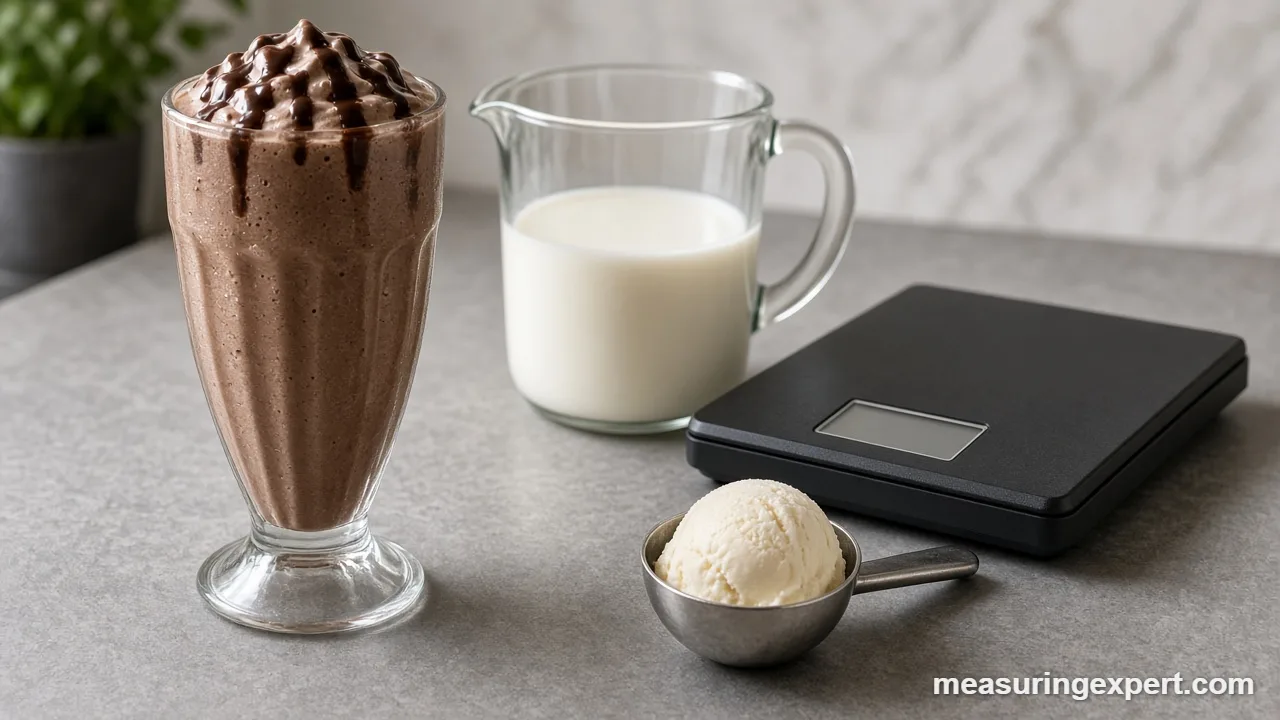
However, milk is far more predictable. King Arthur’s ingredient weight chart lists 1 cup of milk at 8 oz (227 g). Therefore, 1/4 cup of milk weighs about 57 g, and 1/2 cup weighs about 114 g. The chart also recommends a digital scale for the most reliable results.
| Ingredient | Volume | Weight | Source or basis |
|---|---|---|---|
| Ice cream (minimum) | 1 cup (237 mL) | at least 128 g (4.5 oz) | 4.5 lb per gallon federal minimum, calculated |
| Whole milk | 1 cup (237 mL) | 227 g (8 oz) | King Arthur chart |
| Heavy cream | 1 cup (237 mL) | 227 g (8 oz) | King Arthur chart |
| Granulated sugar | 1 cup (237 mL) | 198 g (7 oz) | King Arthur chart |
| Malted milk powder | 1/4 cup (59 mL) | 35 g (1 1/4 oz) | King Arthur chart |
| Honey | 1 tbsp (15 mL) | 21 g (3/4 oz) | King Arthur chart |
If you want to read more about the weight ounce versus the fluid ounce, see how much an ounce is.
How to Measure Ingredients for Milkshakes Step by Step
- Chill the glass. Put the serving glass in the freezer while the ice cream softens.
- Soften the ice cream. Let it sit at room temperature for 10 to 15 minutes, until a scoop presses in easily but is not runny.
- Weigh or scoop the ice cream. Tare the blender jar on a scale and add the ice cream, or press it into a dry measuring cup and level the top.
- Measure the milk. Pour cold whole milk into a liquid measuring cup on a flat counter and read the line at eye level.
- Add the milk in two stages. Pour in about two thirds first, blend, and then add the rest only if the shake is too thick.
- Add small extras last. Measure malt, syrup or flavoring with level spoons, add them, and blend for a few more seconds.
- Serve right away. Pour into the chilled glass, because a shake thins as it warms.
The Food Network also advises against adding ice, because it dilutes the texture. Instead, freeze the glass and keep the milk cold. In addition, malted milk powder and frozen mix-ins thicken the shake rather than thinning it.
Scaling Milkshake Amounts for a Crowd
In fact, scaling is simple multiplication, but only if you keep the ratio. The table assumes a large shake of 2 cups of ice cream and 1/2 cup of milk. Ice cream weights use the federal minimum, so real weights will be the same or higher.
| Shakes | Ice cream | Ice cream (min. weight) | Milk | Milk (weight) |
|---|---|---|---|---|
| 1 | 2 cups (473 mL) | 255 g | 1/2 cup (118 mL) | 114 g |
| 2 | 4 cups (946 mL) | 510 g | 1 cup (237 mL) | 227 g |
| 4 | 8 cups (1.89 L) | 1,021 g | 2 cups (473 mL) | 454 g |
| 6 | 12 cups (2.84 L) | 1,531 g | 3 cups (710 mL) | 681 g |
Also, eight cups of ice cream is half a gallon. In practice, that means one half-gallon carton plus 2 cups of milk makes four large shakes. Most home blenders cannot hold that much at once, so blend in batches and keep the unblended ice cream in the freezer until it is needed.
Fixing Thickness When You Measure Ingredients for Milkshakes
In fact, thickness depends on three things: how soft the ice cream is, how much milk goes in, and how long you blend. Because you can add liquid but never remove it, change one variable at a time.
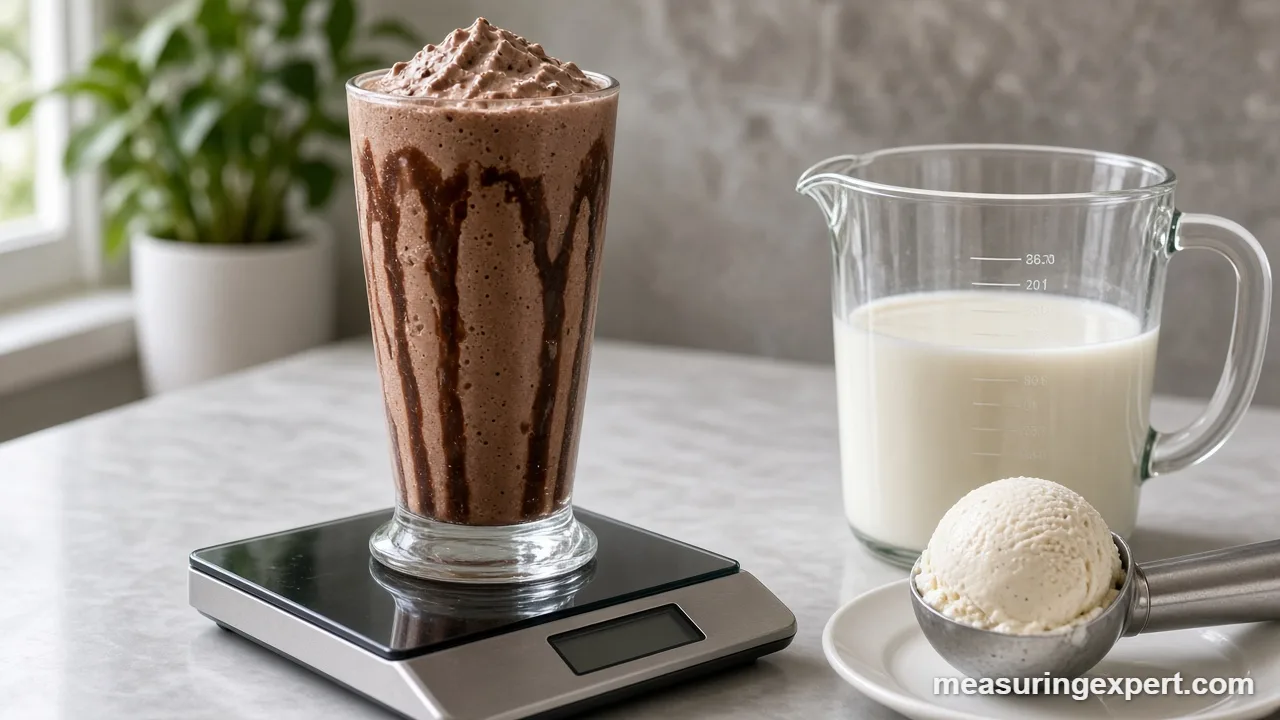
- Too thick: add 1 tablespoon (15 mL) of cold milk and pulse for a few seconds.
- Too thin: add a half cup (118 mL) of ice cream, or a tablespoon of malted milk powder, and blend again.
- Too sweet: use plain vanilla ice cream and add the flavoring in small, measured amounts.
The Food Network suggests letting the ice cream soften for 10 to 15 minutes before blending, but not until it turns runny. Meanwhile, full-fat milk makes a creamier shake, and heavy cream makes a thicker one.
Measuring Malt, Syrup and Mix-Ins
Extras are small, yet they change the result more than their size suggests. For example, 1/4 cup of malted milk powder weighs about 35 g, so 2 tablespoons is about 17 g. Honey is heavy for its volume: one tablespoon weighs about 21 g, compared with about 14 g for a tablespoon of milk.
Similarly, chocolate or caramel syrup works the same way. Use a measuring spoon, level or lightly coated, and add it after the ice cream and milk. Otherwise, the syrup sinks and the blades miss it. For a drink of the same kind, our guide to hot chocolate measurements covers cocoa and milk amounts.
Mistakes When You Measure Ingredients for Milkshakes
Do
- Weigh the ice cream when you can.
- Read liquid cups at eye level on a flat counter.
- Level dry spoons with a straight edge.
- Add the milk in two stages.
- Chill the glass before pouring.
Don’t
- Measure ice cream straight from the freezer without softening it.
- Pour milk into a dry measuring cup.
- Add ice to thicken or cool the shake.
- Assume all brands weigh the same per cup.
- Use tableware spoons for exact amounts.
Honest Limits of Milkshake Measurements
The numbers on this page are starting points, not guarantees. For one thing, the 4.5 pounds per gallon figure is a legal minimum, not a typical value, so your carton may weigh more per cup. In addition, soft-serve, gelato, frozen custard and dairy-free frozen desserts have different air content and different rules. The ratio also assumes whole milk, and plant milks or skim milk can change the feel. In short, use the ratio to get close, and then trust the texture: a good shake should hold a straw upright for a moment and still pour slowly.
When Accurate Amounts Matter Most
Most shakes forgive a spoonful either way. Still, accuracy helps in three cases. First, serving sizes: the FDA says that a label serving size reflects the amount people typically eat or drink, so measuring lets you compare your shake with the label. Second, allergen or ingredient-restricted diets, where you need to know exactly what went into the jar. Third, cooking for a group, where waste adds up.
Frequently Asked Questions
How do I measure ingredients for milkshakes without a scale?
Use the ratio 1 cup of ice cream to 1/4 cup of milk. Scoop the ice cream into a dry measuring cup, press it down gently, and level it. Then pour the milk into a liquid measuring cup and read it at eye level.
What is the best ratio of ice cream to milk for a milkshake?
A good starting ratio is 1 cup of ice cream (about 237 mL) to 1/4 cup of milk (about 59 mL). Use less milk for a spoonable shake and more for a drinkable one.
How much milk per scoop of ice cream?
A standard half-cup scoop of ice cream pairs with about 2 tablespoons of milk (30 mL). Add one extra tablespoon at a time if the blender struggles.
How many scoops of ice cream make one milkshake?
Four half-cup scoops, or 2 cups in total, make one large shake. Three scoops make a smaller one.
How many grams of ice cream are in a cup?
It depends on the brand. US ice cream must weigh at least 4.5 pounds per gallon, so a cup holds at least about 128 g (4.5 oz). Dense premium ice cream weighs more.
Should I measure ingredients for milkshakes by weight or volume?
Weight is more consistent, because ice cream traps air and packs differently each time. Volume is fine for a quick shake, as long as you level the cup and keep the ratio steady.
Why is my milkshake too thin?
Too much milk or soft ice cream is the usual cause. Next time, cut the milk by 1 tablespoon per cup of ice cream and let the ice cream soften for only 10 to 15 minutes.
How do I measure ingredients for milkshakes when I double the recipe?
Double every amount, then add the milk last and in two stages. Larger batches blend differently, so you may need slightly less milk per cup than the single-serving ratio.
How much malted milk powder goes in a milkshake?
Start with 2 tablespoons per shake and adjust to taste. King Arthur lists 1/4 cup of malted milk powder at about 35 g, so 2 tablespoons weighs about 17 g.
Can I use a regular spoon to measure milk for a shake?
For a rough estimate, yes. For repeatable results, use real measuring spoons, because tableware spoons vary in size. One tablespoon is 15 mL on labels.
Measure Ingredients for Milkshakes: The Bottom Line
To sum up, start with 1 cup of ice cream to 1/4 cup of milk, weigh the ice cream when you can, and add the milk in two stages. Then scale the batch by multiplying every amount.
Finally, use the converter above whenever a recipe switches between cups, spoons and milliliters. With a scale, a liquid cup and a level spoon, you can repeat a great shake every time.
1 thought on “How to Measure Ingredients for Milkshakes: Ratios, Weights and Tips”