

To measure ingredients for dehydrating, weigh the fresh food on a digital scale, cut it to an even 1/8 to 1/4 inch (3 to 6 mm), and measure any dip by volume. Weight tells you how much food you loaded. Then thickness and a steady 140 F (60 C) decide how fast it dries.
Convert Weights to Measure Ingredients for Dehydrating
Most dehydrator advice mixes pounds, ounces and grams. As a result, a quick converter saves a lot of mental math. Enter the weight of your fresh produce, and the tool shows it in the other units.
Dehydrating looks forgiving, because food simply loses water until it is dry. In practice, though, the way you measure decides whether a batch dries evenly. For example, thick pieces stay damp in the middle. Likewise, overloaded trays block airflow. A weak pretreatment dip also lets fruit turn brown.
Fortunately, only four things need measuring: the weight of the food, the thickness of each piece, the strength of any dip, and the temperature. Because everything else follows from those, a a scale, a ruler and a thermometer matter more than any recipe.
The advice below comes from university extension guides, including Colorado State University Extension on drying fruits and North Dakota State University Extension on drying vegetables. It also covers fruit drying in detail, so you do not need a separate guide.
Recommended Tools to Measure Ingredients for Dehydrating
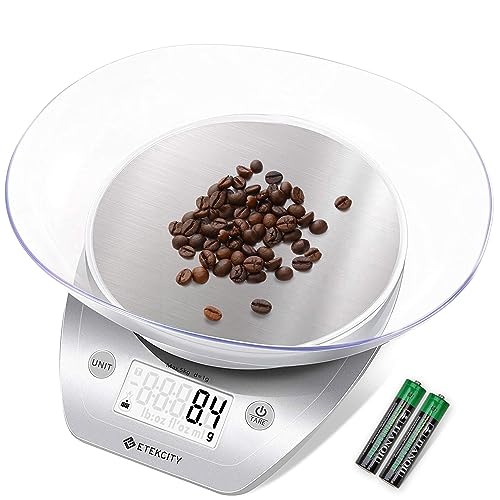
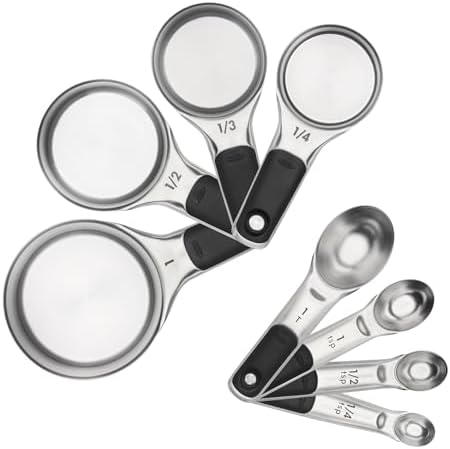
You do not need much gear. First of all, a digital scale that reads in grams and ounces is the most useful single tool. Next, measuring spoons and cups handle dips and brines. Finally, an instant-read thermometer lets you check an oven or dehydrator that has no reliable dial.




As an Amazon Associate, Measuring Expert earns from qualifying purchases.
Key Takeaways
- Weigh fresh food before drying, because cups of sliced fruit pack differently every time.
- Cut most fruit and vegetable slices to 1/8 to 1/4 inch (3 to 6 mm) so they dry at the same pace.
- Colorado State University Extension lists 140 F (60 C) as the drying temperature for fruit.
- A citric acid dip is 1 teaspoon per quart of cold water, with a 10-minute soak.
- Test dryness only after the food has cooled to room temperature.
- Fill conditioning jars only two-thirds full, and check them daily for 4 to 10 days.
Why Weight Beats Cups When You Measure Ingredients for Dehydrating
A cup holds the same space every time. What goes inside it does not weigh the same every time, though. For instance, apple slices stack loosely, whereas chopped apple fills the gaps. Therefore, two cups of “apples” can differ by a wide margin.
A scale removes that problem. First, weigh the prepared food, write the number down, and compare it with the dried weight later. To learn why scales are more consistent, see our guide to the food scale.
| Question | Use a scale | Use a cup or spoon |
|---|---|---|
| How much fresh food am I loading? | Yes: weigh in grams or ounces | No: slices pack unevenly |
| How strong is my citric acid dip? | Optional | Yes: teaspoons per quart |
| How much did the batch dry down? | Yes: weigh before and after | No |
| How much dried food fits in a jar? | Optional | Yes: fill two-thirds full to condition |
If you only need a quick weight conversion, see how much an ounce is. In short, 1 pound is 453.59 g and 1 ounce is 28.35 g.
Slice Thickness Chart to Measure Ingredients for Dehydrating
Thickness is the second measurement that matters. Thin slices dry fast, while thick ones stay moist inside. So use a ruler for your first batch. After that, your eye will learn the size.
| Food | Thickness (inches) | Thickness (mm) | Source |
|---|---|---|---|
| Apples and pears | 1/8 to 1/4 | 3 to 6 | Colorado State |
| Bananas | 1/8 | 3 | Colorado State |
| Melons | 1/4 to 1/2 | 6 to 13 | Colorado State |
| Eggplant, summer squash, onions | 1/4 | 6 | North Dakota State |
| Peppers (strips) | 1/4 to 1/2 | 6 to 13 | North Dakota State |
| Most vegetables, general range | 1/8 to 1/2 | 3 to 13 | North Dakota State |
North Dakota State adds one rule of thumb: cut higher-moisture foods thicker. Also, keep every piece on a tray the same size. A mandoline or a sharp knife with a ruler beside it works well.
How to Measure Ingredients for Dehydrating Fruits
Fruit is where measuring pays off most, because it browns and dries unevenly. This section covers weighing, dips and dryness tests for fruit.
Weigh Fruit Before and After Drying
Weigh the fruit after you peel, core and slice it. Then weigh it again when it is dry. As a result, the difference shows how much water left. For example, 500 g of sliced apple that finishes at 80 g lost 420 g, which is 84 percent of its starting weight. That is a worked example, not a rule, because every fruit and slice differs.
Keep a note of both numbers for each fruit. That way, you will know roughly what a finished batch should weigh. However, never use weight alone to call a batch done. Use the feel test below as well.
Measure Ingredients for Dehydrating: Pretreatment Dips for Fruit
Light-colored fruit such as apples, pears and peaches browns when cut. A short soak slows that. In fact, Colorado State University Extension lists these dips. Soak the cut fruit for 10 minutes and drain it well.
| Dip | Amount per quart of cold water | Notes |
|---|---|---|
| Ascorbic acid | 2 1/2 tablespoons (34 g) | For a small batch: 3 3/4 teaspoons (17 g) per 2 cups |
| Citric acid | 1 teaspoon (5 g) | Easy to scale up |
| Lemon juice | 1 cup juice plus 1 cup water | Equal parts juice and water |
| Sodium metabisulfite | 1 tablespoon (21 g) | Not for anyone with sulfite sensitivity |
To scale a dip, multiply by the number of quarts. For instance, 1 gallon is 4 quarts, so the citric acid dip needs 4 teaspoons. Use a level spoon, because a heaping spoon changes the strength. For an overview of liquid conversions, see how much 30 mL is.
Check Fruit for Dryness and Condition It
Let the fruit cool to room temperature first, because warm fruit feels softer than it is. Dry fruit should be leathery and pliable. To check, squeeze a handful. Then look for any moisture, because none should remain on your hand, and the pieces should spring apart when you let go.
After that, condition the fruit. Fill large containers about two-thirds full of cooled, dried fruit and cover them loosely. Keep them somewhere warm and dry for 4 to 10 days, and shake them daily. If moisture beads form, return the fruit to the trays. As a result, properly stored dried fruit keeps 6 to 12 months, according to Colorado State.
Measure Ingredients for Dehydrating Vegetables and Herbs
Vegetables follow the same basics, with one extra step. Many need blanching first because it stops enzymes that spoil flavor and color. North Dakota State lists blanching times in boiling water. Blanch no more than 1 quart (about 0.95 L) of cut vegetables at a time.
| Vegetable | Blanch time (minutes) |
|---|---|
| Green beans, broccoli, peas, celery | 2 |
| Corn (cut), summer squash | 1 1/2 |
| Carrots | 3 1/2 |
| Cauliflower | 3 to 4 |
| Potatoes | 5 to 6 |
| Onions, peppers, mushrooms, garlic, herbs | No blanching |
Herbs are the easiest. First, wash them, separate the clusters and discard tough stems. They are done when flaky, which North Dakota State puts at about 1 to 2 hours. Vegetables are finished when they are brittle or crisp, again after cooling.
Step-by-Step: How to Measure Ingredients for Dehydrating
- Prep the food first. Wash, peel, core and trim before anything goes on the scale.
- Weigh the prepared food. Record the total in grams or ounces, and weigh each tray if you want to compare batches.
- Cut to a set thickness. Use the chart above and a ruler for the first few pieces.
- Measure the dip or blanch. Use level spoons for citric acid, ascorbic acid or lemon juice and a timer for blanching.
- Load trays in a single layer. Leave gaps between pieces so air can move.
- Set and check the temperature. Use 140 F (60 C) for fruit, and confirm it with a thermometer if the dial is unmarked.
- Rotate and test. Turn large pieces and stir the food every 3 to 4 hours, then cool a sample before testing it.
- Weigh, condition and store. Record the dried weight, condition the fruit, then label and store it.
Scale a Batch When You Measure Ingredients for Dehydrating
Tray space limits batch size. For example, the National Center for Home Food Preservation notes that 12 square feet (about 1.1 square meters) of drying space dries roughly a half-bushel of produce. Most home units have 4 to 10 open mesh trays. Check your model’s manual for its total area. Then keep each tray to a single layer.
When a recipe is written for one pound, the same method scales by weight. Take 2 pounds (907 g) of fruit, and mix enough dip to cover all of it. Meanwhile, keep thickness and temperature the same, because those do not scale with weight.
Cover the fruit fully, and keep the concentration at 1 teaspoon of citric acid per quart. For a kitchen idea on batch prep and storage, our freezing meal portions guide shows how weighing helps there too.
Do and Don’t When You Measure Ingredients for Dehydrating
Do
- Weigh food after peeling and slicing.
- Cut every piece on a tray to the same thickness.
- Use level spoons for dips.
- Cool a sample before testing it.
- Label jars with the food, date and method.
Don’t
- Trust a cup of sliced fruit as a fixed weight.
- Stack slices in layers on a tray.
- Test dryness while the food is still warm.
- Fill conditioning jars to the top.
- Skip the dip on light fruit that browns.
Honest Limits of These Measurements
No measurement here is a guarantee. For one thing, fruit varies in water content, so the same weight can dry in different times. Humidity, tray load and the model of dehydrator change results too. In addition, the dip amounts above come from extension guides, and the gram figures are rounded.
The worked weight loss earlier is only an illustration. Instead, use it to track your own batches. Above all, trust the feel test: leathery for fruit, brittle for vegetables, flaky for herbs.
When to Check With an Extension Office
This page covers fruit, vegetables and herbs. However, meat jerky has separate safety steps, so ask your local extension office or read USDA guidance first. Do the same if you are drying food to sell, or if someone in your home has a sulfite allergy.
Frequently Asked Questions
What is the best way to measure ingredients for dehydrating?
Weigh the prepared food on a digital scale, cut it to an even thickness, and measure dips with level spoons. Finally, check the temperature and test dryness after cooling.
How thick should I slice fruit for dehydrating?
Cut apples and pears 1/8 to 1/4 inch thick (3 to 6 mm), and bananas about 1/8 inch (3 mm). Melons can be 1/4 to 1/2 inch thick.
What temperature should I use to dry fruit?
Colorado State University Extension lists 140 F (60 C). Follow your dehydrator manual if it gives a different setting.
How much food fits in a dehydrator?
About 12 square feet of drying space dries roughly a half-bushel of produce, according to the National Center for Home Food Preservation. Keep each tray to one layer.
How do I make a citric acid dip?
Mix 1 teaspoon of citric acid into 1 quart of cold water. Soak the cut fruit for 10 minutes and drain it well.
How do I know fruit is dry?
First, cool a sample. It should feel leathery and pliable, with no moisture on your hand when you squeeze a handful.
Is 1 cup of liquid the same as 1 cup of dry?
The volume is the same, but the weight is not. A US cup is about 236.6 mL, and a cup of water weighs about 237 g, while a cup of sliced fruit weighs far less.
How do I measure dried fruit?
Weigh it, because cups of dried fruit pack loosely, so grams or ounces give a steadier number than a cup does.
How long does dried fruit keep?
Colorado State says properly stored dried fruit keeps 6 to 12 months in a cool, dry, dark place. Throw out fruit with off odors or mold.
Can I dry food in an oven instead?
Yes, with care. In fact, North Dakota State advises an oven that holds 140 to 145 F, with the door open 2 to 6 inches and a fan nearby. It can take about twice as long, and it is not safe around young children.
The Bottom Line on Measuring for Dehydrating
To sum up, weigh the food, slice it to a set thickness, measure dips by the level spoon, and hold the temperature steady. Then cool a sample and test it before you pack anything away.
Finally, keep notes on starting and finishing weights. Over a few batches, those numbers become your own reference, and the converter at the top of this page handles any pounds-to-grams conversion along the way.