

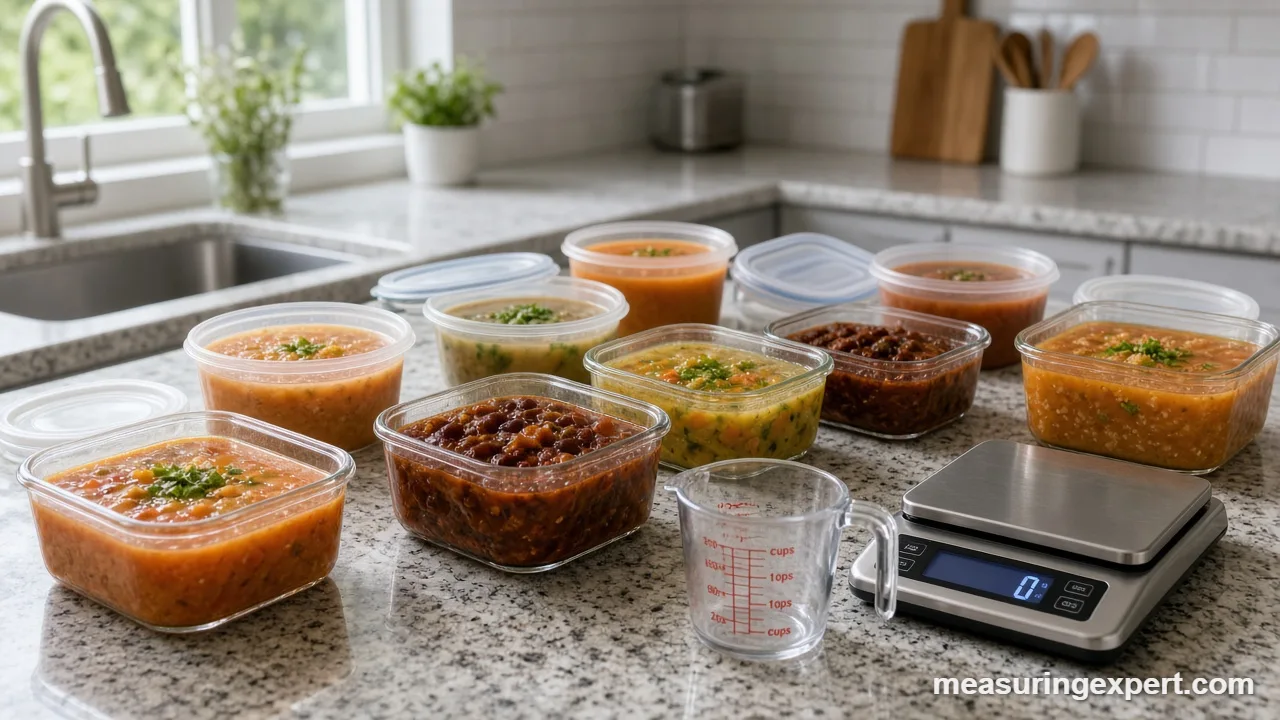
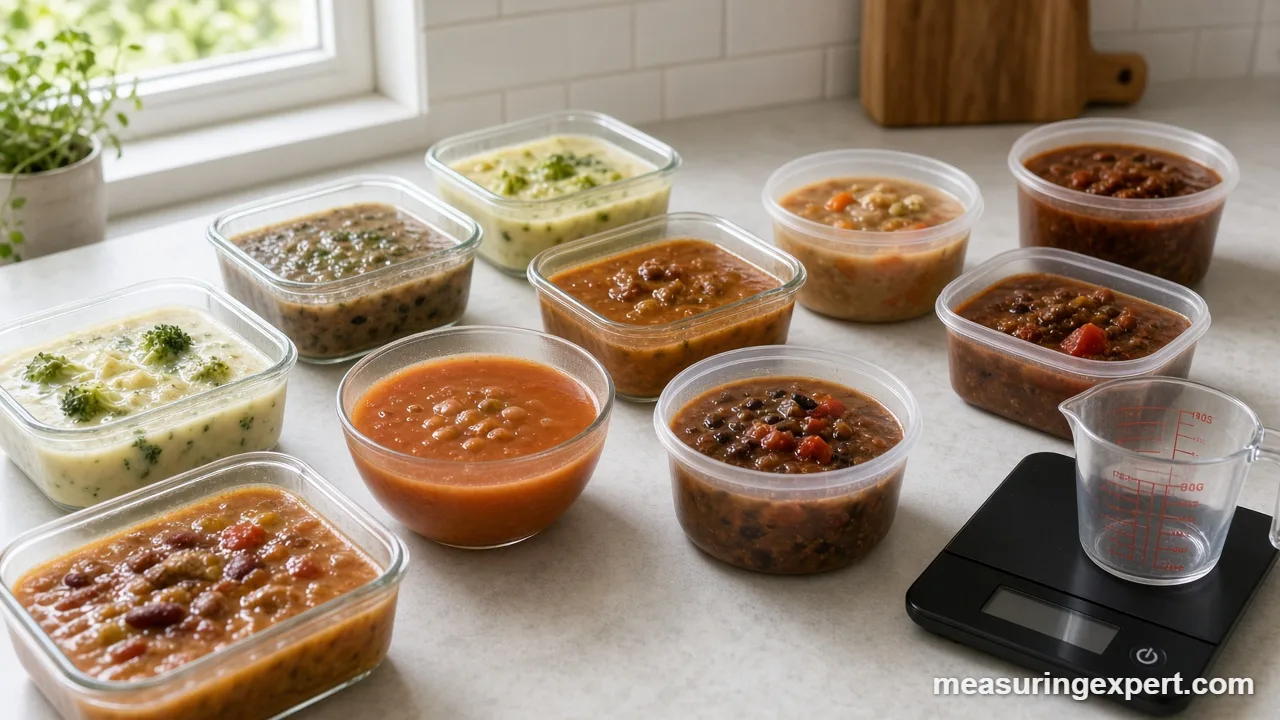
For freezing meal portions, pack 1 to 2 cups (237 to 473 mL) per serving, chill the food first, and fill each container only about 90 percent full. Liquids expand roughly 9 percent as they freeze, so a 1-quart container holds about 3 2/3 cups (868 mL) of soup.
Freezing Meal Portions Calculator
Enter a pot size or a portion size to see it in cups, quarts, gallons, fluid ounces and milliliters. As a result, you can match a big batch to the containers in your freezer.
A freezer full of mystery containers is a common kitchen problem. In most cases, the cause is measuring: portions that are too big, lids that pop off, or bags that burst. Therefore, a few numbers decided in advance save a lot of waste.
This guide covers container fill levels, serving sizes, cooling, thawing and labels. In addition, it shows how to turn one big pot into the right number of containers.
Freezing Meal Portions: Container Fill Chart
Water is about 9 percent larger as ice than as liquid. As a result, because soups, sauces and stews are mostly water, they push against the lid as they freeze. To leave room, divide the container size by 1.09. For example, a 4-cup container divided by 1.09 gives 3.67 cups, which is about 3 2/3 cups.
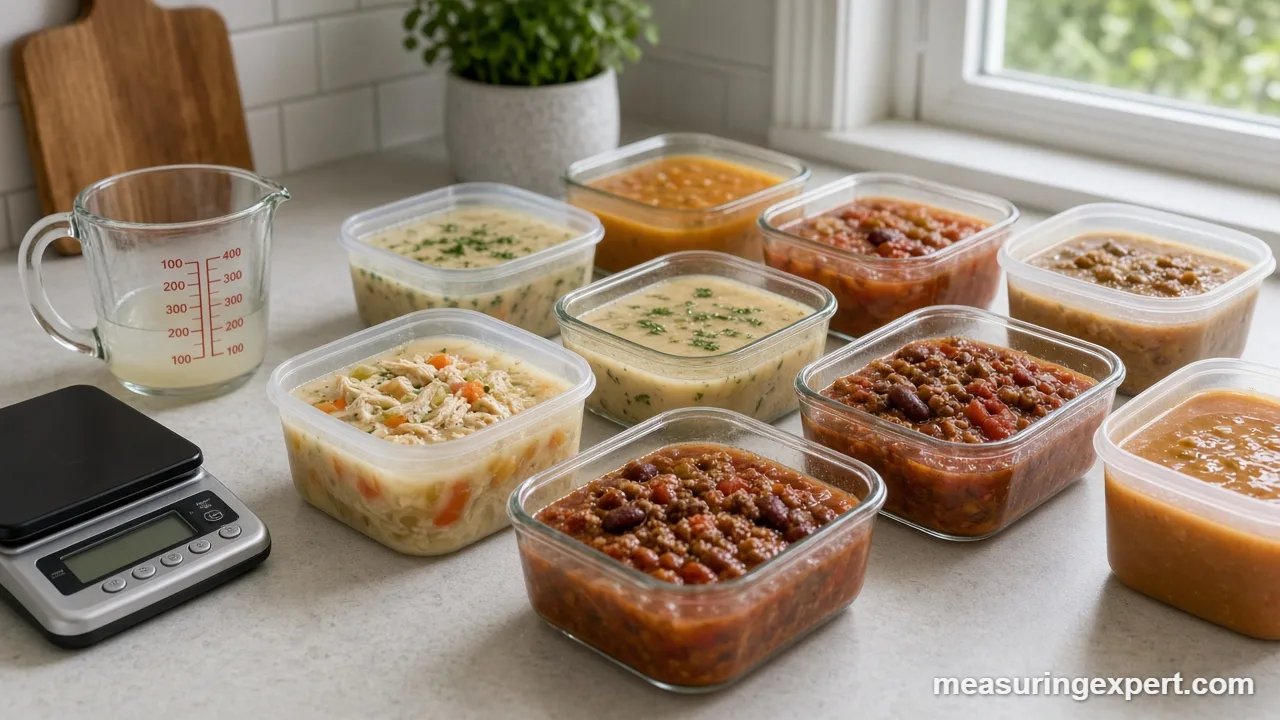
| Container size | Maximum liquid fill | In milliliters |
|---|---|---|
| 1 cup (8 fl oz) | about 7/8 cup | about 217 mL |
| 2 cups (1 pint) | about 1 3/4 cups | about 434 mL |
| 4 cups (1 quart) | about 3 2/3 cups | about 868 mL |
| 8 cups (2 quarts) | about 7 1/3 cups | about 1.74 L |
The National Center for Home Food Preservation publishes its own headspace table for liquid packs and juices. It calls for 1/2 inch in a wide-mouth pint, 1 inch in a wide-mouth quart, and more in narrow-mouth containers. Use it as a cross-check for soups and stews, which behave much the same way.
Recommended Tools for Freezing Meal Portions
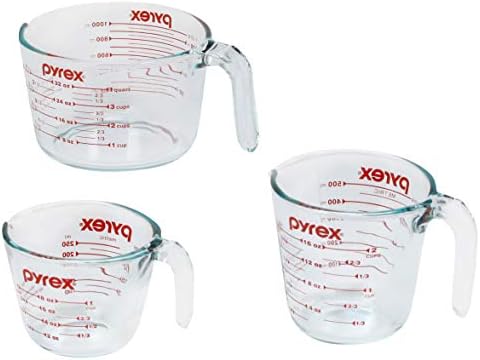
Good tools make portions repeatable. First, a digital scale lets you fill each container by weight. Next, a marked measuring cup handles liquids. In addition, portion trays give you identical blocks that stack neatly. Finally, a small freezer thermometer confirms that the freezer holds 0 F.



As an Amazon Associate, Measuring Expert earns from qualifying purchases.
Key Takeaways
- Pack 1 to 2 cups per serving for soups, chili and sauces.
- Fill rigid containers to about 90 percent, because liquid expands by roughly 9 percent.
- Cool food and split it into shallow containers within 2 hours of cooking.
- A freezer at 0 F (-18 C) keeps food safe; the storage times mostly protect quality.
- Reheat leftovers to 165 F (74 C) as measured with a food thermometer.
- Label every container with the dish, the portion size and the freeze date.
Freezing Meal Portions by Serving Size
There is no single right size, because the answer depends on who eats the meal. For example, single portions thaw fast and prevent waste. Family portions, however, save time on busy nights. The table gives starting points that you can adjust.
| Portion type | Typical amount | Container |
|---|---|---|
| Single soup or chili | 1 1/2 cups (355 mL) | 2-cup container or 1-cup tray cubes |
| Single sauce or gravy | 1/2 cup (118 mL) | 1/2-cup tray or small bag |
| Casserole slice | 1/6 of a 9 x 13 inch pan | Wrapped slice in a bag |
| Family soup or stew | 6 cups (1.42 L) | 2-quart container |
| Cooked rice or grains | 1 cup (237 mL) | Flat bag |
To turn a pot into portions, divide the total cups by the portion size. For example, a 12-cup pot of chili yields 8 portions of 1 1/2 cups. Likewise, a 16-cup (1-gallon) batch of broth fills eight 2-cup containers.
A scale makes this faster. Water-based soups weigh close to 237 g per cup, since 1 mL of water weighs 1 g. Next, put the container on the scale, press tare, and ladle until you reach the target weight. Our kitchen scale guide shows how taring works.
How to Measure and Pack Meals for the Freezer
Follow these steps for each batch. Meanwhile, keep the freezer door closed as much as possible.
- First, measure your pot. Add up the cups of liquid, or weigh the finished dish.
- Then divide that total by your portion size to get the number of containers.
- Cool the food in shallow containers until it reaches about 40 F (4 C), within 2 hours of cooking.
- Next, set each container on a scale, press tare, and fill to the target weight or to the fill line in the chart.
- Leave extra room in narrow-mouth containers and jars, because the neck can crack as liquid expands.
- After that, press the air out of freezer bags, seal them, and lay them flat so they freeze in a thin slab.
- Finally, label each container, then stack the containers once they are fully frozen.
Cooling, Thawing and Reheating Times
The USDA says to refrigerate leftovers within 2 hours of cooking and to divide large amounts into shallow containers so they cool faster. Meanwhile, cold storage should stay at 40 F or below. Therefore, freeze the food after it is cold, not while it is steaming.
| Step | Target | Source note |
|---|---|---|
| Cool and refrigerate | Within 2 hours, at or below 40 F (4 C) | USDA leftovers guidance |
| Freezer temperature | 0 F (-18 C) | FDA storage chart |
| Thaw in the refrigerator | Use within 3 to 4 days after thawing | USDA leftovers guidance |
| Reheat | 165 F (74 C), sauces and soups to a rolling boil | USDA leftovers guidance |
You can also thaw in cold water in a leak-proof bag, or in the microwave. However, food thawed in cold water should be cooked before it goes back in the freezer, and microwaved food should be heated to 165 F right away. For the full list, see the USDA leftovers guidance.
Labels and Storage Time
A label should answer three questions at a glance: what it is, how much it holds, and when it went in. Write the date as month and day, and add a use-by date about 3 months later. Consequently, you never have to guess what is at the back of the freezer.
The FDA Refrigerator and Freezer Storage Chart lists 2 to 3 months for soups, stews and cooked meat dishes, and 4 to 6 months for cooked poultry dishes. It also notes that food held at 0 F stays safe indefinitely, so these times describe quality, not safety. The USDA leftovers page gives a broader 3 to 4 months. In other words, treat the shorter number as the target for best flavor.
If you use bags, write the portion size on the bag before you fill it. Otherwise, the ink smears on a cold, damp surface. For other kitchen conversions, our guide to the metric system in cooking helps with grams and milliliters.
Common Freezer Measuring Mistakes
Do
- Fill rigid containers to about 90 percent.
- Cool food before freezing it.
- Freeze in portions you will actually eat.
- Check the freezer with a thermometer.
Don’t
- Fill a jar to the brim with soup.
- Freeze a whole pot as one huge block.
- Skip the date on the label.
- Refreeze food that thawed on the counter.
Portion errors are the other common problem. For instance, a recipe cut in half still needs the right container, because a half-empty container leaves air that causes freezer burn. Similarly, a pan of casserole frozen whole is hard to portion. If you also preserve food in jars, compare these rules with measuring ingredients for canning.
Honest Limits
The 9 percent figure is a rule of thumb for water-based foods. However, fatty sauces, thick purees and foods with air pockets expand differently. Also, home freezers vary, so the same dish may last longer in a deep freezer that stays steady at 0 F than in a door shelf that warms each time you open it.
In addition, the portion sizes here are starting points rather than nutrition advice. If you need exact calories or serving sizes for health reasons, follow the label or ask a registered dietitian. Meanwhile, if you lack a measuring cup, this guide to measuring cup substitutes can help.
Frequently Asked Questions
How much food should I put in each container when freezing meal portions?
Fill rigid containers to about 90 percent. For example, a 1-quart container holds about 3 2/3 cups (868 mL) of soup or sauce.
How do you portion and freeze meals?
First, cool the food, divide the total cups by your portion size, fill each container by cup or by weight, label it, and freeze it flat or upright.
How do you measure food for meal prep?
Weigh it. For example, put the container on a scale, press tare, and add food until you reach the target grams or ounces. Alternatively, use marked measuring cups for liquids.
How long can freezing meal portions stay in the freezer?
The FDA chart lists 2 to 3 months for soups and stews and 4 to 6 months for cooked poultry dishes. Food held at 0 F stays safe, but quality declines over time.
How many cups of soup is one serving for freezing meal portions?
A common single portion is 1 to 1 1/2 cups (237 to 355 mL). However, use 2 cups (473 mL) if the soup is the whole meal.
What is the best way to measure 3 oz of dry ingredients?
Weigh them, because three ounces is about 85 g. Put a bowl on a digital scale, press tare, and add the ingredient until the display reads 85 g.
Why do I need extra room in the container?
Liquid expands by roughly 9 percent as it freezes. As a result, without extra room, the lid can pop or a glass jar can crack.
Can I freeze food in a glass jar?
Use only jars made for freezing, preferably wide-mouth ones, because NCHFP notes that regular glass jars break easily at freezer temperatures.
Should I cool food before freezing meal portions?
Yes. The USDA says to refrigerate leftovers within 2 hours and to use shallow containers so they cool faster. Then freeze the cold food.
What temperature should I reheat frozen meals to?
Reheat leftovers to 165 F (74 C), measured with a food thermometer. Bring soups, sauces and gravies to a rolling boil.
Freezing Meal Portions: The Bottom Line
To sum up, decide the portion size first, then pick the container, and fill it to about 90 percent. Cool the food, label it, and keep the freezer at 0 F.
Finally, use the calculator near the top to convert pot sizes into cups, quarts and milliliters. A scale and a few good containers turn a messy freezer into a plan.
2 thoughts on “Freezing Meal Portions: How to Measure and Pack Meals for the Freezer”