

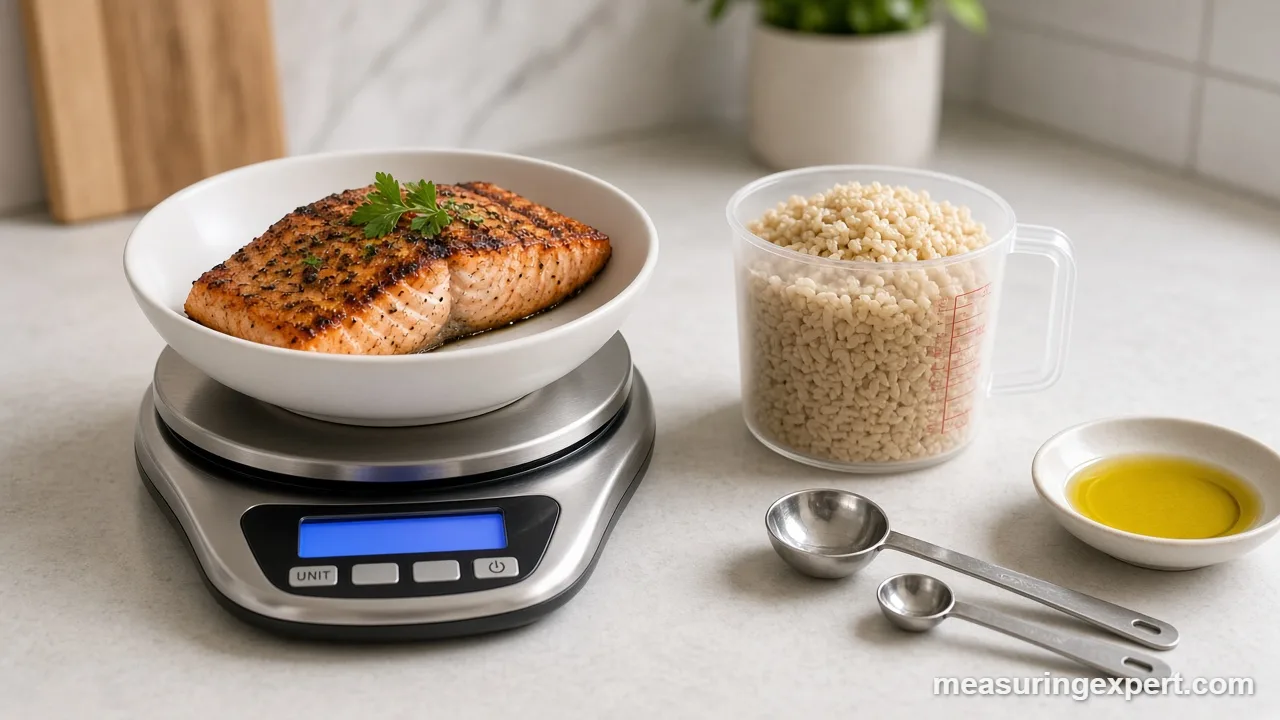
To measure heart-healthy meal portions, weigh or scoop each ingredient instead of guessing. Typical reference amounts are 3 oz (85 g) of cooked meat, 1/2 cup of cooked rice or pasta, and 1 oz (28 g) of nuts. Then compare them with the serving size on the label.
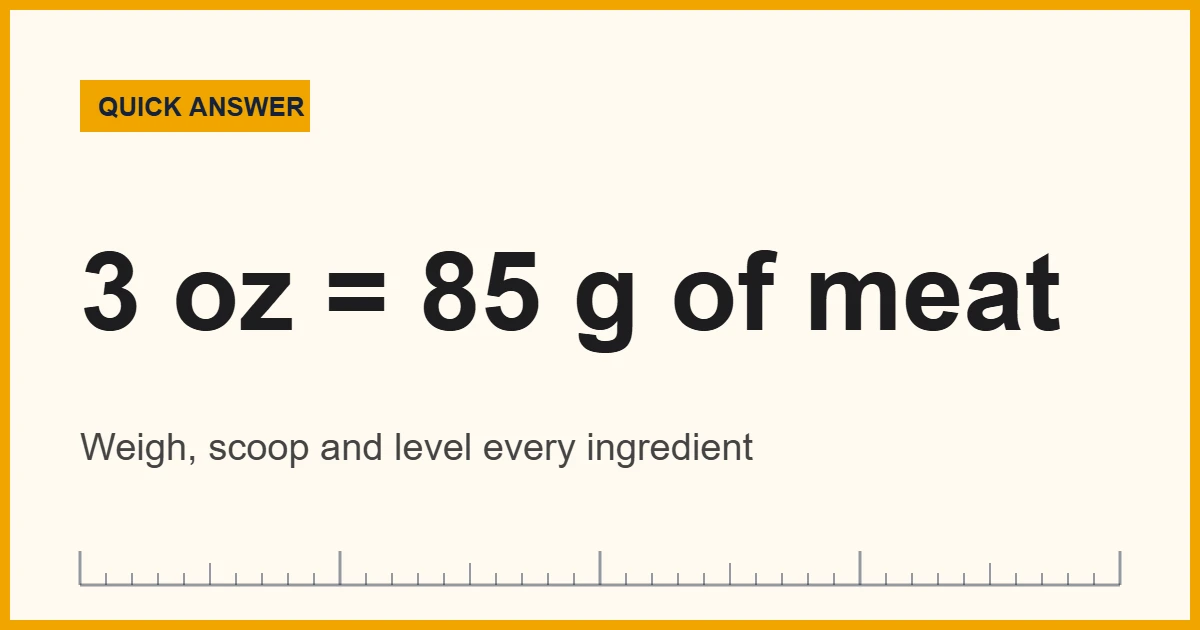
Convert Heart-Healthy Meal Portions Between Ounces and Grams
First, enter an amount in ounces, grams or pounds to see the same weight in the other units. For example, type 3 ounces to see the usual cooked-meat reference amount in grams.
Most people never weigh dinner. Instead, they pour, scoop and eyeball, so a plate can easily hold twice what a recipe intended. In fact, measuring takes only a few extra seconds, and it makes every plate comparable from one night to the next.
This guide covers the practical side only: tools, reference amounts, label reading and a simple routine. It does not tell you what to eat. However, the National Jewish Health guide to serving size vs portion size explains that a serving size is a set amount used on labels, while a portion size is simply what you put on your plate.
As a result, the two numbers often differ. Below, you will learn how to measure each ingredient, how to read the label basis, and how to keep salt and oil amounts consistent.
Heart-Healthy Meal Portions: Reference Chart
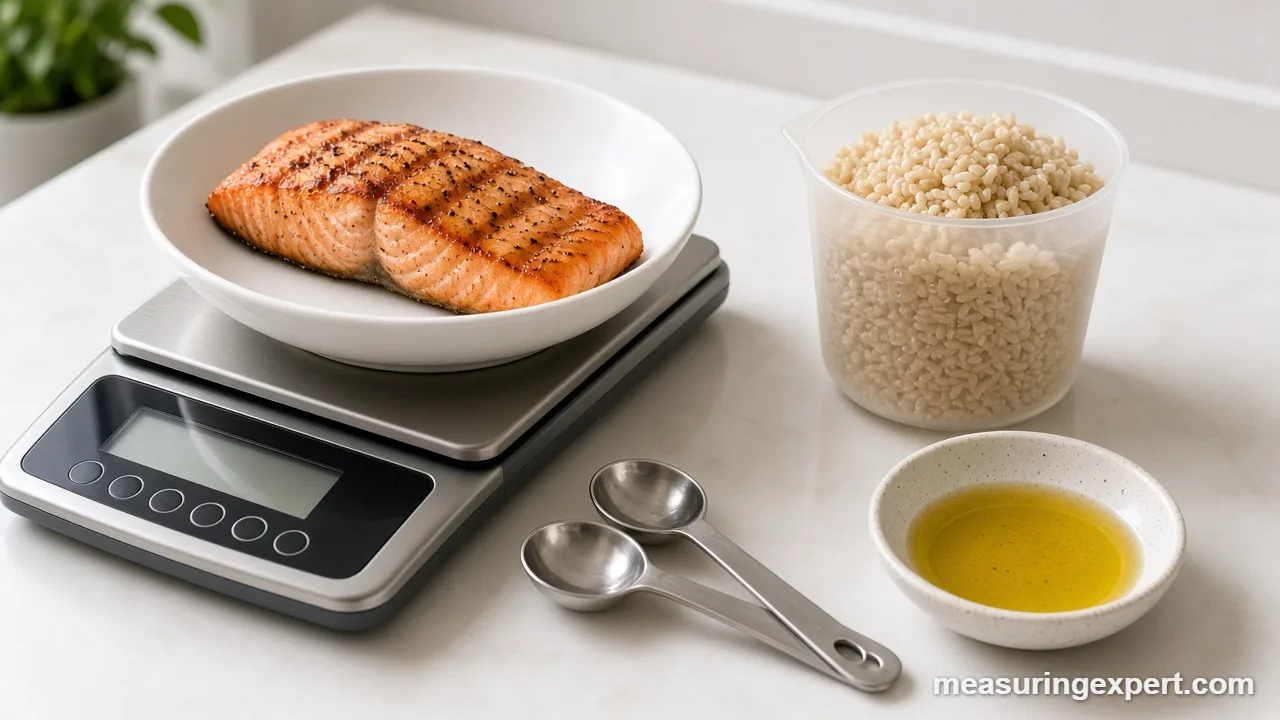
These amounts come from the serving examples in the National Jewish Health guide. In addition, the gram values are converted with the exact definition of the ounce (28.3495 g).
| Food | Reference amount | Metric | Visual cue |
|---|---|---|---|
| Cooked rice | 1/2 cup | about 118 mL | Half a baseball |
| Cooked pasta | 1/2 cup | about 118 mL | Half a baseball |
| Meat, poultry or fish | 3 oz | 85 g | Deck of cards or palm |
| Nuts | 1 oz | 28 g | One loose handful |
| Cheese | 1 1/2 oz | 43 g | About 1 1/2 finger lengths |
| Butter or margarine | 1 tsp | about 4.9 mL | One die from a set of dice |
These are reference amounts, not targets. In practice, your own plan may call for more or less, so use the numbers as a measuring vocabulary. If you want weights for other ingredients, see our guide to measuring ingredients by weight.
Recommended Tools for Measuring Heart-Healthy Meal Portions
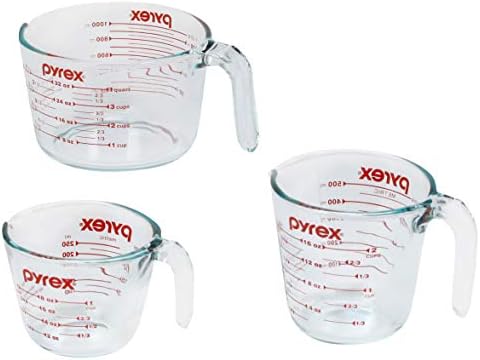
A scale is the single most useful tool here. First, choose one with a tare button so you can zero the bowl. Next, pick a model that switches between grams and ounces. Finally, add measuring cups and spoons for liquids, oils and salt.

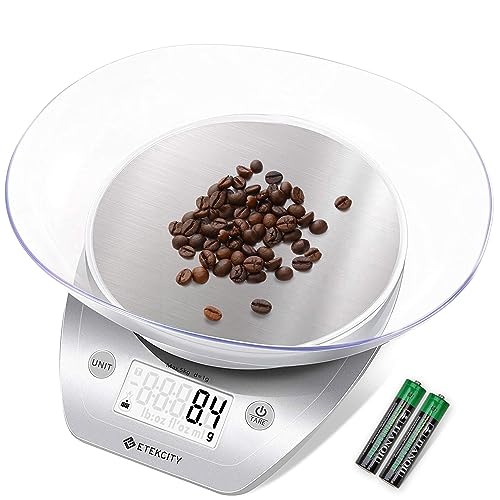

As an Amazon Associate, Measuring Expert earns from qualifying purchases.
Key Takeaways
- A serving size is the label amount, while a portion is what you serve yourself.
- Reference amounts include 3 oz (85 g) of meat, 1/2 cup of cooked grains and 1 oz (28 g) of nuts.
- The FDA lists the sodium Daily Value as less than 2,300 mg per day.
- One teaspoon of table salt contains about 2,300 mg of sodium, so level spoons matter.
- A kitchen scale with a tare button is the fastest way to repeat a portion.
- Weigh raw and cooked food consistently, and note which one you used.
- This page is general information, not medical advice or a diet plan.
Serving Size vs Portion Size for Heart-Healthy Meal Portions
A serving size is a standard amount set by the food maker, the restaurant or the government. A portion size, by contrast, is whatever you actually serve. The Nutrition Facts label uses the serving size as the basis for every number on it.
Therefore, a label can look low in sodium or fat until you notice that your plate holds two or three servings. The FDA points out that nutrition information is usually based on one serving, so you should check the serving size and count how many servings you eat.
| Label shows (per serving) | You eat | Your total |
|---|---|---|
| 140 mg sodium | 1 serving | 140 mg |
| 140 mg sodium | 2 servings | 280 mg |
| 140 mg sodium | 2 1/2 servings | 350 mg |
Multiply the number of servings by each value on the label. In other words, the scale tells you how many servings are on the plate, and the label tells you what each one contains.
How to Measure Heart-Healthy Meal Portions Step by Step
- Read the label basis. Find the serving size and the servings per container before you measure anything.
- Set up the scale. Place an empty bowl on it and press tare so it reads zero.
- Weigh proteins first. Add meat, poultry or fish until the display shows the target in ounces or grams.
- Scoop grains and starches. Use a level measuring cup for cooked rice or pasta, or weigh them to the gram.
- Measure oils and salt with spoons. Level each spoon, and wipe the rim of a sticky one.
- Fill the rest with vegetables. Because vegetables are bulky, measure them by cup or simply fill the remaining space.
- Write the amounts down. Record each number once, then repeat it next time without re-measuring.
For example, a dinner of 3 oz of fish, 1/2 cup of cooked rice and 1 tsp of oil takes about two minutes to weigh. Afterward, the same plate looks identical every night.
Measuring Salt and Sodium in Heart-Healthy Meal Portions
Salt is easy to over-pour because the spoon is so small. According to the American Heart Association’s salt versus sodium explainer, one teaspoon of salt holds 2,300 mg of sodium. The same page lists 2,300 mg per day as the maximum and 1,500 mg per day as the ideal limit for most adults.
| Level spoon of table salt | Sodium (from 2,300 mg per tsp) |
|---|---|
| 1 tsp | 2,300 mg |
| 1/2 tsp | 1,150 mg |
| 1/4 tsp | 575 mg |
| 1/8 tsp | about 288 mg |
The FDA label guide also gives a quick check: 5% of the Daily Value or less per serving is low, and 20% or more is high. Using the 2,300 mg Daily Value, that works out to about 115 mg and 460 mg. Moreover, these thresholds apply to one serving, so your plate total matters too.
Measuring Oils and Fats for Heart-Healthy Meal Portions
Oil pours faster than it looks. A tablespoon of olive oil weighs about 12.5 g, based on the King Arthur Baking ingredient weight chart, which lists a 1/4 cup at 50 g. Therefore, a quick glug from the bottle can easily double the amount.
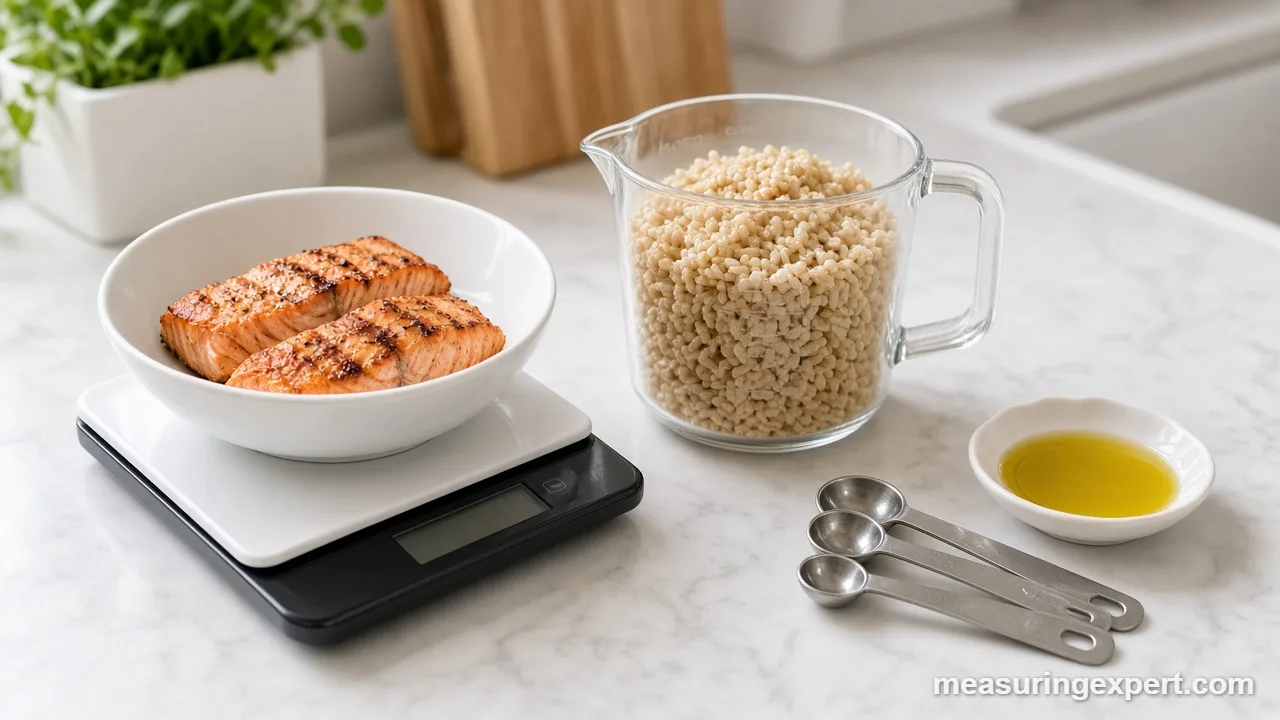
To keep oil consistent, measure it with a spoon over a separate bowl. Alternatively, put the pan on the scale, press tare and pour until the display shows your target in grams. In addition, a spray bottle or brush can help you spread a thin film.
| Measure | Olive oil (about) |
|---|---|
| 1 tsp | 4.2 g |
| 1 tbsp | 12.5 g |
| 1/4 cup | 50 g |
Raw vs Cooked Weights for Heart-Healthy Meal Portions
Meat, rice and pasta change weight during cooking. Meat loses water, while rice and pasta absorb it. As a result, 3 oz of raw chicken and 3 oz of cooked chicken are different amounts of food.
Each label states whether its numbers describe the raw or the cooked food, so check it first. Choose one method and stick with it. Otherwise, your numbers will drift from meal to meal.
Common Mistakes With Heart-Healthy Meal Portions
- Measuring heaped cups. A heaped cup holds noticeably more than a level one, so level every scoop.
- Ignoring servings per container. Because a small bag often holds more than one serving, count them.
- Mixing raw and cooked weights. The numbers do not match, so pick one.
- Confusing fluid ounces with weight ounces. The fluid ounce measures volume, but the ounce measures weight.
- Pouring oil by eye. Spoon it or weigh it every time.
The ounce confusion is especially common, so see how much an ounce is for a clear explanation.
Do and Don’t for Heart-Healthy Meal Portions
- First, check the serving size on every label.
- Also, weigh meat and fish on a scale.
- Level cups and spoons with a straight edge.
- Record the amounts you use often.
- Measure salt before it goes in the pot.
- Assume a portion equals a serving.
- Instead of comparing raw and cooked weights, pick one.
- Pour oil straight from the bottle.
- Rely on a handful for exact amounts.
- Treat reference amounts as medical advice.
Honest Limits of Heart-Healthy Meal Portions
Visual cues are rough because hands, decks of cards and baseballs differ in size. As a result, they work as a reminder rather than a measurement. Moreover, labels round their numbers, and brands vary. For that reason, a scale is more reliable than a visual cue.
Also, this page cannot tell you how much you personally should eat. Needs differ with age, activity, health conditions and medicines. In short, it explains how to measure, not what to measure.
When Accuracy Really Matters
- Following a clinician’s plan. If a doctor or dietitian gave you numbers, weigh to the gram and follow their plan.
- Tracking sodium. Small spoons hold large amounts, so level them every time.
- Cooking for children or older adults. Ask a professional for amounts that fit the person.
Frequently Asked Questions
How do I measure heart-healthy meal portions?
First, check the label’s serving size. Then weigh meat and fish, scoop grains with a level cup, and spoon out oils and salt.
What is a heart-healthy meal portion of meat?
A common reference amount is 3 oz, or 85 g, of cooked meat, poultry or fish. Your own plan may differ, so ask a dietitian.
How much is 3 ounces in grams?
Three ounces is 85.05 g, because 1 oz equals 28.3495 g. A kitchen scale can switch between the two.
How much is a serving of cooked rice?
A common reference serving is 1/2 cup of cooked rice or pasta, which is about 118 mL.
What is the difference between a serving and a portion?
In short, a serving is the label amount. A portion is what you put on your plate, so it can be larger or smaller.
How much sodium is in a teaspoon of salt?
The American Heart Association lists 2,300 mg of sodium in 1 teaspoon of salt.
What does 5% Daily Value mean on a label?
The FDA calls 5% DV or less per serving low and 20% DV or more high. For sodium, that is about 115 mg and 460 mg.
Should I weigh food raw or cooked?
Either works if you stay consistent. Check whether the label describes raw or cooked food, then weigh the same way each time.
How many grams is a tablespoon of olive oil?
About 12.5 g, based on the King Arthur chart. A level teaspoon is about 4.2 g.
Is this article a diet plan?
No. It is general information about measuring. For personal advice, talk to a doctor or registered dietitian.
Heart-Healthy Meal Portions: The Bottom Line
To sum up, heart-healthy meal portions are easier to repeat when you weigh and scoop instead of guessing. Check the label’s serving size, use a scale for meat and grains, and level every spoon of salt and oil.
Finally, remember that numbers on this page are reference amounts and not medical advice. If you also plan meals around other goals, our guides to anti-inflammatory recipes and freezing meal portions use the same measuring habits.
2 thoughts on “Heart-Healthy Meal Portions: How to Measure Ingredients”