

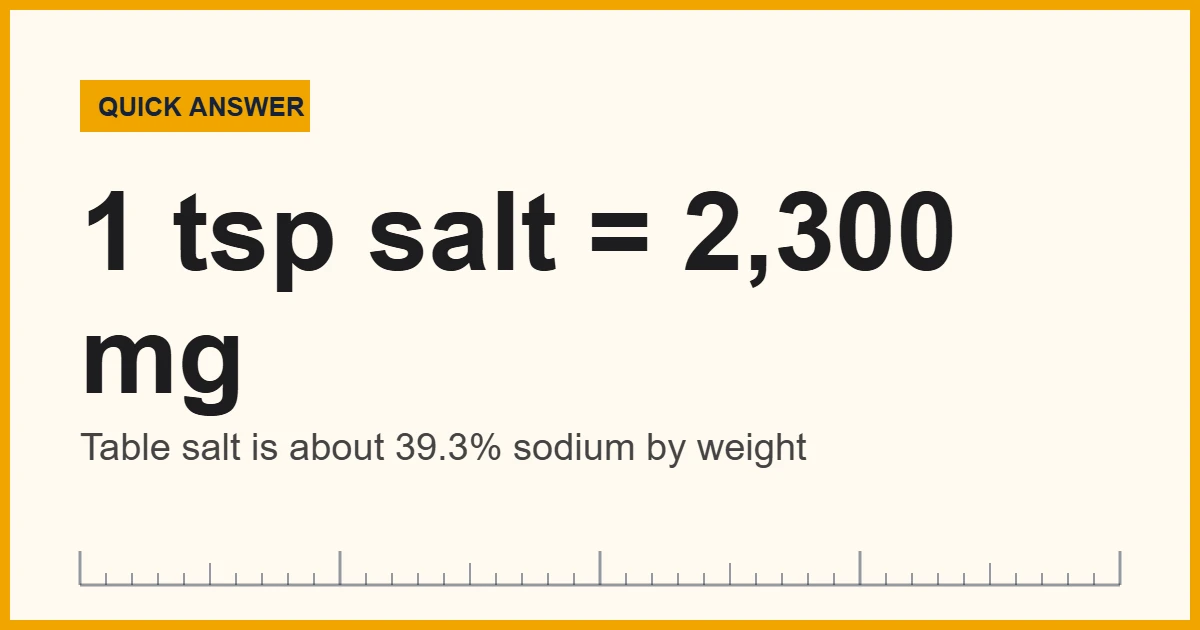
To measure sodium for a low-sodium diet, read the milligrams (mg) on the Nutrition Facts label and multiply by the servings you eat. For home cooking, remember that table salt is about 39 percent sodium, so 1 teaspoon of salt holds roughly 2,300 mg. Weigh salt in grams when you can, because spoons vary.
Convert Salt Grams to Milligrams Before You Measure Sodium
Labels list sodium in milligrams, while a kitchen scale reads grams. Therefore, use the converter below to switch between the two. Then multiply the salt weight by 0.393 to find the sodium inside it, as the example under the tool shows.
Example: 5.85 g of table salt is 5,850 mg of salt. Multiply by 0.393 and you get about 2,300 mg of sodium. That figure matches the FDA’s note that 2,300 mg of sodium is about 1 teaspoon of table salt.
What This Guide Covers When You Measure Sodium
This guide is about the arithmetic only: labels, spoons and scales. It does not tell you how much sodium you should eat. Your doctor or a registered dietitian can set that target for you. In other words, the numbers here are tools, not advice. Once you have a number, though, the steps below help you track it accurately. First, learn the salt math.
In short: sodium and salt are not the same thing, labels count sodium, and most of it comes from packaged food. The US Food and Drug Administration (FDA) says over 70 percent of dietary sodium comes from packaged and prepared foods. Therefore, label math matters more than the salt shaker for many people. Our guide to heart-healthy meal portions covers the portion side of the same job.
- Salt (sodium chloride) is about 39.3 percent sodium by weight.
- 1 teaspoon of table salt is about 2,300 mg of sodium (FDA).
- 5 percent Daily Value (DV) or less per serving is low in sodium; 20 percent DV or more is high (FDA).
- The FDA lists the sodium Daily Value as less than 2,300 mg per day.
- The American Heart Association (AHA) names 1,500 mg per day as an optimal goal for most adults.
Salt vs Sodium: The Math Behind Every Measure Sodium Calculation
Table salt is sodium chloride. Sodium makes up 22.99 of every 58.44 units of its weight, so it is 39.3 percent. As a result, 1 gram of salt holds about 393 mg of sodium. Also, you can run the math in either direction.
| Sodium amount | Table salt needed | Rough spoon size |
|---|---|---|
| 500 mg | 1.27 g | a little under 1/4 tsp |
| 1,500 mg | 3.81 g | about 2/3 tsp |
| 2,300 mg | 5.85 g | about 1 tsp |
The AHA says the body needs less than 500 mg of sodium per day, which it describes as less than 1/4 teaspoon of salt. That matches the table above. However, the spoon sizes are rounded and depend on the salt you use, so treat them as a guide.
Teaspoon Chart: Sodium in Common Spoonfuls of Table Salt
This chart uses the FDA figure of 2,300 mg of sodium per teaspoon of table salt. For example, the smaller amounts are simple fractions of that number.
| Level spoonful of table salt | Approximate sodium | Approximate salt weight |
|---|---|---|
| 1/8 tsp | 288 mg | 0.73 g |
| 1/4 tsp | 575 mg | 1.46 g |
| 1/2 tsp | 1,150 mg | 2.93 g |
| 3/4 tsp | 1,725 mg | 4.39 g |
| 1 tsp | 2,300 mg | 5.85 g |
| 1 tbsp (3 tsp) | 6,900 mg | 17.54 g |
Coarse and flaked salts fill a spoon with more air, so a teaspoon of them holds less sodium than table salt. Meanwhile, fine salt packs tightly. For that reason, a scale is the safer way to measure sodium from salt. For help with spoon sizes, see our post on how much 30 mL is in spoons and ounces.
Recommended Tools to Measure Sodium in Home Cooking
Two tools do most of the work. First, a digital scale with a tare button weighs salt to the gram. Next, a set of measuring spoons with a flat rim helps you level small amounts. In addition, a scale lets you weigh a portion and compare it to the serving size on a label.


As an Amazon Associate, Measuring Expert earns from qualifying purchases.
Label Math: How to Measure Sodium From a Nutrition Facts Label
The label gives sodium per serving, not per package. For this reason, the first step is always to compare the serving size with what you actually eat. Meanwhile, the percent Daily Value column is a quick check. For a 2,300 mg Daily Value, 5 percent is 115 mg and 20 percent is 460 mg.
| Label reading | What the math says |
|---|---|
| 5% DV or less per serving | 115 mg or less: low in sodium |
| 20% DV or more per serving | 460 mg or more: high in sodium |
| 480 mg per serving, 2 servings eaten | 480 x 2 = 960 mg, which is about 42% of 2,300 mg |
The same math works for a whole day. Next, add up the milligrams from each food and compare the total with your own target. The AHA also suggests scanning ingredient lists for “sodium,” “salt” and “soda,” because the label total includes every sodium-containing ingredient. You can read more in the FDA’s page on sodium in your diet.
How to Measure Sodium in a Home-Cooked Recipe
- List every salty ingredient. Include salt, broth, canned beans, sauces, cheese and cured meats, and read each label.
- Weigh the added salt. Place a small bowl on the scale, press tare, and add salt in grams.
- Convert salt to sodium. Multiply the grams of salt by 393 to get milligrams of sodium.
- Add the label amounts. For each packaged item, multiply the sodium per serving by the number of servings you used.
- Add everything together. The sum is the sodium in the whole recipe.
- Divide by the portions. Divide the recipe total by the number of servings you will eat.
For example, suppose a pot of soup uses 1/2 teaspoon of salt (1,150 mg) plus 3 servings of broth at 140 mg each (420 mg). The total is 1,570 mg. If the pot makes 4 bowls, each bowl holds about 393 mg. Of course, those numbers are for illustration only, so use your own labels instead.
Scale or Spoon: Which Is Better to Measure Sodium?
A scale wins for accuracy. A heaping teaspoon holds noticeably more than a level one. In contrast, 1 gram on a scale is always 1 gram. Overall, spoons still work for small, quick amounts, but only if you level them with a straight edge and use the same salt each time.
Likewise, avoid measuring over the pot. For instance, a shake that spills 1/8 teaspoon adds about 288 mg of sodium. Instead, measure into a small dish first, then add it. That habit also helps with ounce-based labels, so see how much an ounce is if you switch between weight units.
Where Hidden Sodium Comes From
The FDA reports that more than 70 percent of sodium in the diet comes from packaged and prepared foods rather than from salt added at the table. It also cites the CDC, which says about 40 percent comes from foods such as deli sandwiches, pizza, soups, savory snacks and burgers. Because of that, adding up labels often shows more sodium than the salt shaker does. In fact, this is why label reading comes first.
However, restaurant meals and unlabeled foods are harder, since you cannot read a label. In those cases, ask for nutrition information when it is available and treat any estimate as a rough guide.
Common Mistakes When You Measure Sodium
Do
- Check the serving size first.
- Weigh salt in grams.
- Include broth, sauces and canned foods.
- Use the same salt each time.
- Write totals down.
Do not
- Confuse salt grams with sodium milligrams.
- Assume one spoon of any salt equals 2,300 mg.
- Ignore the servings per container.
- Count only the salt you add yourself.
- Switch salt substitutes without asking a doctor.
Honest Limits of Sodium Measurements
Label numbers are rounded, so the printed figure is close but not exact. Therefore, expect small gaps between your math and the real amount. Also, natural sodium in fresh foods is usually not on the label for unpackaged items. In addition, spoon sizes and salt grain shapes change the milligrams per teaspoon. For these reasons, the figures here are good for tracking, not for precise clinical work.
Frequently Asked Questions
How do I measure sodium in food?
Read the sodium in milligrams on the Nutrition Facts label, then multiply by the number of servings you eat. For home cooking, weigh the salt and multiply the grams by 393.
How much sodium is in a teaspoon of salt?
The FDA says 2,300 mg of sodium is about 1 teaspoon of table salt. Coarse salts hold less per teaspoon, so weigh them instead.
What percent of salt is sodium?
Table salt is about 39.3 percent sodium by weight. Therefore, 1 gram of salt holds about 393 mg of sodium.
How many grams of salt equal 2,300 mg of sodium?
About 5.85 g of salt, since 2,300 divided by 0.393 is roughly 5,850 mg. That is close to 1 level teaspoon of table salt.
How many grams of salt equal 1,500 mg of sodium?
About 3.81 g of salt. The AHA calls 1,500 mg per day an optimal goal for most adults, but your own target may differ.
What does 5% DV mean for sodium?
It means a serving has 5 percent of the 2,300 mg Daily Value, or about 115 mg. The FDA says 5 percent DV or less is low in sodium.
What counts as high in sodium on a label?
The FDA says 20 percent DV or more per serving is high. With a 2,300 mg Daily Value, that is 460 mg or more per serving.
How do I measure sodium if I eat two servings?
Multiply the sodium per serving by 2. For example, 480 mg per serving becomes 960 mg for two servings.
Is a scale better than a spoon to measure sodium?
Yes. A scale gives the same weight every time, whereas a spoon varies with the salt grain size and how you level it.
Can this article tell me how much sodium I should eat?
No. It covers measuring and label math only. Ask your doctor or a registered dietitian for a sodium target that fits your health.
Measure Sodium: The Bottom Line
To sum up, labels count sodium in milligrams, salt is about 39.3 percent sodium, and 1 teaspoon of table salt is roughly 2,300 mg. Weigh salt, check serving sizes, and add up every packaged item you use.
Finally, keep the math separate from medical decisions. Use the numbers here to track what you eat, and let your doctor or dietitian decide what your target should be.