

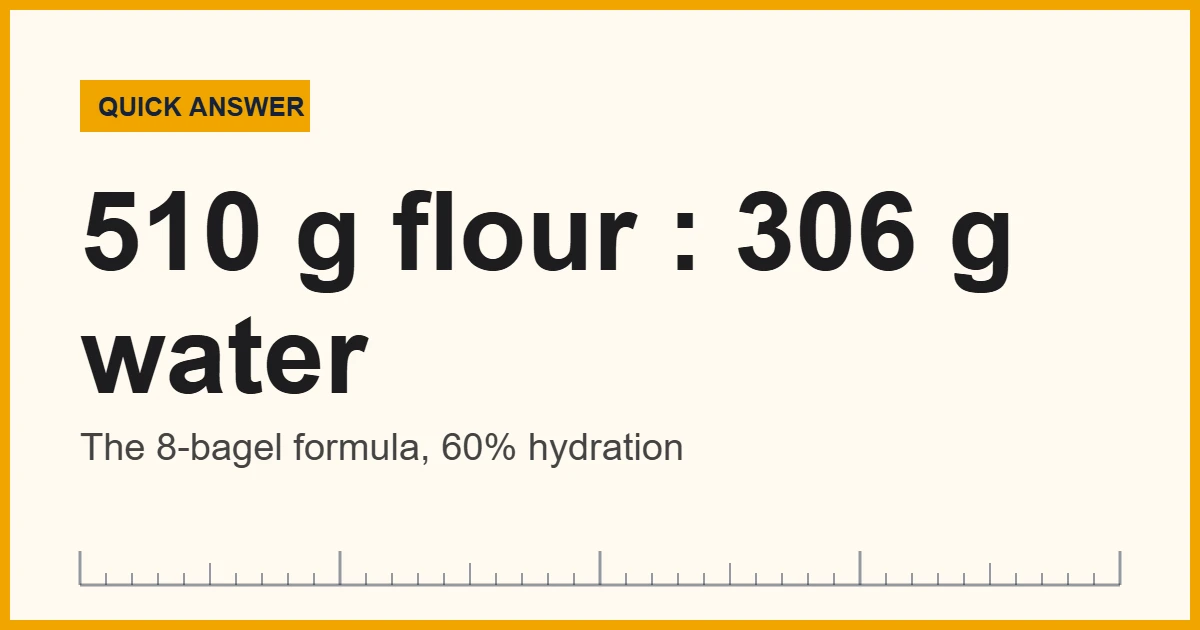
To measure ingredients for bagels, weigh everything in grams on a digital scale. A King Arthur formula for 8 bagels uses 510 g of flour, 306 g of water, 12 g of salt, 5 g of yeast and 12 g of malt. In other words, the water is about 60 percent of the flour weight, which gives a stiff, chewy dough.
Convert Flour Weight Before You Measure Ingredients for Bagels
First, enter the grams of flour in your recipe to see pounds, ounces and kilograms. As a result, you can check a recipe written in cups or ounces against the gram formula on this page.
Bagel dough is unusual. In fact, it is much stiffer than bread dough, and it has very little room for error. For example, a small mistake with flour or water changes how the dough kneads, shapes and boils. Therefore, a scale matters more here than in most recipes.
First, this guide uses the published King Arthur bagel formula as its worked example. In addition, it draws on the King Arthur ingredient weight chart for the cup and spoon conversions. Finally, the sections below show how to weigh each ingredient, scale the batch and avoid the usual mistakes.
The Formula to Measure Ingredients for Bagels (8 Bagels)
This table shows the King Arthur formula for 8 bagels, with the weight in ounces added (see how much an ounce is if the unit is unclear). Notice that the flour is the anchor. In fact, every other number follows from it.
| Ingredient | Grams | Ounces | Rough volume |
|---|---|---|---|
| High-gluten flour (or bread flour) | 510 g | 18.0 oz | 4 1/4 cups |
| Water for the dough | 306 g | 10.8 oz | about 1 1/4 cups |
| Instant or active dry yeast | 5 g | 0.18 oz | 1 1/2 tsp |
| Salt | 12 g | 0.42 oz | 2 tsp |
| Non-diastatic malt powder | 12 g | 0.42 oz | 1 Tbsp |
| Water for the boiling bath | 2,000 g | 70.5 oz | about 2 quarts |
The same source says barley malt syrup can replace the powder at 21 g (1 tablespoon), and that brown sugar or sugar also works. Likewise, bread flour or all-purpose flour can stand in for high-gluten flour, although the bagels will be less chewy.
Recommended Tools to Measure Ingredients for Bagels
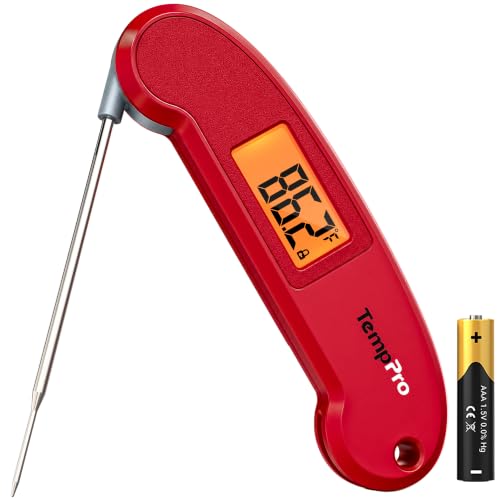
In short, bagels reward a few good tools. First, choose a scale that reads in grams and has a tare button. Next, pick one that handles at least 5 pounds, because a full batch of dough is heavy. Finally, add measuring spoons for the small items and a fast thermometer for water temperature.


As an Amazon Associate, Measuring Expert earns from qualifying purchases.
Key Takeaways
- Weigh every bagel ingredient in grams, because cups vary from kitchen to kitchen.
- Also, King Arthur lists 1 cup of bread flour or all-purpose flour as 120 g.
- In short, the 8-bagel formula uses 510 g flour and 306 g water, which is 60 percent hydration.
- One tablespoon of salt weighs 8, 16 or 18 g depending on the type, so weigh salt too.
- As a result, each of the 8 pieces of dough weighs about 106 g (3.7 oz).
- Finally, scale a batch by multiplying every ingredient by the same factor.
Baker’s Percentages: How to Measure Ingredients for Bagels by Ratio
In addition, professional bakers write recipes as percentages of the flour weight. Also, flour is always 100 percent. Because of that, a ratio works for any batch size and makes recipes easy to compare.
| Ingredient | Grams | Percent of flour |
|---|---|---|
| Flour | 510 g | 100% |
| Water | 306 g | 60% |
| Salt | 12 g | 2.4% |
| Yeast | 5 g | 1.0% |
| Malt powder | 12 g | 2.4% |
The 60 percent figure is the hydration. For comparison, many sandwich bread doughs run wetter, so bagel dough feels dry and tight when you knead it. That stiffness is deliberate, since it helps the bagel keep its ring shape in the boiling water. If a recipe seems too dry, however, check your flour weight before you add water.
Why Cups and Spoons Fail When You Measure Ingredients for Bagels
However, a cup of flour is only 120 g if it is filled the way the chart assumes. Scooping straight from the bag packs the flour, so a cup can hold noticeably more. With a stiff dough, however, that extra flour matters. For instance, an extra 30 g of flour in this formula cuts the hydration from 60 percent to about 56.6 percent (306 divided by 540).
In fact, salt shows the problem even better. For example, the King Arthur chart lists one tablespoon of Diamond Crystal kosher salt as 8 g, Morton kosher salt as 16 g and table salt as 18 g. In other words, the same spoon can hold more than twice as much salt. For a 12 g target, therefore, a weighed amount is far safer than a spoonful.
| Ingredient | Volume | Weight (King Arthur chart) |
|---|---|---|
| All-purpose or bread flour | 1 cup | 120 g |
| Granulated sugar | 1 cup | 198 g |
| Brown sugar, packed | 1 cup | 213 g |
| Milk | 1 cup | 227 g |
| Honey | 1 Tbsp | 21 g |
| Barley malt syrup | 2 Tbsp | 42 g |
| Instant yeast | 1 Tbsp | 9 g |
| Salt, Diamond Crystal kosher | 1 Tbsp | 8 g |
| Salt, Morton kosher | 1 Tbsp | 16 g |
| Salt, table | 1 Tbsp | 18 g |
For more on this habit, see our guide to measuring ingredients by weight.
How to Measure Ingredients for Bagels Step by Step
- Pick a batch size. First, decide how many bagels you want and use the scaling table below.
- Tare the mixing bowl. Next, set the empty bowl on the scale and press the zero button.
- Weigh the flour. Then add flour until the display shows 510 g for 8 bagels.
- Add salt and malt. Next, weigh each into a separate small dish and add them to the bowl.
- Weigh the yeast. Ideally, use a scale that reads to 0.1 g if you have one, because 5 g is a small amount.
- Weigh the water. Instead, pour 306 g into a jug on the scale rather than reading a cup line.
- Mix and knead. Then King Arthur suggests about 10 minutes by machine or 10 to 15 minutes by hand.
- Divide by weight. Finally, weigh the dough, divide by 8, and cut pieces of about 106 g each.
Dividing by weight gives bagels that boil and bake evenly. Otherwise, the small ones brown early while the large ones stay pale inside. After shaping, the source offers an optional chill in the fridge for 6 to 24 hours, and you can boil straight from the fridge.
Scaling a Bagel Batch Up or Down
Scaling is simple multiplication. First, pick a factor, then apply it to every line. As a result, the percentages never change.
| Batch | Flour | Water | Yeast | Salt | Malt |
|---|---|---|---|---|---|
| 4 bagels (x 0.5) | 255 g | 153 g | 2.5 g | 6 g | 6 g |
| 8 bagels (x 1) | 510 g | 306 g | 5 g | 12 g | 12 g |
| 12 bagels (x 1.5) | 765 g | 459 g | 7.5 g | 18 g | 18 g |
| 16 bagels (x 2) | 1,020 g | 612 g | 10 g | 24 g | 24 g |
Keep in mind that the dough per piece stays near 106 g in every row. Therefore, you can check your math by weighing the finished dough and dividing by the number of bagels. For comparison with other dough work, read about measurement in pastry making.
Measuring Yeast, Salt and Malt for Bagels
Small ingredients cause big problems. For instance, a 5 g packet of yeast is easy to misjudge by a full gram with a spoon. Similarly, 12 g of salt can swing wildly between salt types, as the chart above shows.
If your scale only reads in whole grams, however, you can weigh these in one step. Add the salt, then tare, then add the malt. In addition, store a small labeled dish for each so you do not mix them up. Malt powder and barley malt syrup are not interchangeable by volume, so follow the weights in the formula.
Water Bath and Oven Numbers
However, weighing does not stop at the dough. For example, the King Arthur formula boils the bagels in 2,000 g of water, about 2 quarts, at a very gentle boil. Next, each bagel simmers 20 seconds, then flips for 20 seconds more. Afterward, the bagels bake at 450 degrees F (232 degrees C) for 15 to 20 minutes.
| Step | Amount |
|---|---|
| Bath water | 2,000 g (about 2 quarts) |
| Boil time | 20 seconds per side |
| Oven temperature | 450 degrees F (232 degrees C) |
| Bake time | 15 to 20 minutes |
Common Mistakes When You Measure Ingredients for Bagels
- Scooping flour from the bag. As a result, the cup packs down and adds extra flour.
- Trusting spoon measures for salt. For example, salt types differ by a factor of two or more per tablespoon.
- Adding extra water to rescue stiff dough. However, bagel dough is meant to be dry.
- Skipping the tare. The bowl then counts as flour.
- Cutting dough pieces by eye. As a result, uneven bagels bake unevenly.
- Swapping flours without checking. For instance, whole wheat flour weighs 113 g per cup in the chart, not 120 g.
Do and Don’t When You Measure Bagel Ingredients
Do
- Weigh flour, water, salt, yeast and malt.
- Write down the grams you used.
- Then weigh the dough and divide by weight.
- Also, use the same salt each time.
- Keep the dough stiff.
Don’t
- Scoop flour straight from the bag.
- Swap kosher and table salt by the spoon.
- Add water to fix a dry dough.
- Round the yeast up.
- Crowd the boiling pot.
Honest Limits of Bagel Formulas
Overall, a formula is a starting point, not a guarantee. Flour varies by brand and by season, so the same 306 g of water can feel slightly different. Likewise, the volumes in the formula table are rough, because the source rounds cups and spoons. For example, 306 g of water is close to 1 1/4 cups but not exact. In short, trust the grams and treat the volumes as a backup. Finally, ovens run hot or cold, so use the baking time as a range and judge the color.
When Accuracy Really Matters
In fact, most bagel errors come from flour and salt. For example, if you bake for someone on a low-sodium diet or with an allergy, weigh everything and read your ingredient labels. Moreover, malt syrups and flours differ by brand, so check each package.
Frequently Asked Questions
What is the best way to measure ingredients for bagels?
Weigh them in grams on a digital scale. For example, for 8 bagels King Arthur lists 510 g flour, 306 g water, 12 g salt, 5 g yeast and 12 g malt.
How much flour do I need to measure for 8 bagels?
The King Arthur formula uses 510 g of flour, which is about 18 oz or 1.12 lb. In other words, that equals roughly 4 1/4 cups at 120 g per cup.
How much water goes into bagel dough?
The formula uses 306 g of water for 510 g of flour. That is 60 percent hydration, so the dough is stiff.
How many grams is a cup of bread flour?
The King Arthur weight chart lists 1 cup of bread flour as 120 g. Likewise, all-purpose flour is 120 g per cup.
How much salt do bagels need?
The formula uses 12 g of salt for 510 g of flour, which is about 2.4 percent. Weigh it, because a tablespoon holds 8 to 18 g depending on the salt.
Can I measure ingredients for bagels with cups and spoons?
Yes, but results vary. First, level the flour carefully and use the same salt every time. However, a scale gives steadier dough.
How much should each bagel weigh before baking?
For the 8-bagel formula, the total dough is about 845 g. Therefore, divided by 8, each piece is about 106 g or 3.7 oz.
How do I scale a bagel recipe for 12 bagels?
First, multiply every ingredient by 1.5. As a result, you need 765 g flour, 459 g water, 7.5 g yeast, 18 g salt and 18 g malt.
How much water do I use to boil bagels?
The King Arthur formula uses about 2,000 g, or roughly 2 quarts. Also, keep it at a very gentle boil and simmer each bagel about 20 seconds per side.
What oven temperature do bagels need?
In short, the formula bakes at 450 degrees F (232 degrees C) for 15 to 20 minutes, until deep golden brown.
Measure Ingredients for Bagels: The Bottom Line
To sum up, weigh the flour first, then set every other ingredient as a percentage of it. For 8 bagels, that means 510 g flour, 306 g water, 12 g salt, 5 g yeast and 12 g malt, with each piece of dough near 106 g.
Finally, keep a note of your grams after each bake. As a result, over time, that record turns a published formula into your own dependable recipe. The converter near the top of this page handles unit changes for you.