

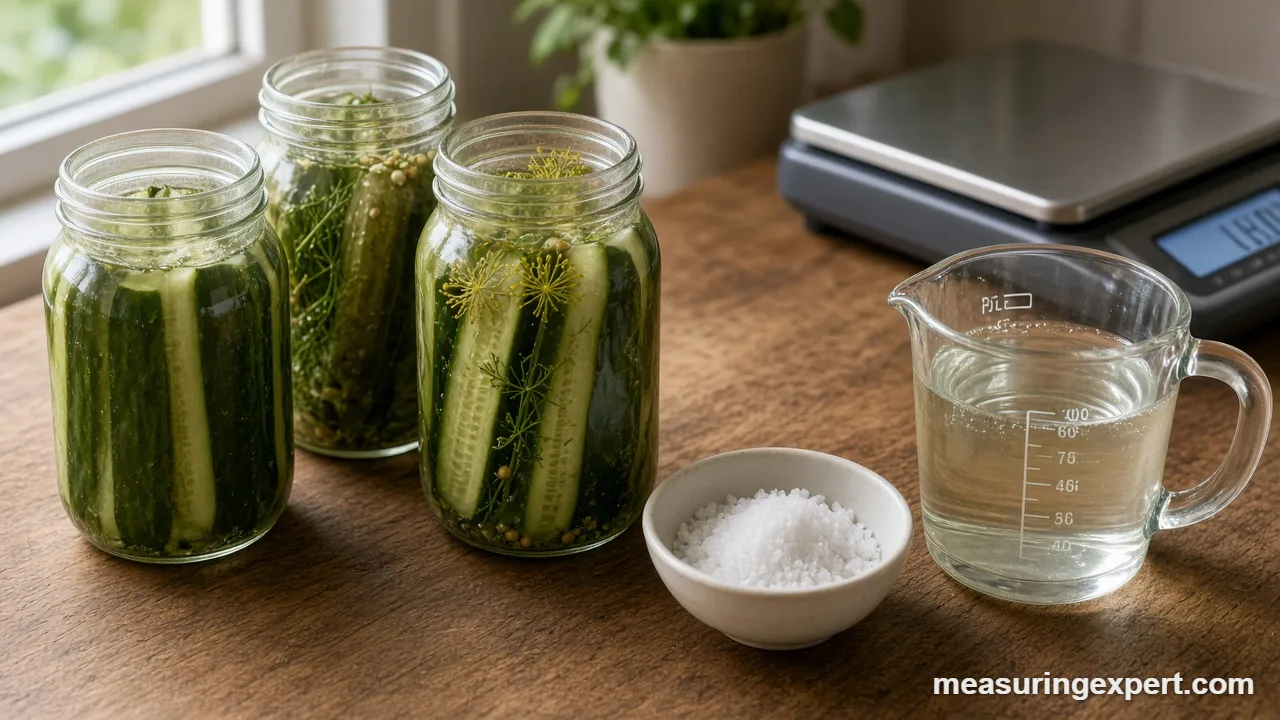
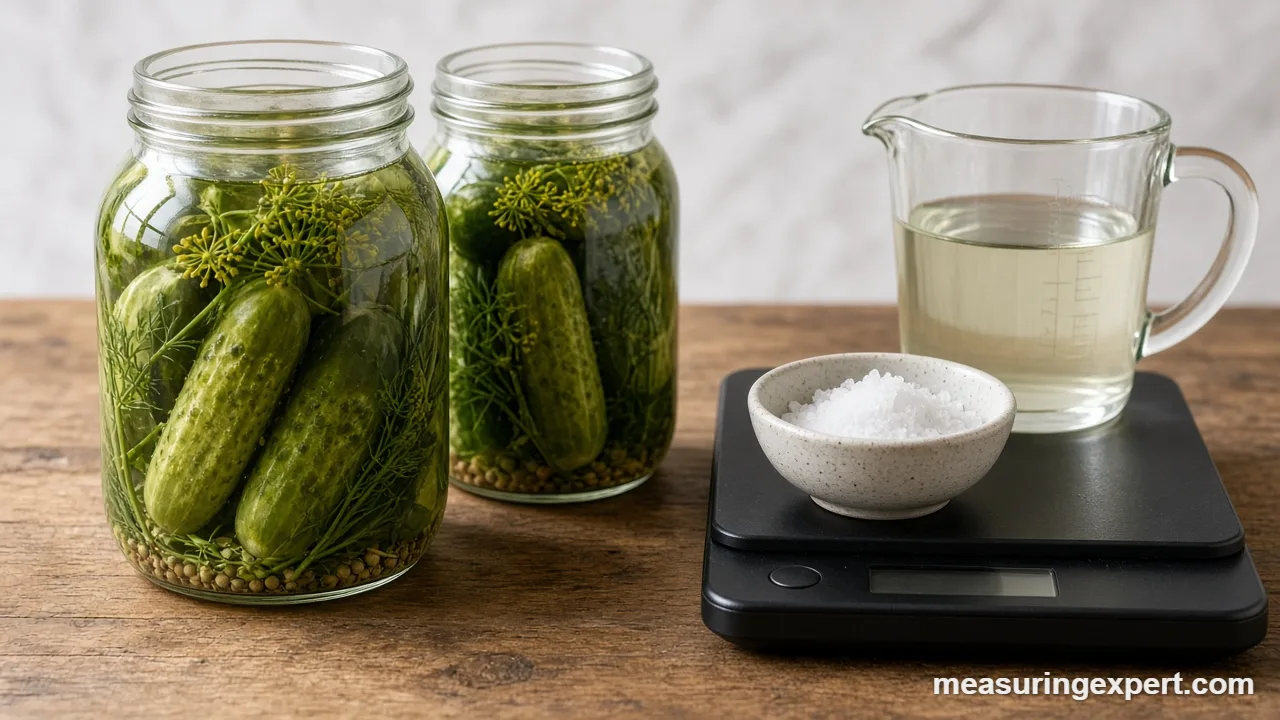
Measure ingredients for pickling by weight for the produce and salt, and by volume for vinegar and water. Weigh salt in grams because spoon sizes vary by brand, use vinegar with 5% acidity, and never change the vinegar-to-water ratio of a tested canning recipe.
Convert Brine Amounts Before You Measure Ingredients for Pickling
Brine recipes mix cups, quarts, tablespoons and milliliters, so the first job is often a quick conversion. Enter an amount below, and the converter shows it in the other kitchen units using the exact US definitions.
A pickle is only as reliable as its brine. Too much salt makes the jar harsh, and too little vinegar can make a canned jar unsafe. Therefore, the amounts matter more here than in most recipes. This guide covers quick refrigerator pickles and boiling-water canned pickles. Fermented pickles follow different rules, so see our guide to measuring ingredients for sauerkraut for those.
The advice below comes from university extension recipes and the National Center for Home Food Preservation (NCHFP), plus the King Arthur ingredient weight chart for salt. Therefore, where a source does not say something, this page does not guess.
- Weigh produce and salt; measure vinegar and water in a liquid measuring cup.
- One tablespoon of salt weighs about 8 g, 16 g or 18 g, depending on the brand and grind.
- Use 5% acidity vinegar for canned pickles.
- Do not alter the vinegar, water or produce proportions in a canning recipe.
- Refrigerator pickles are not shelf stable; the Oregon State recipe says to use them within 3 months.
Weight or Volume: How to Measure Ingredients for Pickling by Weight
In general, volume measures space, and weight measures amount. Packed cucumbers, chopped onions and coarse salt all fill a cup differently, so a cup is a loose guide. However, a scale does not care how the food is packed. For example, 500 g of cucumber slices is the same 500 g whether the slices are thin or thick.
| Ingredient | Best way to measure | Why |
|---|---|---|
| Cucumbers and other produce | Weight (g or lb) | Size and packing change the volume |
| Salt | Weight (g) | Grain size changes what a spoon holds |
| Vinegar | Volume (liquid cup, mL) | Liquids level themselves and read easily |
| Water | Volume (liquid cup, mL) | Same reason as vinegar |
| Sugar | Weight, or a level spoon for small amounts | Small amounts vary little |
| Whole spices and dill seed | Level spoons | Amounts are small and flavor-driven |
Our broader guide to measuring ingredients by weight explains how to use a scale’s tare button. In short, place the bowl on the scale, press tare, and add the ingredient until the display shows your target.
Salt Weights When You Measure Ingredients for Pickling
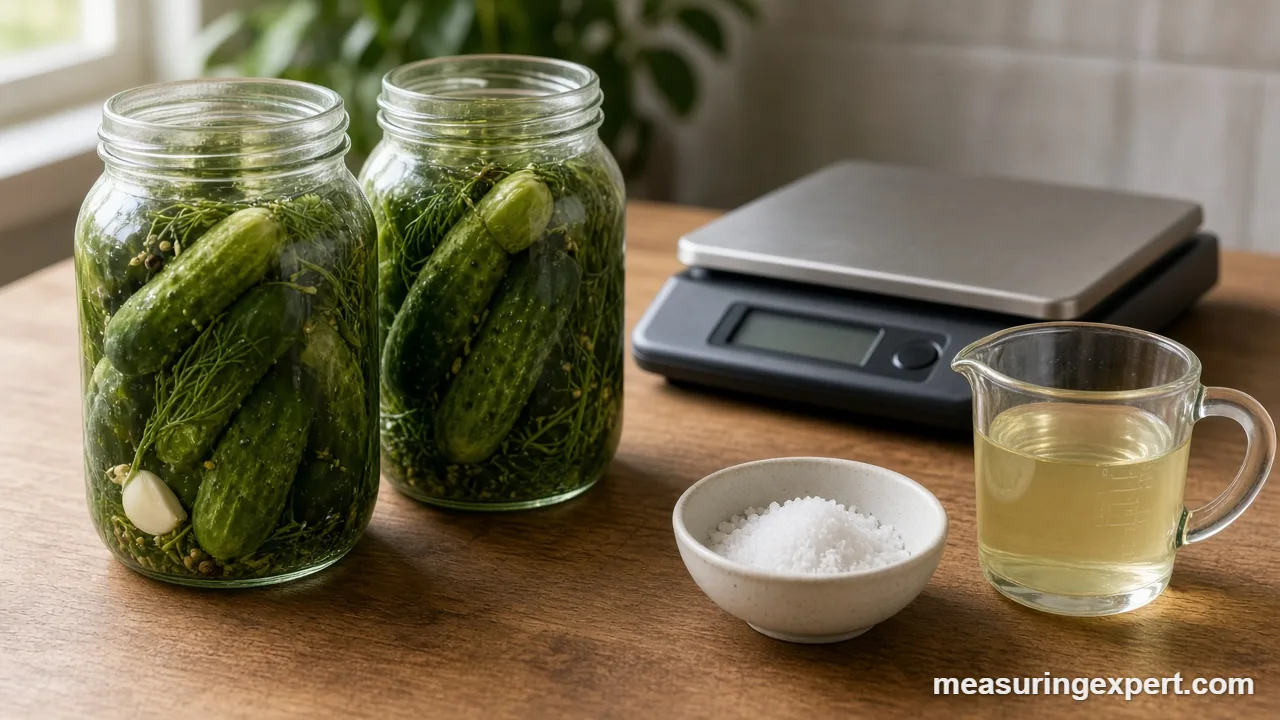
First, salt causes the biggest measuring errors in pickling. For instance, the King Arthur ingredient weight chart lists one tablespoon of each common type at very different weights.
| Salt type | 1 tablespoon | About 1 teaspoon (1/3 of a tablespoon) |
|---|---|---|
| Table salt | 18 g | 6 g |
| Kosher, Morton | 16 g | 5.3 g |
| Kosher, Diamond Crystal | 8 g | 2.7 g |
As a result, a recipe that says “1 teaspoon salt” can differ by more than a factor of two. The Oregon State refrigerator cucumber recipe, for instance, calls for 1 teaspoon of salt in 2/3 cup vinegar plus 1/3 cup water (about 237 mL of liquid). With table salt that is roughly 6 g of salt, or about 2.5% of the brine by weight. With Diamond Crystal it is roughly 2.7 g, or about 1.1%. However, those percentages are simple division, not figures from the recipe. In fact, the page does not name a salt type.
The practical fix is easy. Instead, weigh one level tablespoon of your own salt once, write the number on the container, and use grams from then on.
Brine Ratios From Tested Recipes
Simply put, a brine ratio describes how much vinegar, water and salt go together. Two published recipes show how different the numbers can be. Both come from university extension sources, and neither is a license to invent your own.
| Recipe | Vinegar | Water | Salt | Vinegar share of liquid |
|---|---|---|---|---|
| Refrigerator cucumbers, 1 pint (Oregon State) | 2/3 cup (157.7 mL) | 1/3 cup (78.9 mL) | 1 tsp, salt type not stated | 66.7% |
| Quick fresh-pack dill pickles, 7 to 9 pints (SDSU and NC State extension) | 1 1/2 quarts (1,419.5 mL) | 2 quarts (1,892.7 mL) | 1/2 cup canning or pickling salt, plus 3/4 cup in a 2-gallon soak | 42.9% |
The canning recipe also uses 8 lb of 3 to 5 inch pickling cucumbers, which is about 3.63 kg, and 1/4 cup of sugar. It specifies 5% acidity vinegar and processes pints for 10 minutes in a boiling-water canner at low elevation. However, extension sources add time at higher altitudes.
Next, notice the difference in purpose. For example, the refrigerator recipe stays cold and is eaten within weeks. The canning recipe must keep acid and salt balanced so the jar is safe on a shelf. For that reason, the canning numbers are not adjustable. Likewise, the NCHFP states plainly not to alter vinegar, food or water proportions in a recipe, and not to use vinegar of unknown acidity.
Recommended Tools to Measure Ingredients for Pickling
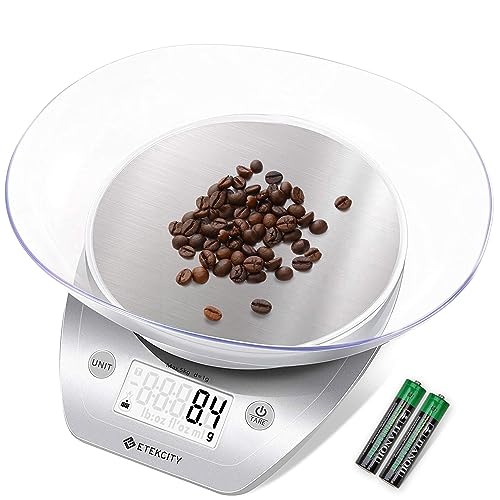
You need very little equipment. First, a digital scale that reads in grams handles the produce and salt. Next, a set of level measuring spoons covers spices and dill seed. Finally, a liquid measuring cup with a spout handles the brine, and a straight edge levels the spoons.



As an Amazon Associate, Measuring Expert earns from qualifying purchases.
How to Measure Ingredients for Pickling, Step by Step
- Choose a tested recipe. Write down its salt type, vinegar strength and jar size before you start.
- Weigh the produce. Tare a clean bowl and weigh the cucumbers or other vegetables in grams.
- Weigh the salt. Then tare a small bowl and weigh the salt. If the recipe lists spoons, weigh one level spoon of your salt first and note the result.
- Measure the vinegar and water. Next, pour each into a liquid measuring cup on a flat counter and read the line at eye level.
- Add the spices. Level each spoonful of whole spices with a straight edge, or weigh them if the recipe gives grams.
- Record the batch. Write down what you measured so the next batch matches this one.
Scaling a Pickle Recipe Up or Down
Scaling a brine is easy arithmetic, but only for recipes where it is allowed. For a refrigerator recipe, multiply every amount by the same factor. For example, two pints need 1 1/3 cups vinegar, 2/3 cup water and 2 teaspoons of salt. In addition, the converter above helps when the totals become awkward fractions.
Canning recipes are different. Tested recipes are written for a set number of jars, and the processing time applies to the jar size, not the batch size. Therefore, make the recipe as written, or run two separate batches. Also, do not stretch one batch by adding extra water.
Common Mistakes When You Measure Ingredients for Pickling
- Swapping salts by volume. One spoon of Diamond Crystal is not one spoon of table salt.
- Using vinegar of unknown strength. Homemade or specialty vinegars may not be 5% acidity.
- Diluting the brine. Extra water to fill a jar changes the acid balance.
- Packing the jar by feel. Too much produce leaves too little brine to cover it.
- Ignoring headspace. The recipes above leave about 1/2 inch at the top of the jar.
- Reading a cup from above. Look at the marking at eye level instead.
Do and Don’t for Pickle Measuring
- Weigh salt and produce.
- Use a liquid cup for brine.
- Check the vinegar label for 5% acidity.
- Level every spoon of spices.
- Label jars with the date.
- Guess at a salt swap.
- Change a canning ratio.
- Use flake salt by the spoon.
- Eyeball vinegar in a mixing bowl.
- Store refrigerator pickles on the shelf.
Honest Limits of Pickle Measurements
Overall, even a careful measurement has limits. A kitchen scale reads to the nearest gram or tenth of a gram, but a cucumber’s water content changes from week to week. Likewise, the salt weights above are one published chart; a different brand or a humid kitchen can shift them. In short, treat the numbers as a reliable starting point, not a guarantee of flavor. If a batch tastes too salty or too sharp, change the next batch in a refrigerator recipe by a small, recorded amount.
When Tested Recipes Matter: Canning Safety
Everything above about weighing salt applies to canning as well, but canning has one extra rule. Shelf-stable pickles must follow a tested recipe, with its exact vinegar, water, salt and processing time. Also, do not invent a canning brine from a refrigerator ratio. For the full set of measuring steps for jars, headspace and processing, read our guide to measuring ingredients for canning.
The NCHFP explains the reason in plain words: the acidity of a pickled product is as important to its safety as it is to taste and texture. If you are new to canning, start with the NCHFP general information on pickling. For milliliter conversions along the way, see how much 30 mL is.
Frequently Asked Questions
How do you measure ingredients for pickling?
Weigh the produce and the salt in grams or ounces, and measure the vinegar and water in a liquid measuring cup. Then follow a tested recipe exactly, because the vinegar, water and produce amounts are part of the safety margin.
Should I weigh salt or use spoons for pickling?
Weigh it when you can. One tablespoon of table salt weighs about 18 g, Morton kosher about 16 g and Diamond Crystal kosher about 8 g, per the King Arthur weight chart, so a spoon of one brand is not a spoon of another.
What is the vinegar to water ratio for pickles?
It depends on the recipe. A tested Oregon State refrigerator recipe uses 2/3 cup vinegar to 1/3 cup water per pint. A tested canning recipe uses 1 1/2 quarts vinegar to 2 quarts water, which is 3 parts to 4. Do not change a canning ratio.
Does the vinegar need to be 5% acidity?
Yes, for canned pickles. The National Center for Home Food Preservation says to use 5% acidity (50 grain) vinegar and warns against using vinegar of unknown strength, because acidity is a safety factor.
Can I use table salt for pickling?
For refrigerator pickles it works, but the brine may turn cloudy because of anticaking additives. For canned or fermented pickles, use canning or pickling salt, as tested recipes specify.
What is the 3-2-1 rule for pickles?
Online, the name 3-2-1 refers to several different home-cook brine ratios, and they do not agree. None of them is a tested canning formula. For shelf-stable jars, use a recipe from a source such as the National Center for Home Food Preservation.
How many cucumbers go in a pint jar?
The Oregon State refrigerator recipe packs about 1 1/2 cups of cucumber slices into one pint jar with about 1/2 inch of headspace. Whole cucumbers vary, so weigh them when a recipe lists a weight.
How long do refrigerator pickles last?
The Oregon State recipe says to use refrigerator pickled cucumbers within 3 months. Keep the jar cold and use clean utensils each time you reach in.
Can I cut the salt in a pickle recipe?
Not in fermented or canned recipes. The National Center for Home Food Preservation warns against cutting back the salt in fermented pickles, and a tested canning recipe should be followed as written.
Is a measuring cup accurate enough for pickling?
For vinegar and water, yes, if you use a liquid measuring cup at eye level. For salt, spices and produce, a scale is more consistent because cups and spoons depend on grain size and packing.
Measure Ingredients for Pickling: The Bottom Line
To sum up, weigh the salt and produce, measure the liquids in a proper cup, and stay with the proportions of a tested recipe. Salt is the biggest source of error, since one tablespoon can weigh 8 g or 18 g.
Finally, keep notes on each batch. Over time, those notes turn a good recipe into your own reliable one, while the safety numbers stay exactly as the tested source wrote them.