

To measure ingredients with a kitchen scale, set your bowl on the scale, press the tare (zero) button, and add the ingredient until the display shows the weight in grams. Press tare again before the next ingredient. Weighing in grams is more repeatable than scooping cups.
Most recipe failures start with the measuring, not the cooking. A cup of flour can weigh 120 g or 150 g, depending on how you fill it. As a result, two cooks can follow the same recipe and get different cakes.
A scale removes that guesswork, but only if you use it well. For example, forgetting to tare, reading ounces when the recipe says grams, or leaning on the platform can all spoil the reading. This guide focuses on technique: the tare button, units, converting cup recipes, and checking the scale itself.
In short: tare first, use grams, add one ingredient at a time, and check the scale with a coin. King Arthur Baking, a major US flour company, recommends weighing ingredients with a digital scale and publishes a weight chart that many recipes follow.
Below, you will find a converter, a cups-to-grams chart, and a step-by-step method. After that, you will see how to handle sticky liquids, tiny amounts, and recipe scaling, and where a kitchen scale reaches its limits.
Measure Ingredients in Grams, Ounces and Pounds
First, enter the weight you have and pick its unit. The converter then shows the same weight in grams, ounces, pounds and kilograms, so you can match any recipe or scale display.
How to Measure Ingredients With the Tare Button
The tare button is the single most useful feature on a kitchen scale. It subtracts whatever is on the platform, so the display shows only the new weight you add.
- Set the scale on a flat surface. A level, hard counter gives the steadiest reading.
- Turn it on and wait for zero. Let the display settle before you place anything on it.
- Place the empty bowl on the platform. The display now shows the bowl’s weight.
- Press tare. The display returns to 0 g, even though the bowl is still there.
- Add the first ingredient slowly. Stop a few grams early, then add the rest by the spoonful.
- Press tare again. The display resets to 0 g, so you can add the next ingredient to the same bowl.
- Repeat for each ingredient. Write down the weights if you want to repeat the recipe later.
Every scale works the same way in principle. However, some models turn off after a short time, so tap the platform now and then while you work. Otherwise, you may lose your tared bowl and have to start again.
Cups to Grams: Measure Ingredients From a US Recipe
Many US recipes still list cups. Therefore, you need a conversion to weigh them. The table uses the figures published by King Arthur Baking for 1 US cup, with the smaller fractions rounded to the nearest gram.
| Ingredient | 1 cup | 1/2 cup | 1/4 cup |
|---|---|---|---|
| All-purpose flour | 120 g | 60 g | 30 g |
| Granulated sugar | 198 g | 99 g | 50 g |
| Brown sugar, packed | 213 g | 107 g | 53 g |
| Powdered sugar, unsifted | 113 g | 57 g | 28 g |
| Butter | 226 g | 113 g | 57 g |
| Vegetable oil | 198 g | 99 g | 50 g |
| Chocolate chips | 170 g | 85 g | 43 g |
| Almond flour | 96 g | 48 g | 24 g |
| Rolled oats (old-fashioned) | 89 g | 45 g | 22 g |
For instance, a recipe that calls for 2 1/4 cups of flour needs 2.25 x 120 = 270 g. Likewise, 3/4 cup of butter is 0.75 x 226 = 169.5 g, or about 170 g. If you do not have a scale yet, our guide to a measuring cup substitute shows how to improvise.
Recommended Tools for Weighing Food
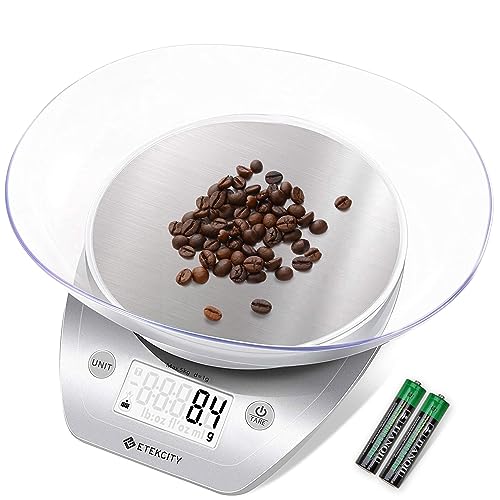
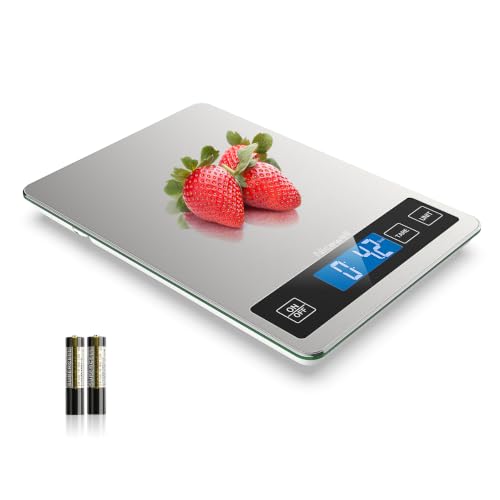
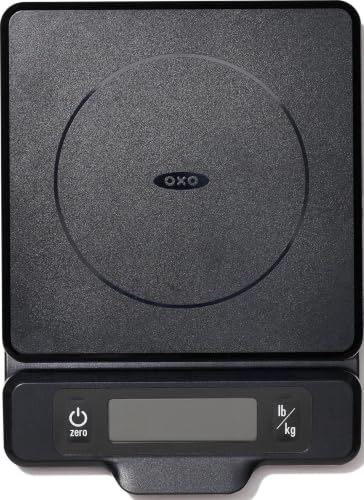
Any scale with a tare button and a gram display will do the job. However, a few features make everyday use easier. First, look for a platform large enough for your bowl. Next, check the capacity, because many home scales stop at 11 pounds (5 kg). Finally, a pull-out or tilted display helps with big bowls. Our reviews of the best baking scale and the best portion control scale compare more models.


As an Amazon Associate, Measuring Expert earns from qualifying purchases.
Key Takeaways
- Tare the empty bowl first, then add each ingredient and tare again.
- Use grams whenever you can, because they are finer than ounces.
- Convert cup recipes with a trusted chart, such as 120 g for 1 cup of all-purpose flour.
- Weigh honey, syrup and peanut butter in the jar and scoop until the display drops.
- Test your scale with US nickels, which weigh 5.00 g each.
- Do not use a kitchen scale for medicine or for selling food.
Grams or Ounces: Which Unit Should You Measure Ingredients In?
Most scales switch between grams, ounces, pounds and sometimes milliliters. Grams are usually the better choice, because one gram is a very small step. One ounce is 28.35 g, so a scale that reads in whole ounces cannot show small differences.
| Unit | Size | Best for |
|---|---|---|
| Gram (g) | 0.035 oz | Baking, spices, small amounts |
| Ounce (oz) | 28.35 g | US recipes written in ounces, portions of meat or cheese |
| Pound (lb) | 453.59 g (16 oz) | Large amounts such as 2 lb of potatoes |
| Kilogram (kg) | 1,000 g (2.20 lb) | Bread dough, big batches |
If a recipe lists ounces, switch the scale to ounces with decimals if it offers them. Otherwise, convert the amount to grams first. For more on the unit itself, see how much an ounce is.
How to Measure Ingredients That Are Liquid or Sticky
Weighing is also the easiest way to handle liquids. Water weighs about 1 g per mL, so 250 mL of water is about 250 g. Milk is slightly heavier, and King Arthur lists 227 g for 1 cup of fresh milk.
Sticky ingredients are harder, because they cling to every spoon and cup. Honey is a good example. King Arthur lists 21 g per tablespoon, even though a US tablespoon holds only about 14.8 mL, because honey is much denser than water. As a result, a spoon of honey weighs more than a spoon of water.
The easiest fix is to weigh from the jar:
- Put the open jar of honey or syrup on the scale.
- Press tare so it reads 0 g.
- Scoop out honey into your mixing bowl.
- Read the display, which now shows a minus sign and the weight removed.
- Stop when the minus number matches the recipe amount.
This way, nothing sticks to a measuring cup and nothing is lost on the way to the bowl.
Scaling a Recipe Up or Down by Weight
Weights scale perfectly, because 1.5 times the flour is simply 1.5 times the grams. Cups, by contrast, make fractions awkward. For example, a 1.5x batch of a recipe with 480 g of flour and 300 g of sugar needs 720 g of flour and 450 g of sugar. A half batch needs 240 g and 150 g.
Round to the nearest gram. However, take extra care with tiny amounts, such as yeast or baking soda, because rounding changes their share the most. If you cannot split an egg cleanly, beat it first, then weigh out the share you need.
How to Measure Ingredients in Small Amounts
Most kitchen scales read in 1 g steps. Therefore, a scale cannot reliably show 2 g of salt or 3 g of yeast. The display rounds to the nearest gram, so the true weight may be off by up to half a gram.
You have three options. First, choose a scale that reads to 0.1 g for spices and leaveners. Second, weigh a larger batch of a dry mix and use part of it. Third, use measuring spoons for the small items and the scale for the rest. King Arthur lists about 4 g for 1 teaspoon of baking powder, which is a useful reference.
Check Your Scale With Coins
You do not need lab weights to check a kitchen scale. According to the US Mint’s coin specifications, a nickel weighs 5.00 g. Therefore, 20 nickels should read very close to 100 g, and 40 nickels close to 200 g.
- Tare the empty platform first.
- Add 20 nickels, and note the reading.
- Repeat with 40 nickels to test a higher weight.
- If the readings are off by more than a gram or two, replace the batteries and test again.
Worn coins can weigh slightly less than new ones. Even so, a large error means the scale needs fresh batteries, a flatter surface or replacement.
Weight, Volume, Mass and Resolution: Terms People Confuse
| Term | What it means | Example |
|---|---|---|
| Ounce (oz) | A unit of weight, 28.35 g | 4 oz of cheese |
| Fluid ounce (fl oz) | A unit of volume, about 29.57 mL | 8 fl oz of milk in a cup |
| Accuracy | How close the reading is to the true weight | 5.00 g coin reads 5 g |
| Resolution | The smallest step the display shows | 1 g or 0.1 g |
| Weight vs volume | Weight changes with the ingredient; volume does not | 1 cup of flour is lighter than 1 cup of sugar |
The ounce mix-up causes most mistakes. A recipe that says “8 oz milk” almost always means fluid ounces, while “8 oz butter” means weight. When in doubt, check the recipe’s gram column or look at the ingredient type.
Do and Don’t When Weighing Ingredients
Do
- Place the scale on a flat, hard surface.
- Tare after the bowl and after each ingredient.
- Add slowly as you near the target.
- Keep the platform dry and clean.
- Switch to grams for baking.
Don’t
- Lean on the counter while weighing.
- Exceed the stated maximum weight.
- Press down on the platform to check it.
- Weigh liquids by fluid ounces on a weight scale.
- Trust a scale with weak batteries.
Honest Limits of a Kitchen Scale
A kitchen scale is accurate enough for cooking, but it is not a precision instrument. For one thing, cheap models can drift as batteries weaken. In addition, many have a small error near their maximum weight, and most round to the nearest gram.
Temperature, drafts and a wobbly counter can also change the reading. Moreover, some scales time out and reset in the middle of a recipe. For these reasons, treat the display as good to within a gram or two, and re-check the reading when the result matters.
When Accuracy Really Matters
For bread, cakes and macarons, small errors show up in the crumb, so weigh carefully and add the last grams slowly. For soup or stir-fry, a few grams do not matter at all.
Medicine and legal sales are a different matter. A kitchen scale is not a pharmacy balance, and it is not certified for selling food by weight. Take medicine in the dose the label gives, using the dosing tool supplied, and ask a pharmacist when unsure. If you sell food by weight, use a scale approved for commercial use in your area.
Frequently Asked Questions
What is the easiest way to measure ingredients with a scale?
Place a bowl on the scale, press tare, and add the first ingredient until the display shows the recipe weight. Then press tare again for the next ingredient.
Should I measure ingredients in grams or ounces?
Grams are better for most cooking, because each step is much smaller than an ounce. Use ounces only when the recipe lists ounces and your scale shows decimals.
How do I measure ingredients if I add too much?
Remove the extra with a spoon until the display matches the target. If you cannot remove it, scale every other ingredient up to match.
Can I measure ingredients without a tare button?
Yes. Weigh the empty bowl, note its weight, and add that number to the recipe amount. Then fill the bowl until the display reaches the total.
How many grams are in a cup of flour?
King Arthur Baking lists 120 g for 1 US cup of all-purpose flour. Other sources give up to 125 g, so use the recipe’s own weight if it has one.
How many ounces are in 100 grams?
100 grams equal about 3.53 ounces, because 1 ounce is 28.35 grams.
Why does my scale show a different weight each time?
Common causes are weak batteries, an uneven surface, and pressing on the platform. Try a flat counter and fresh batteries, then test with coins.
Does 1 mL of water weigh 1 gram?
Closely, yes. Water at room temperature weighs about 1 gram per milliliter, so 250 mL of water is about 250 grams.
How do I weigh honey or syrup?
Set the jar on the scale, press tare, and scoop out the honey. The display shows a minus number, so stop when it matches the recipe amount.
Can I use a kitchen scale for medicine?
No. Kitchen scales are not accurate enough for doses. Use the dosing device that comes with the medicine and ask a pharmacist.
Measure Ingredients by Weight: Bottom Line
To sum up, a kitchen scale is only as good as your technique. Tare the bowl, add each ingredient slowly, tare again, and work in grams. When a recipe lists cups, convert with a trusted chart, and when the result matters, test your scale with a handful of nickels.
Finally, use the converter at the top of this page for any grams-to-ounces question. With this routine, you can measure ingredients faster, wash fewer cups, and repeat your best recipes exactly.
1 thought on “How to Measure Ingredients With a Kitchen Scale: Expert Tips”