

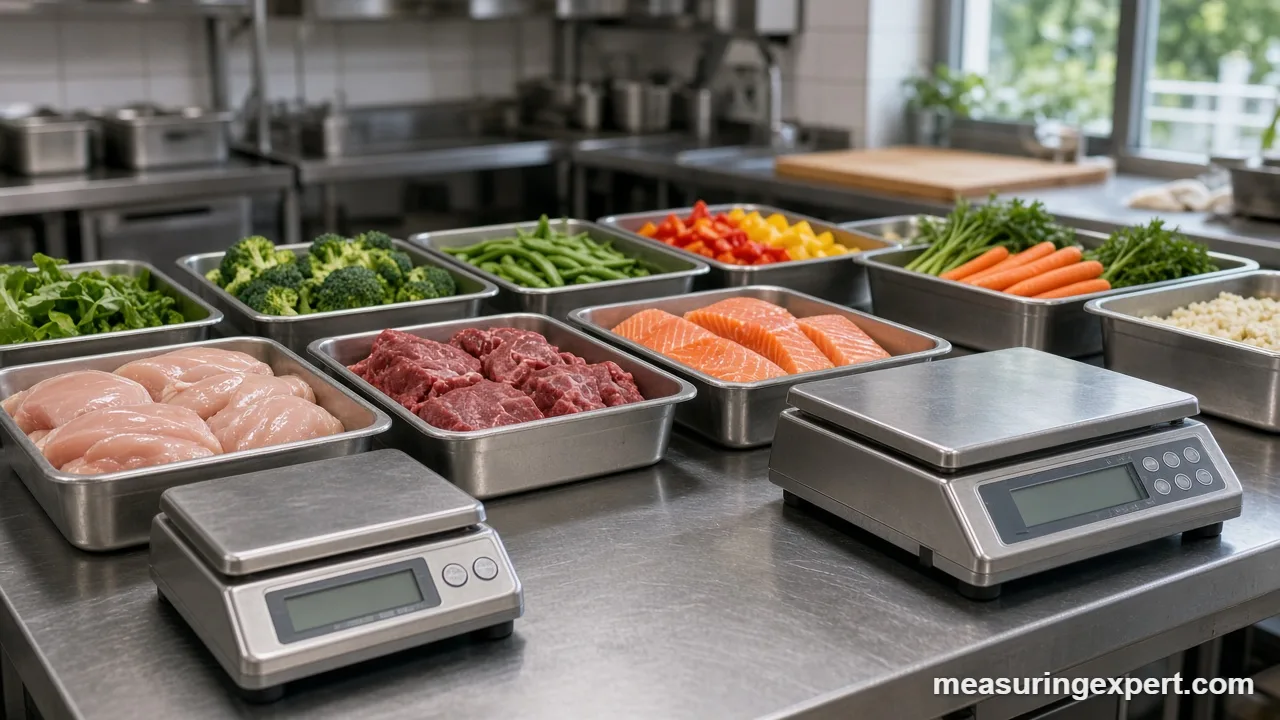
The best commercial kitchen scale for most restaurants is the Edlund WSC-20 Poseidon, a fully submersible 20 lb portion scale with a self-calibration mode. The right choice depends on three things: whether you sell food by weight (then you need NTEP approval), how you clean the line, and the capacity you weigh.
In short: the Edlund WSC-20 for wet prep lines, the Taylor TE10FT on a budget and the CAS SW-1WD when you need a legal-for-trade washdown scale.
As an Amazon Associate, Measuring Expert earns from qualifying purchases. Our picks are based on research, specifications and owner feedback, not paid placement.
Best Overall
Best Budget
Best Legal for Trade
Quick Answer: Which Is the Best Commercial Kitchen Scale for You?
- Overall: Edlund WSC-20 Poseidon, a submersible 20 lb portion scale.
- Legal for trade and washdown: CAS SW-1WD, with NTEP approval and IP66 protection.
- Checkweighing portions: Detecto Mariner WPS12, with over/under alerts and IP67.
- Deli and market counters: Torrey LPC-40L, a Class III price computing scale.
- Receiving deliveries: Torrey EQB-100-W, a 100 lb stainless bench scale.
- Budget portioning: Taylor TE10FT, an NSF compact scale that reads 0.1 oz.
- Key rule: if the weight sets the price, buy an NTEP model.
On This Page
- Commercial Scale Comparison Table
- The 9 Best Commercial Kitchen Scale Picks, Reviewed
- How We Chose
- Legal for Trade: NTEP and Handbook 44
- Portion, Price Computing and Receiving Scales
- Washdown IP Ratings
- Specs That Matter
- Pound, Ounce and Gram Converter
- How to Check Your Scale
- Honest Limits
- FAQ
- Bottom Line
Commercial Scale Comparison Table
| # | Image | Product | Best For | Standout Feature | Link |
|---|---|---|---|---|---|
| 1 |  | Edlund WSC-20 Poseidon | Wet prep lines | Submersible, self-calibration, 20 lb | View |
| 2 | 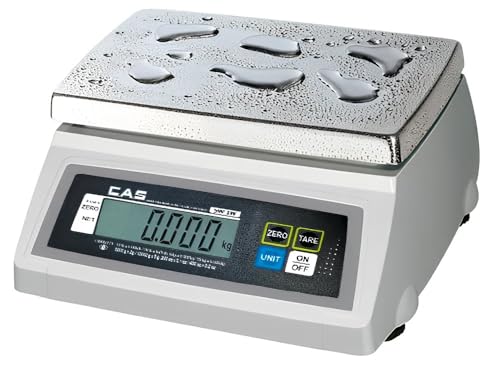 | CAS SW-1WD (50 lb) | Selling by weight in wet areas | NTEP, IP66, dual range | View |
| 3 | 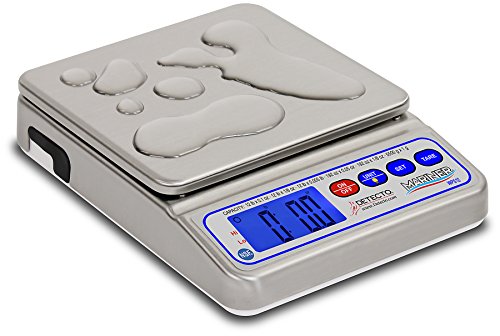 | Detecto Mariner WPS12 | Portion checkweighing | IP67, over/under alerts | View |
| 4 |  | Torrey LPC-40L | Deli and market counters | Class III, 100 PLUs | View |
| 5 |  | Torrey EQB-100-W | Receiving and bulk | 100 lb x 0.02 lb, stainless washdown | View |
| 6 | 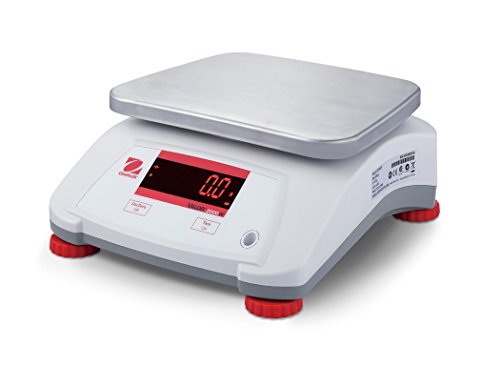 | Ohaus Valor 2000 V22PWE3T | Spice and recipe precision | 0.5 g readability, IPX8 | View |
| 7 |  | Edlund BRV-160 OP | Everyday line portioning | Oversized platform, ClearShield cover | View |
| 8 | 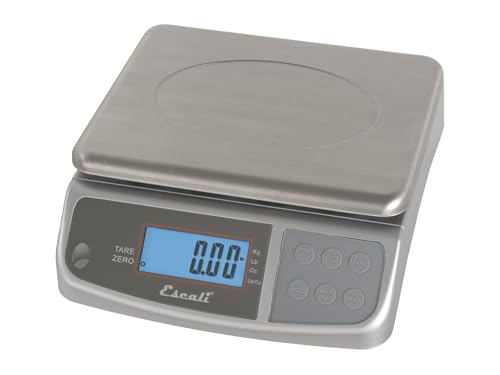 | Escali M-Series 66 lb | Batch prep | 66 lb capacity, NSF | View |
| 9 | 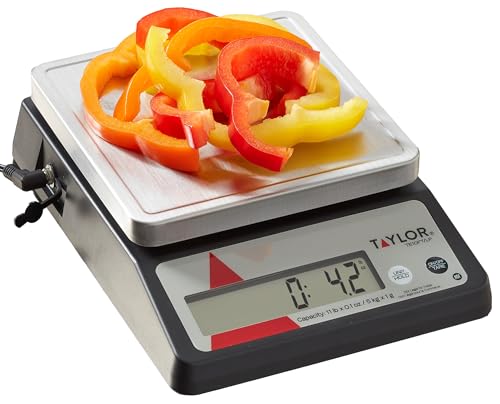 | Taylor TE10FT | Tight budgets | NSF, 0.1 oz graduation | View |
The 9 Best Commercial Kitchen Scale Picks, Reviewed
Every best commercial kitchen scale below is built for foodservice: NSF listing, stainless platforms, washdown housings or legal-for-trade approval. We also split the list by job.
Best Overall
1. Edlund WSC-20 Poseidon Submersible Portion Scale
Best for: Busy prep lines where the scale gets splashed, wiped and rinsed many times a shift.
The Poseidon is Edlund’s fully submersible portion scale. First, it uses a dual stainless steel housing, which Edlund calls a scale within a scale. As a result, the inner load cell is shielded from water and from shock if the scale is dropped. Next, the power supply and the battery bay are water-tight, so you can run it on AC or on four AA cells.
Likewise, the measurement side is strong. It weighs up to 20 lb (10,000 g) and offers six readout modes, from 0.005 lb steps to 2 g steps and fractions down to 1/8 oz. In addition, a self-calibration mode lets you flip the scale over to calibrate it without a test weight. However, it is not listed as NTEP approved, so use it for portioning, not for pricing food by weight.
- Capacity: 20 lb, 320 oz or 10,000 g
- Graduations: 0.005 lb, 0.1 oz, 1/8 oz or 2 g, by mode
- Platform: 6.75 x 6 in, one-piece stainless steel
- Power: water-tight AC supply or 4 AA batteries
- NSF listed; adjustable feet with bubble level
Pros
- Fully submersible for sink cleaning
- Self-calibration without a test weight
- Six readout modes, so fractions are easy
Cons
- Costs far more than a basic portion scale
- Not NTEP approved for trade use
- Small platform, so large bowls overhang
Skip it if: you price food by weight at the counter, because you need an NTEP model for that.
Best Legal for Trade Washdown
2. CAS SW-1WD Dual Range Washdown Scale (50 lb)
Best for: Butchers, delis and seafood counters that sell by weight and still need to hose down the station.
The SW-1W series is the washdown version of CAS’s long-running SW portion scale. Most importantly, it carries NTEP Certificate of Conformance 09-075, so it is approved for legal-for-trade use in the US. CAS also rates the housing up to IP66, which means it is dust tight and resists strong water jets.
The 50 lb model, for example, reads 0.01 lb up to 25 lb, then switches to 0.02 lb up to 50 lb. That gives 2,500 divisions in each range, well inside the Class III limits in NIST Handbook 44. Meanwhile, six D cells run it for up to 1,000 hours.
- Capacity: 25 lb x 0.01 lb / 50 lb x 0.02 lb (10 kg x 5 g / 20 kg x 10 g)
- NTEP CC 09-075; Measurement Canada AM-5695
- Up to IP66 washdown protection
- Power: 6 D batteries (up to 1,000 h) or AC adapter
- 1 in LCD; zero, tare and unit keys
Pros
- Legal for trade and washdown in one unit
- Also runs a very long time on batteries
- Dual range keeps fine steps, especially for small loads
Cons
- AC adapter is not washdown rated
- No price computing, and also no label printing
Skip it if: you need the scale to calculate prices or print labels.
Best for Checkweighing
3. Detecto Mariner WPS12 Submersible Portion Scale
Best for: Kitchens that portion proteins or sides to a target weight and want the scale to flag misses.
Detecto’s Mariner is an all stainless portion scale rated IP67, so it can be submerged for cleaning. Its standout feature, however, is high/low checkweighing. First, you set a target range, and the scale gives an audible over or under alert. As a result, line cooks can portion fast without reading every number.
Specifically, it weighs up to 12 lb in 0.005 lb or 0.1 oz steps, or 5,500 g in 1 g steps. A backlit 1.2 in LCD also helps in dim kitchens. The Ni-MH battery runs about 80 hours per charge, according to Detecto. However, Detecto does not list NTEP approval for this model.
- Capacity: 12 lb x 0.005 lb, 192 oz x 0.05 oz, 5,500 g x 1 g
- IP67 submersible; NSF certified
- High/low checkweighing with audible alert
- Rechargeable Ni-MH, about 80 h per charge
- Platform: 7.5 x 6.75 in
Pros
- Over/under alerts speed up portioning
- Rechargeable, so there are no battery swaps
- Backlit display also helps in dim light
Cons
- No NTEP listing for trade use
- 12 lb cap is low, so batch prep needs another scale
Skip it if: you mostly weigh whole cases or large stock pots.
Best Price Computing
4. Torrey LPC-40L Price Computing Scale
Best for: Delis, bakeries, farm stands and markets that charge customers by the pound.
Specifically, Tor Rey (sold as Torrey) builds this scale for counter sales. Also, it is an Accuracy Class III, legal-for-trade price computing scale. First, you enter a unit price, and then it multiplies weight by price for you. In addition, it stores up to 100 PLUs, so regular items need only one key press.
It weighs 40 lb in 0.01 lb steps, which is 4,000 divisions. Also, its rechargeable battery runs about 100 hours without the backlight, so it works at outdoor markets. In addition, the case and the roughly 12.2 x 8.9 in plate are stainless steel. However, it is not a washdown scale, so keep it on a dry counter.
- Capacity: 40 lb x 0.01 lb
- Accuracy Class III, legal for trade
- 100 PLU memory and progressive tare
- Rechargeable battery, about 100 h without backlight
- RS-232 port; stainless case and plate
Pros
- Built-in price math for counter sales
- Runs for days on one charge
- Stainless construction also resists corrosion
Cons
- Not designed for washdown
- Also lacks a label printer
- Overkill for back-of-house portioning
Skip it if: you never sell food by weight.
Best Receiving Scale
5. Torrey EQB-100-W Washdown Bench Scale
Best for: The back door, where you check produce, meat and seafood deliveries against the invoice.
A receiving scale catches short shipments, so it pays off. This waterproof version of Tor Rey’s EQB bench scale weighs 100 lb in 0.02 lb steps, or 50 kg in 0.01 kg steps. Therefore, it has 5,000 divisions. Moreover, the EQB family is NTEP approved, and the display sits on a tower above the platform, so a full case does not hide the reading.
In addition, the W models use all stainless steel construction and a hermetically sealed indicator, according to retailer spec pages. Also, the rechargeable battery is rated for about 90 hours, and an RS-232 port links to a PC or printer. On the other hand, Tor Rey does not publish an IP code for the W line, so do not submerge it.
- Capacity: 100 lb x 0.02 lb / 50 kg x 0.01 kg
- NTEP approved, legal for trade
- Stainless washdown build, sealed indicator
- Tower display, as well as tare and lb/kg switch
- Rechargeable battery, about 90 h
Pros
- Large capacity for full cases
- Tower display stays visible
- Legal for trade if you resell by weight
Cons
- No published IP rating
- Takes up real space because of the tower
Skip it if: your deliveries are small and a 50 lb portion scale already covers them.
Best Precision
6. Ohaus Valor 2000 V22PWE3T Compact Scale
Best for: Pastry, spice blends, cures and brines where a gram or less changes the result.
The Valor 2000 brings Ohaus lab-balance precision to food prep. This 3 kg model reads 0.5 g, which is 6,000 divisions. In addition, it is rated IPX8, the highest water rating in this list, and the platform is stainless steel.
It also shows g, kg, oz, lb and lb:oz, and it settles in about half a second. Meanwhile, the rechargeable battery lasts about 50 hours per charge. However, retailer listings mark legal-for-trade as not applicable for this model, so treat it as a prep tool.
- Capacity: 3,000 g x 0.5 g (about 6.6 lb x 0.001 lb)
- IPX8 water protection
- Stainless platform, 7.5 x 9.5 in, also easy to wipe
- Rechargeable battery, about 50 h; AC adapter
- Stabilization time: 0.5 s
Pros
- Finest readability in this guide
- IPX8 rating for heavy washing
- Fast readings, since it settles in 0.5 s
Cons
- Only 3 kg capacity
- Not for trade use
- Pricey, especially for a small scale
Skip it if: you weigh whole proteins or bulk batches.
Best Everyday Portion Scale
7. Edlund BRV-160 OP Bravo Digital Portion Scale
Best for: Sandwich, pizza and salad stations that need a dependable 10 lb portion scale at a moderate cost.
The Bravo is Edlund’s workhorse digital portion scale, and the OP version adds an oversized 5 5/8 x 6 15/16 in removable platform. Also, its ClearShield covers protect the keypad and display from juices and grease, and you can replace them in 3-packs.
It weighs 10 lb (160 oz or 5,000 g) in 0.1 oz, 1/8 oz or 1 g steps. Furthermore, it is field recalibratable with an optional test weight, and it runs on AC or 2 AA cells. However, it is not waterproof; Edlund sells a separate BRV-160W for that.
- Capacity: 10 lb, 160 oz or 5,000 g
- Graduations: 0.1 oz, 1/8 oz or 1 g
- Removable stainless platform, 5 5/8 x 6 15/16 in
- ClearShield covers, which also protect the keypad
- AC supply or 2 AA batteries; NSF listed
Pros
- Large platform for plates and bowls
- Replaceable splash covers
- Field recalibration, so no service call is needed
Cons
- Not waterproof
- Also not NTEP approved
Skip it if: your station gets rinsed down; get a submersible model instead.
Best High Capacity Prep
8. Escali M-Series 66 lb NSF Digital Scale
Best for: Batch cooking, dough and bulk prep where you weigh full hotel pans and tubs.
Escali, sold in foodservice under the San Jamar and Carlisle names as model SCDGM66, makes this NSF certified scale for heavier loads. It weighs up to 66 lb (30 kg), and foodservice listings give a 0.1 oz graduation. In addition, it has a dual display, so the cook and the person across the bench can both read it.
Also, the design is spill-proof with a stainless steel platform. However, Escali does not list an IP code or NTEP approval for it, so keep it for back-of-house prep.
- Capacity: 66 lb / 30 kg
- Graduation: 0.1 oz (foodservice listing)
- NSF certified
- Dual display as well as a spill-proof design
- Stainless steel platform
Pros
- High capacity for the size
- Two displays, so two people can read it
- Lower cost than a bench scale, as well as lighter
Cons
- No published IP rating
- Not for trade use
Skip it if: you need to weigh small portions to the gram.
Best Budget
9. Taylor TE10FT Digital Portion Control Scale
Best for: Food trucks, cafes and new restaurants that need an NSF portion scale without a big outlay.
Taylor’s TE10FT is a simple compact scale for portion control. For example, it weighs about 11 lb (5 kg) in 0.1 oz or 1 g steps. Also, it has tare, hold and auto-off, and you can switch auto-off off during long prep runs.
Meanwhile, it runs on an included AC adapter or two AAA batteries. On the other hand, the 0.9 in LCD is small, and the scale has no water rating. So wipe it rather than rinse it.
- Capacity: 11 lb (5 kg)
- Graduation: 0.1 oz or 1 g
- Tare and hold, as well as switchable auto-off
- Removable stainless platform with marine edge
- AC adapter or 2 AAA batteries; NSF
Pros
- Low cost for an NSF scale
- Hold function, which helps with large plates
- Marine edge contains spills
Cons
- Small display
- No water rating
- Light build, so heavy use wears it faster
Skip it if: your scale lives next to a sink or gets hosed down.
How We Chose the Best Commercial Kitchen Scale Picks
We did not run hands-on tests in a restaurant. Instead, our picks are research-based. First, we read manufacturer spec sheets and foodservice dealer spec pages for capacity, graduation, IP rating, NSF listing and NTEP status. Next, we read owner feedback for common failures, such as dead load cells. Finally, we kept only complete, current products from established foodservice brands.
- Measurement quality: graduation size, number of divisions and calibration options.
- Trade approval: NTEP status checked against maker documents.
- Sanitation: NSF listing, stainless surfaces and published IP ratings.
- Fit for the job: one pick each for portioning, checkweighing, pricing, receiving and batch prep.
For legal-for-trade rules, we used NIST Handbook 44 and the NCWM National Type Evaluation Program. For product specs, we used sources such as the Detecto Mariner WPS12 product page.
Legal for Trade: Does the Best Commercial Kitchen Scale Need NTEP?
Only if the weight decides what a customer pays, because that makes it a trade device. In the US, commercial weighing devices must meet NIST Handbook 44, the code of specifications and tolerances adopted by the National Conference on Weights and Measures. The current 2026 edition covers scales in Section 2.20. Then NTEP, run by NCWM, tests a device type and issues a Certificate of Conformance when it passes.
So a deli scale that prices potato salad by the pound needs NTEP approval. By contrast, a portion scale that only keeps burgers consistent does not need it, although NSF listing still matters for sanitation. State and local weights and measures inspectors enforce these rules, so check with yours before you buy.
Accuracy class and divisions, explained
Handbook 44 sorts scales into accuracy classes. In practice, most food and retail scales are Class III. For a Class III scale with a 0.1 g to 2 g division, the table requires 100 to 10,000 divisions. Then you find the count by dividing capacity by the division size. For example, the Torrey LPC-40L reads 40 lb in 0.01 lb steps, which is 4,000 divisions.
Tolerances are also counted in divisions. For instance, a Class III scale tested with a load of 0 to 500 divisions has a maintenance tolerance of 1 division, and the acceptance tolerance for a new scale is half the maintenance value. Heavier test loads, on the other hand, get wider bands.
Portion, Price Computing and Receiving Scales Compared
Restaurants usually need more than one scale, so pick by station, not by brand.
| Type | Typical capacity | Typical graduation | NTEP needed? | Used for |
|---|---|---|---|---|
| Portion scale | 5 to 20 lb (2 to 10 kg) | 0.1 oz, 1/8 oz or 1 to 2 g | Not for portioning only | Proteins, cheese, sides, dough balls |
| Precision prep scale | 1.5 to 6 kg | 0.1 to 0.5 g | No | Spices, cures, leaveners, pastry |
| Price computing scale | 30 to 60 lb | 0.01 lb | Yes | Deli and market counters |
| Receiving or bench scale | 50 to 300 lb | 0.02 to 0.1 lb | Yes, if used for trade | Deliveries, cases, inventory |
For smaller loads, our best kitchen scale guide covers compact home-style scales, and our best baking scale guide focuses on baker’s percentages and 0.1 g models.
Washdown IP Ratings for the Best Commercial Kitchen Scale
IP codes come from the IEC 60529 standard. First, the leading digit rates dust protection. Second, the next digit rates water. Therefore, IP66 and IP67 scales are both dust tight, but they handle water differently.
| Rating | Water protection | Kitchen meaning | Example in this list |
|---|---|---|---|
| No rating | Not tested | Wipe only; keep away from sinks | Taylor TE10FT, Edlund BRV-160 OP |
| IP66 | Powerful water jets | Hose-down cleaning | CAS SW-1WD |
| IP67 | Temporary immersion | Can be dunked in a sink | Detecto WPS12 |
| IPX8 | Continuous immersion, maker-defined | Heavy washing; dust not rated | Ohaus Valor 2000 |
| IP69K | High-pressure, hot water jets | Meat plants, aggressive sanitizing | None here |
Also check the charger. For example, CAS states that the SW-1W adapter is not washdown rated, so unplug it before cleaning.
Specs That Separate the Best Commercial Kitchen Scale From the Rest
- Capacity: size it to your heaviest normal load plus the container. For example, a full hotel pan can pass 20 lb.
- Graduation (d): the smallest step the display shows. Portion work needs 0.1 oz or 1 to 2 g; pastry and cures need 0.5 g or finer.
- Divisions: capacity divided by graduation. Therefore, more divisions mean finer resolution across the range.
- Tare: subtracts the container. Also look for tare up to full capacity.
- Calibration: self-calibration or field calibration with a test weight saves service calls, because no technician is needed.
- Sanitation: NSF listing, stainless platforms and also sealed keypads.
- Power: rechargeable or long-life batteries also keep the scale working away from outlets.
Readability, however, is not the same as accuracy. For instance, a scale that shows 1 g steps can still drift by several grams if it is dirty or off level. That is why precision in the kitchen depends on habits as much as hardware; see our guide to precision in cooking measurements.
Pound, Ounce and Gram Converter for Kitchen Scales
Recipes, invoices and spec sheets mix units all the time. So enter a weight in pounds below, and the converter shows ounces, grams and kilograms. For a quick reference, our ounces to grams for cooking chart covers common portion sizes.
How to Check a Commercial Scale Before Each Shift
These steps take two minutes, and as a result they catch most drift early.
- Level the scale. Adjust the feet until the bubble sits in the center of the level indicator.
- Let it warm up. Next, turn it on and wait a minute or two so the load cell settles.
- Clear and zero it. Remove everything from the platform, and then press zero.
- Place a test weight. Set a known weight near the center of the platform, such as a certified 1 lb or 1 kg mass.
- Compare the reading. The display should match within a division or two. If it does not, recalibrate it using the maker’s procedure.
- Test the tare. Put on an empty container, press tare, and check that the display returns to zero.
- Log the result. Write the date, reading and initials on a check sheet, so drift shows up over time.
Next, clean only to the level the IP rating allows. For daily technique on the line, our article on measuring ingredients with a kitchen scale covers taring and container habits.
Do and Don’t for Restaurant Scales
Honest Limits of Even the Best Commercial Kitchen Scale
Even so, no scale fixes poor technique. For example, a wet towel under the platform or a pan touching the wall will skew every reading. In addition, load cells wear out, and shock from dropped product can damage them without any visible sign. Finally, an NTEP certificate does not replace an in-place inspection by your local weights and measures office.
Commercial Kitchen Scale FAQ
What is the best commercial kitchen scale for a restaurant?
For most restaurants, the best commercial kitchen scale is a submersible NSF portion scale such as the Edlund WSC-20 Poseidon. If you sell food by weight, choose an NTEP model such as the CAS SW-1WD instead.
Does a restaurant scale need to be NTEP certified?
Only when the weight sets a price for a customer, such as at a deli counter. Portion control scales used only in the kitchen do not need NTEP, but local inspectors can confirm the rules in your state.
What does legal for trade mean on a scale?
It means the scale type meets NIST Handbook 44 and has an NTEP Certificate of Conformance. Therefore, it can be used to sell goods by weight once it passes local inspection.
What IP rating does the best commercial kitchen scale need?
For stations that get hosed down, look for IP66 or better. If you dunk the scale in a sink, choose IP67 or IPX8. However, scales with no rating should only be wiped.
What capacity should the best commercial kitchen scale have?
In general, most portion work fits a 10 to 20 lb scale. For example, a 20 lb model covers proteins and sides with room for a container, while receiving needs 50 lb or more.
What graduation do I need for portion control?
Generally, a 0.1 oz or 1 to 2 g graduation suits most portions. For spices, cures and leaveners, a 0.5 g or finer scale gives better control.
How often should I calibrate a commercial scale?
Check it daily with a test weight and recalibrate when it drifts by more than a division or two. Also recalibrate after the scale is moved, dropped or serviced.
Is NSF certification the same as NTEP?
No. NSF covers food safety and cleanability, while NTEP covers weighing accuracy for trade. Many portion scales are NSF listed but not NTEP approved.
Can I use a home kitchen scale in a restaurant?
You can for a short time, but home scales are rarely NSF listed or water rated. As a result, they tend to fail quickly under commercial cleaning and heavy use.
What is the difference between a portion scale and a receiving scale?
A portion scale weighs single servings up to about 20 lb. In contrast, a receiving scale is a larger bench scale, often 100 lb or more, used to check deliveries against invoices.
Bottom Line: The Best Commercial Kitchen Scale for Most Kitchens
The Edlund WSC-20 Poseidon is the best commercial kitchen scale for most restaurant prep lines, because it pairs a fully submersible build with six readout modes and self-calibration. If you sell by weight, however, choose the NTEP-approved CAS SW-1WD or the Torrey LPC-40L. And on a tight budget, the Taylor TE10FT covers basic portioning.
Buying for a workshop, lab or kitchen? Save with Amazon Business
2 thoughts on “9 Best Commercial Kitchen Scales for Restaurants, Delis and Receiving”