

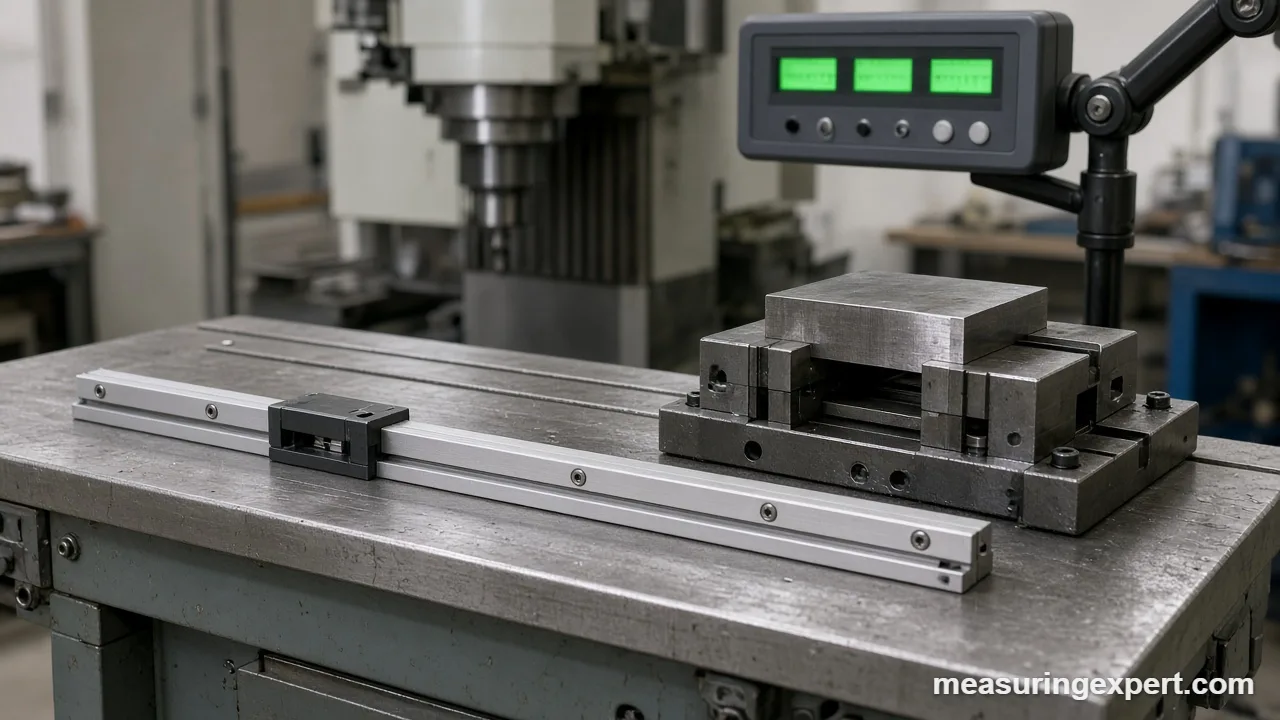
The best linear scale for most hobby mills is the iGaging EZ-View DRO Plus, an absolute scale that remembers its zero and reads to 0.0005 in (0.01 mm). Your choice comes down to resolution, scale type (capacitive, glass or magnetic), travel length and whether you need a full multi-axis kit.
In short: pick the iGaging EZ-View DRO Plus for a single axis, the TOAUTO glass scale kit for a full mill upgrade and the SHAHE magnetic scale when budget comes first.
As an Amazon Associate, Measuring Expert earns from qualifying purchases. Our picks are based on research, specifications and owner feedback, not paid placement.
Best Overall

Best Full Kit

Best Budget

Quick Answer: Which Linear Scale Fits Your Machine?
- Best overall: iGaging EZ-View DRO Plus, with absolute encoding and a 0.0005 in (0.01 mm) display.
- Full mill upgrade: TOAUTO 3-axis kit, with 5 micron glass scales and a console readout.
- Spare or upgrade scale: Ditron 500 mm glass scale, a 5 micron optical encoder.
- Readout console only: SINO SDS6-2V, a two-axis display with bolt-circle and arc functions.
- Quill or short axis: iGaging 6 in Absolute DRO, rated to 0.001 in.
- Lowest cost: SHAHE 0-300 mm magnetic scale, or its 0-150 mm sibling for a lathe.
- Key rule: buy a scale whose travel covers your full axis, then mount it close to the cut.
On This Page
- Linear Scale Comparison Table
- The 7 Best Linear Scale Picks, Reviewed
- How We Chose
- Glass vs Magnetic vs Capacitive Scales
- Resolution, Accuracy and Grades Explained
- Sizing the Best Linear Scale for Your Axis
- Scale Length Converter
- How to Install a DRO Scale
- Do and Don’t
- Honest Limits
- FAQ
- Bottom Line
Best Linear Scale Comparison Table
| # | Product | Best For | Standout Feature | Link |
|---|---|---|---|---|
| 1 | iGaging EZ-View DRO Plus 24 in | Hobby mill X or Y axis | Absolute encoder, 0.01 mm display | View |
| 2 | TOAUTO 3-Axis DRO Kit | Complete mill upgrade | 5 micron glass scales plus console | View |
| 3 | Ditron 500 mm Glass Scale | Replacing or adding an axis | 5 micron optical encoder | View |
| 4 | SINO SDS6-2V Readout | Upgrading the display | Bolt circle, arc and tool memory | View |
| 5 | iGaging 6 in Absolute DRO | Quill and short axes | Rated to 0.001 in, origin memory | View |
| 6 | SHAHE 0-300 mm Magnetic Scale | Tight budgets | Detachable remote LCD | View |
| 7 | SHAHE 0-150 mm Lathe Scale | Lathe tailstock or cross slide | Compact 6 in travel | View |
The 7 Best Linear Scale Picks, Reviewed
First of all, every best linear scale pick below is a digital readout (DRO) scale for machine tools, not a drawing ruler. Also, we mixed single-axis remote scales, glass encoder kits and a stand-alone console, so you can match the tool to your mill or lathe.
Best Overall
1. iGaging EZ-View DRO Plus (24 in)
Best for: Benchtop and knee mill owners who want a clear readout on one or two axes without wiring a console.
The EZ-View DRO Plus is the best linear scale for most home shops because it is simple. First, the scale uses absolute encoding, so it keeps its position after a power loss and does not snap back to zero. Second, the remote display shows 0.0005 in, 0.01 mm or 1/128 in steps, so you can work in whatever unit your drawing uses.
In addition, the display has magnetic strips and a 76 in (193 cm) cable, so it can sit wherever you can see it. Also, an articulating arm lets you stack several displays for a multi-axis setup. Meanwhile, the SPC/USB port lets you log readings to a computer with an optional cable.
- Display resolution: 0.0005 in / 0.01 mm / 1/128 in
- Absolute encoder with origin memory
- Lengths offered: 6, 12, 24 and 36 in (150, 300, 600 and 900 mm)
- Remote cable: 76 in (193 cm); 3 V CR2032 battery
- SPC/USB data output; optional AC adapter
Pros
- No re-zeroing after power-off
- Inch, metric and fraction modes
- Stackable displays for two or three axes
Cons
- No bolt-circle or arc functions like a console
- Capacitive scales dislike coolant and fine chips
Skip it if: you run flood coolant or need 5 micron resolution for fine work.
Best Full Kit
2. TOAUTO 3-Axis DRO Kit With Glass Scales
Best for: Bridgeport-style knee mills and larger lathes that need a full console with machining functions.
First, this kit pairs optical glass scales with a mains-powered console. The scales resolve 5 microns (0.0002 in), so they show steps 2 times finer than a 0.01 mm capacitive scale. As a result, you can creep up on a bore size or a shoulder with real confidence.
In addition, the console does more than count. For example, it stores 200 sets of data, calculates bolt-hole circles (PCD), drills holes along an angled line, finds a center with the 1/2 function and helps cut arcs. So, it saves layout time on every part. Finally, you choose scale lengths from 100 to 1000 mm (about 4 to 39 in) and a 2-axis or 3-axis setup.
- Scale resolution: 5 microns (0.005 mm / 0.0002 in)
- Scale lengths: 100 to 1000 mm
- Console: 200-set memory, PCD, R arc, angled-line drilling, 1/2 centering
- Power: AC 80-260 V, 50-60 Hz
- Operating range: 0 to 45 C (32 to 113 F)
Pros
- Glass scales with fine 5 micron steps
- Real machining functions on the console
- Choice of lengths and axis count
Cons
- Installation takes a full day or more
- Needs mains power near the machine
Skip it if: you only want a readout on one quill or one short axis, because a single remote scale costs far less.
Best Spare Scale
3. Ditron 500 mm 5 Micron Glass Scale

Best for: Owners who already have a TTL console and need to replace a damaged scale or add an axis.
To begin with, Ditron is a long-standing DRO maker, and this listing is a single 500 mm (20 in) optical glass encoder with 5 micron resolution. Because it is sold alone, it suits a repair or a custom build. However, you must check that its connector and signal match your readout before you order.
Ditron’s DC10 family of scales is listed with TTL or RS422 output, IP55 sealing, reference marks every 50 mm and a traverse speed of up to 60 m/min (about 197 ft/min). Also, the family is offered in accuracy grades of plus or minus 5 microns and 10 microns per meter. So, ask the seller which grade and output this exact scale uses.
- Measuring length: 500 mm (20 in)
- Resolution: 5 microns
- Type: optical glass encoder
- DC10 family: TTL or RS422 output, IP55, reference marks every 50 mm
Pros
- Lets you rebuild or extend an existing DRO
- Sealed glass design suits shop conditions
- Reference marks help restore zero
Cons
- No readout included
- Connector pinouts vary between brands
Skip it if: you have no console yet, because a full kit is simpler.
Best Readout Upgrade
4. SINO SDS6-2V Two-Axis Digital Readout

Best for: Machinists who want a feature-rich console for a mill or lathe and will pair it with separate scales.
Likewise, SINO is one of the best known DRO console makers, and the SDS6-2V is its two-axis model. Unlike the other picks, however, it is the display only. Therefore, it fits a shop that already has scales, or one that wants to choose each scale length separately.
According to the SINO manual, you set resolution per axis from 0.1 to 10 microns, so it can work with 1 micron or 5 micron scales. In addition, it offers milling, grinding and lathe modes, 200 user zero points, a 200-tool library, bolt circles, smooth arcs, taper measurement and linear error compensation. Finally, the M/I key switches between millimeters and inches with 4 or 5 decimal places.
- Axes: 2 (X and Y)
- Selectable resolution: 0.1, 0.2, 0.5, 1, 2, 5 or 10 microns
- Modes: milling, grinding and lathe
- Functions: PCD, arc, 200 zero points, 200-tool memory, error compensation
Pros
- Error compensation corrects a known scale error
- Lathe tool library saves setup time
- Works with fine or coarse scales
Cons
- Scales are not included
- Menus take time to learn
Skip it if: you want a single box with scales and readout ready to go.
Best for Quills
5. iGaging 6 in Absolute DRO With Remote Reading

Best for: Drill press and mill quills, lathe tailstocks and other short axes up to 6 in (152 mm).
A quill readout is often the first DRO a hobbyist adds, because drilling and boring depths are hard to read from a small dial. This iGaging unit uses the same absolute idea as our top pick, so it remembers its origin. Also, its stainless steel body and remote display keep the reading at eye level.
Moreover, Grizzly lists the 6 in model with an accuracy of 0.001 in (25.4 microns) and inch, fraction and metric modes. Overall, that is fine for depth stops and hole depths. However, it is not fine enough to split a tenth.
- Travel: 0-6 in (0-152 mm)
- Accuracy: 0.001 in (0.025 mm)
- Absolute origin memory
- Stainless steel body; remote display
Pros
- Short and easy to mount on a quill
- Keeps zero between sessions
- Low cost entry to DRO work
Cons
- Only 6 in of travel
- No console functions
Skip it if: you need to cover a table axis; pick the 24 in EZ-View instead.
Best Budget
6. SHAHE 0-300 mm Magnetic Linear Scale
Best for: Hobbyists on a tight budget who want a remote readout on a small mill table.
To begin with, SHAHE (Wenzhou Sanhe) builds digital calipers and remote scales in large numbers. Moreover, this 300 mm (12 in) scale has a detachable remote LCD and a magnetic display mount. So, you can place the reading where your eye falls during a cut.
A retailer listing for the scale gives a resolution of 0.01 mm and an accuracy of plus or minus 0.10 mm (about 0.004 in). By comparison, that is coarser than our top pick. Even so, it is plenty for positioning holes on brackets, jigs and other hobby parts.
- Range: 0-300 mm (0-12 in)
- Resolution: 0.01 mm
- Listed accuracy: plus or minus 0.10 mm
- Inch, fraction and metric modes; detachable remote LCD
Pros
- Very low entry cost
- Remote display is easy to place
- Other lengths are offered
Cons
- Accuracy spec is loose for precision fits
- Not sealed against coolant
Skip it if: you need tolerances tighter than about 0.004 in (0.1 mm).
Best for Small Lathes
7. SHAHE 0-150 mm Digital Lathe Scale

Best for: Mini lathe owners who want a readout on the cross slide, compound or tailstock.
After all, short axes are where a small scale shines. Specifically, this SHAHE unit covers 150 mm (6 in), which suits a mini lathe cross slide or a tailstock ram. Also, the digital LCD removes the guesswork of counting turns on a small handwheel.
Because the listing gives few figures, treat it as a hobby-grade positioning aid. In other words, use it to know where you are, then confirm critical sizes with a micrometer or caliper.
- Range: 0-150 mm (0-6 in)
- Digital LCD readout
- Listed for milling machines and lathes
Pros
- Compact for crowded lathe slides
- Simple to fit
- Lowest cost pick here
Cons
- Few published specs
- Not for tenth-level work
Skip it if: you need a verified accuracy figure, because inspection work demands one.
How We Chose the Best Linear Scale Picks
We did not bench-test these scales. Instead, our picks are research-based. First, we listed scales and kits from brands with a track record in DRO hardware: iGaging, SHAHE, TOAUTO, Ditron and SINO. Next, we checked each spec against manufacturer pages, manuals and distributor spec sheets from Grizzly, Penn Tool and others. Also, when we could not confirm a figure, we left it out.
We also judged each scale on resolution, stated accuracy, encoder type, travel lengths, sealing, readout features and how easy it is to mount. Then we read owner feedback to spot common failures, such as coolant damage or loose read heads. Finally, we kept no more than two picks per brand, so the list covers different jobs rather than one maker.
Glass vs Magnetic vs Capacitive: Which Linear Scale Type?
In general, three technologies dominate shop DROs. Each one reads position in a different way, so each has its own strengths.
| Type | How it reads | Typical resolution | Strengths | Weak spots |
|---|---|---|---|---|
| Optical glass | Light through a fine grating on glass | 5 or 1 micron | Fine steps, mature tech, sealed housings | Glass can crack if struck; bulkier body |
| Magnetic | Read head senses a magnetized tape | 5 or 1 micron | Thin, cut to length, tolerates oil and chips | Strong magnets nearby can upset the tape |
| Capacitive | Electrode pattern, like a digital caliper | 0.01 mm (0.0005 in) | Cheap, battery powered, easy to fit | Coarser steps; coolant can upset readings |
Overall, for most knee mills, glass scales in a sealed aluminum housing remain the default. However, magnetic tape scales are gaining ground on lathes, where coolant and swarf are constant. Capacitive scales, meanwhile, are the easy first step for benchtop machines.
Resolution, Accuracy and Grades: What the Best Linear Scale Specs Mean
First, resolution is the smallest step the display can show. Accuracy, by contrast, is how close that number is to the true position. A scale can show 5 micron steps yet still be off by 10 microns over a meter, so always read both figures.
Many glass scales list accuracy as a grade, such as plus or minus 5 microns or plus or minus 10 microns per meter. As a result, the per-meter allowance grows with length. For example, a 10 micron per meter scale can be off by about 5 microns over 500 mm. In contrast, capacitive scales often list a flat figure, such as 0.001 in (25.4 microns) for iGaging’s absolute units.
Next, repeatability is the third number. In other words, it tells you whether the scale returns the same reading at the same spot. For production work, repeatability often matters more than absolute accuracy, because you can zero on a known feature.
Temperature matters too. Heidenhain notes that linear encoders are inspected at a reference temperature of 20 C (68 F). Consequently, above or below that, both the scale and the machine grow or shrink. For instance, a 500 mm aluminum part warmed 5 C (9 F) grows about 0.058 mm (0.0023 in), while cast iron grows about 0.027 mm. So, let parts and machine settle before you chase microns.
Finally, remember what a micron is. One micron is 0.001 mm, or about 0.00004 in, and the meter itself is defined by NIST and the SI through the speed of light. If small units feel abstract, our guide to nanometers and other tiny units puts them in context.
Sizing the Best Linear Scale for Your Axis
In fact, scale length is the most common ordering mistake. Typically, listings quote measuring travel, while the body is longer. For example, the iGaging 24 in absolute scale has a total beam length of 28.5 in (724 mm). So, measure the space on your machine as well as the travel.
- Measure full travel. Run the table from stop to stop and record the distance.
- Add a margin. Choose the next size up, so the read head never hits an end.
- Check mounting room. Confirm the body length fits between brackets, handwheels and way covers.
- Match the readout. Check signal type (TTL, RS422 or proprietary) and connector before you mix brands.
As a rule of thumb, a benchtop mill needs about 12 to 16 in on X, while a full knee mill often needs 30 in or more. Similarly, the cross slide on a mini lathe usually needs 6 in or less. In short, buy for the machine you own, not the next one.
Scale Length Converter: Millimeters to Inches
Scale listings mix millimeters and inches, so convert before you compare. Enter a travel length below to see it in inches, centimeters and feet.
How to Install a DRO Scale on a Mill
Above all, installation decides how well any scale performs. Follow these steps for a table axis, and take your time.
- Clean and inspect the axis, then check the gib so the table moves without play.
- Pick a location close to the cutting line, away from chips and coolant splash.
- Drill and tap the mounting holes for the scale body and the read head bracket.
- Mount the scale loosely, then sweep it with a dial indicator and adjust until it runs parallel to the travel.
- Fit the read head bracket and set the head gap to the maker’s spec through the full stroke.
- Route the cable with slack, add a chip guard, then power up and test against a known gauge block or a dial indicator.
A good dial indicator is the key tool for step 4. Generally, aim for parallelism within about 0.002 in (0.05 mm) over the length, or tighter if the maker asks. Also, check your test cuts with a digital caliper once the scale is live.
Do and Don’t for DRO Scales
Similarly, a few simple habits keep a scale reading true for years.
Do
- Mount the scale close to the work, because distance adds error.
- Fit a guard over the scale seal on every axis.
- Verify readings against a known standard each season.
- Use the console’s error compensation if it has one.
Don’t
- Spray compressed air into the scale seal.
- Let the read head bracket flex or hang loose.
- Run a capacitive scale under flood coolant.
- Trust a reading you have never checked against a gauge.
Honest Limits of Even the Best Linear Scale
Remember, though, that a DRO reports where the table is, not where the tool cut. Therefore, deflection, worn ways and a loose gib still show up in your part. A scale also cannot fix Abbe error: the farther the scale sits from the cutting line, the more any tilt in the table adds to the error.
Budget scales also vary from unit to unit. So, check a new scale against a trusted reference before you rely on it. For layout away from the machine, a precision steel ruler is still faster than any DRO.
Best Linear Scale FAQ
What is the best linear scale for a hobby mill?
For most hobby mills, the best linear scale is an absolute capacitive unit such as the iGaging EZ-View DRO Plus. It is easy to fit, keeps its zero and reads to 0.0005 in (0.01 mm).
Is a glass or magnetic linear scale better?
Both reach 5 or 1 micron resolution. Glass scales are the long-time standard for mills, while magnetic tape scales are thinner and handle oil and chips well, so many lathe owners prefer them.
What resolution do I need on a DRO scale?
For general hobby work, 0.01 mm (0.0005 in) is enough. However, choose a 5 micron scale for fine boring and fits, and consider 1 micron only for grinding or very precise work.
What is the difference between resolution and accuracy?
Resolution is the smallest step the display shows. Accuracy is how close the reading is to the true position, so a scale can show fine steps and still carry a larger error.
How long should a linear scale be?
Choose a scale whose measuring travel equals or exceeds your full axis travel. Also, check the body length, because it is several inches longer than the travel.
Can I mix scales and readouts from different brands?
Often, yes, if the signal and connector match. Most glass scales use TTL or RS422 signals, but pinouts differ, so confirm the wiring before you buy.
Does an absolute scale need homing?
No. An absolute scale knows its position at power-on. In contrast, an incremental scale counts from where it starts, so it relies on a reference mark or a manual zero.
Can a DRO scale handle coolant?
Sealed glass and magnetic scales handle splash well, especially with a guard. Capacitive scales, however, can give erratic readings when coolant gets inside.
How do I check DRO accuracy?
Move the axis against a gauge block stack or a long-travel dial indicator and compare the readings. Next, repeat at several points along the travel to find any error.
Is the best linear scale worth it on a lathe?
Yes, especially on the cross slide. A scale shows diameter changes directly, so you stop counting handwheel turns and cut fewer undersize parts.
Bottom Line: The Best Linear Scale for Most Shops
For one or two axes on a hobby mill, the iGaging EZ-View DRO Plus is the best linear scale for most buyers, thanks to absolute encoding and a 0.01 mm display. If you want a full console with bolt circles and 5 micron glass, choose the TOAUTO kit instead.