

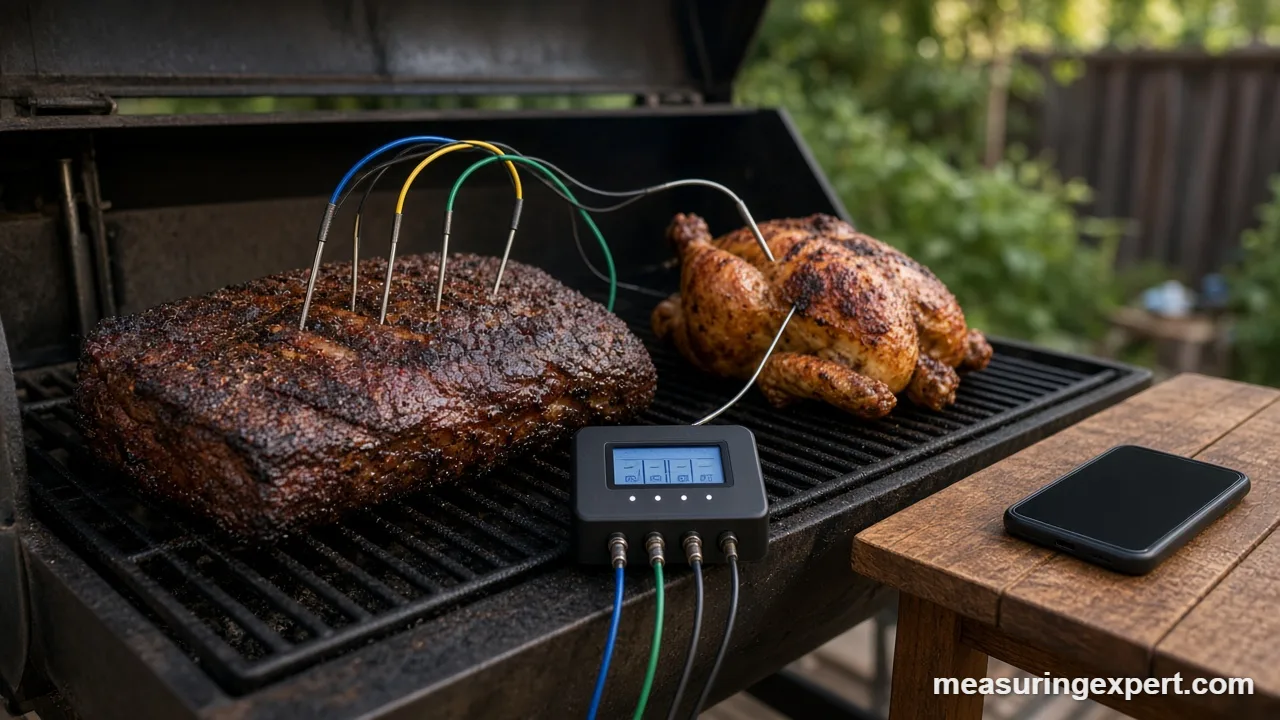
The best Bluetooth food thermometer for most cooks is the ThermoWorks Signals, a four-channel hub with wired probes, Wi-Fi backup and tight accuracy. Your choice depends on how many probes you run at once, whether you need alerts beyond Bluetooth range, and how much app guidance you want.
In short: pick Signals for long smokes, the TempPro TP25 for four probes on a budget, and the INKBIRD IBT-4XS if price comes first.
As an Amazon Associate, Measuring Expert earns from qualifying purchases. Our picks are based on research, specifications and owner feedback, not paid placement.
Best Overall

Best Budget

Quick Answer: Which Bluetooth Thermometer Fits Your Cook?
- Best overall: ThermoWorks Signals, with four channels, Wi-Fi and Bluetooth.
- Best value: TempPro TP25, four probes and a 650 ft Bluetooth rating.
- Lowest cost for four probes: INKBIRD IBT-4XS.
- Coaching for beginners: Weber Connect Smart Grilling Hub.
- Wi-Fi for less: Govee WiFi Meat Thermometer with four probes.
- Handheld with an app: INKBIRD IHT-2PB instant-read.
- Want no cables at all? See our best wireless meat thermometer guide instead.
On This Page
- Best Bluetooth Food Thermometer Comparison
- The 7 Best Bluetooth Food Thermometer Picks, Reviewed
- How We Chose the Best Bluetooth Food Thermometer
- Wired-Probe Hub vs Wireless Probe vs App Instant-Read
- Reading the Spec Sheet of the Best Bluetooth Food Thermometer
- USDA Targets for Your Best Bluetooth Food Thermometer
- How to Set Up Your Best Bluetooth Food Thermometer
- Keep Your Readings Honest: Calibration and Care
- Smart Habits and Common Mistakes
- Where Bluetooth Thermometers Fall Short
- Best Bluetooth Food Thermometer FAQ
- Bottom Line: Our Best Bluetooth Food Thermometer Pick
Best Bluetooth Food Thermometer Comparison
| # | Product | Best For | Standout Feature | Link |
|---|---|---|---|---|
| 1 | ThermoWorks Signals | Long smokes and serious backyard cooks | 4 channels, Wi-Fi plus Bluetooth, IP66 | View |
| 2 | TempPro TempSync PRO TP25 | Four probes on a budget | 650 ft Bluetooth 5.0, cook time estimate | View |
| 3 | INKBIRD IBT-4XS | Low-cost multi-probe smoking | Rotating screen, up to 4 probes | View |
| 4 | Weber Connect Smart Grilling Hub | Beginners who want coaching | Step-by-step app guidance | View |
| 5 | Govee WiFi Meat Thermometer | Wi-Fi alerts for less | Wi-Fi, 4 probes, 40 hour battery | View |
| 6 | TempPro TempSync ELITE TP920 | One roast plus pit air | 650 ft Bluetooth, no account needed | View |
| 7 | INKBIRD IHT-2PB | Spot checks with logging | 2-second read, app presets | View |
In short, every pick above uses probes on cables or a handheld probe, and each one sends readings to a phone app. In contrast, cable-free probes such as MEATER and TempSpike live in our separate wireless guide, so the two lists do not repeat each other.
The 7 Best Bluetooth Food Thermometer Picks, Reviewed
Overall, we split the list by job. First come the multi-probe BBQ hubs, then a guided-cooking hub, a Wi-Fi budget option, a two-probe pick and finally an app-connected instant-read.
Best Overall
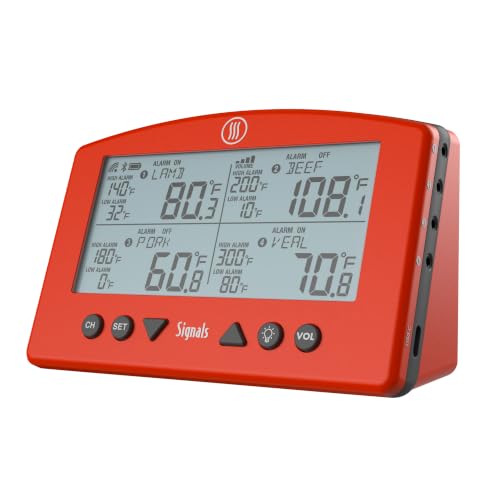
1. ThermoWorks Signals 4-Channel Wi-Fi and Bluetooth Thermometer
Best for: Pitmasters who run long cooks and want four channels, Wi-Fi alerts and a hub that still works with the phone left inside.
Signals is our pick for the best Bluetooth food thermometer overall because it covers every base a long cook needs. It has four wired channels, so you can track a brisket, a pork butt and the pit air at the same time. In addition, it talks to your phone over Bluetooth 4.2 at short range and over 2.4 GHz Wi-Fi when you walk away, so alerts reach you anywhere your phone has a signal.
On the measuring side, ThermoWorks rates it at plus or minus 1.8 F (1 C) from -4 to 248 F, which covers every meat target in the USDA chart. It also reads to 0.1 degree, so you can watch a stall creep upward in real time. Finally, the hub works on its own if your phone dies.
- Channels: 4 (three Pro-Series High Temp penetration probes and one air probe with grate clip included)
- Range: -58 to 572 F (-50 to 300 C); resolution 0.1 degree
- Accuracy: +/-1.8 F (1 C) from -4 to 248 F, wider above that
- Wireless: Bluetooth 4.2 (about 95 ft line of sight) plus 2.4 GHz Wi-Fi
- Body: IP66 splash-proof; rechargeable battery rated up to 16 hours, USB-C power option
Pros
- Wi-Fi plus Bluetooth means no range anxiety at home
- Tight published accuracy in the meat range
- Works standalone with a large backlit display
- Pairs with a Billows fan for pit control
Cons
- The priciest pick on this list
- Wi-Fi needs a 2.4 GHz network
- Probe warranty is shorter than the hub warranty
Skip it if: you only grill weeknight chicken breasts; a single-probe model or an instant-read will do the job for far less.
Best Value
2. TempPro TempSync PRO TP25 (4 Probes)
Best for: Home cooks who want four color-coded probes and long Bluetooth range without paying for Wi-Fi.
The TP25 (sold by ThermoPro, now under the TempPro name) is a classic four-probe Bluetooth hub. Also, each probe is color coded, so you never mix up the turkey breast and the thigh. Moreover, TempPro rates the Bluetooth 5.0 link at about 650 ft (200 m) in open air, which is far more than most patios need.
Next, the free TempPro BBQ app adds the features that make a hub smart. You get editable presets for nine meat types based on USDA guidance, a pre-alarm 5, 10 or 15 degrees before your target, and a live graph. In addition, a cook time estimator predicts when each probe will hit its target.
- Probes: 4 color-coded stainless probes, 8 in (205 mm), 49 in (1250 mm) cables
- Range: 14 to 572 F (-10 to 300 C)
- Accuracy: +/-1.8 F (1 C), NTC sensor
- Wireless: Bluetooth 5.0, rated up to 650 ft (200 m)
- Power: built-in rechargeable 3.7 V lithium battery
Pros
- Four probes at a mid-range price
- Pre-alarm warns you before the target
- Graph and cook time estimate in the app
Cons
- Bluetooth only, so no alerts away from home
- Four cables can tangle around a busy grill
Skip it if: you want alerts while you run errands; then pick a Wi-Fi hub such as Signals or the Govee below.
Best Budget
3. INKBIRD IBT-4XS Bluetooth Grill Thermometer
Best for: Budget smokers and grillers who want four channels and a screen they can read from any angle.
The IBT-4XS is a small, magnetic hub that has stayed popular because it does the basics well. It accepts up to four probes on 60 in (1.5 m) cables, so you can run them from a big offset smoker to a side table. Also, its LED screen rotates when you turn the unit, which helps when it hangs on the side of a grill.
However, its numbers are a step below the pricier picks. For example, INKBIRD lists accuracy at plus or minus 2 F (1 C) and a Bluetooth range of 150 ft (46 m). Moreover, its probes are rated to 572 F (300 C) for short spells but 482 F (250 C) for continuous use. As a result, it suits low-and-slow smoking better than searing.
- Probes: up to 4, 60 in (1.5 m) cables
- Range: 32 to 572 F short term, 32 to 482 F continuous (0 to 300 / 250 C)
- Accuracy: +/-2 F (1 C)
- Wireless: Bluetooth, rated 150 ft (46 m)
- Power: 1000 mAh rechargeable battery; magnetic back
Pros
- Low price for four channels
- Auto-rotating display
- Long probe cables
Cons
- Shortest Bluetooth range here
- Plastic back must stay below 176 F (80 C)
- Lower continuous probe rating
Skip it if: you sear at high heat with the probe in place, or you need range beyond your yard.
Best Guided Cooking
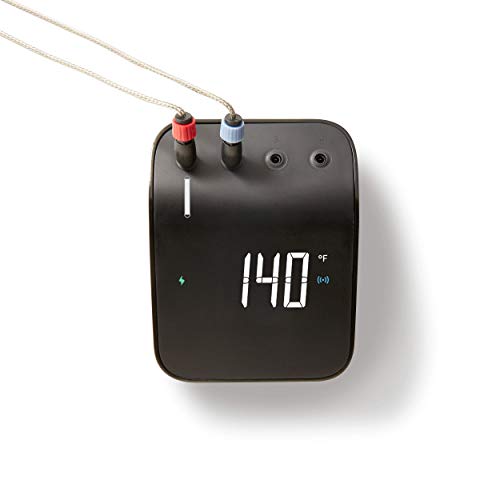
4. Weber Connect Smart Grilling Hub
Best for: New grillers who want the app to tell them when to flip, when to pull and how long is left.
First of all, the Weber Connect hub is less about raw numbers and more about coaching. It connects over Wi-Fi, and it falls back to Bluetooth when Wi-Fi is not available. Also, in the box you get one meat probe and one ambient probe, and the hub accepts up to four probes in total.
Meanwhile, the Weber Connect app walks you through setup, grill prep and the cook itself. For example, you pick a cut and a doneness, and the app counts down the estimated time and pings you when it is time to flip and serve. In short, it is the gentlest way to learn.
- Probes: 1 meat probe and 1 ambient probe included; up to 4 supported
- Wireless: Wi-Fi with Bluetooth backup
- Power: USB rechargeable
- App: doneness picker, ready countdown, flip-and-serve alerts
Pros
- Excellent step-by-step guidance
- Wi-Fi alerts away from home
- Works with Weber’s own smart grills
Cons
- Only two probes in the box
- Weber does not publish an accuracy figure
- Less useful once you cook by temperature alone
Skip it if: you already know your target temperatures and mainly want more channels for the money.
Best Budget Wi-Fi
5. Govee WiFi Meat Thermometer (4 Probes)

Best for: Cooks who want Wi-Fi remote alerts and four probes at a lower price than premium hubs.
To begin with, Govee is best known for smart home gadgets, and this hub brings that app style to the grill. Also, it holds four wired probes and connects through the Govee Home app. Because it uses Wi-Fi, you can check a slow-cooking roast from the store, not just from the couch. Note, however, that it works only on 2.4 GHz networks, not 5 GHz.
On paper, it reads from 32 to 572 F (0 to 300 C) with a stated accuracy of plus or minus 1.8 F (1 C). In addition, the app includes 28 USDA-based presets. Its 3000 mAh battery is rated for up to 40 hours.
- Probes: 4 wired probes
- Range: 32 to 572 F (0 to 300 C)
- Accuracy: +/-1.8 F (1 C)
- Wireless: 2.4 GHz Wi-Fi (no 5 GHz) plus Bluetooth
- Power: 3000 mAh rechargeable, up to 40 hours
Pros
- Wi-Fi alerts at a budget price
- Long battery life
- 28 preset targets in the app
Cons
- 2.4 GHz Wi-Fi only
- Fewer published specs than ThermoWorks
- Several listing versions exist, so check the probe count
Skip it if: your home network is 5 GHz only or you want a hub with a long, well-documented track record.
Best Two-Probe
6. TempPro TempSync ELITE TP920 (2 Probes)

Best for: Cooks who watch one main piece of meat plus the oven or pit air, and want a simple app with no sign-up.
In fact, most cooks need two channels, not four: one probe in the meat and one at grate level. The TP920 does exactly that, and it keeps the same TempPro accuracy of plus or minus 1.8 F (1 C). Also, the app pairs over Bluetooth with no Wi-Fi, account or registration, which many people prefer for privacy.
Similarly, like the TP25, it uses 8 in (205 mm) probes on 49 in (1250 mm) cables and reads from 14 to 572 F (-10 to 300 C). In addition, a touch backlight makes the receiver easy to read at night. As a result, it is a tidy, low-fuss pick for roasts, turkeys and pork shoulders.
- Probes: 2, 8 in (205 mm), 49 in (1250 mm) cables
- Range: 14 to 572 F (-10 to 300 C)
- Accuracy: +/-1.8 F (1 C)
- Wireless: Bluetooth 5.0, rated 650 ft (200 m)
- Extras: graph, cook time estimator, USDA-based presets
Pros
- No account or Wi-Fi setup
- Long Bluetooth range
- Compact receiver with touch backlight
Cons
- Only two channels
- No remote alerts beyond Bluetooth range
Skip it if: you cook several cuts at once; the four-probe TP25 costs only a little more.
Best App Instant-Read
7. INKBIRD IHT-2PB Bluetooth Instant-Read Thermometer

Best for: Cooks who want a fast handheld reading plus app logging, alarms and calibration in one tool.
Of course, not every app thermometer has to live on a hub. The IHT-2PB is an instant-read with Bluetooth, so readings show on its backlit screen and in the app at once. Also, INKBIRD rates the readout at about 2 seconds and accuracy at plus or minus 1 F (0.5 C), which is tight for this class.
In addition, it supports external probes, so you can leave a probe in a roast and still use the tool for spot checks. Moreover, the app has 11 meat presets, 5 doneness levels and a history log. Also, you can calibrate it, which matters because even good sensors drift over time.
- Readout: about 2 seconds
- Range: -58 to 572 F (-50 to 300 C)
- Accuracy: +/-1 F (0.5 C)
- Wireless: Bluetooth, rated up to 328 ft (100 m)
- App: 11 meat presets, 5 doneness levels, alarms, timers, calibration
Pros
- Instant-read speed plus app alerts
- Tightest stated accuracy on this list
- Calibration in the app
Cons
- Fewer channels than a BBQ hub
- INKBIRD’s listing text is unclear on the exact probe count
Skip it if: you mainly smoke for many hours; a dedicated multi-probe hub is easier to leave alone.
How We Chose the Best Bluetooth Food Thermometer
Our picks are research-based. In other words, we did not run hands-on lab tests. Instead, we compared published specs from each maker, read owner feedback, and checked the safe cooking temperatures from USDA FSIS. Then we scored each model on the points below.
- Published accuracy: we favored models that state a figure, ideally plus or minus 2 F or better.
- Channels: more probes let you watch several cuts and the pit air at once.
- Connection: Bluetooth range, plus Wi-Fi for remote alerts.
- App quality: graphs, pre-alarms, presets and calibration.
- Heat limits: probe and cable ratings, because cables often fail first.
- Brand support: established makers with spare probes and manuals online.
Wired-Probe Hub vs Wireless Probe vs App Instant-Read
| Type | How it works | Strengths | Trade-offs |
|---|---|---|---|
| Wired-probe hub | Probes on heat-proof cables plug into a base with Bluetooth or Wi-Fi | Many channels, cheap spare probes, ambient probe for the pit | Cables to route and protect |
| Truly wireless probe | Battery and radio sit inside the probe | No cables, works on rotisseries | Fewer channels, internal heat limits, higher cost per probe |
| App instant-read | Handheld probe that logs readings to an app | Fast spot checks in several places | Not built to stay in the cooker for hours |
For long smokes, a wired hub is often the better tool because you can add channels for little money. However, if cables bother you, read our wireless meat thermometer picks. And for a general kitchen tool, our best food thermometer guide covers instant-reads without apps.
Reading the Spec Sheet of the Best Bluetooth Food Thermometer
Thermometer specs look alike, yet small details matter. So here is what each line means.
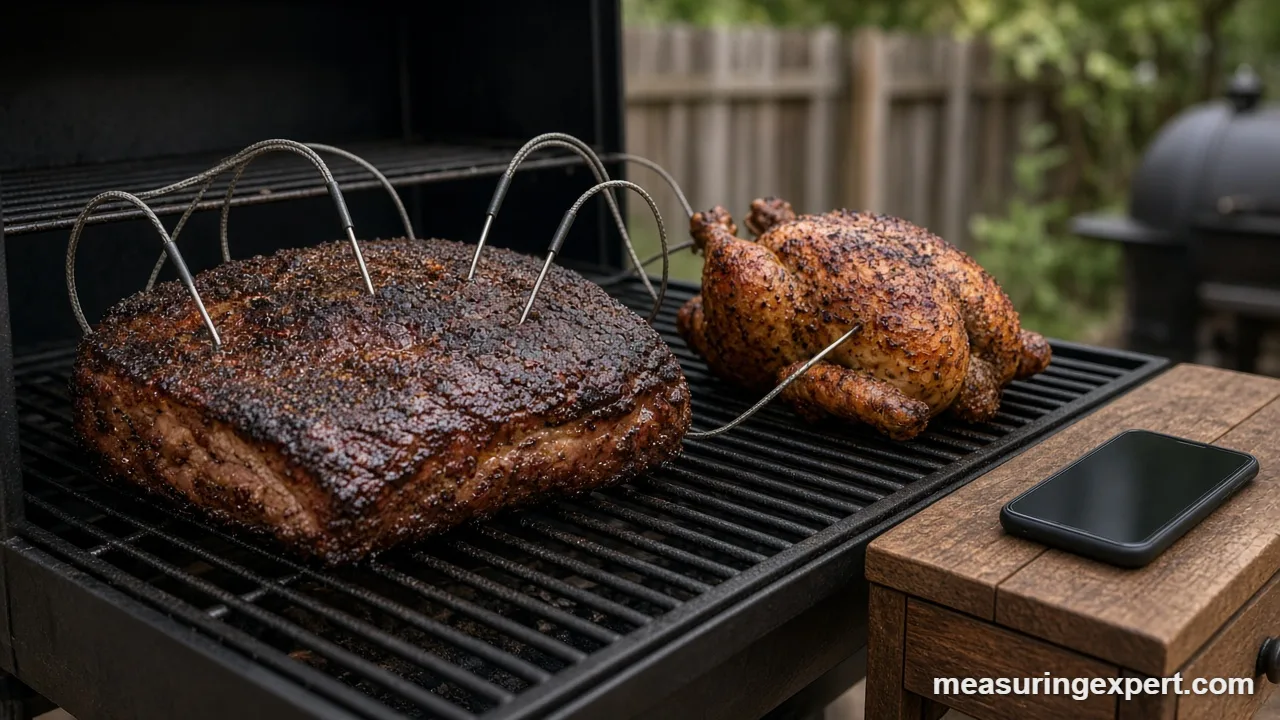
Accuracy: First, accuracy is how close the reading is to the true temperature. For example, plus or minus 1.8 F means a true 145 F could read anywhere from 143.2 to 146.8 F. Also, check the band: ThermoWorks quotes its tightest figure only from -4 to 248 F, and the error widens above that.
Resolution: Next, resolution is the smallest step the display shows, such as 0.1 or 1 degree. Finer resolution helps you see trends, like a brisket stall. However, it does not make the sensor more accurate.
Range and probe ratings: Also, the display range and the probe rating are not the same thing. For instance, the IBT-4XS reads to 572 F for short spells but 482 F continuously. Therefore, compare the continuous rating with your cooker temperature, and keep cables out of direct flame.
Channels and probe type: Penetration probes go into food, while ambient or air probes clip to the grate. For example, a good setup for a smoker is one air probe plus one probe per large cut. In short, four channels cover most backyard cooks.
Wireless range: Makers quote open-air Bluetooth ranges, but walls, steel and your own body block the signal. As a result, real range indoors is often a fraction of the box figure.
USDA Targets for Your Best Bluetooth Food Thermometer
Of course, your thermometer is only as useful as the target you set. These are the safe minimum internal temperatures from the USDA FSIS safe temperature chart, also published at FoodSafety.gov.
| Food | Safe minimum | Rest time |
|---|---|---|
| Beef, pork, veal and lamb steaks, chops, roasts | 145 F (62.8 C) | 3 minutes |
| Fresh or smoked uncooked ham | 145 F (62.8 C) | 3 minutes |
| Ground meats | 160 F (71.1 C) | None |
| All poultry, including ground poultry and stuffing | 165 F (73.9 C) | None |
| Egg dishes | 160 F (71.1 C) | None |
| Fish and shellfish | 145 F (62.8 C) | None |
| Leftovers and casseroles | 165 F (73.9 C) | None |
| Fully cooked ham, reheated (USDA-inspected plant) | 140 F (60 C) | None |
Note that these are safety minimums, not doneness goals. For example, a pulled pork shoulder is safe at 145 F, yet most pitmasters take it near 200 F so the collagen breaks down. So if your app or recipe uses Celsius, convert the numbers below. For oven settings, our Fahrenheit to Celsius baking chart helps too.
How to Set Up Your Best Bluetooth Food Thermometer
A good hub still gives bad numbers if the probe sits in the wrong place. So follow these steps on every cook.
- Charge and pair. First, charge the hub fully, install the app and pair it before the meat goes on. Also, set your Fahrenheit or Celsius preference.
- Check accuracy in ice water. Next, dip each probe in a stirred ice bath and confirm it reads close to 32 F (0 C). Note or calibrate any offset.
- Place the meat probe. Insert the probe from the side into the thickest part of the cut, with the tip at the center and away from bone, fat and gristle.
- Clip the air probe at grate level. Then clip the ambient probe a few inches from the meat at grate height, because that is the heat the food actually feels.
- Route the cables safely. Run each cable through a gap or vent and away from flames, and do not kink it under a tight lid.
- Set targets and alarms. Pick a USDA safe minimum or your preferred doneness, set a pre-alarm a few degrees early, and add a high and low alarm for the pit.
- Confirm and rest. Finally, when the alarm sounds, confirm with a quick instant-read in a second spot, then rest whole cuts for at least 3 minutes.
For more on placement in thin and thick foods, see our guide on how to use a digital thermometer for cooking.
Keep Your Readings Honest: Calibration and Care
Thermistor probes are stable, but heat, drops and moisture can shift them. Therefore, check each probe a few times a season.
- Ice point: a stirred slurry of crushed ice and water sits at 32 F (0 C). In fact, it is the most reliable home reference.
- Boiling point: water boils at 212 F (100 C) only at sea level. At altitude, it boils lower, about 1 F less per 500 ft of elevation, so use the ice bath when you can.
- Compare probes: put all probes in the same glass. If one reads 3 F away from the rest, replace it.
- Calibrate in the app: the INKBIRD IHT-2PB and several hubs let you set an offset. Otherwise, write the offset on a piece of tape on the hub.
Also, coil cables loosely in large loops. Otherwise, tight kinks break the fine wires inside, and the probe then reads high, low or not at all. For heavy use, our best temperature probe guide covers sturdier replacement options.
Smart Habits and Common Mistakes
Overall, small habits make a big difference in the numbers you see.
Where Bluetooth Thermometers Fall Short
- Range claims are best case. So expect much less through walls and grill steel.
- Wi-Fi is mostly 2.4 GHz. Therefore, mesh or 5 GHz-only networks can cause setup trouble.
- Accuracy is not the same at every temperature. In fact, most makers quote their best figure for the food range only.
- Probes are consumables. Budget for a spare, because cables wear out long before the hub.
Best Bluetooth Food Thermometer FAQ
What is the best Bluetooth food thermometer overall?
Our pick for the best Bluetooth food thermometer is the ThermoWorks Signals. It has four channels, Wi-Fi plus Bluetooth, and a published accuracy of plus or minus 1.8 F in the meat range. On a budget, the TempPro TP25 is the better value.
Is a Bluetooth thermometer different from a wireless meat thermometer?
Yes. For example, a Bluetooth hub like these uses probes on heat-proof cables plugged into a base. A truly wireless thermometer puts the battery and radio inside the probe itself. As a result, wired probes cost less per channel and handle long smokes well.
How far does the best Bluetooth food thermometer reach from a grill?
Overall, makers quote open-air ranges from about 95 ft to 650 ft. However, walls, metal grills and lids cut that a lot. So if you want alerts from anywhere, choose a model with Wi-Fi as well.
How accurate should a food thermometer be?
Above all, aim for plus or minus 2 F (about 1 C) or better in the 32 to 212 F band. All seven picks here meet that on paper, and the INKBIRD IHT-2PB claims plus or minus 1 F.
Can I close the grill lid on a probe cable?
Usually, yes, because these cables are made to pass under a lid or door. Still, keep the cable away from direct flame and check the maker’s heat rating, because the cable can fail before the probe tip does.
What temperature is safe for chicken?
USDA FSIS lists 165 F (73.9 C) for all poultry, including ground poultry and stuffing. Also, measure in the thickest part of the breast and the inner thigh, away from bone.
How do I test the accuracy of my thermometer?
First, use an ice bath. Fill a glass with crushed ice, add cold water, stir and wait a few minutes. Then the probe should read 32 F (0 C). If it is off, use the app or device calibration, or note the offset.
Does the best Bluetooth food thermometer need Wi-Fi?
No. In fact, Bluetooth alone works within range of your phone. Wi-Fi adds remote alerts from anywhere, but it needs a 2.4 GHz network for most models, including Signals and Govee.
Why does my probe read high at the start of a cook?
The tip may sit near the surface, touch bone, or sit in a hot spot. So push it into the thickest part, through the side of the cut, and check it again with a second probe or an instant-read.
How long do thermometer probes last?
In general, probes wear out faster than hubs, mostly from heat, kinked cables and water in the jack. Never submerge a probe jack, coil the cable loosely, and replace any probe that reads wrong in an ice bath.
Bottom Line: Our Best Bluetooth Food Thermometer Pick
The ThermoWorks Signals is the best Bluetooth food thermometer for most cooks, because it pairs four channels and tight published accuracy with Wi-Fi backup and a hub that works on its own. If you want four probes for less, choose the TempPro TP25. And if price matters most, the INKBIRD IBT-4XS still covers the basics.
1 thought on “7 Best Bluetooth Food Thermometer Picks for 2026: Wired-Probe Hubs and App Instant-Reads”