

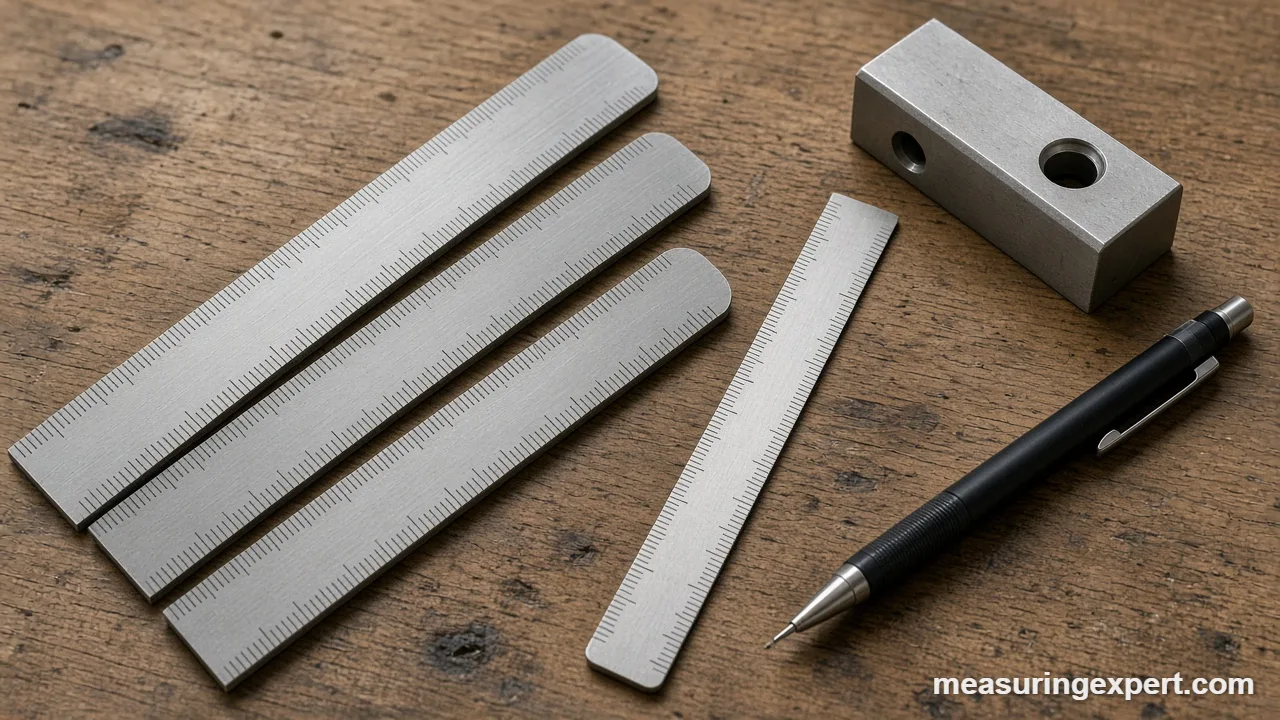
The best precision ruler for most people is the Starrett 6-inch spring-tempered steel rule, because its 4R scale reads down to 1/64 inch on a blade that stays flat. Your choice depends on the units you use, the finest graduation you need, and whether you want a hook, a flexible blade or a long rule.
In short: get the Starrett 4R rule for inch work, the Mitutoyo 182-105 for inch plus metric, and the Mr. Pen 4-pack if you want several lengths on a budget.
As an Amazon Associate, Measuring Expert earns from qualifying purchases. Our picks are based on research, specifications and owner feedback, not paid placement.
Best Overall
Best Budget


Quick Answer: The Best Precision Ruler for Each Job
- Overall: Starrett 6-inch 4R rule, with marks down to 1/64 inch.
- Inch plus metric: Mitutoyo 182-105, with 1/64 in and 0.5 mm scales and a published tolerance.
- Metric only: Shinwa H101-C, a 300 mm zero-glare rule.
- Measuring from an edge: PEC 402-H12 adjustable hook rule.
- Curved parts and decimal inches: PEC 6-inch flexible 5R rule with 1/100-inch marks.
- Marking points: INCRA metric marking rule with holes every 1/4 mm.
- Panels and sheet goods: Woodpeckers 36-inch rule; on a budget, the Mr. Pen 4-pack.
On This Page
- Comparison table
- The 8 picks, reviewed
- How we chose
- Reading fine graduations
- Rigid, flexible, hook and end-reading
- Accuracy classes
- Length converter
- How to read a rule
- Care and checking
- Do and don’t
- Honest limits
- FAQ
- Bottom line
Best Precision Ruler Picks Side by Side
| # | Product | Best For | Standout Feature | Amazon |
|---|---|---|---|---|
| 1 | Starrett 6-inch 4R rule | Most inch-based shop and craft work | 4R graduations down to 1/64 inch on a spring-tempered blade | View |
| 2 | Mitutoyo 182-105 | Mixed inch and metric drawings | 1/32, 1/64, 1 mm and 0.5 mm scales with a published tolerance | View |
| 3 | Shinwa H101-C 300 mm | Metric-only work | Zero-glare satin chrome on a 300 mm rigid blade | View |
| 4 | PEC 402-H12 hook rule | Measuring from an edge or shoulder | Adjustable hook on a 12-inch 4R blade | View |
| 5 | PEC 6-inch flexible 5R | Curves and decimal-inch drawings | Flexible blade with 1/100-inch and 1/64-inch scales | View |
| 6 | INCRA metric marking rule | Marking points without parallax | Marking holes every 1/4 mm for a 0.5 mm pencil | View |
| 7 | Woodpeckers 36-inch rule | Panels and sheet goods | Left-to-right and right-to-left scales with 30-degree beveled edges | View |
| 8 | Mr. Pen 4-Pack | Low-cost set of four lengths | Four lengths (6, 8, 12 and 14 in) with 1/64 in and 0.5 mm marks | View |
The 8 Best Precision Rulers, Reviewed
First, each pick below lists the graduations, length and build we could confirm from maker or distributor pages. We also note who should skip it, because no single rule suits every job. In addition, we compare these steel rules with our guides to the best meter ruler and the best T-square ruler for longer layout jobs.
Best Overall
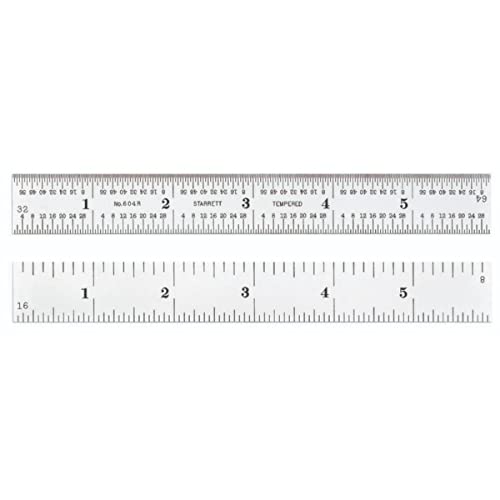
1. Starrett 6-Inch Spring-Tempered Steel Rule (4R)
Best for: Machinists, woodworkers and model makers who want a trusted inch rule, especially one with 1/64-inch marks.
The Starrett 6-inch spring-tempered rule is our pick for the best precision ruler for most inch-based work. For example, it carries the classic Starrett 4R pattern, so you get 8ths, 16ths, quick-reading 32nds and 64ths on one blade. Because the blade is spring-tempered, it springs back flat after a light bend instead of taking a set.
Also, the 6-inch length fits a shirt pocket or an apron. Starrett makes these rules in Athol, Massachusetts, and the 4R style is the pattern many shop teachers still use to teach fractional reading. However, there is no metric scale, so metric work needs a second rule.
- Length: 6 in (152.4 mm)
- Graduations: 4R, with 8ths, 16ths, quick-reading 32nds and 64ths
- Thickness: 3/64 in (about 1.2 mm)
- Material: spring-tempered steel, made in the USA
Pros
- Fine 1/64-inch marks that stay crisp
- Flat, springy blade resists kinks
- Fits a pocket or apron
Cons
- Inch only, with no metric scale
- 64ths are hard to read without magnification
- No published length tolerance on the listing
Skip it if: You work mostly in millimeters; instead, the Mitutoyo or Shinwa rule suits you better.
Best Inch + Metric
2. Mitutoyo 182-105 Rigid Steel Rule, 6 in / 150 mm
Best for: Engineers, inspectors and hobbyists who switch between inch and metric drawings, often on the same job.
Specifically, the Mitutoyo 182-105 is a wide, rigid 150 mm (6 in) rule with four scales: 1/32 in, 1/64 in, 1 mm and 0.5 mm. So one blade covers both unit systems, which saves a lot of conversion on mixed drawings. Its satin-chrome finish also cuts glare under shop lights.
In addition, it is one of the few rules in this list with a published length tolerance. For instance, a Mitutoyo distributor lists +0.004 in / -0.0035 in (+0.1 mm / -0.09 mm). That is close to the width of one 0.5 mm graduation line, so it is good enough for layout and inspection of non-critical parts.
- Range: 0 to 150 mm (6 in)
- Graduations: 1/32 in, 1/64 in, 1 mm and 0.5 mm
- Width: 3/4 in (19 mm); rigid tempered stainless steel
- Listed accuracy: +0.1 mm / -0.09 mm
Pros
- Inch and metric scales on one rule
- Published accuracy figure
- Satin chrome resists glare
Cons
- Rigid blade will not follow curves
- Only 6 in long
- Costs more than budget sets, however good it is
Skip it if: You need a long rule for panels or sheet goods; in that case, a 36-inch rule is a better fit.
Best Metric
3. Shinwa H101-C 300 mm Rigid Zero Glare Metric Rule

Best for: Metric machinists, Japanese-style woodworkers and anyone who mainly reads in millimeters.
Shinwa is a Japanese rule maker, and the H101-C is its 300 mm rigid stainless rule with a zero-glare satin chrome finish. The metric-only layout keeps the face clean, so the millimeter and half-millimeter lines are easy to count. In addition, a 300 mm length covers most bench parts in one pass.
Shinwa sells its stainless rules as made to the Japanese standard JIS B 7516, which sets material, hardness and length tolerance. Therefore, it is a good choice for anyone who wants a standards-backed metric reference at a modest cost.
- Length: 300 mm (about 11.8 in)
- Scale: metric, mm and 0.5 mm
- Finish: zero-glare satin chrome on stainless steel
- Blade: rigid, for straight-line layout
Pros
- Clean metric face is quick to read
- Low-glare finish
- Long enough for most bench parts
Cons
- No inch scale, so inch users need a second rule
- Rigid blade cannot bend around work
- Grade is not printed on the listing
Skip it if: Your plans are in inches; in that case, choose the Starrett or the Mitutoyo instead.
Best Hook Rule
4. PEC Tools 402-H12 12-Inch Adjustable Hook Rule (4R)

Best for: Machinists and cabinetmakers who measure from an edge, shoulder or inside a recess.
A hook rule puts a small stop at the zero end. Then you hook it over an edge, and the reading starts exactly at that edge instead of where your eye guesses it is. The PEC 402-H12 adds an adjustable hook on a 12-inch blade, so you can measure from deep or shallow shoulders as well as from an outside edge.
Also, the blade is hardened and tempered tool steel with a non-glare hard chrome finish and 4R graduations down to 1/64 inch. PEC also makes it in the USA. However, the hook adds a part that can loosen, so check it against a known length now and then.
- Length: 12 in (304.8 mm), 1 in wide
- Graduations: 4R (8ths, 16ths, 32nds, 64ths)
- Thickness: 0.040 in (about 1 mm)
- Hardened tool steel, hard chrome non-glare finish, made in the USA
Pros
- Reads from an edge without guesswork
- Hook adjusts for shoulders and recesses
- Non-glare finish, so less eye strain
Cons
- Inch only
- The hook must be checked for zero
- Too long for a shirt pocket, unlike 6-inch rules
Skip it if: You mostly measure flat stock away from edges, because a plain rule is simpler.
Best Flexible
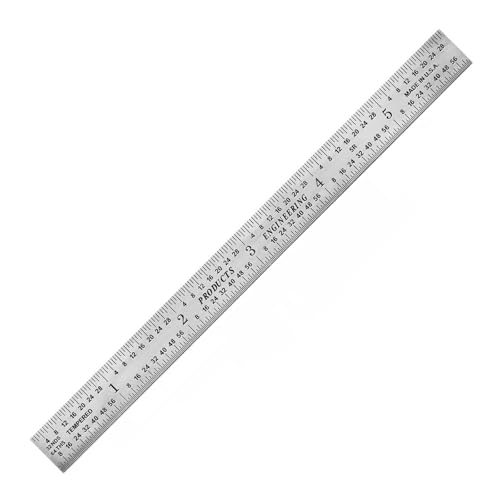
5. PEC Tools 6-Inch Flexible Steel Rule (5R)
Best for: Measuring along curved parts, pipes and molded shapes, or reading decimal inches.
A flexible rule bends around a curved surface, so you can measure along an arc instead of across it. The PEC 6-inch flexible rule uses the 5R pattern: 32nds and 64ths on one side, plus 10ths and 100ths of an inch on the other. As a result, it reads decimal drawings directly, which fractional rules cannot do.
In addition, the thin blade slips into tight spaces where a rigid rule will not fit. PEC also builds it in the USA. However, a flexible blade is not a straightedge, so do not use it to scribe long lines.
- Length: 6 in (152.4 mm)
- Graduations: 5R, with 32nds, 64ths, 10ths and 100ths of an inch
- Blade: flexible hardened steel
- Made in the USA
Pros
- Reads 1/100 inch for decimal drawings
- Bends around curved work
- Thin enough for tight gaps
Cons
- Not a straightedge, because it flexes
- Inch only
- 1/100-inch lines need good light
Skip it if: You need metric marks or, similarly, a stiff edge for scribing.
Best for Layout
6. INCRA Precision Marking Rule, Metric 150 mm

Best for: Woodworkers and model makers who need to mark points, not just read them.
By contrast, the INCRA marking rule takes a different approach. Instead of reading a line by eye, you drop a 0.5 mm mechanical pencil into a hole and mark through it. INCRA spaces the holes every 1/4 mm on the metric version, so the mark lands where the hole is, with no parallax from viewing the scale at an angle.
As a result, it is a strong choice for repeated layout, such as hinge or dowel positions. However, it is a marking tool first; reading an existing part is slower than with a plain rule.
- Length: 150 mm (about 5.9 in)
- Marking holes every 1/4 mm
- Designed for a 0.5 mm mechanical pencil (sold separately)
- Thin steel rule
Pros
- Removes parallax when marking, unlike line scales
- Very fine 1/4 mm steps
- Great for repeat layout, such as hinges
Cons
- Also needs a 0.5 mm pencil
- Slower for simple reading
- Short 150 mm length
Skip it if: You mostly read sizes off parts rather than mark new points, since reading is faster on a plain rule.
Best Long Rule
7. Woodpeckers 36-Inch Woodworking Rule

Best for: Woodworkers who measure panels, cabinet parts and sheet goods.
Long precision rules are rare, and the Woodpeckers 36-inch rule fills that gap. First, it has a left-to-right scale on one side and a right-to-left scale on the other, so you can read from either end of a panel. Second, both edges are beveled at 30 degrees, which puts the scale lines close to the work and cuts parallax.
Also, Woodpeckers makes it from anodized aircraft-grade aluminum in Ohio, with laser-engraved scales and finger grooves in the middle. Because it is aluminum rather than steel, it is light, but it can dent if dropped on a corner.
- Length: 36 in (91.44 cm)
- Scales: left-to-right and right-to-left, laser engraved
- Edges: beveled 30 degrees on both sides
- Anodized aluminum, made in Strongsville, Ohio
Pros
- Reads from either end, so no flipping
- Beveled edges reduce parallax
- Also light for its length
Cons
- Aluminum can dent, unlike steel
- Inch only
- Large to store, so it needs a wall hook
Skip it if: You work on small parts; instead, a 6 or 12-inch steel rule is easier to handle.
Best Budget
8. Mr. Pen Machinist Ruler Set, 4 Pack
Best for: Students, crafters and new shop users who want several lengths at a low cost.
The Mr. Pen set gives you four stainless rules: 6, 8, 12 and 14 inches. For example, one side reads 1/64 and 1/32 inch, and the other reads millimeters and half millimeters. So you get fine graduations in both systems for the price of a single premium rule.
However, Mr. Pen does not publish a length tolerance. Therefore, check one rule against a trusted reference before you use it for close work. Still, for drafting, crafts and general shop use, it is a practical starter kit.
- Lengths: 6, 8, 12 and 14 in (152, 203, 305 and 356 mm)
- Graduations: 1/64 and 1/32 in on one side; mm and 0.5 mm on the other
- Thickness: 0.035 in (about 0.9 mm)
- Scales start at zero on the end
Pros
- Four lengths in one set
- Inch and metric fine marks
- Therefore, a low cost per rule
Cons
- No published accuracy
- Thinner than shop-grade rules
- Finish can show glare
Skip it if: You need a traceable reference; in that case, buy a Starrett or Mitutoyo instead.
How We Chose the Best Precision Ruler Picks
We did not run hands-on tests. Instead, this list comes from research. First, we read maker and distributor spec pages from Starrett, Mitutoyo, Shinwa, PEC, INCRA, Woodpeckers and Mr. Pen. Next, we compared owner feedback for patterns such as worn ends, faint lines and glare. Finally, we checked that each rule is still listed and that its product card works.
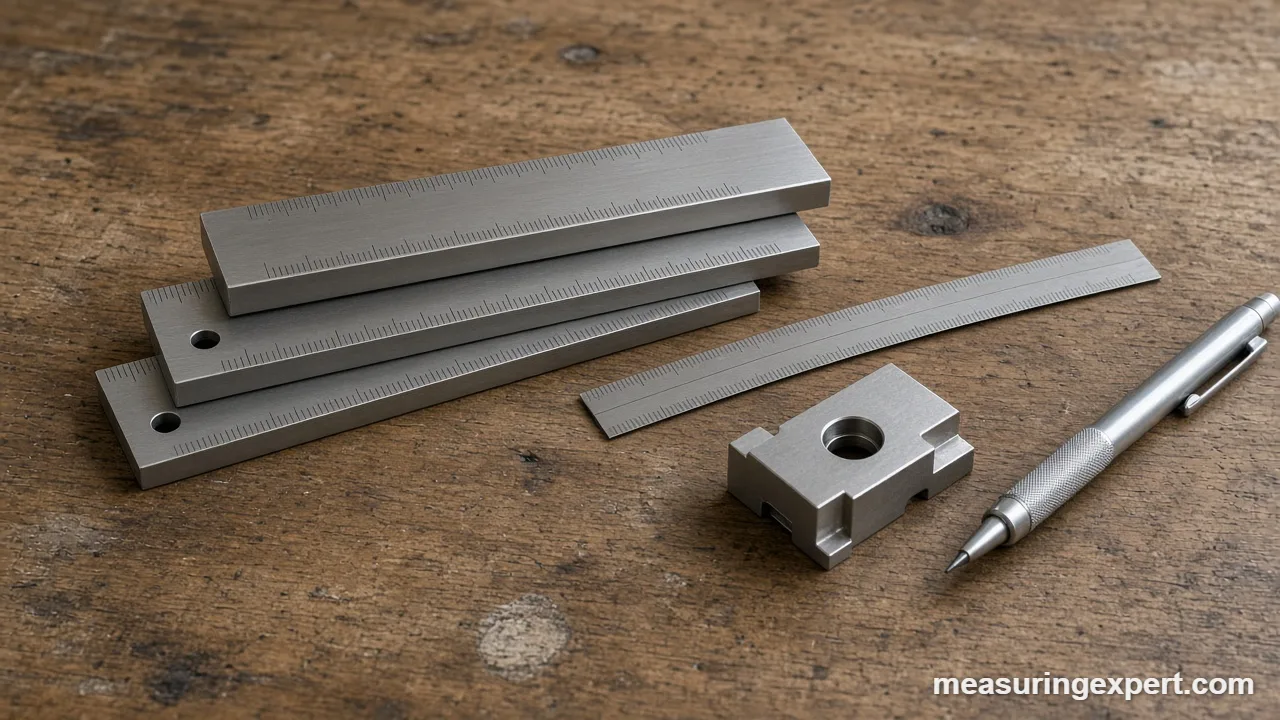
In addition, every pick had to meet these rules:
- Fine graduations: at least 1/64 inch, 1/100 inch or 0.5 mm, or marking holes at an equal or finer step.
- Clear construction: steel or anodized aluminum with engraved or laser-marked lines, not printed plastic.
- A distinct job: overall, metric, hook, flexible, marking, long or budget, with no near-duplicates, so each pick earns its place.
- Brand limit: two models per brand at most, for more variety.
- No overlap: rules from our tape and meter-stick guides stay in those guides.
For unit definitions, we used the NIST page on SI units of length, which confirms that 1 inch is exactly 25.4 mm.
Reading Fine Graduations on the Best Precision Ruler
In general, the finest line on a rule sets how small a step you can read. However, finer is not always better, because tiny marks blur together without good light. So match the graduation to your drawings. If you want a refresher on fractions and metric scales first, see our guide on how to measure length.
| Graduation | Step in inches | Step in mm | Typical use |
|---|---|---|---|
| 1/32 in | 0.03125 | 0.794 | General woodworking and layout |
| 1/64 in | 0.015625 | 0.397 | Machining, fine joinery, model making |
| 1/100 in | 0.01 | 0.254 | Decimal-inch drawings, sheet metal |
| 0.5 mm | 0.0197 | 0.5 | Metric machining and drafting |
| 1 mm | 0.0394 | 1.0 | General metric work |
Rule makers also use short codes for their scale sets. For example, Starrett and PEC call 8ths, 16ths, 32nds and 64ths a 4R pattern. Similarly, PEC calls 32nds, 64ths, 10ths and 100ths a 5R pattern. However, these codes are not universal, so read the listing before you buy.
Rigid, Flexible, Hook or End-Reading: Which Precision Ruler Type?
Similarly, the blade style matters as much as the scale. Also, each style solves a different problem, so many shops own two or three.
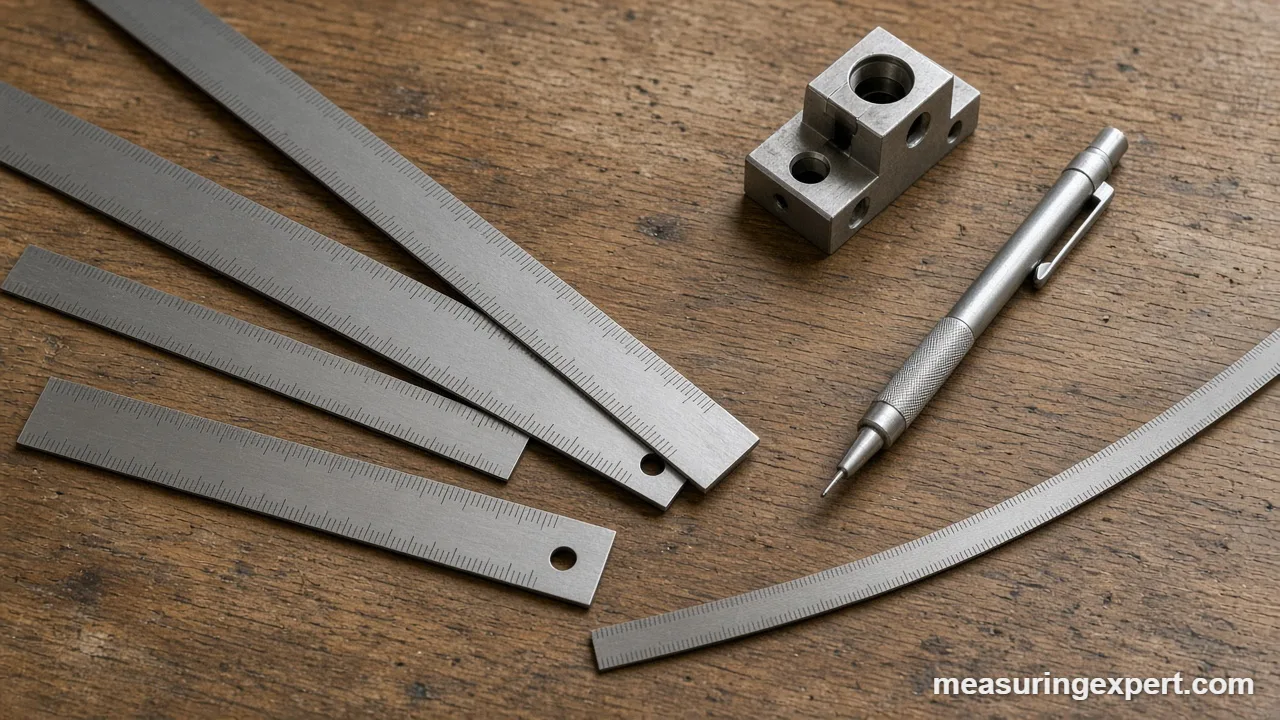
| Type | Strength | Weakness | Pick from this list |
|---|---|---|---|
| Rigid | Works as a straightedge and stays put | Cannot follow curves | Mitutoyo 182-105, Shinwa H101-C |
| Spring-tempered | Flexes a little and springs back flat | Not as stiff as a rigid rule | Starrett 4R rule |
| Flexible | Bends around pipes and curved parts | Poor for scribing lines | PEC 6-inch 5R |
| Hook rule | Zero sits exactly at an edge | Hook must be checked | PEC 402-H12 |
| Marking rule | Pencil holes remove parallax | Slower for reading | INCRA metric |
An end-reading rule has scales that start right at the end of the blade, so you can butt it against a wall or a shoulder. However, any rule end wears with use. As a result, many machinists start at the 1-inch or 10 mm line and subtract it, which avoids the worn end. Alternatively, a hook rule fixes this, because the hook sets the zero for you.
Accuracy Classes for a Precision Ruler
Surprisingly, most rule listings never state a tolerance. However, two standards help you judge what is possible. First, the Japanese standard JIS B 7516 covers metal rules, and Shinwa sells its stainless rules as made to it. Second, the EU Measuring Instruments Directive sets three accuracy classes for material measures of length, such as rules and tapes used in trade.
Under that directive, the maximum permissible error is a + bL in mm, where L is the length rounded up to the next whole meter. The directive’s Annex X sets a and b for each class. As a result, any rule up to 1 m long gets these limits:
| Class | Formula | Rule up to 1 m | Rule up to 2 m |
|---|---|---|---|
| Class I | 0.1 + 0.1L mm | +/-0.2 mm (0.008 in) | +/-0.3 mm (0.012 in) |
| Class II | 0.3 + 0.2L mm | +/-0.5 mm (0.020 in) | +/-0.7 mm (0.028 in) |
| Class III | 0.6 + 0.4L mm | +/-1.0 mm (0.039 in) | +/-1.4 mm (0.055 in) |
For comparison, the Mitutoyo 182-105 is listed at +0.1 mm / -0.09 mm over 150 mm, which is tighter than Class I. In other words, a good machinist rule is usually more accurate than your eye can read.
Length Converter for Ruler Readings
Many drawings mix units, so convert your reading below. The converter uses the exact definition of 1 inch = 25.4 mm. For a quick sense of scale, see our page on how long 6 inches is, the length of a pocket rule.
How to Read a Precision Ruler Without Parallax
In short, parallax is the error you get when your eye is not directly above the mark. It can easily cost you a full 1/64-inch line, so follow these steps:
- First, clean the rule and the part so dust and burrs do not lift the blade.
- Next, lay the rule on its edge so the graduations touch the work, rather than flat with the marks in the air.
- Then align a whole-number line, not the worn end, with the start of the part if you need the best accuracy.
- After that, look straight down at the mark, with your eye directly above it, to avoid parallax.
- Now read the nearest graduation and subtract the starting line if you did not begin at zero.
- Finally, measure twice from opposite ends and average the two readings if they differ.
Keeping Your Best Precision Ruler Accurate
Fortunately, a steel rule needs little care, and a few habits keep it true for decades. First, wipe it after use, because sweat and coolant can stain the finish and fill the engraved lines. Next, store it flat or hanging, and never under heavy tools that can bend it. Also, a light coat of oil helps carbon-steel rules in damp shops.
Besides that, check your rule now and then against a trusted reference. For example, compare a cheap rule with a Starrett or Mitutoyo at several points, not just at the end. If the end is worn or rounded, start measuring from the 1-inch or 10 mm line instead. In addition, keep rules at room temperature before you use them for close work, because ISO 1 sets 20 C (68 F) as the standard reference temperature for length.
Precision Ruler Do and Don’t
Honest Limits of Any Precision Ruler
Even the best precision ruler has limits. First, your eye usually cannot resolve much better than about 0.25 mm (0.01 in) on a scale, so a finer rule will not help much below that. Second, a rule measures between two lines that you choose, and that choice adds error. Therefore, for tolerances tighter than about 0.1 mm (0.004 in), use a caliper or a micrometer instead.
Also, most budget rules list no tolerance at all. So treat any rule without a published figure as a layout tool, not an inspection tool. For quick measurements of larger spaces, a tape is still the faster choice; see our guide to the best tape ruler.
Best Precision Ruler FAQ
What is the best precision ruler for most people?
For most inch-based work, the best precision ruler is the Starrett 6-inch spring-tempered rule with 4R graduations down to 1/64 inch. If you also need metric, the Mitutoyo 182-105 carries 1/32 in, 1/64 in, 1 mm and 0.5 mm scales on one blade.
How accurate is a steel ruler?
In general, a good steel rule is accurate to about 0.1 mm over 150 mm. For example, a Mitutoyo distributor lists +0.1 mm / -0.09 mm for the 182-105. In practice, your eye limits you more than the rule, so most people read to about 0.25 to 0.5 mm.
What does 4R mean on a Starrett rule?
In short, 4R is a graduation code. On Starrett and PEC rules, it means the blade carries 8ths, 16ths, 32nds and 64ths of an inch, with the 32nds set up for quick reading.
What does 5R mean on a ruler?
On PEC rules, 5R means 32nds and 64ths of an inch plus 10ths and 100ths of an inch. So one blade reads both fractional and decimal inch drawings.
Is a hook rule better than a regular rule?
A hook rule is better when you measure from an edge, because the hook sets zero exactly at that edge. However, a plain rule is simpler for flat layout, and the hook must be checked now and then to make sure it still reads zero.
Is the best precision ruler flexible or rigid?
It depends on the job. Choose rigid for straight lines and scribing, because it acts as a straightedge. Instead, choose flexible for curved parts, pipes and tight gaps. That is why many shops keep one of each.
Is the best precision ruler made of steel or aluminum?
For fine marks, stainless or tempered steel is usually best, because steel holds sharp engraved lines and resists wear. By contrast, aluminum suits long rules, such as 36-inch woodworking rules, because it is lighter.
What is JIS B 7516?
JIS B 7516 is the Japanese Industrial Standard for metal rules. It covers material, hardness and length tolerance, and Shinwa sells its stainless rules as made to it.
How small can I measure with the best precision ruler?
Most precision rules have 1/64 inch (0.397 mm), 1/100 inch (0.254 mm) or 0.5 mm graduations. For anything finer, however, switch to a caliper or a micrometer.
How do I check if my ruler is accurate?
Compare it with a reference you trust, such as a calibrated rule or gauge blocks, at room temperature. Then line up the zero ends and check several points along the length, not just the end.
Bottom Line on the Best Precision Ruler
For most buyers, the Starrett 6-Inch Spring-Tempered Steel Rule (4R) is the best precision ruler. Above all, it reads to 1/64 inch, stays flat and fits in a pocket. However, choose the Mitutoyo 182-105 if you need inch and metric on one blade, or the PEC hook rule if you measure from edges all day.