

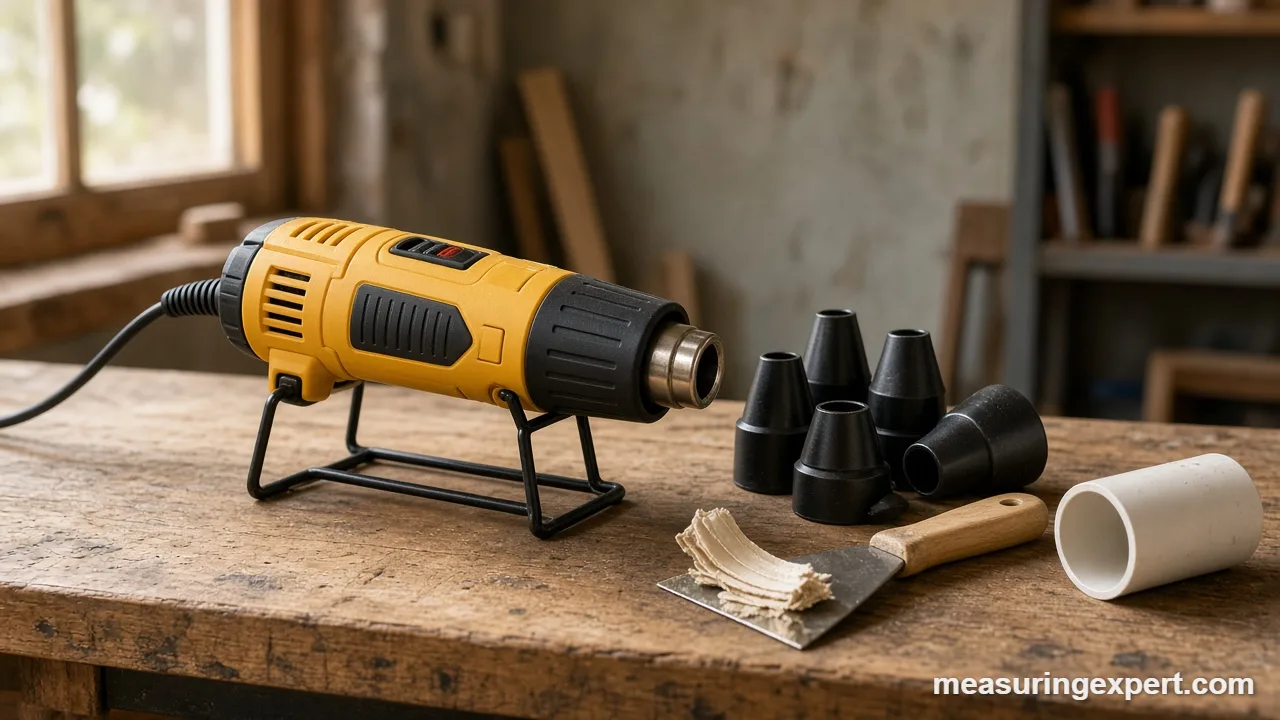
The best heat gun for most people is the DEWALT D26960K, because its LCD lets you set the temperature from 150 to 1100 F in 50 degree steps. What decides your pick is control: a digital readout for repeatable heat, a dial for quick jobs, or a battery tool for work far from an outlet.
In short: DEWALT D26960K overall, Wagner Furno 500 for a budget digital screen, DEWALT DCE530B cordless and Genesis GHG1500A on a tight budget.
As an Amazon Associate, Measuring Expert earns from qualifying purchases. Our picks are based on research, specifications and owner feedback, not paid placement.
Best Overall
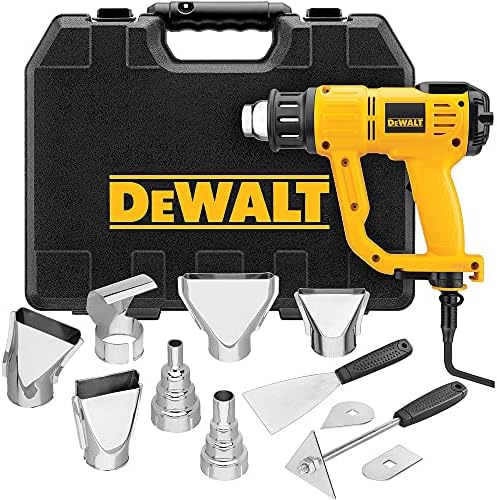
Best Budget
Best Cordless

Quick Answer: Which Hot-Air Tool Fits Your Job?
- Most control for the money: DEWALT D26960K, LCD set in 50 F steps.
- Digital screen on a smaller budget: Wagner Furno 500 with 12 heat settings.
- No outlet nearby: DEWALT DCE530B on a 20V battery.
- Simple dial, wide range: CRAFTSMAN CMEE531, 120 to 1200 F.
- Kit with a carry case: SEEKONE 1800W kit with two heat modes.
- Cheapest useful option: Genesis GHG1500A, two fixed heats and a nozzle set.
- Two heats, light and plain: Wagner HT1000.
On This Page
- Comparison table
- Reviews of each pick
- How we chose
- Specs that matter
- Temperature by job
- How to use one
- F to C converter
- Safety rules
- Honest limits
- FAQ
- Bottom line
One quick note on names. Some shoppers say “heat gun” when they mean a pistol-shaped infrared thermometer that reads surface temperature. However, this guide covers hot-air guns that blow heated air. If you want to measure how hot a surface is, see our infrared surface thermometer picks instead.
Best Heat Gun Comparison Table
First, find your job in the Best For column. After that, jump to the full review for the verified temperature range, airflow and features.
| # | Product | Best For | Standout Feature | Amazon |
|---|---|---|---|---|
| 1 | DEWALT D26960K | Repeatable heat for pros and DIYers | LCD, 150-1100 F in 50 F steps, 8.8-17.7 CFM | View |
| 2 | Wagner Furno 500 | Digital control on a budget | LED screen, 150-1200 F, 12 heat settings | View |
| 3 | DEWALT DCE530B | Cordless work | Up to 990 F and 6.7 CFM on 20V power | View |
| 4 | CRAFTSMAN CMEE531 | Quick dial adjustments | Variable dial, 120-1200 F, two fan speeds | View |
| 5 | SEEKONE 1800W Kit | Crafts and a full kit | Two modes up to 1112 F (600 C), carry case | View |
| 6 | Genesis GHG1500A | Lowest cost | 572 F and 1000 F at 10 and 17 CFM | View |
| 7 | Wagner HT1000 | Simple two-heat tasks | 750 F and 1000 F switch in the handle | View |
The 7 Best Heat Gun Picks, Reviewed
First, we trimmed this list from ten to seven. In fact, three older picks were near-duplicate listings, so they added nothing new. Instead, each tool below covers a different need, from digital control to battery power. Also, every review states only specs we could confirm from the maker or a trusted distributor.
Best Overall
1. DEWALT D26960K with LCD Display Kit
Best for: Anyone who wants to set an exact temperature and get the same heat every time.
The D26960K is the measuring-minded pick here. Above all, its LCD shows the set temperature, and you move it in 50 F steps from 150 F to 1100 F. As a result, you can write down a setting that worked on one job and repeat it next week. For example, shrink tubing, vinyl wrap and paint softening each need very different heat, and a number on a screen beats guessing on a dial.
In addition, The Power Tool Store lists airflow at 8.8 to 17.7 CFM (about 249 to 501 L/min). Also, the motor draws 13 amps and 1550 watts, yet the gun weighs only 2.3 lb. Meanwhile, the DEWALT product page notes overload protection, a built-in kickstand and a hang ring. Finally, the kit box holds a cone nozzle, a fishtail surface nozzle and ten other accessories.
- Temperature: 150 to 1100 F (66 to 593 C), set in 50 F steps
- Airflow: 8.8 to 17.7 CFM (about 249 to 501 L/min)
- Power: 120V, 13 A, 1550 W
- LCD display; overload protection; kickstand and hang ring
- Weight 2.3 lb; hard kit box with cone, fishtail and ten more accessories
Pros
- Screen shows the set temperature
- Fine 50 F steps for repeat jobs
- Light for a corded pro tool
- Large accessory kit in a hard case
Cons
- Top setting stops at 1100 F
- Costs more than dial models
- Display shows the setting, not the surface
Skip it if: you only thaw a pipe twice a year; a two-heat gun does that for less.
Best Budget Digital
2. Wagner Spraytech Furno 500 Variable Temp

Best for: DIYers who want a screen and many settings without paying pro prices.
Similarly, the Furno 500 brings digital control to a lower price. Specifically, Wagner lists 12 temperature settings between 150 F and 1200 F, picked with push buttons and shown on a graphic LED screen. Also, two fan settings let you separate heat from air speed. So you can run low air at high heat for a small spot, or high air at low heat to dry a wide area.
Moreover, a cool-down mode blows cooler air before you set the tool down, which helps protect the element. In addition, the gun is rated at 1500 W, and an integrated stand lets it work hands-free. However, Wagner does not publish an airflow figure, so we cannot compare its CFM with the DEWALT.
- Temperature: 150 to 1200 F (66 to 649 C), 12 settings
- Two fan settings plus a cool-down mode
- Graphic LED screen with push-button controls
- 1500 W; integrated stand
- Includes glass protector and flare nozzles
Pros
- Screen and buttons at a mid price
- Reaches 1200 F for tough jobs
- Cool-down mode is a nice touch
Cons
- No published airflow rating
- Only two nozzles in the box
- Coarser steps than the DEWALT
Skip it if: you need a large accessory kit or a hard case.
Best Cordless
3. DEWALT DCE530B 20V MAX (Tool Only)
Best for: Electricians, mechanics and roof or boat work where no outlet sits nearby.
A battery heat gun trades raw power for freedom, and the DCE530B is a strong example. According to DEWALT, it reaches up to 990 F (532 C) and moves 6.7 CFM (about 190 L/min) at the nozzle on high. In other words, it has less air than a corded gun, so it heats small areas best. For instance, shrink tubing on a wire harness or a stuck bolt suits it well.
Also, a lock-on button allows hands-free running, and an LED light shows the work in dark spaces. Plus, the standard-size nozzle fits many corded attachments, and a flat and a hook nozzle come in the box. Overall, DEWALT quotes up to 42 minutes per charge. However, run time depends on the battery and setting, and the tool ships without one.
- Max output: 990 F (532 C); two temperature settings
- Airflow: 6.7 CFM at the nozzle on high
- 20V MAX battery (sold separately); up to 42 min per charge
- Lock-on button, LED work light
- Flat and hook nozzles; standard-size nozzle mount
Pros
- No cord to drag across a site
- Fits a common 20V battery system
- LED light for dark cabinets
Cons
- Battery and charger cost extra
- Lower airflow for big surfaces
- Only two heat levels, no display
Skip it if: you strip paint from whole doors; a corded gun keeps up better.
Best Variable Dial
4. CRAFTSMAN CMEE531 Corded Hot-Air Tool

Best for: Homeowners who like a turn dial and want a wide range for mixed jobs.
The CMEE531 uses a variable dial instead of a screen. First, CRAFTSMAN lists a range of 120 F to 1200 F, so it goes lower and higher than most two-heat guns. In addition, two fan speeds help you match air to the job. Because the dial has no numbers you can lock in, though, you set it by feel and by watching the material.
Next, the 1500 W element runs on a 6 ft cord, and an integrated stand holds the gun upright while it cools. On the other hand, CRAFTSMAN does not list airflow or nozzles, and the box contains just the gun. So budget for a nozzle set if you plan to shrink tubing or weld plastic.
- Temperature: 120 to 1200 F (49 to 649 C), variable dial
- Two fan speeds
- 1500 W; 6 ft cord
- Integrated support stand
Pros
- Very wide temperature range
- Fast dial changes mid-job
- Stand keeps the hot nozzle up
Cons
- No numeric readout
- No nozzles included
- No published airflow
Skip it if: you need to repeat an exact temperature.
Best Kit with Case
5. SEEKONE 1800W Kit with Carry Case
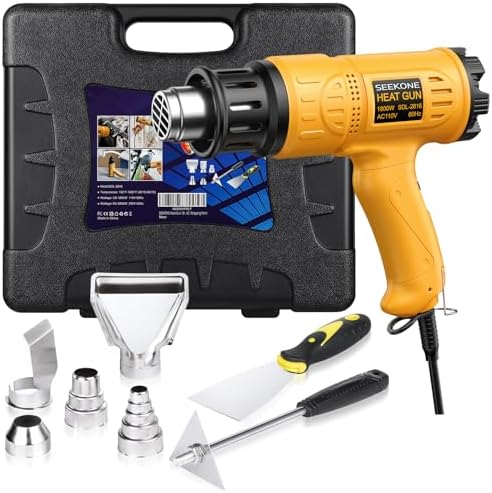
Best for: Crafters and DIYers who want variable heat, nozzles and a case in one box.
SEEKONE sells a popular 1800 W kit with two modes. For example, Mode I runs from about 120 F to 840 F (50 to 450 C), while Mode II climbs to 1112 F (600 C). Similarly, airflow changes with the mode: the listing gives about 190 to 210 L/min on low and 250 to 500 L/min on high. That is roughly 7 to 18 CFM, so it lands near the corded DEWALT on paper.
Besides, a built-in overload protector cuts the heater if it runs too hot, and the kit includes several nozzles and a carry case. However, the temperature knob has no numeric readout. Also, the seller’s listings disagree on the exact nozzle count, so check the current listing before you buy.
- Power: 1800 W
- Mode I: about 120-840 F (50-450 C); Mode II: up to 1112 F (600 C)
- Airflow: about 190-210 L/min low, 250-500 L/min high
- Overload protector; carry case and nozzle set
Pros
- High wattage for the price
- Variable heat in two ranges
- Case keeps nozzles together
Cons
- No temperature display
- Specs vary between listings
- Less support than big tool brands
Skip it if: you want a brand with a large service network.
Best Budget
6. Genesis GHG1500A Dual Temperature Kit
Best for: First-time buyers who need a heat gun for a few simple jobs.
By contrast, the GHG1500A keeps things simple with two fixed settings. On low it puts out about 572 F (300 C) at 10 CFM, and on high about 1000 F (538 C) at 17 CFM, per the HEP Sales spec sheet. In other words, low suits shrink wrap and drying, while high handles paint and stuck fittings.
Also, the motor draws 12.5 A at 120V and is rated at 750 or 1500 W. In addition, the kit adds two deflector nozzles, a reflector nozzle and an air reduction nozzle. As a result, you can spread heat across a pipe or focus it on a small spot. Still, two fixed heats limit fine work on thin plastics.
- Temperature: 572 F and 1000 F (300 and 538 C)
- Airflow: 10 CFM low, 17 CFM high
- Power: 120V, 12.5 A, 750/1500 W
- Nozzles: two deflector, one reflector, one air reduction
Pros
- Very low cost
- Published airflow on both settings
- Useful nozzle set included
Cons
- Only two fixed temperatures
- No stand or display
Skip it if: you work on vinyl, foam or electronics that need gentle, exact heat.
Best Simple Two-Heat
7. Wagner Spraytech HT1000

Best for: Light household tasks such as softening paint, bending PVC and loosening bolts.
Simply put, the HT1000 is a plain, light gun from a long-running paint tool brand. First, a switch in the handle picks 750 F (399 C) or 1000 F (538 C), and Wagner lists two fan speeds. Also, the nozzle resists corrosion, and a built-in hook lets you hang the gun on a pegboard.
However, Wagner does not publish wattage or airflow for this model. Likewise, there is no stand, and a concentrator nozzle is sold separately. So treat it as a simple backup tool, not a precision instrument.
- Temperature: 750 F and 1000 F (399 and 538 C)
- Two fan speeds via handle switch
- Corrosion-resistant nozzle
- Integrated hanging hook
Pros
- Light and easy to handle
- Simple two-position switch
- Hook for wall storage
Cons
- No airflow or wattage published
- No low setting under 750 F
- Extra nozzles cost more
Skip it if: you need low heat for crafts or shrink film.
How We Chose the Best Heat Gun
To be clear, we did not run hands-on lab tests. Instead, these picks come from research: manufacturer product pages, distributor spec sheets, and patterns in owner feedback. In addition, we confirmed that each listing still renders on Amazon and that each item is a complete tool, not a spare part.
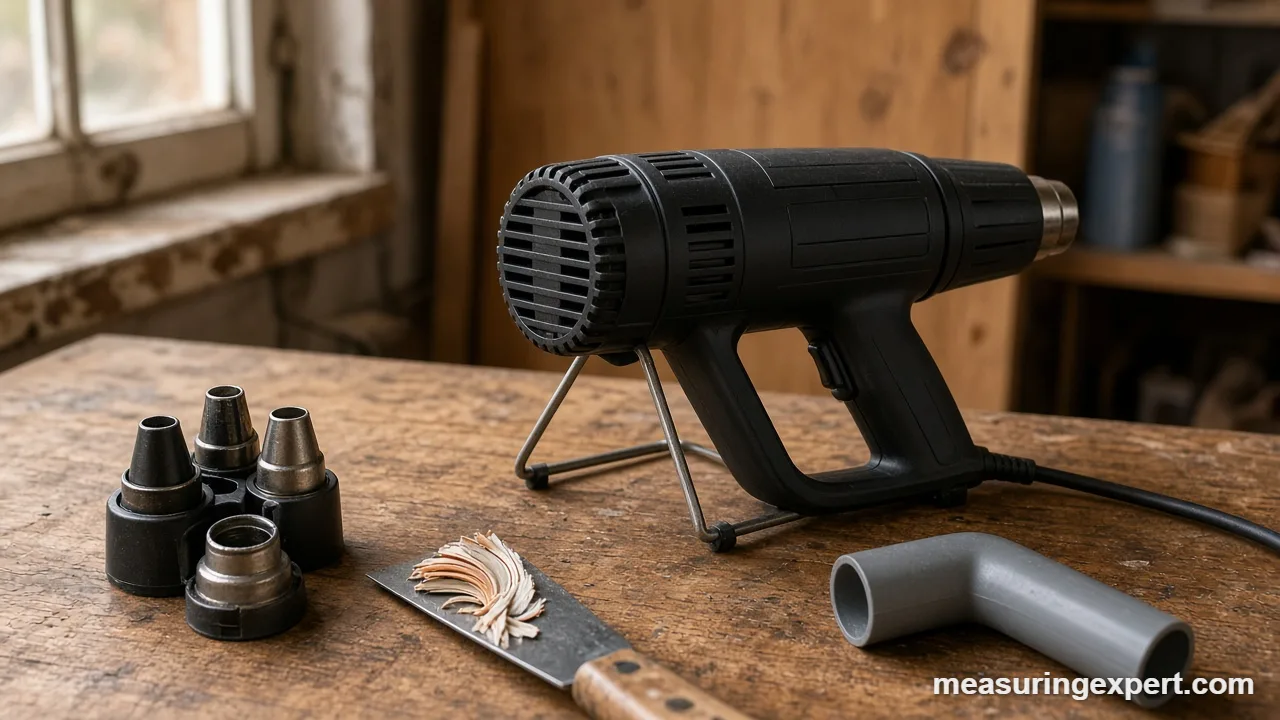
- Published temperature range: the low end matters for crafts, and the high end for paint and plumbing.
- Control: a display or numbered steps beat an unmarked dial for repeat work.
- Airflow: we favored makers that list CFM or L/min, because air moves the heat.
- Safety features: overload protection, stands, hooks and cool-down modes.
- Power source: corded for long jobs, battery for mobility.
- Variety: no more than two picks per brand, and no near-duplicates.
We also dropped three earlier picks. Specifically, two were near-copies of the SEEKONE kit, and one came from a seller with very thin published specs.
Specs That Matter When Buying a Heat Gun
At first glance, heat gun boxes print big numbers. However, only a few of them tell you how the tool will behave on your work. Therefore, here is how to read each one.
Temperature Range and Steps
To begin with, the range is the air temperature at the nozzle, not the temperature of the surface. Because air cools as it travels, the surface is always cooler than the reading, and distance changes it a lot. So a wide range is useful, but fine steps matter more. For example, 50 F steps let you creep up on the right heat for thin plastic without scorching it.
Airflow in CFM or L/min
In simple terms, airflow tells you how much heated air leaves the nozzle. For reference, one CFM equals about 28.3 L/min, so 17.7 CFM is roughly 500 L/min. As a result, more air spreads heat over a larger area and speeds up paint stripping. On the other hand, low air keeps light parts and fine dust from blowing around. Our guide on how to measure the volume of air explains the units in more detail.
Watts and Amps
Most corded guns sit between 1500 and 1800 W. However, that is close to the limit of a standard 15 A household circuit at 120V, so avoid sharing the outlet with another big load. If amps and volts confuse you, see our voltage symbol and unit guide.
Display, Nozzles and Stands
First, a digital display shows the set temperature, which makes jobs repeatable. Meanwhile, nozzles shape the air: a cone concentrates it, a fishtail spreads it, and a reflector wraps it around a pipe. Finally, a stand or kickstand lets the hot nozzle cool without touching your bench.
| Control type | How you set heat | Best use | Example |
|---|---|---|---|
| Digital display | Buttons, numbered steps | Repeat jobs, thin plastics | DEWALT D26960K, Wagner Furno 500 |
| Variable dial | Turn knob by feel | Mixed home jobs | CRAFTSMAN CMEE531, SEEKONE kit |
| Two fixed heats | Switch low or high | Simple, rough tasks | Genesis GHG1500A, Wagner HT1000 |
| Cordless | Two settings on battery | Remote and small jobs | DEWALT DCE530B |
Best Heat Gun Temperature for Common Jobs
In general, every material reacts at its own temperature, and the right setting also depends on distance and airflow. Therefore, treat these as starting points, then adjust while you watch the surface. In short, always start low and work up.
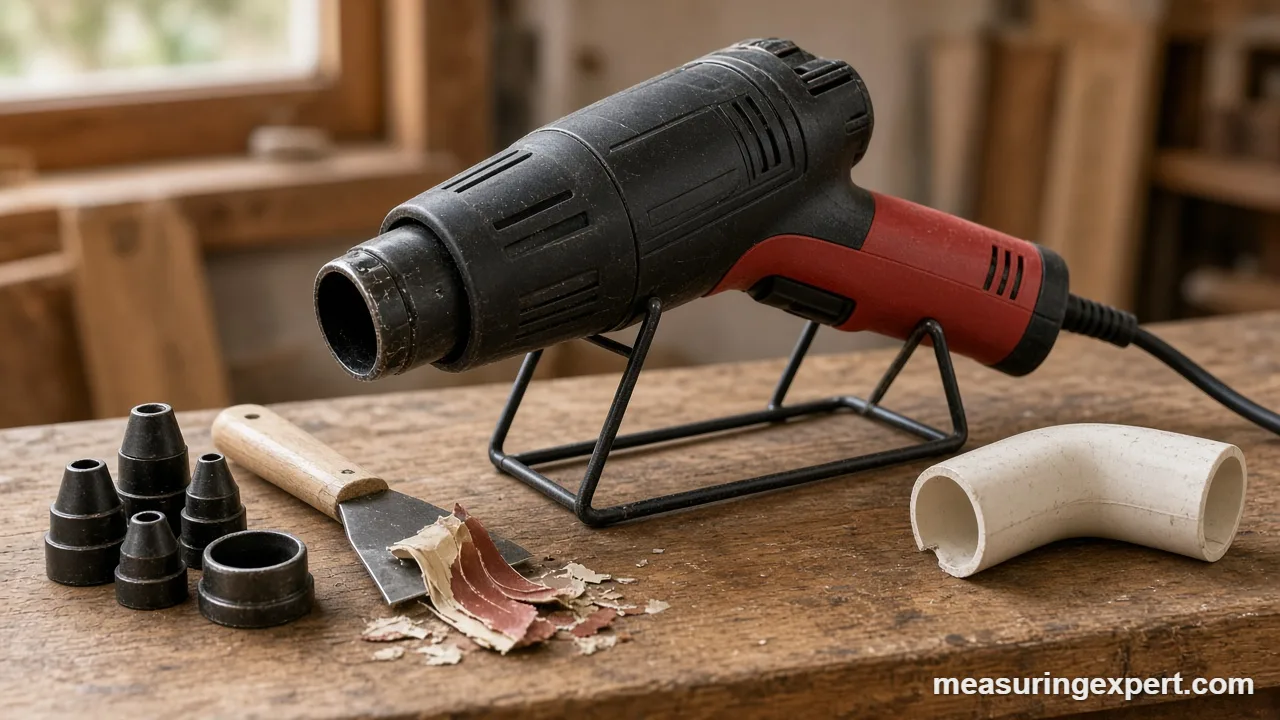
| Job | Typical starting setting | Tip |
|---|---|---|
| Drying, defrosting, loosening labels | Low, about 150-400 F (66-204 C) | Keep the nozzle moving |
| Heat shrink tubing and wrap | Low to mid, about 300-600 F (149-316 C) | Use a reflector nozzle |
| Bending PVC and acrylic | Mid, about 400-750 F (204-399 C) | Heat evenly on all sides |
| Softening paint for scraping | Mid to high, 750-1000 F (399-538 C) | Stay under 1,100 F on old paint |
| Loosening rusted bolts | High, about 1000 F (538 C) | Use a cone nozzle |
If you want to know how hot the surface actually got, aim a non-contact thermometer at it. For whole panels, a thermal camera shows hot spots better, and our thermal imaging camera guide covers those.
How to Use the Best Heat Gun Safely and Accurately
Above all, good technique matters as much as the tool. In fact, most scorched work comes from holding the nozzle still or too close. So follow these steps for any model:
- Clear the area of paper, solvents, dust and anything that can burn.
- Fit the right nozzle while the gun is cold and unplugged.
- Set the lowest useful temperature and a low fan speed.
- Hold the nozzle about 2 to 4 in (5 to 10 cm) from the surface and keep it moving.
- Raise the heat in small steps until the material responds.
- Check the surface with a non-contact thermometer if the job is sensitive.
- Run the cool-down setting or let the gun idle on low, then stand it upright to cool.
Fahrenheit to Celsius Heat Gun Converter
US boxes list Fahrenheit, while many manuals and imported tools use Celsius. To convert, subtract 32 and multiply by 5/9. For example, 1100 F is (1100 – 32) x 5/9 = 593.3 C. Type a temperature below to convert it.
In short, a 600 C rating on an import equals about 1112 F, so it matches most US guns at the top end.
Safety Rules for Hot-Air Tools
A heat gun has no flame, yet its air can ignite wood, paper and dust in seconds. Also, the metal nozzle stays hot for minutes after you switch off. Therefore, treat it like any other high-heat tool.
Old paint needs extra care. For example, homes built before 1978 may have lead paint, and heat can release lead fumes. For that reason, the EPA renovation rule in 40 CFR 745.85 permits heat guns on painted surfaces only below 1,100 F. However, several picks here reach 1200 F, so keep the setting lower on old paint. For fresh finishes, see how long spray paint takes to dry before you try to speed it up with heat.
Honest Limits of Hot-Air Tools
A heat gun cannot tell you the surface temperature. In fact, even a digital model only shows the setting at the nozzle. Similarly, the published range is a lab figure at the outlet, so real results change with distance, nozzle and room air. Also, battery guns lose heat output as the charge drops. Finally, no heat gun replaces a soldering station or a torch for jobs that need focused, very high heat.
Best Heat Gun FAQ
What is the best heat gun for most people?
For most buyers, the DEWALT D26960K is the best heat gun because its LCD sets 150 to 1100 F in 50 F steps. Alternatively, if you want a lower price with a screen, the Wagner Furno 500 is a good second choice.
How hot do these hot-air tools get?
Most corded heat guns reach about 1000 to 1200 F (538 to 649 C) at the nozzle. Meanwhile, low settings start near 120 to 150 F. Cordless models, such as the DEWALT DCE530B, top out lower at about 990 F.
Is a heat gun the same as an infrared temperature gun?
No. A heat gun blows hot air to warm materials. By contrast, an infrared temperature gun only measures surface temperature from a distance. If you need to read temperatures, look at an infrared surface thermometer instead.
What does CFM mean on the best heat gun?
CFM means cubic feet per minute, the volume of air leaving the nozzle. One CFM equals about 28.3 L/min. In general, higher airflow heats larger areas faster, while lower airflow suits small, light parts.
Do I need a digital display?
Not always. However, a display helps when you repeat the same job, such as shrink wrap or vinyl. For rough tasks like loosening bolts, a two-heat gun works fine.
Can I use a heat gun to strip lead paint?
Only with care. The EPA renovation rule allows heat guns on painted surfaces only below 1,100 F. Also, test old paint for lead first, ventilate well and follow lead-safe work practices.
Is cordless as good as corded?
For small jobs, yes. The DEWALT DCE530B handles shrink tubing and small parts well. Still, corded guns move more air, so they finish large surfaces faster.
How far should I hold the nozzle from the surface?
First, start about 2 to 4 in (5 to 10 cm) away and keep the nozzle moving. Then move closer only if the material does not respond. Otherwise, holding it still in one spot causes scorching.
Which best heat gun works for crafts?
For crafts, pick a gun with a low setting and gentle airflow, such as the Wagner Furno 500 or the SEEKONE kit. Fixed high heats, like 750 F on the HT1000, can warp thin craft materials.
How do I convert heat gun temperatures to Celsius?
Subtract 32 from the Fahrenheit value, then multiply by 5/9. For example, 1000 F equals about 538 C. You can also use the converter above for any value.
Bottom Line on the Best Heat Gun
For most workshops, the DEWALT D26960K Heat Gun with LCD Display Kit is the best heat gun to buy. It shows the set temperature, moves in fine 50 F steps and lists its airflow, so your results are repeatable. Meanwhile, pick the Wagner Furno 500 for a cheaper screen, the DCE530B for cordless work or the Genesis GHG1500A for a tight budget.
1 thought on “7 Best Heat Guns of 2026: Temperature, Airflow and Control Compared”