

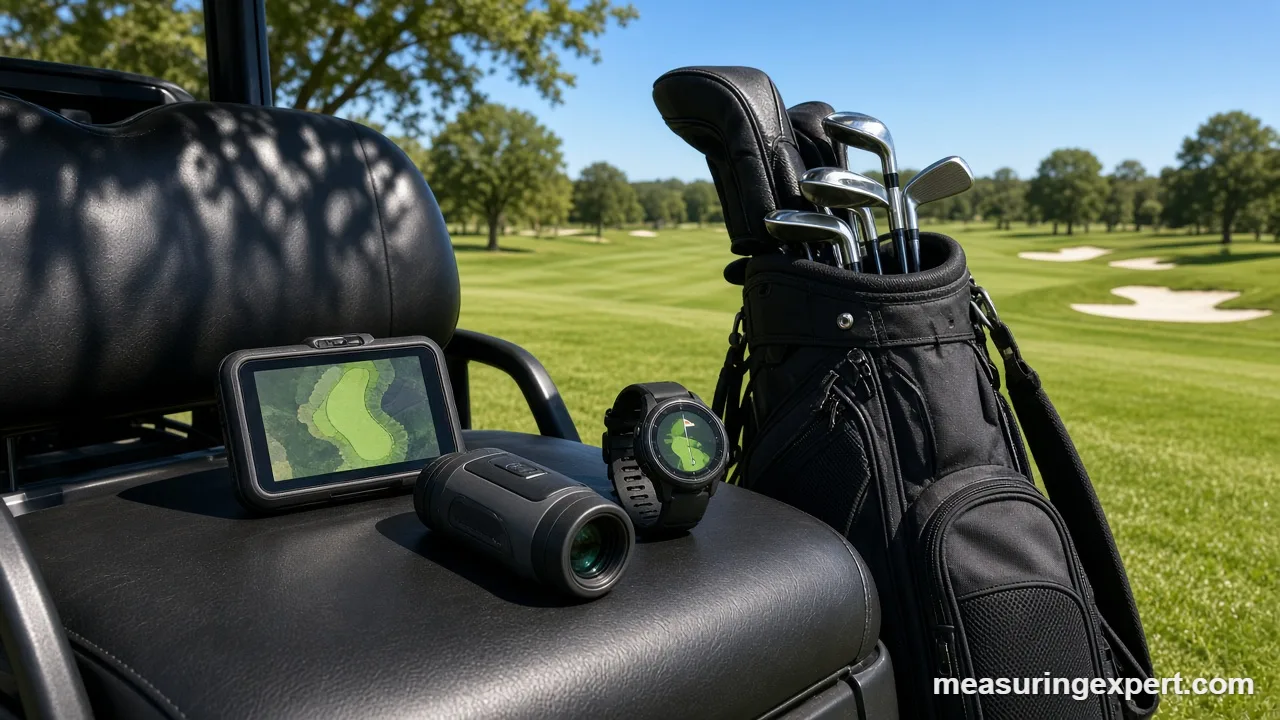
The best GPS golf rangefinder for most players is the Bushnell Phantom 3 Slope, a small handheld with front, center and back yardages, hazard distances and a slope mode you can switch off for events. Your choice depends on the format you like (handheld, watch, speaker or laser hybrid), the accuracy you need and tournament rules.
In short: get the Phantom 3 Slope for all-round use, the Garmin Approach S12 on a budget and the Shot Scope PRO LX+ if you want a laser plus GPS.
As an Amazon Associate, Measuring Expert earns from qualifying purchases. Our picks are based on research, specifications and owner feedback, not paid placement.
Best Overall
Best Budget
Best Laser + GPS
Quick Answer: Which Golf GPS Should You Buy?
- Best overall: Bushnell Phantom 3 Slope, with hazards, a movable pin and a cart magnet.
- On your wrist: Garmin Approach S44, an AMOLED watch with 43,000+ courses.
- Laser plus GPS: Shot Scope PRO LX+, a slope laser with a clip-in GPS unit.
- Tightest laser spec: Mileseey GenePro G1, rated to plus or minus 0.5 yd.
- For cart riders: Bushnell Wingman View, a speaker that calls out yardages.
- Lowest cost: Garmin Approach S12, with up to 30 hours of GPS battery.
- Rule to remember: slope must be off in competition under USGA Rule 4.3.
On This Page
- Comparison Table
- The 8 Picks, Reviewed
- How We Chose
- GPS vs Laser vs Hybrid
- Accuracy in Yards
- Slope Mode and Rule 4.3
- Yards to Meters Converter
- How to Get Accurate Yardages
- Battery and Care
- Honest Limits
- FAQ
- Bottom Line
Best GPS Golf Rangefinder Comparison Table
| # | Image | Product | Best For | Standout Feature | Link |
|---|---|---|---|---|---|
| 1 | 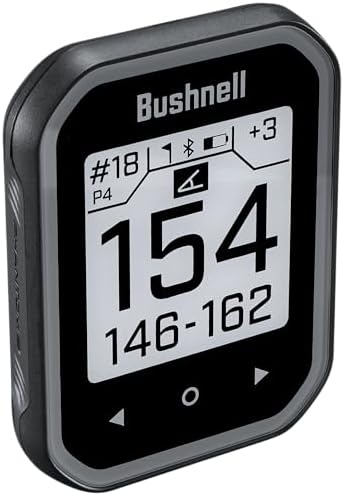 | Bushnell Phantom 3 Slope | Most golfers | Touchscreen, slope, magnet mount | View |
| 2 |  | Garmin Approach S44 | Wrist-based yardage | AMOLED touchscreen, 43,000+ courses | View |
| 3 |  | Shot Scope PRO LX+ | Laser plus GPS backup | Laser with clip-in H4 GPS | View |
| 4 |  | Mileseey GenePro G1 | Tight laser tolerance | Plus or minus 0.5 yd, GPS touchscreen | View |
| 5 | 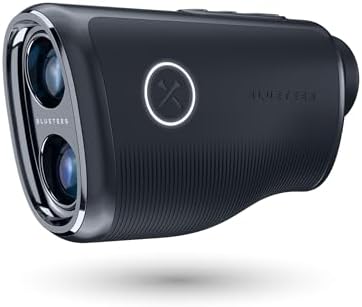 | Blue Tees Captain Pro | App-connected golfers | OLED laser with GPS distances | View |
| 6 |  | Bushnell Wingman View | Cart riders who like music | Audible and on-screen yardage | View |
| 7 |  | GolfBuddy Voice 2S+ | Walkers who want minimal gear | 31 g, voice yardages | View |
| 8 |  | Garmin Approach S12 | First GPS device | 30-hour GPS battery | View |
The 8 Best GPS Golf Rangefinder Picks, Reviewed
This list mixes four formats on purpose: handheld GPS units, GPS watches, a GPS speaker and laser rangefinders with GPS built in or bundled. That way, the best GPS golf rangefinder for you depends on how you play, not on one spec.
Best Overall
1. Bushnell Phantom 3 Slope GPS
Best for: Golfers who want a small handheld GPS with front, center and back yardages, slope-adjusted numbers and a cart magnet.
The Phantom 3 Slope is the best GPS golf rangefinder for most players because it covers the basics with no fuss. Also, it shows front, center and back distances on a 40 x 40 mm touchscreen. In addition, it lists up to 6 hazard or layup distances per hole, so you can plan a layup instead of guessing.
Better still, Bushnell’s GreenView lets you move the pin on the green, which matters on deep greens where center can be 15 yards from the flag. Also, its slope-compensated distances adjust for uphill and downhill shots, and you can switch slope off for tournament play. Finally, the built-in BITE magnet snaps it to a cart bar, and Bushnell rates it IPX6 against heavy spray.
- 38,000+ preloaded courses; updates via the Bushnell Golf app
- Front, center and back distances plus up to 6 hazards per hole
- Slope-compensated distances that can be turned off
- 18+ hours per charge, USB-C, under 3 hours to recharge
- 60 x 76 x 18 mm (2.4 x 3.0 x 0.7 in), 78 g (2.75 oz), IPX6
Pros
- Slope with an off setting for events
- Strong cart magnet built in
- Movable pin for more precise green yardage
Cons
- No numeric accuracy figure published
- Small screen compared with a speaker
Skip it if: you walk and would rather wear your yardages on your wrist.
Best GPS Watch
2. Garmin Approach S44
Best for: Walkers and riders who want hands-free yardages, hazard views and a daily smartwatch in one device.
The Approach S44 has a 1.2 in (30.4 mm) AMOLED touchscreen and comes preloaded with more than 43,000 courses. So, a glance shows front, middle and back of the green, plus hazards such as bunkers, water and layups.
Meanwhile, battery life is rated at up to 15 hours in GPS mode and up to 10 days as a smartwatch. However, some of its best tools, such as PlaysLike Distance and green contours, need a paid Garmin Golf membership. In addition, you can add CT10 club sensors later for automatic shot tracking.
- 1.2 in (30.4 mm) AMOLED touchscreen, 390 x 390 pixels
- 43,000+ preloaded courses
- Up to 15 hours GPS, up to 10 days smartwatch
- Hazard view for bunkers, water and layups
- 42 g (1.5 oz), 43 mm case
Pros
- Yardages always on your wrist
- Bright AMOLED screen
- Works as an everyday smartwatch
Cons
- PlaysLike and green contours need a membership
- Also a smaller screen than a handheld
Skip it if: you want a big map view or a laser reading to the flag.
Best Laser + GPS Combo
3. Shot Scope PRO LX+
Best for: Golfers who want a laser for exact flag distances and a GPS unit for blind shots and hazards, without a subscription.
The PRO LX+ pairs a slope laser with Shot Scope’s H4 GPS handheld. Therefore, you get two ways to measure. The laser reads up to 900 yards (823 m) with 7x magnification, and Shot Scope rates it accurate to 1 yard. Meanwhile, the H4 adds front, middle and back GPS yardages for shots where you cannot see the flag.
In addition, the laser has a slope on and off switch for tournaments, plus a strong built-in cart magnet. Also, the H4 handles shot tracking and more than 100 stats, and Shot Scope says maps, the app and updates come with no subscription fees. On the other hand, the laser runs on a CR123 battery rather than a rechargeable cell.
- Laser range 900 yd (823 m), accurate to 1 yd
- 7x magnification
- Slope on and off switch
- H4 GPS: front, middle and back distances, 15+ hour battery
- CR123 laser battery, about 5,800 measurements
Pros
- Laser and GPS in one purchase
- No subscription for maps or stats
- Shot tracking with club tags
Cons
- Shorter laser range than some rivals
- Disposable laser battery
- Also two devices to charge
Skip it if: you only want a single device and never play blind holes.
Most Accurate Laser
4. Mileseey GenePro G1
Best for: Players who want a laser rangefinder with a GPS course screen built in and the tightest stated laser tolerance on this list.
The GenePro G1 puts a 2.13 in AMOLED touchscreen on the outside of a laser rangefinder. As a result, you can check GPS front, center and back numbers on the screen, then raise the laser to shoot the flag. Also, Mileseey lists 43,000+ preloaded courses with no subscription.
On the laser side, Mileseey rates it at plus or minus 0.5 yards (about 46 cm), with a range up to 1,300 yards and flag lock up to 600 yards. Also, an external switch turns SmartSlope off for events. Its IP65 rating handles rain, although it is not built to be submerged.
- Laser accuracy plus or minus 0.5 yd; range up to 1,300 yd (1,189 m)
- Flag lock up to 600 yd; 6x magnification
- 2.13 in AMOLED touchscreen with 43,000+ courses
- External slope switch
- 1,000 mAh battery, up to 24 hours, USB-C; IP65
Pros
- Tightest stated laser accuracy here
- GPS and laser in one housing
- Long battery life
Cons
- 6x magnification, lower than some rivals
- Also bulkier than a plain laser
Skip it if: you never use a laser and only need GPS numbers.
Best Connected Hybrid
5. Blue Tees Captain Pro
Best for: Tech-minded golfers who want laser, slope and GPS yardages in one rugged unit that links to an app.
The Captain Pro is a laser rangefinder that also shows GPS front, center and back yardages, with 42,000+ courses. Moreover, it reaches up to 1,200 yards (1,097 m) with 7x optics. In addition, its multi-color OLED display has four brightness levels, which helps in low sun.
For competition, press and hold the action button to switch slope off; Blue Tees says it is tournament compliant in that mode. Also, an optional True Distance feature adjusts for slope, wind, elevation and temperature, but that belongs on practice rounds only. Finally, basic distances are free, while advanced app features need a paid membership after a 6-month trial.
- Laser range up to 1,200 yd (1,097 m), 7x optics
- GPS front, center and back distances, 42,000+ courses
- Slope switch; tournament compliant with slope off
- Multi-color OLED with four brightness levels
- IP67, USB-C rechargeable, magnetic strip
Pros
- Laser and GPS yardages in one
- IP67 dust and water rating
- Bright OLED display
Cons
- No published laser tolerance
- Best app features cost extra
Skip it if: you dislike apps and memberships.
Best GPS Speaker
6. Bushnell Wingman View
Best for: Cart golfers who want a Bluetooth speaker that also calls out and shows GPS distances.
A GPS speaker mounts on the cart and reads yardages out loud. However, the Wingman View adds an LCD screen, so you can also see front, center and back distances. Also, press the removable BITE remote, and it announces the numbers; it also covers up to 6 hazards per hole.
In addition, Bushnell lists 36,000+ courses, up to 10 hours per charge (about two rounds) and an IPX6 rating. However, at 23 oz (652 g) it is clearly a cart device, not something to carry in a pocket.
- 36,000+ courses; audible front, center and back yardages
- LCD screen for distances and music info
- Up to 6 hazard distances per hole
- Up to 10 hours per charge, USB-C; IPX6
- 3.2 x 7.3 x 3.1 in (8.1 x 18.5 x 7.9 cm), 23 oz (652 g)
Pros
- Music and yardage in one device
- Removable remote for quick distances
- Screen adds visual yardages
Cons
- Too heavy for walkers, so it stays on the cart
- No slope readings listed
Skip it if: you walk the course or play where music on carts is not welcome.
Best Talking GPS
7. GolfBuddy Voice 2S+
Best for: Walkers and beginners who want simple spoken yardages from a device about the size of a poker chip.
The Voice 2S+ weighs 31 g (1.1 oz) and measures 45 x 45 x 13.2 mm (1.8 x 1.8 x 0.5 in). Next, press the button, and it speaks front, center and back distances; a 1.0 in monochrome screen shows them too. Also, GolfBuddy includes 40,000+ courses in 170 countries with free updates.
Battery life is rated at up to 18 hours in golf mode, so two rounds per charge is realistic. It also uses both GPS and GLONASS satellites. However, the IPX3 rating only covers light spray, so keep it in a pocket in steady rain.
- 40,000+ courses in 170 countries, free updates
- Spoken front, center and back distances in 10 languages
- 1.0 in monochrome LCD, 128 x 64 pixels
- Up to 18 hours in golf mode
- 31 g (1.1 oz); IPX3
Pros
- Tiny, so it fits a pocket
- Spoken yardages keep eyes on the ball
- Long battery life
Cons
- Basic screen, so no maps
- Only IPX3 water resistance
- No hazard map view
Skip it if: you want a course map or slope readings.
Best Budget
8. Garmin Approach S12
Best for: Golfers on a budget who want a simple, readable GPS watch from a major brand.
The Approach S12 skips touchscreens and fancy maps. Instead, it shows front, middle and back of the green, plus hazards and doglegs, on a sunlight-readable 0.9 in screen. In addition, it comes with more than 43,000 preloaded courses, and the watch updates your most-played course wirelessly.
Above all, the battery is its biggest strength: up to 30 hours in GPS mode and up to 10 weeks in watch mode. Also, it keeps score on the wrist and syncs to the Garmin Golf app.
- 43,000+ preloaded courses
- Front, middle and back distances, hazards and doglegs
- Up to 30 hours GPS, up to 10 weeks watch mode
- 0.9 in (23 mm) sunlight-readable display
- 34.1 g (1.2 oz)
Pros
- Excellent battery life
- Also very easy to use
- Light on the wrist
Cons
- Small, low-resolution screen
- No touchscreen or detailed hole maps
Skip it if: you want color maps or smartwatch features.
How We Chose the Best GPS Golf Rangefinder Picks
To be clear, we did not run hands-on tests on the course. Instead, these picks are research-based. First, we read manufacturer spec pages for course counts, laser range and tolerance, battery life and water ratings. Next, we checked owner feedback for common complaints, such as weak magnets, slow satellite fixes and charging port failures. Finally, we dropped products the maker no longer sells or lists as sold out.
- Measurement quality: stated laser tolerance in yards, GPS features such as a movable pin, and hazard detail.
- Rules compliance: a slope feature that can be switched off scored higher.
- Course coverage: 36,000 or more preloaded courses with free map updates.
- Battery: enough for at least two rounds, ideally with USB-C charging.
- Durability: published IP ratings and sturdy mounts.
- Use cases: one strong option per format, from talking clip-ons to laser hybrids.
For the rules side, we used the USGA guidance on distance measuring devices and the text of Rule 4 of the Rules of Golf, which the USGA and The R&A publish jointly.
GPS vs Laser vs Hybrid: Which Format Fits Your Game?
Every device here measures distance in yards or meters, but they get the number in different ways. For instance, GPS compares your position with a mapped point on the course. A laser, by contrast, times a light pulse to whatever you aim at. So the two answer slightly different questions.
| Format | How it measures | Strength | Weakness | Our pick |
|---|---|---|---|---|
| Handheld GPS | Satellite position vs course map | Hazards, layups, blind shots | Map points, not the actual flag | Bushnell Phantom 3 Slope |
| GPS watch | Satellite position vs course map | Always on your wrist | Small screen | Garmin Approach S44, S12 |
| GPS speaker | Satellite position, spoken aloud | Hands-free on a cart | Heavy; cart only | Bushnell Wingman View |
| Talking clip-on | Satellite position, spoken aloud | Tiny and light | Very basic screen | GolfBuddy Voice 2S+ |
| Laser with GPS | Laser pulse plus GPS map | Exact flag distance and backup numbers | Bulkier, costs more | Shot Scope PRO LX+, Mileseey G1, Blue Tees Captain Pro |
If you mostly need distances outside golf, such as measuring rooms or fences, a construction laser is a better tool; see our guide to the best laser distance measurer. In contrast, a golf laser is tuned to lock onto a flagstick hundreds of yards away instead.
How Accurate Is the Best GPS Golf Rangefinder, in Yards?
First, accuracy works differently for each method. For lasers, makers state a tolerance. For example, Mileseey rates the GenePro G1 at plus or minus 0.5 yards, and Shot Scope rates the PRO LX laser at 1 yard. In other words, a 150-yard reading on the G1 should fall between 149.5 and 150.5 yards.
GPS is harder to pin down, which is why most golf brands publish no yardage tolerance at all. Instead, your result depends on the satellite fix, tree cover and how carefully the course was mapped. As a reference, the US government states that the GPS signal itself has a worst-case pseudorange accuracy of 7.8 m (about 8.5 yd) at 95% confidence on the official GPS accuracy page. However, that is a signal figure, not the accuracy you will see on a given hole.
A useful scale check: 1 yard is exactly 0.9144 m, or 3 ft. So a 3-yard GPS error is about 2.7 m. As a result, that rarely changes your club choice for a long approach. On a short wedge, however, it can. For more on the unit itself, read how many yards are in a mile.
Slope Mode, USGA Rule 4.3 and the Best GPS Golf Rangefinder
Slope mode adjusts a straight-line distance for the height difference to the target. For example, a green 150 yards away and 30 ft (10 yd) uphill will play longer than 150; many golfers use a rough rule of about 1 extra yard per 3 ft of rise, although each brand uses its own formula. Even so, the angle involved is small, only about 3.8 degrees in that example. If angles are new to you, see what an angle is and how it is measured.
This is where the rules matter most. Rule 4.3a(1) allows you to get distance or direction information from a device. However, it does not allow measuring elevation changes. Therefore, slope must be off during a round that counts. The USGA also notes that committees can use Model Local Rule G-5 to ban distance devices altogether, as in the U.S. Open itself.
Every slope-capable pick here lets you turn slope off. For instance, the Phantom 3 has an off setting, the PRO LX+ and GenePro G1 use a physical switch, and the Captain Pro turns slope off with a long press on its action button.
Convert Yards to Meters for Course Distances
For example, courses outside the US often list meters, while most American scorecards use yards. Simply enter a distance below to switch between yards, meters and feet; the conversion uses the exact definition of 1 yd = 0.9144 m.
How to Get Accurate Yardages From a Golf GPS
Most bad GPS numbers come from setup, not from the device. So follow these steps before and during a round.
- Charge and update before the round. Fully charge the device the night before. Then sync it with its app so the course map is current.
- Let it find satellites in the open. Turn it on in the parking lot or on the range, away from buildings and heavy trees. Bushnell, for example, quotes a first fix in under 45 seconds.
- Confirm the course and hole. Next, check that auto course recognition picked the right course and the right tee box. Otherwise, every number will be wrong.
- Stand still, then read the green yardages. First stop at your ball, then read front, center and back. Next, move the pin marker if your device supports it.
- Check hazards and layups. Scroll to bunker and water carry numbers before you pick a club. Also, note the distance to the front edge of any hazard.
- Switch slope off for competition. Before an event round, turn slope or plays-like features off, as Rule 4.3 requires. Finally, confirm the local rules allow distance devices at all.
Battery, Charging and Care
Generally, battery life is listed in hours, and a round usually takes four or more. For that reason, the 10-hour Wingman View covers about two rounds, while the 30-hour Garmin S12 can go far longer. Also, charge before you leave home, because a cold morning can drain lithium cells faster.
- Wipe the laser lens with a soft cloth, not your shirt, so you do not scratch the coating.
- Also, dry the charging port after a wet round.
- Match the IP rating to your weather: IPX3 handles light spray, while IP67 survives a short dunk.
Honest Limits of Golf GPS and Lasers
First, no device knows the real pin position unless you tell it, so GPS center-of-green numbers can be well off on a deep green. Lasers, meanwhile, can lock onto trees behind the flag; flag-lock vibration helps, but it is not perfect. In addition, slope numbers are estimates, and wind, temperature and lie still change how far a ball flies. Finally, course maps can be out of date after a redesign, so report errors through the brand app.
Best GPS Golf Rangefinder FAQ
What is the best GPS golf rangefinder for most golfers?
For most golfers, the Bushnell Phantom 3 Slope is the best pick. It shows front, center and back yardages, hazards and slope-adjusted numbers, and slope can be turned off for events. If you prefer a watch, choose the Garmin Approach S44 instead.
Is a GPS or a laser rangefinder more accurate?
A laser is more precise to a target you can see; for example, Mileseey rates the GenePro G1 at plus or minus 0.5 yards. GPS, however, depends on the satellite fix and the course map, so expect it to be a few yards off at times.
Is the best GPS golf rangefinder legal in tournaments?
Usually yes. Under Rule 4.3 of the Rules of Golf, distance information is allowed, but measuring elevation changes is not. So turn slope off. Also, a committee can ban all distance devices with Model Local Rule G-5.
Can I use a rangefinder with slope in a USGA event?
You may carry a device with slope if the slope function is turned off and you do not use it. If you use slope during a round, Rule 4.3 gives the general penalty for the first breach and disqualification for a second breach.
Do GPS golf devices need a subscription?
Many do not. Bushnell, GolfBuddy and Shot Scope include course maps without fees. On the other hand, Garmin and Blue Tees lock some advanced features, such as PlaysLike distances or AI club advice, behind optional memberships.
What does front, center and back mean on a golf GPS?
Simply put, these are the distances to the near edge, the middle and the far edge of the green. As a result, you know how much room you have short and long of the pin, even when you cannot see the flag.
Which best GPS golf rangefinder type suits walkers?
Walkers usually prefer a watch or a clip-on device because both are light. For example, the Garmin Approach S12 and the GolfBuddy Voice 2S+ weigh about 31 to 34 g, so you forget you are carrying them.
How do I convert yards to meters for golf?
Multiply yards by 0.9144, because 1 yard is exactly 0.9144 m. So 150 yards is about 137.2 m. Most devices also let you switch units in settings, or you can use the converter on this page.
Why do GPS distances jump around?
Trees, buildings and a weak satellite fix can shift your position by a few yards. Also, the device needs a moment after you stop walking to settle. Therefore, stand still for a second or two before you read a number.
Should I buy a laser with GPS or two separate devices?
A hybrid such as the Mileseey GenePro G1 or Blue Tees Captain Pro means one device to charge. In contrast, the Shot Scope PRO LX+ gives you a laser plus a separate GPS unit you can leave on the cart.
Bottom Line: The Best GPS Golf Rangefinder for Most Golfers
The Bushnell Phantom 3 Slope is the best GPS golf rangefinder for most golfers, because it combines clear green yardages, hazards, a movable pin and a slope mode you can switch off. If you want your numbers on your wrist, choose the Garmin Approach S44, or the S12 on a budget. And if you want exact flag distances too, pick a laser hybrid such as the Shot Scope PRO LX+.
Black Friday is coming: shop the deals with Prime