


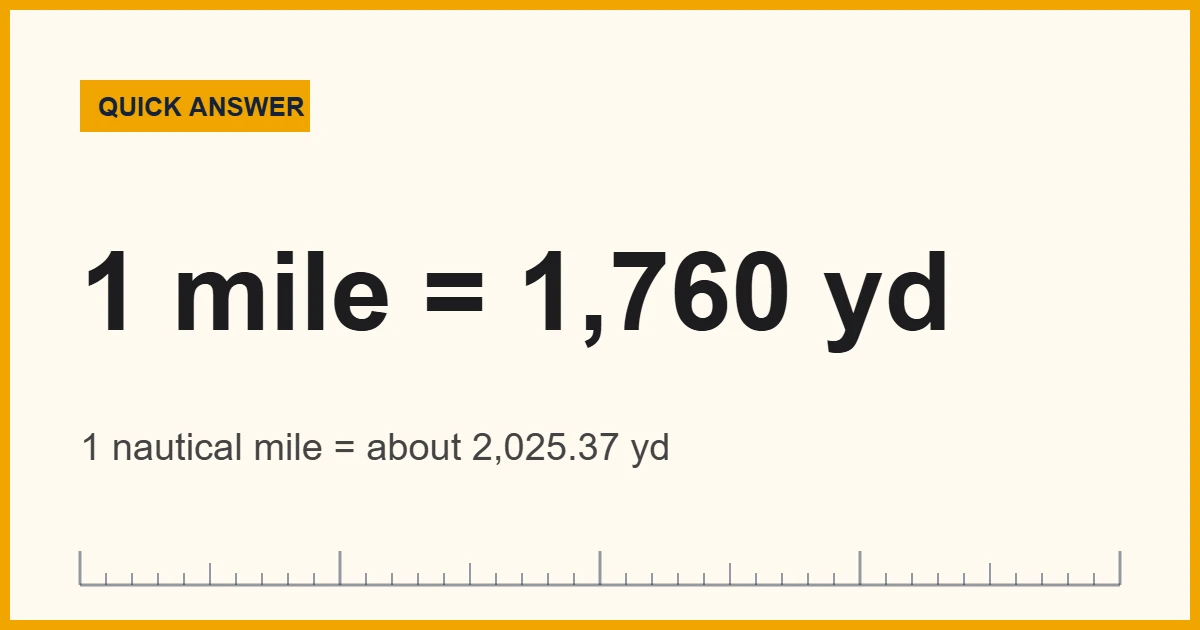
There are exactly 1,760 yards in a mile. This is because of the definition: one statute mile is 5,280 feet, and one yard is 3 feet, so 5,280 / 3 = 1,760 yards. In metric terms, a mile is 1,609.344 meters and a yard is 0.9144 meters. A nautical mile is longer: about 2,025.37 yards (1,852 m).
Convert Miles to Yards
Enter any distance and choose the unit you start with. The converter then uses the exact international definitions, so a mile is always 1,760 yards and a yard is always 0.9144 meters.
The yard and the mile both belong to the US customary system, which the United States still uses for road signs, sports fields and property. Because the two units were tied together long ago, the conversion also never changes. Since 1959, the yard has been fixed at exactly 0.9144 meters. As a result, the mile is fixed at exactly 1,609.344 meters.
The US National Institute of Standards and Technology (NIST) lists these values in its SI conversion factor tables. For example, it gives the mile as 1,609.344 m and the nautical mile as 1,852 m. So whenever you see a different number of yards in a mile, check which mile the writer means.
Next, below you will find a quick chart, a comparison of the three miles, and some everyday ways to picture 1,760 yards.
Yards in a Mile Chart
Specifically, this chart covers the distances people ask about most. First, every yard value is exact. The meter values, however, are rounded to two decimals.
| Miles | Yards | Feet | Meters |
|---|---|---|---|
| 0.1 mi | 176 yd | 528 ft | 160.93 m |
| 1/4 mi | 440 yd | 1,320 ft | 402.34 m |
| 1/2 mi | 880 yd | 2,640 ft | 804.67 m |
| 3/4 mi | 1,320 yd | 3,960 ft | 1,207.01 m |
| 1 mi | 1,760 yd | 5,280 ft | 1,609.34 m |
| 1 1/2 mi | 2,640 yd | 7,920 ft | 2,414.02 m |
| 2 mi | 3,520 yd | 10,560 ft | 3,218.69 m |
| 3 mi | 5,280 yd | 15,840 ft | 4,828.03 m |
| 5 mi | 8,800 yd | 26,400 ft | 8,046.72 m |
| 10 mi | 17,600 yd | 52,800 ft | 16,093.44 m |
| 26.2 mi (marathon) | 46,145 yd | 138,435 ft | 42,195 m |
Printable tip: the chart fits on one page, so you can print it for a training log or a classroom wall. Also, note that 3 miles happens to equal 5,280 yards, the same number as the feet in one mile.
Why Are There 1,760 Yards in a Mile?
In fact, the odd number comes from history, not from math. The Roman mile was 1,000 paces, or about 5,000 Roman feet. English farmers, meanwhile, measured land in furlongs, the length of a plowed furrow. In 1593, an act of Parliament set the mile at 8 furlongs so the two systems would fit together. Each furlong was 220 yards, so the mile became 8 x 220 = 1,760 yards.

| Unit | Yards | Fraction of a mile |
|---|---|---|
| Chain | 22 yd | 1/80 |
| Furlong | 220 yd | 1/8 |
| Quarter mile | 440 yd | 1/4 |
| Statute mile | 1,760 yd | 1 |
| League (land) | 5,280 yd | 3 |
Even so, horse racing still uses furlongs today. A race “of 6 furlongs”, for instance, is 1,320 yards, or three quarters of a mile. For more units like these, see our guide to length units.
Yards in a Mile: Statute vs Nautical vs Survey
At first glance, there is just one mile; however, three different miles show up in US sources. In general, “mile” means the statute mile. Pilots and sailors, however, use the nautical mile, and older land records may use the survey mile.
| Mile | Defined as | Yards | Feet | Meters |
|---|---|---|---|---|
| Statute (international) mile | 5,280 international feet | 1,760 | 5,280 | 1,609.344 |
| Nautical mile | exactly 1,852 m | about 2,025.37 | about 6,076.12 | 1,852 |
| US survey mile | 5,280 US survey feet | about 1,760.0035 | 5,280 survey ft | about 1,609.347 |
By comparison, the nautical mile is about 1.1508 statute miles. Originally, it was linked to one minute of latitude, which is why ships and aircraft find it useful. Speeds at sea are given in knots, or nautical miles per hour; our page on how fast a knot is explains that unit.
How Long Is 1,760 Yards in Real Life?
Of course, big numbers are hard to picture. Instead, compare the mile with places you already know.

Track laps vs yards in a mile
A standard outdoor track is 400 meters per lap in lane 1. In other words, that is about 437.45 yards. So four laps make 1,600 m, or about 1,749.78 yards. As a result, four laps fall about 10.2 yards short of a full mile. So you need about 4.02 laps to cover a full mile.
American football field
To start, the playing field is 100 yards from goal line to goal line. Therefore, one mile equals 17.6 fields. With both 10-yard end zones the field is 120 yards long, so a mile is about 14.67 full fields.
City blocks and yards in a mile
However, blocks vary a lot from city to city. In Manhattan, for example, about 20 north-south blocks make a mile. Our guide on how long a city block is lists typical sizes in other cities.
How to Convert Miles to Yards
Fortunately, the math is simple once you know the factor. Follow these steps, or alternatively use the converter above.
- Write down the distance in miles. First, use decimals rather than fractions, so 1 1/4 miles becomes 1.25.
- Multiply by 1,760. For example, 1.25 x 1,760 = 2,200 yards.
- Check which mile you have. For nautical miles, multiply by about 2,025.37 instead.
- Convert back if needed. To turn yards into miles, divide by 1,760; for instance, 880 / 1,760 = 0.5 mile.
- Round only at the end. Keep full precision during the math, and then round the final answer.
A quick shortcut also helps. Since 1,760 is close to 1,750, multiplying by 7 and then by 250 gets you within about 0.6 percent.
Recommended Tools for Measuring Yards and Miles
For long distances, however, you need a different tool than a tape measure. For example, a measuring wheel counts feet as you walk, so it suits property lines, driveways and race courses. A laser rangefinder, meanwhile, reads distance in yards from one spot, which golfers and hunters use. In short, choose a wheel for ground you can walk and a rangefinder for distances you can only see.


As an Amazon Associate, Measuring Expert earns from qualifying purchases.
Do and Don’t: Yards in a Mile
Do
- Use 1,760 yards for a road or running mile, because that is the statute mile.
- Switch to 2,025.37 yards at sea or in the air instead.
- Remember that a 400 m track lap is not a quarter mile.
- Keep full precision until the last step, so errors do not add up.
- Label your answers with the unit; otherwise, they are easy to misread.
Don’t
- Confuse 1,760 yards with 5,280 feet.
- Assume all city blocks are the same length, since they vary widely.
- Count end zones when comparing a mile with 100-yard fields.
- Mix square yards (area) with yards (length).
- Round 1.609 km to 1.6 km for precise work, because the error adds up.
Another common slip is the acre. An acre is 4,840 square yards, which is an area, not a length. So it cannot be compared directly with a mile of length.
Honest Limits of These Numbers
Admittedly, the 1,760 figure is exact, but real-world distances are not. For instance, a GPS watch may log 1,700 or 1,800 yards for the same mile because of signal drift and corner cutting. Similarly, measuring wheels can slip on wet grass or gravel. In addition, many “mile” markers on trails are estimates. In short, the definition is perfect, while the measurement is only as good as the tool and the person using it.
When Accuracy Really Matters
For a walk or a jog, of course, a mile is a mile. Still, some situations call for care:
- Certified races. For example, road race courses are measured with calibrated bicycle methods, and they include a small safety margin.
- Property and boundaries. For instance, old deeds may use survey feet, chains or rods. For that reason, a licensed surveyor should interpret them.
- Navigation. Mixing statute and nautical miles creates an error of about 15 percent, which matters for fuel and timing.
Frequently Asked Questions
How many yards in a mile exactly?
There are exactly 1,760 yards in a statute mile. This is because 5,280 feet per mile divided by 3 feet per yard equals 1,760.
How many yards in a nautical mile?
A nautical mile is exactly 1,852 meters, which is about 2,025.37 yards or about 6,076.12 feet.
How many yards in a half mile?
To begin with, a half mile is 880 yards. A quarter mile is 440 yards, and three quarters of a mile is 1,320 yards.
How many feet are in a mile?
There are 5,280 feet in a mile. In other words, that is 1,760 yards times 3 feet per yard.
How many football fields make up the yards in a mile?
A mile equals 17.6 football fields of 100 yards each. Counting both end zones, a field is 120 yards, so a mile is about 14.67 fields.
Is 4 laps of a track a mile?
Not quite. Four laps of a 400 m track equal 1,600 meters, about 1,749.78 yards. As a result, that is about 10.2 yards short of a mile.
How many yards are in a kilometer?
First of all, a kilometer is about 1,093.61 yards. Therefore, a mile is about 1.609 times longer than a kilometer.
How do I convert yards to miles?
Divide the number of yards by 1,760. For example, 3,520 yards divided by 1,760 equals 2 miles.
Why are there not 1,000 yards in a mile?
The mile grew out of the Roman pace and the English furlong. Then, in 1593, it was set at 8 furlongs of 220 yards, which gives 1,760 yards.
Is a yard longer than a meter?
No. A yard is 0.9144 meters, so a meter is about 1.094 yards, or roughly 3.4 inches longer than a yard.
Yards in a Mile: The Bottom Line
To sum up, there are exactly 1,760 yards in a statute mile, the same as 5,280 feet or 1,609.344 meters. A nautical mile is longer at about 2,025.37 yards, and the old survey mile is only a fraction of an inch longer than the statute mile.
Finally, for quick checks, picture 17.6 football fields or just over four track laps. For any other distance, use the converter at the top of this page.
6 thoughts on “How Many Yards in a Mile? 1,760 Yards, Plus Nautical and Survey Miles”