
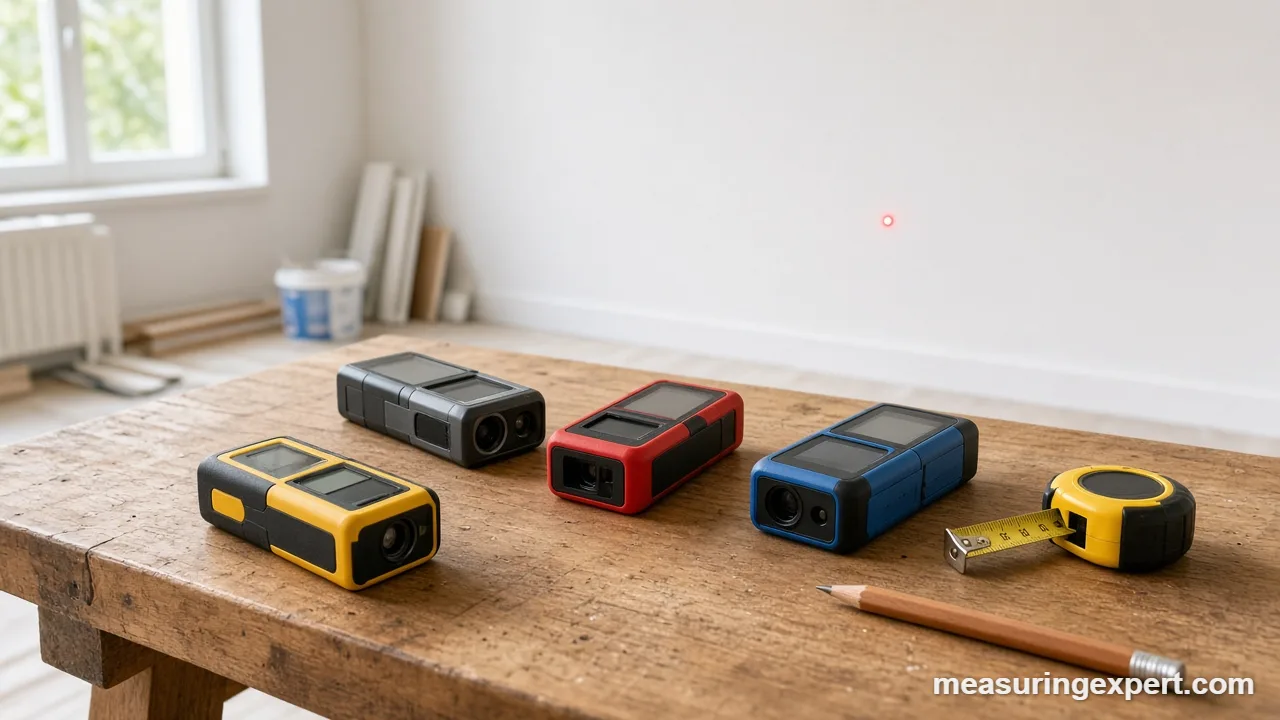
The best laser distance measurer for most people is the Bosch GLM165-25G: a green-beam, IP65 tool rated at +/-1/16 in. out to 165 ft. However, the right pick depends on three things: how far you measure, whether you work outdoors, and whether you need readings sent to an app.
In short: Bosch GLM165-25G overall, MILESEEY S50 for long range on a budget, Leica DISTO X1 for pros, and MILESEEY S7 for outdoor aiming.
As an Amazon Associate, Measuring Expert earns from qualifying purchases. Our picks are based on research, specifications and owner feedback, not paid placement.
Best Overall

Best Budget
Best Pro
Quick Answer: Which Laser Measure Fits Your Job?
- Most homes and trades: the Bosch GLM165-25G pairs a green beam with an IP65 body.
- Long range for less: the MILESEEY S50 is rated to 400 ft with 18 modes.
- Pro accuracy and data: the Leica DISTO X1 quotes +/-1.5 mm under ISO 16331-1.
- Simplest to use: the Bosch GLM100-23 has two buttons and fraction rounding.
- Tool pouch size: the Klein Tools 93LDM100C weighs just 2.3 oz.
- Bright daylight: the MILESEEY S7 adds a viewfinder camera for aiming.
- Phone sketches: the Leica DISTO D1 sends each reading over Bluetooth.
On This Page
- Comparison table
- The 7 picks, reviewed
- How we chose
- How a laser measure works
- Specs that matter
- Feet and meters converter
- How to measure accurately
- Checking calibration
- Honest limits
- FAQ
- Bottom line
Best Laser Distance Measurer Comparison
First, find your main job in the Best For column. Then jump to the review for range, accuracy and the trade-offs.
| # | Product | Best For | Standout Feature | Amazon |
|---|---|---|---|---|
| 1 | Bosch GLM165-25G Blaze Green-Beam | Most homes and trades | Green beam, IP65 and +/-1/16 in. accuracy | View |
| 2 | MILESEEY S50 Green-Beam | Long range on a budget | 400 ft green beam and 18 modes | View |
| 3 | Leica DISTO X1 | Pros who log data | +/-1.5 mm per ISO 16331-1, Bluetooth and NFC | View |
| 4 | Bosch GLM100-23 Blaze | Quick room and trim measurements | Two-button operation with rounding | View |
| 5 | Klein Tools 93LDM100C Compact | Electricians and service techs | Tiny 2.3 oz body with IP54 rating | View |
| 6 | MILESEEY S7 Outdoor with Camera | Yards, roofs and long exterior shots | Viewfinder camera and IP65 housing | View |
| 7 | Leica DISTO D1 | Sending readings to an app | Bluetooth in an 87 g body | View |
The 7 Best Laser Distance Measurer Picks, Reviewed
We start with the all-round picks, because they suit most readers. Next come the pro and simple models. Finally, we cover compact, outdoor and app-first tools.
Best Overall
1. Bosch GLM165-25G Blaze Green-Beam
Best for: homeowners, remodelers and trades who want one reliable laser for rooms, hallways and small exterior jobs.
The Bosch GLM165-25G is our pick for the best laser distance measurer for most people. Specifically, it reaches 165 ft (about 50 m), and Bosch rates it at +/-1/16 in. (about 1.6 mm). In addition, the green beam is easier to spot on far walls and in bright rooms. Bosch markets its green beams as up to four times brighter than red.
On the measuring side, it also offers 11 functions, including length, area, volume, indirect height and add or subtract. Also, a rounding button converts long decimals into the nearest useful fraction, so you can read 12 ft 3-5/16 in. instead of a long decimal. Finally, the IP65 rating means it is dust tight and resists water jets, which is rare at this level.
- Range: up to 165 ft (about 50 m)
- Accuracy: +/-1/16 in.; stakeout accuracy +/-1/2 in.
- Display: backlit color screen
- Protection: IP65 dust and water rating
- Power: 2 AA batteries included; also works with the Bosch GBA37V10 pack
Pros
- Green dot is easy to find on far walls
- IP65 housing suits dusty job sites
- Rounding button gives tape-style fractions
Cons
- No Bluetooth or app
- Bosch notes a stakeout accuracy issue on some date codes
Skip it if: you need to send readings to a phone or sketch floor plans in an app.
Best Value
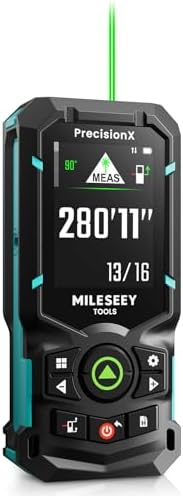
2. MILESEEY S50 Green-Beam
Best for: DIYers and estimators who want long range and lots of modes without paying pro-brand prices.
Above all, the MILESEEY S50 packs a lot of range into a small body. Specifically, the maker lists 0.16 to 400 ft (0.05 to 120 m) and +/-1/16 in. (+/-1.5 mm) accuracy. As a result, it covers long halls, gyms and lot lines that a 165 ft tool cannot reach.
It also has 18 measuring modes, including Pythagoras, wall area and indirect height. In addition, a red side laser helps you line up parallel to a wall. Besides, the S50 runs on two rechargeable AA Ni-MH cells that charge over USB-C, and you can swap in fresh AA cells on site. However, its IP54 rating is lower than the Bosch, so keep it out of heavy rain.
- Range: 0.16 to 400 ft (0.05 to 120 m)
- Accuracy: +/-1/16 in. (+/-1.5 mm)
- Display: 2.4 in. color IPS screen
- Power: 2 rechargeable AA Ni-MH cells, USB-C charging
- Units: m, mm, cm, ft, in, plus 1/16 and 1/32 in. fractions
Pros
- Very long rated range
- Many modes for area and height work
- Rechargeable but still takes AA cells
Cons
- IP54, so less weather sealing
- More menus to learn than a basic laser
Skip it if: you want the simplest possible one-button tool.
Best Pro
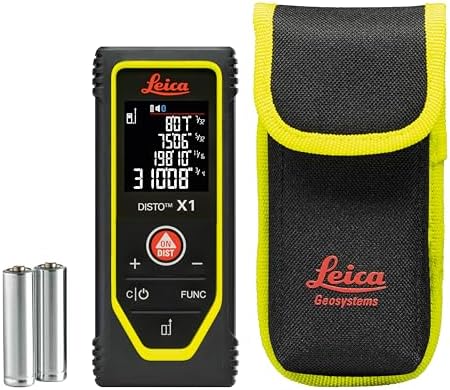
3. Leica DISTO X1
Best for: contractors, estimators and inspectors who want a tight, standards-based accuracy rating and app support.
The X1 is a rugged, compact model in Leica’s DISTO line. In particular, Leica rates it at +/-1.5 mm (about 1/16 in.) typical accuracy over 0.05 to 100 m (about 330 ft). Importantly, Leica states both figures under ISO 16331-1, the test standard for handheld laser distance meters. Therefore, you can compare its numbers with confidence.
It also connects by Bluetooth and NFC to the DISTO Plan app and other compatible apps. In addition, it has an IP65 housing and a 2 m drop test. Leica even publishes the laser dot size: 6 mm at 10 m, 30 mm at 50 m and 60 mm at 100 m. This data therefore shows why aim gets harder at long range.
- Range: 0.05 to 100 m (about 330 ft), per ISO 16331-1
- Typical accuracy: +/-1.5 mm; resolution 0.1 mm
- Connectivity: Bluetooth and NFC; DISTO Plan app
- Protection: IP65 and 2 m drop tested
- Power: 2 AAA batteries, up to 7,000 measurements per set
Pros
- Accuracy stated to a recognized standard
- Rugged IP65 body
- App and NFC data transfer
Cons
- Mono display, no camera
- Fewer onboard modes than the MILESEEY units
Skip it if: you never record measurements and just need quick room sizes.
Best Simple
4. Bosch GLM100-23 Blaze

Best for: anyone who wants a fast, no-fuss laser for rooms, cabinets and trim.
By comparison, the Bosch GLM100-23 is the easy choice. Even so, it reaches 100 ft (about 30 m) with +/-1/16 in. accuracy. Moreover, it uses just two buttons: one to measure and one to round the result. So you can switch from a decimal readout to 1/2, 1/4, 1/8, 1/16 or 1/32 in. steps.
It starts in a real-time mode, so the number updates as you move closer to or farther from a wall. Thus, it is handy for marking a set distance. In addition, a click wheel handles settings, and the display has a big-number mode. At 0.19 lb, it also slips into a shirt pocket.
- Range: up to 100 ft (about 30 m)
- Accuracy: +/-1/16 in.
- Rounding: from 1/2 in. down to 1/32 in.
- Power: 2 AAA batteries included
- Weight: 0.19 lb
Pros
- Very easy to learn
- Rounding matches tape-measure habits
- Light and pocketable
Cons
- Red beam is harder to see in bright light
- No app or angle sensor
Skip it if: you need area, volume or indirect height functions.
Best Compact
5. Klein Tools 93LDM100C Compact

Best for: electricians, low-voltage installers and service techs who need a quick check between jobs.
On the other hand, the Klein Tools 93LDM100C is a small, single-purpose laser. Specifically, it measures from 2 in. to 100 ft (5.1 cm to 30.5 m). Klein rates it at +/-1/16 in. up to 33 ft (10 m) and +/-1/8 in. up to 100 ft. That two-tier spec is honest, and it reflects how all lasers lose accuracy with distance.
In practice, it does the basics well: single or continuous readings, inches, feet and inches, or meters, and a choice to measure from the top or bottom of the tool. Also, it shows the last two readings on screen. Furthermore, its IP54 body weighs only 2.3 oz (65 g), so it rides in a tool pouch.
- Range: 2 in. to 100 ft (5.1 cm to 30.5 m)
- Accuracy: +/-1/16 in. to 33 ft; +/-1/8 in. to 100 ft
- Display: reverse-contrast LCD for low light
- Protection: IP54
- Power: 2 AAA batteries included
Pros
- Small enough for any pouch
- Clear, published accuracy tiers
- Last two readings stay on screen
Cons
- No area or volume math
- Looser accuracy past 33 ft
Skip it if: you need to calculate square footage on the tool.
Best Outdoor
6. MILESEEY S7 Outdoor with Camera
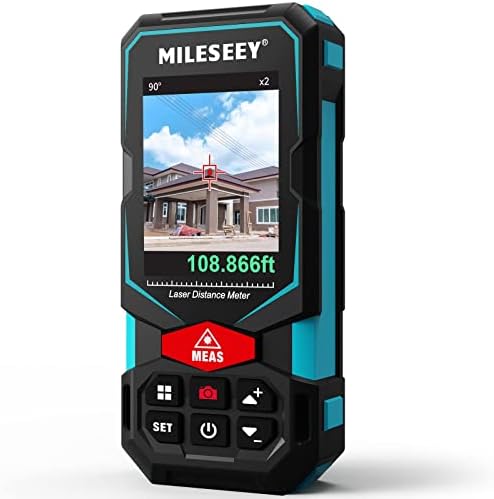
Best for: landscapers, fence builders and roofers who aim at targets they cannot see in daylight.
Outdoors, the hard part is not range but finding the dot. The MILESEEY S7 solves that with a viewfinder camera and digital zoom on its 2.4 in. color screen. So you aim at the crosshair instead of hunting for a red spot on siding.
Specifically, the maker lists 0.66 to 330 ft (0.2 to 100 m) and +/-1/16 in. (+/-2 mm) accuracy. In addition, it has 16 functions, including Pythagoras, stake out, auto level and point-to-point. It also stores up to 1,000 records and syncs by Bluetooth to an app with floor plan drawing. Finally, the IP65 rating suits wet yards.
- Range: 0.66 to 330 ft (0.2 to 100 m)
- Accuracy: +/-1/16 in. (+/-2 mm)
- Aiming: viewfinder camera with digital zoom
- Protection: IP65
- Power: 3 AAA Ni-MH rechargeable cells with USB-C
Pros
- Camera makes daylight aiming practical
- IP65 weather sealing
- Point-to-point and stake-out modes
Cons
- Heavier than pocket models at 180 g
- Many menus for a casual user
Skip it if: you only measure indoors, where a camera adds bulk without much benefit.
Best Smart Pocket
7. Leica DISTO D1

Best for: designers, real estate agents and DIYers who want readings to land in a phone sketch.
Similarly, the Leica DISTO D1 is a tiny Bluetooth laser. Leica lists a 0.2 to 40 m (about 0.7 to 131 ft) range with +/-2.0 mm typical accuracy. Also, it weighs 87 g with batteries. Therefore, it suits room-by-room work rather than long exterior runs.
Above all, its main strength is the link to the DISTO Plan app. For example, you can draw a rough room on your phone, tap a wall, and send the reading straight to it. As a result, that workflow cuts copying errors. If floor plans are your main goal, see our guide to the best floor plan laser measurer picks as well.
- Range: 0.2 to 40 m (about 0.7 to 131 ft)
- Typical accuracy: +/-2.0 mm
- Connectivity: Bluetooth; DISTO Plan app
- Protection: IP54
- Power: 2 AAA, up to 10,000 measurements per set
Pros
- Very small and light
- Smooth app workflow
- Leica build and support
Cons
- Short 40 m range
- Few onboard functions
Skip it if: you measure long distances or work mostly outdoors.
How We Chose the Best Laser Distance Measurer Picks
We did not run hands-on tests. Instead, these picks are research-based. First, we read maker spec pages and manuals. Next, we weighed owner feedback on aiming, battery life and durability. Finally, we scored each model on the points below.
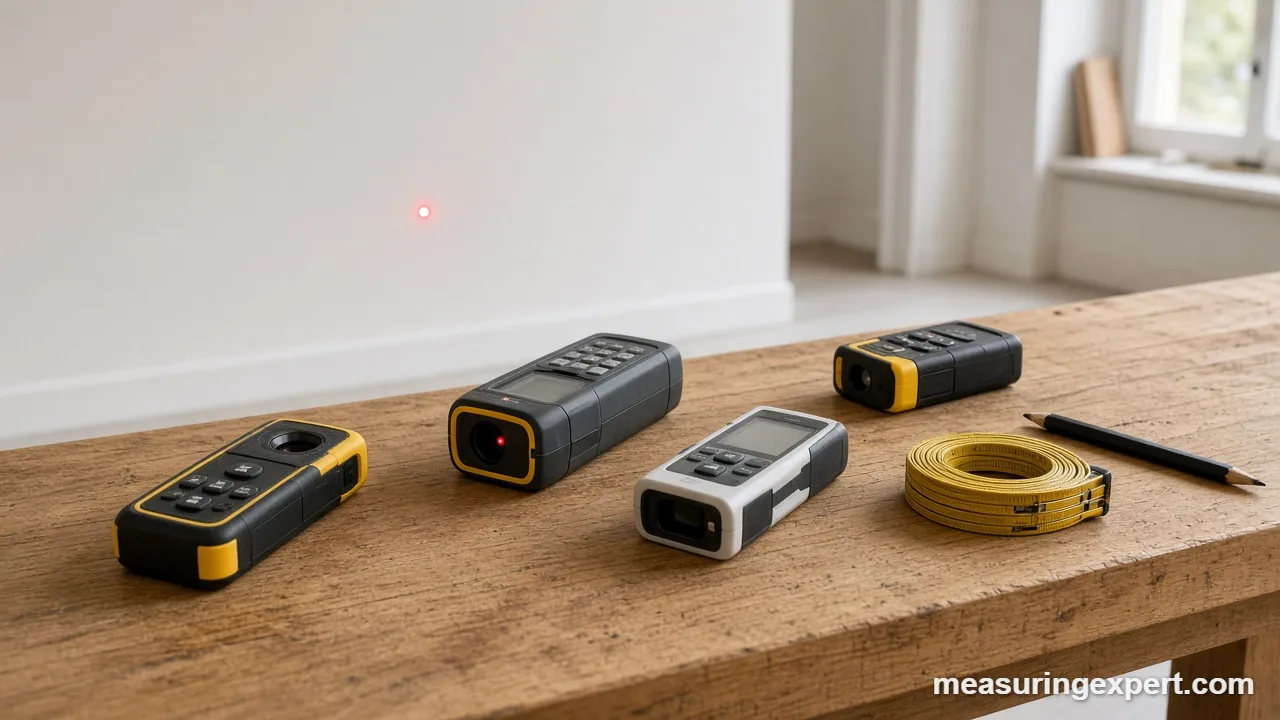
- Stated accuracy: a clear tolerance, ideally with the distance it applies to, earned credit.
- Test standard: specs quoted under ISO 16331-1 ranked higher, because they are easier to compare.
- Real-world aiming: green beams, cameras and bright displays counted for long or sunny work.
- Durability: IP ratings and drop tests mattered for job-site use.
- Use case spread: we covered home, pro, compact, outdoor and app use, with no more than two models per brand.
- Current models only: we left out tools the maker lists as discontinued.
Our sources include the Bosch GLM165-25G spec page, the Leica DISTO X1 data sheet, the MILESEEY S50 product page, and the Klein Tools catalog.
How a Laser Distance Measurer Works
First, a laser measure sends out a short pulse or a modulated beam of light. Next, the light bounces off the target, and a sensor in the tool catches the return. Then a chip works out the distance from the travel time or the phase shift of the signal. Because light covers about 300 mm in one nanosecond, the timing electronics must be very precise.
That is also why the target matters. Generally, a light, flat, matte surface returns a strong signal. By contrast, glass, mirrors, shiny metal and dark fabric scatter or absorb the beam. As a result, the tool may show an error or a wrong reading. For tricky surfaces, hold a target plate or a sheet of white card at the end point.
Laser measure vs tape measure
A laser shines on long spans, high ceilings and solo work. However, a tape still wins for short cuts, outside corners and marking stock. Therefore, most pros carry both. If you need a tape too, see our best tape measure picks.
Specs That Matter on the Best Laser Distance Measurer
Initially, spec sheets look alike. Still, a few numbers decide how the tool works in your hands, so read them closely.
| Spec | What it means | What to look for |
|---|---|---|
| Accuracy | Maximum expected error, often at 10 m (33 ft) | +/-1/16 in. (about 1.5 to 2 mm) or better |
| Range | Longest rated distance, usually on a good target | 100 ft indoors; 300 ft or more for outdoor work |
| Resolution | Smallest step the display shows | 1/32 in. or 0.1 mm for trim work |
| Beam color | Red (about 635 nm) or green (about 515 nm) | Green for bright rooms and far walls |
| IP rating | Dust and water protection | IP54 for general use; IP65 for job sites |
| Functions | Area, volume, Pythagoras, stake out | Area and volume at minimum for estimating |
| Connectivity | Bluetooth or NFC link to an app | Only if you sketch plans or keep records |
Accuracy is a range, not one number
Most makers quote accuracy at short range. However, error grows as the dot gets bigger and the return signal weakens. For example, Leica lists a dot of 6 mm at 10 m but 60 mm at 100 m. Similarly, Klein rates its compact model at +/-1/16 in. to 33 ft and +/-1/8 in. to 100 ft. So, if you measure long spans, look for a rating that covers your typical distance.
Area, volume and indirect height
Area and volume modes multiply two or three readings for you, which helps with paint, flooring and HVAC sizing. In addition, Pythagoras modes estimate a height from two or three shots when you cannot reach the top. However, each extra shot adds error, so use direct readings when you can. For the math behind area modes, see our guide to the area of a shape.
Feet and Meters Converter
Many tools switch units, but plans and product sheets still mix them. So check the conversion before you order material. One foot is exactly 0.3048 m, and one inch is exactly 25.4 mm.
For example, a +/-1/16 in. tolerance equals about +/-1.6 mm, so it is close to a +/-1.5 mm metric rating.
How to Use a Laser Distance Measurer Accurately
Indeed, good habits matter as much as the tool. Follow these steps for rooms, ceilings and exterior runs.
- Set the reference point: Choose whether the reading starts from the back, front or tripod socket. Most tools default to the back edge, so place that edge against the start surface.
- Pick your units: Select feet and inches, decimal feet or meters before you start, so you do not convert by hand later.
- Brace the tool: Hold the tool flat against the wall or floor so it cannot rock. For long shots, rest it on a tripod or a solid surface.
- Aim square at the target: Point at a flat, light-colored spot that faces you. If you aim at an angle, the beam hits a point farther away and the reading runs long.
- Measure and hold steady: Press the measure button and keep still until the reading locks. In bright light, use a target card or the camera viewfinder.
- Repeat and compare: Take the same reading two or three times. If they differ by more than the rated tolerance, check the reference point and the target surface.
- Record the result: Write the number down at once or send it to an app by Bluetooth, then label which wall or span it belongs to.
Checking Calibration and Care
A laser measure has no spring to wear, yet drops and heat can still shift the optics. Therefore, check it now and then against a known span.
- First, pick a fixed distance indoors, such as wall to wall in a hallway, and confirm it with a steel tape.
- Next, measure it with the laser three times and log the average with the date.
- Then repeat the check every few months, or after any hard drop.
- If the reading drifts past the rated tolerance, contact the maker for service.
For care, wipe the lens and receiver window with a soft, dry cloth. Also, store the tool in its pouch, away from car dashboards in summer. Finally, swap weak batteries early, because low voltage can cause error codes.
Honest Limits of Even the Best Laser Distance Measurer
Basically, a laser measures a straight line to one spot. It cannot follow a curve, and it cannot tell you whether a wall is plumb. In addition, bright sun hides the dot, so long outdoor shots need a camera model, a target plate or shade.
Also, area and volume modes assume square rooms. In older homes, that can mean a few percent of error in flooring or paint orders. So treat on-tool math as an estimate, and add a waste allowance before you buy.
Best Laser Distance Measurer FAQ
What is the best laser distance measurer for home use?
For most homes, the Bosch GLM165-25G is our top pick. It reaches 165 ft, is rated at +/-1/16 in., and has an IP65 housing. If you want a simpler tool, the Bosch GLM100-23 covers rooms up to 100 ft with two buttons.
How accurate is a laser distance measurer?
Most quality models are rated at about +/-1/16 in. (1.5 to 2 mm) at short range. However, error usually grows with distance. For example, Klein rates its 93LDM100C at +/-1/16 in. up to 33 ft and +/-1/8 in. up to 100 ft.
Is a green or red beam better on the best laser distance measurer?
Generally, green is easier to see. Bosch markets its green beams as up to four times brighter than red. So green helps in bright rooms and on far walls, while red models often cost less and use less power.
Can I use a laser distance measurer outdoors?
Yes, but sunlight makes the dot hard to see past about 30 to 60 ft. Therefore, outdoor work goes best with a camera viewfinder model, such as the MILESEEY S7, and a reflective target card.
What does ISO 16331-1 mean on a laser measure?
ISO 16331-1 is the international test standard for handheld laser distance meters. When a maker such as Leica quotes range and accuracy under it, the numbers come from a defined test method, so they are easier to compare.
Do I need Bluetooth on the best laser distance measurer?
Only if you record many readings. Bluetooth sends each reading to an app, which cuts copying errors in floor plans and estimates. For quick checks, a non-connected model is simpler and often cheaper.
Why does my laser measure give an error on some surfaces?
In general, the sensor needs enough reflected light. As a result, glass, mirrors, polished metal, dark matte surfaces and water can scatter or absorb the beam. Aim at a flat, light surface or use a target plate.
Is a laser distance measurer safe for eyes?
Most handheld models use a Class 2 laser of 1 mW or less. The blink reflex normally protects you from brief exposure. Even so, never stare into the beam or aim it at people, pets or drivers.
How do I check the calibration of a laser measure?
Measure a fixed, known distance, such as a wall-to-wall span checked with a steel tape. Then repeat it a few times and log the result. If the reading drifts beyond the rated tolerance, contact the maker for service.
Laser measure or tape measure: which should I buy?
Get both if you can. A laser is faster for rooms and long spans, and you can work alone. However, a tape is better for short cuts, outside corners and marking material. Our best tape measure guide covers that side.
Bottom Line on the Best Laser Distance Measurer
For most buyers, the Bosch GLM165-25G is the best laser distance measurer: it is rated at +/-1/16 in., reaches 165 ft, and its green beam and IP65 body suit both homes and job sites. However, choose the MILESEEY S50 for long range on a budget, the Leica DISTO X1 for standards-based accuracy and app data, or the MILESEEY S7 for outdoor work.
3 thoughts on “Best Laser Distance Measurer: 7 Picks for Rooms, Job Sites and Yards”