

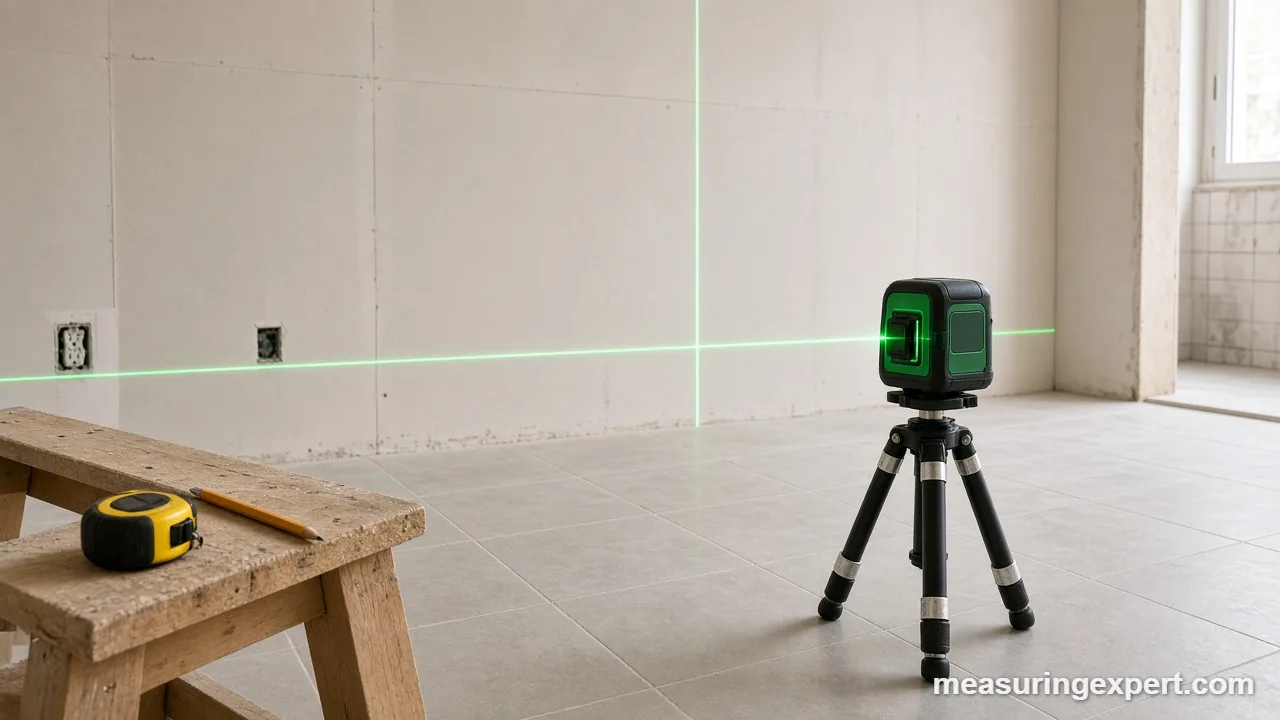
The best laser level for most people is the DEWALT DW088CG, a green cross-line laser rated at plus or minus 1/8 in at 30 ft with an IP54 housing. What decides your choice is the job: line lasers for indoor walls, rotary lasers for yards, plus accuracy, beam color and range.
In short: get the DEWALT DW088CG for most jobs, the Huepar 9011G on a budget, the Bosch GLL3-330CG for full-room layout, and the Bosch GRL900-20HVK rotary kit for yards and slabs.
As an Amazon Associate, Measuring Expert earns from qualifying purchases. Our picks are based on research, specifications and owner feedback, not paid placement.
Best Overall

Best Budget

Best Pro

Quick Answer: Which Laser Level Fits Your Job?
- Most walls, cabinets and tile: the DEWALT DW088CG, because it is rated at 1/8 in at 30 ft.
- Tight budget: the Huepar 9011G, because it is fine for frames, shelves and backsplash work.
- Whole-room layout: the Bosch GLL3-330CG, since it has three 360-degree planes and app control.
- Electricians and small spaces: the Klein 93CPLG, because it is a compact rechargeable 3×360 tool.
- Full-room lines on a budget: the Huepar HM03CG, since it is rated at 1/9 in at 33 ft.
- Large commercial rooms: the DEWALT DCLE34031, because it reaches 330 ft with a detector.
- Yards, slabs and grading: a rotary laser such as the Bosch GRL900-20HVK REVOLVE900 Rotary Laser Kit.
On This Page
- Comparison table
- The 7 picks, reviewed
- How we chose
- Line vs rotary lasers
- Accuracy explained
- Green vs red beams
- How self-leveling works
- Other specs that matter
- How to set up a laser level
- Checking calibration
- Length converter
- Honest limits
- FAQ
- Bottom line
Best Laser Level Comparison Table
| # | Product | Best For | Standout Feature | Amazon |
|---|---|---|---|---|
| 1 | DEWALT DW088CG Green Cross-Line Laser | Most indoor layout jobs | 1/8 in at 30 ft accuracy, IP54 | View |
| 2 | Huepar 9011G Self-Leveling Green Cross-Line Laser | Picture hanging and light DIY | 1/9 in at 33 ft listed accuracy | View |
| 3 | Bosch GLL3-330CG 360-Degree Connected Three-Plane Laser | Full-room layout and remodels | Three 360-degree green planes with app control | View |
| 4 | Klein Tools 93CPLG Compact Green Planar Laser Level | Electricians and tight spaces | 3×360 planes in a compact, rechargeable body | View |
| 5 | Huepar HM03CG 3×360 Rechargeable Green Laser Level | Whole rooms on a budget | 3×360 planes with an 8-hour Li-ion pack | View |
| 6 | DEWALT DCLE34031 20V MAX XR 3×360 Green Line Laser | Large rooms and commercial interiors | 330 ft with a detector, 11 hours on a 2Ah pack | View |
| 7 | Bosch GRL900-20HVK REVOLVE900 Rotary Laser Kit | Grading, decks, slabs and long runs | 1/8 in at 100 ft with a full kit | View |
The 7 Best Laser Level Picks, Reviewed
Also, every spec below comes from the maker’s own product page, and we left out any figure we could not confirm.
Best Overall
1. DEWALT DW088CG Green Cross-Line Laser
Best for: DIYers and trades who want a tough, accurate cross-line laser for cabinets, tile, framing and wall layout.
The DW088CG is the best laser level for most people because it pairs a tight spec with a job-site build. Specifically, DEWALT rates it at plus or minus 1/8 in at 30 ft (about 3.2 mm at 9.1 m). In other words, the line can drift no more than about 0.35 mm per meter, which is fine for cabinets and tile.
First, it projects one horizontal and one vertical green line. In addition, DEWALT lists a 100 ft (30 m) visible range indoors, and up to 165 ft (50 m) with the optional DW0892G detector. Also, it carries an IP54 rating and a 1 m drop rating.
- Accuracy: plus or minus 1/8 in at 30 ft (3.1 mm at 9.1 m)
- Visible range: 100 ft; up to 165 ft with the DW0892G detector
- Beam: green cross line (horizontal and vertical)
- IP54 water and debris resistance; 1 m drop rating
- Power: 3 AA batteries (included)
Pros
- Tight accuracy for a cross-line tool
- Detector support for brighter rooms
- Rugged, sealed housing
Cons
- Only two lines, so no full-room 360 planes
- AA cells, not a rechargeable pack
- Detector is sold separately
Skip it if: you lay out whole rooms at once; a 3×360 tool like the Bosch GLL3-330CG then covers every wall from one setup.
Best Budget
2. Huepar 9011G Self-Leveling Green Cross-Line Laser
Best for: homeowners who hang shelves, frames and backsplash tile and want a green beam on a small budget.
The 9011G is a simple cross-line laser with a surprisingly tight listed spec. For example, Huepar rates it at plus or minus 1/9 in at 33 ft, which works out to about 0.28 mm per meter. Better still, it self-levels within 4 degrees (plus or minus 1 degree) in under 3 seconds.
However, the range is modest. Huepar lists an 85 ft (26 m) working range at 100 lux, and it says outdoor use is not recommended. So, treat it as an indoor tool for walls and ceilings. Also, a pivoting magnetic base comes in the box, which helps on steel studs and door frames.
- Accuracy: plus or minus 1/9 in at 33 ft
- Working range: 85 ft (26 m) at 100 lux
- Self-leveling range: 4 degrees (plus or minus 1 degree)
- IP54; 2 AA batteries (not included), up to 6 hours
- Mount: 1/4-20 thread plus a 360-degree magnetic base
Pros
- Low outlay for a green beam
- Tight listed accuracy
- Magnetic pivot base included
Cons
- Indoor use only, per the maker
- No detector mode for long range
- Batteries not included
Skip it if: you need to work outside or across a large space; instead, a detector-ready tool such as the DW088CG reaches farther.
Best Pro
3. Bosch GLL3-330CG 360-Degree Connected Three-Plane Laser
Best for: remodelers, drywall and ceiling crews, and serious DIYers who want lines on every wall from one setup.
A three-plane laser projects one horizontal and two vertical 360-degree planes. As a result, it marks all four walls, the floor and the ceiling at once, and the two vertical planes cross at 90 degrees for squaring a room. The GLL3-330CG does this with a green beam that Bosch says is up to 4x brighter than standard red.
For example, Bluetooth and the free Bosch Leveling Remote App let you switch planes, change line visibility and get battery alerts from across the room. Bosch lists up to 200 ft (61 m) diameter, or 330 ft (100 m) with the LR8 receiver, but no accuracy figure on this page.
- Lines: three 360-degree planes (one horizontal, two vertical)
- Range: up to 200 ft diameter; 330 ft with the LR8 receiver
- Self-leveling range: up to 4 degrees
- Power: 12V Max 2.0 Ah battery and charger, or 4 AA via the AA1 adapter
- IP54; Class 2 green diode, 500 to 540 nm
Pros
- Full-room coverage from one spot
- App control and alerts
- Dual power: 12V pack or AA cells
Cons
- No accuracy figure on the product page
- Larger and heavier than a cross-line tool
- Costs more than the other line lasers
Skip it if: you only hang pictures; in that case, a simple cross-line laser like the Huepar 9011G is easier to carry.
Best Compact 360
4. Klein Tools 93CPLG Compact Green Planar Laser Level

Best for: electricians, low-voltage installers and DIYers who want 360-degree planes in a small, rechargeable tool.
Above all, the 93CPLG packs three 360-degree green planes (X, Y and Z) into a compact body. Klein lists accuracy as 3 mm per 10 m, which it also gives as 3/16 in at 30 ft. Therefore, it is a little looser than the DEWALT, yet still fine for box heights, conduit runs and cabinet lines.
Also, the rechargeable lithium-ion pack runs about 6 hours, and a fuel gauge shows what is left. In addition, a rare-earth magnetic bracket grips steel studs and strut. Finally, the lines flash when the tool is out of level.
- Accuracy: plus or minus 3 mm per 10 m (3/16 in at 30 ft)
- Working range: 100 ft (30.5 m)
- Beam: three 360-degree green planes, Class 2, 1 mW or less
- IP54; 1 m (3 ft) drop rating
- Rechargeable Li-ion, about 6 hours; magnetic bracket and 1/4-20 mount
Pros
- 360 planes in a compact size
- Built-in rechargeable battery with fuel gauge
- Strong magnetic bracket
Cons
- Looser spec than the DW088CG
- Self-leveling range not listed
- No detector mode listed on the page
Skip it if: you need the tightest spec for long tile runs; instead, the DEWALT or Huepar cross-line tools are rated tighter.
Best Budget 360
5. Huepar HM03CG 3×360 Rechargeable Green Laser Level

Best for: DIYers who want full-room 360-degree lines for tile, ceilings and trim without a pro-tool outlay.
Above all, the HM03CG gives you three 360-degree green planes at a modest outlay. In fact, Huepar rates it at plus or minus 1/9 in at 33 ft, the same tight spec as the 9011G. As a result, it can square a room and run a level line around all four walls from one spot.
Meanwhile, power comes from a 3.7V, 4,000 mAh lithium-ion pack that Huepar says runs up to 8 hours and charges over USB-C. In addition, Huepar lists an indoor working range of up to 98 ft at 100 lux, and up to 200 ft in pulse mode with its LR-6RG or LR-5RG detector.
- Accuracy: plus or minus 1/9 in at 33 ft
- Range: up to 98 ft indoors; 200 ft in pulse mode with a Huepar detector
- Self-leveling: within 3 degrees
- IP54; 3.7V 4,000 mAh Li-ion, up to 8 hours, USB-C charging
- Mount: 1/4-20 thread plus a magnetic pivoting base (1/4-20 and 5/8-11 threads)
Pros
- Tight listed accuracy for a 3×360 tool
- Rechargeable pack with USB-C
- Magnetic bracket and hard case included
Cons
- Detector must be a Huepar model
- Narrower self-leveling range than some tools
Skip it if: you only need a single wall line; in that case, the Huepar 9011G is smaller and simpler.
Best Long-Range Line Laser
6. DEWALT DCLE34031 20V MAX XR 3×360 Green Line Laser

Best for: trades on the DEWALT 20V or 12V platform who lay out large rooms, offices and commercial ceilings.
In short, the DCLE34031 is DEWALT’s high-precision 3×360 line laser. Specifically, DEWALT rates it at plus or minus 1/8 in at 30 ft and lists about 130 ft (40 m) of visible range. With a detector, it reaches up to 330 ft (100 m), which is far more than most line lasers.
Also, it runs on DEWALT 20V MAX batteries, and DEWALT lists up to 11 hours of runtime on a 2Ah pack with all lines on. In addition, the housing carries an IP54 rating and comes with a trade bracket and target card.
- Accuracy: plus or minus 1/8 in at 30 ft
- Range: about 130 ft visible; up to 330 ft with a detector
- Beam: three green 360-degree lines
- IP54 water resistance
- Power: DEWALT 20V MAX; up to 11 hours on a 2Ah pack
Pros
- Longest visible range among the line lasers here
- Long runtime on platform batteries
- Tight 1/8 in at 30 ft spec
Cons
- Best value only if you own DEWALT batteries
- Bulky for small DIY jobs
- Detector sold separately
Skip it if: you only hang shelves at home; instead, the DW088CG or Huepar 9011G is plenty.
Best Rotary
7. Bosch GRL900-20HVK REVOLVE900 Rotary Laser Kit

Best for: contractors and ambitious DIYers who need a level plane across a yard, slab or large building.
First, a rotary laser spins one beam to sweep a full, flat plane. Because a receiver picks up the beam, it works far beyond what the eye can see outdoors. In addition, Bosch rates the GRL900-20HVK at plus or minus 1/8 in at 100 ft, which is about 1 mm per 10 m and the tightest spec on this list.
Moreover, the kit is complete, with an LR10 receiver, tripod, 8 ft grade rod, remote control and wall mount. It self-levels up to 5 degrees and also lays down a vertical beam with a 90-degree point for squaring. Bosch lists the receiver range as both 500 ft and 1,000 ft, so plan on the lower figure.
- Accuracy: plus or minus 1/8 in at 100 ft
- Range with LR10 receiver: listed as 500 ft to 1,000 ft (the page gives both)
- Self-leveling: up to 5 degrees; horizontal and vertical modes
- Beam: red, Class 3R, under 5 mW, 630 to 670 nm
- IP54; kit with receiver, tripod, grade rod, remote and wall mount
Pros
- Tightest accuracy on the list
- Complete kit, ready for site work
- Horizontal and vertical modes
Cons
- Red Class 3R beam needs more care around eyes
- Overkill for indoor DIY
- Heavier and slower to set up than a line laser
Skip it if: your work is all indoors on walls; after all, a line laser is faster to set up and easier to see.
How We Chose the Best Laser Level Picks
First, we did not test these tools by hand. Instead, we compared published specs, manuals and owner feedback, and we kept only brands with clear spec sheets and service support. Here is what we weighed:
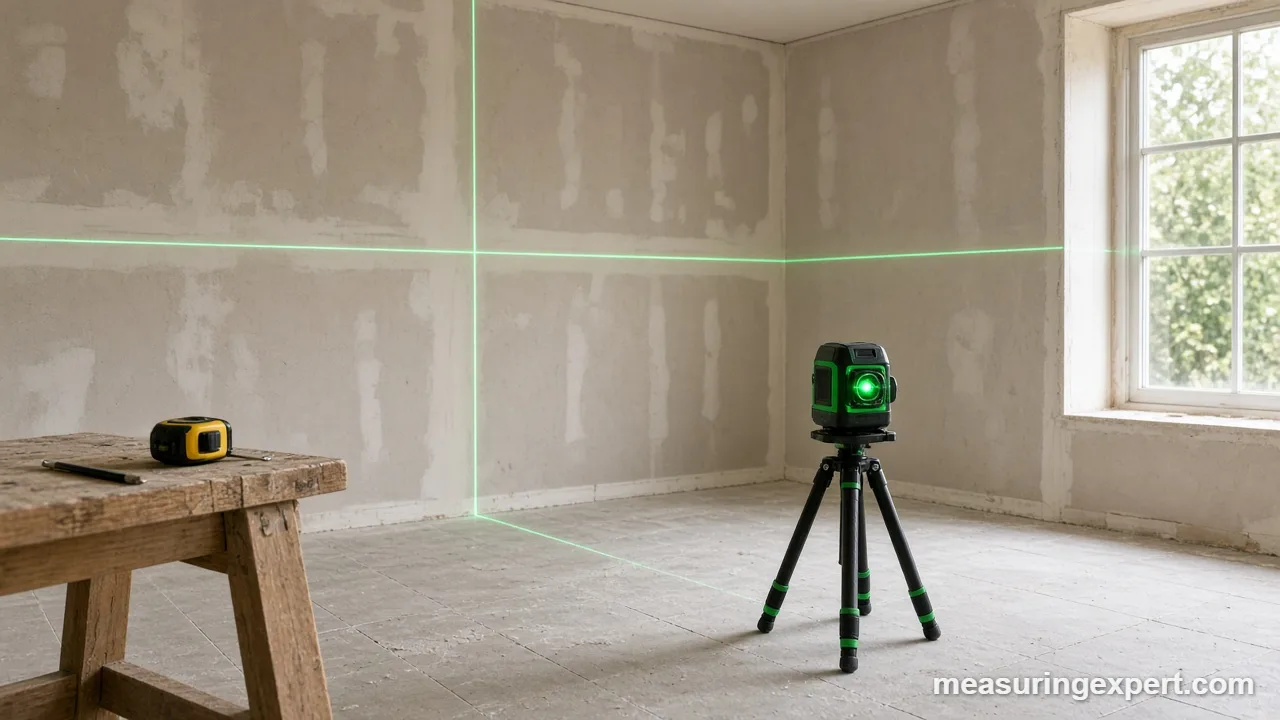
- Stated accuracy: a clear figure such as 1/8 in at 30 ft, taken from the maker’s page.
- Beam type and color: cross-line, 360-degree planes or rotary, in green or red.
- Range: visible range indoors and detector range for brighter spaces.
- Self-leveling range: how far off level the base can sit before the beam warns you.
- Durability: IP rating, drop rating and mounts.
- Power: AA cells, a built-in pack or a tool-platform battery.
Also, we read each laser’s class against FDA guidance on laser products and instruments, and we cross-checked accuracy claims such as the one on the DEWALT DW088CG product page.
Line vs Rotary: Which Type of Laser Level?
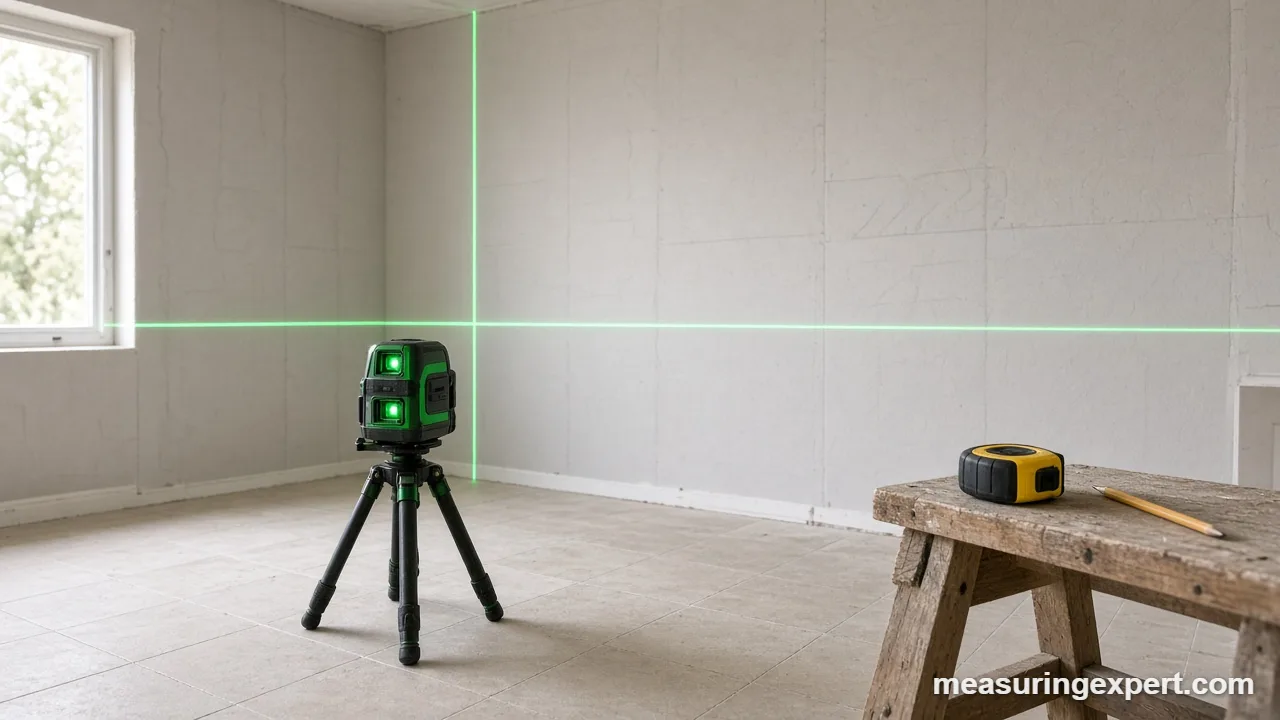
First, a line laser uses a lens to spread the beam into a visible line. A rotary laser instead spins a single dot very fast to sweep a flat plane. As a result, the beam is thin and dim to the eye, but a detector can find it from hundreds of feet away.
| Type | What it projects | Typical range | Best jobs |
|---|---|---|---|
| Cross-line | One horizontal and one vertical line | 30 to 100 ft visible | Pictures, shelves, tile, cabinets |
| 3×360 (three-plane) | One horizontal and two vertical 360-degree planes | 100 to 200 ft diameter | Whole rooms, drop ceilings, framing |
| Rotary | One spinning beam that sweeps a full plane | Hundreds of feet with a receiver | Grading, footings, fences, decks |
Overall, for most indoor work, a cross-line or 3×360 tool is the better choice. However, once you work outside in sun, or across a large slab, a rotary laser with a detector wins. Also, if you want to track grade across a yard, our guide on how to measure elevation change shows how a rotary laser and grade rod work together.
Laser Level Accuracy: What 1/8 in at 30 ft Means
Makers state accuracy as an error at a set distance, for example plus or minus 1/8 in at 30 ft. In other words, the line can sit up to 1/8 in (3.2 mm) above or below true level at 30 ft (9.1 m). Similarly, in metric terms it is about 0.35 mm per meter, or 3.5 mm per 10 m.
Error grows in a straight line with distance, so double the distance and you double the possible error.
| Stated spec | At 10 ft (3 m) | At 20 ft (6 m) | At 30 ft (9 m) | At 50 ft (15 m) |
|---|---|---|---|---|
| 1/8 in at 100 ft (Bosch GRL900-20HVK rotary) | 0.01 in (0.3 mm) | 0.03 in (0.6 mm) | 0.04 in (1.0 mm) | 0.06 in (1.6 mm) |
| 1/9 in at 33 ft (Huepar 9011G) | 0.03 in (0.9 mm) | 0.07 in (1.7 mm) | 0.10 in (2.6 mm) | 0.17 in (4.3 mm) |
| 1/8 in at 30 ft (DEWALT DW088CG) | 0.04 in (1.1 mm) | 0.08 in (2.1 mm) | 0.13 in (3.2 mm) | 0.21 in (5.3 mm) |
| 3/16 in at 30 ft (Klein 93CPLG) | 0.06 in (1.6 mm) | 0.13 in (3.2 mm) | 0.19 in (4.8 mm) | 0.31 in (7.9 mm) |
| 1/4 in at 30 ft (basic tools) | 0.08 in (2.1 mm) | 0.17 in (4.2 mm) | 0.25 in (6.4 mm) | 0.42 in (10.6 mm) |
How Accurate Should the Best Laser Level Be?
For example, for hanging frames any of these specs is fine. For tile, cabinets and drop ceilings, however, aim for 1/8 in at 30 ft or tighter. Also remember that the beam itself gets wider with distance, so always mark the center of the line. Finally, for a refresher on reading small fractions of an inch, see our guide on how to measure length.
Green vs Red Beams on the Best Laser Level
Green lasers look brighter indoors because the human eye is most sensitive to light near 555 nm, and green diodes sit close to that. For example, Bosch says its green beams appear up to 4x brighter than its standard red ones. So, a green line stays visible farther across a lit room.
Red still has a place, though. Red tools often cost less, and the same batteries tend to last longer. In addition, in direct sun neither color is easy to see, so a detector matters more than beam color outdoors. Many rotary lasers, such as the Bosch GRL900-20HVK, still use red diodes for that reason.
How Self-Leveling Works
First, most line lasers hang their optics on a small pendulum that gravity pulls to true level. Meanwhile, magnetic damping stops it from swinging, so the beam settles in a few seconds. Rotary lasers often use electronic sensors and small motors instead.
Also, every tool has a self-leveling range, often 3 to 5 degrees. For instance, the Huepar HM03CG levels within 3 degrees, and the Huepar 9011G within about 4 degrees. If the base sits farther off level than that, the beam blinks or shuts off. Therefore, set the tripod roughly level first, and let the tool do the fine work.
Other Laser Level Specs That Matter
- Range: the visible range is what you can see indoors. However, with pulse mode and a detector, many tools reach 165 ft or more.
- IP rating: IP54 resists dust and splashes. Higher ratings, such as IP55 and IP66, handle jets of water too.
- Drop rating: for example, a 1 m rating means the maker tested falls from about 3 ft.
- Laser class: most line lasers are Class 2, while many rotary lasers are Class 3R. Never look into either beam.
- Power: AA cells are easy to find. On the other hand, a built-in or platform battery saves money over time.
However, if you also need to measure distances, a laser level does not replace a distance meter. For that job, see our picks for the best laser distance measurer.
How to Set Up a Laser Level
- Set up on a stable base. First, mount the laser on a tripod, a magnetic bracket or a flat, solid surface.
- Release the pendulum. Next, slide the lock to free the self-leveling pendulum, and wait a few seconds for the beam to settle.
- Check for blinking. If the beam blinks, the base is outside the leveling range, so adjust the tripod until it stays solid.
- Set your reference height. Then measure up from the floor at one point and slide the tool up or down to match.
- Mark in the middle of the line. Mark the center of the beam, because lines get wider with distance.
- Lock it before you move it. Finally, lock the pendulum before carrying the tool to protect its calibration.
Checking Your Laser Level Calibration
Even so, a drop can knock a laser out of spec, so check it before any big job. The two-wall check needs two walls about 30 ft (9 m) apart.
- First, set the tool close to wall A and mark the center of the horizontal line on both walls.
- Next, turn the tool 180 degrees and mark both walls again.
- Then move the tool close to wall B and repeat both marks.
- Finally, compare the gaps between the pairs of marks with the maker’s tolerance.
If it is out of spec, send it to an authorized service center, because most line lasers are not user-adjustable.
Laser Range and Error Converter
For example, use this converter to turn a spec distance into the unit you work in. For example, enter 30 ft to see it in meters, or enter 0.125 in to see 1/8 in in millimeters.
Honest Limits of Any Laser Level
- Sunlight: bright sun washes out visible lines, so you need a detector outdoors.
- Calibration drifts: drops and rough transport can shift the optics.
- Beam width: lines grow wider with distance, which makes precise marks harder.
Best Laser Level FAQ
What is the best laser level for most people?
For most homes and trades, the DEWALT DW088CG is the best laser level, because it is rated at plus or minus 1/8 in at 30 ft and has an IP54 housing.
Should I buy a line laser or a rotary laser?
Buy a line laser for indoor walls, cabinets, tile and ceilings, because the lines are visible right away. Instead, buy a rotary laser for yards, slabs and long outdoor runs, where a detector finds the beam at hundreds of feet.
Is a green or red beam better on a laser level?
Green is easier to see indoors, because the human eye is most sensitive to green light. Outdoors in sun, use a detector with either color.
How accurate does the best laser level need to be?
For hanging pictures, 1/4 in at 30 ft is enough. For tile, cabinets and drop ceilings, aim for 1/8 in at 30 ft or tighter, because errors double as the distance doubles.
What does plus or minus 1/8 in at 30 ft mean?
It means the beam may sit up to 1/8 in (about 3 mm) high or low at 30 ft (9.1 m) from the tool. So, across a 15 ft wall the possible error is about 1/16 in.
What does self-leveling mean?
A pendulum or motor inside the tool sets the beam level on its own, as long as the base is within its range, often 3 to 5 degrees.
Can I use a line laser outdoors?
Only in shade or at short range, because sunlight washes out the line. For longer outdoor work, use a tool with pulse mode and a detector, or a rotary laser.
How do I check if my best laser level is still accurate?
Use the two-wall check: mark the line on one wall, rotate the tool 180 degrees, and mark again on the opposite wall. Then compare the gap with the maker’s tolerance.
Is the beam from a laser level safe for my eyes?
Most line lasers are Class 2, and many rotary lasers are Class 3R. Never stare into the beam or look at it through optics, and keep it below eye level when you can.
What range should the best laser level have?
For a single room, 30 to 65 ft is plenty. For yards and building sites, pick a rotary laser with a detector.
Bottom Line on the Best Laser Level
For most buyers, the DEWALT DW088CG is the best laser level. Its 1/8 in at 30 ft rating keeps cabinets and tile true, and the IP54 housing handles job-site dust. Meanwhile, the Huepar 9011G suits small budgets, and the Bosch GLL3-330CG suits full-room layout. For yards and slabs, step up to a rotary laser such as the Bosch GRL900-20HVK REVOLVE900 Rotary Laser Kit. Whatever you pick, check its calibration before a big job.