

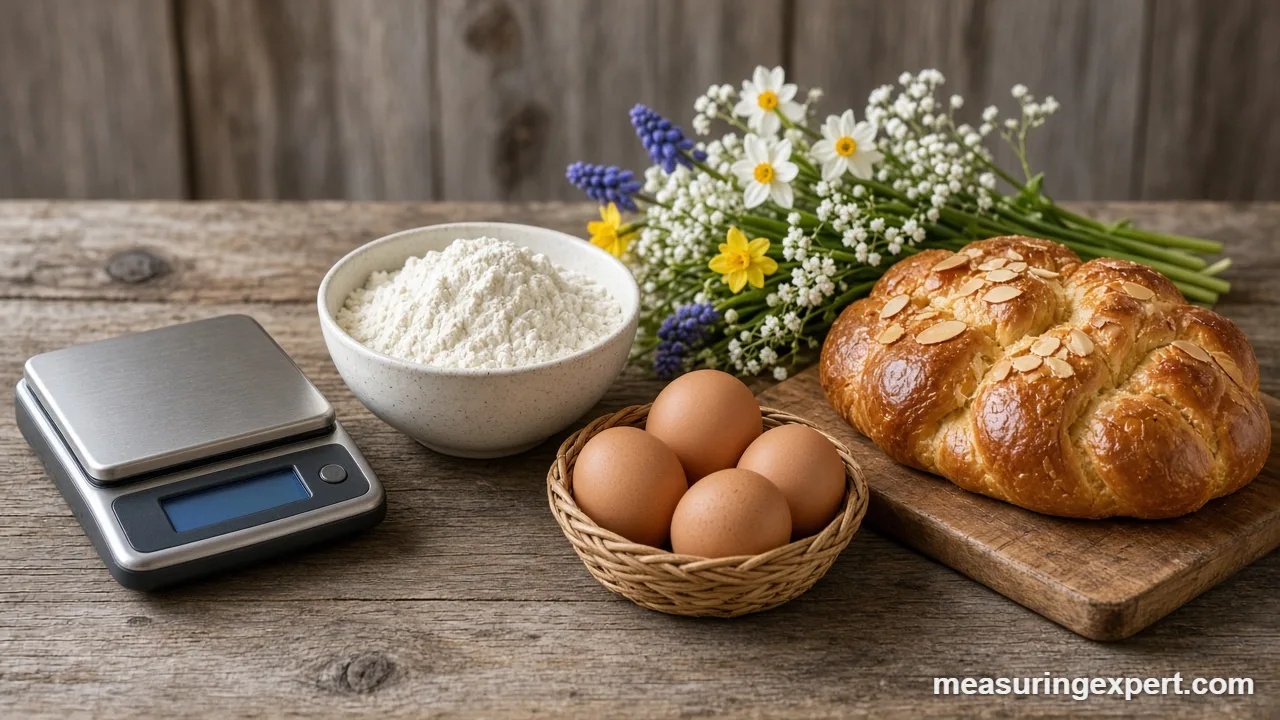
Easter baking turns out best when you weigh flour and eggs instead of scooping and guessing. One cup of bread flour is 120 g (4 1/4 oz), one large egg without its shell is 50 g (1 3/4 oz), and one packet of yeast is about 2 1/4 teaspoons. Weigh what you can, and level the rest.
Convert Cups, Tablespoons and Milliliters for Easter Baking
Enter any amount of cups to see tablespoons, teaspoons, milliliters and fluid ounces. For example, the default is one cup.
For example, hot cross buns, Easter bread, carrot cake and lemon bars all depend on the same few measurements. In fact, eggs, flour, yeast and dairy make up most of the batter. As a result, small errors in any one of them show up in the crumb, the rise and the flavor.
This guide covers Easter baking from the shopping list to the oven. First, you will see how big an egg really is. Then come flour, yeast, dairy and add-ins, followed by scaling a recipe and keeping decorated eggs safe. For weights, we use the King Arthur Baking ingredient weight chart, and egg and food safety facts come from USDA.
Measuring Eggs for Easter Baking
First, most recipes assume large eggs. USDA sets egg sizes by the minimum weight of a dozen: large is 24 oz, extra large is 27 oz, medium is 21 oz, and jumbo is 30 oz, according to the Egg Safety Center. In other words, a large egg in its shell averages at least 2 oz, or about 57 g.
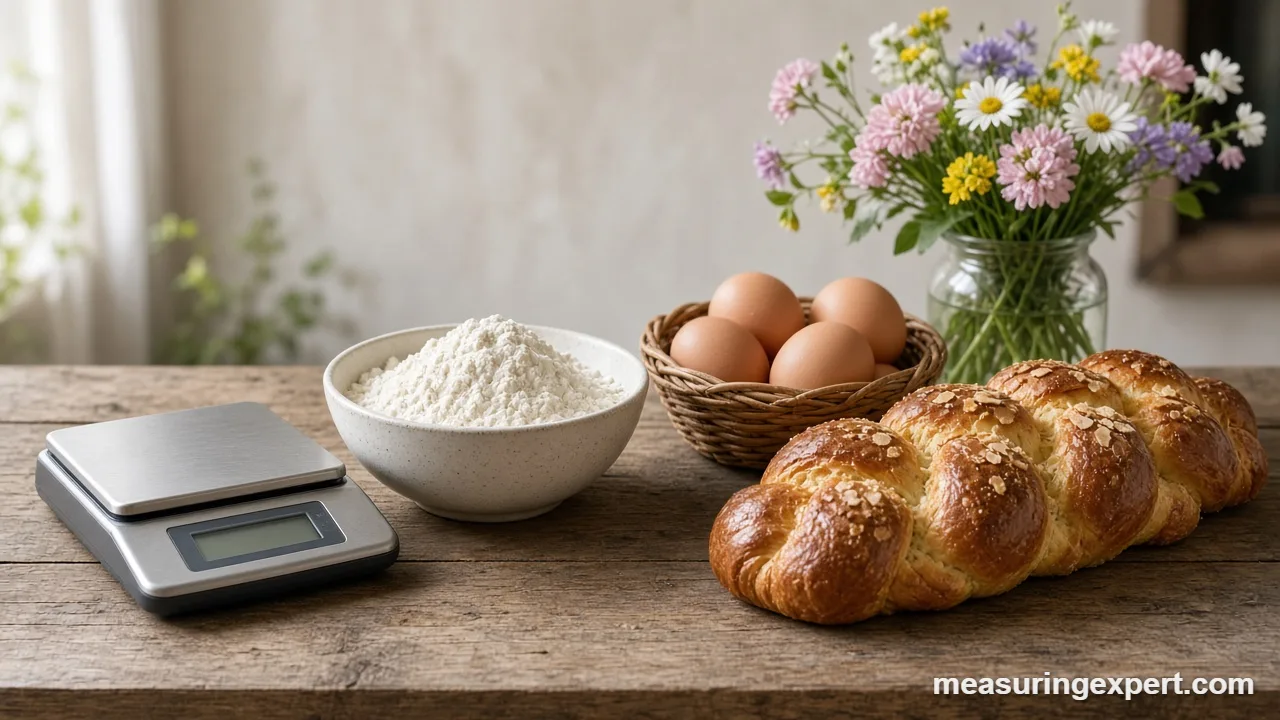
However, the shell takes up some of that. King Arthur, for instance, lists one large egg without its shell at 1 3/4 oz, or 50 g. Also, an egg white is about 30 to 35 g, and a yolk is about 14 g.
Weighing eggs, in short, solves two problems. First, it lets you swap sizes: if a recipe needs 3 large eggs, that is about 150 g of beaten egg. Second, it lets you halve a recipe that calls for an odd number of eggs. To do that, whisk the eggs together and pour out the weight you need.
Ingredient Weights for Easter Baking
First, this chart lists the ingredients that show up most in Easter baking. However, brands vary a little, so treat the numbers as dependable averages.
| Ingredient | Amount | Ounces | Grams |
|---|---|---|---|
| Bread flour | 1 cup | 4 1/4 | 120 |
| Cake flour | 1 cup | 4 1/4 | 120 |
| Almond flour | 1 cup | 3 3/8 | 96 |
| Large egg, no shell | 1 egg | 1 3/4 | 50 |
| Egg white | 1 large | 1 to 1 1/4 | 30 to 35 |
| Egg yolk | 1 large | 1/2 | 14 |
| Sour cream | 1 cup | 8 | 227 |
| Cream cheese | 1 cup | 8 | 227 |
| Heavy cream | 1 cup | 8 | 227 |
| Raisins, loose | 1 cup | 5 1/4 | 149 |
| Sliced almonds | 1/2 cup | 1 1/2 | 43 |
| Honey | 1 tablespoon | 3/4 | 21 |
| Baking powder | 1 teaspoon | 1/8 | 4 |
Source: the King Arthur Baking ingredient weight chart. Notably, the chart gives 120 g for all-purpose, bread and cake flour alike. Still, weigh each flour the way your recipe says, because brands differ.
Measuring Yeast and Water for Easter Baking
In particular, yeast breads such as hot cross buns and Italian Easter bread need two small measurements done well. First, there is the yeast. King Arthur notes that a packet used to hold about 1 tablespoon and now holds closer to 2 1/4 teaspoons. In addition, active dry and instant yeast can be swapped 1:1, though active dry may need 15 to 20 minutes more to rise.
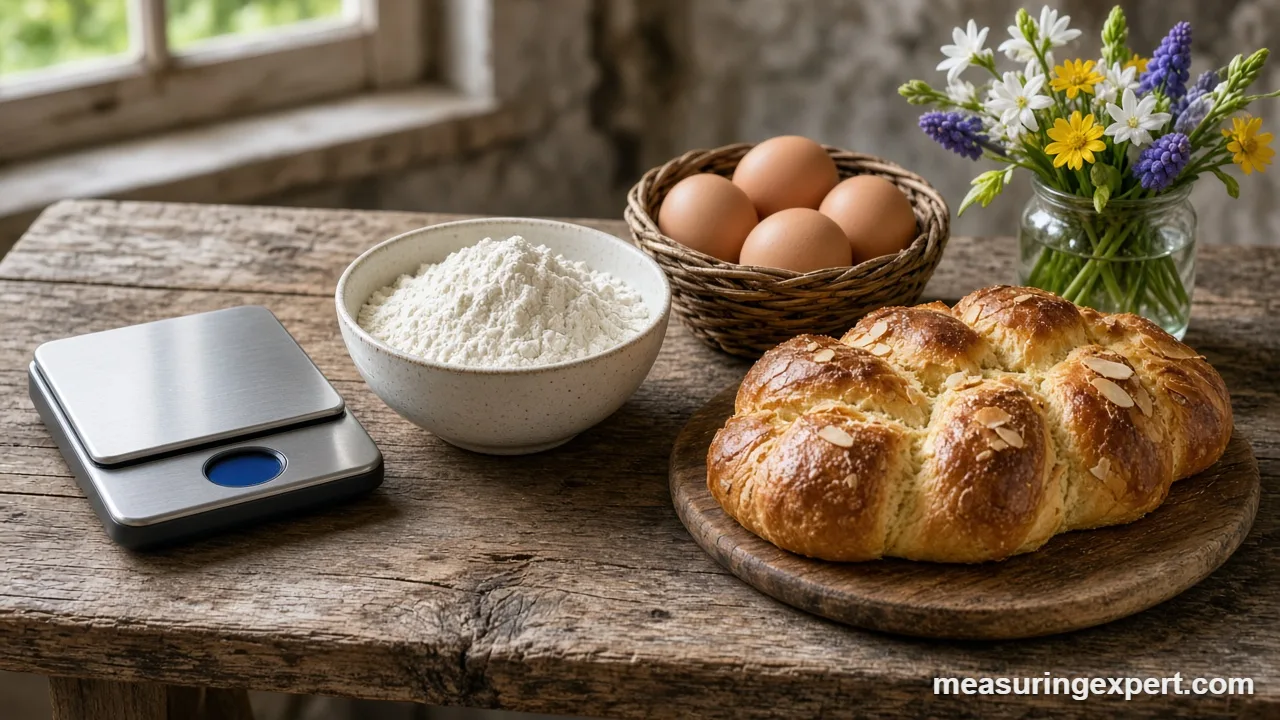
Second, there is the water temperature. The same King Arthur yeast guide says water hotter than 139 F kills yeast, and it suggests rising dough at 70 to 100 F. Therefore, an instant-read thermometer is worth using. For more on yeast amounts, see our guide to converting yeast measurements.
Sour Cream, Cream Cheese and Add-Ins
Next, Easter cakes, bars and frostings often call for sour cream or cream cheese. Both, likewise, weigh 227 g per cup, or 8 oz. As a result, two cups of sour cream is 16 oz, or 454 g, which is the same as 1 lb.
Add-ins such as raisins, nuts and coconut, however, are easy to over-measure. For example, a loose cup of raisins weighs about 149 g. In contrast, half a cup of sliced almonds weighs only about 43 g. When a recipe lists add-ins in grams, weigh them, because cups of chunky items vary with how you pile them.
Honey, meanwhile, sticks to the spoon. A tablespoon weighs about 21 g, so weigh it straight into the bowl and nothing gets left behind. Otherwise, if you must use a spoon, coat it with a little oil first.
How to Measure Ingredients for Easter Baking, Step by Step
- Take eggs and dairy out early. Check the recipe, because many Easter baking recipes want them at room temperature.
- Weigh the flour first. First, put the bowl on the scale, press tare, and add flour until the display shows the target.
- Add sugar and salt. Next, tare after each ingredient, so you read only the one you just added.
- Weigh eggs, cream and sour cream. Crack the eggs into a separate bowl, then weigh the beaten egg.
- Measure yeast with a level spoon. Next, sweep the top flat with the back of a knife.
- Check the water with a thermometer. Also, keep it below 139 F, or use the recipe temperature if it gives one.
- Add the add-ins last. Finally, fold in raisins, nuts or chocolate once the dough or batter is mixed.
However, if you only have cups, spoon the flour into a dry cup and level it. Our guide to measuring ingredients with a kitchen scale explains the weighing method in more detail.
Scaling an Easter Baking Recipe
Easter often means feeding a crowd, so the table below scales a sample sweet bread dough with 4 cups of flour (480 g), 3 large eggs (150 g), 1/2 cup of butter (113 g), 1/2 cup of sugar (99 g) and 1 packet of yeast (2 1/4 tsp).
| Batch | Flour | Eggs | Butter | Sugar | Yeast |
|---|---|---|---|---|---|
| Half | 240 g (2 cups) | 75 g (1 1/2 eggs) | 57 g (4 tbsp) | 50 g (1/4 cup) | 1 1/8 tsp |
| Normal | 480 g (4 cups) | 150 g (3 eggs) | 113 g (1/2 cup) | 99 g (1/2 cup) | 2 1/4 tsp |
| One and a half | 720 g (6 cups) | 225 g (4 1/2 eggs) | 170 g (3/4 cup) | 149 g (3/4 cup) | 3 3/8 tsp |
| Double | 960 g (8 cups) | 300 g (6 eggs) | 227 g (1 cup) | 198 g (1 cup) | 4 1/2 tsp |
Note that the gram weights use the King Arthur values (butter 227 g per cup, sugar 198 g per cup). One cup is 16 tablespoons, so 4 tablespoons is 1/4 cup. Likewise, 4 1/2 teaspoons of yeast equals 1 tablespoon plus 1 1/2 teaspoons. Also, larger doughs rise at their own pace, so watch the dough rather than the clock.
For other kitchen math, see our guide to the metric system in cooking.
Recommended Tools for Easter Baking Measurements
First, a digital scale handles most of the work here, since flour, eggs and dairy all weigh well. In addition, a set of measuring spoons covers yeast, baking powder and spices. Finally, a glass measuring cup suits milk and cream, and a thermometer protects the yeast.


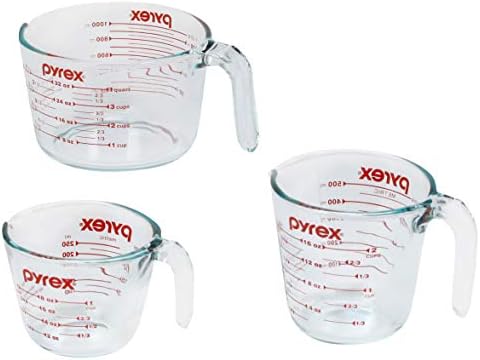


As an Amazon Associate, Measuring Expert earns from qualifying purchases.
Key Takeaways
- A large egg without its shell is 50 g, so you can weigh eggs and swap sizes.
- One cup of bread or cake flour is about 120 g by the King Arthur chart.
- One yeast packet is about 2 1/4 teaspoons, and water above 139 F kills yeast.
- Sour cream and cream cheese weigh 227 g per cup, so 2 cups is 454 g.
- Hard-cooked Easter eggs go back in the refrigerator within 2 hours.
- Scale by weight, and use a level spoon for yeast and baking powder.
Egg Safety for Easter Baking and Decorating
Easter brings extra egg handling. First, USDA says to keep eggs at 40 F or below and not to leave refrigerated eggs out for more than 2 hours. Next, hard-cooked eggs should go back in the refrigerator within 2 hours of cooking and be eaten within 1 week. The same applies after dyeing. Therefore, use food-safe coloring and wash your hands first.
Decorated Italian Easter bread that has whole eggs baked into it, however, follows a shorter rule. USDA says to serve it within 2 hours, or refrigerate it and use it within 3 to 4 days. Finally, do not eat hard-cooked eggs that were hidden or handled during an egg hunt. See the USDA shell egg guide for the full list.
Meanwhile, hard-cooked eggs also need a reliable timer. Our guide on how to use a kitchen timer can help.
Common Mistakes in Easter Baking Measurements
- Scooping flour with the cup. The cup packs the flour, so the bread turns out dense.
- Using the wrong egg size. A recipe written for large eggs can, therefore, run wet or dry with medium or jumbo eggs.
- Using hot water on yeast. Water above 139 F kills it, so the dough will not rise.
- Treating a liquid cup like a dry cup. You cannot level a liquid cup, so the amount is a guess.
- Mixing up tsp and tbsp. Three teaspoons make one tablespoon, so a mix-up triples or cuts the amount to a third.
- Leaving decorated eggs out. Return them to the refrigerator within 2 hours.
Do and Don’t for Easter Baking
Do
- Weigh flour, butter and eggs when you can.
- Use a thermometer for yeast water.
- Crack eggs into a separate bowl.
- Level every spoon of yeast and baking powder.
- Refrigerate dyed eggs within 2 hours.
Don’t
- Scoop flour straight from the bag.
- Pour boiling water on yeast.
- Swap egg sizes without weighing.
- Round tablespoons and teaspoons by eye.
- Eat eggs that sat out at an egg hunt.
Honest Limits of These Measurements
Overall, every gram figure here is an average from one source. For one thing, flour brands differ, humidity changes how much water flour holds, and eggs vary within a size class. For instance, USDA sizes are minimums for a dozen, not exact weights for each egg. In short, use the numbers as a strong starting point. Therefore, if your recipe gives its own weights, follow those first.
When Accuracy Really Matters
Most home bakers can forgive a spoon of flour here or there. However, yeast, leaveners and salt are the exceptions, because small errors change the rise and the taste. Likewise, food safety for eggs and dairy matters more than precision. So anyone cooking for very young children, older adults, pregnant guests or people with weakened immune systems should follow USDA guidance closely.
Frequently Asked Questions
What is the best way to measure ingredients for Easter baking?
First, weigh flour, butter, sugar and eggs on a digital scale. Also, use level spoons for yeast and baking powder, and a liquid cup for milk and cream.
How much does a large egg weigh for Easter baking?
In short, a large egg without its shell weighs about 50 g, or 1 3/4 oz. In its shell, however, USDA large eggs average at least 2 oz, or about 57 g.
How much does a cup of bread flour weigh?
For a cup of bread flour, King Arthur lists 120 g, or 4 1/4 oz, when you spoon and level it.
How do you measure 2 cups of sour cream?
Two cups of sour cream weigh 454 g, or 16 oz. You can weigh it on a scale. Alternatively, use a dry measuring cup and level the top.
How many teaspoons are in a yeast packet?
A packet holds about 2 1/4 teaspoons today. Older packets, however, held closer to 1 tablespoon, so check the recipe.
What water temperature kills yeast?
In fact, King Arthur says water hotter than 139 F kills yeast. For rising dough, however, it suggests 70 to 100 F.
Can I use medium eggs in Easter baking?
Yes, but weigh them. For example, three large eggs are about 150 g without shells, so use that weight of beaten medium eggs instead.
How long can dyed Easter eggs stay out?
USDA says to return hard-cooked eggs to the refrigerator within 2 hours of cooking or dyeing, and to eat them within 1 week.
How many tablespoons are in a cup?
In fact, there are 16 tablespoons in a US cup. As a result, 1/4 cup equals 4 tablespoons.
Do I need a scale for Easter baking?
No, but a scale gives more consistent results than cups. Otherwise, spoon the flour into a dry cup and level it.
Easter Baking: The Bottom Line
To sum up, weigh your flour, eggs and dairy, and watch your yeast water. A cup of flour is about 120 g, a large egg without the shell is 50 g, and a cup of sour cream is 227 g. As a result, your Easter baking will come out the same from one batch to the next.
Finally, keep dyed and decorated eggs cold, and use the converter above whenever a recipe switches between cups, spoons and milliliters. For a similar guide, see how to measure Halloween treats.