

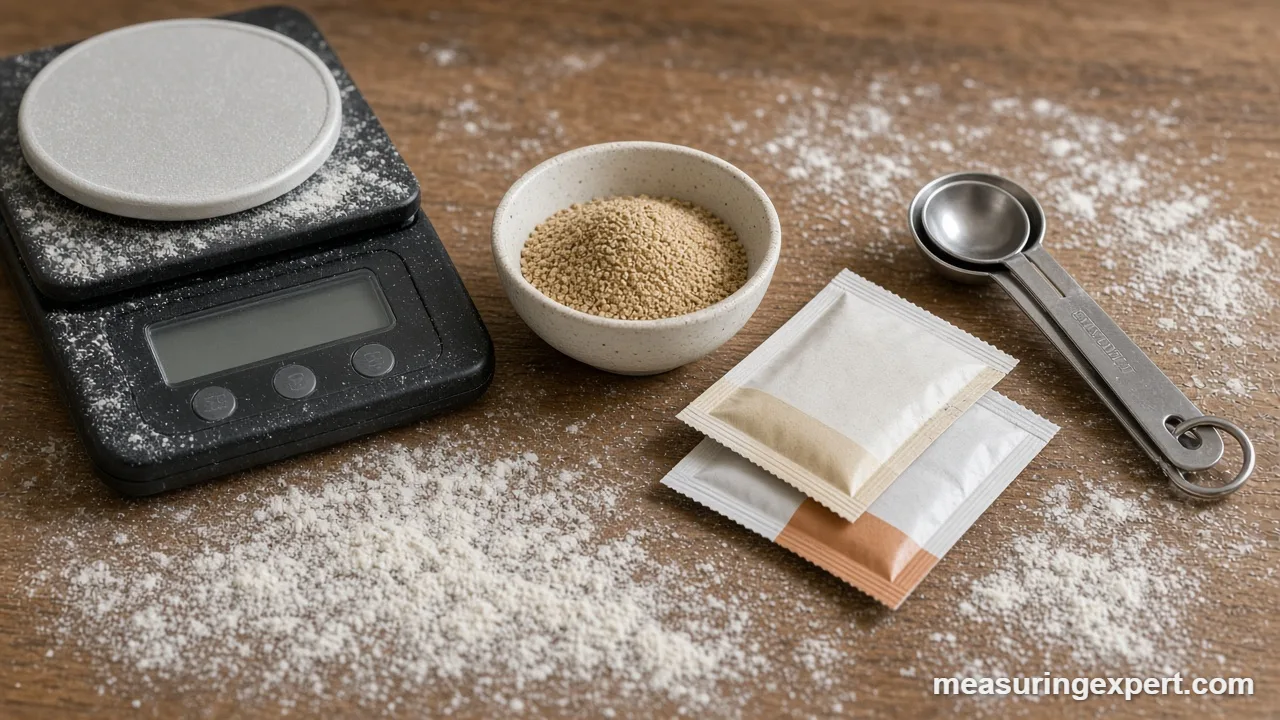
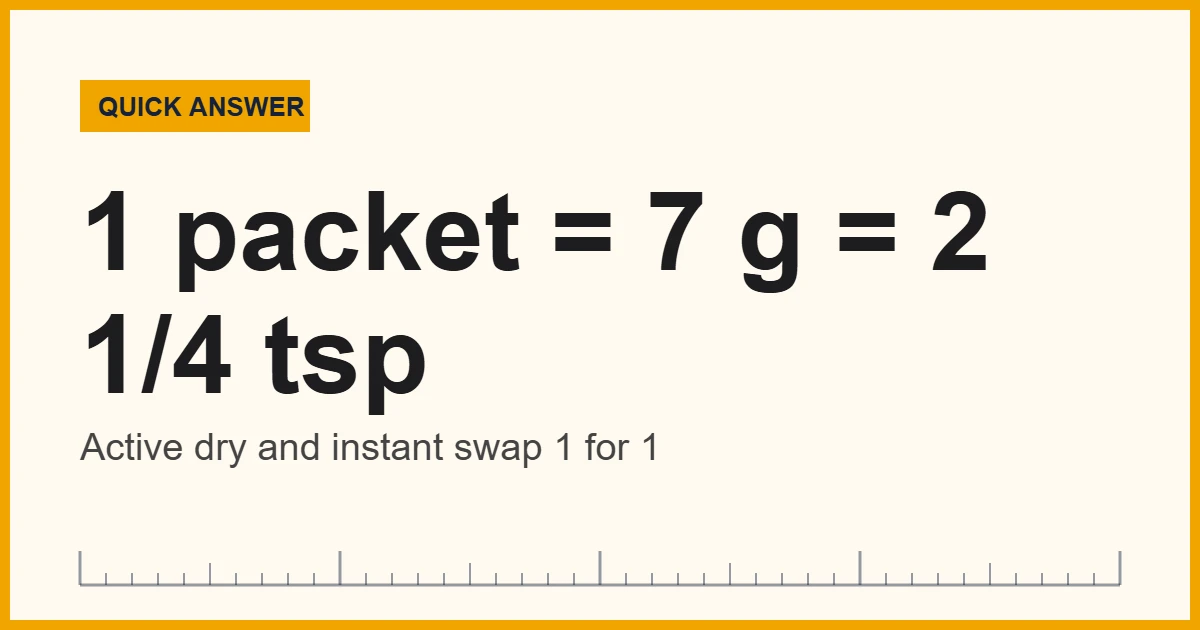
To convert yeast measurements, remember that one 1/4 oz packet is 7 g, or about 2 1/4 tsp, of dry yeast. Active dry and instant yeast swap 1 for 1. Fresh cake yeast is weaker by weight, so use roughly 2.7 times as much fresh yeast as dry (about 19 g per packet).
Yeast recipes use three kinds of yeast and at least three kinds of units. As a result, a recipe that lists grams of fresh yeast can leave you staring at a jar of dry yeast and a set of teaspoons. Fortunately, the math is short once you know a few anchor numbers.
In this guide, you will learn how to convert yeast measurements between teaspoons, grams, ounces and packets. In addition, you will see how to swap active dry, instant and fresh yeast. Finally, you will find worked examples, tool tips and ten quick answers.
The figures come from yeast maker Red Star, whose yeast conversion chart pairs fresh yeast with dry yeast in grams, teaspoons and packages. King Arthur Baking gives the same 7 g packet size in its guide to active dry versus instant yeast.
Convert Yeast Measurements: Packets, Teaspoons and Grams
To start, use this chart for dry yeast (active dry or instant). It matches Red Star’s figures of 7 g, or 2 1/4 tsp, per 1/4 oz packet. Also, fresh yeast amounts are in the last column.
| Packets (1/4 oz) | Teaspoons | Grams | Ounces | Fresh cake yeast |
|---|---|---|---|---|
| 1/4 packet | 9/16 tsp | 1.75 g | 0.06 oz | about 5 g |
| 1/2 packet | 1 1/8 tsp | 3.5 g | 0.12 oz | about 9 g |
| 1 packet | 2 1/4 tsp | 7 g | 0.25 oz | about 19 g (2/3 oz) |
| 2 packets | 4 1/2 tsp | 14 g | 0.5 oz | about 38 g (1 1/3 oz) |
| 3 packets | 6 3/4 tsp | 21 g | 0.74 oz | about 57 g (2 oz) |
| 4 packets | 9 tsp (3 tbsp) | 28 g | 0.99 oz | about 66 g (2 1/3 oz) |
First, one level teaspoon of dry yeast weighs about 3.1 g, and one tablespoon about 9.3 g. In addition, a packet is close to 2 tsp on a heaped spoon, so weigh it when the recipe is picky. For other ounce conversions, see how much an ounce is.
Yeast Weight Converter
First, enter the grams from your recipe. Then the converter shows ounces and other units, with the formula underneath. For teaspoons, divide the grams by 3.1.
Convert Yeast Measurements Between Active Dry, Instant and Fresh
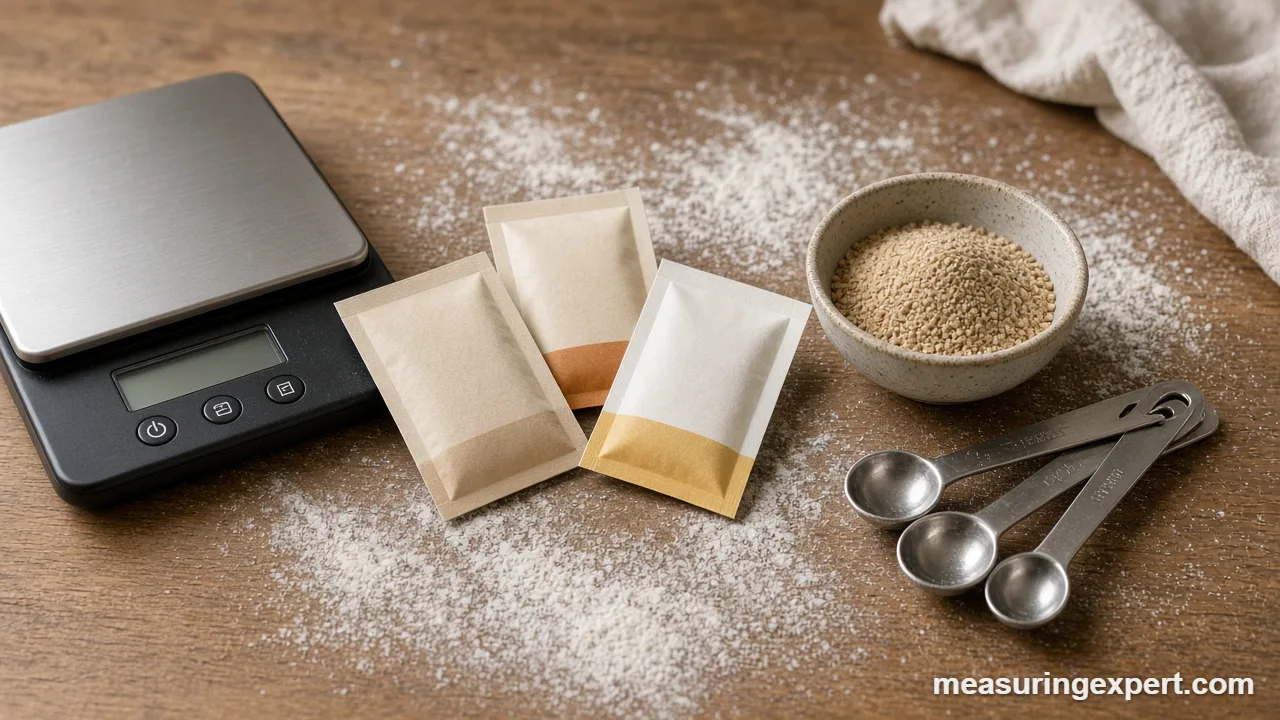
In fact, all three kinds are the same species of yeast. However, they differ in moisture, so they behave differently in the bowl. The table below sums up how to swap them.
| Type | How it is sold | How to use it | Swap rule |
|---|---|---|---|
| Active dry yeast | Coarse dry granules | Dissolve in warm water first | Baseline |
| Instant yeast | Fine dry granules | Mix straight into the flour | 1 for 1 with active dry, by weight or volume |
| Fresh (cake) yeast | Moist, crumbly block | Crumble into liquid or flour | About 2.7 times the dry weight |
In fact, both Red Star and King Arthur say instant and active dry yeast swap evenly. Some older recipes and bread machine manuals call for less instant yeast, so follow the recipe if it states an amount.
How to Convert Yeast Measurements From Fresh to Dry
Fresh yeast is mostly water, so it takes more of it to match the leavening power of dry yeast. For instance, Red Star pairs 2/3 oz of fresh yeast with one 7 g packet of dry yeast. As a result, that works out to about 2.7 grams of fresh yeast for every gram of dry.
Here are two worked examples, so you can see the math:
- Fresh to dry: A recipe asks for 25 g of fresh yeast. Then divide by 2.7 to get about 9.3 g of dry yeast, which is roughly 3 tsp or 1 tbsp.
- Dry to fresh: A recipe asks for 2 tsp of dry yeast, or about 6.2 g. Then multiply by 2.7 to get about 17 g of fresh yeast.
- Ounces of fresh yeast: One ounce of fresh yeast equals about 10.5 g of dry yeast, or 3 3/8 tsp.
The old rule of thumb says 3 to 1, and it is close. In practice, though, Red Star’s own chart gives the slightly lower 2.7 to 1. Cake yeast sizes have also changed over the years, so check the package weight before you cut it.
How to Convert Yeast Measurements Step by Step
- Find the unit in your recipe. It may be teaspoons, grams, ounces, packets or a fraction of a cake.
- Convert it to grams of dry yeast. Use 3.1 g per teaspoon, 9.3 g per tablespoon, and 7 g per packet.
- Check the yeast type. Dry types swap 1 for 1, so keep the same weight.
- Convert for fresh yeast if needed. Multiply the dry grams by 2.7 for fresh, or divide fresh grams by 2.7 for dry.
- Weigh it out. Tare a small bowl on a scale and add yeast until you hit the number.
- Write it on the recipe. Next time you will have the exact amount ready.
Recommended Tools to Measure Yeast
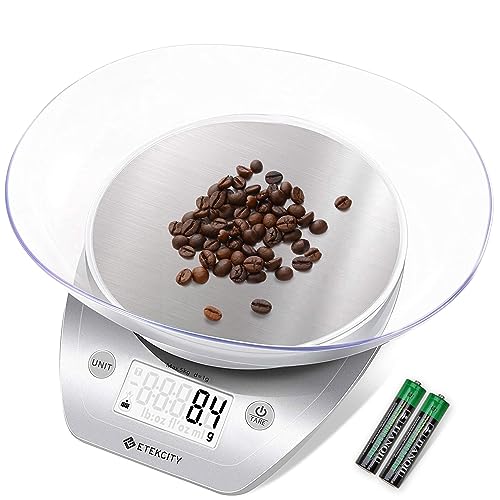
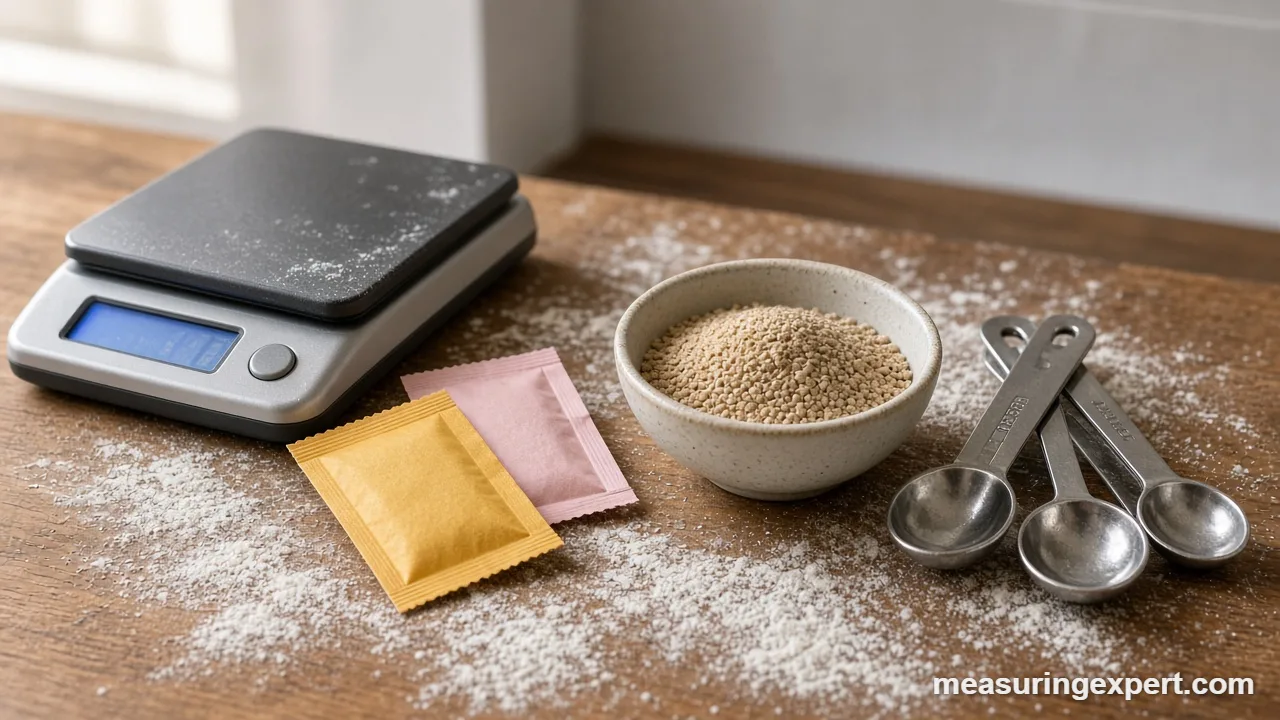
Yeast amounts are small, so precision matters more than with flour. First, a scale that reads in 1 g steps (or finer) makes the conversions above easy. Next, a good spoon set handles quarter and half teaspoons. Our baking scale guide explains what to look for.




As an Amazon Associate, Measuring Expert earns from qualifying purchases.
Adjusting Yeast for Sugar, Flour and Bread Machines
The recipe size and the dough also change how much yeast you need. Red Star lists these rules of thumb, so use them as a starting point.
- Flour amount: The chart above scales with flour. For example, one packet suits up to about 4 cups of flour, and two packets suit 4 to 8 cups.
- Sweet doughs: If the dough has more than 1/2 cup of sugar per 4 cups of flour, Red Star advises adding one more packet.
- Bread machines: Red Star suggests 3/4 tsp of active dry yeast or 1/2 tsp of instant yeast per cup of flour.
However, bread machines use less instant yeast than active dry. This is a machine setting, not a general swap rule, so use it only for machine recipes. For measuring spoon sizes, our guide to how much 30 mL is shows how spoons relate to milliliters.
Do and Don’t When You Convert Yeast
Do
- Weigh yeast when you can.
- Level every teaspoon with a knife.
- Check the package size of cake yeast.
- Keep dry yeast sealed and cool.
- Test old yeast in warm water first.
Don’t
- Swap fresh and dry yeast 1 for 1.
- Use heaping spoons by habit.
- Mix up a packet with a tablespoon.
- Add yeast to very hot water.
- Round to the nearest whole teaspoon.
Honest Limits When You Convert Yeast Measurements
First, these numbers are averages. For one thing, brands pack their granules differently, so a teaspoon of one brand can weigh slightly more than a teaspoon of another. Moreover, a heaped teaspoon holds up to a third more than a level one. For instance, King Arthur even describes a packet as a slightly heaped 2 tsp, while Red Star lists 2 1/4 tsp.
Likewise, yeast is alive, so its strength fades with age and warmth. As a result, an old jar may need extra time to raise the dough, no matter how exactly you converted it. In short, a conversion tells you how much to add, and the dough tells you whether it worked.
Frequently Asked Questions
How do I convert yeast measurements from packets to teaspoons?
One standard 1/4 oz packet is 7 g, which is about 2 1/4 tsp of dry yeast. Two packets are about 4 1/2 tsp.
What is one package of active dry yeast equivalent to in instant yeast?
It equals one package of instant yeast, since the two swap 1 for 1 by weight or volume. That is about 7 g or 2 1/4 tsp.
How do you convert 2 teaspoons of active dry yeast to instant yeast?
In short, use 2 teaspoons of instant yeast. Red Star and King Arthur both say the two swap evenly. Some bread machine recipes use less, so follow the recipe if it says so.
How much dry yeast is equivalent to fresh yeast?
Use about 2.7 g of fresh yeast for each 1 g of dry yeast. For example, 7 g of dry yeast matches about 19 g (2/3 oz) of fresh yeast.
How many grams are in a teaspoon of yeast?
One level teaspoon of dry yeast weighs about 3.1 g. A tablespoon, which is 3 teaspoons, weighs about 9.3 g.
How do I convert fresh yeast to dry yeast in a recipe?
Divide the grams of fresh yeast by 2.7. For example, 25 g of fresh yeast becomes about 9.3 g of dry yeast, or roughly 1 tablespoon.
How much dry yeast equals a 2 oz cake of fresh yeast?
A 2 oz (57 g) cake equals about 21 g of dry yeast, or 6 3/4 tsp. That is three standard packets.
What calculations can you do to substitute one type of yeast for another?
For dry types, keep the same amount. However, for fresh, multiply the dry weight by 2.7, or divide the fresh weight by 2.7 to find dry.
Can I convert yeast measurements with spoons instead of a scale?
Yes, but a scale is more accurate. Therefore, use level spoons, and remember that a heaped spoon holds noticeably more yeast than a level one.
How many ounces is a packet of yeast?
A standard packet is 1/4 oz, which is 7 g. Also, this is weight, not fluid ounces.
Convert Yeast Measurements: The Bottom Line
To sum up, one packet is 7 g or about 2 1/4 tsp of dry yeast, and active dry and instant yeast swap evenly. Fresh yeast needs about 2.7 times the dry weight. In short, remember these three numbers, and most recipes convert in seconds.
Finally, weigh the yeast whenever you can, and use the converter above for ounces. Meanwhile, trust the dough: if it rises on time, your conversion worked.
1 thought on “How to Convert Yeast Measurements: Tsp, Grams and Packets”