

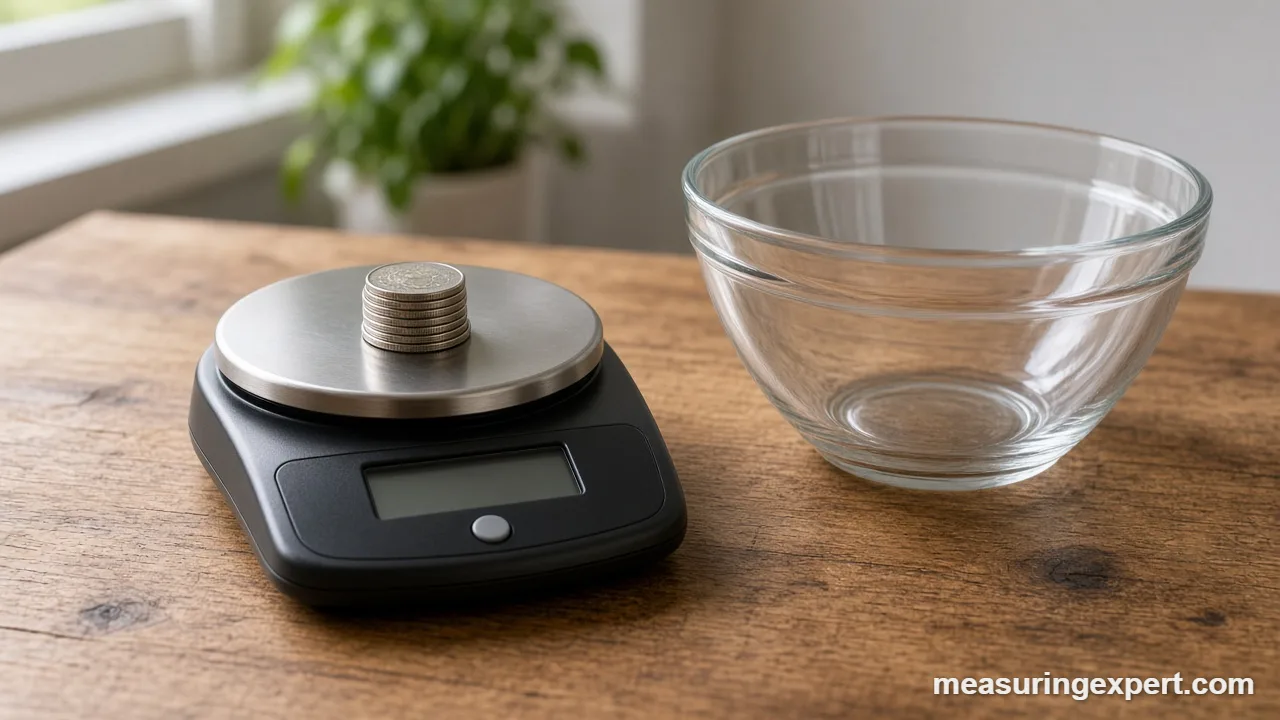
Kitchen scale accuracy comes down to four things: resolution (how small a step the display shows), capacity, a working tare button, and a quick calibration check. For that check, a US nickel weighs 5.00 g, so a healthy scale should read 5 g (0.18 oz) with one coin on the platform.
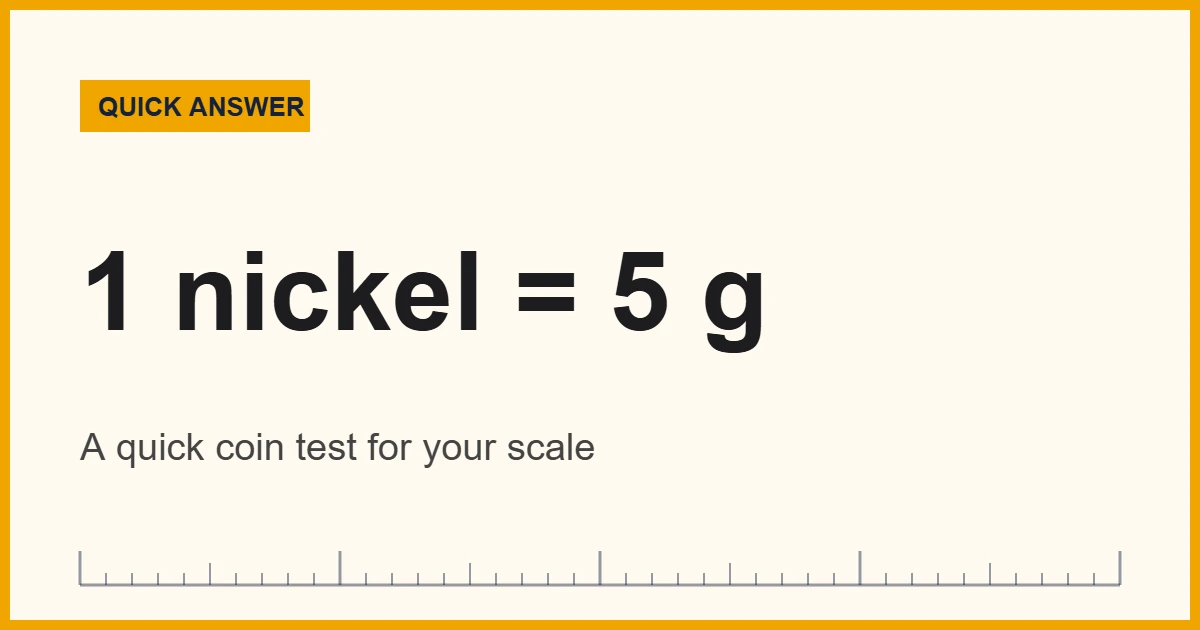
Weight Converter for Checking Your Scale
Use this converter to switch a reading between grams, ounces, pounds and kilograms. It helps when a recipe lists one unit and your display shows another.
Many shoppers ask which scale is the best, yet the better question is what makes one scale more trustworthy than another. Two scales can look alike and cost about the same. Even so, one may drift, round poorly or lose its zero after a few weeks. As a result, a basic grasp of kitchen scale accuracy saves you from buying twice.
In practice, accuracy matters most in baking, coffee, bread and portion tracking. For example, a few grams of extra salt or yeast changes the result, while a few extra grams of potatoes do not. Therefore, match the scale to the job, and then check it once before you rely on it.
Below, you will first see how the key terms differ. After that, you will learn how to test kitchen scale accuracy at home with a coin, and finally where to find our product roundups.
Kitchen Scale Accuracy vs Precision vs Resolution
Product pages often use these three words as if they meant the same thing. They do not. In short, resolution is what the display can show, precision is how repeatable the reading is, and accuracy is how close the reading is to the true weight.
| Term | Plain meaning | Example |
|---|---|---|
| Resolution | The smallest step the display shows | A display that moves in 1 g steps, or in 0.1 g steps |
| Precision (repeatability) | Whether the same load gives the same reading each time | A coin reads 5 g on ten weighings in a row |
| Accuracy | How close the reading is to the true weight | A 100 g test weight reads 100 g, not 103 g |
A scale can be precise and still wrong. For instance, it may read 103 g every single time for a true 100 g load. Likewise, a scale with a 0.1 g display is not automatically accurate to 0.1 g. The display only shows the digits; the sensor inside decides whether they are right.
The Features Behind Kitchen Scale Accuracy
Resolution: 1 g or 0.1 g?
Resolution sets the floor for any reading. A scale that steps by 1 g rounds every load to the nearest gram, so a 5 g load can show anywhere between 4.5 g and 5.5 g of real weight. That is a possible error of up to 10 percent on a small amount. By contrast, a 0.1 g scale rounds to the nearest 0.05 g, which is about 1 percent on the same 5 g.
For everyday cooking, 1 g is plenty. However, if you weigh yeast, salt for bread, spices or coffee, 0.1 g resolution is more useful. Moreover, higher resolution usually comes with a lower capacity, so check both numbers together.
Capacity: Match the Scale to the Biggest Load
Capacity is the heaviest load the scale can weigh, bowl included. Most home scales list 5 kg (about 11 lb), which covers a large mixing bowl full of dough. Because the bowl counts toward the limit, add its weight to your heaviest batch before you decide. Going over the limit can overload the sensor and, as a result, shift its readings for good.
Tare: Zero the Bowl, Not the Recipe
The tare button subtracts whatever sits on the platform, so you can weigh each ingredient straight into the same bowl. It removes the mental math, and it cuts the chance of an arithmetic slip. Still, tare does not fix a bad sensor. If the display drifts after you press it, the scale has a stability problem.
Units, Platform and Power
Look for a scale that switches between grams, ounces and pounds, because recipes use all three. A flat, solid platform helps too, since a wobbly surface gives uneven readings. Finally, fresh batteries matter more than most people think. A weak battery is one of the most common reasons a good scale starts to read oddly.
Digital vs Spring Scales for Kitchen Scale Accuracy
Most buyers now choose a digital scale with a load cell. Spring scales still exist, though. Here is how the two compare.
| Feature | Digital (load cell) | Spring (dial) |
|---|---|---|
| Typical resolution | 1 g or 0.1 g | Often 5 g to 10 g, hard to read between marks |
| Tare | Button, instant | Dial knob, manual |
| Power | Batteries or USB | None |
| Drift over time | Can drift with load and temperature | Spring fatigue can shift the zero |
| Best for | Baking, coffee, small amounts | Rough portions, large amounts |
Since a spring scale shows weight on a dial, parallax (reading the needle from an angle) adds error. For that reason, digital scales suit baking better.
How to Test Kitchen Scale Accuracy at Home
You do not need lab weights for a first check. According to the US Mint coin specifications, a nickel weighs 5.00 g, a quarter 5.67 g and a dime 2.268 g. Those values make coins handy, free test weights for the low end of your scale.
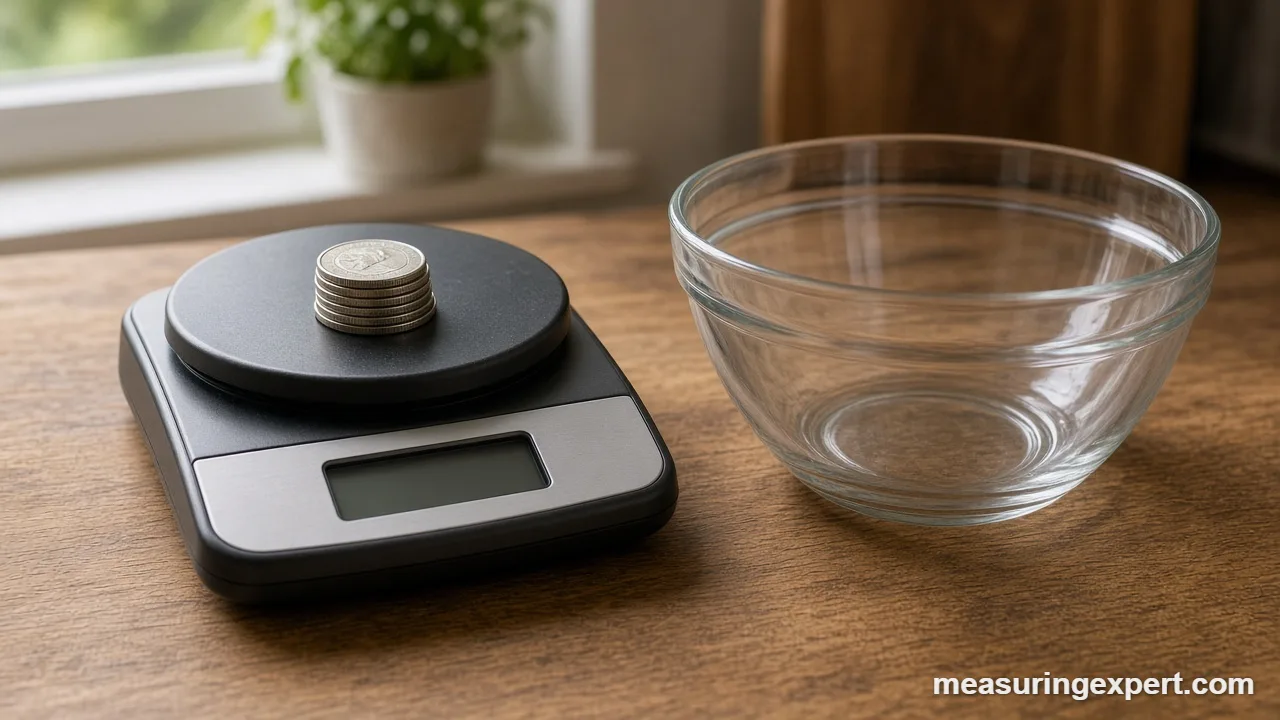
- Warm up and level. Place the scale on a flat, hard counter, switch it on, and wait about a minute until the display settles at zero.
- Check zero. With nothing on the platform, the display should read 0 and stay there.
- Weigh one nickel. Set a single nickel in the middle of the platform. A 1 g scale should show 5 g; a 0.1 g scale should show about 5.0 g.
- Stack more coins. Add nickels one at a time and compare. Four nickels should read 20 g, ten should read 50 g and twenty should read 100 g.
- Move the load. Put the same coins near the edge of the platform. The reading should stay within one display step of the center value.
- Repeat three times. Remove the coins, wait for zero and weigh again. Three matching readings show good repeatability.
What Your Kitchen Scale Accuracy Results Mean
Circulated coins lose a tiny amount of metal to wear, so a difference of a few tenths of a gram on a 0.1 g scale is normal. A gap of a gram or more across several coins is a different story. In that case, try new batteries and a different surface first. If the error stays, the scale needs replacing. For a deeper look at why instruments drift, read our guide to tool calibration.
Recommended Kitchen Scales for Kitchen Scale Accuracy
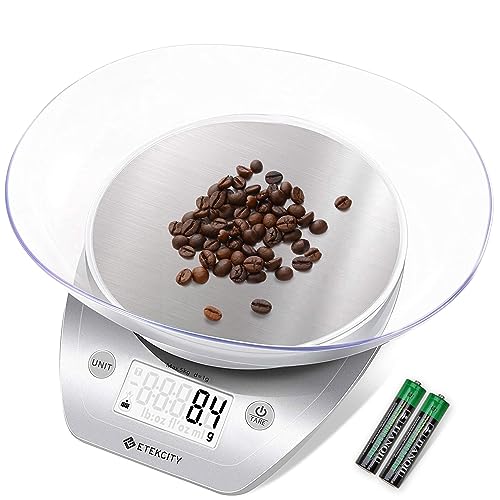
The scales below cover different budgets and display styles. First, compare the resolution and capacity listed on each page. Next, read recent buyer reports for comments about drift or battery life. Then, run the nickel test the day the scale arrives, while you can still return it.



As an Amazon Associate, Measuring Expert earns from qualifying purchases.
Key Takeaways: Where to Go Next
- Kitchen scale accuracy depends on resolution, capacity, tare and calibration.
- A 1 g display is fine for most cooking; choose 0.1 g for yeast, salt and coffee.
- Look for at least 5 kg (11 lb) capacity, and remember the bowl counts.
- A US nickel weighs 5.00 g, which makes it a free test weight.
- Repeatability matters: the same load should give the same reading every time.
- Fresh batteries fix many odd readings.
- For picks by type, see our kitchen scale roundup, the baking scale roundup and the portion control scale roundup.
Once your scale passes the test, our guide to weighing food step by step shows how to use it day to day.
Do and Don’t for Reliable Readings
Do
- Use a flat, hard surface.
- Let the scale settle at zero before each use.
- Replace weak batteries early.
- Check the scale with coins every few months.
- Keep the platform clean and dry.
Don’t
- Press down on the platform to “test” it.
- Exceed the capacity, even briefly.
- Weigh on a soft towel or a wobbly table.
- Trust a reading taken while the display still moves.
- Store heavy items on top of the scale.
Honest Limits of Kitchen Scale Accuracy
No home scale is perfect. Load cells react to temperature, humidity, battery voltage and even a draft from a fan. In addition, many cheap scales do not state their error in grams, so a printed resolution says little about true accuracy. Because of this, use your scale for what it does well: consistent, repeatable measuring of food. Conversely, it is not a certified instrument, and no coin test can prove that it is. If you need legal-for-trade or lab-grade weighing, a calibration lab or a certified scale is the right tool.
When to Replace or Recalibrate Your Scale
Most budget kitchen scales have no user calibration at all, while some mid-range models include a calibration mode that needs a known weight. Check the manual before you try it. Replace the scale if it drifts at zero, gives different readings for the same load, or fails the coin test after a battery change.
When a result really matters, such as a professional bakery or a lab task, ask a calibration service to certify a scale against traceable weights. The manufacturer can also tell you which test weights suit your model.
Frequently Asked Questions
What affects kitchen scale accuracy the most?
The load cell quality, battery level and a flat surface matter most. Resolution only sets how finely the display rounds, so it does not guarantee accuracy.
How do I test kitchen scale accuracy with a nickel?
Place one US nickel on the platform. It weighs 5.00 g, so a 1 g scale should show 5 g. Then stack more nickels: 20 coins should read about 100 g.
How much does a US nickel weigh?
A US nickel weighs 5.00 g, or about 0.176 oz, according to the US Mint. A quarter weighs 5.67 g.
Is a 0.1 g kitchen scale more accurate than a 1 g scale?
Not automatically. A 0.1 g display shows smaller steps, but it can still be wrong. Accuracy depends on the sensor and on calibration as well as on resolution.
What capacity should a kitchen scale have?
For home cooking, 5 kg (about 11 lb) is enough. Remember that the bowl counts toward the limit.
Why does my kitchen scale reading change by itself?
Weak batteries, drafts, a soft surface or a worn load cell can cause drift. Try fresh batteries and a hard counter before you replace the scale.
Does kitchen scale accuracy change with age?
Yes, it can. Load cells and springs fatigue with heavy use, overloads and temperature swings. A coin check every few months catches drift early.
What does the tare button do?
Tare resets the display to zero with the bowl on the platform, so the scale shows only what you add. It does not correct a sensor error.
Can I calibrate a kitchen scale at home?
Some models have a calibration mode that asks for a known weight, so check the manual. Many budget scales have none, which means replacement is the only fix.
Which is better for kitchen scale accuracy, digital or spring?
Digital scales usually win, because they show finer steps and avoid dial-reading errors. Spring scales suit rough portions and large amounts.
Kitchen Scale Accuracy: The Bottom Line
To sum up, choose a scale by resolution, capacity and tare, then confirm it with a nickel: 5.00 g per coin, 100 g for twenty. A scale that passes, repeats and holds zero will serve most home cooks well.
Finally, when you are ready to shop, start with our best kitchen scale picks, and run the coin test the day your scale arrives.