


The best refrigerant leak detector for most HVAC technicians is the Fieldpiece DR82, an infrared model rated at 0.03 oz/yr (1 g/yr) with a 10-year typical sensor life. However, the right choice depends on sensor type, rated sensitivity, A2L compatibility and whether you service homes, cars or commercial racks.
In short: get the Fieldpiece DR82 for daily service, the Elitech ILD-200 on a budget, and the Fieldpiece DR58 for heated diode sensitivity at a lower price.
As an Amazon Associate, Measuring Expert earns from qualifying purchases. Our picks are based on research, specifications and owner feedback, not paid placement.
Best Overall
Best Budget
Best Heated Diode
Best Refrigerant Leak Detector Picks in Brief
- Overall: Fieldpiece DR82, infrared, 0.03 oz/yr, A2L compatible.
- Pro infrared: INFICON D-TEK 3 with optional CO2 and R-290 sensors.
- Heated diode: Fieldpiece DR58, same rated sensitivity as the DR82.
- Car A/C: INFICON AST200IR, certified to SAE J2791 and J2913.
- Budget: Elitech ILD-200 infrared, rated to 0.14 oz/yr.
- Backup tool: Elitech ILD-100H heated diode.
- Nitrogen tests: Amprobe ULD-405 ultrasonic receiver.
On This Page
- Comparison chart
- The 7 picks, reviewed
- How we chose
- Heated diode vs infrared vs ultrasonic vs UV dye
- What oz/yr sensitivity means
- Leak rate converter
- A2L refrigerants
- How to sweep for a leak
- EPA Section 608 note
- Sensor care and checks
- Honest limits
- FAQ
- Bottom line
Best Refrigerant Leak Detector Comparison Chart
First, pick a sensor type. Then compare the use case and the standout feature, and jump to the full review.
| # | Image | Product | Best For | Standout Feature | Amazon |
|---|---|---|---|---|---|
| 1 |  | Fieldpiece DR82 | Daily HVAC service work | IR sensor, 10-year typical life | View |
| 2 |  | INFICON D-TEK 3 | Commercial refrigeration and mixed fleets | Swappable sensors incl. CO2 option | View |
| 3 |  | Fieldpiece DR58 | High sensitivity at a lower price than IR | 0.03 oz/yr, three sensitivity levels | View |
| 4 | 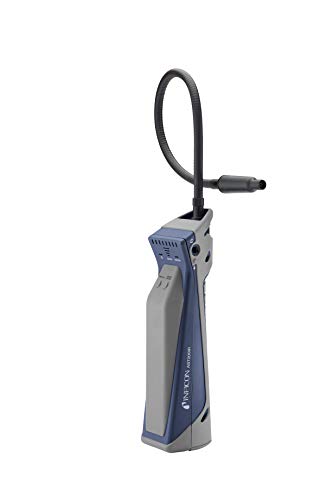 | INFICON AST200IR | Automotive A/C shops | Certified to SAE J2791 and J2913 | View |
| 5 |  | Elitech ILD-200 | Homeowners, new techs and light use | IR sensor at a lower price | View |
| 6 |  | Elitech ILD-100H | A second detector for the truck | Heated diode at a low price | View |
| 7 |  | Amprobe ULD-405 | Nitrogen tests and any pressurized gas | Hears 20-90 kHz leak noise | View |
The 7 Best Refrigerant Leak Detector Picks, Reviewed
We start with the two infrared leaders, then cover heated diode, automotive, budget and ultrasonic tools. Each sensitivity figure below comes from the maker, so we quote it in both oz/yr and g/yr.
Best Overall
1. Fieldpiece DR82 Infrared
Best for: HVAC technicians who hunt leaks every week and want a sensor that lasts for years.
The DR82 is our pick as the best refrigerant leak detector for most working techs. It uses an infrared (IR) sensor, which reads refrigerant by how the gas absorbs infrared light. As a result, the sensor does not burn out the way a heated element does, and Fieldpiece rates its life at 10 years typical.
Fieldpiece lists a maximum sensitivity of 0.03 oz/yr (1 g/yr) with the probe held still and 0.1 oz/yr (3 g/yr) while the probe is moving. In addition, the maker says it works on A2L refrigerants as well as HFC, HCFC, CFC and HFO blends. Also, the body is designed to IP54, so dust and a little rain are not a problem on a rooftop. See the Fieldpiece DR82 spec page for the full list.
- Sensor: infrared, 10 years typical life
- Sensitivity: 0.03 oz/yr (1 g/yr) still; 0.1 oz/yr (3 g/yr) moving
- Refrigerants: HFC, HCFC, CFC, HFO and blends; A2L compatible
- Response: under 1 s; recovery under 5 s
- Power: built-in 2550 mAh Li-ion, about 10 h per charge; IP54; 14 oz (400 g)
Pros
- Long sensor life cuts running costs
- Fast response and quick recovery
- Also rated for A2L work
Cons
- Costs more than heated diode units
- Battery is not user replaceable
- IR cannot hear a leak in a noisy fan
Skip it if: You check one or two systems a year, because a budget Elitech covers light use for far less.
Best Pro Infrared
2. INFICON D-TEK 3
Best for: Commercial refrigeration techs who see many refrigerant types, including CO2 racks.
INFICON has made refrigerant leak detectors for decades, and the D-TEK 3 is its handheld infrared model. INFICON lists sensitivity per the EN 14624 test method: 1 g/yr (0.04 oz/yr) for R-134a and 0.5 g/yr (0.02 oz/yr) for R-1234yf. In addition, the maker labels it A2L certified.
The standout feature is the sensor bay. For example, an optional CO2 sensor reads R-744 down to 2 g/yr, and an optional flammable sensor covers R-290 at 5 g/yr. Meanwhile, the Li-ion battery is field replaceable and runs about 10 hours, and the unit can work while it charges over Micro USB.
- Sensor: infrared, redesigned; optional CO2 and flammable sensors
- Sensitivity (EN 14624): R-134a 1 g/yr; R-1234yf 0.5 g/yr
- A2L: certified by the maker; R-32 on the compatible list
- Power: field-replaceable Li-ion, about 10 h; runs on Micro USB
- Warranty: two-year replacement
Pros
- Published EN 14624 figures per gas
- Optional CO2 and R-290 sensors
- Also a replaceable battery
Cons
- Extra sensors cost extra
- More features than residential work needs
- R-454B is not named on the spec page
Skip it if: You only service home split systems, because the DR82 is simpler for that work.
Best Heated Diode
3. Fieldpiece DR58 Heated Diode
Best for: Techs who want top sensitivity without paying for an infrared sensor.
A heated diode sensor warms a ceramic element, and halogenated refrigerant changes the current through it. So it is very sensitive, but the element wears out with use. Fieldpiece rates the DR58 sensor at 300 hours typical, which is many months of normal service work.
On paper, the DR58 matches the DR82 at 0.03 oz/yr (1 g/yr) still and 0.1 oz/yr (3 g/yr) in motion. In addition, it has high, medium and low sensitivity steps, a longer 18-hour battery life and the same IP54 design. Fieldpiece says it works on A2L refrigerants and tracer gas, but adds that it is for qualified, certified techs.
- Sensor: heated diode, 300 h typical life
- Sensitivity: 0.03 oz/yr (1 g/yr) still; 0.1 oz/yr (3 g/yr) moving
- Levels: high, medium, low
- Refrigerants: HFC, HCFC, CFC, HFO and blends; A2L compatible
- Power: built-in Li-ion, about 18 h; IP54; 14 oz (400 g)
Pros
- Same rated sensitivity as the DR82
- Longer battery life per charge
- Also three sensitivity steps
Cons
- Sensor needs replacing over time
- Recovery is slower than the IR model
- Battery is not user replaceable
Skip it if: You hate buying parts, since an IR sensor lasts years longer.
Best for Car A/C
4. INFICON AST200IR
Best for: Auto A/C techs who service both R-134a and R-1234yf systems.
Car A/C work has its own test standards. SAE J2791 covers electronic detectors for R-134a, and SAE J2913 covers detectors for R-1234yf. INFICON lists both as certifications for the AST200IR, and it says the unit meets all SAE standards for automotive A/C leak detection.
The AST200IR uses an infrared sensor with 1 g/yr (0.03 oz/yr) sensitivity per EN 14624. Also, INFICON labels it A2L certified, which matters because R-1234yf is an A2L refrigerant. Finally, an optional CO2 sensor adds R-744 detection, and the Li-ion battery can run the unit over Micro USB while it charges.
- Sensor: infrared; optional CO2 sensor
- Sensitivity: 1 g/yr (0.03 oz/yr) per EN 14624
- Certifications: SAE J2791, SAE J2913, A2L certified
- Refrigerants: R-134a, R-1234yf, HFCs, HFOs and blends
- Power: rechargeable Li-ion; runs on Micro USB
Pros
- Both SAE automotive certifications
- Covers R-134a and R-1234yf
- Also an optional CO2 sensor
Cons
- Aimed at car A/C, not commercial racks
- Sensor life is not published
- No IP rating listed
Skip it if: You work mainly on home HVAC, because the DR82 or D-TEK 3 fits that work better.
Best Budget
5. Elitech ILD-200 Infrared
Best for: New technicians, handy homeowners and rental owners who want an IR sensor on a budget.
Elitech is a large maker of HVAC test tools, and the ILD-200 is its entry infrared detector. Elitech rates sensitivity at up to 0.14 oz/yr, which is about 4 g/yr. That is coarser than the Fieldpiece and INFICON units, but it still finds the leaks that drain a home system over a season.
In addition, Elitech lists a 10-year sensor life. Also, its refrigerant list names R-22, R-410A, R-404A, R-1234yf, R-32 and R-454B. As a result, it covers the newer A2L refrigerants in current home equipment. However, Elitech does not publish an A2L certification for it, so follow the system maker’s rules.
- Sensor: infrared, 10-year sensor life
- Sensitivity: up to 0.14 oz/yr (about 4 g/yr)
- Refrigerants listed: R-22, R-410A, R-404A, R-1234yf, R-32, R-454B
- Probe: flexible gooseneck
- Blends listed: AZ-50, HP62, MP39
Pros
- IR sensor at an entry price
- Names R-32 and R-454B
- Also a flexible probe
Cons
- About four times less sensitive than the DR82
- No published SAE or EN test result
- Warranty terms are unclear online
Skip it if: You chase very slow leaks for a living, because the rated sensitivity is coarser.
Best Budget Heated Diode
6. Elitech ILD-100H Heated Diode
Best for: Techs who want a low-cost backup detector, and DIY users who need one now and then.
The ILD-100H is the heated diode partner to the ILD-200. So it trades the long IR sensor life for a lower price. Elitech lists the same broad refrigerant range, including R-22, R-410A, R-134a, R-1234yf, R-32 and R-454B.
However, Elitech does not publish a sensitivity figure in oz/yr or g/yr for this model. For that reason, we treat it as a budget tool, not a precision one. Still, a heated diode detector is good at telling you a leak is near, and then bubbles confirm the exact spot.
- Sensor: heated diode
- Refrigerants listed: R-22, R-410A, R-134a, R-1234yf, R-32, R-454B
- Uses: home HVAC and automotive A/C
- Warranty: one year
Pros
- Low cost for a heated diode
- Wide refrigerant list
- Also good as a backup tool
Cons
- No published sensitivity figure
- Sensor wears with use
- No SAE or EN certification listed
Skip it if: You need a documented sensitivity for a job report, because the maker gives none.
Best Ultrasonic
7. Amprobe ULD-405 Ultrasonic
Best for: Techs who pressure test with nitrogen, and anyone chasing air, vacuum or gas leaks.
An ultrasonic detector does not sense refrigerant at all. Instead, it hears the high-pitched hiss of gas forced through a small hole. The ULD-405 picks up 20 to 90 kHz and shifts it down so you can hear it. As a result, it works with nitrogen, air or any refrigerant, as long as the system holds pressure.
Also, the 2.5 in color screen shows signal strength, and adjustable sensitivity helps you narrow in. The kit includes a parabola for distance work, a tubular extension, a flexible tubing adapter and earbuds that fit under a hard hat. Finally, four AA cells run it for about 105 hours.
- Method: ultrasonic receiver, 20 to 90 kHz
- Display: 2.5 in color TFT LCD
- Kit: PB-1 parabola, TE-1 extension, TEA-1 tubing adapter, earbuds, soft case
- Power: 4 x AA alkaline, about 105 h
Pros
- Works with any gas, including nitrogen
- Long battery life on AA cells
- Also finds air and vacuum leaks
Cons
- Cannot measure a leak rate in oz/yr
- Struggles in noisy machine rooms
- Needs pressure to make sound
Skip it if: You want to sniff for refrigerant in a still system, because a gas sensor is the right tool.
How We Chose Each Best Refrigerant Leak Detector
We did not bench test these tools. Instead, our picks are research based. First, we read the maker spec pages and manuals for each model. Next, we compared published sensitivity in oz/yr or g/yr, the test method behind it, and sensor life. Then we weighed owner feedback on false alarms, battery life and build quality.

- Published sensitivity: a figure in oz/yr or g/yr ranked higher than vague claims like “ultra sensitive.”
- Test standard: EN 14624 or SAE J2791/J2913 results counted in a model’s favor.
- A2L support: we checked whether the maker states the tool works with A2L refrigerants such as R-32 and R-454B.
- Running cost: sensor life and battery type matter as much as the purchase price.
- Brand support: we kept to established brands with replacement sensors, filters and manuals.
Sources included the Fieldpiece and INFICON spec pages, Elitech and Amprobe product pages, and the EPA Section 608 program page. Where a maker gave no figure, we say so rather than guess.
Heated Diode vs Infrared vs Ultrasonic vs UV Dye
There are four main ways to find a refrigerant leak. Each one measures something different, so the right method depends on the job. In practice, many techs carry two: an electronic sniffer to find the area, and bubbles or dye to confirm the exact spot.

| Method | What it senses | Strengths | Weak spots |
|---|---|---|---|
| Heated diode | Halogen gas changing current through a hot ceramic element | Very sensitive (to about 0.03 oz/yr), lower price | Sensor wears out (for example, 300 h typical on the DR58) |
| Infrared (IR) | Refrigerant absorbing infrared light in a sample cell | Long sensor life (up to 10 years), few false alarms | Higher price; still needs a clean filter |
| Ultrasonic | The 20 to 90 kHz hiss of gas escaping a hole | Works with nitrogen, air or any gas | Needs pressure; no oz/yr reading; noise interferes |
| UV dye | Fluorescent dye carried out with oil at the leak | Shows the exact spot; finds intermittent leaks | System must run for the dye to reach the leak; check OEM approval |
| Bubble solution | Gas forming bubbles in a soap film | Cheap, confirms a pinpoint spot | Slow on large systems; misses very small leaks |
Older corona discharge sniffers also exist. However, they tend to false alarm on humidity and other vapors, so we left them out. In short, buy IR for long life, heated diode for sensitivity per dollar, and an ultrasonic tool for nitrogen tests.
When UV dye makes sense
Dye is useful for a slow leak that comes and goes with temperature. You inject a small dose, run the system, and then sweep with a UV or violet lamp and yellow glasses. For example, Spectroline’s EZ-Ject kit uses 0.5 oz (15 mL) cartridges of universal/POE dye. Still, some equipment makers limit additives, so check the system manual before you add dye.
What oz/yr and g/yr Sensitivity Really Means
Leak rate is a mass of refrigerant lost per year. In the US, makers quote ounces per year (oz/yr); elsewhere, they use grams per year (g/yr or g/a). One ounce is exactly 28.349523125 g, so 0.1 oz/yr is about 2.8 g/yr.
A lower number means a smaller leak the tool can sense. For example, the Fieldpiece DR82 is rated at 0.03 oz/yr (about 0.85 g/yr, rounded to 1 g/yr) with the probe still. The Elitech ILD-200 is rated at 0.14 oz/yr, about 4 g/yr. So the Fieldpiece senses a leak roughly four times smaller under the same conditions.
However, ratings are not always comparable. EN 14624 and the SAE standards define how a detector is tested against a calibrated reference leak. A spec with no stated method may be a best case. Also, note the moving figure: the DR82 drops to 0.1 oz/yr (3 g/yr) when the probe sweeps, which is closer to real use.
- SAE J2791: the automotive test for R-134a electronic leak detectors.
- SAE J2913: the matching automotive test for R-1234yf detectors.
- EN 14624: the European test standard for portable refrigerant leak detectors.
Leak Rate Converter: Ounces to Grams
Use this converter to compare a spec sheet in oz/yr with one in g/yr. Enter the ounces per year, and read the grams per year (the time unit stays the same).
Because the ounce is defined as exactly 28.349523125 g, these conversions are exact before rounding.
A2L Refrigerants: R-32, R-454B and Your Detector
New US home systems are moving from R-410A to A2L refrigerants such as R-32 and R-454B. Under ASHRAE Standard 34, “A” means lower toxicity and “2L” means lower flammability. So these gases can burn under some conditions, even though they are hard to ignite.
That matters for leak detection in two ways. First, your detector must actually sense the new gas. Second, it should be approved for use around a mildly flammable refrigerant. For that reason, check the spec page for the words “A2L compatible” or “A2L certified,” not just a long refrigerant list.
Also, pair your detector with gauges and hoses rated for the same refrigerant. Our refrigerant gauge set guide covers manifolds with A2L support, and the vacuum pressure tester guide covers the vacuum side of the job.
How to Sweep for a Refrigerant Leak
Good technique matters as much as the tool. Follow these steps with any electronic sniffer.
- Confirm the detector is rated for the refrigerant in the system, including A2L gases such as R-32 or R-454B.
- Turn the detector on in clean air, let it warm up and zero, and set it to its highest sensitivity.
- Shut off or shield the fans, because moving air dilutes a leak and spreads it away from the probe.
- Move the probe tip slowly, about 1 to 2 in (25 to 50 mm) per second, within about 1/4 in (6 mm) of joints and fittings.
- Check below each fitting too, since most refrigerants are heavier than air and sink.
- When the tool alarms, pull the probe away, let it clear, lower the sensitivity and sweep again to pinpoint the spot.
- Confirm the exact leak with bubble solution or a UV lamp before you cut or braze anything.
- After the repair, pressure test with dry nitrogen, pull a deep vacuum and sweep the joint again.
EPA Section 608 Note for Leak Work
Under Section 608 of the Clean Air Act, it is illegal to knowingly vent refrigerant while servicing or disposing of A/C and refrigeration equipment. In addition, technicians who maintain, service, repair or dispose of equipment that could release refrigerant must hold EPA Section 608 certification.
Larger systems also have leak repair rules. According to the EPA leak repair requirements page, appliances with 50 lb or more of ozone-depleting refrigerant must be repaired within 30 days once the annual leak rate passes a trigger. The triggers are 30% for industrial process refrigeration, 20% for commercial refrigeration and 10% for comfort cooling. Also, EPA has since extended similar rules to many HFC systems, so check the current rules for your equipment.
A leak detector does not make a homeowner legal to open a sealed system. So if you are a DIY user, use the tool to find the problem area, then call a certified tech to recover, repair and recharge.
Sensor Care, Filters and Reference Leak Checks
A detector is only as good as its last check. Therefore, treat it like any other measuring tool and verify it on a schedule.
- Filters: replace the probe tip filter when it looks dirty or wet, because oil and dust block the gas.
- Reference leak: a calibrated vial, such as INFICON’s TEK-Check R-134a source, shows whether the tool still alarms at a known rate.
- Sensor hours: heated diode sensors fade with use, so log the hours and replace the sensor when response slows.
- Batteries: a weak battery can cut sensitivity on some models, so charge before each job.
- Storage: keep the tool away from solvents, refrigerant cylinders and brake cleaner, which can saturate the sensor.
Leaks also show up in system readings first. For example, rising superheat and low suction pressure often point to an undercharge. Defrost controls read pressure and temperature too, as explained in our piece on how a pressure-time-temperature defrost system measures frost.
Honest Limits of Any Leak Detector
No tool finds every leak on the first pass. Wind, fans and a cluttered coil can scatter the gas, so the alarm may sound far from the hole. Likewise, a detector set to its highest sensitivity can trigger on a fitting that was just cleaned with solvent.
Also, a handheld tool tells you where gas is, not how much the system has lost. For that, you need a charge record, a scale and gauge readings. Finally, a tiny leak inside an evaporator coil may only show up with dye, a standing pressure test or a coil swap. In short, use the detector to narrow the search, then confirm with a second method.
Best Refrigerant Leak Detector FAQ
What is the best refrigerant leak detector for most technicians?
For most techs, the Fieldpiece DR82 is the best pick. It pairs an infrared sensor rated for 10 years typical with 0.03 oz/yr (1 g/yr) sensitivity, and Fieldpiece says it works on A2L refrigerants.
Is infrared or heated diode the best refrigerant leak detector type?
Both can reach about 0.03 oz/yr on paper. However, infrared sensors last years and false alarm less, while heated diode sensors cost less up front but wear out, for example after about 300 hours on the Fieldpiece DR58.
What does 0.1 oz/yr sensitivity mean?
It means the tool can sense a leak that would lose 0.1 ounce of refrigerant per year, which is about 2.8 grams per year. A lower number means a smaller leak the detector can find.
Which best refrigerant leak detector works with R-32 and R-454B?
Look for an A2L rating on the spec page. Fieldpiece lists the DR82 and DR58 as A2L compatible, INFICON labels the D-TEK 3 A2L certified, and Elitech names R-32 and R-454B for its ILD-200.
What is the best refrigerant leak detector for car A/C?
Pick a tool certified to SAE J2791 for R-134a and SAE J2913 for R-1234yf. The INFICON AST200IR lists both certifications and an infrared sensor rated at 1 g/yr.
Can an ultrasonic detector find refrigerant leaks?
Yes, but only while the system is under pressure. An ultrasonic tool hears the hiss of escaping gas, so it works with refrigerant or nitrogen, yet it cannot give a leak rate in oz/yr.
Is UV dye better than an electronic leak detector?
Not better, just different. Dye shows the exact spot of a slow or on-and-off leak, but the system must run for the dye to reach it, and some makers limit additives. Many techs use both.
Do I need EPA certification to use a refrigerant leak detector?
You can buy and use the detector itself without a license. However, EPA Section 608 certification is required to open, service, recover or recharge most refrigerant systems.
How often should I check my detector against a reference leak?
Check it before important jobs and whenever it seems slow to alarm. A calibrated reference leak vial shows whether the tool still responds at a known rate.
Is the best refrigerant leak detector worth it for a homeowner?
Only if you want to find the general area of a leak before calling a pro. A budget infrared model like the Elitech ILD-200 is enough, but a certified tech must still make the repair.
Bottom Line on the Best Refrigerant Leak Detector
For most technicians, the Fieldpiece DR82 Infrared Refrigerant Leak Detector is the best refrigerant leak detector. After all, it pairs 0.03 oz/yr sensitivity with an infrared sensor that Fieldpiece rates for 10 years, and it works on A2L refrigerants. However, choose the DR58 to save money with a heated diode, the AST200IR for car A/C, or the Elitech ILD-200 for light use.
Black Friday is coming: shop the deals with Prime
1 thought on “Best Refrigerant Leak Detector for HVAC and Car A/C (2026 Picks)”