

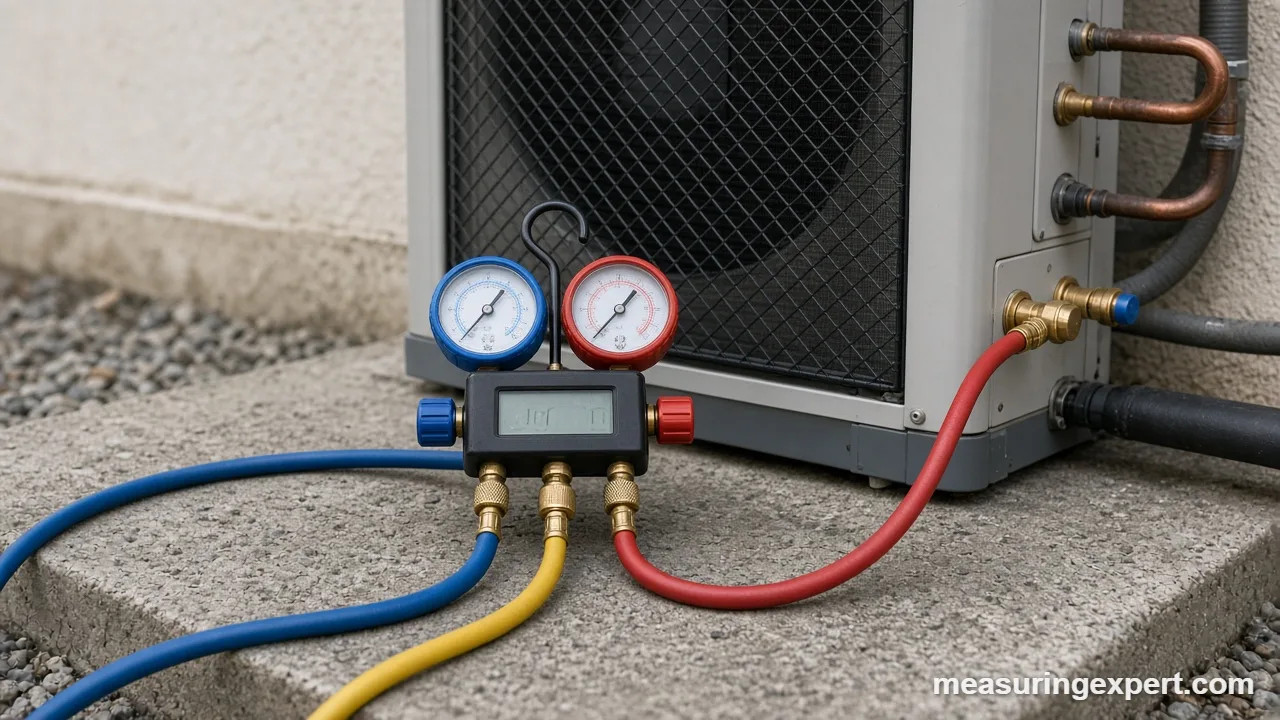
The best refrigerant gauge set for most HVAC techs is the Fieldpiece SM382V, a digital 3-port manifold with a built-in micron gauge, live superheat and subcooling, and A2L support. However, the right set depends on analog or digital readout, 2 or 4 valves, your refrigerants and your budget.
In short: choose the Fieldpiece SM382V for daily service, the Elitech DMG-2SE on a budget, and the Yellow Jacket 46015 if you want a rugged analog 4-valve set.
As an Amazon Associate, Measuring Expert earns from qualifying purchases. Our picks are based on research, specifications and owner feedback, not paid placement.
Best Overall
Best Budget
Best Analog
Quick Answer: Best Refrigerant Gauge Set Picks
- Overall: Fieldpiece SM382V, digital, built-in vacuum gauge, over 70 refrigerants.
- Smart 2-valve: Testo 550s with +/-0.5% FS accuracy and clamp probes.
- Digital 4-valve: CPS BlackMax BMD200A with a 3/8 in vacuum port.
- Budget digital: Elitech DMG-2SE with 88 refrigerants on board.
- Analog: Yellow Jacket 46015 (4-valve) or Mastercool 58161 (2-way), both A2L ready.
On This Page
- Comparison table
- The 9 picks, reviewed
- How we chose
- Analog vs digital vs wireless
- Accuracy, resolution and range
- Reading a P-T chart
- Superheat and subcooling
- A2L compatibility
- Pressure converter
- How to connect a gauge set
- EPA Section 608 note
- Care and calibration
- Honest limits
- FAQ
- Bottom line
Best Refrigerant Gauge Set Comparison Table
| # | Image | Product | Best For | Standout Feature | Amazon |
|---|---|---|---|---|---|
| 1 |  | Fieldpiece SM382V | Daily residential and light commercial service | Built-in vacuum gauge, 1,000 ft wireless | View |
| 2 | 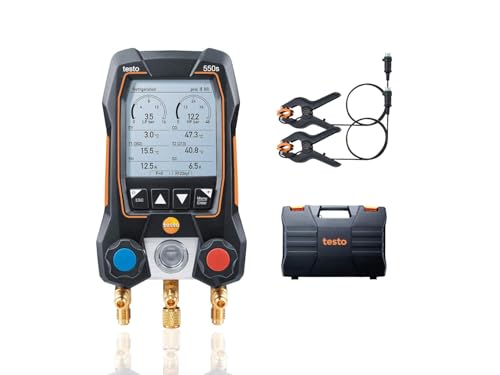 | Testo 550s | Techs who want app reports and published accuracy | +/-0.5% FS, 60 refrigerants on board | View |
| 3 |  | CPS BMD200A | Evacuation and charging on bigger systems | 3/8 in vacuum port, 350 ft wireless | View |
| 4 |  | Elitech DMG-2SE | New techs and homeowners moving up from analog | 88 refrigerants, auto superheat/subcooling | View |
| 5 |  | Testo 549i | Hoseless readings and multi-system checks | Screws onto service ports, 0.01 psi resolution | View |
| 6 |  | Yellow Jacket 46015 | Techs who want a rugged analog set for A2L work | R-32/R-454B/R-410A scales, 3/8 in bores | View |
| 7 |  | Mastercool 58161 | A simple, durable set for R-410A and A2L systems | Forged brass, silicone-dampened gauges | View |
| 8 | 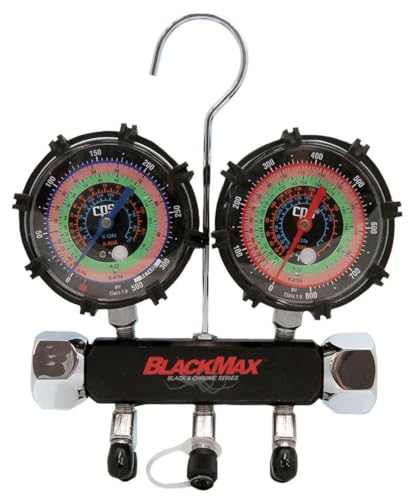 | CPS MBH5P5Z | Older R-22, R-134a and R-410A equipment | Four refrigerant scales on one dial | View |
| 9 |  | Mastercool 81661 | Automotive A/C on R-1234yf vehicles | R-1234yf couplers with disconnect sleeve | View |
The 9 Best Refrigerant Gauge Set Options, Reviewed
We start with digital manifolds, then cover wireless probes, analog sets and a car A/C kit.
Best Overall
1. Fieldpiece SM382V SMAN 3-Port
Best for: HVAC techs who charge, evacuate and check superheat on most calls and want one tool for all of it.
Overall, the SM382V is our pick as the best refrigerant gauge set for most working techs. It is a 3-port digital manifold, so it reads the suction and liquid sides, calculates saturation temperature, and shows superheat and subcooling live.
Fieldpiece rates the manifold to 870 psig (6,000 kPa) and says it supports more than 70 refrigerants, including A2L blends such as R-32 and R-454B. Also, it ships with two TC24 pipe clamp thermocouples and one bead thermocouple. Finally, the Job Link app mirrors readings up to 1,000 ft (305 m) away in line of sight, which helps, for instance, when the condenser sits on a roof.
- Max manifold pressure: 870 psig (6,000 kPa)
- Vacuum: 50 to 9,999 microns, built in
- Temperature: -50 to 257 F (-46 to 125 C); two TC24 clamps plus a bead probe
- Refrigerants: over 70, A2L compatible
Pros
- Vacuum gauge built in, so no extra tool
- Long battery life on AA cells
- Also very long wireless range
Cons
- However, Fieldpiece does not list pressure accuracy online
- Only three ports, so no dedicated vacuum port
- Also costs more than any analog set here
Skip it if: You only top off one car A/C a year, because an analog R-1234yf set does that job for far less.
Best Smart 2-Valve
2. Testo 550s Smart Digital Manifold
Best for: Technicians who want a compact 2-valve digital manifold with clear published specs and app-based reports.
Testo publishes the numbers that matter, so the 550s is easy to judge. For example, the pressure range is -1 to 60 bar (about -14.5 to 870 psi) with +/-0.5% of full scale accuracy and 0.01 bar resolution.
In addition, the manifold stores 60 refrigerants, and Testo says the app can add 30 more. This kit includes two wired NTC clamp probes, so superheat and subcooling work out of the box.
- Pressure: -1 to 60 bar (-14.5 to 870 psi); +/-0.5% FS; 0.01 bar resolution
- Overload: 65 bar (about 943 psi)
- Temperature: -50 to 150 C (-58 to 302 F), +/-0.5 C, 0.1 C resolution
- Refrigerants: 60 stored, 30 more via app update
Pros
- Clear published accuracy and resolution
- Clamp probes included in this kit
- Also app reports you can send to a customer
Cons
- 2-valve block, no separate vacuum port
- Also, no built-in micron gauge in this kit
- Besides, battery life drops by more than half with Bluetooth on
Skip it if: You want to pull a deep vacuum through 3/8 in hose, because a 4-valve manifold does that faster.
Best 4-Valve Digital
3. CPS BlackMax BMD200A 4-Valve
Best for: Techs who do a lot of evacuation and recovery work and want a dedicated 3/8 in vacuum port.
A 4-valve manifold adds a separate vacuum valve and port. Accordingly, the BMD200A has three 1/4 in ports for suction, liquid and charging, plus one 3/8 in vacuum port.
Also, CPS lists pressure to 800 psi with +/-0.5% of full scale accuracy, which works out to about 4 psi. In addition, it supports more than 100 refrigerants, lets you save 10 favorites, and is listed as A2L compatible.
- Pressure: up to 800 psi; +/-0.5% FS
- Ports: 3 x 1/4 in plus 1 x 3/8 in vacuum
- Temperature: -40 to 302 F (-40 to 150 C), +/-1 F at 77 F
- Refrigerants: over 100, A2L compatible; 10 favorites
Pros
- True 4-valve layout with a 3/8 in vacuum port
- Published accuracy and wide refrigerant list
- Also a storage case in the kit
Cons
- However, no micron range is listed for it
- Also, hoses are not in the listed kit contents
- A newer model with less owner feedback so far
Skip it if: You mostly service small split systems, because the lighter Testo 550s covers that work.
Best Budget Digital
4. Elitech DMG-2SE Digital Manifold
Best for: New technicians, maintenance staff and handy owners who want digital readings without a pro price.
Because Elitech makes a wide range of HVAC test tools, the DMG-2SE is its entry digital manifold. Its pressure range is -14.7 to 600 psi, and it has +/-1% of full scale accuracy and 1 psi resolution. So the worst-case error is about 6 psi, which is coarser than the Testo or CPS units but still far tighter than reading a small analog dial by eye.
In addition, the DMG-2SE stores 88 refrigerants and calculates superheat and subcooling automatically. However, its 600 psi ceiling leaves less headroom on R-410A and R-32 high sides during very hot weather, so watch the reading on summer calls.
- Pressure: -14.7 to 600 psi
- Accuracy: +/-1% FS; resolution 1 psi
- Refrigerants: 88 stored
- Units: psi, kPa, MPa, bar, inHg
Pros
- Low cost for a digital manifold
- Large refrigerant library
- Also five pressure units
Cons
- However, 600 psi max is tight for hot-day R-410A
- Coarser 1 psi resolution
- Also, Elitech gives fewer published specs than Testo
Skip it if: You work on commercial systems in hot climates, because the 600 psi limit can be reached.
Best Wireless Probes
5. Testo 549i Wireless Pressure Probes
Best for: Techs who want hoseless pressure readings on a phone and less refrigerant loss per hookup.
Wireless probes, by contrast, skip the manifold body entirely. Instead, each 549i screws onto a service port and sends pressure to the testo Smart App.
Next, consider the specs: each probe reads -14 to 870 psi (-1 to 60 bar) with +/-0.5% of full scale accuracy and 0.01 psi resolution. For superheat and subcooling, Testo says you need two 549i probes plus two 115i clamp thermometers, so check whether your listing is a single probe or a set.
- Pressure: -14 to 870 psi (-1 to 60 bar); +/-0.5% FS
- Resolution: 0.01 psi; overload 943 psi (65 bar)
- Connection: 7/16 in UNF
- Bluetooth: up to 60 ft; app reads up to six probes
Pros
- No hoses, so less refrigerant loss
- Fine 0.01 psi resolution
- Also PDF and Excel export from the app
Cons
- No valves, so you still need hoses to charge or recover
- Needs a phone for every reading
- Superheat needs extra 115i clamps
Skip it if: You charge systems all day, because you still need a manifold and hoses to add refrigerant.
Best Analog 4-Valve
6. Yellow Jacket 46015 Brute II A2L
Best for: Technicians who prefer analog needles but need scales for the new A2L refrigerants.
The Yellow Jacket 46015 is a 4-valve test and charging manifold with 3-1/8 in (80 mm) gauges scaled for R-32, R-454B and R-410A in psi and degrees F.
Meanwhile, the forged aluminum alloy body has 3/8 in bores for faster evacuation, and a sight glass lets you watch refrigerant flow. In addition, the kit includes three 60 in PLUS II hoses with a compact ball valve and a 60 in 3/8 in vacuum and charging hose.
- Valves: 4; sight glass; 100-mesh filter
- Gauges: 3-1/8 in (80 mm), R-32/454B/410A, psi and F
- Body: forged aluminum alloy, 3/8 in bores; made in USA
- Hoses: 3 x 60 in 1/4 in PLUS II with ball valve, 1 x 60 in 3/8 in
Pros
- No batteries, works in any weather
- A2L scales on the dial
- Also field recalibration from the front
Cons
- No automatic superheat or subcooling
- Also, analog dials are harder to read precisely
- Scales do not cover R-22 or R-134a
Skip it if: You want logged data for customer reports, because an analog set cannot record anything.
Best Analog 2-Way
7. Mastercool 58161 Brass 2-Way
Best for: Techs and serious DIY users who want a straightforward 2-way analog set for current split systems.
To begin with, a 2-way (2-valve) manifold is the classic layout: a blue low-side valve, a red high-side valve and a yellow center port. Similarly, the Mastercool 58161 uses a heavy forged brass body with free-floating piston valves, which Mastercool says reduce o-ring wear.
Moreover, its 3-1/8 in gauges read psi and degrees F and are listed for R-454B, R-410A and R-32. Finally, the set comes with three 60 in nylon barrier hoses and standard 1/4 in SAE fittings.
- Valves: 2-way, free-floating piston
- Gauges: 3-1/8 in, psi and F; silicone dampened
- Refrigerants: R-454B, R-410A, R-32; A2L compatible
- Hoses: 3 x 60 in nylon barrier; 1/4 in SAE
Pros
- Simple and very durable
- Dampened needles are easier to read
- Also recalibrates in the field
Cons
- Brass is heavier than aluminum
- However, no vacuum port or sight glass is listed
- Then there is manual superheat math with a P-T chart
Skip it if: You need a dedicated vacuum port, because the Yellow Jacket 4-valve set has one.
Best Budget Analog
8. CPS BlackMax MBH5P5Z 2-Valve
Best for: Owners and techs who still see older R-22 and R-134a equipment alongside R-410A.
In contrast, the MBH5P5Z is a compact 2-valve analog set with an anodized aluminum body. Still, its 2.5 in (68 mm) gauges carry Class 1.6 accuracy and have scales for R-134a, R-22, R-404A and R-410A.
However, a Class 1.6 gauge can be off by 1.6% of its full scale. For example, on an 800 psi dial that is up to about 12.8 psi, which is roughly 2.7 F of saturation temperature on R-410A at a 100 F condensing point.
- Gauges: 2.5 in (68 mm), Class 1.6
- Scales: R-134a, R-22, R-404A, R-410A
- Body: anodized aluminum, 2 valves
- Hoses: 5 ft premium barrier hoses; SAE 45-degree fittings
Pros
- Four refrigerant scales in one set
- Light aluminum body
- Also a low entry cost
Cons
- However, no A2L scales such as R-32 or R-454B
- Smaller 2.5 in dials
- Class 1.6 limits charging precision
Skip it if: You work on new R-32 or R-454B equipment, because the dial has no scale for them.
Best for Car A/C
9. Mastercool 81661 R-1234yf Brass Set
Best for: Auto techs and DIY owners servicing newer cars that use R-1234yf.
Most newer cars use R-1234yf, an A2L refrigerant with its own service fittings. Therefore, the Mastercool 81661 is a 2-way brass manifold built for it. It also has 12 mm fittings, R-1234yf high and low couplers with an extended disconnect protection sleeve, and three 60 in hoses.
Also, Mastercool includes a 1/4 in flare to 1/2 in ACME left-hand vacuum pump adapter and says the barrier hoses meet SAE J2888. Then, the 3-1/8 in gauges read psi and bar and can be recalibrated.
- Body: 2-way brass with three 12 mm female fittings
- Couplers: R-1234yf high and low, with disconnect sleeve
- Gauges: 3-1/8 in, psi and bar; recalibratable
- Hoses: 3 x 60 in; SAE J2888 barrier hoses
Pros
- Correct couplers for R-1234yf
- Vacuum pump adapter included
- Also a sturdy brass body
Cons
- However, not for home HVAC service ports
- No R-134a couplers in this kit
- Analog only, no logging
Skip it if: You work on home heat pumps, because the fittings and scales are made for cars.
How We Chose the Best Refrigerant Gauge Set Picks
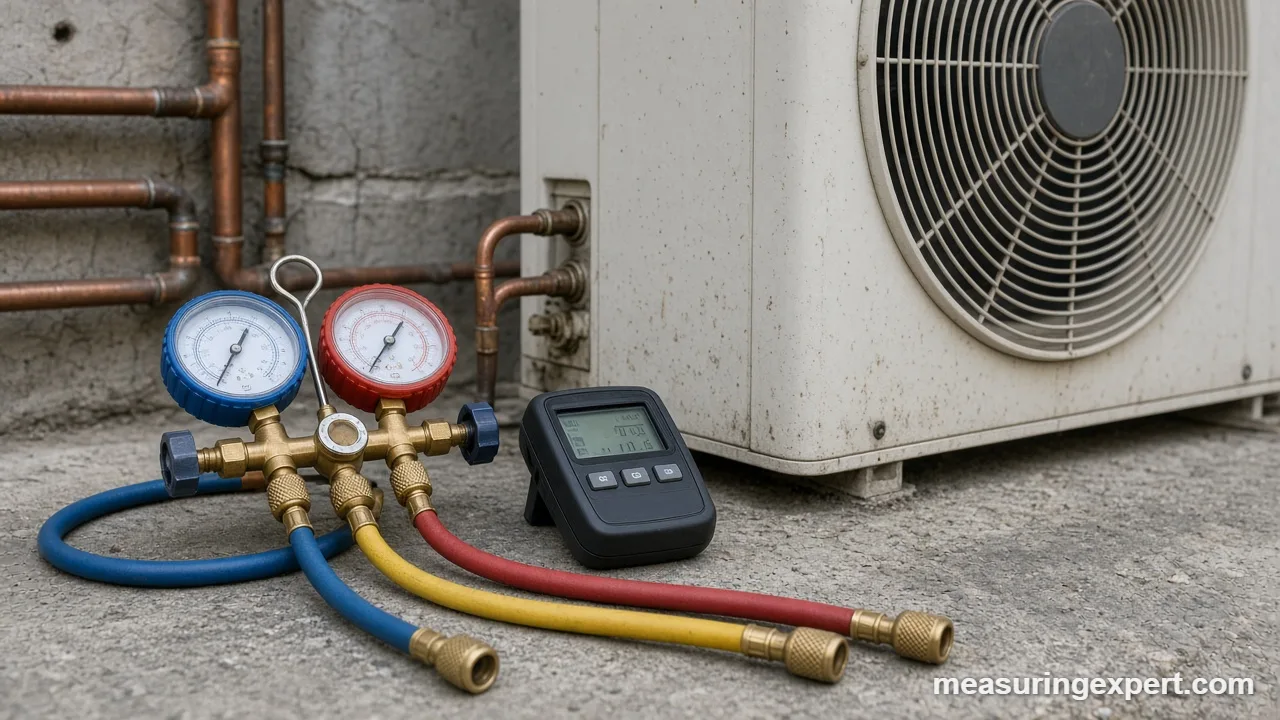
To be clear, we did not bench test these gauges. Instead, our picks are research based. First, we read the maker spec pages, data sheets and manuals. Next, we compared pressure range, published accuracy, resolution and refrigerant support. Then we weighed owner feedback on hose leaks, sensor drift and build quality.
- Published accuracy: a stated figure such as +/-0.5% of full scale beat vague claims.
- Refrigerant coverage: R-410A plus the A2L refrigerants R-32 and R-454B, and R-1234yf for cars.
- Headroom: similarly, high-side range must clear hot-day R-410A and R-32 pressures.
- Brand support: makers that sell parts, publish manuals and allow field recalibration.
Sources included the maker product pages, the Arkema Forane P-T chart for saturation values and the EPA Section 608 program. We also skipped tools from our refrigerant leak detector and vacuum and pressure tester roundups, so each guide covers different gear.
Analog vs Digital vs Wireless: Which Best Refrigerant Gauge Set Type Fits?
First, all three types measure refrigerant pressure at the service ports. However, they differ in how precisely you can read it and what they do with it. A digital manifold, for example, turns pressure into saturation temperature for you.
| Type | How it reads | Strengths | Weak spots |
|---|---|---|---|
| Analog 2-valve | Bourdon-tube dials with printed temperature scales | No batteries, simple, low cost | Class 1.6 or similar error; manual superheat math |
| Analog 4-valve | Same dials, plus separate vacuum and charging valves | Faster evacuation through a 3/8 in hose | Heavier; no data logging |
| Digital manifold | Pressure sensors, stored P-T data, clamp probes | Live superheat and subcooling; 60 to 100+ refrigerants | Needs batteries; costs more; needs zeroing |
| Wireless probes | Sensors on the ports that send data to a phone | No hoses, less refrigerant loss | No valves for charging; phone required |
In short, 2 valves are enough for checks and simple charging, while 4 valves help when you evacuate often.
Accuracy, Resolution and Range on a Refrigerant Gauge Set
Makers usually state accuracy as a percent of full scale (FS), so the possible error is the same anywhere on the scale. For example, +/-0.5% FS on an 870 psi sensor is about +/-4.4 psi, while +/-1% FS on a 600 psi sensor is +/-6 psi.
A pressure error also becomes a temperature error. On R-410A near 40 F, saturation pressure rises about 2.4 psi per degree, so a 4.4 psi error shifts the reading by roughly 1.8 F. Near 100 F the slope is about 4.8 psi per degree, so the same error is under 1 F. As a result, low-side readings need the most care.
- Resolution is the smallest step the display shows, such as 0.01 bar. It is not accuracy.
- Range should exceed your highest pressure. R-410A hits about 419 psig at 120 F.
Also, gauges read psig, the pressure above local atmosphere. Add about 14.7 psi at sea level for absolute pressure (see how gas pressure is measured).
How to Read a Refrigerant P-T Chart
Where liquid and vapor mix in a coil, pressure and temperature are locked together. As a result, a pressure-temperature (P-T) chart can print that saturation curve. Therefore, if you know the pressure, you know the boiling or condensing temperature. For glide blends such as R-454B, charts list bubble (liquid) and dew (vapor) values.
| Temp | R-22 | R-134a | R-410A | R-32 | R-454B bubble / dew |
|---|---|---|---|---|---|
| 30 F (-1.1 C) | 55.0 | 26.1 | 97.4 | 99.1 | 92.9 / 88.1 |
| 40 F (4.4 C) | 68.6 | 35.0 | 118.8 | 121.0 | 113.3 / 107.7 |
| 50 F (10.0 C) | 84.1 | 45.4 | 143.2 | 145.9 | 136.6 / 130.1 |
| 90 F (32.2 C) | 168.4 | 104.3 | 275.4 | 281.3 | 262.5 / 251.9 |
| 100 F (37.8 C) | 195.9 | 124.2 | 318.6 | 325.7 | 303.6 / 291.6 |
| 110 F (43.3 C) | 226.4 | 146.4 | 366.4 | 374.9 | 348.9 / 336.4 |
| 120 F (48.9 C) | 260.0 | 171.2 | 419.4 | 429.3 | 399.1 / 385.8 |
Values are saturation pressures in psig: Arkema chart for the first four, Daikin A2L chart (Weitron data) for R-454B. Notice that R-454B runs lower than R-410A, so an R-410A dial gives the wrong saturation temperature on an R-454B system.
Superheat and Subcooling, Step by Step
In both cases, you compare a real pipe temperature with the saturation temperature from your gauge.
- Superheat = suction line temperature minus suction saturation temperature. For example, R-410A at 118.8 psig saturates at 40 F, so a 50 F suction line means 10 F of superheat.
- Subcooling = liquid saturation temperature minus liquid line temperature. For example, R-410A at 318.6 psig saturates at 100 F, so a 90 F liquid line means 10 F of subcooling.
However, with R-454B, use dew values for superheat and bubble values for subcooling. Finally, always charge to the target the equipment maker prints.
A2L Compatibility and the Best Refrigerant Gauge Set for New Systems
New US home systems are moving to R-32 and R-454B, and most new cars use R-1234yf. Notably, these refrigerants carry an A2L safety class: lower toxicity and lower flammability.
For a gauge set, “A2L compatible” mostly means the right P-T data or dial scales, enough pressure range, and seals and hoses the maker has reviewed for those fluids. In addition, recovery machines and vacuum pumps need their own A2L ratings, since they contain motors and switches.
Refrigerant Gauge Set Pressure Converter
For example, European data sheets often use bar, while US charts use psig. So use this converter to switch between psi, kPa, bar, inHg and atm.
How to Connect Your Best Refrigerant Gauge Set
This is a general sequence for a split system. Even so, always follow the equipment maker’s instructions, and wear gloves and safety glasses.
- Close both manifold valves and check that hoses and gaskets are clean.
- For a digital manifold, turn it on with the hoses open to air and zero the sensors.
- Next, select the refrigerant, or confirm the dial scale matches the nameplate.
- Connect the blue hose to the low-side (suction) port and the red hose to the high-side (liquid) port.
- Then attach clamp probes to bare copper on the suction and liquid lines near the ports.
- Run the system at least 10 to 15 minutes so pressures settle.
- Read both pressures, then compare superheat and subcooling with the maker’s targets.
- Finally, disconnect quickly to limit refrigerant loss, and cap the service ports.
EPA Section 608 Note
In the US, Section 608 of the Clean Air Act prohibits venting refrigerants such as HFCs during service. Also, technicians who service stationary equipment need EPA certification: Type I, II or III, or Universal for all three. So a homeowner can read pressures, but adding or recovering refrigerant is a job for a certified tech. Meanwhile, car A/C work falls under Section 609.
Care and Calibration for a Refrigerant Gauge Set
First, check zero before each job: an analog needle should rest on 0 with the hoses open to air, and a digital manifold should zero the same way. Then, if a needle sits off zero, use the recalibration screw. Next, replace worn hose gaskets, since a bad gasket leaks and skews vacuum readings.
Honest Limits
In the end, a gauge set tells you pressure and, with clamps, temperature. However, it does not tell you charge weight, airflow or the cause of a fault. For instance, low suction pressure can come from low charge, a dirty filter or a restriction.
Refrigerant Gauge Set FAQ
What is the best refrigerant gauge set for most technicians?
For most techs, the Fieldpiece SM382V is the best refrigerant gauge set. In fact, it is a digital 3-port manifold with a built-in 50 to 9,999 micron vacuum gauge, live superheat and subcooling, over 70 refrigerants and A2L support.
Is digital or analog the best refrigerant gauge set type?
Overall, digital manifolds are more precise and calculate superheat and subcooling for you. However, analog sets need no batteries and cost less. As a result, many techs keep an analog set as a backup and use digital for final charging.
What is the difference between a 2-valve and a 4-valve manifold?
First, a 2-valve manifold has low and high valves plus a shared center port. Second, a 4-valve manifold adds separate vacuum and charging valves, often with a 3/8 in vacuum port, so you can evacuate faster and charge without swapping hoses.
Can I use an R-410A gauge set on R-454B or R-32?
First, the gauge will read pressure correctly if its range is high enough. However, an R-410A dial shows the wrong saturation temperature for R-454B, so use an A2L-scaled set, a P-T chart, or a digital manifold set to the right refrigerant.
What pressure should R-410A read at 40 F?
First, saturated R-410A is about 118.8 psig at 40 F (4.4 C), according to the Arkema chart. Similarly, at 100 F (37.8 C) it is about 318.6 psig. However, real readings depend on load and conditions.
How accurate does the best refrigerant gauge set need to be?
In general, +/-0.5% to +/-1% of full scale is a good target. In other words, that is about 4 to 6 psi, or roughly 1 to 2 F of saturation temperature on R-410A. Class 1.6 analog dials are coarser.
Do I need a separate micron gauge with a digital manifold?
Only if the manifold has no vacuum sensor. For example, the Fieldpiece SM382V reads 50 to 9,999 microns built in. However, many other manifolds need an add-on vacuum probe for deep evacuation checks.
Do I need EPA certification to buy a refrigerant gauge set?
No, anyone can buy gauges. However, EPA Section 608 requires certification to service stationary equipment that can release refrigerant, and Section 609 covers car A/C work.
Which is the best refrigerant gauge set for R-1234yf car A/C?
Use a set with R-1234yf couplers and 12 mm fittings, such as the Mastercool 81661. R-134a couplers do not fit R-1234yf service ports, so check the label under the hood first.
How often should I calibrate a refrigerant gauge set?
First, check zero before every job. Then compare against a trusted reference gauge every few months, or sooner after a drop. Also, analog sets with a recalibration screw can be reset in the field.
Bottom Line on the Best Refrigerant Gauge Set
For most technicians, the Fieldpiece SM382V Wireless 3-Port SMAN Refrigerant Manifold is the best refrigerant gauge set. After all, it combines a built-in micron gauge, live superheat and subcooling, A2L support and long battery life in one body. However, pick the Testo 550s for published accuracy, the Elitech DMG-2SE to save money, or the Yellow Jacket 46015 if you trust analog needles.
Black Friday is coming: shop the deals with Prime
2 thoughts on “Best Refrigerant Gauge Set 2026: Digital, Analog and Wireless Picks”