

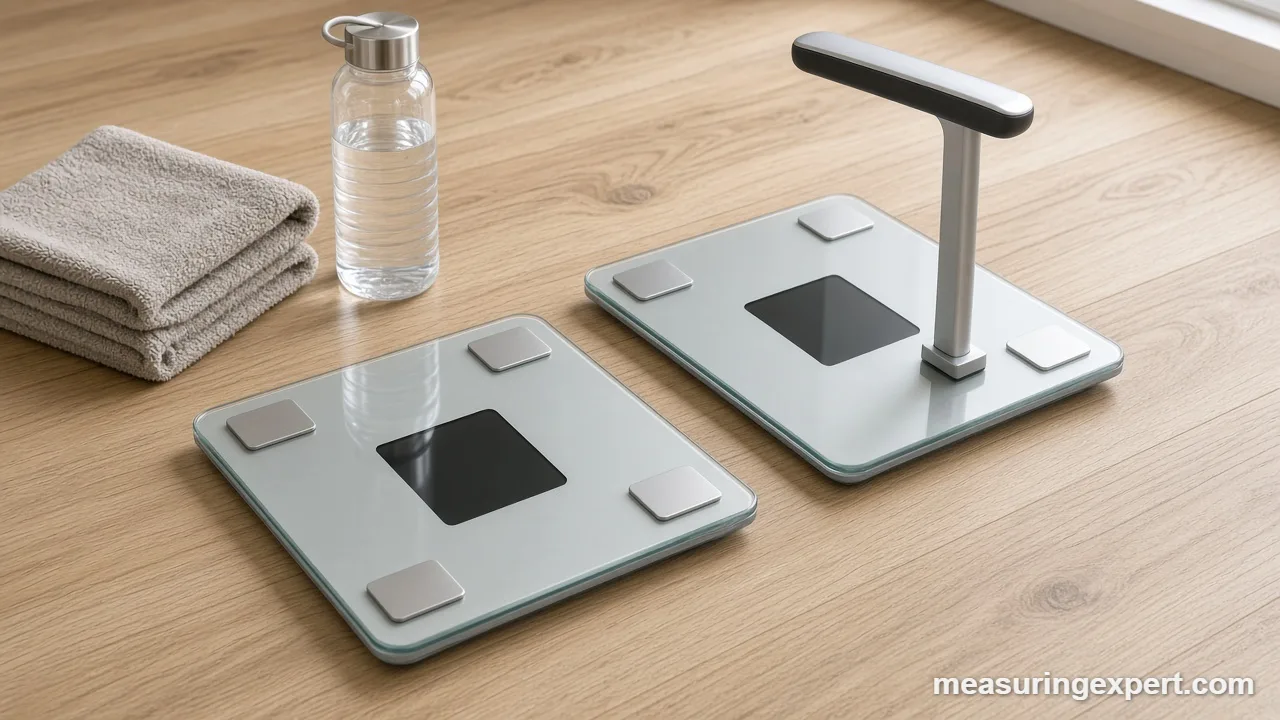
The best fitness scale for most people is the Withings Body Comp, a Wi-Fi body composition scale with a clear color screen, athlete mode and 0.1 lb resolution. What decides your choice is whether you want foot-only readings or an 8-electrode handle model that estimates each arm, leg and the trunk.
In short: get the Withings Body Comp for daily tracking, the eufy P2 Pro if budget comes first, and the InBody H20N when you want segmental 8-electrode estimates.
As an Amazon Associate, Measuring Expert earns from qualifying purchases. Our picks are based on research, specifications and owner feedback, not paid placement.
Best Overall


Best Pro

Quick Answer: Which Fitness Scale Fits You?
- Most people: Withings Body Comp, a foot-sensor smart scale with Wi-Fi sync and athlete mode.
- Tight budget: eufy Smart Scale P2 Pro, which still offers 16 readings and 0.1 lb steps.
- Segmental 8-electrode estimates: InBody H20N, which uses two frequencies and a handle.
- Handle scale with a big screen: RENPHO MorphoScan Nova, which charges over USB-C.
- Heart metrics on top of body composition: Withings Body Scan with its 6-lead ECG handle.
- Garmin watch owners: Garmin Index S2, because it syncs straight to Garmin Connect.
- No app at all: Tanita BC-568 for segmental readings, or the Tanita BC-533 for simple ones.
On This Page
- Best Fitness Scale Comparison Table
- The 8 Best Fitness Scale Picks, Reviewed
- How We Chose the Best Fitness Scale
- How a Body Composition Scale Measures You
- Foot-Only vs 8-Electrode: Which Design to Buy
- Specs That Matter on the Best Fitness Scale
- How to Weigh In for Consistent Readings
- Body Weight Converter: kg, lb and oz
- What BIA Numbers Can and Cannot Tell You
- Best Fitness Scale FAQ
- Final Pick for the Best Fitness Scale
Best Fitness Scale Comparison Table
| # | Product | Best For | Standout Feature | Link |
|---|---|---|---|---|
| 1 | Withings Body Comp | Everyday tracking | Wi-Fi sync, 2.8 in color screen, athlete mode | View |
| 2 | InBody H20N | Segmental estimates | 8 electrodes, 20 and 100 kHz | View |
| 3 | RENPHO MorphoScan Nova | Value handle scale | 4.3 in handle screen, USB-C charging | View |
| 4 | eufy Smart Scale P2 Pro | Budget buyers | 16 readings, IPX5, Wi-Fi and Bluetooth | View |
| 5 | Withings Body Scan | Heart and body data | 6-lead ECG handle, 5-zone analysis | View |
| 6 | Garmin Index S2 | Garmin users | Up to 16 users, Garmin Connect sync | View |
| 7 | Tanita BC-568 | Segmental without an app | Retractable handgrips, 8 electrodes | View |
| 8 | Tanita BC-533 | Simple offline use | Glass platform, 4 user memories | View |
The 8 Best Fitness Scale Picks, Reviewed
First of all, each pick below runs on bioelectrical impedance analysis (BIA). So every body fat or muscle figure is an estimate, not a direct measurement. Weight, on the other hand, is a true measurement, and all of these scales report it to a fine step.
Best Overall
1. Withings Body Comp
Best for: anyone who wants reliable daily weigh-ins plus body composition trends with little fuss.
The Body Comp is a foot-sensor scale, so you simply step on barefoot. It weighs from 5 to 200 kg (9 to 440 lb) in 50 g (0.1 lb) steps, and it shows kg, lb or stones. In addition, it estimates body fat, body water, muscle mass, bone mass, visceral fat and basal metabolic rate. It also reports standing heart rate, vascular age and an electrodermal activity score.
For fitness users, however, the key detail is Athlete Mode. Standard BIA formulas can misjudge very lean, trained people, so this mode switches to a better-suited equation. Because it syncs over Wi-Fi, readings reach the Withings app even when your phone is in another room.
- Range: 5 to 200 kg (9 to 440 lb); graduation 50 g (0.1 lb)
- Wi-Fi and Bluetooth; up to 8 recognized users
- 2.8 in color screen; 4 AAA batteries rated for about 15 months
- Athlete, Pregnancy, Baby and Eyes Closed modes
Pros
- Wide 440 lb range with 0.1 lb resolution
- Automatic Wi-Fi sync and user recognition
- Athlete Mode for trained users
Cons
- Foot-only BIA, so no arm or trunk breakdown
- Some coaching features sit behind the optional Withings+ plan
- App setup needs a phone, not a computer
Skip it if: you want separate estimates for each limb; a handle model such as the InBody H20N suits that better.
Best 8-Electrode Scale
2. InBody H20N (Dial H20)
Best for: lifters and athletes who want segmental muscle and fat estimates at home.
InBody builds the clinic analyzers many gyms use, and the H20N brings a smaller version home. First, you stand on the plate and hold a handle, so current flows through both hands and both feet. As a result, the scale takes 10 impedance readings across 5 segments: each arm, each leg and the trunk. It also measures at two frequencies, 20 kHz and 100 kHz, which helps it separate fluid inside and outside cells.
The screen shows weight, body fat percentage, skeletal muscle mass and BMI. Meanwhile, the InBody app adds body fat mass and basal metabolic rate. However, the H20N is Bluetooth only, so you open the app to sync.
- 8-point tactile electrodes with thumb contacts
- Direct segmental multi-frequency BIA at 20 and 100 kHz
- Weight range 10 to 150 kg (22 to 330 lb)
- Test time about 8 seconds; 4 AA batteries; Bluetooth
Pros
- True hand-to-foot current path
- Segmental readings for 5 body regions
- Two frequencies instead of one
Cons
- Lower 330 lb capacity than most picks
- Bluetooth only, no Wi-Fi sync
- Bulkier than a flat glass scale because of the handle
Skip it if: you weigh more than 330 lb, or you only care about weight and a single body fat number.
Best Value Handle Scale
3. RENPHO MorphoScan Nova

Best for: buyers who want an 8-electrode handle scale with a large screen for less than premium brands charge.
Similarly, this RENPHO splits its 8 electrodes between the glass footplate and a handle. Like the InBody, it measures at 20 kHz and 100 kHz. Then it maps fat and muscle across 5 segments and reports more than 50 metrics in the RENPHO Health app. The 4.3 in color screen sits on the handle, so you read results at eye level instead of looking down at your feet.
Another plus, moreover, is power. Instead of disposable cells, it uses a 1000 mAh battery that charges over USB-C, and RENPHO rates it for up to 5 months per charge.
- 8 electrodes, 4 of them on the handle; thumb contacts double as buttons
- Dual-frequency BIA, 20 and 100 kHz; 5-segment analysis
- Capacity 180 kg (400 lb)
- Rechargeable via USB-C; Bluetooth; Apple Health and Fitbit sync
Pros
- Large handle display that is also easy to read
- Rechargeable battery, because USB-C replaces disposable cells
- Segmental data at a mid-range price
Cons
- 50-plus metrics can feel like noise
- Handle cord adds clutter in small bathrooms
- Bluetooth sync needs the app open
Skip it if: you prefer a flat scale that slides under a cabinet.
Best Budget
4. eufy Smart Scale P2 Pro
Best for: a first body composition scale that still syncs over Wi-Fi.
In contrast, the P2 Pro is a foot-to-foot BIA scale with 16 readings, including body fat, muscle mass, bone mass, body water, protein, visceral fat, skeletal muscle mass and heart rate. It weighs in 0.1 lb (0.05 kg) steps up to 180 kg (396 lb). Also, it has both Bluetooth 5.0 and 2.4 GHz Wi-Fi, so it can upload readings without your phone nearby.
Moreover, eufy calibrates the body composition formulas for ages 16 to 80. In addition, the scale is rated IPX5, which helps in a damp bathroom. It recognizes users by weight within about 3 kg, so two people of similar weight should check the app after each reading.
- 16 measurements, including heart rate and a 3D virtual body model
- 0.2 to 396 lb range; 0.1 lb resolution
- Bluetooth 5.0 and 2.4 GHz Wi-Fi; unlimited users
- 4 AAA batteries, about 6 months; IPX5; 11 x 11 in
Pros
- Wi-Fi at a budget price
- Fine 0.1 lb weight steps
- Water-resistant IPX5 build
Cons
- Foot-only current path
- Also lacks a color screen on the scale itself
- Weight-based user matching can mix up similar users
Skip it if: you are under 16 or want segmental readings.
Best Premium
5. Withings Body Scan

Best for: data-driven users who want segmental body composition and heart readings in one device.
In short, the Body Scan adds a retractable handle to a Withings glass scale. While you hold it, the scale estimates muscle and fat in 5 zones and records a 6-lead ECG that screens for atrial fibrillation. Moreover, the ECG feature received FDA clearance in 2023, before the US launch. A full scan takes about 90 seconds, however, so most owners run quick weigh-ins on busy days.
- Retractable handle with hand and thumb electrodes
- 5-zone muscle and fat estimates; 6-lead ECG
- Wi-Fi and Bluetooth; up to 8 users
- Athlete, Pregnancy, Baby and Eyes Closed modes
Pros
- Heart and body data from one device, which also saves space
- Segmental estimates with a handle
- Automatic Wi-Fi sync
Cons
- The most expensive pick here
- Full scan is slow, although quick weigh-ins still work
- ECG is a screening tool, not a diagnosis
Skip it if: you only need weight and body fat trends; the Body Comp covers that for much less.
Best for Garmin Users
6. Garmin Index S2

Best for: runners and cyclists who already log training on a Garmin watch or bike computer.
The Index S2 reports weight, BMI, body fat percentage, skeletal muscle mass, bone mass and body water. Still, its real strength is the ecosystem. For example, readings flow over Wi-Fi straight into Garmin Connect, next to your training load and sleep data. Also, it stores up to 16 users, which is more than most smart scales.
- Capacity 181.4 kg (400 lb)
- Wi-Fi sync to Garmin Connect
- Up to 16 users
- 4 AAA batteries rated for up to 9 months
Pros
- Seamless Garmin Connect integration
- Generous 16-user limit
- High-resolution color display
Cons
- Foot-only BIA; therefore the upper body is estimated
- Less useful without other Garmin gear, especially a watch
- Fewer metrics than budget rivals
Skip it if: you use Apple Health or another platform as your main hub.
Best Without an App
7. Tanita BC-568 InnerScan Segmental

Best for: people who want segmental readings on the scale screen without accounts or phones.
Tanita has made BIA monitors for decades, and the BC-568 is its segmental InnerScan model. Specifically, retractable handgrips plus foot plates give it 8 electrodes. So it reports body fat and muscle mass for the trunk, each arm and each leg. It also shows weight, visceral fat rating, total body water, bone mass, metabolic age, physique rating, daily calorie intake and BMI.
- 8 electrodes: retractable handgrips plus foot electrodes
- Capacity 330 lb; 0.2 lb (100 g) graduation
- Athlete Mode
- 4 AA batteries included; Tanita lists no app connection
Pros
- Segmental results on the scale itself
- No account, no data sharing
- Athlete Mode for trained users
Cons
- Coarser 0.2 lb steps
- No automatic trend charts
- Also limited to 330 lb
Skip it if: you want graphs and history without writing numbers down.
Best Simple Scale
8. Tanita BC-533 InnerScan

Best for: households that want body fat, water and muscle estimates with a few button presses.
By contrast, the BC-533 is a foot-to-foot glass scale. It stores 4 personal profiles, and it shows body fat percentage, total body water, muscle mass, physique rating, visceral fat, bone mass, daily calorie intake and metabolic age. According to the manual, Athlete Mode suits people who train about 10 hours a week with a resting heart rate near 60 bpm or lower.
- Foot-to-foot BIA on a clear glass platform
- 4 personal memories; age settings from 7 to 99
- Athlete Mode per Tanita’s definition
- Runs on AA batteries
Pros
- Above all, works with no phone or Wi-Fi
- Body fat ranges for ages 7 and up
- Simple four-user memory
Cons
- No data history or sync, because it has no app
- Foot-only current path
- Basic display, especially next to app-based picks
Skip it if: you want automatic logging or segmental results.
How We Chose the Best Fitness Scale
To be clear, we did not test these scales by hand. Instead, we built the list from research. First, we read spec pages and manuals from Withings, InBody, RENPHO, eufy, Garmin and Tanita. Next, we checked how each scale measures: foot-only or hand-to-foot, single or dual frequency. Finally, we read owner feedback for sync problems, drifting weight and confusing user matching.
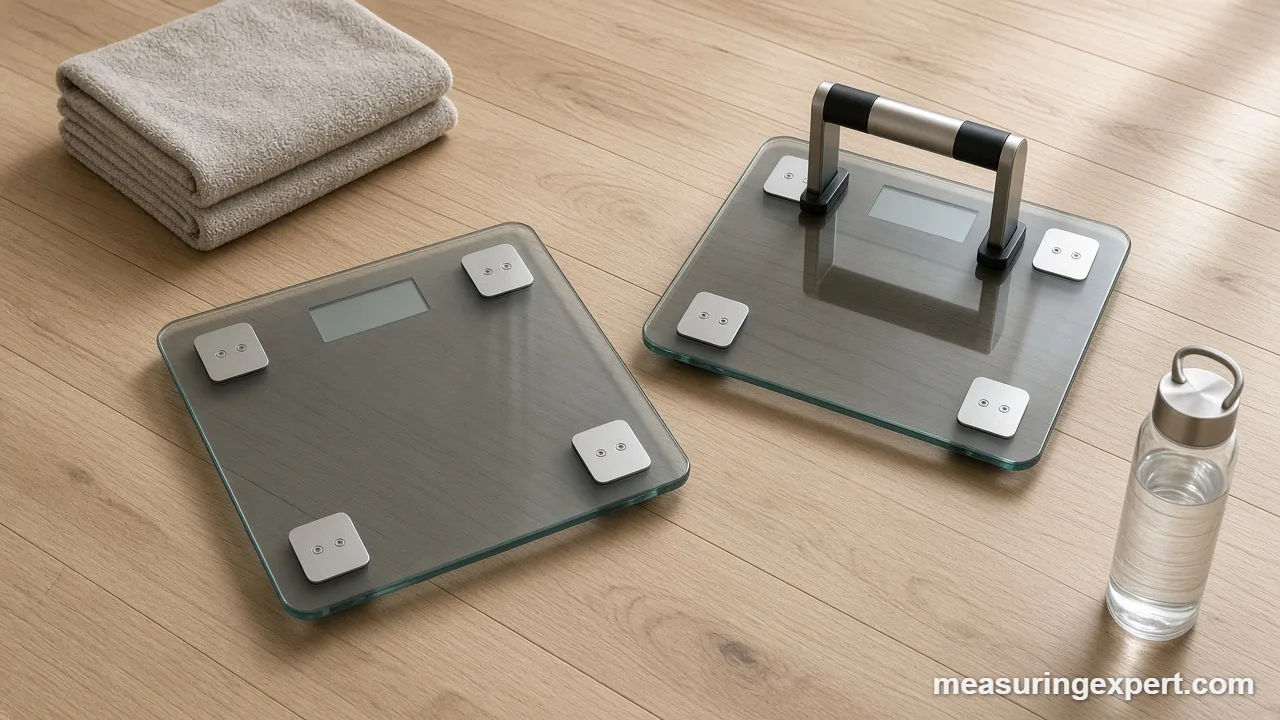
- Measurement design: we favored dual-frequency and 8-electrode models for segmental data.
- Weight resolution and range: 0.1 lb steps and a capacity that fits real households.
- Athlete handling: an athlete mode or published guidance for trained users.
- Data path: Wi-Fi, Bluetooth or offline, so every user type has an option.
- Brand limit: no more than two products per brand, because variety helps buyers compare.
For background on the method, we leaned on the ESPEN review of bioelectrical impedance principles and methods and on Tanita’s own BC-568 product page for segmental specs.
How a Body Composition Scale Measures You
First, a scale measures weight directly with load cells. Body composition, however, is a calculation. The scale sends a tiny, harmless alternating current through your body and measures impedance, which is the opposition to that current. Lean tissue holds a lot of water and conducts well, while fat conducts poorly.
Next, the scale plugs impedance, weight, height, age and sex into a prediction equation. That equation comes from studies that compared BIA with reference methods such as DEXA. As a result, your number is only as good as the match between you and the study group. For this reason, athlete modes exist.
Frequency also matters. At low frequency, current mostly flows through fluid outside cells. At higher frequency, by contrast, it passes through cell membranes too. So a dual-frequency scale such as the InBody H20N or RENPHO Nova gets two views of your body water instead of one.
To illustrate, here is how the scale turns a percentage into mass. Suppose a reading shows 80.0 kg (176.4 lb) and 25.0% body fat. Then fat mass is 80.0 x 0.25 = 20.0 kg (44.1 lb), and fat-free mass is 60.0 kg (132.3 lb). Therefore, a 1-point swing in body fat percentage moves the fat mass by 0.8 kg (1.8 lb) at this weight, even if your body did not change.
Foot-Only vs 8-Electrode: Which Design to Buy
Above all, the biggest choice is the current path. A foot-only scale sends current up one leg and down the other. Because of that, it mostly sees your legs and lower trunk. A handle model, in contrast, adds hand electrodes, so current also crosses the arms and upper body.
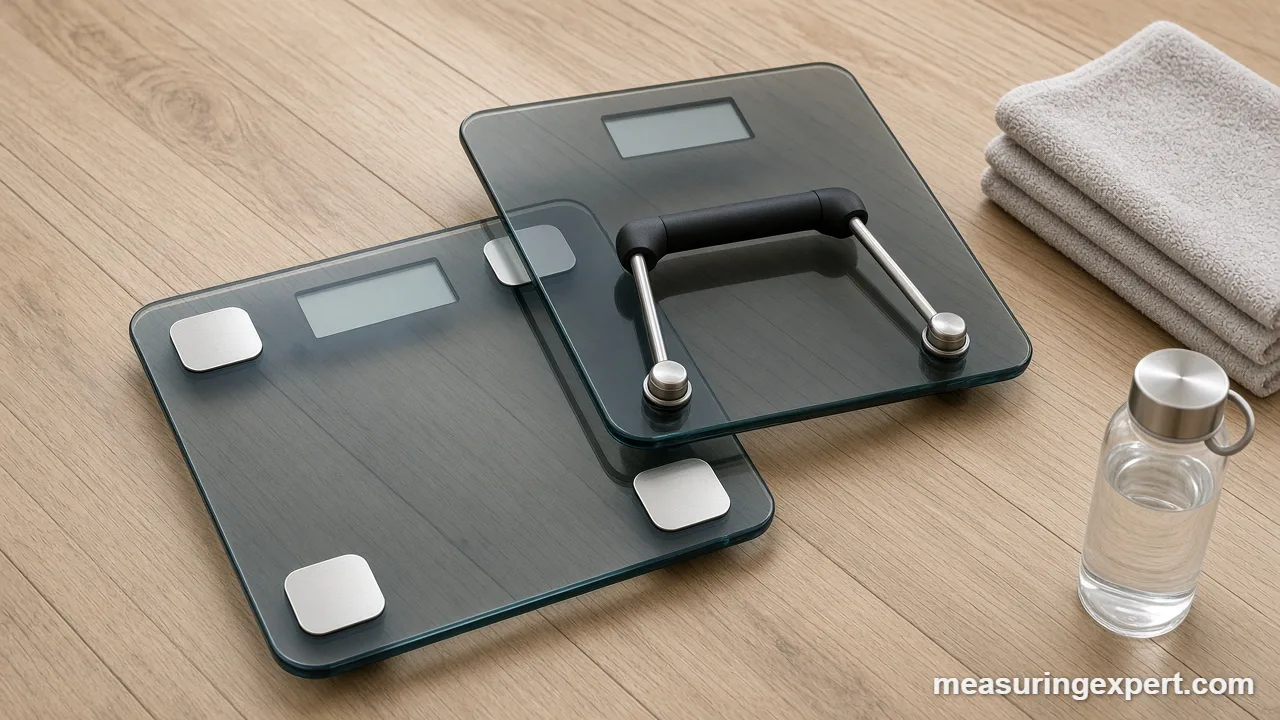
| Design | Current path | Segmental data | Examples here | Trade-off |
|---|---|---|---|---|
| 4-electrode foot scale | Foot to foot | No | Withings Body Comp, eufy P2 Pro, Garmin Index S2, Tanita BC-533 | Fast and flat, but upper body is estimated |
| 8-electrode handle scale | Hands and feet | Yes, 5 segments | InBody H20N, RENPHO Nova, Withings Body Scan, Tanita BC-568 | Fuller picture, but slower and bulkier |
| Dual-frequency | Either path | Usually | InBody H20N, RENPHO Nova | Better fluid separation, higher price |
In particular, if you train upper body hard, a handle scale reflects arm changes better. On the other hand, if you mostly want a steady weight trend, a foot scale is quicker and easier to live with. For plain weigh-ins without body composition, see our best bathroom scale guide.
Specs That Matter on the Best Fitness Scale
- Resolution (graduation): the smallest weight step shown. A 0.1 lb (about 45 g) step tracks small changes better than 0.2 lb (about 91 g).
- Capacity: most picks reach 396 to 440 lb, while the InBody H20N and Tanita BC-568 stop at 330 lb.
- Electrodes and frequency: 8 electrodes allow segmental data, and two frequencies help separate body water.
- Athlete mode: important for lean, trained users, since standard equations can overstate their body fat.
- Connectivity: Wi-Fi syncs on its own; Bluetooth needs the app open. Compare options in our best wireless weight scale roundup and our best Bluetooth bathroom scale picks.
- Power: AAA or AA cells last months; a rechargeable battery avoids buying cells.
- User recognition: weight-based matching works until two users weigh about the same.
Also, remember that resolution is not accuracy. A scale can show 0.1 lb steps and still read high or low if it sits on carpet or an uneven tile.
How to Weigh In for Consistent Readings
Generally, BIA reacts to hydration, food and skin contact. So a steady routine matters more than any single number. Therefore, follow these steps every time.
- Place the scale on a hard, flat floor. After all, carpet and sloped tile shift the load cells and spoil the weight reading.
- Pick a fixed time. For example, weigh in each morning after using the bathroom and before eating or drinking.
- Skip the reading after hard exercise or a sauna. That is because sweat loss and blood flow changes distort impedance for hours.
- Go barefoot with clean, dry skin. Otherwise, lotion or socks block the electrodes.
- Stand still and centered. Keep feet on the electrode pads and, on handle models, hold the grips with arms straight and away from your body.
- Let the scale finish. Wait until the reading locks, then step off.
- Judge trends, not days. Finally, compare weekly averages in the app rather than reacting to one morning.
Body Weight Converter: kg, lb and oz
Many apps store readings in kilograms, while US users think in pounds. Use the converter below to switch units. One pound is exactly 0.45359237 kg by definition.
What BIA Numbers Can and Cannot Tell You
In general, home BIA is good at one thing: showing a trend when you measure the same way each day. However, it is weak at absolute truth. A scale can read several points away from a DEXA scan for one person and close for another. Also, hydration swings, a big meal or a recent workout can move the body fat figure overnight.
In addition, none of these scales measure muscle directly. Instead, they infer it from water and an equation. So treat muscle, bone and visceral fat numbers as rough indicators, and use a tape measure as a second view. Our guide on how to measure your waist explains a consistent method.
Best Fitness Scale FAQ
What is the best fitness scale for most people?
For most people, the Withings Body Comp is the best fitness scale. It weighs in 0.1 lb steps up to 440 lb, syncs over Wi-Fi and has an athlete mode.
Are body fat scales accurate?
Weight readings are accurate on a hard floor. Body fat, however, is an estimate from impedance and an equation, so it is best for tracking trends rather than exact values.
Is an 8-electrode scale more accurate than a foot-only scale?
Usually it gives a fuller picture, because current passes through the arms and trunk as well as the legs. It also allows segmental estimates for each limb.
Which best fitness scale suits athletes?
Look for an athlete mode and, ideally, 8 electrodes. The InBody H20N, Withings Body Comp and Tanita BC-568 are strong choices for trained users.
Why does my body fat reading change from day to day?
BIA depends on body water. So hydration, meals, alcohol, exercise and even skin moisture can shift the reading from one day to the next.
Can I use a smart scale with a pacemaker?
No. Manufacturers warn that people with pacemakers or other implanted electronic devices should not use the body composition function. Weight-only use depends on the model, so check the manual.
Do I need an app to use the best fitness scale?
Not always. The Tanita BC-568 and BC-533 show results on the scale itself, while Withings, InBody, RENPHO, eufy and Garmin rely on an app for full data.
Wi-Fi or Bluetooth: which is better for a fitness scale?
Wi-Fi syncs on its own, even when your phone is elsewhere. Bluetooth, on the other hand, needs your phone nearby with the app open to transfer readings.
Where should I place the best fitness scale?
Place it on a hard, level floor such as tile or wood. Carpet and uneven surfaces can make the weight reading drift.
How often should I weigh myself on a body composition scale?
Daily or a few times a week is fine if you keep the same routine. Then compare weekly averages, since single readings vary with hydration.
Final Pick for the Best Fitness Scale
For most buyers, the Withings Body Comp is the best fitness scale: it pairs fine 0.1 lb resolution with Wi-Fi sync and an athlete mode. If you want segmental data instead, choose the InBody H20N or the RENPHO MorphoScan Nova. In any case, weigh in the same way each day and read the trend.
2 thoughts on “Best Fitness Scale for Body Composition Tracking in 2026”