

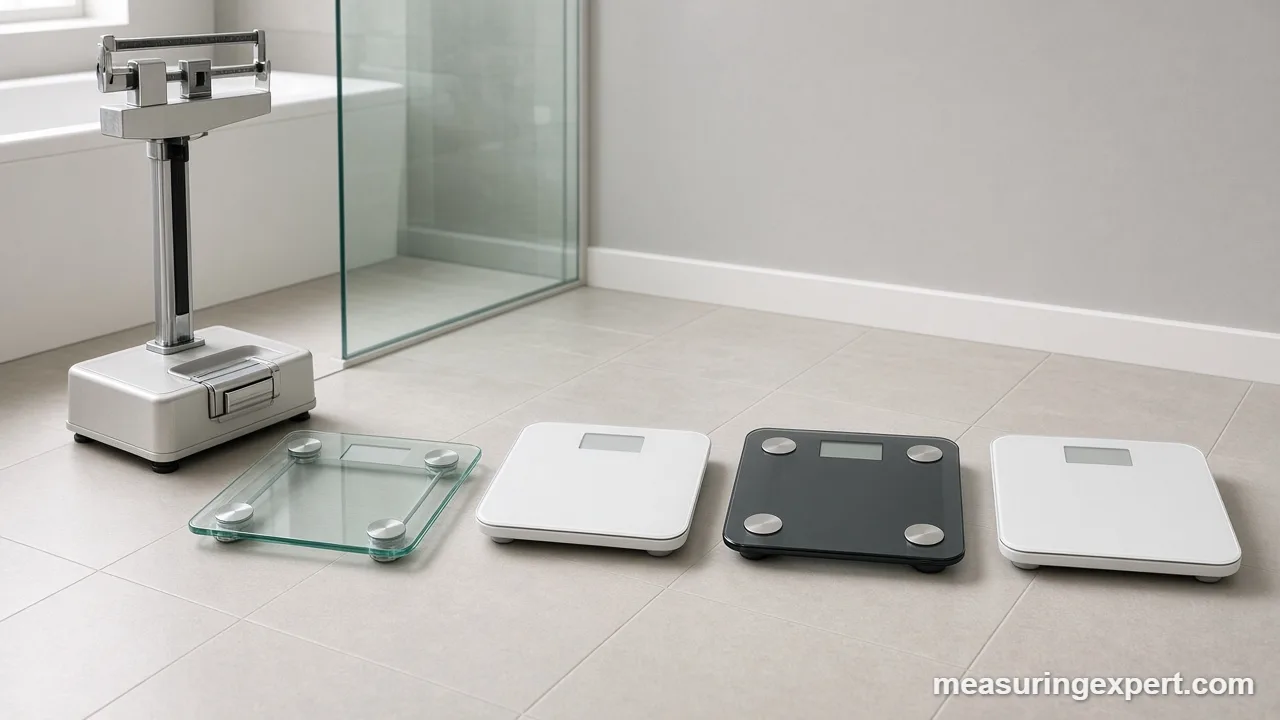
The best scale for simple, reliable body weight at home is the Etekcity Digital Body Weight Bathroom Scale. It reads up to 400 lb in lb or kg, has a backlit display and needs no app. Your choice then comes down to weight capacity, display size, surface grip and whether you want a talking or beam model.
In short: get the Etekcity glass scale for most homes, the Greater Goods AccuCheck on a budget, and the Health o meter 402LB beam scale for clinic-style weighing.
As an Amazon Associate, Measuring Expert earns from qualifying purchases. Our picks are based on research, specifications and owner feedback, not paid placement.
Best Overall
Best Budget

Best Pro
Quick Answer: Which One Should You Buy?
- Most homes: Etekcity Digital Body Weight Bathroom Scale.
- Tight budget: Greater Goods AccuCheck.
- Clinic-style, no batteries: Health o meter 402LB beam scale.
- Over 400 lb or a wide stance: EatSmart Precision 550 lb.
- Low vision: Taylor 70844091M talking scale.
- Wet feet and slick floors: Greater Goods Designer scale with a silicone top.
On This Page
- Comparison table
- The 8 picks, reviewed
- How we chose
- Digital vs mechanical vs talking
- Specs that matter
- How to weigh yourself
- How to check accuracy
- Weight converter
- Honest limits
- FAQ
- Bottom line
Best Scale Comparison: 8 Basic Bathroom Scales
| # | Product | Best For | Standout Feature | Amazon |
|---|---|---|---|---|
| 1 | Etekcity Digital Body Weight Bathroom Scale | Most homes that want a plain, dependable weight readout | 400 lb capacity, 6 mm tempered glass, backlit LCD | View |
| 2 | Greater Goods AccuCheck Digital Bathroom Scale | Low-cost, no-fuss weighing | Step-on with auto-calibration, 0.1 lb readout | View |
| 3 | Health o meter 402LB Mechanical Beam Scale | Clinic-style weighing with no batteries | Sliding-poise beam with height rod | View |
| 4 | EatSmart Precision 550 lb Extra-Wide Bathroom Scale | Higher weights and wider stances | 550 lb capacity, extra-wide platform | View |
| 5 | Taylor 70844091M Talking Digital Scale | Low vision or reading the display is hard | Announces the weight out loud | View |
| 6 | Taylor Digital Glass Scale with Stainless Steel Accents | A clear blue readout in a classic style | 2.8 x 1.3 in blue backlit LCD | View |
| 7 | Etekcity Digital Bathroom Scale (0.05 lb Readout) | Watching small day-to-day changes | 0.05 lb display steps | View |
| 8 | Greater Goods Designer Bathroom Scale | A grippy top and a hidden display | Silicone cover with a hidden LED display | View |
Every pick here is a basic weight scale with no app. If you want readings to log to your phone, see our guide to the best Bluetooth bathroom scale instead. For kitchen, postal or lab weighing, our best digital scale guide covers precision models.
The 8 Best Scale Picks for Body Weight, Reviewed
Best Overall
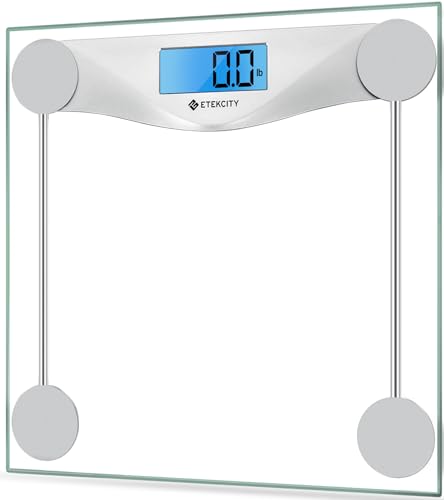
1. Etekcity Digital Body Weight Bathroom Scale
Best for: anyone who wants the best scale for everyday weight checks without apps, accounts or body fat estimates.
This Etekcity glass scale is our best scale for most people because it does one job and keeps the job simple. In practice, you step on, it reads, and it shows a clear number on a blue backlit display. As a result, it suits a shared bathroom where nobody wants to pair a phone or set up profiles.
Specifically, the platform is 6 mm tempered glass, and the listing rates it for up to 400 lb (about 181 kg). In addition, it switches between pounds and kilograms and reads in 0.2 lb (0.1 kg) steps. The 11.9 x 11.9 in platform has anti-skid pads underneath, and it runs on two AAA batteries.
- Capacity: 400 lb (180 kg)
- Graduation: 0.2 lb / 0.1 kg
- Platform: 6 mm tempered glass, 11.9 x 11.9 in
- Display: 2.9 x 1.1 in blue backlit LCD
- Power: 2 AAA batteries
Pros
- Very simple step-on use
- Readable backlit numbers
- Switches between lb and kg
Cons
- No memory of past readings
- Glass top can feel slippery with wet feet
Skip it if: you want automatic logging to a phone; a Bluetooth model fits that job better.
Best Budget
2. Greater Goods AccuCheck Digital Bathroom Scale
Best for: buyers who want the lowest-effort scale with a fine readout and very little to configure.
The Greater Goods AccuCheck is a basic digital bathroom scale with a small footprint and a clean look. Also, it turns on when you step onto it, so there is no tap to wake it. Also, the maker describes auto-calibration, which means the scale sets its own zero before each reading.
Meanwhile, retail listings rate it for up to 400 lb and give a 0.1 lb readout. However, keep in mind that a 0.1 lb display step is resolution, not a promise of accuracy. In short, it is a sensible first scale for a dorm, a guest bath or a tight budget.
- Capacity: 400 lb (about 181 kg)
- Readout: 0.1 lb steps
- Start-up: step-on activation
- Zeroing: automatic calibration
- Power: AAA battery
Pros
- Step-on, no tapping
- Fine 0.1 lb display steps
- Compact and easy to store
Cons
- Reads in pounds only on the listing we checked
- No backlight details published
Skip it if: you need kilograms on the display; the Etekcity glass model covers that.
Best Pro
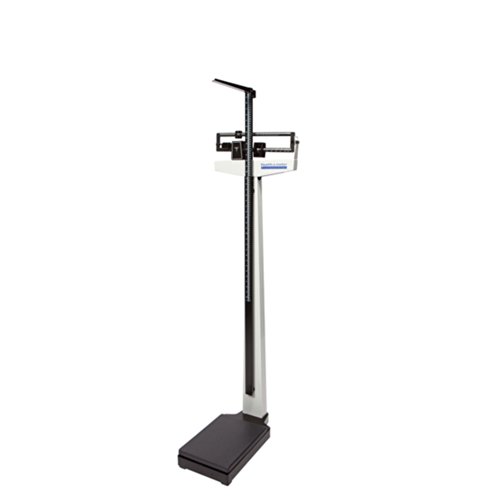
3. Health o meter 402LB Mechanical Beam Scale
Best for: home clinics, gyms, schools and anyone who wants the classic doctor’s office scale.
The Health o meter 402LB is the beam scale you see in many medical offices. Instead of a load cell and a chip, it uses sliding poises on a graduated beam. So you balance the beam, then read the weight from the poise positions. As a result, it needs no batteries, and the reading does not drift with a weak cell.
Overall, it is rated for 400 lb, and the beam reads in 1/4 lb (0.25 lb) steps. In addition, a built-in height rod lets you measure height in the same spot. However, it is large and heavy, so it suits a fixed corner rather than a small bathroom.
- Capacity: 400 lb
- Graduation: 0.25 lb
- Platform: 10.5 x 14 in (about 27 x 36 cm)
- Height rod: built in
- Power: none needed
Pros
- No batteries or electronics to fail
- Height rod included
- Easy to check against known weights
Cons
- Large and heavy
- Slower to read than a digital scale
- Costs far more than a bathroom scale
Skip it if: you have a small bathroom or just want a quick step-on number.
Best High Capacity
4. EatSmart Precision 550 lb Extra-Wide Bathroom Scale

Best for: people who need a higher weight limit or more room for their feet than a standard 12 in platform gives.
For comparison, most basic bathroom scales stop at about 400 lb. This EatSmart model raises the limit to 550 lb (about 249 kg), and it uses a wide platform so you can stand with your feet naturally apart. Therefore, it is easier to stay steady, and a steady stance gives a more repeatable reading.
Similarly, the listing describes a glass top on a large platform. Also, a wider platform spreads your weight across the load cells more evenly. If you are close to a standard scale’s limit, choose a higher-capacity model rather than run a smaller one near its maximum.
- Capacity: 550 lb (about 249 kg)
- Platform: large, extra-wide
- Top: glass
- Type: basic digital bathroom scale
Pros
- Much higher weight limit
- Roomy platform for a stable stance
- No app or setup needed
Cons
- Takes more floor space
- Bigger to store under a vanity
- Fewer published specs than rivals
Skip it if: floor space is tight and you are well under 400 lb.
Best Talking Scale
5. Taylor 70844091M Talking Digital Scale

Best for: people with low vision, or anyone who cannot easily look down at a small display.
A talking scale speaks the reading out loud, so you do not have to bend over to see the numbers. In addition, this Taylor model is a long-running choice in that small category. As a result, it is a good fit for older relatives, for people with low vision, or for anyone who wears glasses only for reading.
Additionally, the listing notes a five-year warranty. However, a voice feature does not make a scale more accurate; it only changes how you get the number. So set it on a hard floor and weigh yourself the same way each time, just as you would with any other scale.
- Readout: spoken weight plus a digital display
- Type: digital bathroom scale
- Warranty: five years, per the listing
Pros
- Hands-free, eyes-free reading
- Helpful for low vision
- Long warranty
Cons
- Voice can be loud in a shared home
- Fewer published specs than rivals
Skip it if: you never struggle to read a display; a standard glass scale costs less.
Best Classic Glass
6. Taylor Digital Glass Scale with Stainless Steel Accents

Best for: buyers who want a conventional glass scale from a long-established scale brand.
Taylor has made household measuring tools for a very long time, and this glass scale is a straightforward example. For instance, it has a clear glass platform trimmed with metal accents and a blue backlit LCD. Taylor lists the display at 2.8 x 1.3 in, so the numbers are easy to see.
Moreover, it is rated for 400 lb and reads in 0.2 lb steps (about 91 g). Also, the platform is 11.8 x 11.8 in, which is the typical size for a standard bathroom scale. For example, if you are replacing an older scale, this one will fit the same spot.
- Capacity: 400 lb
- Graduation: 0.2 lb
- Platform: 11.8 x 11.8 in (30 x 30 cm)
- Display: 2.8 x 1.3 in blue backlit LCD
- Units: pounds
Pros
- Clear backlit display
- Standard footprint
- Established scale maker
Cons
- Pounds only, per Taylor’s page
- 0.2 lb steps are coarser than some rivals
Skip it if: you track in kilograms; pick a model with a unit switch.
Best Fine Readout
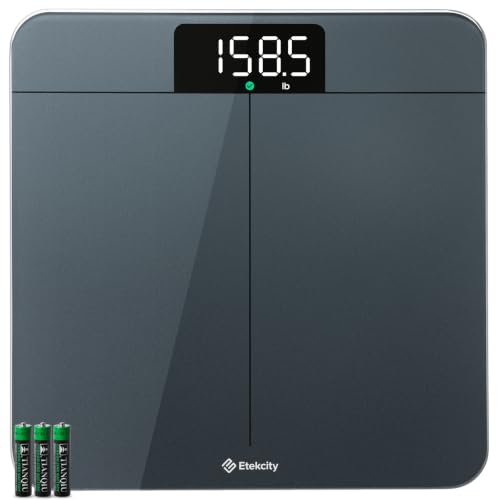
7. Etekcity Digital Bathroom Scale (0.05 lb Readout)
Best for: people who like to see small changes in the readout and understand the difference between resolution and accuracy.
This second Etekcity scale is listed with a 0.05 lb readout, which is about 23 g per step. In other words, that is a finer display step than most bathroom scales offer. As a result, you can see small shifts that a 0.2 lb scale would round away.
However, a finer display does not mean the scale is closer to your true weight. After all, bathroom scales still carry a tolerance, and your body changes during the day. Therefore, use the fine steps to watch trends, not to judge a single reading. For that use, it is a solid, simple pick.
- Readout: 0.05 lb steps (about 23 g)
- Type: basic digital bathroom scale
- App: none needed
Pros
- Very fine display steps
- Simple to use
- Good for trend watching
Cons
- Fine steps can look jumpy
- Display resolution is not accuracy
Skip it if: small changes in the last digit would bother you more than they help.
Best Non-Slip
8. Greater Goods Designer Bathroom Scale

Best for: bathrooms where wet feet and slick glass are a worry, or where style matters.
This Greater Goods model covers the top in a non-slip silicone layer instead of bare glass. So it feels steadier when you step on with damp feet after a shower. In addition, the LED numbers sit hidden under the surface and appear only when the scale is on, which gives it a clean look.
Besides that, it comes in several colors, which helps it blend with a bathroom. On the other hand, the silicone cover can collect lint and hair, so wipe it now and then. For a household that has had a slip scare on a glass scale, it is the best scale option in this guide.
- Top: non-slip silicone cover
- Display: hidden LED digits
- Type: basic digital bathroom scale
- Finish: several colors
Pros
- Grippy surface for wet feet
- Clean hidden display
- Color choices
Cons
- Silicone shows lint and hair
- Fewer published specs than rivals
Skip it if: you want the largest possible display; the Taylor glass model lists a 2.8 in wide readout.
How We Chose the Best Scale Picks
We did not test these scales by hand. Instead, we built this list from research. First, we limited it to basic, non-smart scales, because our other guides already cover app-connected models. Next, we compared published specs from the makers and from major retailers, and we read owner feedback for patterns such as drifting readings or failed displays.
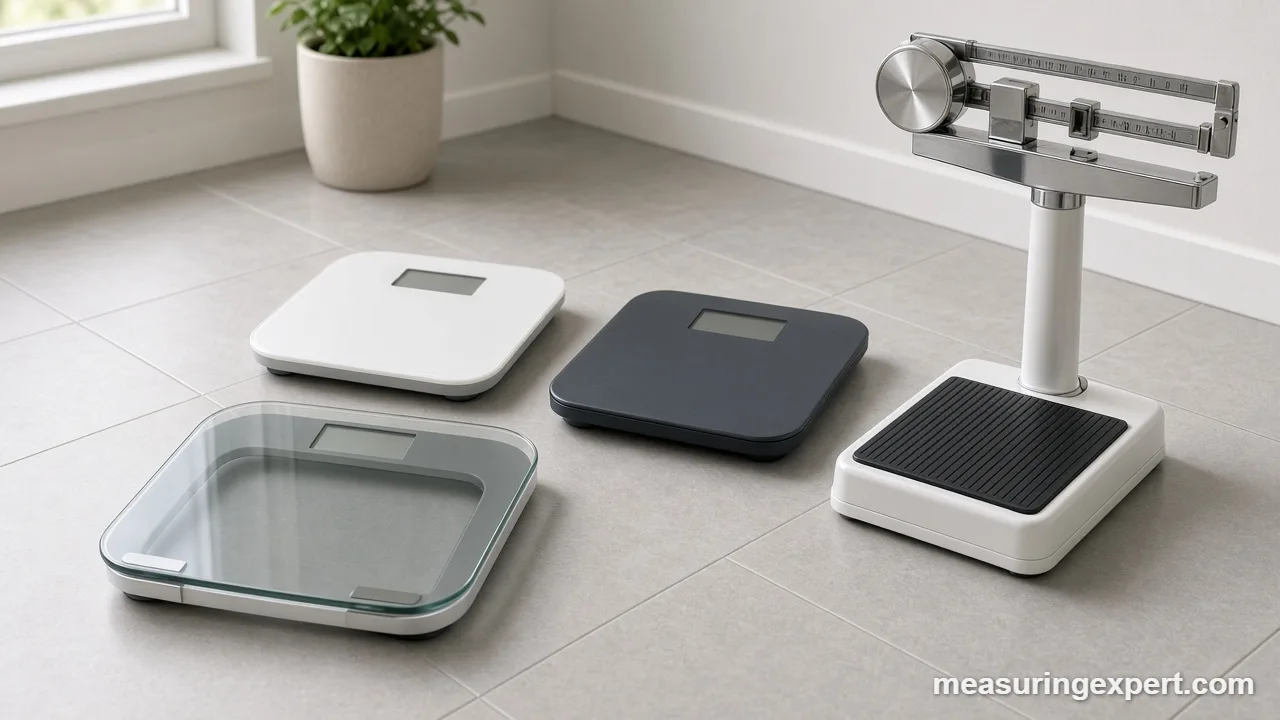
Then we scored each scale on a short set of measuring criteria:
- Capacity: the maximum load the maker rates the scale for.
- Graduation: the display step, such as 0.1 lb or 0.2 lb.
- Units: whether it shows pounds only, or kilograms and stones too.
- Stability: platform size, surface grip and how steady you can stand.
- Readability: display size, backlight or a spoken readout.
- Brand track record: established makers with support and spare parts.
Finally, we kept the list to two picks per brand at most, so each scale covers a different need. Because Amazon listings change often, check the current listing before you buy.
Digital, Mechanical or Talking: Which Type Is the Best Scale for You?
Basic bathroom scales come in three main types. In each case, the scale measures the same thing, the downward force your body puts on the platform, and then shows it as weight. However, they turn that force into a number in different ways.
| Type | How it measures | Good at | Watch out for |
|---|---|---|---|
| Digital glass or plastic | Load cells bend slightly; a chip converts the change into a number | Quick, clear readings and unit switching | Needs batteries; sensitive to carpet and uneven floors |
| Mechanical beam | Sliding weights balance a lever, like a classic balance | No batteries, easy to check, long life | Large, heavy and slower to read |
| Mechanical dial | A spring stretches and turns a needle | Cheap and battery-free | Coarse marks; springs can drift over time |
| Talking digital | Same load cells as a digital scale, plus a voice readout | Low vision or limited mobility | Voice can be loud; same setup rules apply |
Strictly speaking, a scale measures force and reports it as mass. That is why the same person reads slightly differently at very different locations. For more on that idea, see our explainer on what mass is and how it differs from weight. In daily use at home, though, the difference is far too small to notice.
Best Scale Specs Explained: What the Numbers Mean
Of course, product listings are full of numbers. Here is what the main ones mean, and which ones matter for body weight.
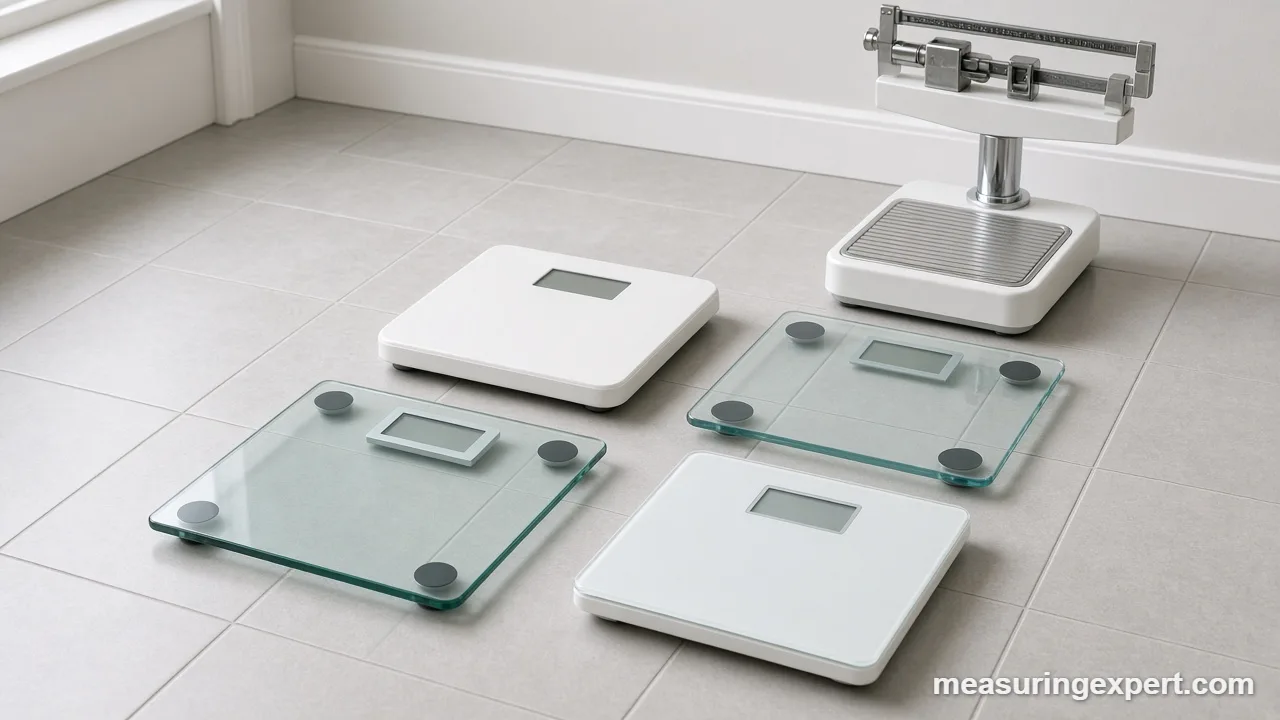
Capacity. Simply put, capacity is the heaviest load the scale is rated to read. Most basic models top out at 400 lb (about 181 kg), while high-capacity models reach 440 to 550 lb (about 200 to 249 kg). As a rule, pick a scale whose limit sits well above your weight, because load cells work best away from their maximum.
Graduation and resolution. Similarly, graduation is the smallest step the display shows. Common steps are 0.2 lb (about 91 g), 0.1 lb (about 45 g) and 0.05 lb (about 23 g). A beam scale often reads in 0.25 lb steps. However, resolution is not accuracy. A scale can show 0.05 lb steps and still read a little high or low overall.
Accuracy and repeatability. First, accuracy is how close the reading is to your true weight. Second, repeatability is whether you get the same number when you step off and back on. For tracking, repeatability matters most, because you compare readings over time on the same scale. Few basic scale makers publish a formal accuracy figure, so we treat a clear spec sheet as a plus.
Units, Platform and Power on the Best Scale
Units. Most digital scales switch between pounds and kilograms, and some add stones. One stone equals exactly 14 lb, or about 6.35 kg. If you share a home with someone who uses UK units, our guide to US vs UK units explains stones and other imperial measures.
Platform and surface. Typically, a standard platform is about 12 x 12 in (30 x 30 cm). Wider platforms help taller people and anyone who needs a broader stance. Also, check the surface: bare glass looks sleek but can be slick when wet, while silicone or textured tops give more grip.
Power. Digital scales usually run on AAA, AA or lithium coin cells. Also, weak batteries are a common cause of odd readings. In contrast, beam and dial scales need no power at all.
How to Weigh Yourself at Home
In fact, good habits matter more than the scale you buy. Follow these steps for readings you can compare from day to day.
- Place the scale on a hard floor. Set it on tile, wood or concrete that is flat and level, never on a rug or carpet.
- Let it settle and zero. Step-on models zero themselves; for a tap-on model, tap first and wait for 0.0 before stepping on.
- Weigh at the same time. Pick one time each day, for example right after waking and using the bathroom, before eating or drinking.
- Wear the same clothes or none. Clothes and shoes add weight, so keep them the same between readings.
- Stand still in the center. Put your feet evenly on the platform, look straight ahead and stay still until the number locks.
- Track weekly averages. Write down each reading and compare weekly averages, because single readings move with water and food.
How to Check Whether Your Readings Are True
Fortunately, you do not need lab weights to run a useful check at home. Instead, try these three simple tests.
- Repeat test: step on and off five times in a row. A good scale should give the same reading, or very close, each time.
- Known-weight test: weigh yourself, then weigh yourself holding a dumbbell or a sealed product with a printed net weight. The difference should be close to the item’s weight. For example, a 10 lb dumbbell is about 4.54 kg.
- Position test: move the scale a few inches on the same floor and weigh again. A big change points to an uneven floor or a weak load cell.
Keep in mind that dumbbells and food packages have their own tolerances. Therefore, treat this as a sanity check, not a calibration. A beam scale is the easiest type to check, because you can confirm the beam balances at zero before each use.
Care and calibration
Generally, most digital bathroom scales calibrate themselves when they switch on, so there is no user calibration menu. To help that process, keep the scale level, keep it dry, and avoid storing heavy items on top. In addition, wipe glass tops with a damp cloth rather than spraying cleaner into the edges, where it can reach the electronics.
Body Weight Converter: Pounds, Kilograms and Ounces
Need to switch units? Then enter your weight below. The calculator uses the exact definition 1 lb = 0.45359237 kg, which is the international definition of the pound.
For example, 180 kg, a common metric capacity, works out to about 396.8 lb. For smaller conversions, see how many ounces are in a kilo. The kilogram itself is now defined by a constant of nature; NIST explains how the kilogram was redefined in plain terms.
Honest Limits of Even the Best Scale
A bathroom scale is a useful tool. Even so, it has limits worth knowing:
- Your weight moves during the day. Food, drinks, sweat and water shifts can change it by a pound or more between morning and evening.
- Two scales rarely agree exactly. So pick one scale and stick with it for tracking.
- Floors matter. For example, even a hard floor with a slight slope can change a reading.
- Basic scales do not estimate body fat. That is by design; if you want those estimates, a smart scale is the right tool, and even then they are estimates.
- A scale is not a medical device unless it says so. Clinic scales are often built and certified for that use, while household scales usually are not.
Measurement science has a name for these ideas: uncertainty. In short, no reading is ever perfectly exact, so look for consistency rather than perfection.
Do and don’t
Best Scale FAQ
What is the best scale for body weight at home?
For most homes, the best scale is a simple digital bathroom scale such as the Etekcity glass model. It reads up to 400 lb, switches between lb and kg, and needs no app. However, pick a higher-capacity or talking model if those needs apply.
Is a basic model as accurate as a smart one?
Generally yes, because both types weigh you with the same kind of load cells. A smart scale adds Bluetooth logging and body fat estimates, but those extras do not make the weight reading more accurate. So a basic scale is fine if you only need weight.
Why do my readings change from day to day?
Most of the time, changes come from setup and timing. For example, carpet, an uneven floor, a cold start or leaning can shift a reading. Also, your body weight changes during the day with food, drinks and water. Weigh on a hard floor at the same time each day.
Should a bathroom scale go on carpet?
No. Carpet lets the platform flex and can push the feet unevenly onto the load cells. As a result, readings often come out low or inconsistent. Instead, use tile, wood or another hard, level surface.
How can I check my readings for accuracy?
Use a known weight, such as a dumbbell or a sealed bag with a printed net weight. First weigh yourself, then weigh yourself holding the item. The difference should be close to the item’s weight. Also, step on several times to check repeatability.
What does 0.1 lb or 0.2 lb mean on a display?
That number is the display step, also called resolution or graduation. A 0.2 lb scale shows readings in 0.2 lb jumps, which is about 91 g. However, the step size does not tell you how close the reading is to your true weight.
Is a mechanical beam scale the best scale for home use?
A beam scale like the Health o meter 402LB needs no batteries and is easy to check, which is why clinics use them. On the other hand, it is large, heavy and slower to read. For most homes, a digital scale is more practical.
How do I convert my weight from pounds to kilograms?
Multiply pounds by 0.45359237, which is the exact legal definition. For example, 150 lb is about 68.04 kg. To go the other way, divide kilograms by 0.45359237. The calculator in this guide does the math for you.
How many pounds are in a stone?
By definition, one stone is exactly 14 lb, which is about 6.35 kg. Stones are still common for body weight in the UK and Ireland. To convert, divide your weight in pounds by 14.
What is the best scale for people over 400 lb?
Choose a high-capacity model such as the EatSmart Precision 550 lb, which is rated to about 249 kg. Also, a wider platform helps you stand steady. As a rule, keep your weight well below any scale’s maximum.
Bottom Line: Our Best Scale Pick
For most homes, the Etekcity Digital Body Weight Bathroom Scale is the best scale for plain, dependable body weight. It is simple, it reads in lb or kg, and it has a clear backlit display. However, choose the Greater Goods AccuCheck to save money, the EatSmart 550 lb for more capacity, or the Health o meter 402LB for a battery-free beam scale.
1 thought on “Best Scale for Body Weight: 8 Basic Bathroom Scales for 2026”