

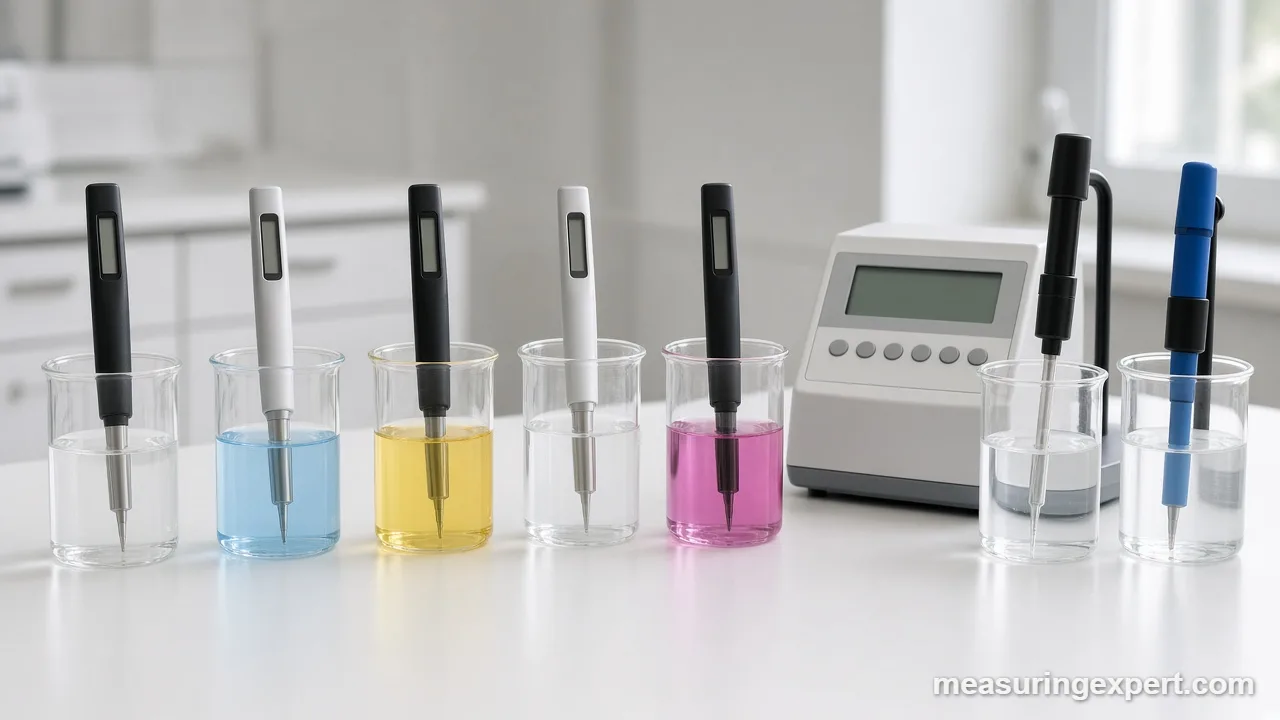
The best dual display pH meter for most buyers is the Apera PH60, because it shows pH and temperature together and holds +/-0.01 pH accuracy in a waterproof pen. Your choice depends on resolution, calibration points, the extra readings you need (EC, TDS or ORP) and whether you work in the field or at a bench.
In short: pick the Apera PH60 for precise pocket readings, the Milwaukee PH55 for value, and the Apera PH800 when you need a benchtop with stored records.
As an Amazon Associate, Measuring Expert earns from qualifying purchases. Our picks are based on research, specifications and owner feedback, not paid placement.
Best Overall
Best Value
Best Benchtop
Quick Answer: The Best Dual Display pH Meter for Each Job
- Most people: Apera PH60, with +/-0.01 pH accuracy and 3-point calibration.
- Good value: Milwaukee PH55, a dual-level LCD pen with a double-junction probe.
- Tanks and pools: Hanna pHep 5, which floats if you drop it.
- Hydroponics: Bluelab pH PenPlus, IP68 with a screw-on probe.
- Nutrient strength too: Bluelab Combo Meter for pH, EC, ppm and temperature.
- Sanitizer checks: Hanna HI98121 adds ORP to pH and temperature.
- Lab bench: Apera PH800, which stores 500 readings with calibration data.
On This Page
- Comparison table
- The 8 picks, reviewed
- How we chose
- Why temperature belongs on the screen
- Pen, portable or benchtop
- Specs worth reading
- How to calibrate
- Electrode care
- Do and don’t
- Honest limits
- FAQ
- Bottom line
Best Dual Display pH Meter Picks at a Glance
| # | Image | Product | Best For | Standout Feature | Amazon |
|---|---|---|---|---|---|
| 1 |  | Apera PH60 (AI311) | Most people who want lab-style pH and temperature readings in a pocket pen | +/-0.01 pH accuracy with a 3-color backlit dual display | View |
| 2 | 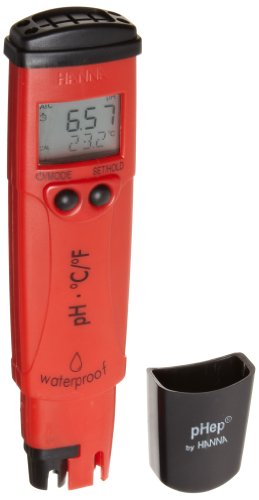 | Hanna pHep 5 HI98128 | Hydroponic tanks, ponds and pools where a pen may get dropped | Floats, with a replaceable electrode and 3-point calibration | View |
| 3 |  | Milwaukee PH55 | Gardeners and hobbyists who want pH plus temperature without paying for 0.01 resolution | Dual-level LCD and a replaceable double-junction probe | View |
| 4 | 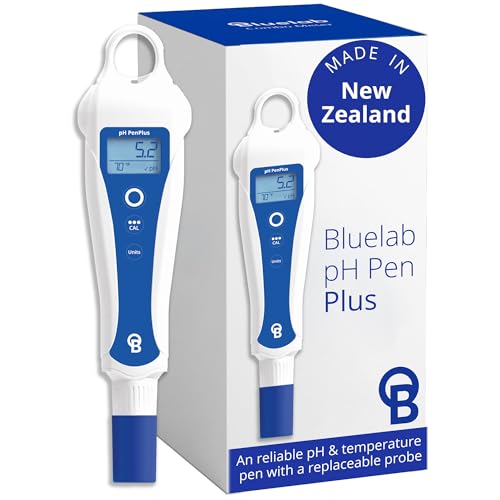 | Bluelab pH PenPlus | Hydroponic and indoor growers who want a rugged, simple pen | IP68 body and a screw-on replaceable pH/temperature probe | View |
| 5 | 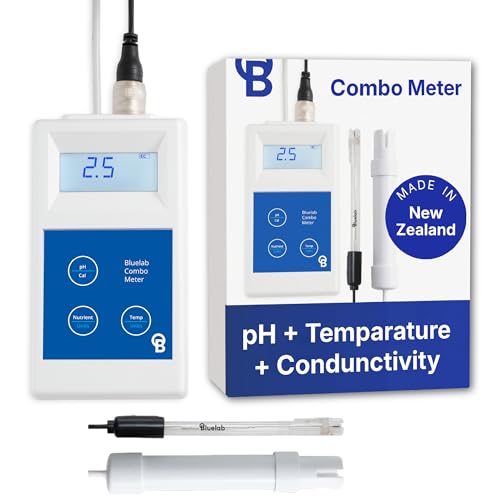 | Bluelab Combo Meter | Growers who check pH, nutrient strength and temperature in one go | pH, EC, CF, ppm and temperature from one handheld | View |
| 6 |  | Hanna HI98121 | Pools, spas, wine and water treatment where ORP matters too | pH, ORP and temperature in one waterproof pen | View |
| 7 |  | Milwaukee MW102 | Field and soil-slurry work where a separate probe on a cable helps | Separate lab-grade pH probe and stainless temperature probe | View |
| 8 |  | Apera PH800 (AI521) | Labs, classrooms and QA benches that need records | 500 timestamped records with USB export | View |
The 8 Best Dual Display pH Meters, Reviewed
Each pick shows pH and temperature, and two add EC or ORP. We note accuracy, calibration points and temperature range for each one.
Best Overall
1. Apera Instruments PH60 Premium pH Tester (AI311)
Best for: Home brewers, aquarium keepers, growers and teachers who want a precise pen that shows pH and temperature together.
The Apera PH60 is our pick for the best dual display pH meter in pen form. Its backlit screen shows pH and temperature at the same time, and the backlight changes color with the mode, so you always know whether you are measuring or calibrating. Apera rates it at +/-0.01 pH, a benchtop-class figure.
In addition, it calibrates automatically at 1 to 3 points and recognizes five buffer values. Better yet, the kit ships with pH 4.00, 7.00 and 10.01 solutions, so you can run a full 3-point calibration on day one. The probe is also replaceable, so a worn electrode does not mean a new meter.
- pH range: -2.00 to 16.00, resolution 0.01 or 0.1
- Accuracy: +/-0.01 pH +/-1 digit; temperature +/-0.5 C
- Temperature: 0 to 50 C (32 to 122 F), with ATC over the same span
- Calibration: 1 to 3 points (1.68, 4.00, 7.00, 10.01, 12.45)
- Build: IP67, floats; 4 AAA batteries, up to 2,000 hours
Pros
- Benchtop-class accuracy in a pen
- Three buffers included in the kit
- Replaceable probe also extends its life
- Battery life is also very long
Cons
- Temperature range stops at 50 C (122 F)
- Single-junction probe is less suited to dirty samples
- Costs more than basic pens
Skip it if: You mostly test nutrient tanks and also need EC; a combo meter such as the Bluelab Combo Meter covers both.
Best Floating Pen
2. Hanna Instruments pHep 5 HI98128 pH/Temperature Tester
Best for: Growers and pool owners who want a sturdy, floating pen with a stability indicator.
Hanna’s pHep 5 is a waterproof pen that floats if it slips into a tank. Its display shows temperature in C or F next to the pH value. Also, a clock icon stays on until the reading settles, so you know when to write the number down instead of guessing.
Next, it calibrates at one, two or three points with either the USA buffer set (4.01, 7.01, 10.01) or the NIST set (4.01, 6.86, 9.18). Plus, the HI73127 electrode screws out for replacement. However, Hanna lists accuracy at +/-0.05 pH, so it is a step below the Apera on paper.
- pH range: -2.00 to 16.00, resolution 0.01
- Accuracy: +/-0.05 pH at 25 C; temperature +/-0.5 C (+/-1 F)
- Temperature: -5.0 to 60.0 C (23 to 140 F), with ATC
- Calibration: 1 to 3 points, USA or NIST buffers
- Power: four 1.5 V cells, about 300 hours; auto-off after 8 minutes
Pros
- Floats if dropped in a tank
- Stability indicator, so you never log an early reading
- Replaceable HI73127 electrode
- Wider temperature range than most pens
Cons
- Accuracy is +/-0.05 pH, not +/-0.01
- Also uses button cells, which cost more than AAA
- No backlight listed
Skip it if: You need the tightest pocket accuracy; the Apera PH60 is rated five times tighter.
Best Value
3. Milwaukee Instruments PH55 PRO pH/Temperature Tester
Best for: Budget-minded growers and aquarists who still want ATC, a replaceable probe and a dual-level screen.
The Milwaukee PH55 is a simple pen with a dual-level LCD: pH on top and temperature underneath. It reads to 0.1 pH with +/-0.1 pH accuracy, and that is enough for most garden and aquarium work.
Also, the Mi56P electrode is gel-filled and double-junction, so it resists clogging better than a basic single-junction tip. Calibration is automatic at one or two points, with standard or NIST buffers. As a result, it covers the essentials without the cost of a lab pen.
- pH range: -2.0 to 16.0, resolution 0.1, accuracy +/-0.1
- Temperature: -5.0 to 60.0 C (23 to 140 F), accuracy +/-0.5 C
- Calibration: 1 or 2 points (4.01/7.01/10.01 or 4.01/6.86/9.18)
- Build: IP65 waterproof; replaceable Mi56P electrode
- Power: four LR44 cells, about 300 hours
Pros
- Clear dual-level display
- Double-junction, replaceable probe
- ATC from -5 to 60 C
- Also simple, with two-button operation
Cons
- 0.1 pH resolution only
- No 3-point calibration
- IP65, not IP67
Skip it if: You test lab samples, wine or anything that needs 0.01 pH resolution.
Best for Hydroponics
4. Bluelab pH PenPlus with Replaceable Probe
Best for: Indoor growers who check nutrient solution daily and want a pen that shrugs off spills.
Above all, Bluelab built the pH PenPlus for growers. It reads pH and temperature, and it switches between C and F. Its IP68 rating means it is dust tight and waterproof. As a result, a splash at the reservoir is not a problem.
In addition, the pH and temperature probe screws on, so you can replace the sensor rather than the whole pen. Bluelab sets a 30-day calibration reminder, and the kit includes pH 7.0 and 4.0 sachets for a 2-point calibration. However, Bluelab says to use it in solutions with an EC of 0.2 or higher, so it is not meant for very pure water.
- pH range: 0.0 to 14.0, resolution 0.1, accuracy +/-0.1 at 25 C
- Temperature: 0 to 50 C (32 to 122 F), accuracy +/-1 C (+/-2 F)
- Calibration: 2 points with a 30-day reminder
- Build: IP68; replaceable pH ProbePlus; 1 AAA battery
- Extras: hold function, backlit display, auto-off
Pros
- IP68 waterproof and dustproof
- Replaceable probe
- Calibration reminder, so checks become routine
- Easy for beginners
Cons
- However, only 0.1 pH resolution
- Not for low-EC or pure water
- Temperature resolution is 1 degree
Skip it if: You test RO, distilled or rain water, which sit below the EC 0.2 limit.
Best pH/EC/TDS
5. Bluelab Combo Meter (pH, EC and Temperature)
Best for: Hydroponic growers who want pH, conductivity and temperature on one screen with one tool.
If you also track nutrient strength, the Bluelab Combo Meter saves a second device. It measures pH, conductivity (EC, CF, ppm 500 and ppm 700) and temperature. The pH probe sits on a 2 m (6.6 ft) cable, so you can reach into a deep reservoir while the meter stays dry.
Moreover, the conductivity probe comes factory calibrated, so you only calibrate pH, at 2 points. Also, the replaceable pH probe uses a BNC connector. Bluelab backs the meter with a 5-year limited warranty, although the pH probe itself carries 6 months.
- pH: 0.0 to 14.0, resolution 0.1, accuracy +/-0.1
- EC: 0.0 to 9.9, accuracy +/-0.1; ppm 500: 0 to 4,950, accuracy +/-50
- Temperature: 0 to 50 C (32 to 122 F), accuracy +/-1 C
- Calibration: 2-point pH; EC factory calibrated
- Warranty: 5 years on the meter, 6 months on the pH probe
Pros
- Three readings from one meter
- Long 2 m probe cables
- Replaceable BNC pH probe
- Long meter warranty
Cons
- Bulkier than a pen, because of the two probes
- pH resolution is only 0.1
- More expensive than single pens
Skip it if: You only need pH; a pen such as the Apera PH60 is more precise and smaller.
Best pH/ORP
6. Hanna Instruments HI98121 pH/ORP/Temperature Tester
Best for: Pool and spa owners, winemakers and water treatment staff who also watch oxidation-reduction potential.
In addition to pH and temperature, the HI98121 adds ORP. ORP, measured in millivolts, shows how strongly a sample oxidizes, so pool owners use it to judge sanitizer activity.
For pH, it reads to 0.01 with +/-0.05 pH accuracy and calibrates at one or two points. Meanwhile, the ORP side comes factory calibrated, with +/-2 mV accuracy. Besides, the pH electrode is replaceable, and the pen runs about 250 hours on four 1.5 V cells.
- pH: -2.00 to 16.00, resolution 0.01, accuracy +/-0.05
- ORP: +/-1,000 mV, resolution 1 mV, accuracy +/-2 mV
- Temperature: -5.0 to 60.0 C (23 to 140 F), accuracy +/-0.5 C
- Calibration: 1 or 2 points for pH; ORP factory calibrated
- Power: four 1.5 V cells, about 250 hours
Pros
- Adds ORP for sanitizer checks
- 0.01 pH resolution
- Also waterproof, with ATC
Cons
- Only 2-point pH calibration
- Costs more than pH-only pens
- ORP needs care to read well
Skip it if: You never measure ORP; the pHep 5 gives you 3-point calibration for less.
Best Portable Meter
7. Milwaukee Instruments MW102 PRO+ pH/Temperature Meter
Best for: Users who want a handheld meter with separate probes on cables for buckets, tanks and field samples.
First of all, the MW102 is a handheld meter rather than a pen. It comes with an SE220 gel-filled, double-junction pH probe and an MA831R stainless temperature probe, both on 3 ft cables. So you can dip into a bucket or a soil slurry while the meter stays on the bench or in your hand.
Meanwhile, it reads pH to 0.01 with +/-0.02 pH accuracy and compensates for temperature from 0 to 70 C. Calibration, too, is automatic at one or two points. In short, it sits between a pen and a benchtop.
- pH: -2.00 to 16.00, resolution 0.01, accuracy +/-0.02
- Temperature: -5 to 70 C (23 to 158 F), accuracy +/-0.5 C at 25 C
- ATC: 0 to 70 C
- Calibration: 1 or 2 points (4.01, 7.01, 10.01)
- Power: one 9 V battery, about 300 hours
Pros
- Probes on cables reach into deep containers
- +/-0.02 pH accuracy
- Separate probes are easy to replace
- Higher ATC range than pens
Cons
- However, not waterproof like the pens
- Two probes to manage
- No 3-point calibration
Skip it if: You want one sealed pen for quick dips; any pen above is simpler.
Best Benchtop
8. Apera Instruments PH800 Benchtop pH Meter Kit (AI521)
Best for: Labs, schools and food or brewing QA that need repeatable readings and stored records.
For bench work, the Apera PH800 is a full laboratory meter. It ships with a 3-in-1 pH and temperature electrode (201T-F) and accepts standard BNC electrodes. Moreover, its ATC runs from 0 to 100 C, so it handles warm samples better than any pen here.
In addition, it stores 500 timestamped data sets, including the calibration slope and offset, and exports them by USB as CSV or PDF. Therefore, it suits audited work. Finally, calibration is automatic at 1 to 3 points, with USA or NIST buffer sets.
- pH: -2 to 19.99, resolution 0.1/0.01, accuracy +/-0.01 +/-1 digit
- mV: +/-1,999 mV, resolution 1 mV
- Temperature: 0 to 80 C (32 to 176 F), resolution 0.1 C, accuracy +/-0.5 C
- Calibration: 1 to 3 points; kit includes 4.00, 7.00 and 10.01 buffers
- Data: 500 records, USB output; 3-year meter warranty
Pros
- Lab-grade accuracy and stability
- Stores records with calibration data
- Accepts any BNC electrode
- Also a long instrument warranty
Cons
- Needs mains power and bench space
- Therefore overkill for garden or pool checks
- Largest investment on the list
Skip it if: You test in the field; a pen or the MW102 travels much better.
How We Chose the Best Dual Display pH Meter Picks
We did not run hands-on tests. Instead, we built this list from research. First, we read the manufacturer spec sheets and manuals from Apera, Hanna, Milwaukee and Bluelab. Next, we compared owner feedback for patterns such as drifting probes, slow readings and fragile caps. Finally, we checked that each model is still sold and supported by its maker.
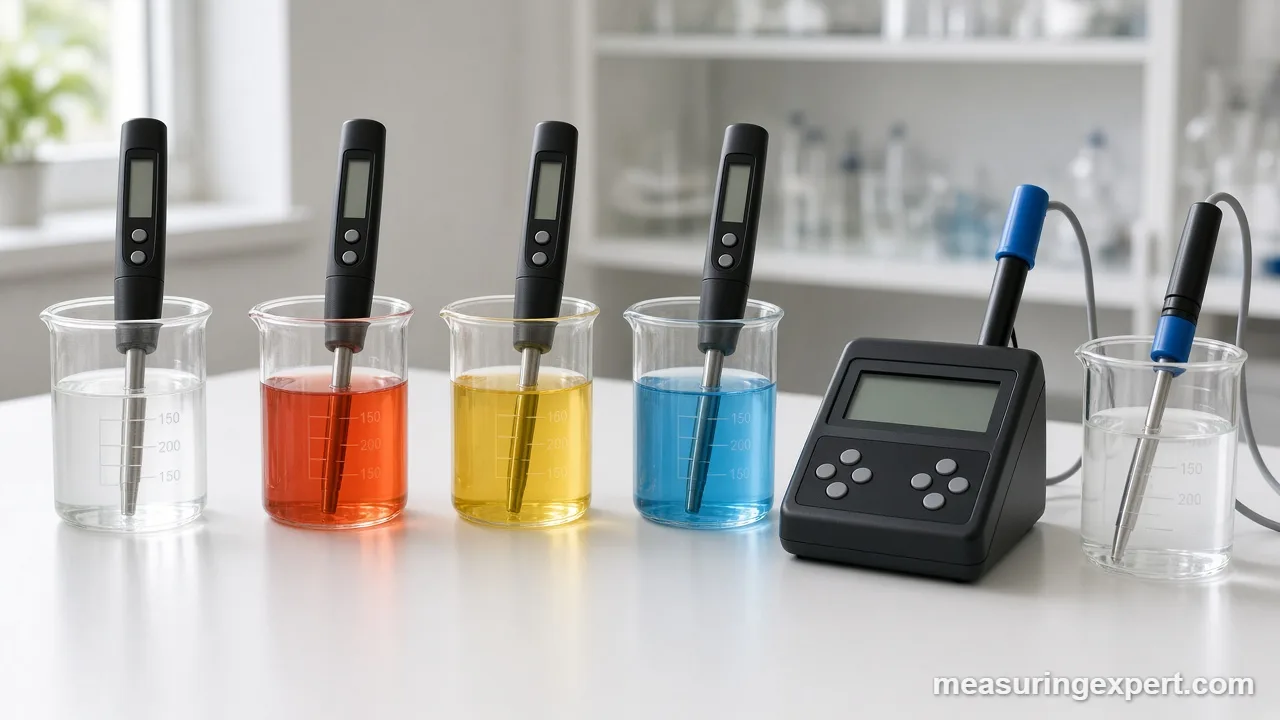
Every pick had to meet these rules:
- Two readings at once: pH plus temperature on the same screen, or pH with EC, TDS or ORP.
- Automatic temperature compensation (ATC): a built-in sensor that corrects the electrode response.
- At least 2-point calibration: one point alone cannot correct the slope of the electrode.
- Published accuracy: a clear figure such as +/-0.01 or +/-0.1 pH, not just “high precision.”
- Service life: a replaceable probe or a long warranty, from an established brand.
We also limited each brand to two models. For background on pH itself, we used the USGS Water Science School page on pH and water.
Why the Best Dual Display pH Meter Shows Temperature
A pH electrode makes a small voltage, and the meter turns that voltage into pH. However, the size of that voltage per pH unit changes with temperature. In theory, the Nernst slope is 54.20 mV per pH at 0 C (32 F), 59.16 mV at 25 C (77 F) and 64.12 mV at 50 C (122 F). So a meter that ignored temperature would misread any sample far from 25 C.
ATC fixes that part of the error. To do this, the temperature sensor in the probe feeds the meter, and the meter applies the correct slope. Also, the temperature on screen tells you when the probe has settled, and it lets you log both values together.
Pen, Portable or Benchtop: Which Dual Display pH Meter Type?
| Type | Typical accuracy | Best for | Trade-off |
|---|---|---|---|
| Pocket pen | +/-0.1 to +/-0.01 pH | Quick checks of tanks, pools, aquariums and drinks | Short probe, so deep tanks are awkward |
| Combo pen or meter | +/-0.1 pH plus EC or ORP | Hydroponics, pools and spas | More probes to look after |
| Portable meter with cabled probes | +/-0.02 pH | Buckets, deep tanks, soil slurries in the field | Meter body is not always waterproof |
| Benchtop | +/-0.01 pH or better | Labs, schools, food and brewing QA | Needs a bench, because it runs on mains power |
If you only need a rough number, a set of pH test strips costs far less. However, strips only give a color band, often in whole or half units. If you garden, a direct-contact soil pH meter may suit you better than a liquid pen. Similarly, if dissolved solids are your main concern, look at a dedicated TDS water tester.
Specs to Read Before You Buy the Best Dual Display pH Meter
Resolution vs accuracy: Resolution is the smallest step the screen shows, such as 0.01 pH. On the other hand, accuracy is how close that number sits to the true value, such as +/-0.05 pH. A meter can show two decimals and still be accurate only to +/-0.1, so read both figures. For example, the Hanna pHep 5 shows 0.01 pH but is rated at +/-0.05 pH.
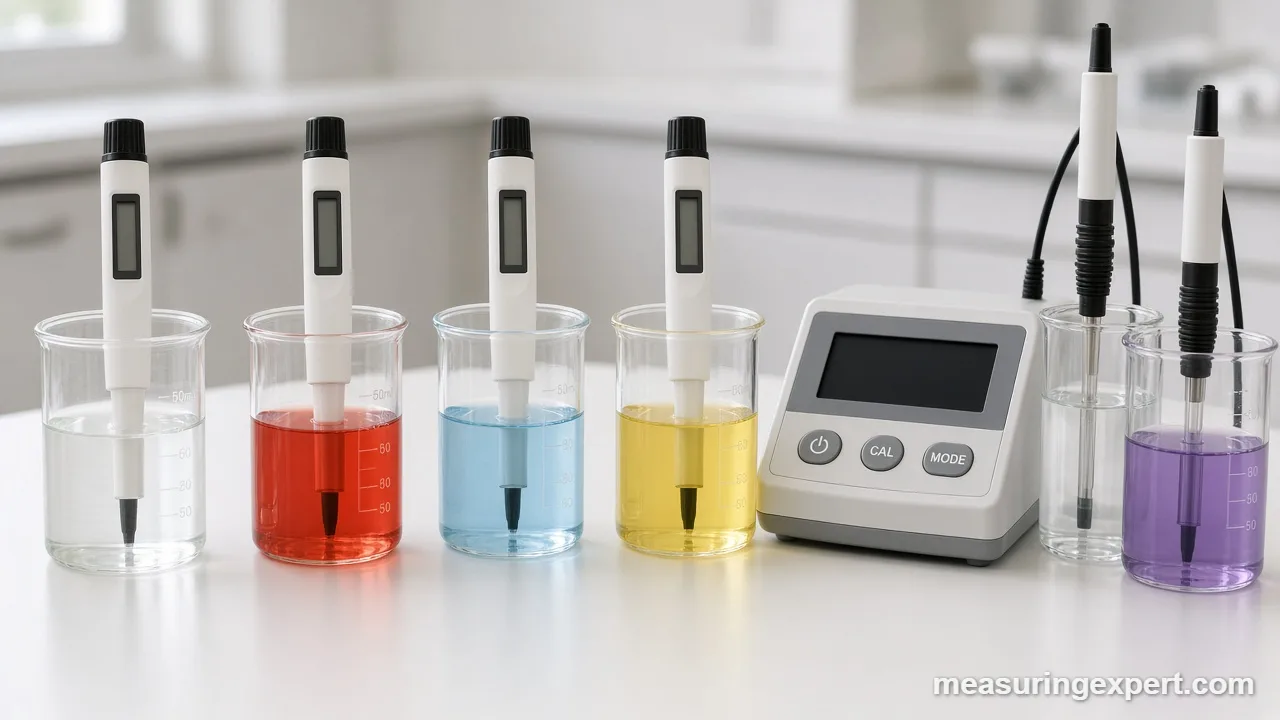
Calibration points and buffer sets: A 2-point calibration sets both the offset and the slope of the electrode. In contrast, a 3-point calibration adds a third buffer, so the meter stays accurate on both sides of pH 7. Meters also use one of two buffer families: the USA set (4.01, 7.01, 10.01) or the NIST set (4.01, 6.86, 9.18). Use the set your meter expects, or it may reject the buffer.
Temperature range and ATC span: Pens usually stop at 50 or 60 C (122 or 140 F). In contrast, the Milwaukee MW102 compensates to 70 C (158 F) and the Apera PH800 to 100 C (212 F). If you test warm wort or hot process water, check the ATC span, not just the display range.
Probe design: Single-junction probes respond fast in clean water, whereas double-junction probes add a second barrier. As a result, double-junction probes last longer in nutrient solutions, wine and dirty samples. Also, a replaceable probe turns a worn sensor into a small repair rather than a new meter.
Water rating and power: IP65 resists splashes and jets, IP67 survives brief dunking, and IP68 handles longer immersion.
How to Calibrate a Dual Display pH Meter
Calibrate before first use and then on a schedule: daily for lab work, and weekly or every 30 days for garden and pool checks.
- First, rinse the electrode with distilled or deionized water and blot it gently with a lint-free tissue.
- Next, pour fresh pH 7 buffer into a clean cup; never dip into the stock bottle.
- Put the probe in the buffer, start calibration mode and wait for the stability sign before you confirm.
- Then rinse the probe and repeat with pH 4 buffer, which sets the slope on the acid side.
- For a 3-point calibration, rinse again and finish with pH 10 buffer.
- After that, check that the temperature on screen matches the buffer label temperature, usually 25 C (77 F).
- Finally, rinse the probe, put a few drops of storage solution in the cap and close it.
Electrode Care That Keeps Readings Honest
The glass bulb is the part that measures, so it needs to stay wet and clean. Store it in KCl storage solution or pH 4 buffer, never in distilled water, because pure water pulls ions out of the glass. In addition, rinse the probe between samples, and clean it with a mild cleaning solution if readings turn slow.
Of course, electrodes wear out with use. As a rule, expect to replace a hard-working probe every one to two years. Slow response and drift after calibration are the usual signs. Because of this, models with replaceable probes cost less to own over time.
Do and Don’t for Accurate pH and Temperature Readings
Also, match the meter to the sample. For drinking water, the EPA secondary standard lists a pH range of 6.5 to 8.5. Any pen here can confirm that.
Honest Limits of Any Handheld pH Meter
In practice, no meter is more accurate than its last calibration. So a +/-0.01 pH rating only holds right after a careful calibration with fresh buffers.
In addition, pens struggle with some samples. For example, low-conductivity water, such as RO or rain water, reads slowly. Likewise, oils, proteins and solids coat the glass.
Dual Display pH Meter FAQ
What is the best dual display pH meter for most people?
For most people, the best dual display pH meter is the Apera PH60. It shows pH and temperature together, is rated at +/-0.01 pH, floats, carries an IP67 rating and calibrates at up to 3 points with the buffers included in the kit.
What does a dual display pH meter show?
It shows two readings on one screen at the same time, usually pH and temperature. In addition, some combo meters show EC, TDS (ppm) or ORP, so you can check several water values in one dip.
Why does a pH meter need to show temperature?
Temperature changes the electrode response, from about 54 mV per pH at 0 C to about 64 mV at 50 C. So the meter uses its temperature sensor to correct the reading. Also, seeing the temperature tells you when the probe has settled.
Is the best dual display pH meter worth it over test strips?
Yes, if you test often or need decimals. By contrast, strips give a color band, often in half or whole units. A meter reads to 0.1 or 0.01 pH and also shows temperature, so it suits hydroponics, brewing and lab work.
How often should I calibrate the best dual display pH meter?
Calibrate before first use, then daily for lab work and about weekly or every 30 days for garden, pool and aquarium checks. In addition, calibrate after you replace the probe or if readings start to drift.
Is 2-point or 3-point calibration better?
A 3-point calibration is better when you measure on both sides of pH 7, because it fits the slope on the acid and the alkaline side. However, a 2-point calibration with pH 7 and pH 4 is enough for most acidic samples such as nutrient solutions.
What does ATC mean on a pH meter?
ATC means automatic temperature compensation. A built-in sensor measures temperature, and the meter adjusts the electrode slope to match. It does not convert the sample to a 25 C value, so compare readings taken at similar temperatures.
How should I store a pH meter probe?
Keep the glass bulb wet with a few drops of KCl storage solution or pH 4 buffer in the cap. However, never store it dry or in distilled water, because both damage the glass and slow the response.
Which is the best dual display pH meter for hydroponics?
The Bluelab pH PenPlus suits growers who want a rugged pen with an IP68 rating and a replaceable probe. If you also track nutrient strength, the Bluelab Combo Meter reads pH, EC, ppm and temperature.
Can I use a dual display pH meter for soil?
Yes, but most pens test a soil slurry rather than the soil itself. First, mix soil with distilled water, let it settle, and then read the liquid. For direct readings in the ground, use a meter with a spear probe.
Bottom Line on the Best Dual Display pH Meter
For most buyers, the Apera Instruments PH60 Premium pH Tester is the best dual display pH meter. It shows pH and temperature together, holds +/-0.01 pH accuracy and calibrates at up to 3 points. However, choose the Bluelab Combo Meter if you also track nutrient strength, or the Apera PH800 if you need a bench meter with stored records.
Black Friday is coming: shop the deals with Prime
1 thought on “8 Best Dual Display pH Meters for 2026 (pH + Temperature)”