

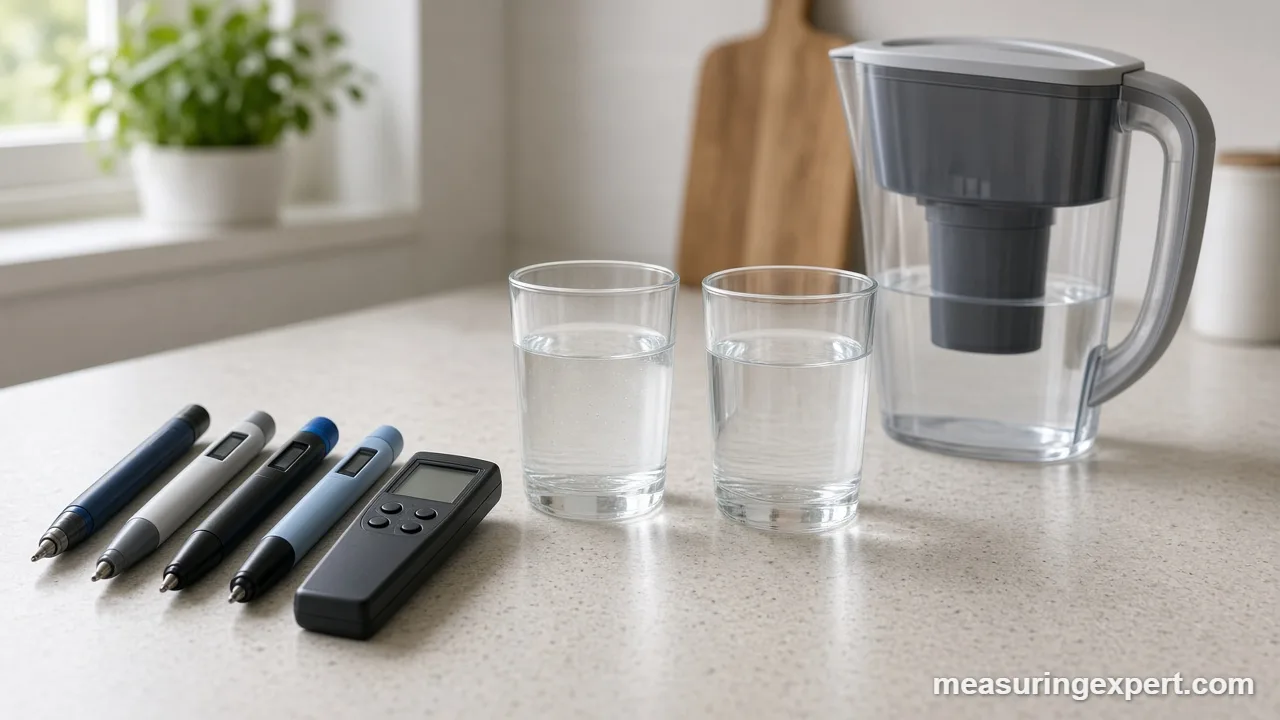
The best TDS water tester for most homes is the HM Digital COM-100, because it reads both EC and ppm and lets you pick the conversion factor. However, the right choice depends on your water: RO and tap checks need fine low-range steps, while nutrient or salty water needs a wider range.
In short: buy the COM-100 for accuracy and flexibility, the TDS-3 for a cheap filter check, and the Apera EC60-Z if you want readings logged on your phone.
As an Amazon Associate, Measuring Expert earns from qualifying purchases. Our picks are based on research, specifications and owner feedback, not paid placement.
Best Overall

Best Budget

Best Smart

Quick Answer: Which Best TDS Water Tester Fits You
- Overall: HM Digital COM-100, with EC, ppm and a choice of three scales.
- Budget: HM Digital TDS-3 for RO and tap comparisons.
- Smart: Apera EC60-Z, which logs every reading in an app.
- Drinking water pen: Hanna DiST 1, with automatic calibration.
- High range: Hanna DiST 6, adjustable from 0.45 to 1.00.
- pH plus TDS: Apera PCO60-Z, a seven-in-one smart tester.
- Growers: Bluelab Truncheon (no calibration) or the Bluelab Conductivity Pen.
On This Page
- Comparison table
- The 8 picks, reviewed
- How we chose
- TDS is EC times a factor
- Why temperature matters
- Meter types compared
- Specs worth reading
- How to test your water
- What your reading means
- What TDS cannot tell you
- Calibration and care
- FAQ
- Bottom line
Best TDS Water Tester Comparison
First, match the range to your water. Then look at the standout feature and jump to the full review.
| # | Product | Best For | Standout Feature | Amazon |
|---|---|---|---|---|
| 1 | HM Digital COM-100 | Drinking water, RO and aquariums | Selectable KCl, 442 or NaCl scale | View |
| 2 | HM Digital TDS-3 | Checking an RO filter or tap water | Hold button and a carry case | View |
| 3 | Apera EC60-Z | Logging readings on a phone | Bluetooth app with cloud log | View |
| 4 | Hanna DiST 1 | Drinking water in ppm | Auto one-point calibration | View |
| 5 | Hanna DiST 6 | Brackish, process and pond water | Adjustable factor 0.45 to 1.00 | View |
| 6 | Apera PCO60-Z | pH, ORP and TDS in one tool | Seven readings, one app | View |
| 7 | Bluelab Truncheon | Nutrient tanks, no calibration | No calibration required | View |
| 8 | Bluelab Conductivity Pen | Compact nutrient and runoff checks | Floats, waterproof, ATC | View |
The 8 Best TDS Water Tester Picks, Reviewed
Best Overall
1. HM Digital COM-100 Waterproof EC/TDS/Temp Meter
Best for: Home users, RO owners and aquarium keepers who want one meter that reads both EC and ppm correctly.
The HM Digital COM-100 is our pick as the best TDS water tester for most people. It reads EC from 0 to 9,990 uS/cm and TDS up to 5,000 ppm on the 0.5 scale or 8,560 ppm on the 0.7 scale. Better yet, you choose the conversion: KCl, 442 or NaCl. So you can match the scale your filter maker, lab or nutrient chart uses.
In addition, the resolution drops to 0.1 ppm below 100 ppm. That matters for RO and distilled water, because a cheap pen only shows whole numbers. Also, the housing is IP67 and floats, the probe (SP-C1) is replaceable, and you can calibrate it with push buttons at any point in its range.
- EC range: 0 to 9,990 uS/cm (0 to 9.99 mS/cm)
- TDS range: 0 to 5,000 ppm (0.5) or 0 to 8,560 ppm (0.7)
- Resolution: 0.1 ppm below 100; rated accuracy +/-2%
- ATC with three temperature coefficients; 0 to 55 C (32 to 130 F)
- IP67, floats; replaceable SP-C1 probe; 2 x AAA
Pros
- Choice of KCl, 442 or NaCl conversion
- Fine 0.1 ppm steps for RO water
- Waterproof body with a swappable probe
Cons
- Costs several times a basic pen
- More menus than a one-button tester
- No app or data logging
Skip it if: You only want a quick yes or no on a filter, because the TDS-3 below does that for much less.
Best Budget
2. HM Digital TDS-3 Handheld TDS Meter
Best for: Anyone who wants a simple, proven pen to watch an RO system or compare tap and filtered water.
The TDS-3 is the pen many filter companies ship in the box, and it is easy to see why. For example, it reads 0 to 9,990 ppm, with 1 ppm steps up to 999 and 10 ppm steps above that. In addition, HM Digital rates it at +/-2% from 0 to 5,000 ppm.
However, it uses a fixed NaCl factor of about 0.5 and does not show EC. For a filter check, that is fine. Also, it has ATC from 1 to 50 C, a built-in thermometer, a HOLD button and a vinyl case with a belt clip. Finally, recalibration uses a small screwdriver and a 342 ppm NaCl solution.
- TDS range: 0 to 9,990 ppm; 1 ppm steps to 999
- Rated accuracy: +/-2% (0 to 5,000 ppm)
- Fixed NaCl factor (about 0.5)
- ATC: 1 to 50 C (33 to 122 F); thermometer in C
- HOLD, 10-minute auto off, 2 x LR44, carry case
Pros
- Low cost and very simple
- HOLD lets you read it out of the glass
- Also a sturdy carry case
Cons
- Fixed 0.5 factor, no EC display
- Not waterproof
- Temperature shows in Celsius only
Skip it if: You need EC readings or a different conversion factor, since the COM-100 above handles both.
Best Smart
3. Apera Instruments EC60-Z Smart Conductivity/TDS Tester
Best for: Aquarium keepers, labs and well owners who want each reading saved with a date and time.
The EC60-Z pairs with the ZenTest app over Bluetooth (about 30 ft or 10 m). Then the app stores readings in a cloud log, sends calibration reminders and walks you through each step. In other words, it turns a pocket tester into a simple record keeper.
On the measurement side, it reads EC to 20 mS/cm in three ranges and TDS to 10,000 ppm. Furthermore, Apera rates it at +/-1% of full scale, which is tighter than most pens. Also, calibration is automatic at 1 to 3 points, the body is IP67 and the EC60-DE probe can be replaced. It also reads salinity up to 10 ppt.
- EC: 0 to 20 mS/cm in three ranges; +/-1% F.S.
- TDS: 0 to 10,000 ppm; 0.1 ppm resolution at the low end
- ATC: 0 to 50 C (32 to 122 F)
- Calibration: 1 to 3 points, automatic recognition
- IP67; Bluetooth app; replaceable EC60-DE probe; 4 x AA
Pros
- App log removes pen-and-paper notes
- Tight +/-1% F.S. rating
- Also multi-point calibration
Cons
- Needs a phone for the extras
- Larger than a basic pen
- Probe is a separate purchase later
Skip it if: You dislike apps, because the COM-100 gives similar control on its own screen.
Best Simple Pen
4. Hanna Instruments HI98301 DiST 1 TDS Tester

Best for: People who want a lab-brand pen for tap, well or bottled water and nothing more.
Hanna is one of the best-known names in water testing, and the DiST 1 is its basic TDS pen. For instance, it reads 0 to 2,000 ppm in 1 ppm steps, which covers nearly all drinking water. Also, Hanna rates it at +/-2% of full scale.
Notably, calibration is automatic at one point (1,382 ppm). As a result, you dip it in the standard and it sets itself, with no screwdriver. Besides, it uses a 0.5 factor and ATC from 0 to 50 C. Also, the CR2032 cell is rated for about 250 hours of use.
- TDS range: 0 to 2,000 ppm; 1 ppm resolution
- Rated accuracy: +/-2% F.S.
- Factor: 0.5; ATC 0 to 50 C (32 to 122 F)
- Calibration: automatic, one point at 1,382 ppm
- Power: CR2032, about 250 hours
Pros
- Easy automatic calibration
- Trusted lab brand
- Also long battery life
Cons
- Tops out at 2,000 ppm
- No EC display or factor choice
- +/-2% F.S. means about +/-40 ppm
Skip it if: You test brackish or nutrient water above 2,000 ppm, because the DiST 6 below goes to 10 g/L.
Best High Range
5. Hanna Instruments HI98312 DiST 6 EC/TDS/Temperature Tester

Best for: Pond keepers, well owners with salty water and anyone who needs full control of the TDS math.
The DiST 6 reads EC to 20.00 mS/cm and TDS to 10.00 g/L (10,000 ppm). More important, it lets you set the TDS factor anywhere from 0.45 to 1.00. In addition, it lets you set the temperature coefficient (beta) from 0.0 to 2.4% per degree C. In fact, few pocket testers give you both.
Also, the case is waterproof and floats, and the graphite HI73311 electrode is replaceable. Similarly, calibration is automatic at one point (12.88 mS/cm or 6.44 g/L). See the Hanna DiST 6 spec page for the full list.
- EC: 0.00 to 20.00 mS/cm; TDS: 0.00 to 10.00 g/L
- Rated accuracy: +/-2% F.S.
- TDS factor: adjustable 0.45 to 1.00
- ATC with beta adjustable 0.0 to 2.4%/C; reads 0 to 60 C
- Waterproof, floats; replaceable HI73311 electrode
Pros
- Full control of factor and beta
- High range for salty water
- Also a replaceable electrode
Cons
- 0.01 g/L steps are coarse for RO water
- +/-2% F.S. is about +/-200 ppm
- Overkill for a tap check
Skip it if: You test RO or distilled water, since 10 ppm steps hide small changes there.
Best Multi-Parameter
6. Apera Instruments PCO60-Z Smart Multi-Parameter Tester

Best for: Aquarium, pool and lab users who check pH and ORP as often as TDS.
After all, TDS alone tells only part of the story. So if you also track pH or ORP, the PCO60-Z saves you from carrying three pens. Specifically, it reads pH, EC, TDS, salinity, resistivity, ORP and temperature, and it logs each reading in the ZenTest app.
Moreover, Apera rates EC and TDS at +/-1% F.S. +/-1 digit, with TDS to 10,000 ppm. Also, EC and pH both calibrate at 1 to 3 points with automatic buffer recognition. Finally, the body is IP67, and it accepts several Apera probes, so you can swap a pH probe when it ages.
- Reads pH, EC, TDS, salinity, resistivity, ORP, temperature
- TDS: 0 to 10,000 ppm; +/-1% F.S. +/-1 digit
- ATC: 0 to 50 C (32 to 122 F)
- Calibration: 1 to 3 points for pH and EC
- IP67; Bluetooth app with cloud log; 4 x AA
Pros
- One tool for most water checks
- App log for every parameter
- Also accepts swappable probes
Cons
- pH probe needs care and storage
- Larger and heavier than a pen
- More than a TDS-only buyer needs
Skip it if: You only need ppm, because the EC60-Z gives the same TDS features in a simpler tool.
Best for Hydroponics
7. Bluelab Truncheon Nutrient Meter

Best for: Hydroponic and indoor growers who mix nutrients and want a meter they can leave in the reservoir corner.
The Truncheon is a long wand that reads nutrient strength as EC, CF, ppm 500 or ppm 700. Moreover, Bluelab says it needs no calibration. As a result, it suits a busy grow room where a pen would drift or get dropped.
However, its range is built for nutrient solutions, not drinking water. Specifically, it reads EC 0.2 to 3.6 (ppm 500 scale: 100 to 1,800) in 0.1 EC steps, with an accuracy of +/-0.1 EC. Also, it is waterproof, runs on 3 x AA and carries a 5-year limited warranty from Bluelab.
- Units: EC, CF, ppm 500, ppm 700
- Range: EC 0.2 to 3.6; ppm 500: 100 to 1,800
- Accuracy at 25 C: +/-0.1 EC (+/-50 ppm on the 500 scale)
- Temperature compensated; solution 0 to 50 C
- Waterproof; 3 x AA; 5-year limited warranty
Pros
- No calibration needed
- Tough waterproof wand
- Also all four grower scales
Cons
- Cannot read below 100 ppm
- Coarse 50 ppm steps
- Long, so it needs a deep sample
Skip it if: You test drinking or RO water, because its range starts too high.
Best Grower Pen
8. Bluelab Conductivity Pen (PENCON)
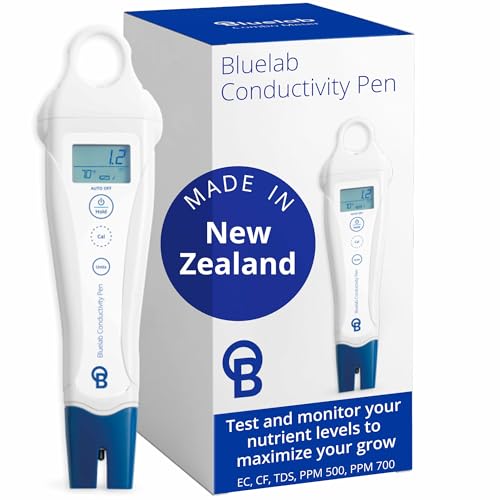
Best for: Growers who want a pocket-size EC/ppm pen with a wider range than the Truncheon.
The Bluelab Conductivity Pen reads EC 0.0 to 10.0, ppm 500 to 5,000 and ppm 700 to 7,000. So it covers both weak seedling feeds and strong runoff tests. In addition, it shows temperature in C or F.
Moreover, it is waterproof, it floats if you drop it in a tank, and it has ATC through a built-in sensor. Also, Bluelab ships it factory calibrated, and it runs on one AAA cell. Still, resolution is 10 ppm, so it is not a tool for RO water.
- EC: 0.0 to 10.0; ppm 500: 0 to 5,000; ppm 700: 0 to 7,000
- Accuracy: +/-0.1 EC (+/-50 ppm on the 500 scale)
- ATC; temperature 0 to 50 C (32 to 122 F)
- Waterproof and floats
- Power: 1 x AAA; 1-year limited warranty
Pros
- Pocket size with grower scales
- Floats and shrugs off splashes
- Also reads temperature
Cons
- 10 ppm steps
- Shorter warranty than the Truncheon
- No KCl or adjustable factor
Skip it if: You want a lab-style factor choice, because the DiST 6 or COM-100 offers it.
How We Chose the Best TDS Water Tester
We did not run hands-on tests. Instead, our picks are research-based. First, we read the maker spec sheets for each meter, including range, resolution, rated accuracy, temperature compensation and calibration method. Next, we read owner feedback for recurring faults such as drift, dead probes or leaks. Finally, we checked the drinking water numbers against EPA guidance.
- Correct math: we favored meters that show EC, name their conversion factor, or let you change it.
- Range for the job: fine steps for RO and tap water, and a wide range for nutrient or salty water.
- Temperature compensation: every pick has ATC, since an uncompensated reading is close to useless.
- Calibration: we gave credit for automatic or push-button calibration and for replaceable probes.
- Brand support: established makers only, with at most two models each.
TDS Is EC Times a Conversion Factor
A TDS meter does not weigh anything. Instead, it measures electrical conductivity (EC), which is how easily current flows between two electrodes. For example, dissolved ions such as calcium, sodium, chloride and bicarbonate carry that current. So more ions mean a higher EC.
The meter then multiplies EC by a conversion factor to estimate total dissolved solids in ppm (mg/L). In fact, the formula is simple:
TDS (ppm) = EC (uS/cm) x conversion factor
However, the factor depends on which salt the meter assumes is in the water. That is why two good meters can show different ppm for the same glass. Here is the same 300 uS/cm sample on three common scales:
| Scale | Factor | Where you see it | 300 uS/cm reads as |
|---|---|---|---|
| NaCl | 0.5 | Most pocket pens, RO filter checks, Bluelab “ppm 500” | 150 ppm |
| Natural water average | 0.64 | Some labs and meters that use a middle value for mixed minerals | 192 ppm |
| 442 (or “ppm 700”) | 0.7 | Hydroponic charts, HM Digital 442 mode, Bluelab “ppm 700” | 210 ppm |
In short, always note the scale next to the number. Better still, record EC as well, because EC is the raw measurement and does not depend on the factor.
Why Temperature Changes the Reading (ATC)
Specifically, conductivity rises as water warms, by roughly 2% per degree C for typical fresh water. As a result, the same tap water reads about 20% lower at 15 C (59 F) than at 25 C (77 F) if the meter does not correct it. For that reason, meters report EC at a reference of 25 C.
Therefore, automatic temperature compensation (ATC) does the correction for you. First, a small sensor in the probe reads the water temperature, and the meter scales the result back to 25 C. In general, most pens use a fixed coefficient near 2% per degree C. Advanced testers such as the Hanna DiST 6 let you adjust it.
Even with ATC, give the probe 20 to 30 seconds to settle. After all, the sensor needs time to reach the water temperature.
Best TDS Water Tester Types Compared
| Type | Good for | Trade-off | Example |
|---|---|---|---|
| Basic TDS pen | RO and tap checks | Fixed 0.5 factor; often no EC display | HM Digital TDS-3, Hanna DiST 1 |
| EC/TDS combo meter | Aquariums, wells, labs | Costs more; more settings to learn | HM Digital COM-100, Hanna DiST 6 |
| Smart (Bluetooth) tester | Logging trends over time | Needs a phone and AA batteries | Apera EC60-Z, PCO60-Z |
| Grower nutrient meter | Hydroponic reservoirs | Range starts too high for RO water | Bluelab Truncheon, Conductivity Pen |
Also note that a TDS meter is not the same as a water hardness test kit. In contrast, hardness kits count only calcium and magnesium, while TDS counts every ion. Likewise, for seawater and brine a dedicated salinity tester reads in ppt or specific gravity and is often the better tool.
Specs Worth Reading on a TDS Meter
Range and resolution. RO and distilled water usually sit in the low tens of ppm or below. So you want 1 ppm steps at least, and 0.1 ppm is better. On the other hand, nutrient and brackish water need thousands of ppm, where 10 ppm steps are fine.
Accuracy and “F.S.” A rating of +/-2% F.S. means 2% of the full scale, not of your reading. For example, on a 0 to 2,000 ppm pen that is +/-40 ppm everywhere on the scale. In contrast, +/-2% of reading shrinks as the number gets smaller.
Conversion factor. Above all, look for a meter that names its factor. Ideally, it also lets you change it, or at least shows EC so you can do the math yourself.
Calibration method. First, automatic calibration recognizes the standard and sets itself. Meanwhile, push-button calibration lets you use any standard in range.
How to Test Water With a TDS Meter
- Rinse a clean glass or cup three times with the water you plan to test.
- Fill it with at least 1 inch (2.5 cm) of water, or more than the probe depth.
- Remove the cap and rinse the probe with the same water.
- Switch the meter on and dip it to the immersion line, then stir gently to clear air bubbles.
- Wait 20 to 30 seconds so the ATC sensor can match the water temperature.
- Read the value, or press HOLD and lift it out to read it.
- Write down the number, the scale (0.5, 0.64 or 0.7) and the temperature.
- Rinse the probe with distilled water, shake it dry and replace the cap.
For a filter check, test the tap water first and then the filtered water. Then divide the difference by the tap reading to get the rejection percent. For example, 250 ppm in and 15 ppm out is a 94% rejection.
What Your TDS Reading Means
The EPA lists 500 mg/L as the secondary drinking water standard for TDS. However, this is a non-enforceable guideline for taste and appearance. Above it, for example, the EPA notes possible hardness, deposits, colored water, staining and a salty taste. It is not a health limit.
| Reading (0.5 scale) | Typical meaning |
|---|---|
| 0 to 50 ppm | Distilled, DI or well-working RO water |
| 50 to 300 ppm | Common for many city and well supplies |
| 300 to 500 ppm | Mineral-rich water; still under the EPA secondary level |
| Over 500 ppm | Above the EPA secondary standard; taste and scale issues likely |
| Over 1,000 ppm | Slightly saline or brackish; test further |
What a TDS Meter Cannot Tell You
A TDS meter cannot identify a contaminant. Instead, it sums all charged particles into one number. So 300 ppm of harmless calcium bicarbonate and 300 ppm of something worse look the same.
- Toxic metals at trace levels: the EPA action level for lead is 0.015 mg/L, and the arsenic limit is 0.010 mg/L. In short, both are far below what a TDS meter can resolve. See the EPA primary drinking water rules.
- Uncharged compounds: similarly, many pesticides, solvents and PFAS do not raise conductivity much.
- Microbes: likewise, bacteria and viruses do not show up at all.
- pH and hardness: you need a pH meter or pH test strips and a hardness kit for those.
Caring for Your Best TDS Water Tester
First, check calibration about once a month, or before any important test. To do so, use a fresh standard that matches your scale, such as 342 ppm NaCl for the TDS-3 or 1,413 uS/cm for EC meters. Next, pour a little into a clean cup, and never dip the meter into the bottle itself.
Meanwhile, keep the probe clean. Mineral film and oils slow the response, so rinse with distilled water after each use. If readings creep, soak the probe briefly in clean water and wipe it gently.
TDS Meter FAQ
What does a TDS water tester measure?
It measures electrical conductivity (EC) and multiplies it by a conversion factor, often 0.5, to estimate total dissolved solids in ppm (mg/L). In other words, the ppm number is a calculated estimate, not a direct weight of the solids.
What is the best TDS water tester for RO systems?
For RO water, pick a meter with fine low-range steps. The HM Digital COM-100 shows 0.1 ppm below 100 ppm, while the TDS-3 is a cheaper choice for simple before and after checks.
Why do two TDS meters give different readings?
Most often, they use different conversion factors. For example, a 0.5 pen and a 0.7 meter will read 150 and 210 ppm for the same 300 uS/cm water. Calibration drift and temperature can also add small differences.
What TDS level is safe to drink?
There is no federal health limit for TDS. The EPA secondary standard is 500 mg/L, but it is a non-enforceable guide for taste, scale and staining. A TDS reading alone cannot show whether water is safe.
Can the best TDS water tester detect lead or bacteria?
No. Even the best TDS water tester cannot identify a contaminant. Lead matters at 0.015 mg/L, which is far below what a TDS meter resolves, and bacteria do not change conductivity. Use a certified lab for those.
Does the best TDS water tester need ATC?
Yes. Conductivity changes by roughly 2% per degree C, so a reading without automatic temperature compensation can be off by 20% or more. All of our picks include ATC.
How often should I calibrate a TDS water tester?
Check it about once a month, or before an important test. Use a fresh standard that matches the meter’s scale, and pour it into a separate cup instead of dipping into the bottle.
Is a TDS meter the same as a water hardness test?
No. Hardness tests measure only calcium and magnesium, while TDS counts every dissolved ion. So water can have a moderate TDS reading and still be soft, or the other way around.
Which conversion factor should I use?
Use the factor your reference uses. RO makers and most pens use 0.5, hydroponic charts often use 0.7, and some labs use about 0.64 for natural water. If in doubt, record EC, which needs no factor.
Is the best TDS water tester good for hydroponics?
Yes, as long as the range fits. Grower meters such as the Bluelab Truncheon and Conductivity Pen read the ppm 500 and ppm 700 scales that nutrient charts use, while drinking water pens may top out too low.
Bottom Line on the Best TDS Water Tester
For most homes, the HM Digital COM-100 Waterproof EC/TDS/Temp Meter is the best TDS water tester. It reads EC and ppm, lets you choose the KCl, 442 or NaCl scale, and resolves 0.1 ppm on RO water. Otherwise, pick the TDS-3 for a cheap filter check, the EC60-Z for an app log, or a Bluelab tool for nutrient tanks. Whatever you buy, remember that TDS is a screening number, not a safety test.
1 thought on “8 Best TDS Water Testers for Drinking, RO and Hydroponic Water (2026)”