

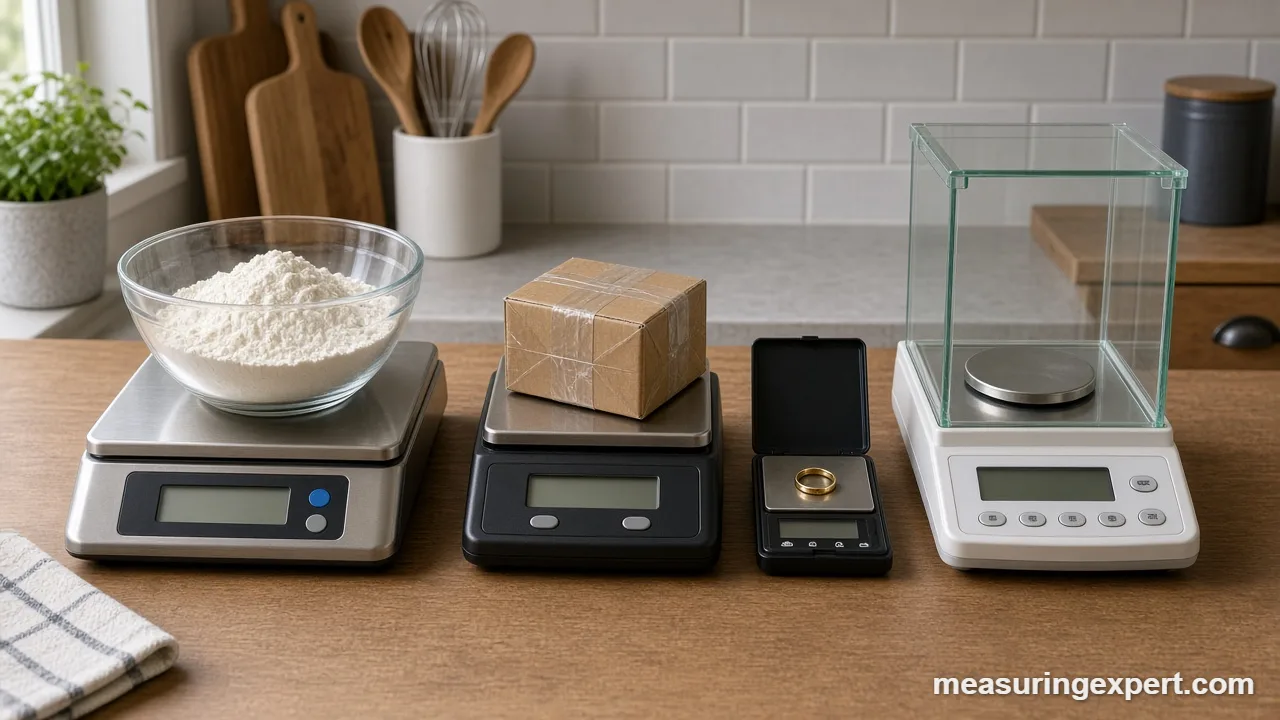
The best digital scale for most homes is the My Weigh UltraShip 55, a 55 lb bench scale with a detachable display that reads parcels to 0.1 oz. Still, no single scale does everything: capacity, resolution and where you weigh decide whether you need a kitchen, postal, jewelry, lab or bathroom model.
In short: get the My Weigh UltraShip 55 for all-round use, the Amazon Basics scale on a budget, and the Ohaus Scout SPX222 when you need lab-grade 0.01 g readings.
As an Amazon Associate, Measuring Expert earns from qualifying purchases. Our picks are based on research, specifications and owner feedback, not paid placement.
Best Overall
Best Budget
Best Pro
Quick Answer: Which Digital Scale Fits Your Job?
- One scale for most things: My Weigh UltraShip 55, with 55 lb capacity and a display on a cord.
- Cheapest useful option: Amazon Basics Digital Kitchen Scale for recipes and light household use.
- Lab or classroom: Ohaus Scout SPX222, with published 0.01 g repeatability and linearity.
- Milligram powders: U.S. Solid 1 mg balance with a glass draft shield.
- Jewelry, gems and coins: GemOro Platinum XP500, 500 g x 0.01 g with a cover.
- Postage: Accuteck 8250, in 0.1 oz steps up to 25 lb.
- Body weight or bags: the Etekcity bathroom scale and Etekcity luggage scale.
On This Page
- Comparison table
- The 8 picks, reviewed
- How we chose
- Scale types compared
- Specs that decide precision
- Mass unit converter
- How to check a scale with a test weight
- Placement and care
- Honest limits
- FAQ
- Bottom line
Best Digital Scale Picks at a Glance
| # | Image | Product | Best For | Standout Feature | Amazon |
|---|---|---|---|---|---|
| 1 |  | My Weigh UltraShip 55 | Home offices, workshops and bulk food | Detachable backlit display on a 2 ft cord | View |
| 2 |  | Amazon Basics Kitchen Scale | Simple home weighing on a tight budget | Five units, including fl oz and mL for water-like liquids | View |
| 3 |  | Ohaus Scout SPX222 | Classrooms, labs and serious hobby work | Published 0.01 g repeatability and linearity | View |
| 4 |  | U.S. Solid 1 mg Balance | Powders, reagents and reloading components | 0.001 g (1 mg) steps inside a glass draft shield | View |
| 5 |  | GemOro Platinum XP500 | Gold, silver, gems and coins | Covered 4 x 4 in steel platform with 500 g x 0.01 g | View |
| 6 |  | Accuteck 8250 | Letters, Etsy orders and small parcels | 0.1 oz steps to 25 lb with a HOLD key | View |
| 7 | 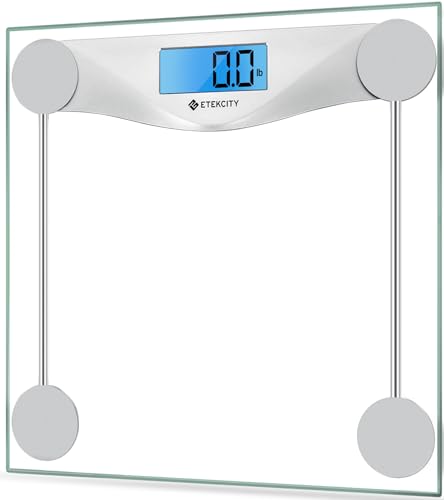 | Etekcity Bathroom Scale | Simple body weight tracking | Tempered glass platform with 0.2 lb steps | View |
| 8 | 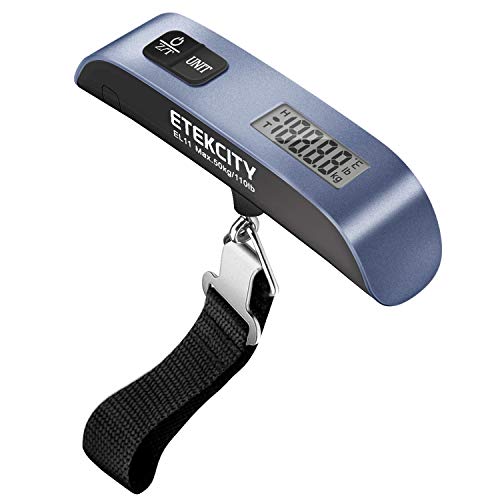 | Etekcity Luggage Scale | Suitcases, fishing catches and odd-shaped loads | Hook-and-strap design that weighs what will not fit on a platform | View |
The 8 Best Digital Scale Picks by Category, Reviewed
This list covers general-purpose and precision scales, one strong pick per job. We already have deeper guides for some single categories, so we link to them instead of repeating their picks. For instance, espresso and pour-over brewers should start with our best coffee scale picks.
Best Overall
1. My Weigh UltraShip 55 Digital Scale
Best for: Anyone who wants one sturdy bench scale for parcels, hobby supplies, homebrew grain and large batches of food.
The UltraShip 55 is our pick for the best digital scale for most households because it covers the widest span of everyday jobs. For example, it weighs up to 55 lb (25 kg), so it handles a shipping box, a sack of flour or a bucket of brewing grain.
The clever part is the display. First, it detaches and sits on a 2 ft cord, so a wide box no longer hides the numbers. In addition, a HOLD key freezes the reading, and you can set the auto-off or keep it on all day. Keep in mind that it uses stepped resolution: the step is 0.1 oz up to 2 lb, then 0.5 oz up to 55 lb. Similarly, in grams the step is 2 g below 900 g and 10 g above that, so it is not a baking scale.
- Capacity: 55 lb (25 kg)
- Resolution: 0.1 oz to 2 lb, 0.5 oz to 55 lb; 2 g to 900 g, 10 g to 25 kg
- Units: lb, oz, lb:oz, kg and g
- Platform: 8 x 6.25 in (20 x 16 cm); detachable backlit display on a 2 ft cord
- Power: AC adapter included, or four C batteries; tare, HOLD and programmable auto-off
Pros
- Large capacity for a compact bench scale
- Detachable display solves the big-box problem
- Also runs all day on the AC adapter
Cons
- However, a coarse 2 g step in grams
- C batteries are bulky and not included
- Plastic body on some listings
Skip it if: you mostly weigh small amounts in grams, such as coffee doses, spices or supplements.
Best Budget
2. Amazon Basics Digital Kitchen Scale
Best for: First-time buyers who want a plain countertop scale for recipes, portion checks and small household items.
If you only need a basic flat scale, this one keeps things simple. It has a stainless steel platform, a tare button and an LCD, and it weighs up to 11 lb (about 5 kg).
In addition, it shows pounds, ounces, grams, fluid ounces and milliliters. However, the volume modes assume a liquid with the density of water, so treat mL readings for milk, oil or honey as estimates. Also note that the seller lists a 2 g minimum load rather than a published step size, so it suits recipes better than tiny doses. For more kitchen-focused picks with finer steps, see our best kitchen scale guide.
- Capacity: 11 lb (about 5 kg); 2 g minimum load listed
- Units: lb, oz, g, fl oz and mL
- Platform: stainless steel; size 8.3 x 7 x 1.3 in (21 x 18 x 3.3 cm)
- Power: two AAA batteries (included); tare button
Pros
- Low cost of entry, so it suits a first scale
- Flat steel top is easy to wipe
- Also slim enough for a drawer
Cons
- However, no published resolution or accuracy figure
- Not for loads under a few grams
- Basic LCD with no backlight listed
Skip it if: you need to weigh doses under a few grams or want a published accuracy spec.
Best Pro Precision
3. Ohaus Scout SPX222 Portable Balance
Best for: Students, lab techs, soap and cosmetic makers, and anyone who needs a traceable 0.01 g reading with a real spec sheet.
First of all, Ohaus is a lab balance maker, and the Scout SPX shows it. Unlike most consumer scales, the SPX222 publishes the three numbers that define a precise instrument. For example, its readability is 0.01 g, and its repeatability and linearity are both 0.01 g. As a result, you know how far a reading can stray, not just how many digits it shows.
It also supports both span and linearity calibration with an external weight, which is how labs keep a balance honest. In addition, Fisher Scientific lists a 1 second stabilization time, a backlit LCD and optional RS-232, USB and Ethernet interfaces for logging. On the other hand, its 220 g capacity is small, so it is a precision tool rather than an all-purpose one.
- Capacity: 220 g; readability 0.01 g
- Repeatability: 0.01 g; linearity: 0.01 g; stabilization about 1 s
- Calibration: external span or linearity calibration (200 g span mass)
- Pan: 4.7 in (120 mm) stainless steel; size 8 x 8.8 x 2.1 in
- Power: AC adapter or four AA batteries (about 80 h listed); optional RS-232, USB, Ethernet
Pros
- Full lab-style spec sheet
- Span and linearity calibration
- Also stackable and battery capable for field use
Cons
- However, only 220 g capacity
- Calibration masses sold separately on many listings
- Costs far more than a pocket scale
Skip it if: you weigh anything heavier than a coffee mug or only need gram-level readings.
Best Milligram
4. U.S. Solid 1 mg Analytical Balance (200 g)
Best for: Hobby chemists, reloaders and supplement makers who need milligram readings and can give the balance a quiet bench.
First of all, at 1 mg, air currents, static and even body heat change the reading. For that reason, this balance sits inside a glass draft shield with sliding doors, which is the feature that separates a true milligram balance from a pocket scale with an extra digit. Also, it reads to 0.001 g up to 200 g, and it has an RS-232 port for sending readings to a computer.
However, U.S. Solid does not publish repeatability or linearity on the pages we could open, so we rank it below the Ohaus for documented performance. Before you rely on it, check it with a known calibration mass, then weigh well above the 20 mg minimum load listed for this class of balance.
- Capacity: 200 g; readability 0.001 g (1 mg)
- Glass draft shield with front CAL and UNIT keys
- RS-232 data interface
- Power: AC adapter or four 1.5 V batteries
Pros
- True milligram readability
- Draft shield blocks air currents
- Also logs readings over RS-232
Cons
- Also, no published repeatability figure
- Besides, it needs a level, vibration-free table
- Bulky compared with pocket scales
Skip it if: you only need 0.01 g; a pocket or jewelry scale is smaller and much cheaper.
Best for Jewelry and Coins
5. GemOro Platinum XP500 Pocket Jewelry Scale
Best for: Jewelers, coin collectors and gem buyers who weigh in carats and grams and want a scale that travels.
To begin with, GemOro is a jewelry trade brand, and the XP500 is built for the bench and the show floor. Because it reads to 0.01 g up to 500 g, it handles a single ring or a roll of coins.
In addition, two trays come with it: the large one doubles as a lid that protects the sensor in a bag, and the small one covers the platform. Gesswein, a jewelry tool supplier, lists a 5-year limited replacement warranty, which is long for this class. If you want even smaller and cheaper pocket models, our best pocket scale guide covers them.
- Capacity: 500 g; readability 0.01 g
- Units: includes grams and carats
- Platform: 4 x 4 in (10 x 10 cm) stainless steel; two trays, one doubles as a cover
- Size: 5.25 x 4.5 x 0.94 in; two AAA batteries; 5-year limited warranty (per Gesswein)
Pros
- Large platform for a pocket scale
- Cover protects the load cell in transit
- Also a long warranty
Cons
- However, calibration weights are sold separately
- AC adapter is an extra
- No published repeatability
Skip it if: you need milligram readings for powders; step up to a draft-shield balance instead.
Best for Postage
6. Accuteck 8250 Digital Shipping and Postal Scale
Best for: Small sellers and home offices that print postage and need the weight to the tenth of an ounce.
Because postage is priced by weight, a scale that rounds up costs you money on every label. The Accuteck 8250 reads in 0.1 oz steps up to 25 lb, then 0.2 oz steps up to its 50 lb limit. As a result, it is fine enough for flat envelopes yet strong enough for a medium box.
In addition, a HOLD key locks the reading after you lift a box off, which helps when the package covers the screen. On batteries it powers down after about three minutes idle, while the included adapter keeps it on.
- Capacity: 50 lb; 0.1 oz steps to 25 lb, then 0.2 oz
- Units: kg, lb:oz, oz and g
- Power: three AAA batteries or 5 V AC adapter (both included)
- HOLD and tare; auto-off after about 3 minutes on batteries
Pros
- Fine 0.1 oz steps for postage
- Both power options in the box
- Also compact for a desk
Cons
- However, a small platform for large boxes
- Fixed display can hide under a wide box
- Backlight details vary by listing
Skip it if: you ship large boxes often; the My Weigh with its detachable display is easier to read.
Best Basic Bathroom
7. Etekcity Digital Body Weight Bathroom Scale (400 lb)
Best for: People who just want a clear body weight number, without an app, body fat estimates or Bluetooth.
Nowadays, many bathroom scales push apps and body composition, too. However, the most repeatable number any bathroom scale gives is plain weight, and this Etekcity keeps to that job. Etekcity lists this 400 lb glass model (EB4074C) at 0.2 lb or 0.1 kg steps, with lb and kg units and two AAA batteries.
If you want weight trends synced to a phone, our best Bluetooth bathroom scale guide covers the smart models, so we do not repeat them here.
- Capacity: 400 lb (180 kg); 0.2 lb or 0.1 kg steps
- Units: lb and kg
- Platform: tempered glass; 11.9 x 11.9 x 0.95 in (30.3 x 30.3 x 2.4 cm)
- Power: two AAA batteries; auto-off after about 15 s
Pros
- Simple, no app needed
- Thin and easy to store
- Also a high 400 lb capacity
Cons
- However, no memory or trend tracking
- Glass top can be slippery with wet feet
- Readings shift on carpet
Skip it if: you want body fat, BMI or automatic syncing to a health app.
Best Hanging Scale
8. Etekcity Digital Luggage Scale (110 lb)
Best for: Travelers and anyone who weighs bags, sacks or gear that will not sit on a flat scale.
A hanging scale measures tension in a strap instead of pressure on a platform. Therefore, it can weigh a suitcase, a bag of feed or a duffel of camping gear. This Etekcity model takes up to 110 lb (50 kg), shows lb or kg, and locks the reading once the load is steady, so you can set the bag down before you read it.
In addition, it has a tare function and an auto-off, and the battery is included.
- Capacity: 110 lb (50 kg)
- Units: lb and kg
- Auto-lock reading, tare and auto-off
- Battery included; strap with hook
Pros
- Weighs loads with no flat base
- Pocket size for travel
- Also locks the reading for you
Cons
- However, you must lift the full load
- Coarser than any platform scale
- Etekcity does not publish accuracy for it
Skip it if: you need fine readings; a platform scale is more precise for anything under a few pounds.
How We Chose the Best Digital Scale Picks
To be clear, we did not run hands-on tests for this list. Instead, our picks are research-based. First, we read maker and supplier spec pages for each scale, including the Fisher Scientific spec table for the Ohaus Scout SPX, Etekcity’s product page and jewelry supplier listings for the GemOro. Then we read owner feedback for patterns such as drift.
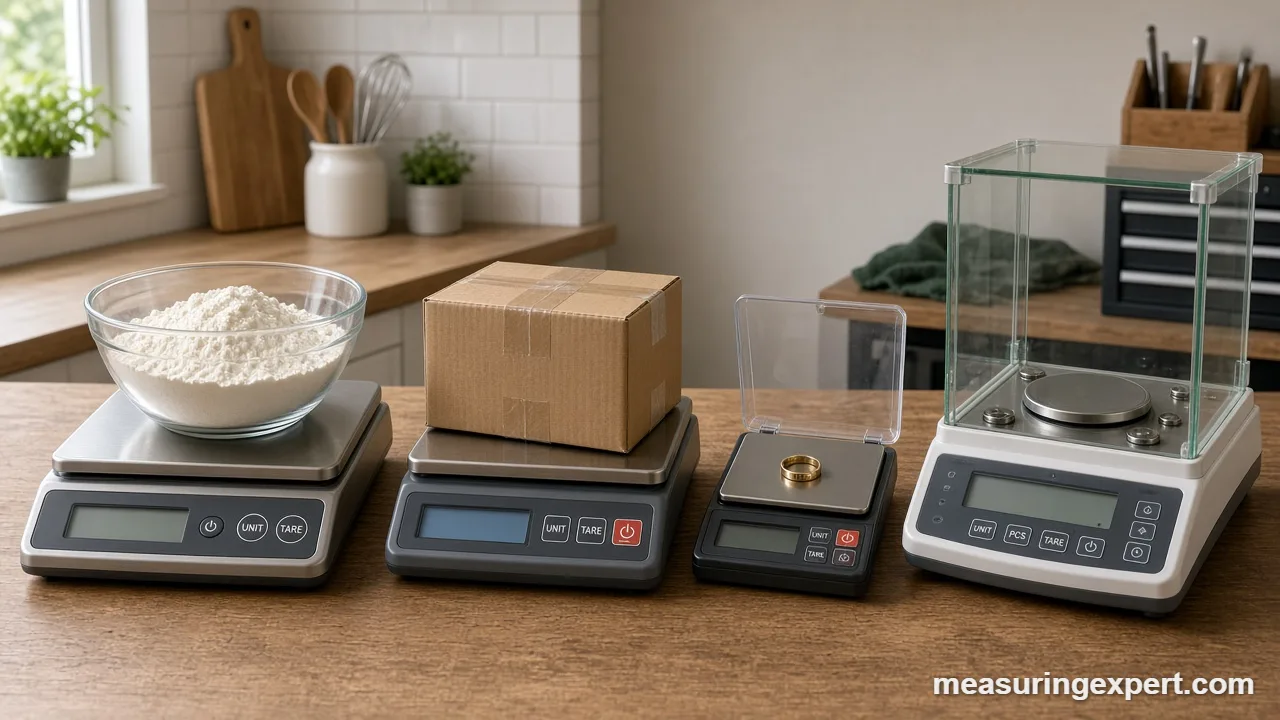
After that, we scored each scale on five points:
- Published specs: capacity and readability at minimum; repeatability and linearity earned extra credit.
- Job fit: each pick had to win a real category, from postage to milligram powders.
- Calibration path: scales you can check or recalibrate with a known weight ranked higher.
- Usability: tare, hold, display placement, power options and auto-off behavior.
- Brand support: established makers with current product pages and stated warranties.
Finally, we cut unbranded listings, near-duplicates and any category that already has its own guide on this site.
Digital Scale Types: Capacity vs Resolution
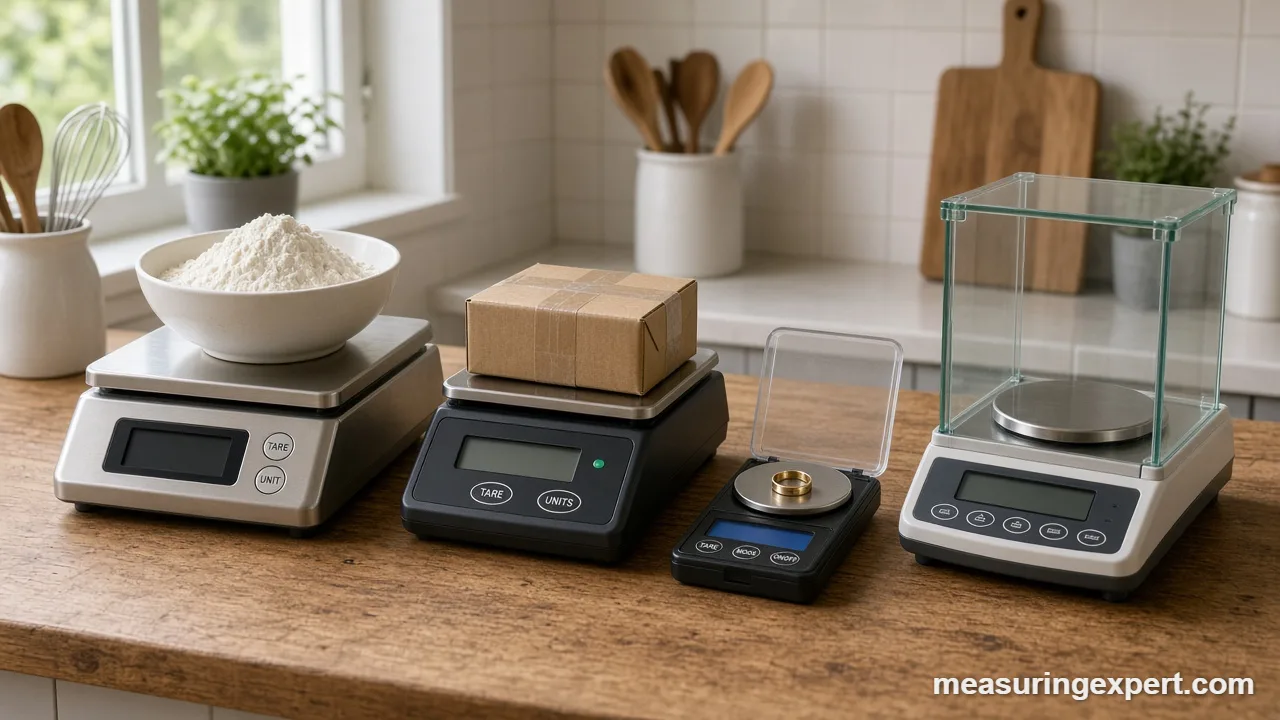
To start, every digital scale uses a sensor, usually a strain-gauge load cell, that bends slightly under a load and changes its electrical signal. However, lab balances often use more refined sensors. Either way, the design trades capacity against resolution: the more a scale can hold, the coarser its smallest step tends to be.
| Type | Example capacity x step | Good for | Example here |
|---|---|---|---|
| Analytical balance | 200 g x 0.001 g | Powders, reagents, reloading | U.S. Solid 1 mg |
| Precision lab balance | 220 g x 0.01 g | Classrooms, labs, cosmetics | Ohaus Scout SPX222 |
| Jewelry or pocket scale | 500 g x 0.01 g | Gold, gems, coins | GemOro XP500 |
| Kitchen scale | 11 lb (5 kg), gram range | Recipes, portions | Amazon Basics |
| Postal or bench scale | 50-55 lb x 0.1 oz | Parcels, bulk food, hobby | Accuteck 8250, My Weigh |
| Bathroom scale | 400 lb x 0.2 lb | Body weight | Etekcity |
| Hanging scale | 110 lb (50 kg) | Luggage, sacks, gear | Etekcity luggage |
As a rule of thumb, pick a scale whose smallest step is no more than about one tenth of the smallest amount you care about. For example, weighing a 1 g dose to within 10 percent calls for 0.1 g steps or finer, while a 5 lb parcel is fine at 0.1 oz.
Specs That Make the Best Digital Scale Precise
Spec sheets for scales look alike at first. However, a handful of numbers tell you nearly everything.
Readability vs accuracy
First, readability, also called resolution or division, is the smallest step the display shows. Accuracy, by contrast, is how close that reading is to the true mass. So a scale can show 0.01 g and still be off by several hundredths. For this reason, lab makers such as Ohaus publish more than one number.
Repeatability: this is how closely the scale returns the same reading when you weigh the same object again. In practice, it is the spec that matters most for daily use, because you usually compare one reading with the next.
Linearity: this tells you how far readings stray across the range. For instance, a scale may be right at 100 g yet slightly off at 200 g.
Stepped resolution: many postal and kitchen scales change step size partway up the range. The My Weigh UltraShip 55, for example, steps 0.1 oz up to 2 lb and 0.5 oz above that. Therefore, always read the full spec line, not just the headline number.
Capacity, tare and minimum load
To begin with, capacity is the most the scale can hold, and that limit includes the container, because tare only hides its weight on the screen. Meanwhile, the minimum load is the smallest amount a scale weighs reliably. As a result, below it readings may jump or stay at zero, so do not weigh near the floor of the range.
Units: grams and ounces cover most jobs, while carats (0.2 g) suit gems and grains (64.79891 mg) suit reloading.
Mass Unit Converter for Scale Readings
Often, a recipe, label or spec sheet gives a weight in one unit while your scale shows another. So enter a value in grams below, and the converter returns ounces, pounds, kilograms, milligrams, carats and grains. For whole-kilo jumps, our guide to how many ounces are in a kilo walks through the math.
The factors are exact by definition: 1 lb equals 453.59237 g and 1 oz equals 28.349523125 g. Even the kilogram itself is now fixed by a constant of nature, as NIST explains in its kilogram redefinition page.
How to Check a Digital Scale With a Test Weight
A quick check tells you whether your scale still reads true. For this, you need a known mass near the weight you usually measure, such as a calibration weight or a sealed item of known weight.
- Place the scale on a hard, level surface away from fans, vents and sunny windows.
- Next, turn it on and let it warm up for a minute or two before weighing.
- Press tare with the platform empty so the display reads zero.
- Set the test weight in the center of the platform and note the reading once it settles.
- Then remove it, confirm the display returns to zero, and repeat three to five times.
- Compare the average with the known mass, and look at how much the readings spread.
- Finally, if the error is larger than the maker’s stated tolerance, run the calibration routine in the manual.
Placement, Calibration and Care
Most odd readings come from the setup, not a faulty scale. So start with the surface: a soft floor or wobbly counter makes any scale wander. Also keep precision scales away from air vents, because even gentle drafts move the last digit.
- First, recheck or recalibrate after moving a scale to a new room or a different floor.
- Also keep it at a steady room temperature, since load cells drift as they warm or cool.
Honest Limits of Even the Best Digital Scale
No scale is perfect. First, more digits on a display do not prove better accuracy. Second, cheap scales rarely publish repeatability, so check them yourself with a known weight. Finally, body weight changes with water intake and time of day, so a bathroom scale reading moves even when the scale is fine.
Best Digital Scale FAQ
What is the best digital scale for most people?
For most homes, the best digital scale is the My Weigh UltraShip 55. It weighs up to 55 lb, reads parcels to 0.1 oz and has a detachable display, so one scale covers shipping, bulk food and hobby jobs.
What is the most accurate type of digital scale?
In general, lab balances are the most accurate scales most people can buy. For example, the Ohaus Scout SPX222 publishes 0.01 g readability, repeatability and linearity, while analytical balances read to 0.001 g inside a draft shield.
Is resolution the same as accuracy on a scale?
No. Resolution is the smallest step the display shows, while accuracy is how close the reading is to the true mass. As a result, a scale can show 0.01 g yet still be off by more than that.
How do I know if my digital scale is accurate?
Weigh a known calibration mass three to five times. Then the average shows accuracy, and the spread between readings shows repeatability. If both fall within the maker’s tolerance, the scale is reading true.
Which best digital scale should I buy for postage?
For postage, the Accuteck 8250 is our pick. Specifically, it reads in 0.1 oz steps up to 25 lb, has a HOLD key and runs on batteries or the included adapter, so you avoid paying for rounded-up weights.
What is the best digital scale for jewelry and coins?
The GemOro Platinum XP500 suits jewelry and coins. Specifically, it reads 500 g in 0.01 g steps, includes carats, and has a 4 x 4 in steel platform with a tray that doubles as a protective cover.
Do I need a milligram scale?
Only if you weigh doses below about 1 g, such as powders, reagents or reloading components. In that case, choose a 0.001 g balance with a draft shield, because air currents alone can move a milligram reading.
Why does my scale show a different weight each time?
Usually, the cause is the setup. An uneven or soft surface, a draft, a cold scale or an off-center load can all shift readings. Instead, move it to a hard, level spot, let it warm up and tare it first.
Can a kitchen scale replace a postal scale?
Sometimes. A kitchen scale handles letters and light parcels, but most top out near 11 lb and many lack a HOLD key. For regular shipping, a 50 lb postal scale is easier and safer for the sensor.
Is the best digital scale legal for trade?
Not usually. Home and hobby scales, including the picks here, are not certified for selling goods by weight. Instead, businesses need an approved legal-for-trade scale under US weights and measures rules.
Bottom Line: The Best Digital Scale for Most Homes
For most buyers, the My Weigh UltraShip 55 Digital Scale is the best digital scale to own. It handles parcels, bulk food and hobby supplies up to 55 lb, and its detachable display stays readable under a big box. However, choose the Ohaus Scout SPX222 when the job calls for documented 0.01 g precision, or the GemOro XP500 for jewelry and coins.
Black Friday is coming: shop the deals with Prime
1 thought on “Best Digital Scale in 2026: 8 Picks for Kitchen, Postal, Lab, Jewelry and Bathroom Weighing”