

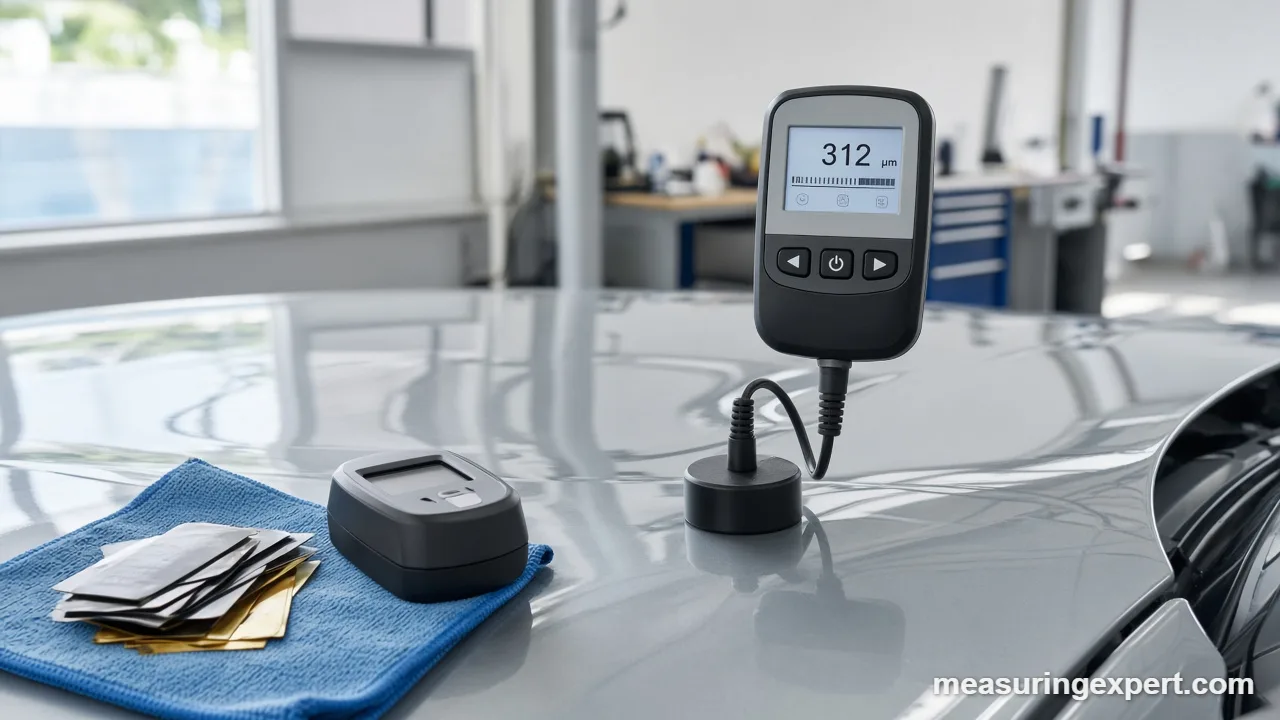
The best paint thickness gauge for most serious users is the DeFelsko PosiTector 6000 FN, because its combo probe reads paint on steel and aluminum with inspection-grade accuracy. However, the right choice depends on the substrate, the accuracy you need and whether you must prove results to a spec such as SSPC-PA 2.
In short: buy the PosiTector 6000 FN for pro work, the Elcometer 311 for car bodies, and the UNI-T UT343D for occasional used-car checks.
As an Amazon Associate, Measuring Expert earns from qualifying purchases. Our picks are based on research, specifications and owner feedback, not paid placement.

Best for Auto Body
Best Budget
Quick Answer: The Best Paint Thickness Gauge for Your Job
- Pro inspection on steel and aluminum: DeFelsko PosiTector 6000 FN Advanced.
- Car bodies and estimates: Elcometer 311 Model T, built for refinish work.
- Middle ground with real specs: Extech CG204, or the CG304 for Bluetooth and 2000 µm range.
- Tight budget: UNI-T UT343D for occasional used-car checks.
- Plastic bumpers and wood: PosiTector 200 B1 (ultrasonic).
- Key unit fact: 1 mil = 0.001 in = 25.4 µm.
On This Page
- Paint gauge comparison table
- The 8 picks, reviewed
- How we chose
- Fe vs NFe: how the probes work
- Reading car paint numbers
- Mils vs microns
- Mils to microns converter
- ASTM D7091 and SSPC-PA 2
- How to check a used car
- Zero, verify and adjust
- Do and Don’t
- Honest limits
- FAQ
- Bottom line
Best Paint Thickness Gauge Comparison Table
In short, each pick appears in one row, and the reviews below explain the specs.
| # | Product | Best For | Standout Feature | Amazon |
|---|---|---|---|---|
| 1 | DeFelsko PosiTector 6000 FN Advanced | Inspectors, painters and serious detailers | Fe/NFe combo probe with SSPC-PA 2 mode and app | View |
| 2 | Elcometer 311 Model T FNF | Body shops, appraisers and car buyers | Purpose-built automotive refinish meter with Bluetooth | View |
| 3 | Extech CG204 | DIY restorers and small shops | Fe/NFe auto-detect with 400-reading memory | View |
| 4 | UNI-T UT343D | Used-car buyers on a budget | 0.1 µm resolution and 500-group memory | View |
| 5 | Extech CG304 | Shops that log and report readings | 0 to 2000 µm range, 2,500-reading memory, Bluetooth | View |
| 6 | PCE Instruments PCE-CT 29 | Fabricators checking DFT to a spec | SSPC mode plus grouped statistics with standard deviation | View |
| 7 | REED Instruments CM-8822-NIST | Quality control that needs paperwork | Ships with a NIST-traceable calibration certificate | View |
| 8 | DeFelsko PosiTector 200 B1 | Bumpers, wood finishes and plastics | Ultrasonic reading on non-metal substrates | View |
The 8 Best Paint Thickness Gauge Picks, Reviewed
This list focuses on dry film thickness (DFT) gauges for paint and coatings. For dial gauges, sheet gauges and the ferrous-only PosiTector 6000 F1 (not the FN combo below), see our broader best thickness gauge picks.
Best Overall
1. DeFelsko PosiTector 6000 FN Advanced
Best for: Coating inspectors, body shops and serious detailers, especially those who want inspection-grade accuracy on both steel and aluminum.
Overall, the PosiTector 6000 is the best paint thickness gauge in this list if accuracy and records matter more than cost. Also, the FN combo probe reads on both steel and aluminum, so one tool covers a whole car or a mixed fabrication shop.
First, DeFelsko rates the FN probe at 0 to 60 mils (0 to 1500 µm). Accuracy is +/-(0.1 mil + 1%) above 2 mils, or +/-(2 µm + 1%) above 50 µm. As a result, a 110 µm reading carries only about +/-3 µm of error. In addition, the Advanced body stores 250,000 readings in up to 1,000 batches and adds SSPC-PA 2 and ISO 19840 modes.
- Range: 0 to 60 mils (0 to 1500 µm) on steel and aluminum
- Accuracy: +/-(0.05 mil + 1%) up to 2 mils; +/-(0.1 mil + 1%) above 2 mils
- Memory (Advanced): 250,000 readings in up to 1,000 batches
- WiFi and Bluetooth to the PosiTector App; SSPC-PA 2, ISO 19840 and IMO PSPC modes
Pros
- Tightest published accuracy in this list
- Built-in SSPC-PA 2 spot and area statistics
- Probe can be swapped for other PosiTector probes
Cons
- Costs several times more than hobby gauges
- More menus than a used-car buyer needs
- Does not read paint on plastic bumpers
Skip it if: you only check one or two used cars a year, because a simpler gauge answers the same repaint question.
Best for Auto Body
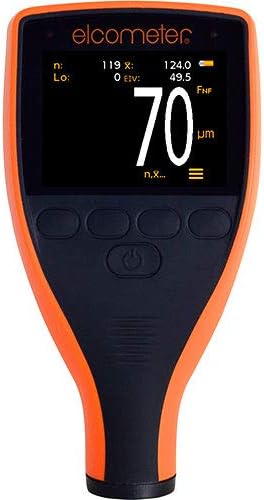
2. Elcometer 311 Model T FNF
Best for: Appraisers, body shop estimators and car buyers, especially those who want a tool designed only for vehicle paint.
First, Elcometer built the 311 for one job: reading paint on car bodies. Also, it reads steel and aluminum panels and switches between them instantly. In addition, the Model T adds Bluetooth, so readings can go to an inspection app or to ElcoMaster for a report.
However, its numbers reflect that narrow focus. Specifically, the range is 0 to 500 µm (0 to 20 mils), and resolution is 10 µm (0.5 mil). Also, accuracy is +/-5% or +/-20 µm (1.0 mil), whichever is greater. For example, at a typical factory reading near 110 µm, the +/-20 µm floor applies. That is fine for spotting a repaint; however, it is too coarse for spec work.
- Range: 0 to 500 µm (0 to 20 mils) on steel and aluminum
- Accuracy: +/-5% or +/-20 µm (1.0 mil), whichever is greater
- Resolution: 10 µm (0.5 mil)
- Bluetooth to an inspection app or ElcoMaster (Model T only)
Pros
- Designed around vehicle inspection
- Quick steel/aluminum switching
- Bluetooth reporting for estimates
Cons
- Coarse 10 µm resolution
- Only reaches 20 mils, so heavy filler reads over range
- Not suited to industrial coating specs
Skip it if: you need to prove a coating meets a written spec, since the accuracy band is too wide for that.
Best Value
3. Extech CG204
Best for: Restorers, DIY painters and small shops, especially those that want a name-brand Fe/NFe gauge with real specs at a moderate cost.
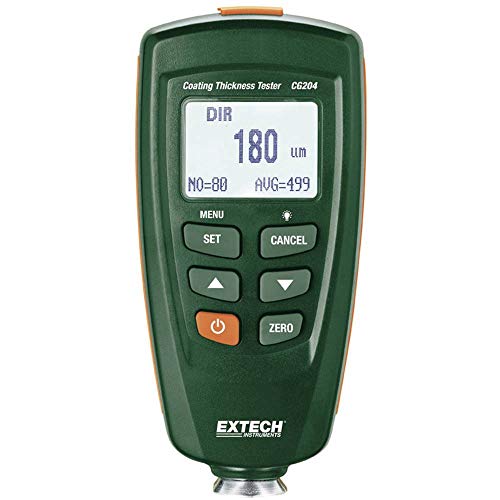
Overall, the CG204 is a sensible middle ground. It uses magnetic induction on steel and eddy current on aluminum, and it recognizes the substrate on its own. Also, Extech publishes a full spec sheet.
First, the range is 0 to 1250 µm (0 to 49 mils) on both metals, with 0.1 µm resolution and +/-3% basic accuracy. In addition, the gauge needs a base metal at least 0.5 mm thick on steel and 0.3 mm on aluminum. Next, it stores 400 readings and exports them over USB.
- Range: 0 to 1250 µm (0 to 49 mils), Fe and NFe
- Resolution 0.1 µm; basic accuracy +/-3%
- Minimum substrate: 0.5 mm (Fe), 0.3 mm (NFe); minimum curvature 1.5 mm / 3 mm
- Memory: 400 readings; USB cable and software; high/low alarms
Pros
- Full, published spec sheet
- Automatic steel/aluminum detection
- Calibration foils included
Cons
- No Bluetooth
- Smaller memory than the CG304
- +/-3% is looser than the DeFelsko
Skip it if: you want wireless reports, because the CG304 adds Bluetooth for a modest step up.
Best Budget
4. UNI-T UT343D
Best for: Used-car shoppers and hobby detailers, especially those who want a branded gauge for occasional checks.
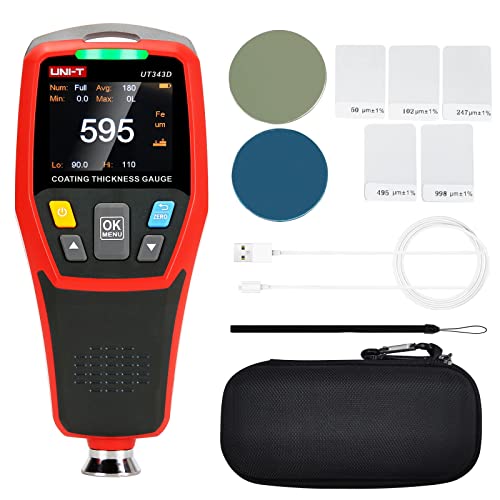
The UT343D reads both ferrous and non-ferrous metals, and it offers single or continuous modes with max, min and average readouts.
Specifically, UNI-T lists a 0 to 1250 µm range with +/-(3% + 1 µm) accuracy. Meanwhile, resolution is 0.1 µm below 100 µm and 1 µm above. Also, it stores 500 groups of data and pairs with PC software over USB. However, UNI-T does not publish minimum substrate or curvature limits on its product page.
- Range: 0 to 1250 µm (about 0 to 49 mils), Fe and NFe
- Accuracy: +/-(3% + 1 µm)
- Resolution: 0.1 µm (0 to 99.9 µm); 1 µm above
- Memory: 500 groups; USB link to PC software
Pros
- Low cost for a branded Fe/NFe gauge
- Continuous mode with max/min/average
- Fine resolution in the paint range
Cons
- Fewer published specs than Extech or PCE
- No Bluetooth or app
- Calibration support is thinner than pro brands
Skip it if: you need traceable calibration paperwork for a client.
Best Bluetooth
5. Extech CG304
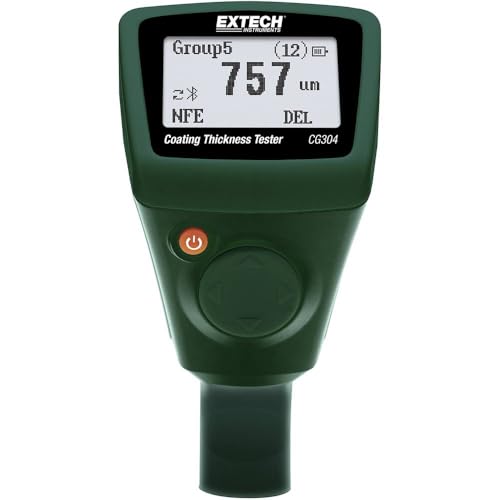
Best for: Shops and fabricators, especially those who need longer range, bigger memory and wireless transfer to a PC.
In short, the CG304 takes the CG204 and stretches it. First, the range grows to 0 to 2000 µm (0 to 78.7 mils). Next, memory jumps to 2,500 readings. Finally, Bluetooth sends data to a PC for analysis and reports.
Also, accuracy is +/-(2% + 2 µm), loosening to +/-3.5% from 1000 to 2000 µm. Thus, at 110 µm, the band is about +/-4 µm. In addition, it auto-detects steel versus aluminum.
- Range: 0 to 2000 µm (0 to 78.7 mils), Fe and NFe
- Accuracy: +/-(2% + 2 µm); +/-3.5% from 1000 to 2000 µm
- Resolution: 0.1 µm
- Memory: 2,500 readings; Bluetooth to PC software
Pros
- Wide range for powder coat and filler
- Large memory with wireless transfer
- Tighter accuracy than the CG204
Cons
- Bluetooth goes to PC software, not a phone app
- Costs noticeably more than the CG204
- No built-in SSPC-PA 2 statistics
Skip it if: you mainly check car paint, since the extra range and memory add little there.
Best for Spec Work
6. PCE Instruments PCE-CT 29
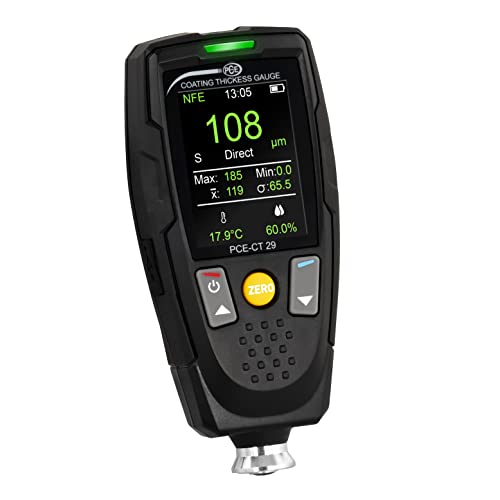
Best for: Fabricators and coating crews, especially those who need grouped statistics and an SSPC mode without paying for a top-tier gauge.
In short, the PCE-CT 29 is the budget route to spec-style reporting. First, it has direct, group and SSPC modes. Also, each group holds 50 readings, with up to 50 groups stored, and it shows the average, highest, lowest and standard deviation for each.
Next, PCE lists a 0 to 2000 µm range on steel and nonferrous metals, with +/-(2% + 2 µm) accuracy and +/-(1% + 1 µm) repeatability. Similarly, it switches among µm, mm, mils and inches. However, one PCE page lists 1500 µm in its highlights, so treat 2000 µm as the spec-table figure.
- Range: 0 to 2000 µm, Fe and NFe
- Accuracy +/-(2% + 2 µm); repeatability +/-(1% + 1 µm)
- Memory: 50 groups x 50 readings with average, max, min and standard deviation
- Modes: direct, group and SSPC; units µm, mm, mils and inch
Pros
- SSPC mode at a mid-range cost
- Standard deviation helps spot bad spray passes
- Four display units
Cons
- Product page has a range discrepancy
- USB only, no wireless
- Smaller brand presence in US auto shops
Skip it if: you want a simple used-car checker, because the group menus slow down quick panel sweeps.
Best With Certificate
7. REED Instruments CM-8822-NIST
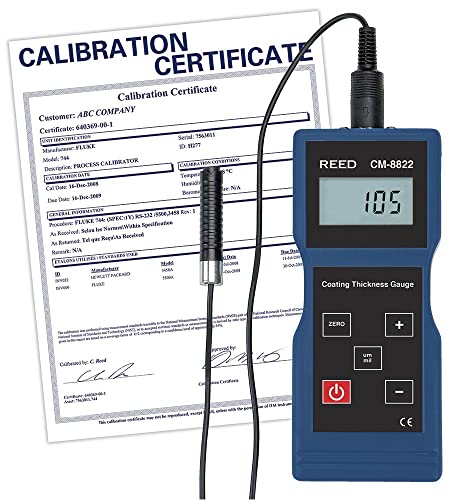
Best for: QC departments and contractors, especially those who must show a traceable calibration certificate with their readings.
Above all, REED sells the CM-8822 with a NIST-traceable certificate in the -NIST version. Also, the gauge recognizes the ferrous (F) or nonferrous (NF) probe automatically and shows which one is active.
Also, according to the REED manual, the range is 0 to 40 mils (0 to 1000 µm). Moreover, accuracy is +/-2 µm below 100 µm and +/-3% above, with 0.1 µm resolution in the low range. In addition, the manual walks through a zero on bare substrate followed by a check on a calibration foil.
- Range: 0 to 40 mils (0 to 1000 µm)
- Accuracy: +/-2 µm below 100 µm; +/-3% at 100 µm and above
- User-selectable µm or mils; F and NF probe recognition
- Zero and foil calibration; substrates and foils included
Pros
- Traceable certificate out of the box
- Tight accuracy in the paint range
- Clear zero-and-foil procedure in the manual
Cons
- No stated data memory
- Shorter 40 mil range than the CG304
- Bulkier battery pack (4 x AA)
Skip it if: you need to log hundreds of readings, because the manual lists no memory.
Best for Plastic and Wood
8. DeFelsko PosiTector 200 B1
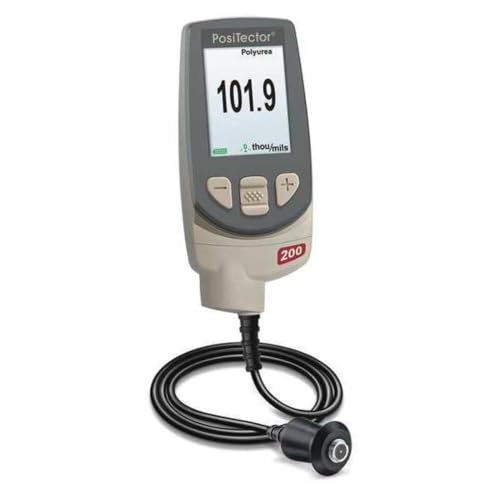
Best for: Anyone who must measure paint on plastic bumpers, plastic trim or wood finishes, where magnetic gauges read nothing.
Every other gauge here needs metal under the paint, whereas the PosiTector 200 uses ultrasound, so it reads polymer coatings on wood and plastic. That matters on modern cars, because bumper covers and many trim parts are plastic.
Specifically, the B1 probe covers 13 to 1000 µm (0.5 to 40 mils) with +/-(2 µm + 3%) accuracy, and it conforms to ASTM D6132 and ISO 2808. However, the Standard B1 reports total coating thickness only; the Advanced B3 can split up to three layers. Also, ultrasonic gauges need a drop of couplant gel at each reading. For more ultrasonic options, see our ultrasonic thickness gauge guide.
- Range: 13 to 1000 µm (0.5 to 40 mils), polymer coatings
- Accuracy: +/-(2 µm + 3% of reading)
- Substrates: wood, plastic and similar non-metals
- Standard model: total thickness only; memory 1,000 readings
Pros
- Reads paint where magnetic gauges cannot
- Same PosiTector platform as the 6000
- Published, standards-based accuracy
Cons
- Needs couplant gel for each reading
- Slower than a magnetic gauge on a full car
- Not for metal panels; pair it with a 6000
Skip it if: you only measure on steel or aluminum, because a magnetic or eddy current gauge is faster there.
How We Chose the Best Paint Thickness Gauge Picks
We did not run hands-on tests for this guide; instead, the picks are research-based. First, we read the spec pages and manuals from DeFelsko, Elcometer, Extech, UNI-T, PCE Instruments and REED. Next, we checked claims against inspection standards and weighed owner feedback on repeatability.
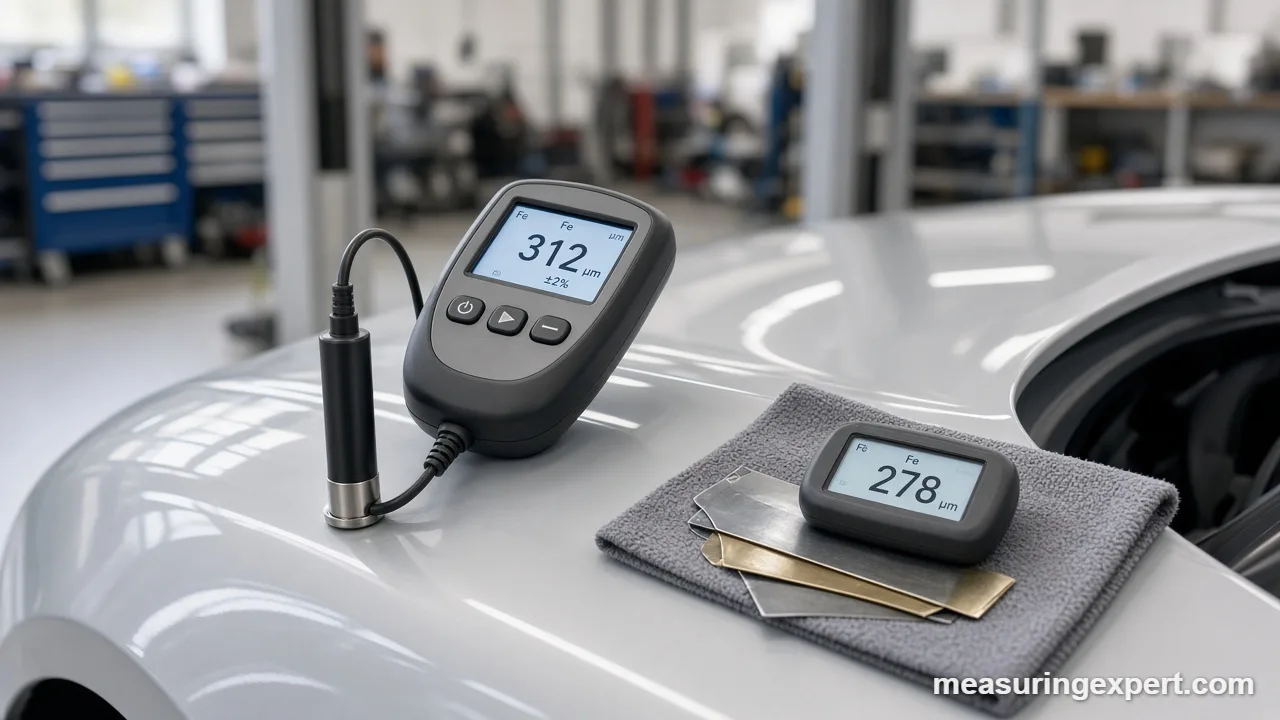
Then we scored each gauge on five points:
- Substrate coverage: steel only, steel plus aluminum, or non-metals by ultrasound.
- Published accuracy: a stated tolerance, not just “high precision”.
- Range and resolution: room for primer, paint and filler.
- Verification support: zero plates, foils, certificates and a clear adjustment procedure.
- Data: memory, statistics, USB or Bluetooth, and spec modes such as SSPC-PA 2.
In addition, we capped each brand at two picks. We also left out unbranded listings that publish no tolerance, because a gauge without a stated accuracy cannot be checked against anything.
Fe vs NFe: Matching the Best Paint Thickness Gauge to the Metal
In fact, most car paint gauges are two gauges in one body. Therefore, first ask what sits under the paint.
| Probe type | Principle | Works on | Watch out for |
|---|---|---|---|
| Ferrous (Fe) | Magnetic induction: the coating sets the gap between a magnetic probe and the steel | Paint, powder coat and zinc on steel or iron | Reads nothing on aluminum; edges and thin sheet skew readings |
| Nonferrous (NFe) | Eddy current: a coil induces currents in the metal, and the coating changes the signal | Paint and anodize on aluminum, copper and brass | Needs a conductive base; very thin sheet reads low |
| Ultrasonic | Times a sound pulse through the coating and back | Paint on plastic, wood and other non-metals | Needs couplant; slower per reading |
For example, many trucks and luxury cars now use aluminum hoods, doors or whole bodies. However, a ferrous-only gauge shows no reading there. Therefore, a combo (Fe/NFe) gauge is the safe default for automotive use. Meanwhile, plastic bumper covers need an ultrasonic gauge.
Reading Car Paint With the Best Paint Thickness Gauge
First, a paint gauge cannot tell you a car was repaired. Instead, it shows you where the film is thicker than the rest of the body. As a result, consistency across panels matters more than any single number.
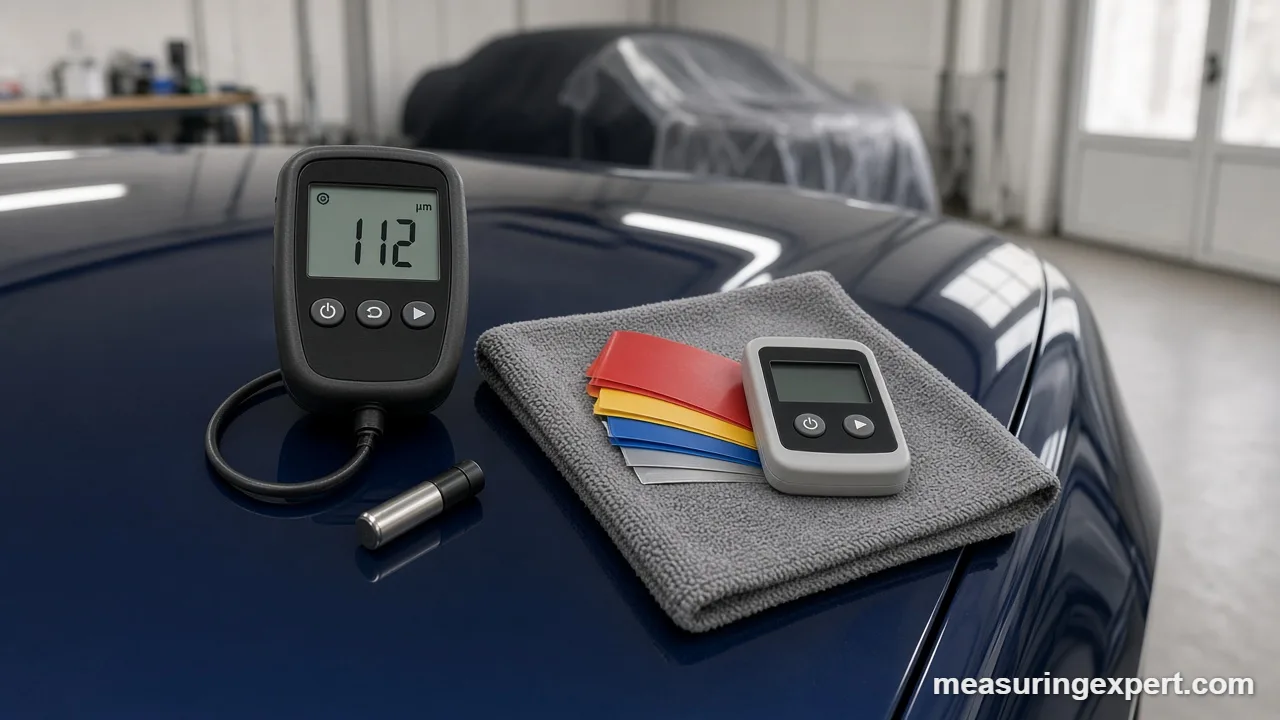
For instance, DeFelsko gives a useful case study in its automotive paint inspection guide. For example, on one vehicle, most readings fell between 4.2 and 4.5 mils (about 107 to 114 µm). Near the bottom of one panel, however, a reading hit 10.6 mils (about 269 µm). Lower still, it rose to 36.8 mils (about 935 µm), which pointed to heavy plastic filler over a rust repair.
| Pattern you see | Likely cause | Next step |
|---|---|---|
| One panel reads clearly thicker than its neighbors | Repaint of that panel | Check the gaps, overspray and color match |
| Thickness rises toward one area of a panel | Blending or local repair | Grid the area with more readings |
| Readings jump to many times the norm | Body filler under the paint | Have a body shop inspect the panel |
| No reading at all on a panel | Aluminum on a Fe-only gauge, or a plastic part | Switch to NFe or ultrasonic |
Also, factory thickness varies by maker and model, so the best baseline is the car in front of you.
Mils vs Microns on the Best Paint Thickness Gauge
In the US, shops usually talk in mils; by contrast, most of the world uses microns. First, a mil is one thousandth of an inch, not a millimeter. Since the inch is defined as exactly 25.4 mm, 1 mil equals exactly 25.4 µm. Conversely, 100 µm is about 3.94 mils.
| Mils | Microns (µm) | Typical context |
|---|---|---|
| 1 mil | 25.4 µm | Thin single coat |
| 4.5 mils | 114.3 µm | Upper end of the DeFelsko case-study car |
| 10 mils | 254 µm | Far above that car; suspect a repaint |
| 20 mils | 508 µm | Top of the Elcometer 311 range |
| 60 mils | 1524 µm | Top of the PosiTector 6000 FN range (rated 1500 µm) |
However, makers round ranges: DeFelsko lists 60 mils beside 1500 µm, although 60 mils is 1524 µm. Therefore, for tight specs, read the gauge in the spec’s own unit.
Mils to Microns Converter
First, enter a reading in mils to see it in millimeters and inches. Then multiply millimeters by 1,000 for microns. For example, 4.5 mils is 0.1143 mm, or 114.3 µm.
For general unit habits, our guide on how to measure length covers inch fractions and metric scales.
ASTM D7091, SSPC-PA 2 and the Best Paint Thickness Gauge
First, ASTM D7091 is the standard practice for nondestructive dry film thickness measurement with magnetic and eddy current gauges. Also, it covers calibration, verification of accuracy and adjustment, and it expects users to verify a gauge before, during and after use.
Second, SSPC-PA 2 explains how many readings to take and how to judge them against a spec. As KTA explains, a spot measurement is the average of at least three gauge readings, and in sample checks those readings sit inside a 1.5 in (38 mm) circle. Meanwhile, individual readings are not restricted on their own. Under the default restriction level, each spot may range from 80% of the minimum to 120% of the maximum spec. However, the overall average must still land inside the specified range.
For example, if a spec calls for 8 to 12 mils, spots from 6.4 to 14.4 mils pass, as long as the average stays between 8 and 12. The PosiTector 6000 Advanced and PCE-CT 29 do this math in their SSPC modes.
How to Check a Used Car With the Best Paint Thickness Gauge
- Wash the car or at least wipe each test spot, because dirt and wax add false thickness.
- Next, zero the gauge on its bare steel and aluminum plates, then check it on a supplied foil.
- Start on the roof or another flat panel and take five to ten readings to set a baseline.
- Then work around the car panel by panel, about 1 in (25 mm) from edges and seams.
- Hold the probe flat and still; lift it fully between readings instead of dragging it.
- Focus on lower doors, rear quarters and fender centers, where damage and rust repairs are common.
- When a panel reads high, grid it with extra readings to see if the rise is local or panel-wide.
- Finally, switch to NFe mode or an ultrasonic gauge for aluminum and plastic parts, and record everything.
Zero, Verify and Adjust: Keeping Readings Honest
First, calibration is the lab process that produces a certificate. Next, verification is your quick check on a known foil or standard before use. Adjustment, by contrast, is changing the gauge so it reads the known value.
In practice, verify on a foil close to the thickness you expect. For example, a foil near 100 to 125 µm (4 to 5 mils) suits car paint. If the reading is outside the combined foil and gauge tolerance, adjust on the same base metal you are measuring. Also, replace creased or worn foils.
Coating Gauge Do and Don’t
Honest Limits of Even the Best Paint Thickness Gauge
Above all, any coating gauge measures only total film above the base metal. Moreover, most magnetic and eddy current gauges cannot separate clear coat, color and primer. Also, curved, thin or narrow parts can skew readings.
In addition, a thicker reading is a clue, not proof of an accident. After all, factory finishes vary, and a quality repaint can be close to factory thickness. Therefore, pair the gauge with a close look at panel gaps, overspray and VIN labels.
Best Paint Thickness Gauge FAQ
What is the best paint thickness gauge for most people?
For professional work, the DeFelsko PosiTector 6000 FN is the best paint thickness gauge, because it reads steel and aluminum with tight published accuracy. For used-car checks, the Elcometer 311 or UNI-T UT343D is enough.
Do I need a ferrous and nonferrous paint gauge for cars?
Yes, in most cases. Many cars use aluminum hoods, doors or bodies, and a ferrous-only gauge gives no reading on aluminum. So a combo Fe/NFe gauge is the safe choice for automotive use.
How many microns are in a mil?
One mil is exactly 25.4 microns, because a mil is 0.001 in and an inch is exactly 25.4 mm. Going the other way, 100 microns is about 3.94 mils.
What is a normal factory paint thickness reading?
It varies by maker and model, so there is no single normal number. In one DeFelsko case study, factory readings ran 4.2 to 4.5 mils (about 107 to 114 microns), and the useful test was consistency across panels.
Can a paint thickness gauge detect body filler?
Yes. Filler adds a lot of non-metal thickness, so readings jump to several times the normal value. In the DeFelsko example, one repaired area read 36.8 mils against a normal 4.2 to 4.5 mils.
Can I measure paint on a plastic bumper?
Not with a magnetic or eddy current gauge, because they need metal under the coating. Instead, use an ultrasonic gauge such as the PosiTector 200 B1, which reads polymer coatings on plastic and wood.
What is ASTM D7091?
ASTM D7091 is the standard practice for nondestructive dry film thickness measurement with magnetic and eddy current gauges. It covers calibration, verification of accuracy and adjustment, and it asks users to verify gauges before, during and after use.
What does SSPC-PA 2 require?
A spot is the average of at least three readings. Under the default level, each spot may run from 80% of the minimum to 120% of the maximum spec, while the overall average must stay in range.
How often should I verify my coating thickness gauge?
Check it on a known foil or standard at the start of each session, during long sessions and at the end. Also send it for a certified calibration on the schedule your quality system or customer requires.
Why do my paint gauge readings jump around?
Common causes are dirt, wax, curved or thin metal, readings too close to an edge, and dragging the probe. Clean the spot, stay about 1 in from edges, lift the probe between readings and average several readings.
Bottom Line on the Best Paint Thickness Gauge
Overall, the DeFelsko PosiTector 6000 FN Advanced is the best paint thickness gauge for anyone who measures coatings for a living. Also, it reads steel and aluminum, keeps an SSPC-PA 2 record and carries the tightest published accuracy here. On the other hand, a car buyer can do the same repaint hunt with the Elcometer 311 or the UNI-T UT343D, as long as readings are compared panel to panel.