

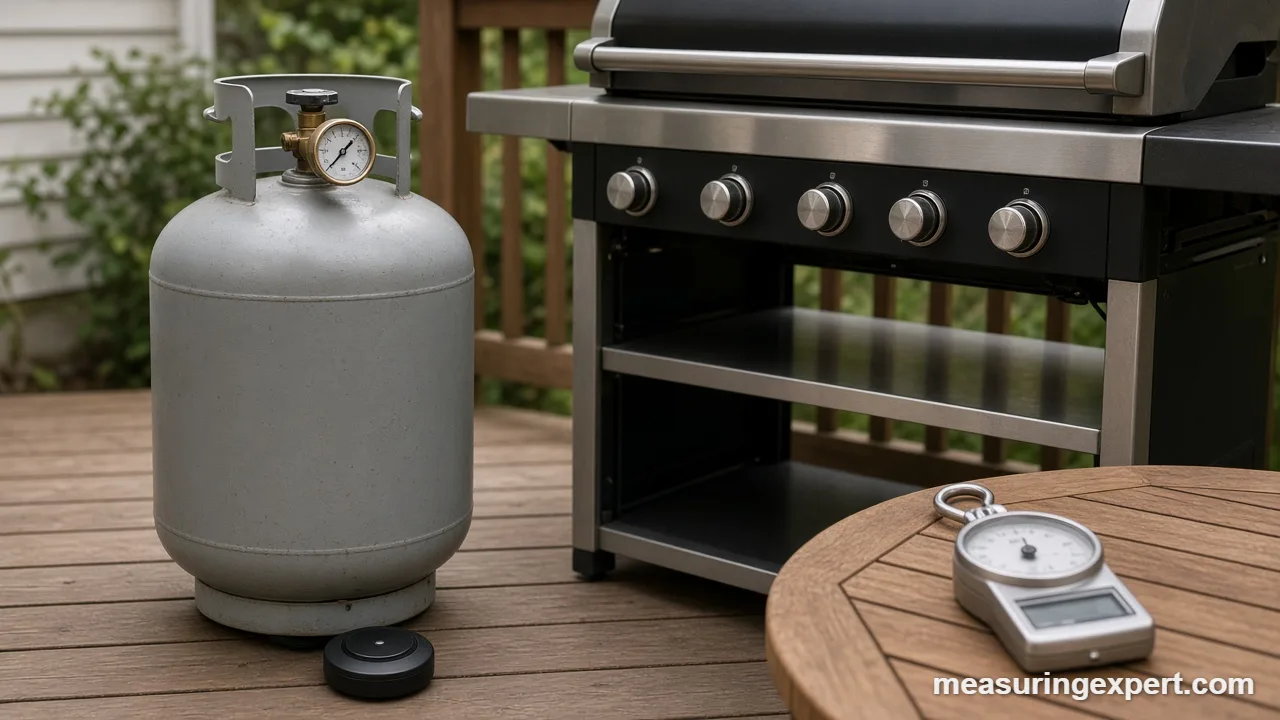
The best propane tank gauge for most people is the Mopeka Pro Check Universal, an ultrasonic sensor that reads the actual liquid level and sends it to your phone. The right choice depends on your tank size, your budget and how much you trust a pressure dial that shifts with the weather.
In short: pick Mopeka for real level readings, Flame King for a sturdy inline dial, Calpose on a budget, and a simple scale if you want the most honest number for the least money.
As an Amazon Associate, Measuring Expert earns from qualifying purchases. Our picks are based on research, specifications and owner feedback, not paid placement.
Best Overall

Best Inline Dial

Best Budget

Quick Answer: The Best Propane Tank Gauge by Need
- Most accurate level: Mopeka Pro Check Universal, because it measures liquid height with sound, not pressure.
- Two RV cylinders: the Mopeka Pro Check bundle with an LED display you can mount inside.
- Classic inline dial: Flame King solid brass gauge with a glow-in-the-dark face.
- Lowest cost: Calpose, a simple 3-color dial for 5 to 40 lb cylinders.
- Honest number: a hanging scale such as the Flame King digital grip scale, used with the tare weight on the collar.
- No tools at all: a magnetic temperature strip, read after pouring warm water down the side.
- Rule of thumb: pressure tells you gas is present; weight tells you how much is left.
On This Page
- Comparison Table
- The 8 Picks, Reviewed
- How We Chose
- Gauge Types Compared
- Why Pressure Dials Mislead
- How to Weigh Your Tank
- Propane Weight Calculator
- Specs That Matter
- Safety Notes
- FAQ
- Bottom Line
Best Propane Tank Gauge Comparison Table
| # | Product | Best For | Standout Feature | Link |
|---|---|---|---|---|
| 1 | Mopeka Pro Check Universal + Tank Halo | Most users | Ultrasonic level reading in an app | View |
| 2 | Mopeka Pro Check Dual-Tank Bundle | RVs with two cylinders | Wireless LED display for two tanks | View |
| 3 | Flame King Brass Gauge (2-Pack) | Grills and heaters | Solid brass, glow-in-the-dark dial | View |
| 4 | Flame King Digital Grip Scale | Weighing cylinders | Lift-and-read weight for 5 to 40 lb tanks | View |
| 5 | GasPro Propane Gauge | Smaller 5 to 20 lb tanks | Compact Type 1 inline dial | View |
| 6 | Calpose 3-Color Gauge | Tight budgets | Simple color-coded face | View |
| 7 | Dozyant Gauge 2-Pack | Spare-tank owners | Two gauges for two cylinders | View |
| 8 | Oudain Magnetic Level Strip | Zero-install checks | Stick-on temperature strip | View |
The 8 Best Propane Tank Gauge Picks, Reviewed
We grouped these picks by how they measure, because the method matters more than the brand. First come the sensors that read real liquid level, then the scale, then the pressure dials, and finally a strip that costs little and needs no fittings.
Best Overall
1. Mopeka Pro Check Universal with Tank Halo
Best for: Grill owners, campers and RVers who want a true percentage reading instead of a guess.
The Pro Check Universal is a small puck that sits under the tank. First, it sends an ultrasonic pulse up through the liquid propane and times the echo from the liquid surface. As a result, it reports how high the liquid is, which the free Tank Check app turns into a percentage for your tank size. Because it measures height rather than pressure, a cold morning does not make a full tank look empty.
On steel cylinders, for example, the sensor holds on with a magnet. The Tank Halo in this bundle is a collar that holds the sensor in place, which also helps on tanks that are not magnetic. In addition, Mopeka lists the sensor for 20, 30 and 40 lb DOT cylinders and tanks up to 250 gallons, upright or horizontal. However, a good reading depends on solid contact, so you should keep the mounting surface clean and follow the setup steps.
- Measurement method: bottom-mounted ultrasonic sensor, no tank penetration
- Tanks: 20, 30 and 40 lb DOT cylinders, up to 250 gallons, vertical or horizontal
- Power: replaceable CR2032 coin cell, rated 3 to 5 years
- App: Mopeka Tank Check for iOS and Android
- Operating range: -58 to 140 F (-50 to 60 C)
Pros
- Reads actual liquid level, so temperature swings matter far less
- Also, nothing goes between the tank valve and the regulator
- Coin cell lasts years, according to Mopeka
Cons
- Bluetooth only, so you need to be nearby unless you add a Wi-Fi bridge
- Rust, dents or a tilted tank can upset readings
Skip it if: you only grill a few times a year and a bathroom scale already lives in your garage.
Best for RVs
2. Mopeka Pro Check Dual-Tank Bundle with LED Display

Best for: Travel trailers and motorhomes with two cylinders on the tongue or in a side bay.
Basically, this bundle pairs two Pro Check sensors with a small wireless LED display. Mopeka says the display shows levels for two cylinders of 20, 30, 40 or 100 lb using Pro Check sensors, and it runs on a coin cell. So you can glance at a panel inside the camper instead of walking outside with a flashlight. In addition, the same sensors still report to the app on your phone.
Also, the standard Pro Check is meant for propane, butane and LPG in steel and aluminum tanks. As a result, it is a good match for the steel cylinders that ship on most trailers. Meanwhile, the included Tank Halos keep each sensor seated as the rig bounces down the road.
- Sensors: two Pro Check ultrasonic sensors with Tank Halos
- Display: wireless LED unit for two 20, 30, 40 or 100 lb cylinders
- Tanks: steel and aluminum DOT cylinders up to 250 gallons
- Sensor battery: replaceable CR2032, rated 2 to 4 years
Pros
- Inside display, so no trips out in the rain
- Monitors both cylinders at once, too
- Also works with the phone app
Cons
- Costs more than a single sensor, of course
- Overkill for one grill tank
Skip it if: you have one cylinder and do not need a mounted display.
Best Inline Dial
3. Flame King Solid Brass Propane Gauge (2-Pack)
Best for: People who want a classic dial on a grill, patio heater or camp stove tank.
Flame King is a long-running propane cylinder brand, and this gauge screws between the tank valve and your regulator with a Type 1 (QCC1) connection. In addition, its multi-color face shows good, low and refill zones, and the dial glows in the dark for late cookouts. Also, the body is solid brass rather than plastic.
On top of that, Flame King lists the gauge with an excess flow check valve and the UL, ANSI Z21.18 and CSA 6.25 standards. Still, remember what it measures: tank pressure. For that reason the needle stays in the green for most of the tank and then drops near the end, as we explain in the section on why pressure dials mislead.
- Connection: Type 1 (QCC1) inline, between valve and regulator
- Body: solid brass
- Display: color zones for good, low and refill; glow-in-the-dark dial
- Listed standards: UL, ANSI Z21.18, CSA 6.25
Pros
- Brass body and established brand
- Also easy to read at night
- Two-pack covers a spare tank
Cons
- Pressure-based, so it is a rough guide to level
- Adds one more joint to leak-check after every swap
Skip it if: you want a percentage you can plan a weekend around.
Best Scale
4. Flame King Digital Grip Scale

Best for: Anyone who wants the most accurate reading for the least money and does not mind lifting the tank.
Weighing is the method propane pros use, and this little scale makes it quick. First, you hook it under the cylinder collar, choose a tank size from 5 to 40 lb, then lift and read the display. Next, subtract the tare weight stamped on the collar, and what remains is the propane itself. Because liquid propane weighs about 4.2 pounds per gallon, you can turn that number into gallons in your head.
In terms of size, Flame King lists it as a handheld unit of about 6 ounces that runs on two AAA batteries with auto power-off. As a result, it lives happily in a grill drawer or RV bin. On the other hand, a full 20 lb tank weighs roughly 37 lb (16.8 kg), so lifting it is the real limit.
- Tank sizes: 5, 10, 20, 30 and 40 lb
- Method: hang from collar, lift, read weight
- Power: 2 AAA batteries, auto power-off
- Size: about 4.75 x 3.25 x 1 in; weight about 6 oz
Pros
- Weight, unlike pressure, does not change with temperature
- No fittings, so nothing to leak
- Works on every cylinder you own, as well
Cons
- You must lift the tank, which is hard for some people
- Also lacks remote reading or alerts
Skip it if: lifting 30 to 40 pounds is not safe for you; in that case, a Mopeka sensor is the better route.
Best for Small Tanks
5. GasPro Propane Tank Gauge

Best for: Owners of 5, 11 and 20 lb tanks for camp stoves, fire pits and portable heaters.
GasPro sells a wide range of hoses, adapters and regulators, and this compact gauge fits the same Type 1 valves. Specifically, the listing covers 5 to 20 lb tanks, so it suits the smaller cylinders that get carried around. In addition, it uses the same color-band face as most dials, which makes it quick to read.
However, like every inline dial here, it reads pressure. Therefore, think of it as a “gas is present and flowing” indicator that also warns you when the tank is nearly done. So for trip planning, weigh the tank before you leave.
- Connection: Type 1 (QCC1)
- Listed tank range: 5 to 20 lb cylinders
- Display: color-coded dial
Pros
- Compact body, so it suits small tanks
- Brand known for propane fittings
Cons
- Not listed for 30 or 40 lb cylinders
- Shares the pressure-dial weakness on level
Skip it if: your main tank is 30 lb or larger.
Best Budget
6. Calpose 3-Color Propane Tank Gauge
Best for: Casual grillers who want a basic warning before the burgers stall.
The Calpose is the plainest gauge in this roundup, and that is the appeal. For instance, it threads on with a Type 1 (QCC1) connection, fits 5 to 40 lb cylinders, and shows three color zones. So there is nothing to pair, charge or calibrate.
Because it is cheap and simple, it also makes a good spare. However, a plain dial cannot correct for a 30 degree temperature swing, so read it with the same caution as the other pressure gauges.
- Connection: Type 1 (QCC1)
- Listed tank range: 5 to 40 lb cylinders
- Display: 3-color coded face
Pros
- Very simple to install and, similarly, to read
- Fits the common grill-tank range
Cons
- Plain face with few markings
- Level reading is approximate at best
Skip it if: you want the sturdier brass build of the Flame King.
Best Value Pack
7. Dozyant Propane Tank Gauge (2-Pack)

Best for: Households that rotate two tanks, such as a grill tank and a spare.
Dozyant is a familiar name in grill hoses and adapters, and this two-pack puts a gauge on each cylinder. Moreover, it is listed for 5 to 40 lb tanks with a Type 1 connection, and the listing describes it as a level indicator with leak detection. In practice, that leak feature means you can watch for a needle that drops while all burners are off.
That check is useful, but it does not replace a soapy-water test on every joint. Also, like the other dials, it reads pressure, so treat the color zones as a broad hint.
- Connection: Type 1 inline
- Listed tank range: 5 to 40 lb cylinders
- Pack: two gauges
Pros
- Two gauges for two tanks
- Can hint at a slow leak with burners off
Cons
- Fewer published specs than the Flame King
- Still gives only an approximate level
Skip it if: you only own one tank.
Best No-Install
8. Oudain Magnetic Propane Level Strip

Best for: People who want a cheap visual check without adding any fitting to the gas line.
To begin with, a magnetic strip uses heat-sensitive (thermochromic) ink. Liquid propane soaks up heat far better than the vapor above it, so after you pour a cup of warm tap water down the strip, the section beside the liquid stays cooler and shows a different color. As a result, that color line marks the liquid level for a few minutes.
Because the strip sticks to steel with a magnet, you can move it from tank to tank. On the downside, it needs a temperature difference to work, so it can be hard to read on a hot afternoon or right after a refill.
- Method: thermochromic strip read after warm water
- Mount: magnetic, for steel cylinders
- Pack: two strips
Pros
- No connection to the gas line at all
- Moves easily between steel tanks, too
Cons
- Needs warm water or a temperature change
- Will not stick to aluminum or composite tanks
Skip it if: you want a reading at a glance, any time of day.
How We Chose the Best Propane Tank Gauge
To be clear, we did not bench-test these gauges. Instead, our picks are research-based. First, we read manufacturer pages and manuals, compared listed specs, and weighed owner feedback for patterns such as stuck needles, sensor dropouts and fitting leaks. Next, we filtered with five questions:
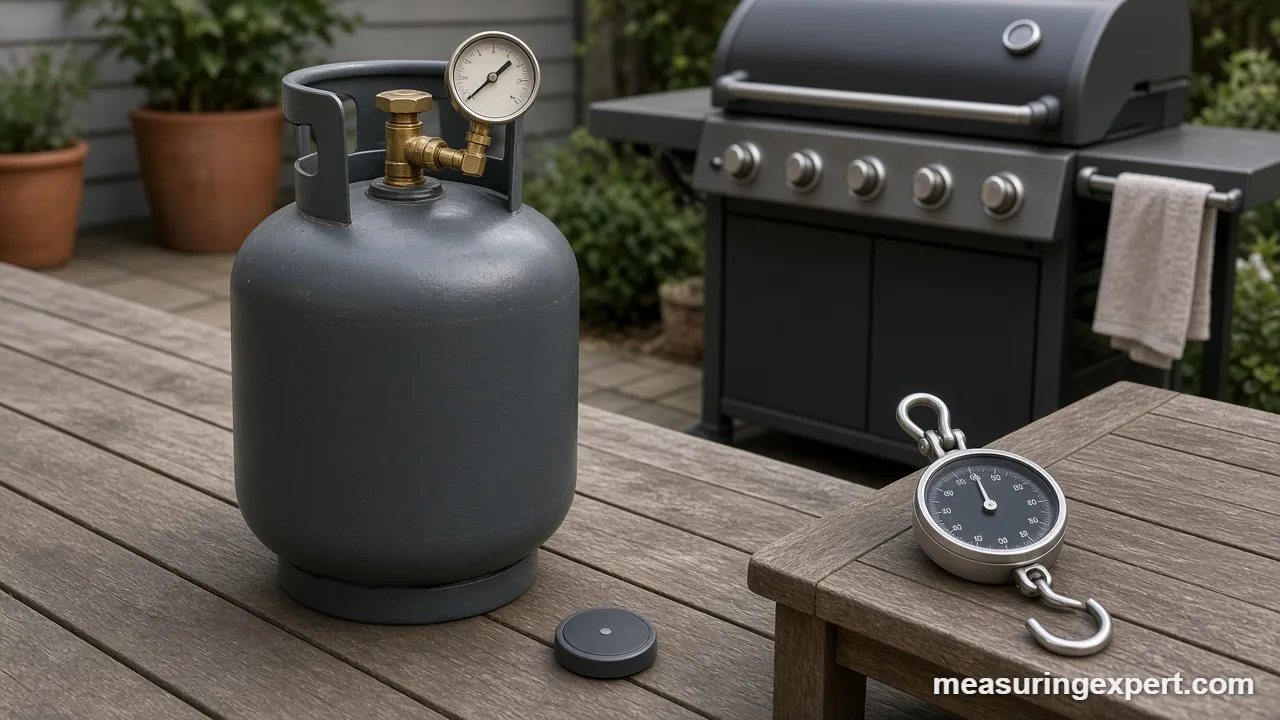
- Method: does it measure liquid level, weight or pressure?
- Fit: which tank sizes and connections does the maker list?
- Build: brass, plastic or sealed electronics?
- Safety: does it add a joint, and is it listed to a gas-appliance standard?
- Brand: is the maker established, with clear support pages?
For the physics, we used propane vapor pressure data from the NIST Chemistry WebBook, and for sensor details we used Mopeka’s product pages. Finally, we capped each brand at two picks.
Inline, Magnetic, Scale or Smart: Gauge Types Compared
In fact, each type answers a slightly different question. So before you pick a brand, decide which question you need answered.
| Type | What it measures | Level accuracy | Main catch |
|---|---|---|---|
| Inline pressure dial | Vapor pressure in the tank | Low: changes with temperature | Drops only near empty |
| Magnetic temperature strip | Wall temperature difference | Fair, for a few minutes | Needs warm water or a temperature change |
| Scale or hanging scale | Gross weight minus tare | High | You must lift or set the tank |
| Ultrasonic sensor (Mopeka) | Height of liquid by echo | High with good contact | Mounting and rust matter |
| Smart scale (GasWatch style) | Weight, sent to an app | High | Tank must sit on the base |
| Dial-reading monitor (Tank Utility) | Float gauge on large tanks | Good for big tanks | Made for home tanks, not cylinders |
Smart scales, such as the GasWatch-style base that sends tank weight to a phone, combine the honest weight method with alerts. Similarly, monitors such as Generac’s Tank Utility read the float gauge on large home tanks and report over a cell network. Those suit 100 gallon and larger tanks, so they sit outside this cylinder-focused list.
Why a Pressure Dial Is Not the Best Propane Tank Gauge for Level
To start, a propane cylinder holds liquid with vapor above it. As long as any liquid remains, the vapor pressure depends almost entirely on temperature, not on how much liquid is left. In other words, a nearly full tank and a one-quarter tank at the same temperature show nearly the same pressure.
Using the Antoine equation coefficients that NIST publishes for propane, we calculated how far that pressure swings across normal outdoor weather:
| Tank temperature | Approx. vapor pressure |
|---|---|
| 0 F (-18 C) | about 25 psig (1.7 bar) |
| 40 F (4 C) | about 66 psig (4.6 bar) |
| 70 F (21 C) | about 114 psig (7.8 bar) |
| 100 F (38 C) | about 178 psig (12.3 bar) |
As a result, the same full tank can read four to seven times higher on a hot day than on a frozen one. For this reason, many dials print two or three temperature bands on the face. Also, when a burner runs hard, boiling liquid cools the tank and pressure falls, so the needle may dip during a cook and recover later. In the end, the dial only drops for good when the liquid is almost gone, which is why it is better at saying “refill soon” than “half full.” For a deeper look at how gas pressure behaves, see our guide to the pressure of a gas.
How to Weigh a Propane Tank Step by Step
By comparison, weighing gives the most trustworthy number, and it takes about a minute. Here is the method:
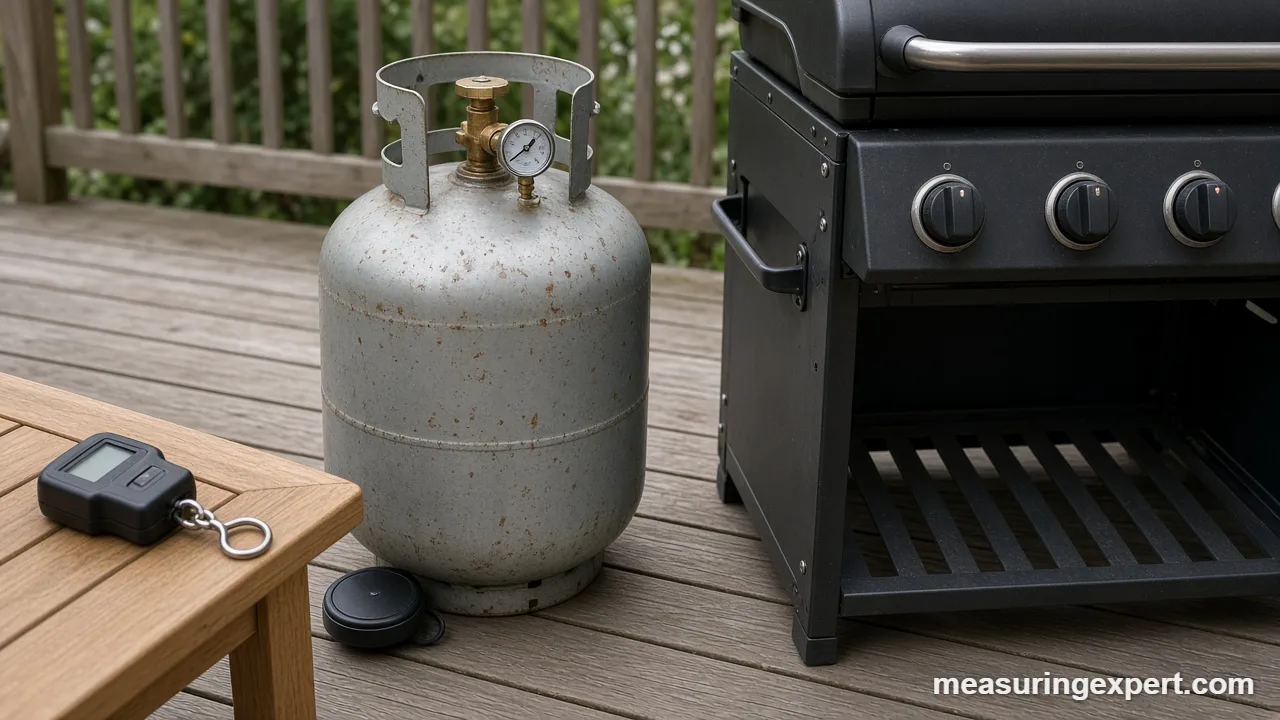
- Close the cylinder valve and disconnect the regulator, or simply weigh a spare tank.
- Find the tare weight stamped on the collar, marked TW (for example, TW 17 means the empty tank weighs 17 lb).
- Weigh the whole cylinder on a bathroom scale, a hanging scale or a propane scale.
- Subtract the tare weight from the gross weight to get pounds of propane.
- Divide the propane weight by 4.2 to estimate gallons, or by the rated capacity (20 lb for a grill tank) to get percent full.
- Reconnect, open the valve slowly and check every joint with soapy water.
For example, say a grill tank weighs 29 lb and its collar reads TW 17. Then, 29 minus 17 leaves 12 lb of propane (5.4 kg). Next, 12 divided by 4.2 is about 2.9 gallons, and 12 divided by 20 means the tank is about 60 percent full. Meanwhile, a full 20 lb tank holds about 4.8 gallons and weighs roughly 37 lb (16.8 kg).
Want to size up bigger storage? Our tank volume guide shows how to work out capacity from dimensions.
Propane Weight Calculator
Use this converter to switch the propane weight you just worked out between pounds, kilograms and ounces. Then divide pounds by 4.2 for gallons.
Specs to Compare in the Best Propane Tank Gauge
Connection. Most grill-size cylinders in the US use a Type 1 (QCC1) valve. Therefore, an inline gauge must match it, and it adds one more joint to check for leaks.
Tank range. Makers list which cylinders a gauge fits, often 5 to 40 lb. In addition, ultrasonic sensors list tank material, since Mopeka uses different versions for steel and for aluminum or composite tanks.
Resolution. A dial with three color bands gives three steps. In contrast, a scale reads to a fraction of a pound, while an ultrasonic app shows a percentage. Therefore, if you need to know whether you have enough for a two-day trip, pick weight or ultrasound.
Temperature handling. For example, some dials print bands for cold, mild and hot weather. That helps; however, it is still a correction to a pressure reading rather than a level measurement.
Power and connectivity. Coin-cell sensors can run for years. However, Bluetooth range is short, so remote alerts usually need a Wi-Fi bridge or a cellular monitor.
Standards. Finally, look for gas-appliance listings such as ANSI Z21.18 or CSA 6.25 on inline parts, because they sit in the gas path.
Propane Safety Notes for Gauge Owners
- Leak-check: after every tank swap, brush soapy water on each joint; growing bubbles mean a leak.
- Storage: keep cylinders upright, outdoors and away from heat, never in a basement or living space.
- Transport: secure tanks upright with the valve closed, and do not leave them in a hot closed car.
- Filling: cylinders are filled to about 80 percent of liquid capacity on purpose, leaving room for expansion.
- Inline parts: any gauge in the gas path must stay tight and undamaged; replace a cracked or sticking unit.
- Detectors: fuel-burning appliances indoors call for a carbon monoxide detector.
The Propane Education and Research Council keeps a useful propane safety page with cylinder handling guides.
Best Propane Tank Gauge FAQ
What is the best propane tank gauge for a 20 lb grill tank?
For most grill owners, the best propane tank gauge is an ultrasonic sensor such as the Mopeka Pro Check Universal, because it reads real liquid level. On a tight budget, a simple scale used with the tare weight is nearly as accurate.
Are inline propane pressure gauges accurate?
They measure pressure accurately; however, pressure is a poor guide to level. Propane vapor pressure depends on temperature, so the needle stays high until the tank is nearly empty and swings with the weather.
How do I find the tare weight on a propane tank?
Look on the metal collar around the valve for the letters TW followed by a number. In other words, that number is the empty weight in pounds, often around 17 lb on a standard 20 lb grill cylinder.
How much does a gallon of propane weigh?
Liquid propane weighs about 4.2 pounds per gallon, or roughly 0.5 kg per liter. A full 20 lb tank therefore holds a little under 5 gallons.
Do magnetic propane tank strips work?
Yes, within limits. They show a color line at the liquid level after you pour warm water down the strip, because the liquid stays cooler than the vapor space. However, they only stick to steel tanks.
Is a smart sensor the best propane tank gauge for an RV?
Usually, yes. A dual-tank ultrasonic kit such as the Mopeka Pro Check bundle shows both cylinders on an inside display and in an app, so you can plan refills without going outside.
Why does my gauge show full and then suddenly empty?
Actually, that is normal for a pressure dial. Pressure stays near the vapor pressure until the liquid is almost gone, then it falls quickly, so the needle drops late.
Does cold weather affect propane tank readings?
It strongly affects pressure dials, since vapor pressure falls from about 114 psig at 70 F to about 25 psig at 0 F. By contrast, weight and ultrasonic readings are far less affected.
Can a propane gauge detect leaks?
Some inline gauges can hint at a leak if the needle drops while every burner is off. Still, the reliable test is soapy water on each joint after you connect a tank.
Do I need a different gauge for a 100 gallon tank?
Yes, in most cases, because large tanks usually have a built-in float gauge. Remote monitors such as Generac’s Tank Utility read that gauge, while Mopeka lists its Pro Check Universal for tanks up to 250 gallons.
Bottom Line: Our Best Propane Tank Gauge Pick
If you want a real level reading, our best propane tank gauge pick is the Mopeka Pro Check Universal with Tank Halo. After all, it measures liquid height, not pressure, so weather swings do not fool it. Otherwise, a basic scale and the TW number on the collar give an honest answer for very little money, and a brass Flame King dial makes a handy “refill soon” warning.