

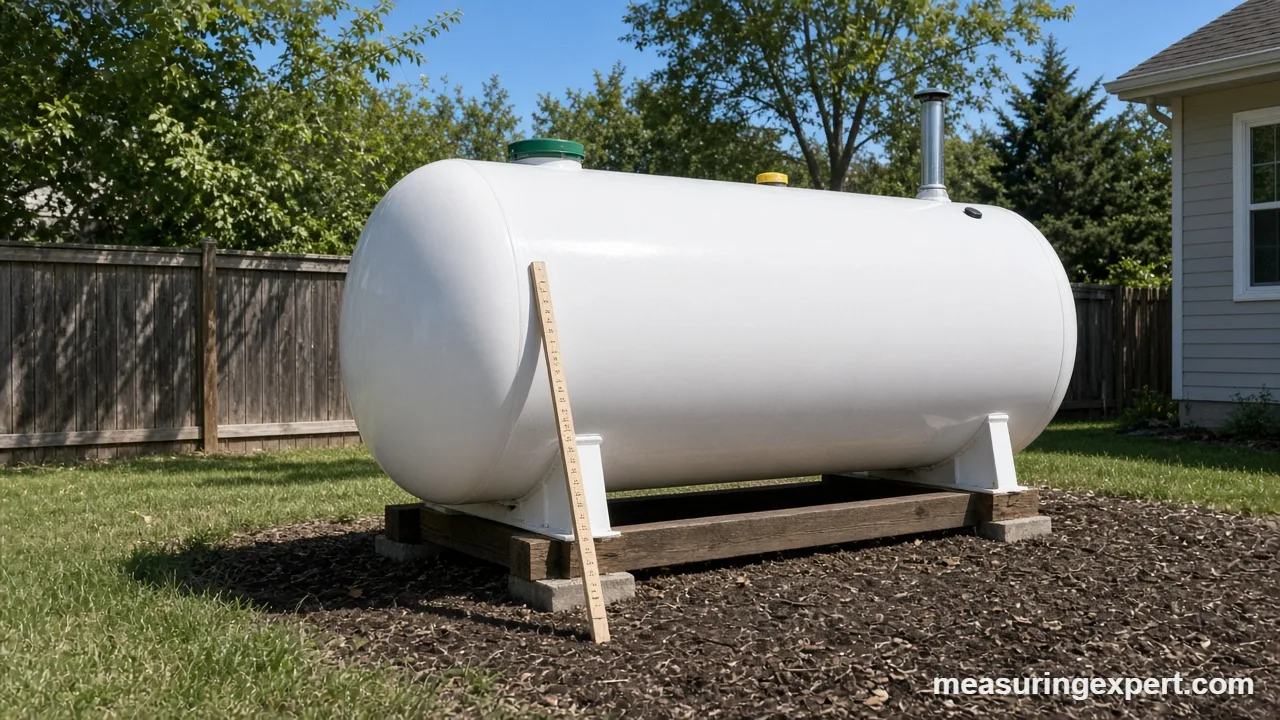
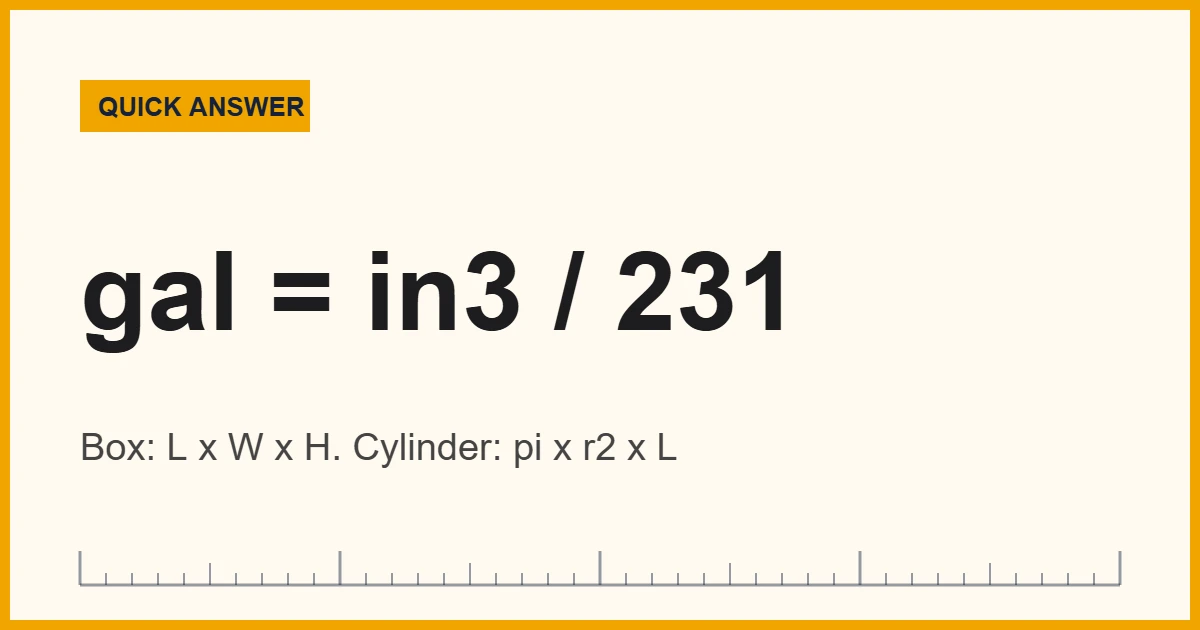
To find the volume of a tank, measure its inside dimensions and use the formula for its shape: length x width x height for a rectangular tank, or pi x r2 x length for a cylinder. Work in inches, then divide cubic inches by 231 to get US gallons, or multiply by 0.016387 to get liters.
Most tanks are one of a few simple shapes: a box, an upright cylinder, a cylinder lying on its side, a capsule with rounded ends, or an oval. So you rarely need anything more than a tape measure and a calculator. The hard part is usually not the math. Instead, it is measuring the right dimensions and handling a tank that is only partly full.
Why the Volume of a Tank Can Be Tricky
That second problem trips up many people. In an upright tank, the liquid volume rises in a straight line with the depth. In a horizontal tank, however, it does not. This is because the middle of the tank holds far more liquid per inch than the curved top and bottom. As a result, a dipstick reading of one quarter of the height means only about one fifth of the capacity.
In short: measure the inside, pick the right formula, keep everything in one unit, and convert to gallons or liters at the very end. For a horizontal tank that is partly full, use the circular segment formula or the depth table further down.
Also, the unit math rests on exact definitions. NIST, the US national measurement lab, defines the liter as one cubic decimeter, or 1,000 cubic centimeters. Meanwhile, the US gallon is defined as exactly 231 cubic inches, which works out to 3.785411784 liters. For the partial-fill math, the standard circular segment formula from Wolfram MathWorld does the heavy lifting.
Next, below you will find a gallon converter, formulas for five tank shapes, worked examples with real numbers, and a dipstick chart for horizontal tanks.
Convert Your Tank Volume From Gallons to Liters
First, work out the volume in US gallons with one of the formulas below. Then type the number here. After that, the converter uses the exact NIST definition of the gallon and shows liters, quarts, pints, cups and fluid ounces. It is a unit converter rather than a shape calculator, so do the geometry step first.
Recommended Tools for Measuring a Tank
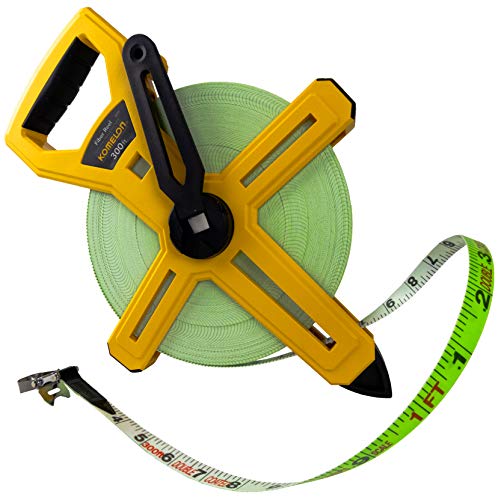
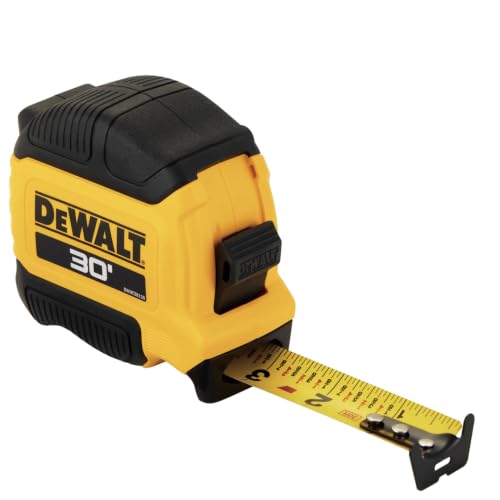
First, for most home tanks, a sturdy 25- or 30-foot tape is all you need. In addition, a long fiberglass reel tape helps when you must wrap the outside of a big round tank. Laser distance meters, on the other hand, are handy for tall tanks and long runs where a tape sags. So the list below covers all three, based on manufacturer specs and buyer reports.



As an Amazon Associate, Measuring Expert earns from qualifying purchases.
- First, a rectangular tank: V = length x width x height.
- Vertical or horizontal cylinder (full): V = pi x r2 x length, where r is half the inside diameter.
- A horizontal tank that is partly full needs the circular segment formula, not a simple ratio.
- Similarly, a capsule tank is a cylinder plus one sphere made of its two rounded ends.
- Cubic inches divided by 231 gives US gallons; cubic feet times 7.4805 gives US gallons.
- Also, use inside dimensions, since the wall takes up space.
- Finally, nominal tank sizes are often a little larger than the real usable volume.
Volume of a Tank: Formulas by Shape
First, start by naming the shape. Then match it to a row in this table. In every formula, r is the inside radius (half the inside diameter), and all lengths must use the same unit.
| Tank shape | What to measure | Full volume formula |
|---|---|---|
| Rectangular (box) | Inside length, width, height | V = L x W x H |
| Vertical cylinder | Inside diameter, height | V = pi x r² x H |
| Horizontal cylinder | Inside diameter, length | V = pi x r² x L |
| Capsule (rounded ends) | Diameter, length of the straight part | V = pi x r² x L + 4/3 x pi x r³ |
| Elliptical (true oval) | Width, height, length | V = pi x (W/2) x (H/2) x L |
| Obround (flat sides, round ends) | Width, height, length | V = [pi x (W/2)² + W x (H – W)] x L |
Notice that the horizontal and vertical cylinder use the same full-volume formula. In fact, only the partial-fill math changes when you lay the tank down. Also, for a closer look at the cylinder itself, see our guide on how to measure cylinder volume.
How to Measure the Volume of a Tank, Step by Step
- Identify the shape. Check whether the tank is a box, an upright cylinder, a lying cylinder, a capsule or an oval.
- Measure the inside. Take the inside diameter or width, plus the height or length, in inches or centimeters.
- Subtract the wall if you can only reach the outside. Take away twice the wall thickness from each outside width or diameter.
- Apply the formula. Use the table above, keeping every number in one unit.
- Convert the result. Divide cubic inches by 231 for US gallons, or divide cubic centimeters by 1,000 for liters.
- Find the liquid level if needed. Measure the depth with a dipstick and use the partial-fill method for your shape.
- Sanity-check the answer. Compare it with the size on the tank label or the fill records, and enter the gallons in the converter above.
Volume of a Tank With Flat Sides
Box-shaped tanks are the easiest. For instance, fish tanks, many water troughs and some fuel and chemical tanks fall into this group. Therefore, simply multiply the three inside dimensions.
For example, take an aquarium that measures 48 x 24 x 20 inches inside. First, multiply: 48 x 24 x 20 = 23,040 cubic inches. Next, divide by 231 to get 99.7 US gallons. In metric, by comparison, that is about 377.6 liters. Similarly, a 4 x 2 x 2-foot trough holds 16 cubic feet, which is 119.7 gallons or 453 liters.
Moreover, partial fill is just as simple here. Because the sides are straight, the volume scales directly with the depth. So water 15 inches deep in that 20-inch aquarium means 15/20, or 75%, of the full volume, which is 74.8 gallons. In practice, aquariums also lose space to gravel and decor, so the real water volume is a bit lower.
Volume of a Tank Standing Upright
Typically, upright cylinders include water storage tanks, rain barrels and water heaters. The formula is V = pi x r2 x H. In other words, you find the area of the circular floor and multiply it by the height.
For example, consider a tank 4 feet across and 6 feet tall. Here the radius is 2 feet, so the floor area is pi x 22 = 12.57 square feet. Then 12.57 x 6 = 75.4 cubic feet. Finally, 75.4 x 7.4805 = 564 US gallons, or about 2,135 liters. Likewise, a metric example works the same way: a tank 1.2 m across and 1.5 m tall holds pi x 0.62 x 1.5 = 1.696 cubic meters, or about 1,696 liters (448 gallons).
Once again, partial fill is linear. Each inch of depth in a 48-inch-wide upright tank holds pi x 242 / 231 = 7.83 gallons. Therefore, liquid 30 inches deep means about 235 gallons. However, upright tanks with a cone or dome bottom are the exception; in that case, work out the cone separately and add it.
Volume of a Tank Lying on Its Side
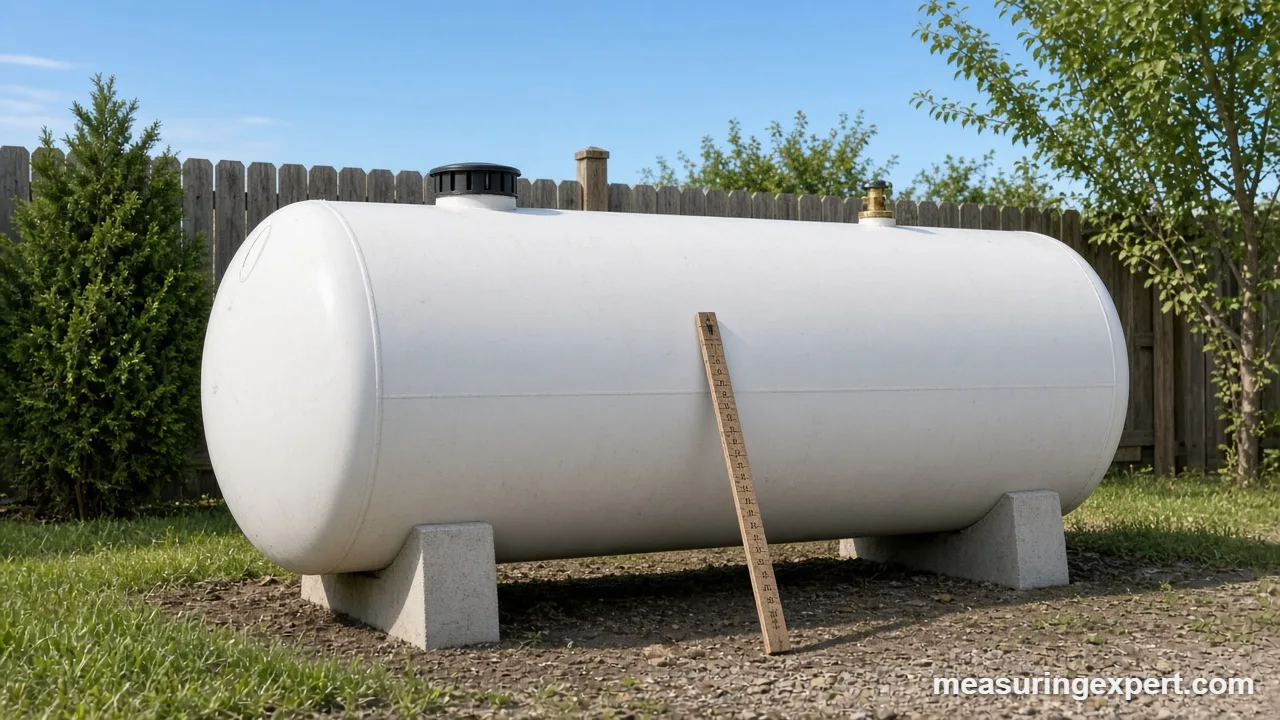
When full, a horizontal cylinder uses the same formula as an upright one: V = pi x r2 x L. A tank 48 inches in diameter and 72 inches long, for example, holds pi x 242 x 72 = 130,288 cubic inches. Then dividing by 231 gives 564 US gallons, the same as the upright tank above.
The partial-fill formula for a horizontal tank
Most of the time, though, you want to know how much is in the tank now. For that, find the area of the liquid’s cross-section (a circular segment) and multiply it by the length:
A = r^2 x acos((r – h) / r) – (r – h) x sqrt(2rh – h^2)V = A x L
Here, h is the liquid depth and acos is the inverse cosine in radians. Also, this works for any depth from 0 to the full diameter. Then divide cubic inches by 231 for gallons.
Worked example: partial fill
Take the same 48 x 72-inch tank with liquid 12 inches deep. So r = 24 and h = 12 here. First, r – h = 12, and 12 / 24 = 0.5. Next, acos(0.5) = 1.0472 radians, so the first term is 576 x 1.0472 = 603.2. Then sqrt(2 x 24 x 12 – 144) = sqrt(432) = 20.78, and 12 x 20.78 = 249.4. As a result, the segment area is 603.2 – 249.4 = 353.8 square inches. Finally, 353.8 x 72 / 231 = 110.3 gallons, or about 417 liters.
That is only 19.6% of the tank, even though the liquid reaches 25% of the height. As a result, a simple depth ratio overstates the contents of a nearly empty horizontal tank and understates a nearly full one. Similarly, the table below shows the full pattern.
| Depth (48 in tank) | Share of height | Share of volume | Gallons (72 in long) | Liters |
|---|---|---|---|---|
| 6 in | 12.5% | 7.2% | 40.7 | 154 |
| 12 in | 25% | 19.6% | 110.3 | 417 |
| 18 in | 37.5% | 34.3% | 193.2 | 731 |
| 24 in | 50% | 50% | 282.0 | 1,068 |
| 30 in | 62.5% | 65.7% | 370.8 | 1,404 |
| 36 in | 75% | 80.4% | 453.8 | 1,718 |
| 42 in | 87.5% | 92.8% | 523.3 | 1,981 |
| 48 in | 100% | 100% | 564.0 | 2,135 |
Volume of a Tank With Rounded or Oval Ends
Capsule tanks
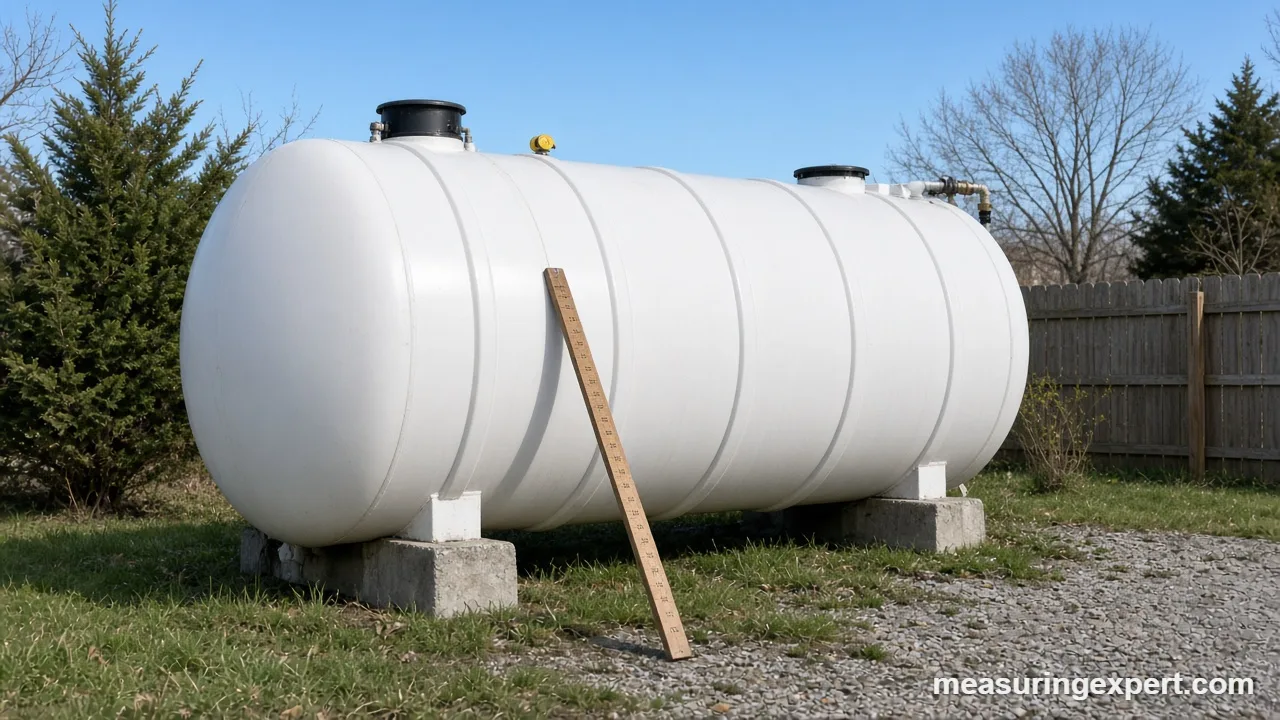
Propane tanks and many pressure vessels have a straight cylinder in the middle and a rounded cap on each end. Even so, if the caps are true half-spheres, the two caps together make one full sphere. So the volume is the cylinder plus the sphere: V = pi x r2 x L + 4/3 x pi x r3, where L is the length of the straight section only.
For instance, a tank 36 inches across with a 96-inch straight section has r = 18. The cylinder part holds pi x 182 x 96 / 231 = 423.0 gallons. Meanwhile, the two ends hold 4/3 x pi x 183 / 231 = 105.8 gallons. Altogether that is 528.8 gallons, or about 2,002 liters. Many real tanks, however, have flatter dished ends, so they hold somewhat less than this.
Oval and obround tanks
Meanwhile, home heating oil tanks are often called “oval,” but the common 275-gallon style is really obround: flat sides with half-round top and bottom. Yet the two shapes give quite different answers, so look closely before you pick a formula.
| Shape (27 in wide, 44 in high, 60 in long) | Cross-section area | Volume |
|---|---|---|
| Obround (flat sides, round ends) | 1,031.6 sq in | 267.9 gal (1,014 L) |
| True ellipse | 933.1 sq in | 242.4 gal (917 L) |
| Rectangle (wrong, for comparison) | 1,188 sq in | 308.6 gal (1,168 L) |
As you can see, the obround result of about 268 gallons is close to the 275-gallon nominal size. That gap is normal, because makers usually quote outside dimensions and round up. For partial fill in an obround tank, in contrast, use the segment formula for the round top and bottom and simple depth x width for the straight middle band.
Reading the Volume of a Tank From a Dipstick or Sight Gauge
Of course, a dipstick or a clear sight tube tells you the liquid depth, not the volume. As a result, turning depth into gallons depends on the shape. For boxes and upright cylinders, simply multiply the depth by the gallons per inch. For horizontal tanks, use this percentage chart, which works for any diameter.
| Depth as share of diameter | Share of full volume | Depth as share of diameter | Share of full volume |
|---|---|---|---|
| 10% | 5.2% | 60% | 62.6% |
| 20% | 14.2% | 70% | 74.8% |
| 25% | 19.6% | 75% | 80.4% |
| 30% | 25.2% | 80% | 85.8% |
| 40% | 37.4% | 90% | 94.8% |
| 50% | 50.0% | 100% | 100% |
To use it, first divide your dipstick reading by the inside diameter. Then look up the share and multiply it by the full volume. For example, 20 inches of oil in a 48-inch tank is 41.7% of the diameter, or roughly 39% of the volume.
Next, a few habits make readings more reliable. For one, lower the stick straight down until it touches the bottom, then pull it out and read the wet line right away. In addition, take the reading at the center of a horizontal tank, since a stick near the end can hit the curved head. Likewise, a sight gauge works the same way, but check that the tube is clean and the valves are open.
Converting the Volume of a Tank to Gallons or Liters
Do all the geometry in one unit, and convert only at the end. After all, mixing feet and inches halfway through is the most common cause of wildly wrong answers. Besides, these factors are exact or rounded from exact definitions.
| From | To | Multiply by |
|---|---|---|
| Cubic inches | US gallons | 1/231 (0.004329) |
| Cubic inches | Liters | 0.016387064 |
| Cubic feet | US gallons | 7.4805 |
| Cubic feet | Liters | 28.316846592 |
| Cubic centimeters | Liters | 0.001 |
| Cubic meters | Liters | 1,000 |
| Cubic meters | US gallons | 264.17 |
| US gallons | Liters | 3.785411784 |
Watch out for the imperial gallon used in the UK, which is about 4.546 liters. In other words, a tank listed as 100 imperial gallons holds about 120 US gallons. For more units side by side, in addition, our guide to units of volume has full tables. Likewise, if your “tank” is a backyard pool, see how to measure pool volume for sloped floors and odd shapes.
Do and Don’t When You Measure a Tank
Do
- Use inside dimensions whenever you can reach them.
- Also keep every number in inches, or every number in centimeters.
- Average two or three readings of each dimension.
- Read a dipstick at the center of a horizontal tank.
- Compare your answer with the label or delivery records.
Don’t
- Put the diameter in place of the radius.
- Assume half the height means half the volume in an oval tank.
- Use a straight ratio for a partly full horizontal tank.
- Also don’t count the rounded ends of a capsule as part of the straight length.
- Climb onto or into a tank to measure it.
Honest Limits of Tank Volume Math
The formulas are exact for perfect shapes. Real tanks, however, are not perfect. For example, plastic tanks bulge when full, steel tanks have dished ends instead of true half-spheres, and many have fittings, baffles or sumps inside. So treat any hand calculation as a close estimate, often within a few percent.
In addition, small measuring errors grow. Because the radius is squared, a 1% error in diameter gives about a 2% error in volume. For example, misreading a 48-inch diameter as 49 inches adds about 4% to the answer. Similarly, a tank that sits slightly tilted throws off every dipstick reading, especially near empty.
Finally, capacity and safe fill are different things. Fuel tanks are rarely filled to 100%, because liquid expands as it warms. Propane tanks, for instance, are normally filled to about 80% of their water capacity. Therefore, the number that matters for ordering fuel is the usable volume, not the geometric one.
When to Call a Professional
For a fish tank, rain barrel or water trough, your own math is plenty. On the other hand, fuel, chemicals and pressure tanks are different. Above all, their rated capacity is stamped on a data plate, and fill limits come from codes and the manufacturer. So if you need an exact figure for billing, legal records or safety, ask your fuel supplier, a tank installer or a licensed inspector. In addition, large storage tanks are often calibrated (“strapped”) by specialists who build a certified depth-to-volume chart.
Frequently Asked Questions
How do I calculate the volume of a tank in gallons?
Measure the inside dimensions in inches, use the formula for the tank’s shape to get cubic inches, and then divide by 231. If you measured in feet, multiply cubic feet by 7.4805 instead.
What is the formula for the volume of a cylindrical tank?
Use V = pi x r^2 x L, where r is half the inside diameter and L is the height or length. The same formula works for upright and horizontal tanks when they are full.
How do I find the volume of a partly full horizontal tank?
Find the segment area with A = r^2 x acos((r – h)/r) – (r – h) x sqrt(2rh – h^2), where h is the liquid depth. Then multiply A by the tank length.
How many gallons are in a 275-gallon oil tank?
A typical 27 x 44 x 60-inch obround tank works out to about 268 gallons by geometry. The usable amount is lower still, since suppliers do not fill it to the brim.
How do I convert tank volume to liters?
First, multiply cubic inches by 0.016387, or multiply US gallons by 3.785. If you measured in centimeters, divide cubic centimeters by 1,000.
Why does a dipstick at half height show half the volume?
At exactly half the height, a symmetrical tank is split into two equal halves. Above and below the middle, however, the curved shape makes the volume change faster or slower than the depth.
Should I measure the inside or the outside of the tank?
In general, measure the inside whenever possible. If you can only reach the outside, subtract twice the wall thickness from each width or diameter before you calculate.
How do I find the volume of a capsule-shaped tank?
Add the cylinder and the two rounded ends: V = pi x r^2 x L + 4/3 x pi x r^3. Note that L is the straight middle length only, not the total length.
What is the volume of a tank 4 feet across and 6 feet tall?
It holds about 75.4 cubic feet. In turn, that equals about 564 US gallons, or roughly 2,135 liters.
How accurate is a hand-calculated tank volume?
For a tank close to a simple shape, expect accuracy within a few percent. However, dished ends, bulging walls, internal fittings and a tilted tank all add error.
The Bottom Line on Tank Volume
To sum up, finding how much a tank holds takes three steps: identify the shape, measure the inside, and apply the matching formula. Then divide cubic inches by 231 for gallons, or use the converter at the top of this page for liters, quarts and more.
For partly full tanks, upright shapes are simple, while horizontal and oval tanks need the segment formula or the depth chart above. Finally, for fuel and pressure tanks, trust the data plate and your supplier’s chart over any hand calculation.