

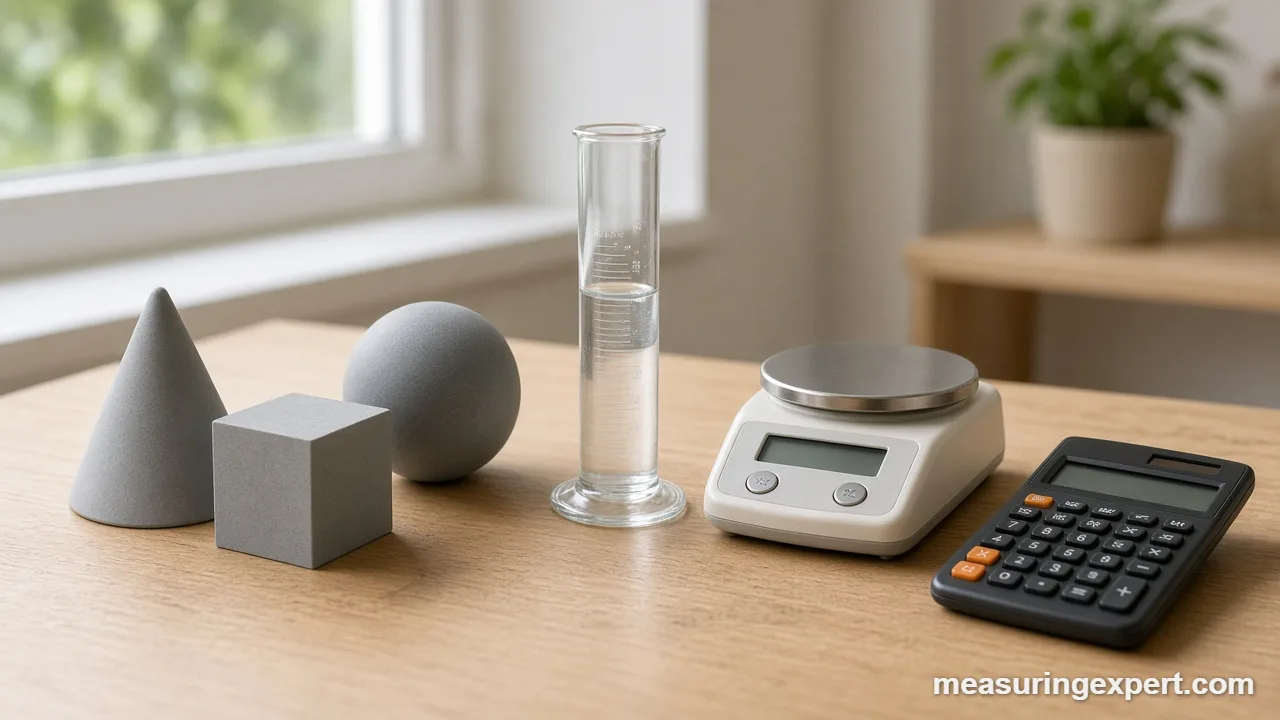
The best way to calculate volume depends on what you are measuring. For regular shapes, measure the sides and use a formula. Irregular solids call for water displacement, while liquids go into a marked vessel. If you know mass and density, divide mass by density. Split composite shapes into simple parts and add them.
Volume is simply the amount of space something takes up. Yet the right way to find it changes from one object to the next, because shapes and materials differ. A shipping box, a garden rock, a bottle of oil and a grain silo each call for a different method. As a result, if you pick the wrong one, you either do a lot of extra work or get a number that is far off.
Start With the Situation, Not the Math
So this guide starts with the situation, not the math. First, you identify what kind of thing you have. Next, you match it to one of five methods: a geometry formula, water displacement, a measuring vessel, mass divided by density, or splitting a composite shape into parts. In addition, each method below comes with a worked example, the tools it needs, and the mistakes that throw it off.
In short: measure regular shapes, dunk irregular solids, pour liquids, weigh things when you know the density, and break complex shapes into simple ones. Then convert the answer into the unit you need with the converter below.
The units themselves are fixed by definition. For example, the US National Institute of Standards and Technology (NIST) explains on its SI units of volume page that the cubic meter is the SI unit of volume, a liter is a cubic decimeter, and a milliliter is a cubic centimeter. As a result, 1 cm3 of a solid and 1 mL of a liquid describe exactly the same amount of space.
Convert Your Volume Result Into Any Unit
Once you have a number from any method below, enter it here. For instance, type the liters from a formula or the milliliters from a displacement test, and the converter shows the same volume in US gallons, quarts, cups, fluid ounces and cubic centimeters.
Recommended Tools to Calculate Volume Accurately
You can calculate volume with a ruler and a calculator for many jobs. Still, a few basic tools make every method faster and more accurate. For example, a tape measure or caliper handles the dimensions for formulas, a graduated cylinder covers displacement and liquids, and a digital scale lets you use the mass and density method.
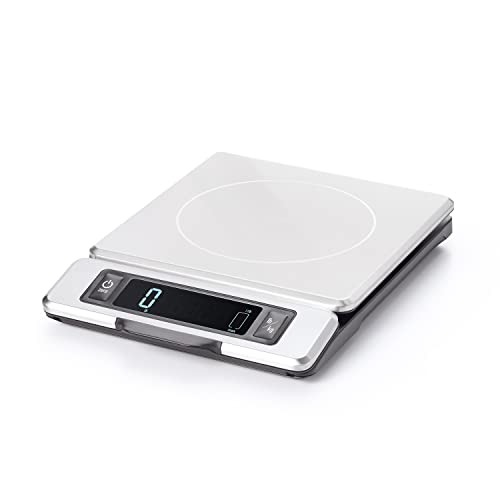
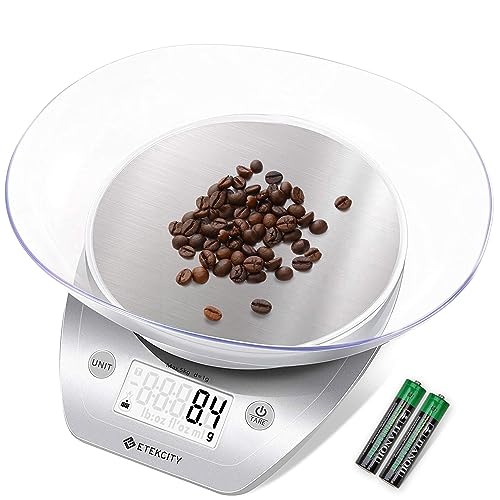
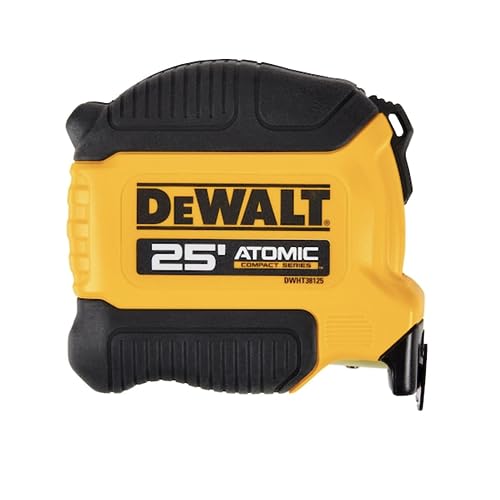


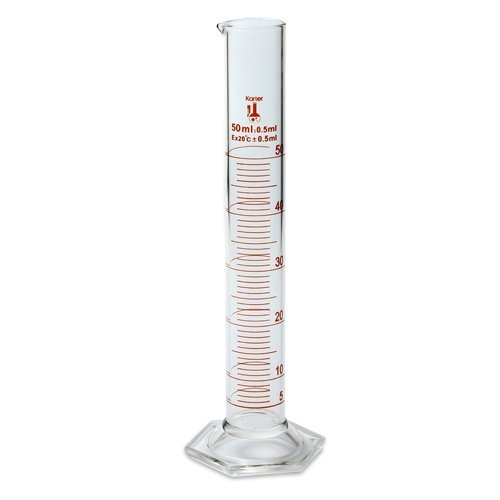
As an Amazon Associate, Measuring Expert earns from qualifying purchases.
Key Takeaways
- Choose the method by situation first; the math comes second.
- Regular shapes: measure length, width, height or radius, then apply a formula.
- Irregular solids: sink them in water and read how far the level rises.
- Liquids: pour them into a graduated vessel and read the bottom of the meniscus.
- Known material: volume equals mass divided by density.
- Complex shapes: split them into boxes, cylinders and cones, then add the parts.
- Keep every dimension in one unit before you multiply.
How to Choose the Best Way to Calculate Volume
To begin, ask two questions. First, is the thing solid, liquid or a space (like a room or a tank)? Second, does it have a regular shape you can measure with a ruler? The table below then points you to the best method.
| Your situation | Best method | Example | Main tool |
|---|---|---|---|
| Box, cube, cylinder, ball, cone or pyramid | Geometry formula | Shipping box, pipe, ball | Tape measure or caliper |
| Small solid with an odd shape that can get wet | Water displacement | Rock, key, figurine | Graduated cylinder |
| Liquid you can pour | Measuring vessel | Oil, water, paint | Measuring cup or cylinder |
| Material with a known density | Mass divided by density | Water, metal stock, a liquid by weight | Digital scale |
| Shape made of several simple parts | Split and add | L-shaped room, silo, house with a gable | Tape measure plus formulas |
| Object that is too big, porous or water-sensitive | Approximate with simple shapes | Tree trunk, pile of gravel, sofa | Tape measure |
Calculate Volume With a Formula (Regular Shapes)
A formula is the fastest and most accurate route whenever the shape is regular. First, you measure a few dimensions; then you plug them in, and the answer comes out in cubic units of whatever you measured in. For example, inches give cubic inches and centimeters give cubic centimeters.
| Shape | Formula | Worked example | Result |
|---|---|---|---|
| Cube | V = s x s x s | s = 4 in | 64 in³ (about 1,049 cm³) |
| Rectangular box | V = l x w x h | 12 x 10 x 8 in | 960 in³ (about 15.73 L or 4.16 gal) |
| Cylinder | V = π x r² x h | r = 3 in, h = 10 in | 282.7 in³ (about 4.63 L) |
| Sphere | V = 4/3 x π x r³ | r = 5 cm | 523.6 cm³ |
| Cone | V = 1/3 x π x r² x h | r = 3 cm, h = 8 cm | 75.40 cm³ |
| Pyramid | V = 1/3 x base area x h | 6 x 6 cm base, h = 9 cm | 108 cm³ |
| Triangular prism | V = 1/2 x b x h x length | b = 4, h = 3, length = 10 cm | 60 cm³ |
Notice the pattern. Prisms and cylinders are always base area times height. Meanwhile, cones and pyramids hold exactly one third of the matching prism or cylinder. Therefore, if you remember the base-times-height idea, most formulas follow from it. For a deeper walk-through of boxes, cubes and cubic units, see our guide on how to calculate cubic volume.
Calculate Volume of Irregular Solids by Displacement
Unfortunately, a rock or a carved figure has no simple formula. Instead, you let water do the measuring. When a solid sinks completely, it pushes aside water equal to its own volume, so the rise in water level is the volume of the object.
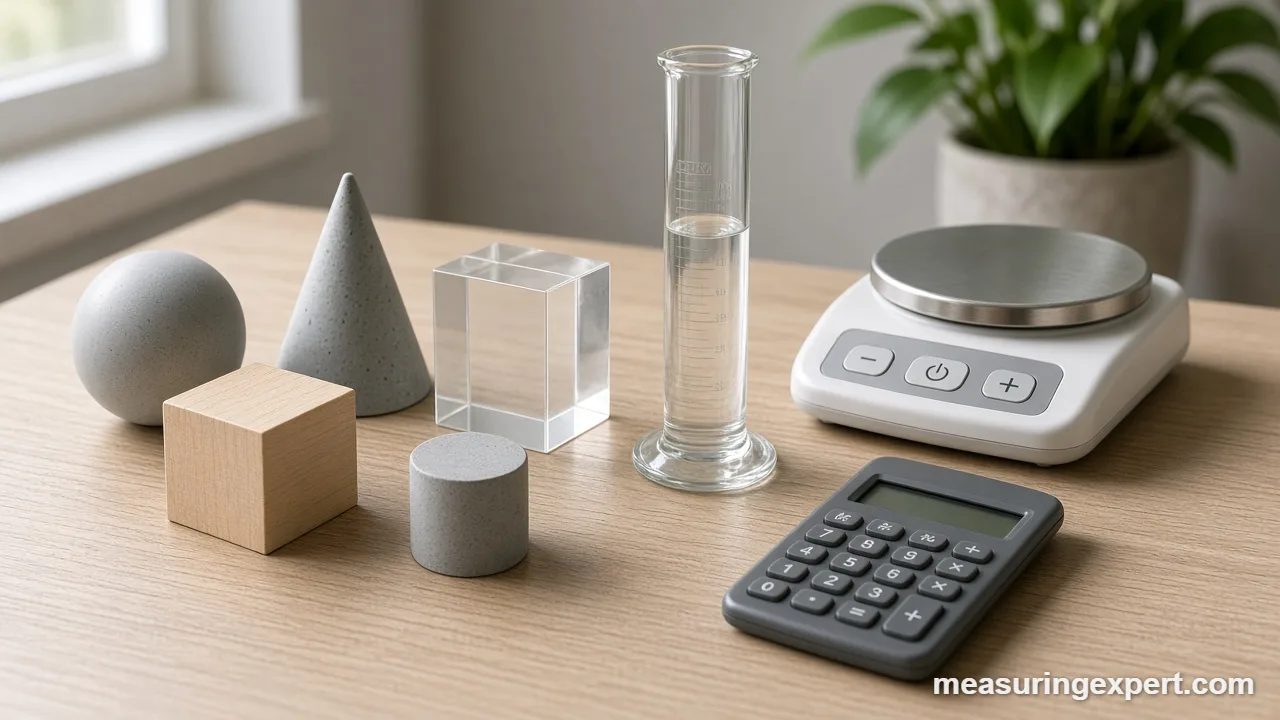
This method only works when the object sinks fully, does not absorb water, and does not dissolve. For floating items, push them under with a thin wire and subtract the tiny volume of the wire if it matters. Similarly, for objects too big for a cylinder, use an overflow can or a bucket set in a tray and measure the water that spills out. Our full guide to the volume of an irregular object covers those variations in detail.
Calculate Volume of Liquids With Measuring Vessels
Liquids take the shape of their container, so you usually do not calculate their volume at all. Instead, you simply read it: pour the liquid into a marked vessel and read the scale at eye level.
- Kitchen measuring cups work for cooking, where a few milliliters do not matter.
- Graduated cylinders are tall and narrow, so each mark is far apart and easier to read precisely.
- Volumetric flasks, pipettes and pycnometers are the choice for lab work that needs high accuracy.
For water-based liquids in clear glass, read the bottom of the curved surface, called the meniscus. In addition, set the vessel on a flat surface and crouch so your eye is level with the mark. Otherwise, looking from above makes the reading look higher than it really is.
When the liquid is already in a regular container, such as a rectangular tank or a round drum, you can also calculate volume from the inside dimensions and the fill depth. For example, a round container with a 10 in inside diameter filled 12 in deep holds about 942.5 in³, or about 15.4 L.
Calculate Volume From Mass and Density
Sometimes, however, weighing is easier than measuring. If you know what a material is and its density, then volume = mass / density. For this reason, it works well for bulk liquids and for solids that cannot get wet.
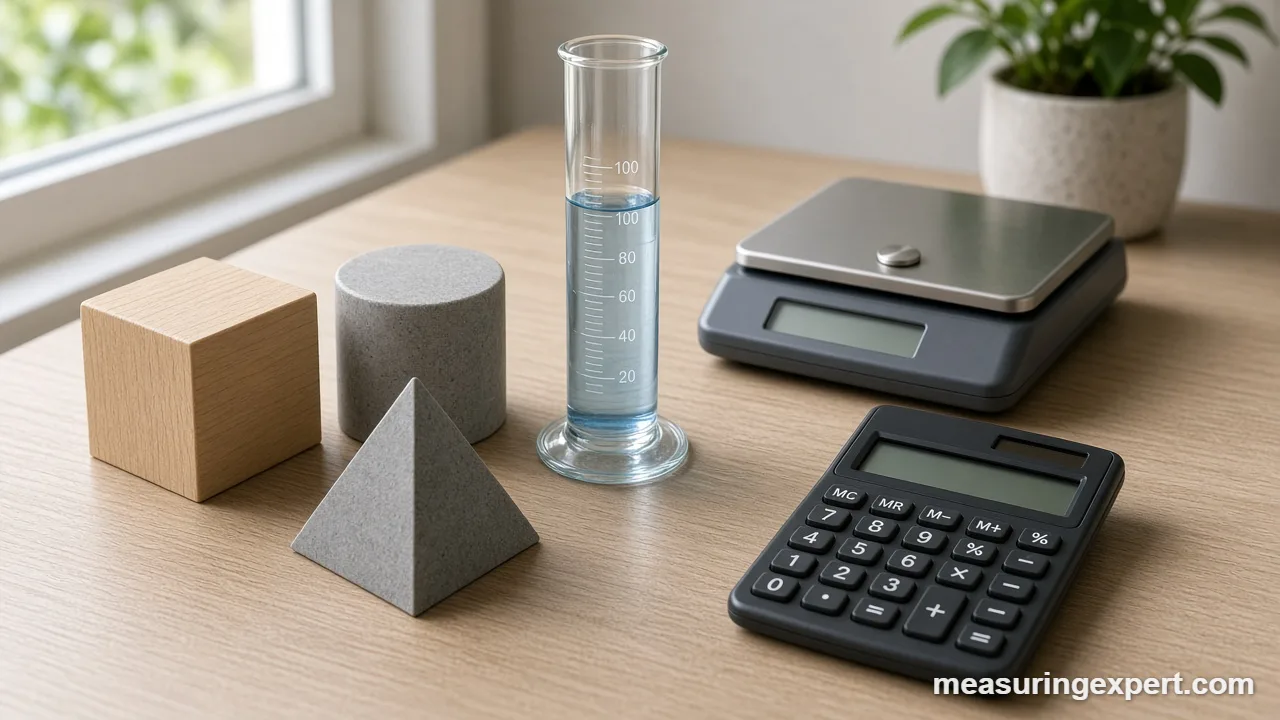
The catch is that density must come from a reliable source and match your exact material and temperature. For example, alloys, woods and foods vary a lot. Similarly, powders and granular materials contain air gaps, so their bulk density is much lower than the density of the solid itself.
Calculate Volume of Composite Shapes by Splitting Them
In practice, many real objects combine simple shapes. A grain silo is a cylinder with a cone on top, and an L-shaped room is two boxes. Even so, the method is the same every time: split, solve each part, then add (or subtract holes).
For a part that is missing, such as a hole through a block, calculate the hole as its own shape and subtract it. Also, sketch the object first and label every dimension. That way, you avoid double counting where two parts overlap.
How to Calculate Volume Step by Step
- Identify the situation. Decide whether you have a regular solid, an irregular solid, a liquid, a known material or a composite shape.
- Pick the matching method. Use the decision table above to choose a formula, displacement, a measuring vessel, mass and density, or splitting.
- Measure carefully. Take each dimension, water level or mass twice and use the average.
- Convert to one unit. Change every dimension to inches, feet, centimeters or meters before you multiply.
- Calculate the volume. Apply the formula or subtraction, and add parts for composite shapes.
- Convert the result. Enter the answer in the converter above to get liters, gallons or fluid ounces.
- Sanity-check it. Compare the answer to something familiar, such as a 1-gallon jug, to catch a slipped decimal.
Volume Unit Conversions You Will Need
Formulas give cubic units, while containers are sold in liters and gallons. Therefore, these exact or rounded equivalents bridge the two. They follow from the definitions 1 in = 2.54 cm and 1 US gallon = 231 in³.
| Unit | Equals | Also equals |
|---|---|---|
| 1 cubic inch (in³) | 16.387064 cm³ (exact) | 16.39 mL |
| 1 cubic foot (ft³) | 1,728 in³ | 28.32 L, 7.481 US gal |
| 1 cubic yard (yd³) | 27 ft³ | 0.7646 m³ |
| 1 US gallon | 231 in³ (exact) | 3.785 L |
| 1 liter (L) | 1,000 cm³ (1 dm³) | 0.2642 US gal |
| 1 cubic meter (m³) | 1,000 L | 264.2 US gal |
A common mistake is converting the answer with a length factor. Because volume is three-dimensional, you have to cube the factor: 1 ft is 12 in, but 1 ft³ is 12 x 12 x 12 = 1,728 in³.
Do and Don’t When You Calculate Volume
Do
- Choose the method by situation before doing any math.
- Keep all dimensions in the same unit.
- Use inside dimensions for containers and outside dimensions for solids.
- Read liquid levels at eye level, at the bottom of the meniscus.
- Write down every measurement as you take it.
Don’t
- Mix inches and feet in one formula.
- Use the diameter where a formula asks for the radius.
- Submerge porous or water-sensitive objects.
- Guess densities for alloys, woods or foods.
- Convert cubic units with a plain length factor.
Honest Limits of Each Method
No method is perfect, and each has a typical weak spot. For instance, formulas assume a perfect shape, but real boxes bulge and real pipes are slightly oval. Displacement accuracy depends on the spacing of the marks on your cylinder; a 250 mL cylinder marked every 2 mL cannot resolve a 0.5 mL pebble. Likewise, kitchen cups are made for cooking, not lab work. Meanwhile, the mass and density method is only as good as the density figure, which shifts with temperature, moisture and composition. Finally, composite shapes add up the small errors of every part. In practice, report your result with sensible rounding, and measure twice when a mistake would cost money.
When to Call a Professional
For everyday jobs such as buying mulch, filling an aquarium or checking a recipe, the methods above are plenty. However, some situations need certified measurements. For example, fuel and chemical tanks may need calibration by a qualified tank calibration service. Likewise, concrete pours for structures should follow the engineer’s quantities, and lab or pharmaceutical work requires calibrated volumetric glassware. If a measurement is used to buy or sell goods, local weights and measures officials set the rules.
Calculate Volume: Frequently Asked Questions
What is the easiest way to calculate volume?
For a box shape, multiply length by width by height. For a liquid, pour it into a measuring cup and read the mark. Both take less than a minute.
How do I calculate volume of an irregular object?
Use water displacement. Note the water level in a graduated cylinder, sink the object completely, and subtract the first reading from the second. The difference in mL equals the volume in cubic centimeters.
Is 1 mL the same as 1 cubic centimeter?
Yes. A milliliter is defined as exactly one cubic centimeter, so the two names describe the same volume.
How do I calculate volume from mass?
Divide the mass by the density of the material. For example, 500 g of water at room temperature divided by about 0.998 g/cm3 gives about 501 mL.
What is the formula for the volume of a cylinder?
Volume equals pi times the radius squared times the height. A cylinder 3 in in radius and 10 in tall holds about 282.7 cubic inches, or 4.63 liters.
How do I calculate volume of a room or tank in gallons?
Measure the inside length, width and height in inches, multiply them, and divide by 231. For dimensions in feet, multiply and then multiply by about 7.48.
How do I find the volume of a shape made of several parts?
Split it into simple shapes such as boxes, cylinders and cones. Calculate each part, add them, and subtract any holes or cut-outs.
Why are cone and pyramid formulas divided by 3?
A cone holds exactly one third of a cylinder with the same base and height. Similarly, a pyramid holds one third of the matching prism.
Can I use water displacement for objects that float?
Yes, if you push the object fully under with a thin wire or pin. Otherwise only the submerged part is measured, and the result comes out too low.
What units should I use to calculate volume?
Use any length unit, as long as every dimension uses the same one. Inches give cubic inches and centimeters give cubic centimeters. Then convert the result to liters or gallons.
The Bottom Line
To sum up, the best way to calculate volume starts with the situation. Use a formula for regular shapes, displacement for irregular solids, a measuring vessel for liquids, mass divided by density for known materials, and splitting for composite shapes. In other words, each one answers the same question with the least effort for that object.
So pick the method, measure carefully in one unit, and run the result through the converter at the top of the page. When the stakes are high, such as tanks, structures or trade, hand the job to a professional with calibrated equipment.