

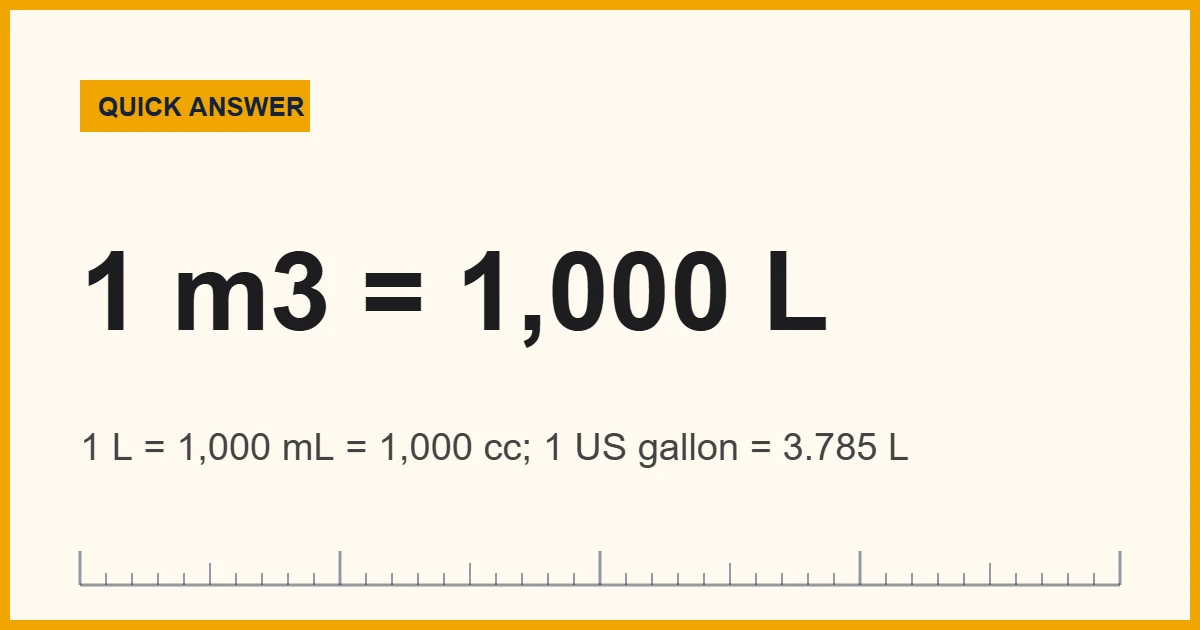
The main units of volume are the cubic meter (m3), the SI unit, and the liter (L), which equals one cubic decimeter. In daily life, 1 L = 1,000 mL and 1 mL = 1 cm3 (cc). In the US, people also use gallons, quarts, pints, cups and fluid ounces, and 1 US gallon = 3.785 L.
Convert Units of Volume Instantly
First, enter an amount and pick the unit you start with. The converter then shows the same volume in milliliters, liters, US gallons, quarts, pints, cups, fluid ounces and UK pints, using the exact legal definitions.
Volume is the amount of three-dimensional space something fills, whether it is milk in a jug, air in a room or concrete in a slab. Because space has three dimensions, every unit of volume is really a length unit multiplied by itself three times. For example, a cubic meter is a cube 1 meter on each side, and a cubic inch is a cube 1 inch on each side.
Two Families of Volume Units
In practice, you meet two families of units. First, there is the metric system, built on the cubic meter, the liter and the milliliter. Second, there are the US customary units, such as the gallon, quart, pint, cup and fluid ounce, plus cubic inches, cubic feet and cubic yards. Meanwhile, the UK still uses imperial pints for beer and milk, and those pints differ from US pints.
The US National Institute of Standards and Technology (NIST) explains on its SI units of volume page that the cubic meter is the official SI unit, while the liter is a special name for the cubic decimeter. As a result, 1,000 liters make exactly 1 cubic meter. The international rulebook, the SI Brochure from the BIPM, lists the liter among the non-SI units accepted for use with the SI.
Quick Chart: Common Units of Volume in Liters
This chart lists the units you are most likely to meet, from the smallest to the largest. In addition, each row gives the exact or rounded metric value, so you can compare units at a glance. Also, feel free to print it and keep it near your workbench or kitchen.
| Unit (symbol) | System | Metric value | Handy relationship |
|---|---|---|---|
| Milliliter (mL) | Metric | 0.001 L | Same as 1 cm3 or 1 cc |
| US teaspoon (tsp) | US customary | 4.929 mL | 1/3 tablespoon |
| US tablespoon (tbsp) | US customary | 14.79 mL | 3 teaspoons |
| Cubic inch (in3) | US customary | 16.39 mL | 231 in3 = 1 US gallon |
| US fluid ounce (fl oz) | US customary | 29.57 mL | 2 tablespoons |
| US cup | US customary | 236.6 mL | 8 fl oz (labels use 240 mL) |
| US pint (pt) | US customary | 473.2 mL | 2 cups |
| Imperial pint | UK imperial | 568.3 mL | 20 imperial fl oz |
| US quart (qt) | US customary | 946.4 mL | 2 pints |
| Liter (L) | Metric | 1 L | 1,000 mL; about 1.057 US qt |
| US gallon (gal) | US customary | 3.785 L | 4 quarts or 128 fl oz |
| Imperial gallon | UK imperial | 4.546 L | About 1.2 US gallons |
| Cubic foot (ft3) | US customary | 28.32 L | About 7.48 US gallons |
| Cubic yard (yd3) | US customary | 764.6 L | 27 cubic feet |
| Cubic meter (m3) | SI | 1,000 L | About 264.2 US gallons |
Recommended Tools for Measuring Units of Volume
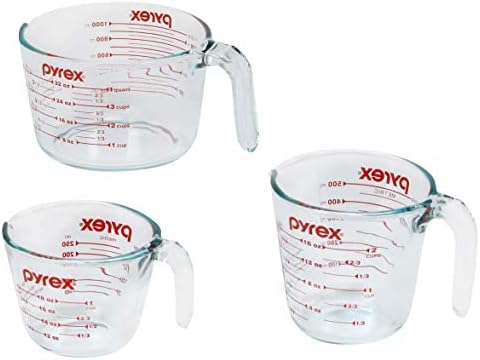
A few simple tools cover almost every volume you need to measure at home, in class or in the garage. First, a clear measuring jug with both mL and cup markings handles liquids. Next, a set of graduated cylinders gives you lab-style precision for small amounts. Finally, an angled measuring cup lets you read the level from above, which makes repeat measurements quicker.




As an Amazon Associate, Measuring Expert earns from qualifying purchases.
The SI Unit: Cubic Meter, Liter and Milliliter
To begin with, the cubic meter sits at the top of the metric family. It is large, so you mostly see it for water bills, shipping containers, concrete, gas meters and room air. For example, a standard bathtub holds roughly a quarter of a cubic meter, which is about 250 liters.
By contrast, the liter is the everyday metric unit. In fact, it equals 1 cubic decimeter, a cube 10 cm on each side. Meanwhile, the milliliter is one thousandth of a liter, which makes it exactly the same size as a cubic centimeter. As a result, doctors write “cc” and chemists write “mL” for the same amount.
| Metric unit | Symbol | Equals | Typical use |
|---|---|---|---|
| Cubic meter | m3 | 1,000 L | Water bills, concrete, shipping |
| Liter (cubic decimeter) | L or dm3 | 1,000 mL | Drinks, fuel, engine size |
| Deciliter | dL | 100 mL | European recipes, lab results |
| Milliliter (cubic centimeter) | mL, cm3, cc | 0.001 L | Medicine, cooking, lab work |
| Microliter (cubic millimeter) | uL, mm3 | 0.001 mL | Pipettes, blood tests |
Because metric volume grows from length, the steps between units are clean powers of ten. For the same reason, area units follow the same pattern with squares instead of cubes; our guide to area measurement units walks through square meters and acres. Likewise, the length units guide covers the meters and inches that every cubic unit comes from.
US Customary Units of Volume
Similarly, the US customary system has two kinds of volume units. On one hand, there are liquid units built on the gallon: gallon, quart, pint, cup, fluid ounce, tablespoon and teaspoon. On the other hand, there are cubic units built on the inch and the foot. Since 1959, the inch equals exactly 2.54 cm, so every US unit has an exact metric value.
- Gallon: 231 cubic inches, or exactly 3.785411784 L.
- Quart: a quarter gallon, so about 946.4 mL.
- Pint: half a quart, so about 473.2 mL.
- Cup: half a pint, or 8 fl oz, so about 236.6 mL.
- Fluid ounce: 1/128 gallon, so about 29.57 mL.
- Tablespoon and teaspoon: 1/2 fl oz and 1/6 fl oz, about 14.79 mL and 4.93 mL.
So the ladder is simple once you remember it: 1 gallon = 4 quarts = 8 pints = 16 cups = 128 fluid ounces. For kitchen-sized amounts, see how much 30 mL is in spoons and ounces.
US vs Imperial vs Metric: Same Names, Different Sizes
Still, many people assume that “imperial” means the US system. In fact, the British imperial units of 1824 and the US customary units share names but not sizes. For example, the imperial gallon is about 20% bigger than the US gallon. However, the imperial fluid ounce is slightly smaller than the US one, because an imperial pint holds 20 fluid ounces instead of 16.
| Unit | US customary | UK imperial | Metric kitchen |
|---|---|---|---|
| Gallon | 3.785 L | 4.546 L | – |
| Quart | 946.4 mL | 1.137 L | – |
| Pint | 473.2 mL (16 fl oz) | 568.3 mL (20 fl oz) | – |
| Cup | 236.6 mL (labels: 240 mL) | not used today | 250 mL |
| Fluid ounce | 29.57 mL | 28.41 mL | – |
| Tablespoon | 14.79 mL | 15 mL (metric) | 15 mL (Australia: 20 mL) |
Therefore, this difference matters whenever you follow a British fuel figure, a UK recipe or an old car manual. For instance, a “pint” of milk in London is about 95 mL bigger than a pint in Chicago.
Dry Volume, Cubic Feet and Other Big Units
The US also keeps a separate set of dry units for grain and produce. A dry pint holds about 550.6 mL, so it is bigger than a liquid pint. Similarly, a bushel holds 2,150.42 cubic inches, which is about 35.24 L. In general, you will see these at farm stands and in crop reports.
For larger jobs, however, cubic units take over. For example, mulch, soil and concrete come in cubic yards, and refrigerators, freezers and room air in cubic feet. Meanwhile, oil trades in 42-gallon barrels (about 159 L), and water engineers use the acre-foot, about 1,233 cubic meters. If you want to know why these big units are always cubes, our explainer on why volume uses cubic units goes deeper.
How to Convert Between Units of Volume
- Identify the system. First, check whether the source is US customary, UK imperial or metric before you touch a number.
- Convert to liters or milliliters first. Multiply by the unit’s metric value, for example 2 US quarts x 946.4 mL = 1,892.7 mL.
- Divide by the target unit. Next, divide the metric amount by the size of the unit you want, such as 1,892.7 mL / 29.57 mL = 64 fl oz.
- Cube the factor for cubic units. For cubic units, cube the length factor: 1 ft = 12 in, so 1 ft3 = 12 x 12 x 12 = 1,728 in3.
- Round only at the end. Otherwise, rounding drift creeps in, so keep four significant figures until the final answer.
- Sanity-check the result. Finally, a liter should come out a little more than a quart, and a cubic meter close to 264 gallons.
Of course, you can also skip the arithmetic and type the amount into the converter at the top of this page.
Do and Don’t When Working With Volume
Do
- Write the unit next to every number, so nobody has to guess.
- Use a capital L for liters, because a small l looks like 1.
- Check whether a recipe is US, UK or Australian.
- Read a measuring jug at eye level, because angles distort the reading.
- Weigh ingredients when precision counts.
Don’t
- Treat fluid ounces and weight ounces as equal, because they rarely are.
- Assume a UK pint matches a US pint; instead, check the source.
- Multiply cubic units by a length factor only once.
- Round halfway through a calculation, because errors add up.
- Use kitchen spoons to dose medicine.
Honest Limits of Volume Measurements
The values on this page are definitions. However, real tools only approach them. For instance, a kitchen measuring cup can easily be off by a few percent, and the way you fill it matters even more than its markings. In addition, liquids expand as they warm, so a liter of water at 80 degrees F takes up slightly more space than it does at 40 degrees F. For this reason, labs measure at a stated temperature, often 20 degrees C. For dry ingredients, volume is even less reliable because flour, sugar and rice settle and pack. In short, use volume units for convenience and switch to weight whenever results must repeat exactly.
When Accuracy Really Matters
For most cooking and household jobs, rounding 3.785 L to “about 3.8 L” is perfectly fine. Still, some situations call for more care:
- Medicine. Instead of a kitchen spoon, always dose in mL with the syringe or cup that comes with the product.
- Lab work. Choose a graduated cylinder or volumetric flask rather than a beaker; the guide to measuring volume in chemistry covers the glassware.
- Fuel, chemicals and pool treatments. Moreover, product labels assume the units of their own country, so a UK gallon dose in a US gallon of water is about 20% too strong.
- Construction orders. Concrete and gravel orders round up, so measure twice and add a margin for waste.
FAQs About Units of Volume
What is the SI unit of volume?
The SI unit of volume is the cubic meter (m3). The liter is an accepted special name for the cubic decimeter, so 1 m3 equals 1,000 liters.
What units of volume do people use most?
Most of the world uses liters and milliliters day to day. However, in the US, people mostly use gallons, quarts, pints, cups, fluid ounces and spoons, plus cubic feet and cubic yards for big jobs.
Is a liter the same as a cubic decimeter?
Yes. One liter is exactly one cubic decimeter, a cube 10 cm on each side. Therefore, that cube holds 1,000 mL.
Are mL and cc the same?
Yes. One milliliter equals one cubic centimeter, so it is often written cc in medicine and engines.
How many liters are in a US gallon?
One US gallon holds exactly 3.785411784 liters, usually rounded to 3.785 L. However, an imperial gallon holds 4.54609 liters.
Which units of volume are used for liquids?
Liquids are usually measured in milliliters and liters, or in fluid ounces, cups, pints, quarts and gallons in the US. Labs also use microliters for very small samples.
How is the volume of a solid measured?
For a regular shape, multiply length x width x height and give the answer in cubic units. Otherwise, for an irregular object, measure the water it displaces in a graduated cylinder; 1 mL of rise equals 1 cm3.
Is a fluid ounce a unit of weight?
No. A fluid ounce is a unit of volume, about 29.57 mL in the US. By contrast, a weight ounce is about 28.35 grams.
How many cubic feet are in a cubic meter?
One cubic meter equals about 35.31 cubic feet. Conversely, one cubic foot is about 28.32 liters.
Why do the US and UK units of volume differ?
Britain redefined its gallon in 1824, while the US kept an older wine gallon of 231 cubic inches. As a result, the names match but the sizes do not.
The Bottom Line on Units of Volume
To sum up, the cubic meter is the official SI unit, the liter and milliliter handle everyday metric amounts, and the US relies on gallons, quarts, pints, cups and fluid ounces. In particular, remember the anchors: 1 m3 = 1,000 L, 1 L = 1,000 mL, 1 mL = 1 cc, and 1 US gallon = 3.785 L.
Above all, check which system a number comes from before you convert it, because a UK pint and a US pint are not the same. Then let the converter at the top of this page do the math.
2 thoughts on “What Unit Is Used to Measure Volume? Units of Volume Explained”